654 indexed papers · 430 research notes

Research archive

Reset
Figure 1 from On the importance of medium-resolution continuum spectroscopy for JWST's extragalactic legacy

2026-11-06 · 2611.07070v1 · Research note

On the importance of medium-resolution continuum spectroscopy for JWST's extragalactic legacy

Adam C. Carnall, Ho-Hin Leung, Struan D. Stevenson, et al.

This planning paper argues that deep JWST/NIRSpec medium-resolution continuum spectroscopy can turn high-redshift galaxy surveys from emission-line detections into measurements of stellar populations, neutral gas, and kinematics; its empirical EXCELS-based exposure scaling motivates a 1,000-hour survey concept.

2026-11-06 · 2611.07006v1 · Research note

Black Hole Seeds and Little Red Dots: Connecting Formation and Growth with a JWST Multi-Cycle Treasury Program

Fabio Pacucci, Raffaella Schneider, Harley Katz, et al.

This white paper proposes a coordinated, multi-cycle JWST program to determine whether Little Red Dots trace accreting black holes and to separate black-hole seeding signatures from later growth through uniform spectroscopy, imaging, and time-domain data.

2026-11-05 · 2611.06334v1

Supermassive black holes and nuclear star clusters in galaxies: constraining formation and co-evolution with SHARP and MICADO

E. Dalla Bonta', E. Portaluri, C. Arcidiacono, et al.

This SHARP and MICADO science case sets out a unified, parsec-scale program to measure supermassive-black-hole masses, nuclear-star-cluster kinematics and populations, nuclear structure, and gas-inflow signatures in nearby galaxy nuclei. The central aim is to distinguish in-situ cluster growth, star-cluster infall, and black-hole-driven cusp formation, while mapping the transition from low-mass nuclei where clusters can regulate gas supply and black-hole growth to massive core galaxies shaped by mergers and black-hole binaries. Its key practical result is to define the black-hole-mass and distance regimes in which ELT/SHARP can resolve the sphere of influence and nuclear-cluster scales beyond JWST/NIRSpec capabilities. Nearby systems are explicitly presented as a local physics laboratory rather than direct evolutionary analogues of compact active nuclei at high redshift.
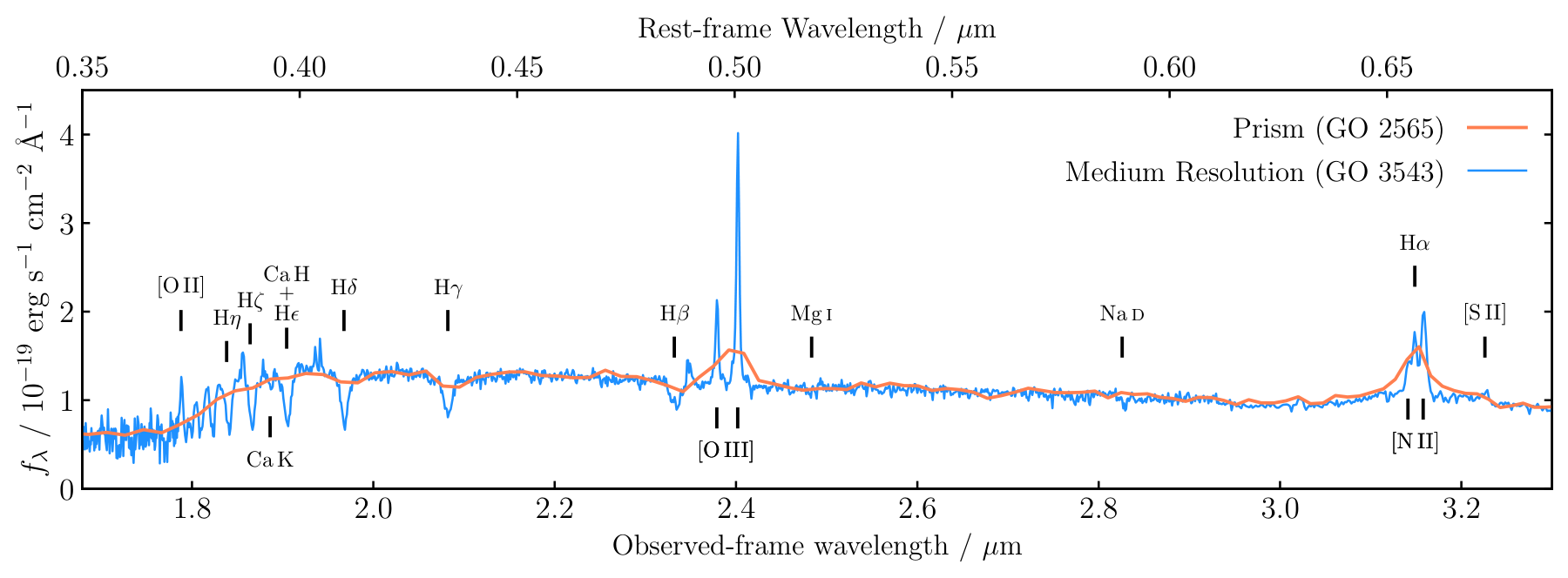
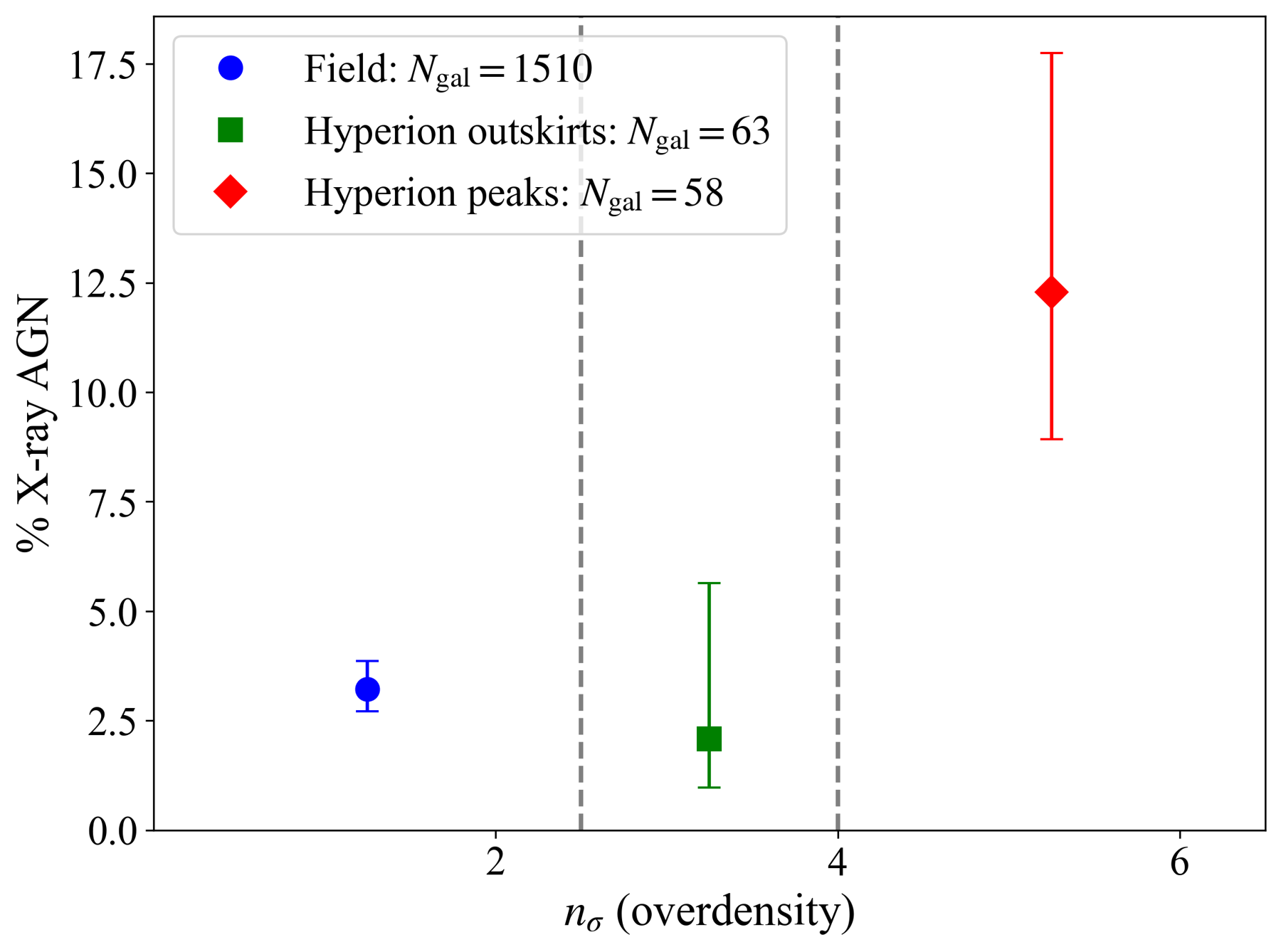
Figure 1 from Spectroscopy-informed Deep Learning Searches for Photometric Little Red Dots in JWST Surveys

2026-11-05 · 2611.06026v1 · Research note

Spectroscopy-informed Deep Learning Searches for Photometric Little Red Dots in JWST Surveys

Chenxuan Zhang, Huanian Zhang, Qingwen Wu

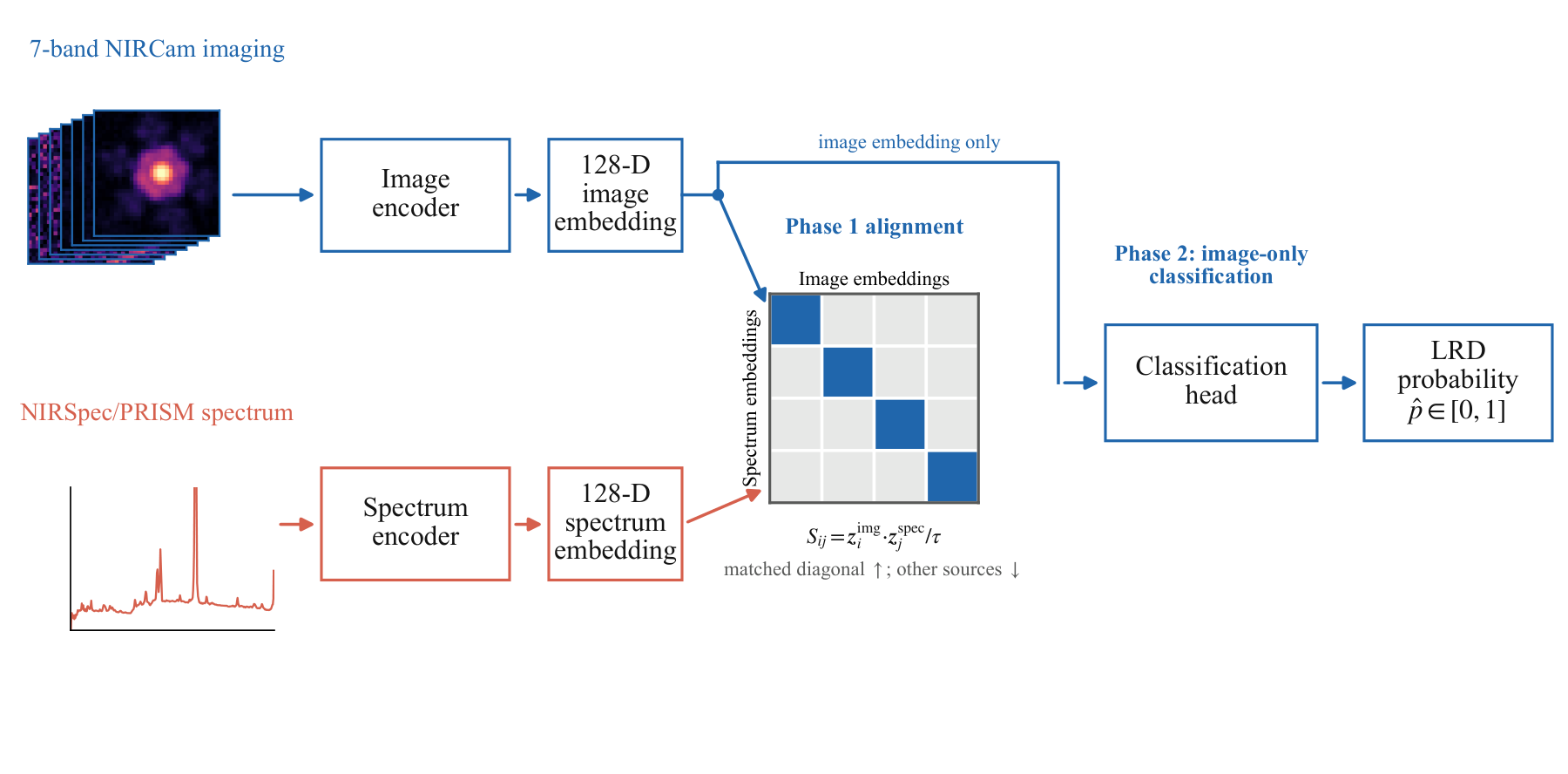
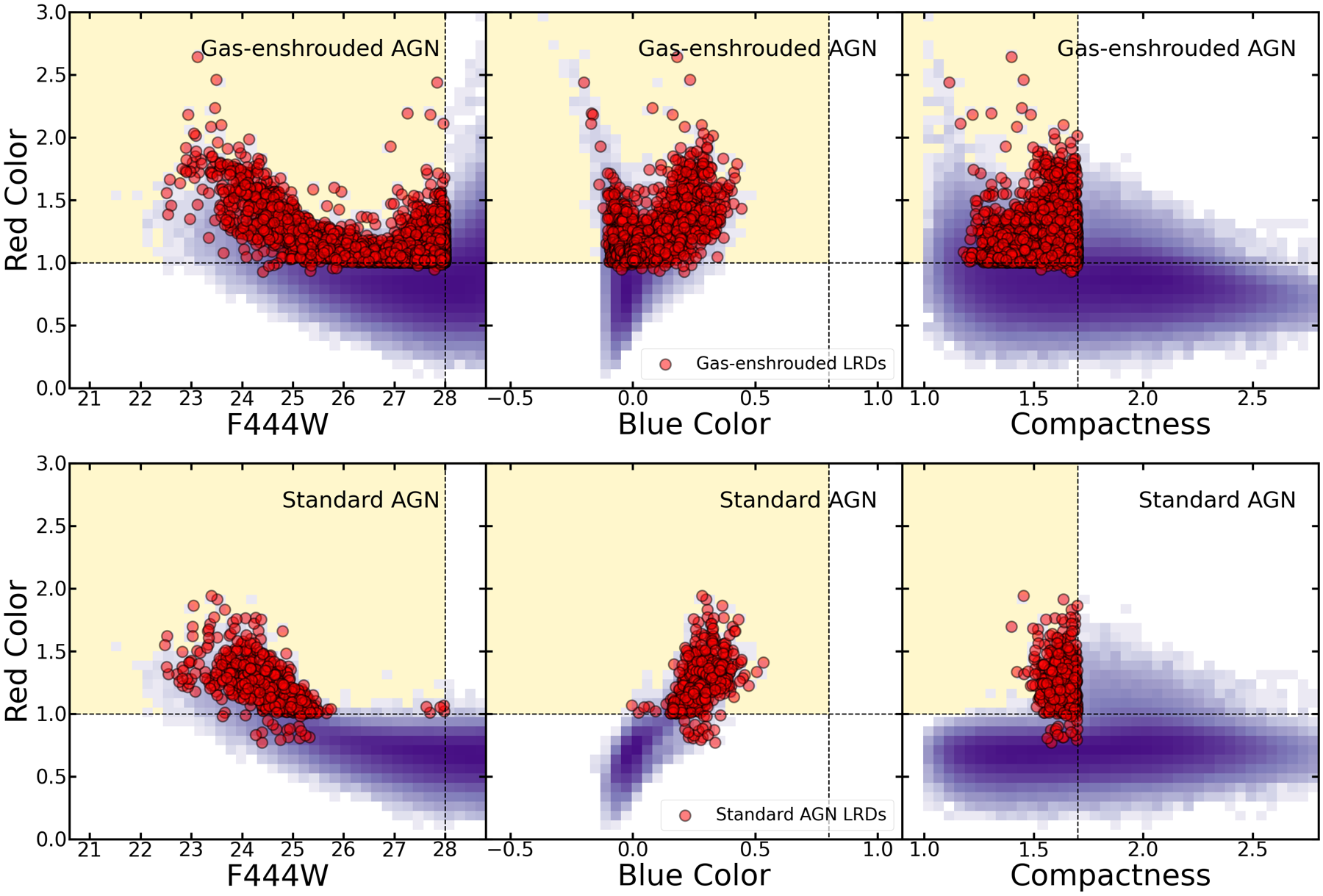
A two-stage, spectroscopy-informed NIRCam classifier finds LRD candidates beyond standard color selections. Held-out recall/precision are 0.92/0.79, while broad Hα in 10 of 13 grating-observed candidates supports—without confirming—the LRD interpretation of many new selections.

Figure 1 from The STARfall pathway: forging intermediate-mass black holes through stellar collisions in dense star clusters

2026-11-04 · 2611.03812v1 · Research note

The STARfall pathway: forging intermediate-mass black holes through stellar collisions in dense star clusters

Filippo Simonato, Manuel Arca Sedda, Taeho Ryu, et al.

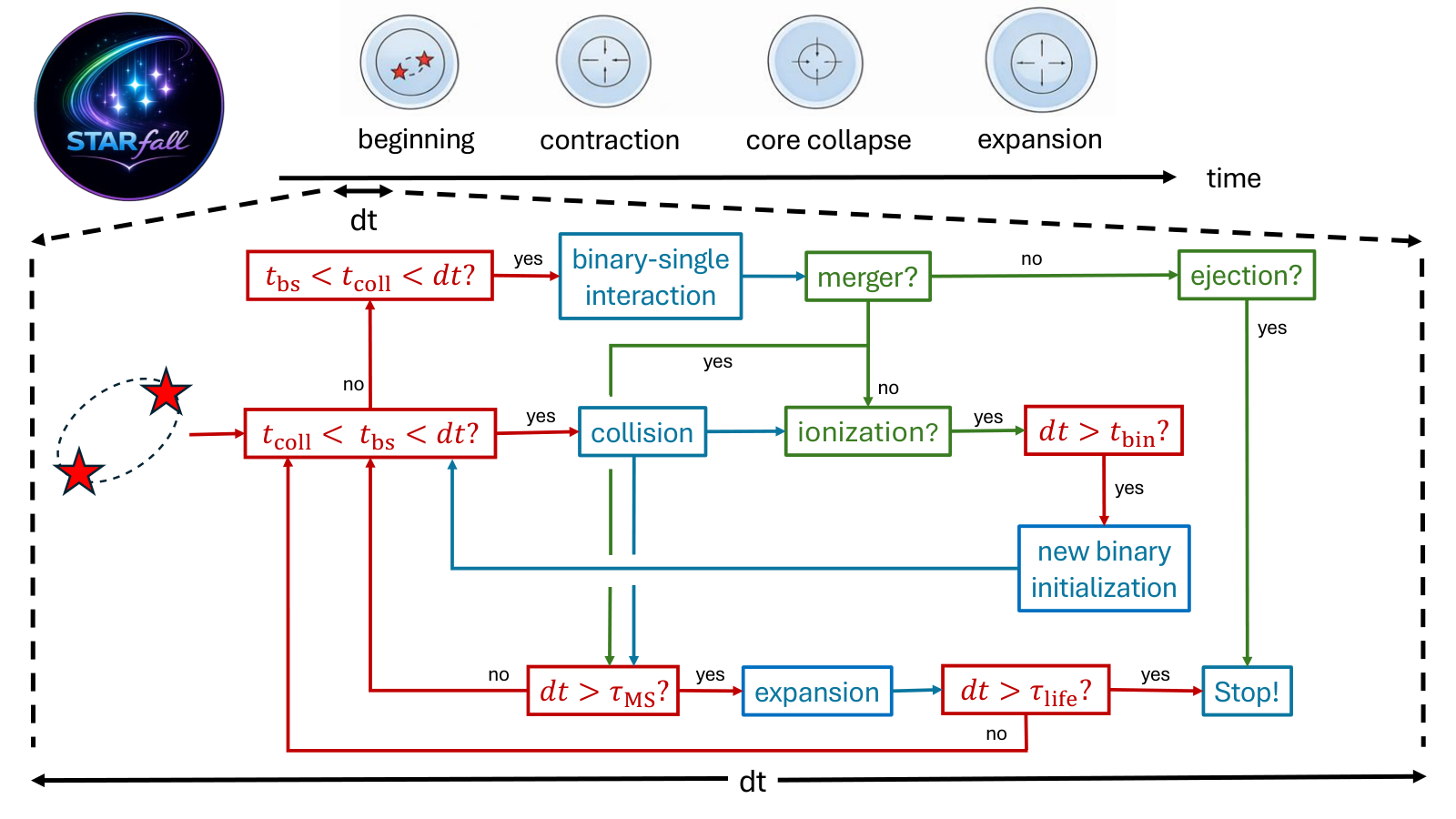
STARfall semi-analytically models collision-driven very massive stars in dense clusters, predicting 10^3–10^4 M⊙ IMBH seeds under favorable density and timescale conditions. Its Little Red Dot implication is conditional on unresolved systems being sufficiently compact stellar clusters.

Figure 1 from Ly$α$ in Compact Broad-Line Emitters, Including Little Red Dots, Is More Closely Linked to the Host Galaxy than to the Broad-Line Nucleus

2026-11-04 · 2611.03801v1 · Research note

Ly$α$ in Compact Broad-Line Emitters, Including Little Red Dots, Is More Closely Linked to the Host Galaxy than to the Broad-Line Nucleus

Yongda Zhu, Zheng Ma, Xiaojing Lin, et al.

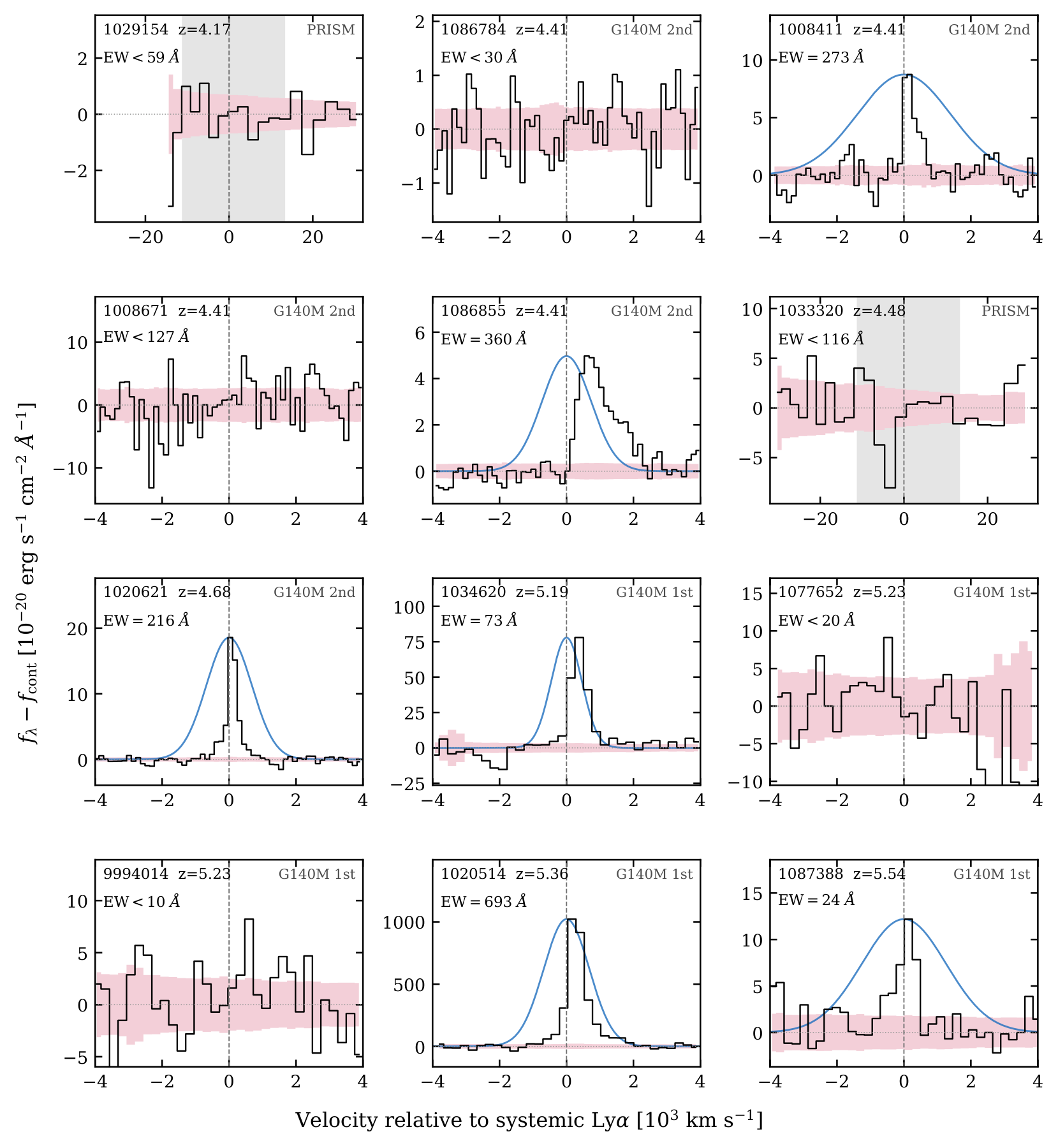
In 12 z=4.17–5.54 compact broad-line emitters, Lyα is detected in six and is systematically narrower than broad Hα. Host-SED predictions correlate more closely with observed Lyα than nuclear Hα/UV, although excess Lyα permits nuclear emission.

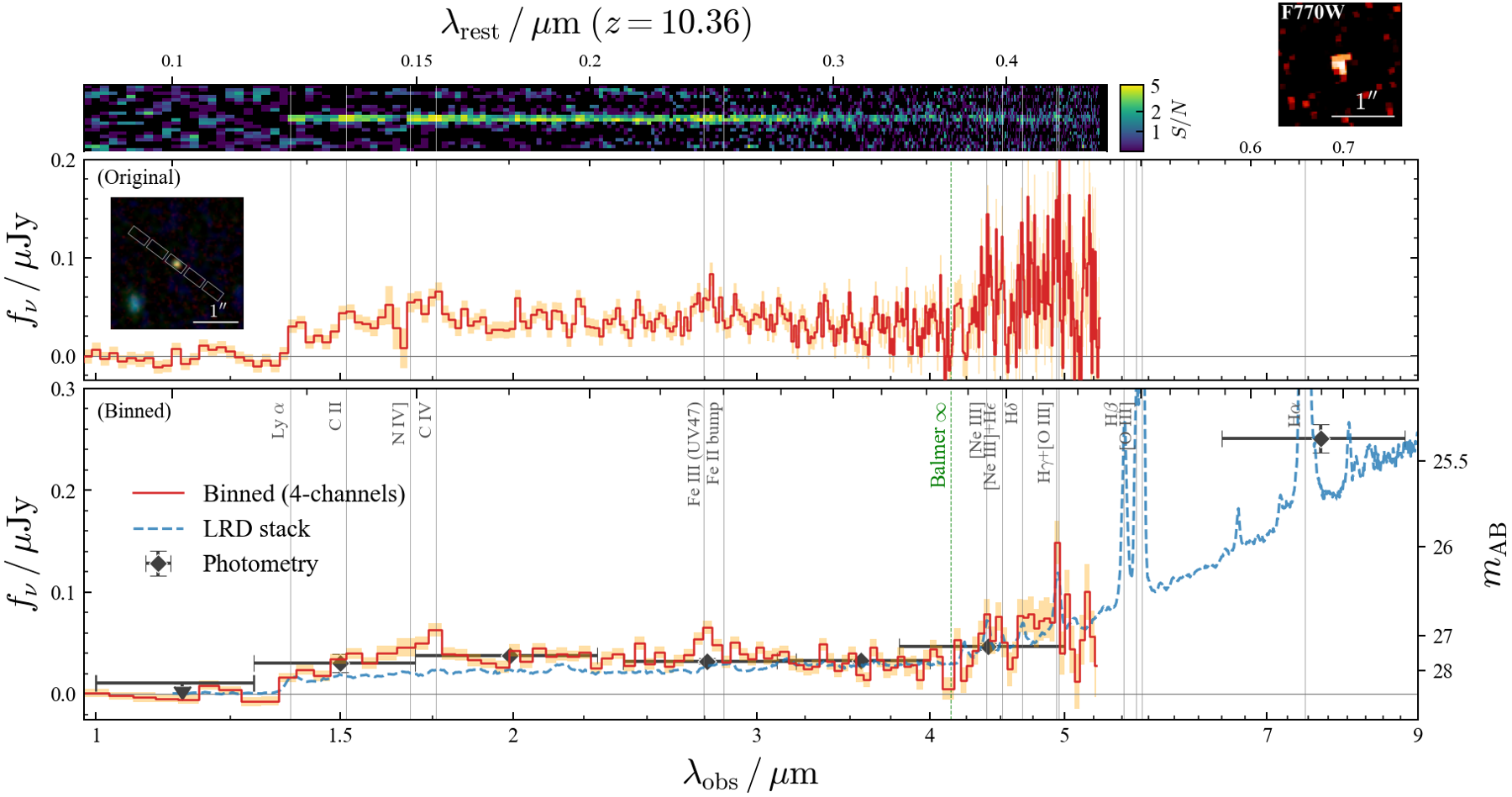
Figure 1 from EMBER: A Little Red Dot Candidate at $z_{\rm spec}=10.36$ in the Seed Black Hole Era

2026-11-03 · 2611.00195v1 · Research note

EMBER: A Little Red Dot Candidate at $z_{\rm spec}=10.36$ in the Seed Black Hole Era

Takumi S. Tanaka, Hollis B. Akins, John D. Silverman, et al.

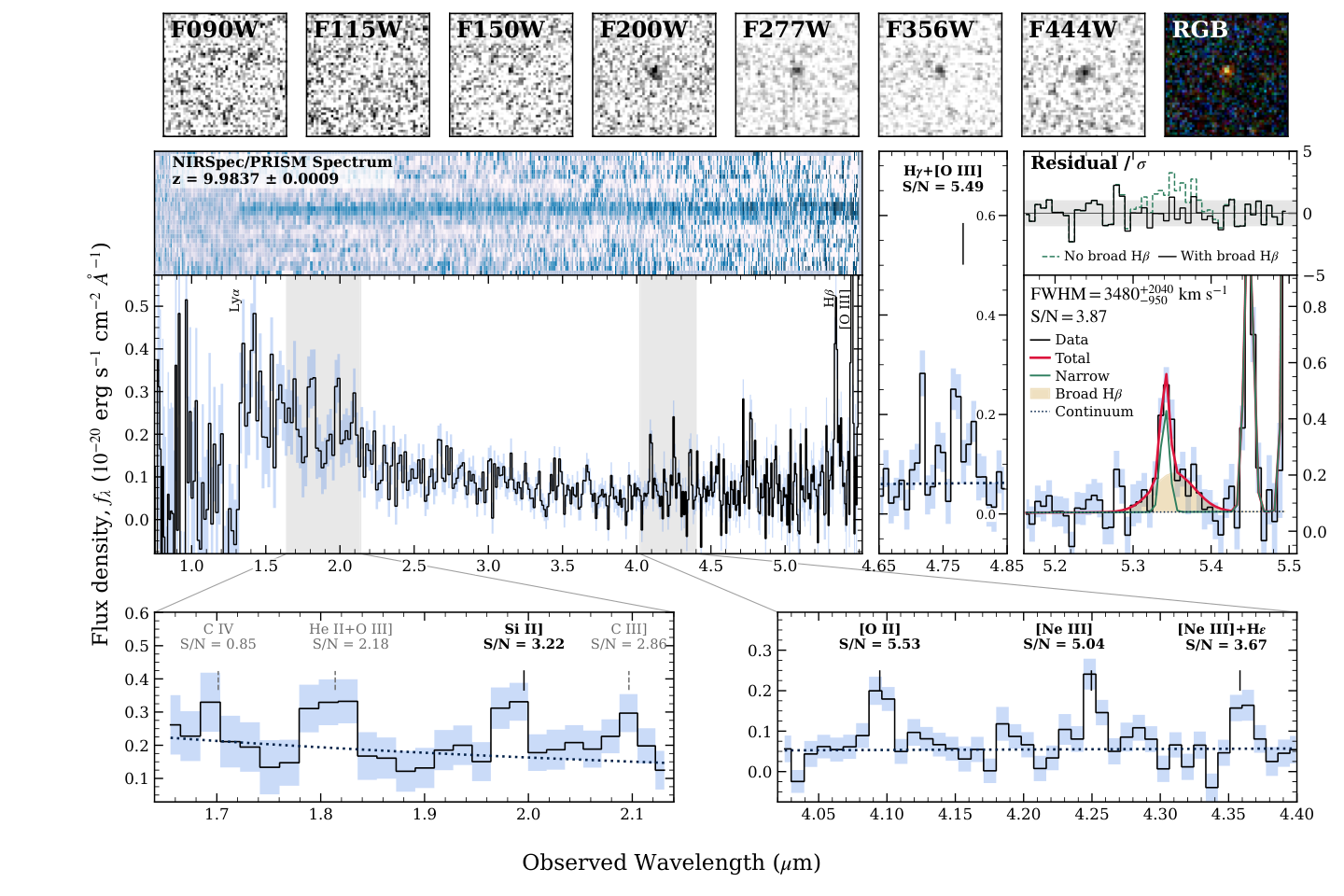
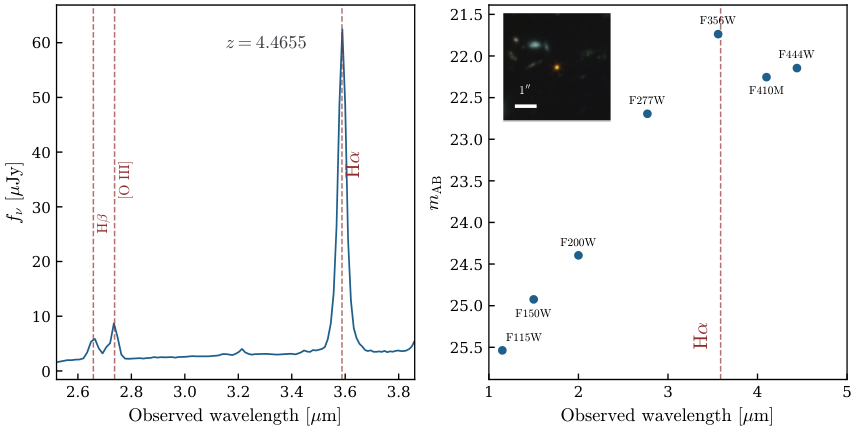
JWST/NIRSpec finds CW-LRD-z10 at zspec=10.361, with a Balmer-limit V-shaped continuum and tentative high-ionization/auroral lines. It is a strong z>10 LRD candidate, but present spectroscopy does not unambiguously establish either broad-line or AGN status.

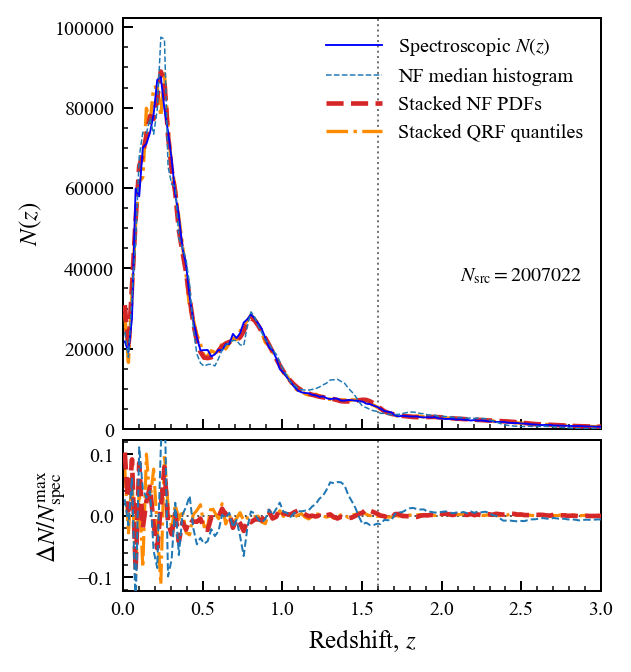
Figure 3 from Beyond Point Photo-$z$ Estimates: Normalizing Flows for Tomographic $N(z)$ Reconstruction with DESI DR1

2026-11-03 · 2611.00121v1 · Research note

Beyond Point Photo-$z$ Estimates: Normalizing Flows for Tomographic $N(z)$ Reconstruction with DESI DR1

Zhuo Chen, Antoine Rocher, Kwan Chuen Chan, et al.

On a spatially independent DESI DR1 test set, conditional normalizing-flow redshift PDFs generally reconstruct tomographic N(z) better than quantile random forests, especially at high redshift; calibration improves several low-z mean-redshift biases but leaves population-transfer and residual-calibration limitations.

2026-11-03 · 2610.33154v1 · Research note

A Composite Rest-Frame UV Spectrum of Galaxies at $5.7 < z < 6.9$: Ionization, Outflows, and Implications for Intergalactic Metal Enrichment

David DePalma, Robert A. Simcoe, Anna-Christina Eilers, et al.

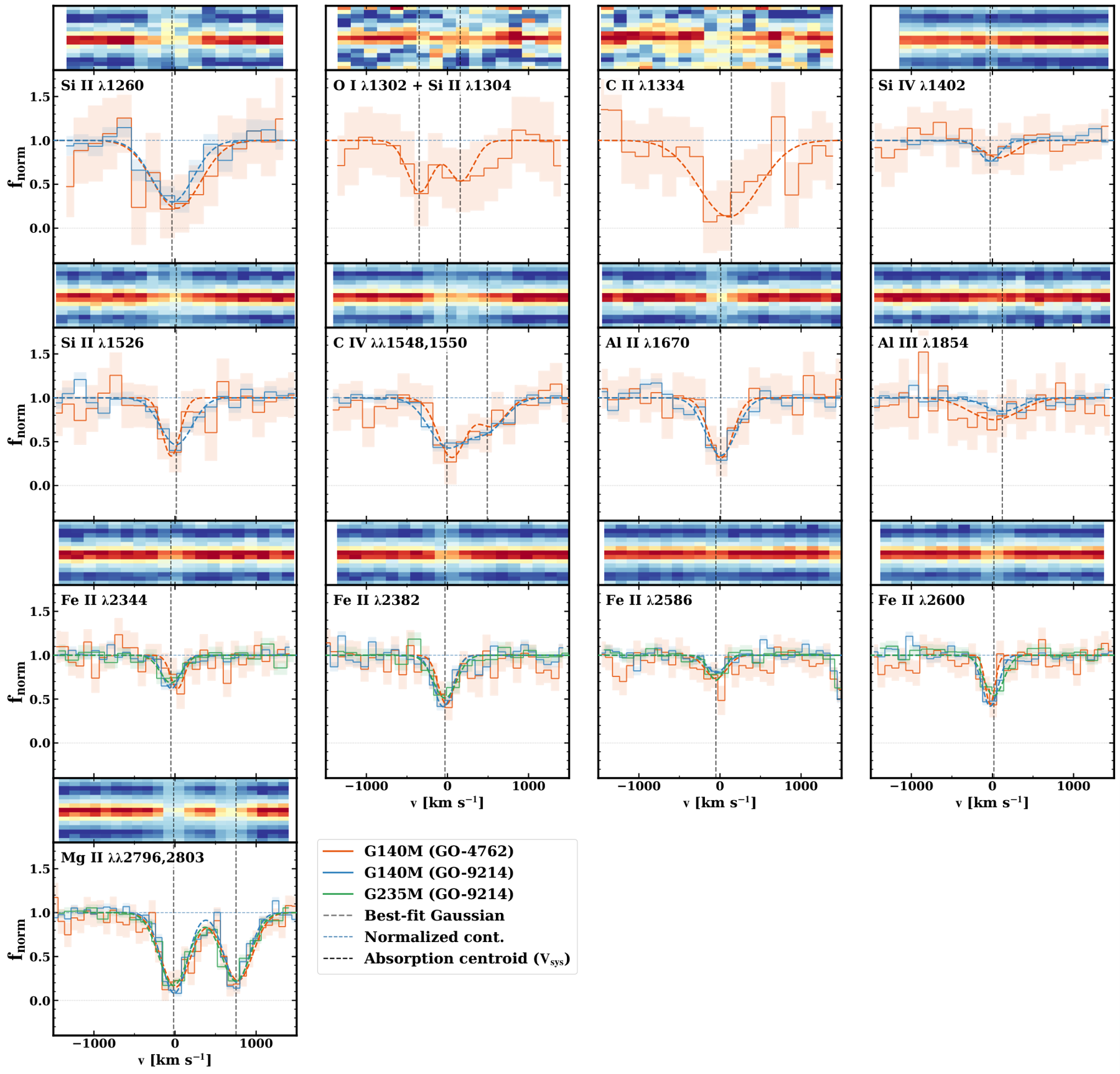
A 104-galaxy JWST composite at mean z=6.50 finds ≈180–200 km s⁻¹ blueshifted interstellar absorption. A simple wind-propagation model places most material only 3–9 proper kpc away, challenging bright [O III]-selected galaxies as the dominant source of widespread intergalactic metals.

2026-10-28 · 2610.37564v1 · Research note

Little Red Dots with Broad H$β$ Lines Reveal the Black Hole Mass Function at 7<z<9.5

Anthony J. Taylor, Steven L. Finkelstein, Hollis B. Akins, et al.

A systematic JWST/NIRSpec PRISM search finds 20 broad-Hβ emitters at 7<z<9.5, all photometrically/morphologically consistent with LRDs. Completeness-corrected mass-function evolution and inferred BH accretion density are conditional on broad Hβ being a virial black-hole-mass tracer.

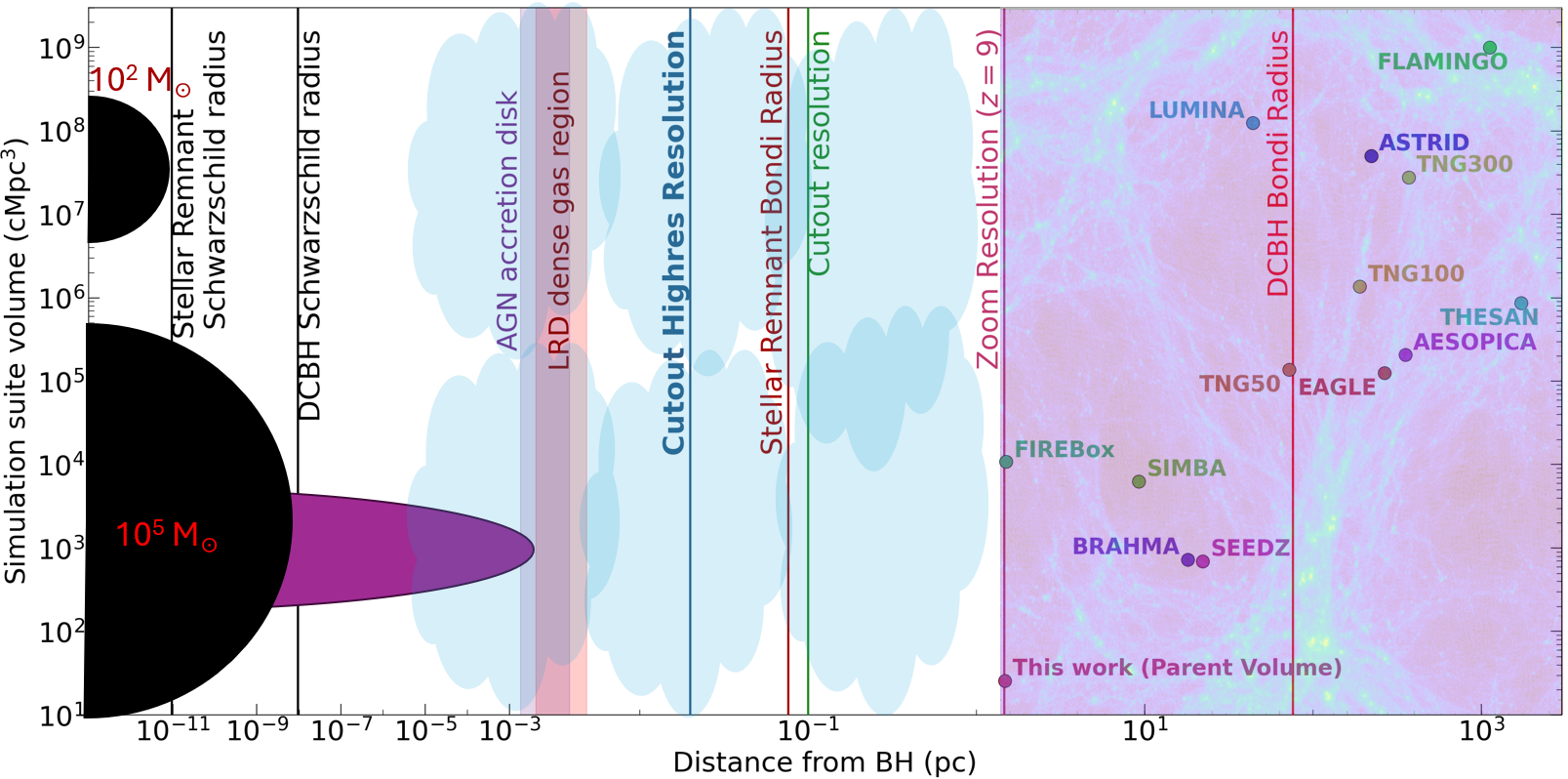
Figure 1 from Heavy Seeds and the Multi-scale Fueling of Early Supermassive Black Holes and Little Red Dots

2026-10-28 · 2610.36089v1 · Research note

Heavy Seeds and the Multi-scale Fueling of Early Supermassive Black Holes and Little Red Dots

Junehyoung Jeon, Volker Bromm, Boyuan Liu, et al.

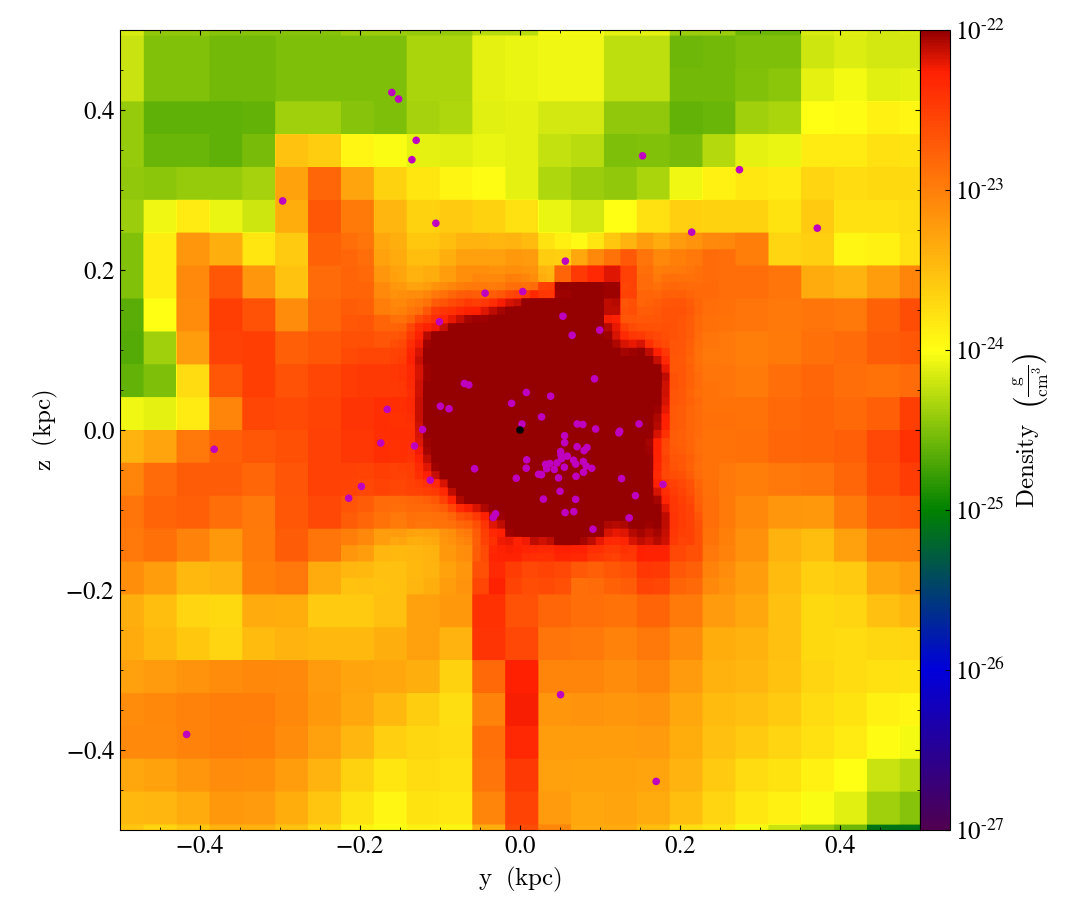
Nested sub-pc cutouts suggest that a direct-collapse heavy seed, unlike a stellar-remnant seed in these simulations, can assemble dense nearby gas, undergo bursty super-Eddington accretion, and yield a Balmer-break LRD-like spectrum. This is a model-dependent result, not a demographic measurement.
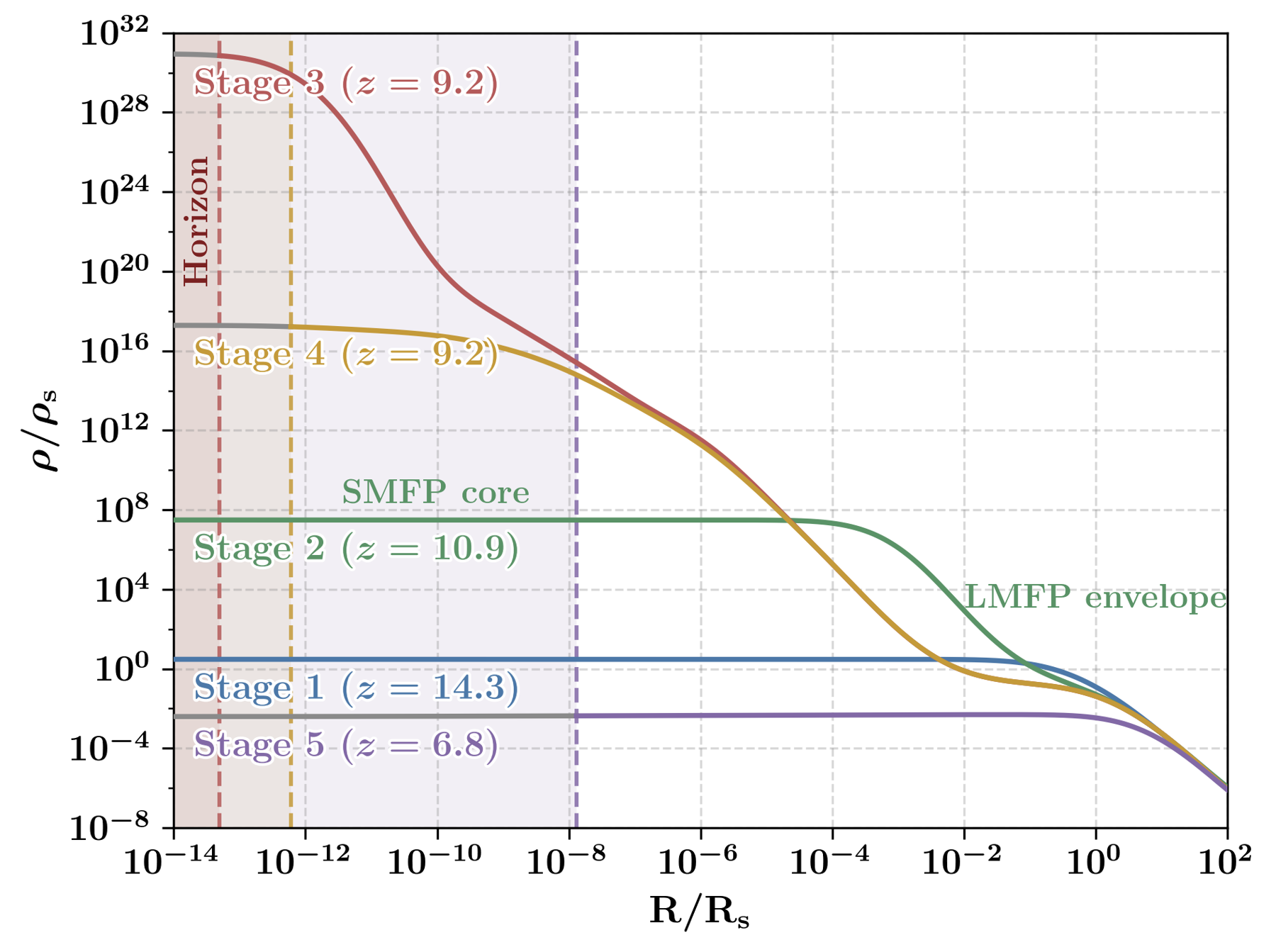
Figure 2 from Local Analogs of Little Red Dots: Clues to the X-ray Weakness

2026-10-26 · 2610.32430v1 · Research note

Local Analogs of Little Red Dots: Clues to the X-ray Weakness

Shi-Jiang Chen, Jun-Xian Wang, Zhen-Ya Zheng, et al.
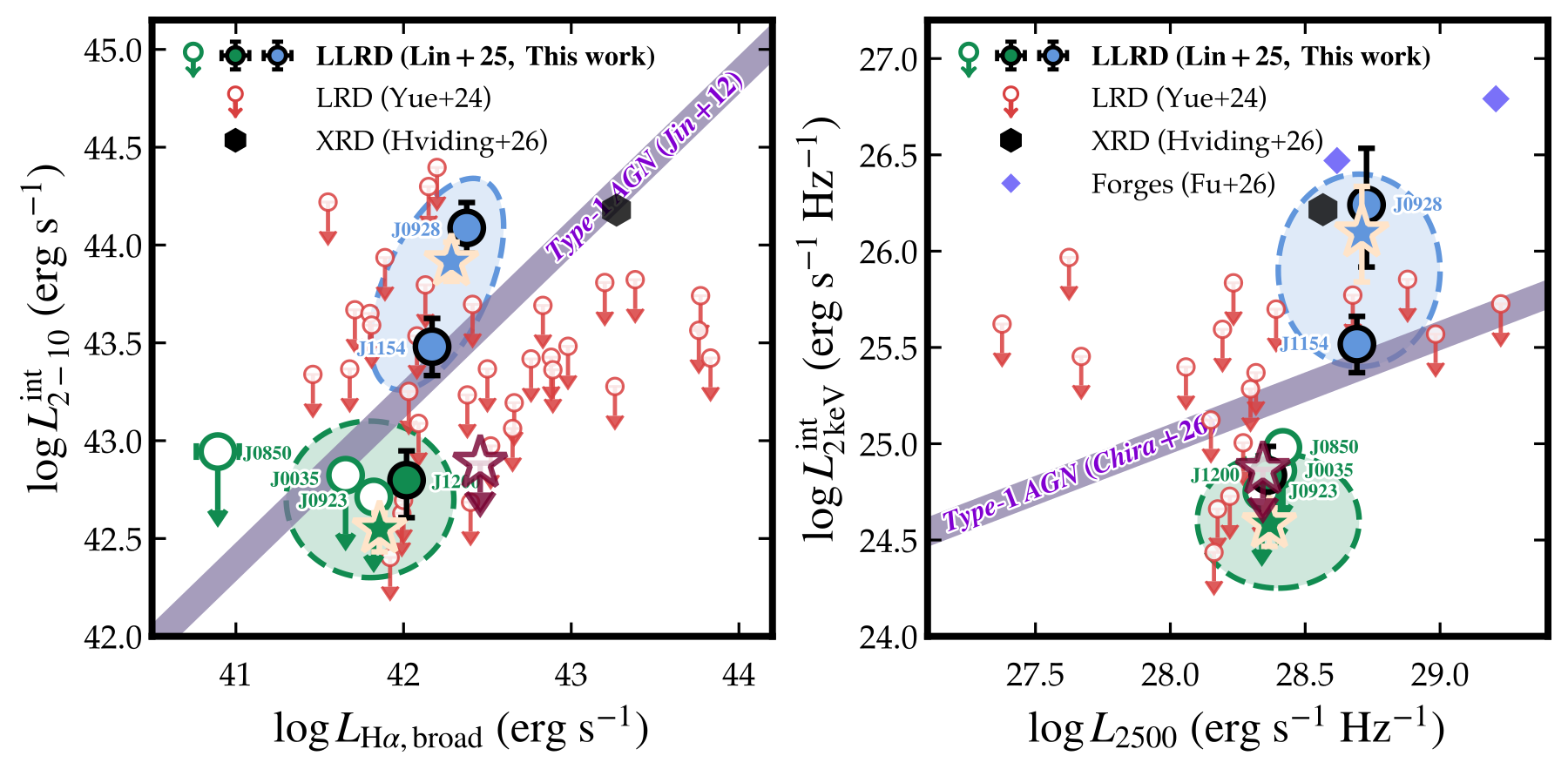
Einstein Probe observations of six z≈0.3 local LRD analogs find an X-weak subgroup whose stacked soft-X-ray constraints favor modest intrinsic coronal weakness plus Compton-thin absorption, rather than the specific unobscured super-Eddington or local Compton-thick geometries tested.

Figure 3 from A Little Red Dot emerging from a nitrogen-rich UV-luminous galaxy with Very Massive Stars

2026-10-22 · 2610.29887v1 · Research note

A Little Red Dot emerging from a nitrogen-rich UV-luminous galaxy with Very Massive Stars

Alberto Torralba, Jorryt Matthee, Rui Marques-Chaves, et al.

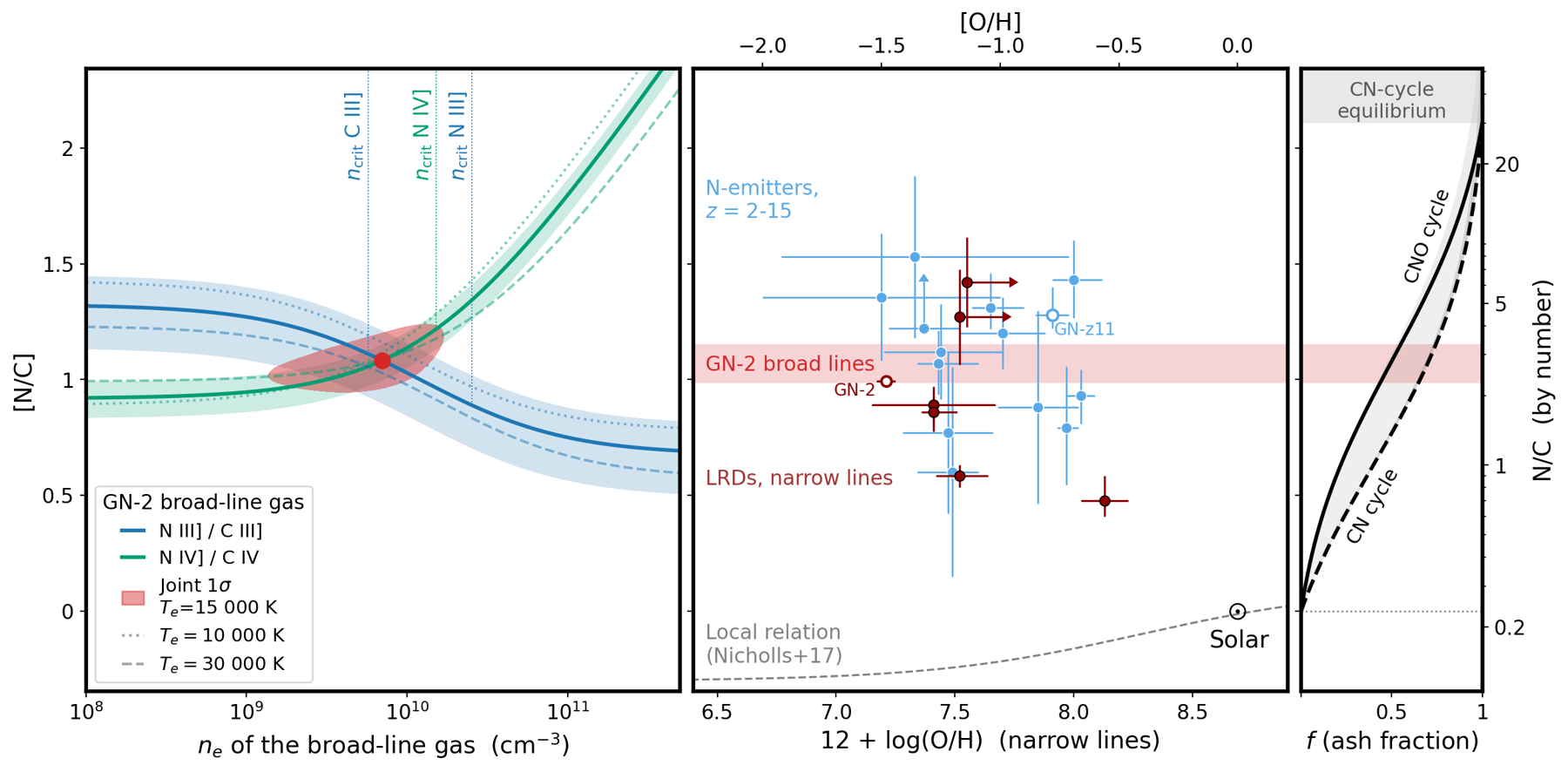
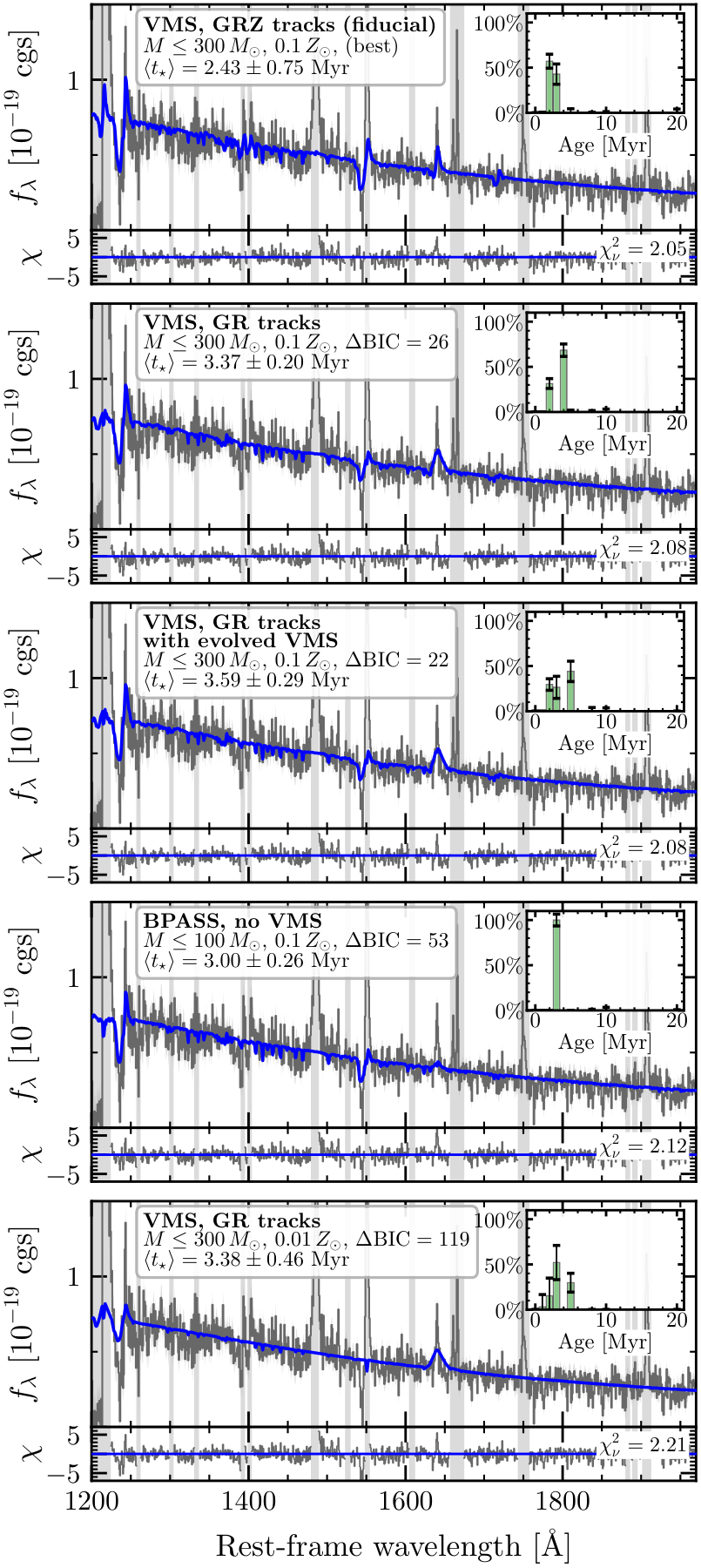
Medium-resolution JWST/NIRSpec spectroscopy of the single z=6.6 galaxy COLA1 links a very young, VMS-favored UV population, extreme nitrogen enrichment, and LRD-like optical Balmer structure; the proposed evolution into an LRD remains model-dependent.

Figure 2 from A heterogeneous set of unusual quasars selected from astrometry and broad-band photometry

2026-10-15 · 2610.19838v1 · Research note

A heterogeneous set of unusual quasars selected from astrometry and broad-band photometry

C. Cheng, K. Valeckas, L. Christensen, et al.

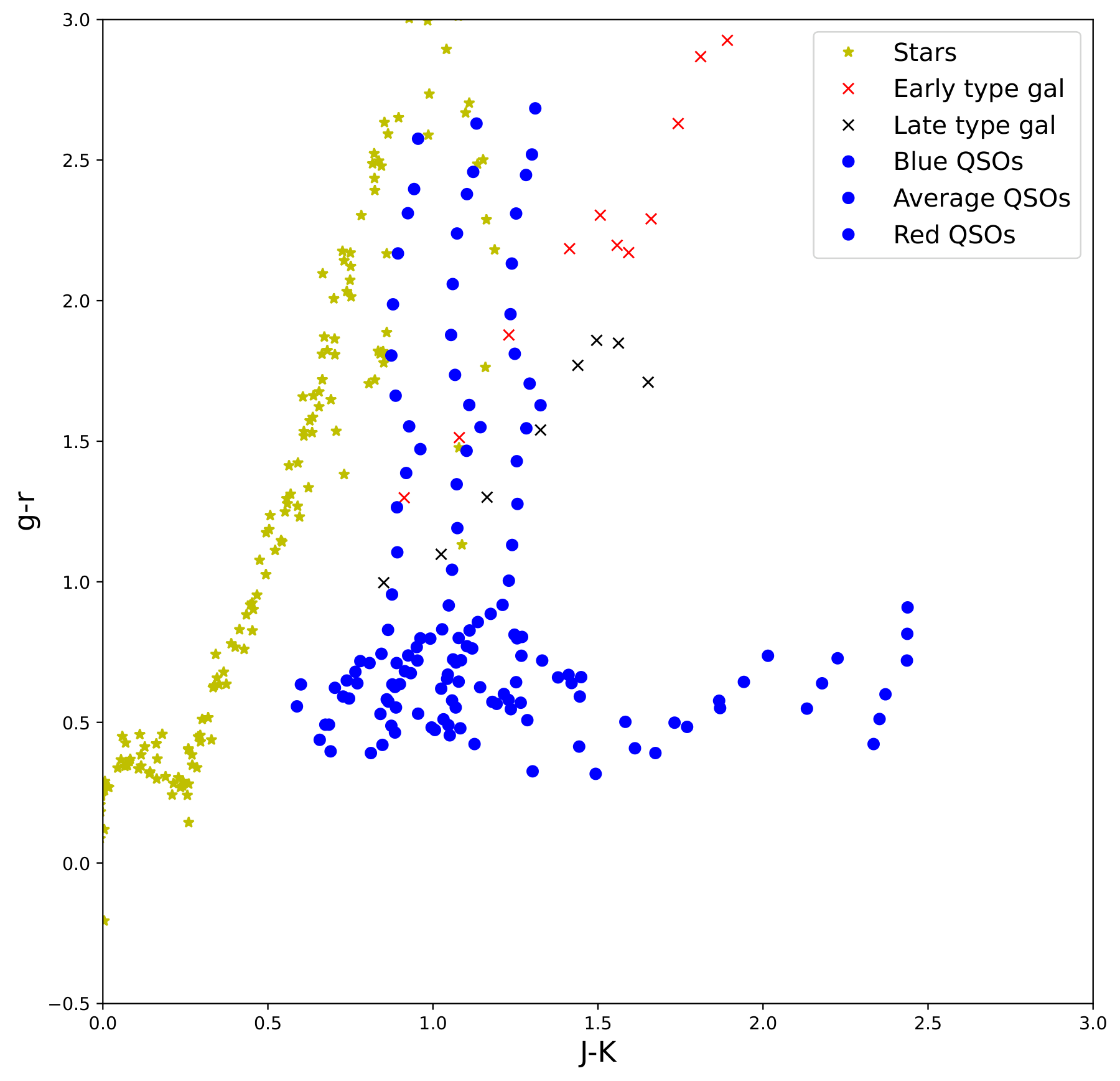
Gaia zero-motion selection plus broad-band colours and spectroscopy confirmed 21 quasars among 24 candidates, disproportionately finding BAL quasars in photometrically transitional regions. One low-redshift normal quasar is described as LRD-like, but this is not a high-redshift LRD sample.

Figure 3 from Deep X-ray View of a Distant Protocluster Anchored by a Quasar at $z=6.63$: No Evidence for Enhanced X-ray AGN Activity

2026-10-15 · 2610.19317v1 · Research note

Deep X-ray View of a Distant Protocluster Anchored by a Quasar at $z=6.63$: No Evidence for Enhanced X-ray AGN Activity

Shouyi Wang, Feige Wang, Jinyi Yang, et al.

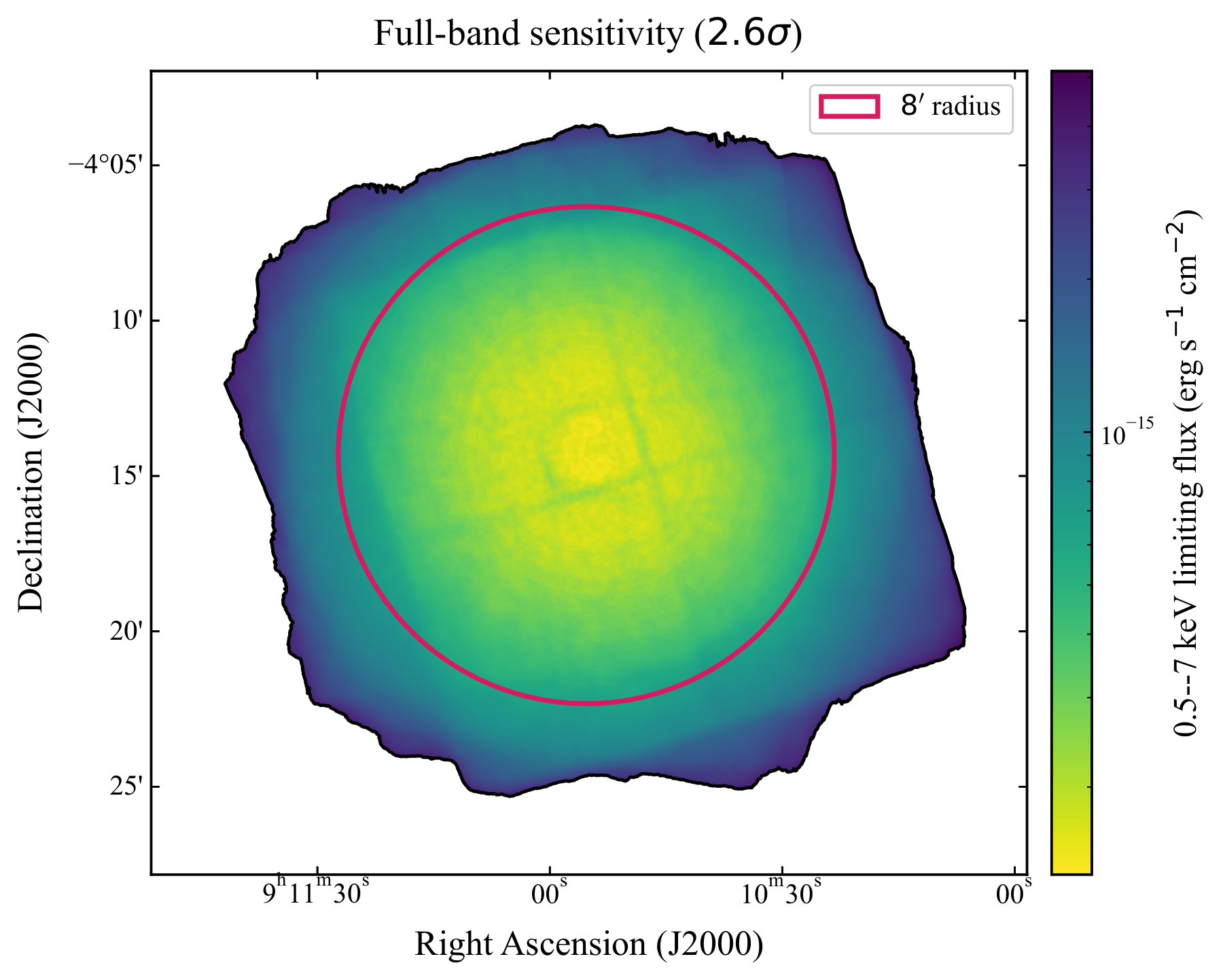
In 865 ks of Chandra imaging, no X-ray AGN is detected among 21 confirmed non-quasar members of the z=6.63 J0910−0414 protocluster. The resulting limits do not establish environmental enhancement, but still allow substantial excess activity.

2026-10-15 · 2610.18968v1 · Research note

The Dance of the Little Red Dots: Spectroscopy of Two Blue Companions at z = 3.9 and 5.5 Reveals Young, Metal-Poor Starbursts Merging with Their LRDs within a Few Hundred Myr

Fabio Pacucci, Pierluigi Rinaldi

Spectroscopy of two LRD–blue-companion pairs confirms small line-of-sight velocity offsets and young, metal-poor companion starbursts. Orbital modeling favors a merger for Tango and conditionally for Waltz, while the proposed heavy-seed connection remains interpretive.

Figure 2 from Widespread steep X-ray spectra of luminous $z\simeq5.85-7.6$ quasars and their implications for future X-ray surveys

2026-10-08 · 2610.10522v1 · Research note

Widespread steep X-ray spectra of luminous $z\simeq5.85-7.6$ quasars and their implications for future X-ray surveys

A. Tortosa, L. Zappacosta, E. Piconcelli, et al.

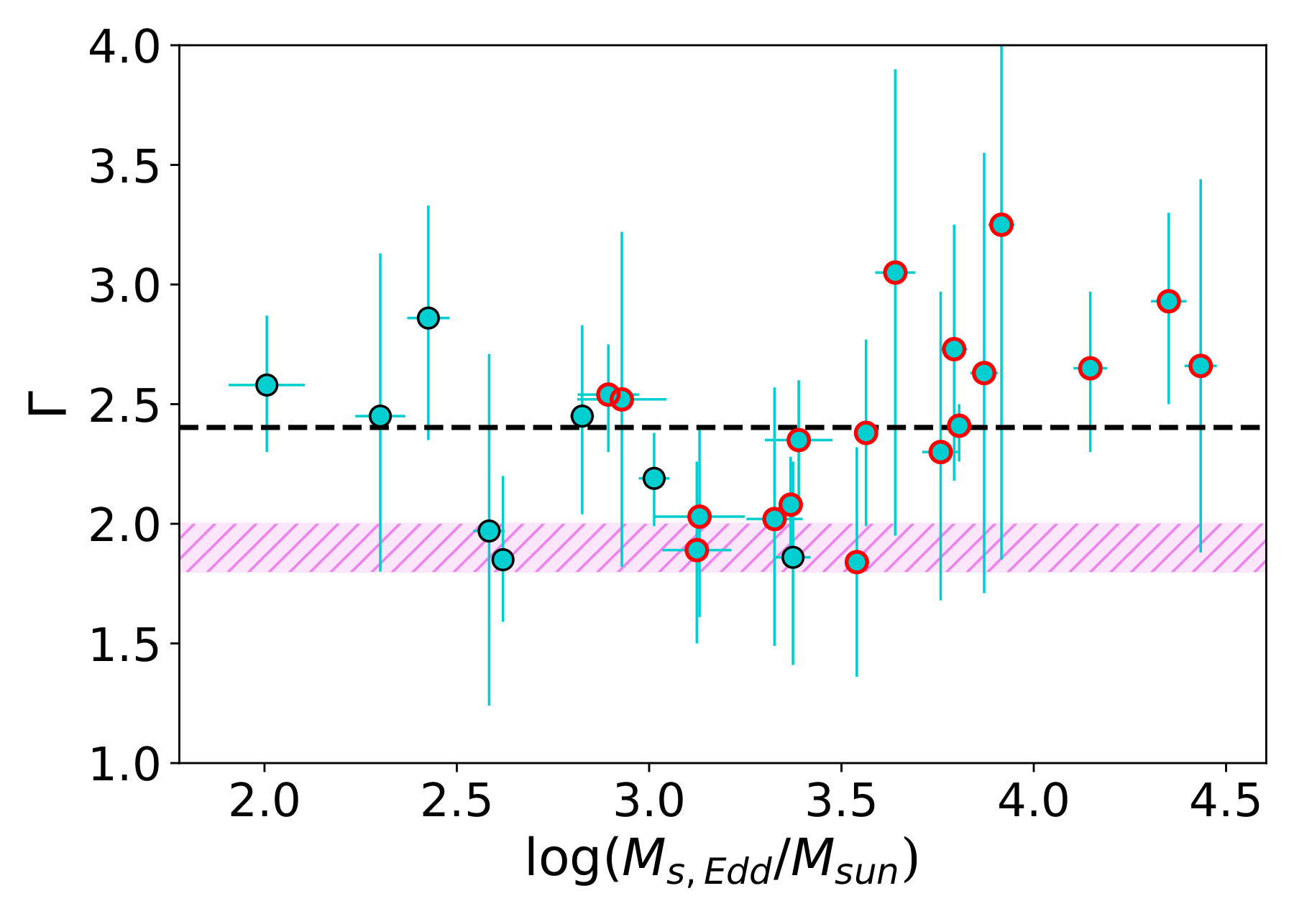
Across 28 luminous quasars at z=5.85–7.56, X-ray continua are systematically steep, yet show no significant dependence on black-hole growth indicators. The inferred spectral shapes could modestly to severely reduce high-redshift survey count rates.

Figure 1 from MUSE-ALMA Haloes XVI: a census of the condensed baryons in z~0.5 HI absorption-selected galaxies

2026-10-08 · 2610.10117v1 · Research note

MUSE-ALMA Haloes XVI: a census of the condensed baryons in z~0.5 HI absorption-selected galaxies

T. O'Beirne, C. Péroux, M. Zwaan, et al.

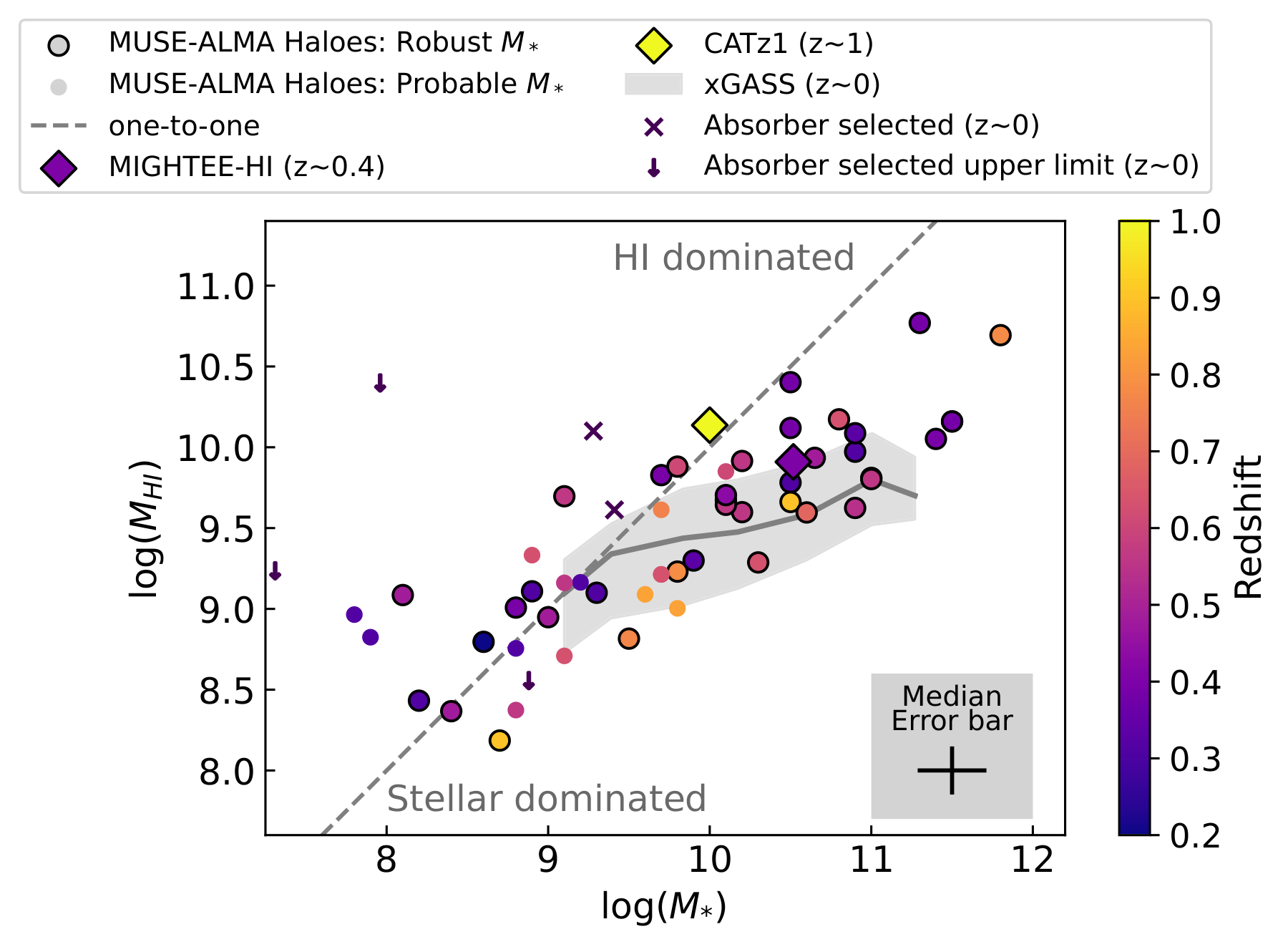
Across 79 H I absorber-selected galaxies at 0.2<z<1.2, the authors combine multiwavelength data to inventory stars and cold gas, finding broadly consistent indirect H I estimators at small impact parameter but environmentally driven scatter and mass-dependent gas fractions.

2026-10-07 · 2610.08731v1 · Research note

Halo Mass Function Constraints on Early Galaxy and AGN Populations in the JWST Era

Elan Yogeswaren, Robert Schaefer

This framework treats JWST massive galaxies, AGN, and UV luminosity functions as host-halo supply tests. It finds that rare-halo abundance predictions depend strongly on high-redshift HMF calibration and assumed baryonic or black-hole mappings, precluding simple source-by-source consistency claims.

Figure 3 from Unveiling the Origins of the Molecular Gas Reservoirs in Recently Quenched Massive Galaxies

2026-10-06 · 2610.06680v1 · Research note

Unveiling the Origins of the Molecular Gas Reservoirs in Recently Quenched Massive Galaxies

E. Savitch, D. Narayanan, D. J. Setton, et al.

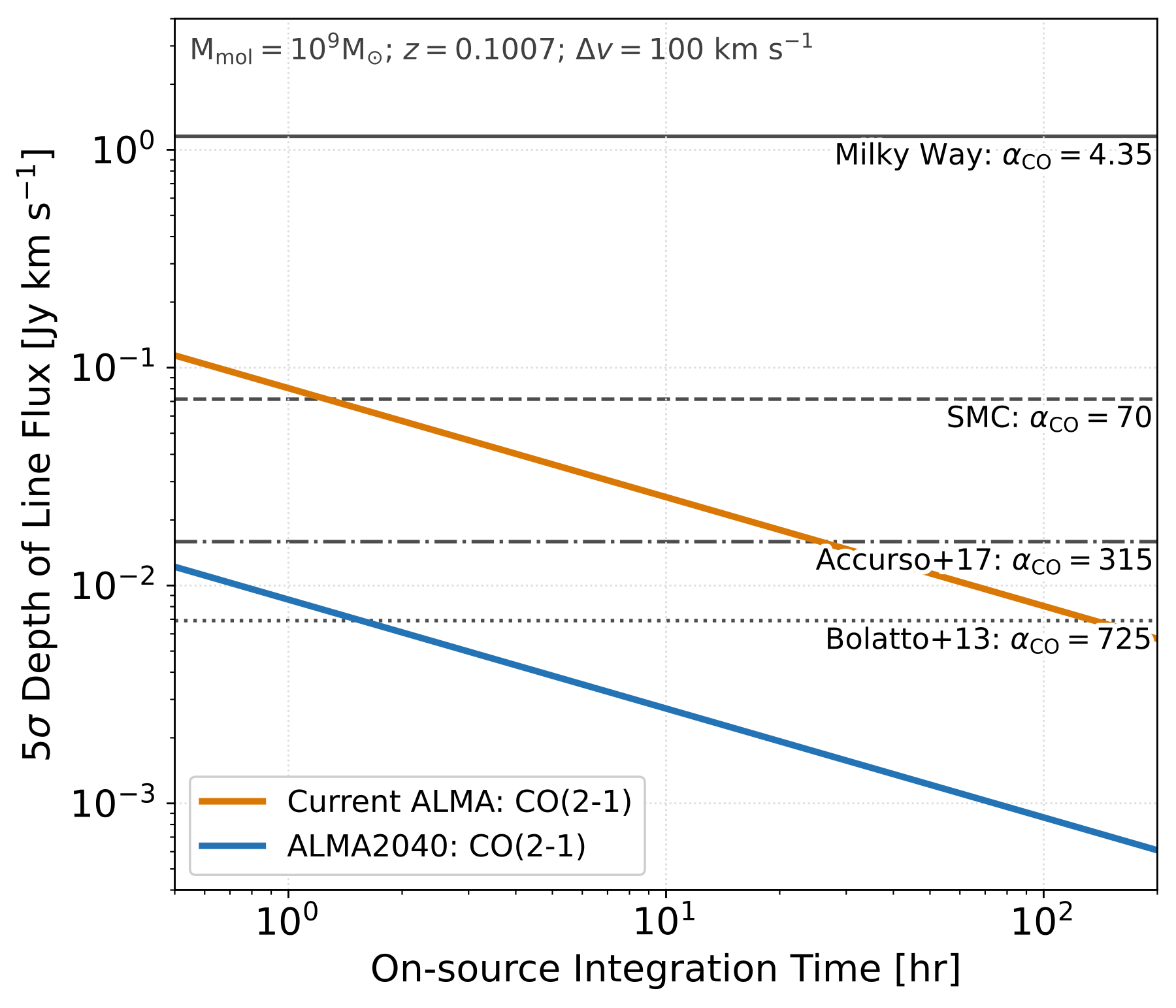
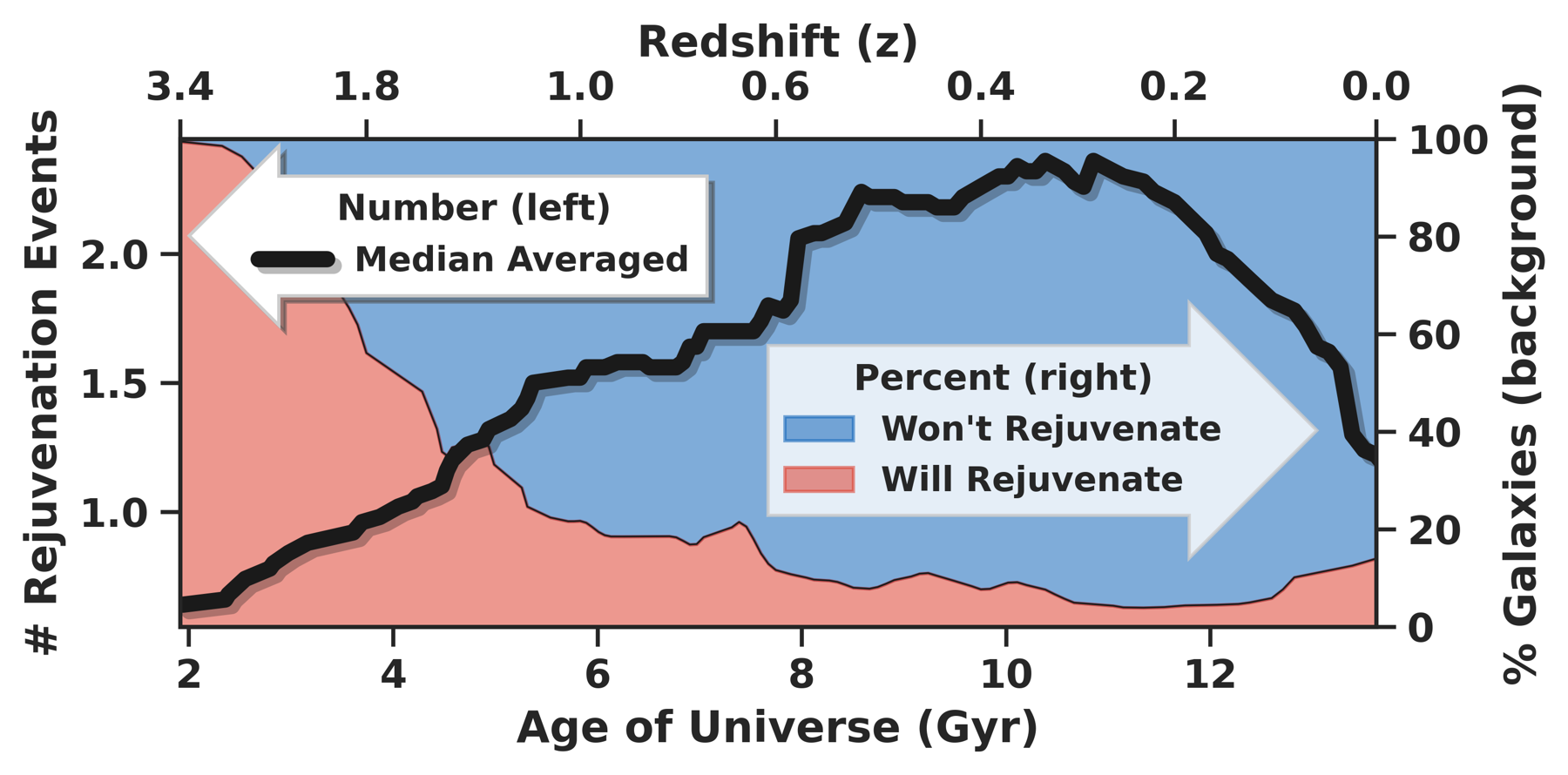
In Simba, apparently molecular-gas-rich recently quenched galaxies can reflect dust-hidden star formation, a low CO–H2 conversion factor, or temporary quiescence. The model favors no single explanation; rejuvenation is high-redshift-weighted and comparatively uncommon.

Figure 1 from Chandra X-ray Spectral Evidence of the Dual AGN Nature of the Gravitational lens MG B2016+112 at z=3.273 with 175 pc separation

2026-10-01 · 2609.38590v1 · Research note

Chandra X-ray Spectral Evidence of the Dual AGN Nature of the Gravitational lens MG B2016+112 at z=3.273 with 175 pc separation

Daniel A. Schwartz, Julia M. Sisk-Reynes, Anna Barnacka

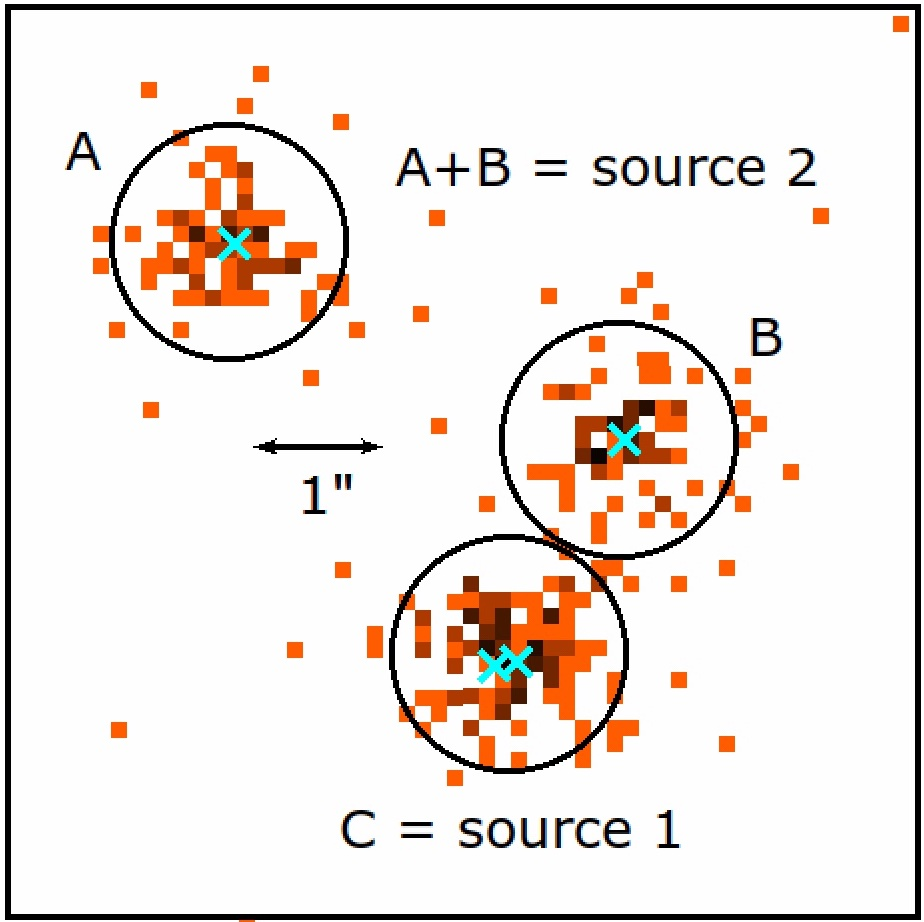
Separate Chandra spectra of the two lensed X-ray emitters in MG B2016+112 support the authors’ dual-AGN interpretation: the inner-caustic component is intrinsically absorbed, disfavoring its alternative identification as a highly magnified jet feature.

Figure 2 from Caught in the act: diffuse stellar and Ly$α$ emission around a halo-less quasar in the assembling cluster CARLA J0800+4029 at z=2

2026-09-30 · 2609.37445v1 · Research note

Caught in the act: diffuse stellar and Ly$α$ emission around a halo-less quasar in the assembling cluster CARLA J0800+4029 at z=2

Sofia G. Gallego, Simona Mei, Emanuele Daddi, et al.

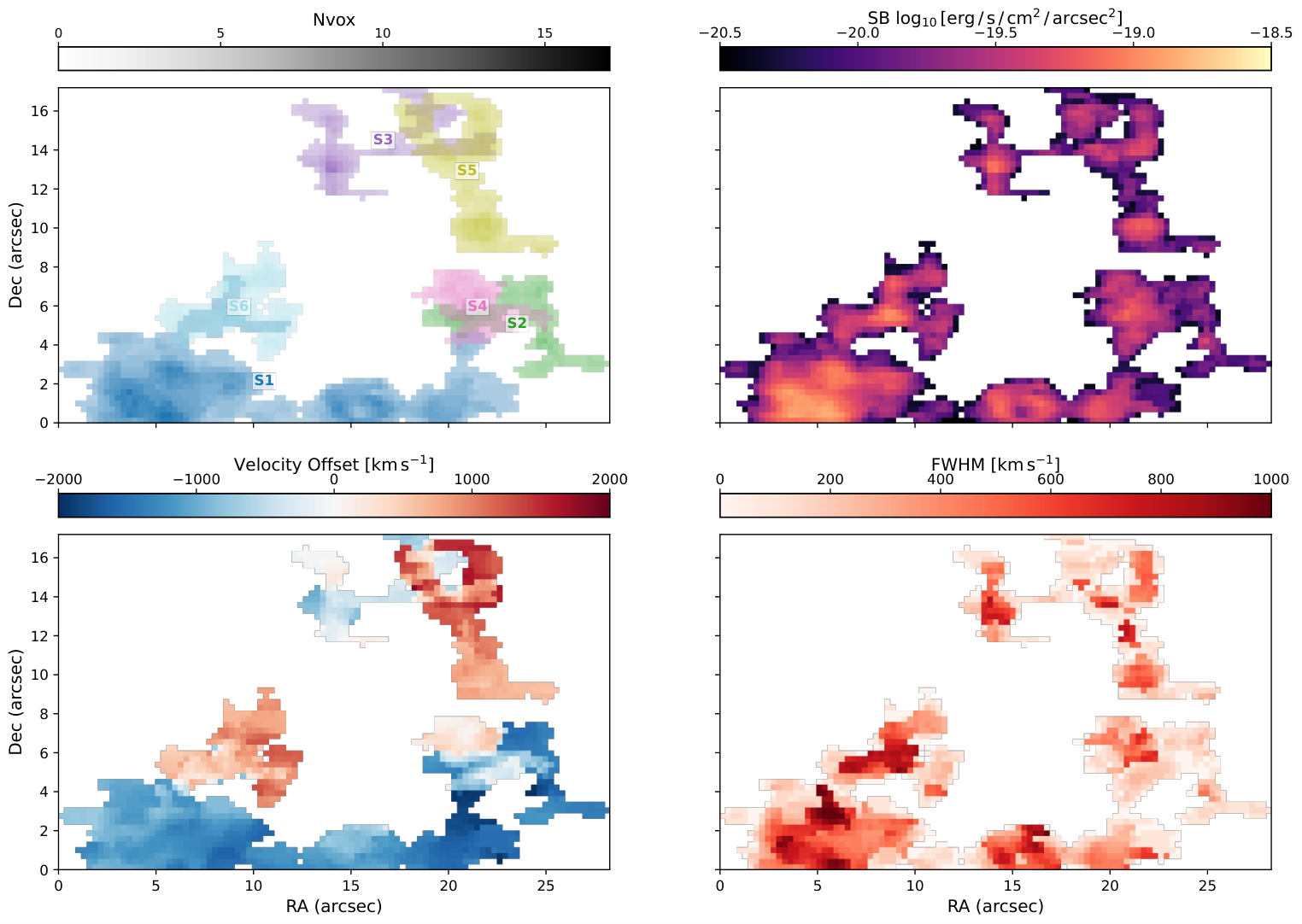
KCWI and HST reveal that CARLA J0800+4029’s dominant Lyα reservoir is tidal and offset from its radio-loud quasar, while a matched-area quasar-halo limit is 3.4 times lower, consistent with spatially redistributed baryons during cluster assembly.

Figure 1 from Connecting the Dots: Prospects for Detecting Multi-Source Inflation through Scale-Dependent and Stochastic Bias of Little Red Dots

2026-09-30 · 2609.36002v1 · Research note

Connecting the Dots: Prospects for Detecting Multi-Source Inflation through Scale-Dependent and Stochastic Bias of Little Red Dots

Peter L. Taylor, Xinyi Chen, Christopher M. Hirata, et al.

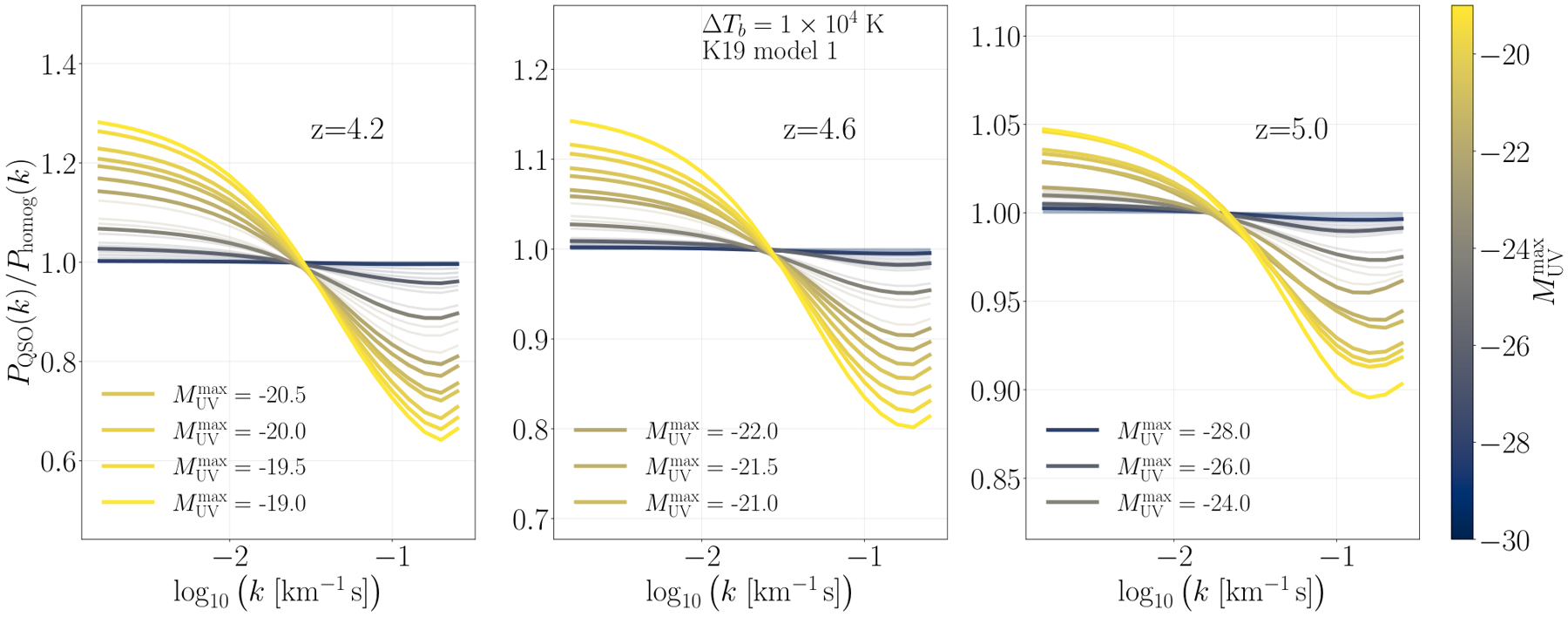
This paper forecasts whether a purpose-built, wide space survey of LRD clustering at z=4–9 could jointly constrain local fNL and τNL and test the multi-source Suyama–Yamaguchi inequality; its conclusions remain conditional on idealised survey and covariance assumptions.

2026-09-29 · 2609.34903v1 · Research note

Exploring the observed properties of JWST Little Red Dots with cosmological simulations and dust radiative transfer

Saksham Chandna, Fabio Di Mascia, Simona Gallerani, et al.

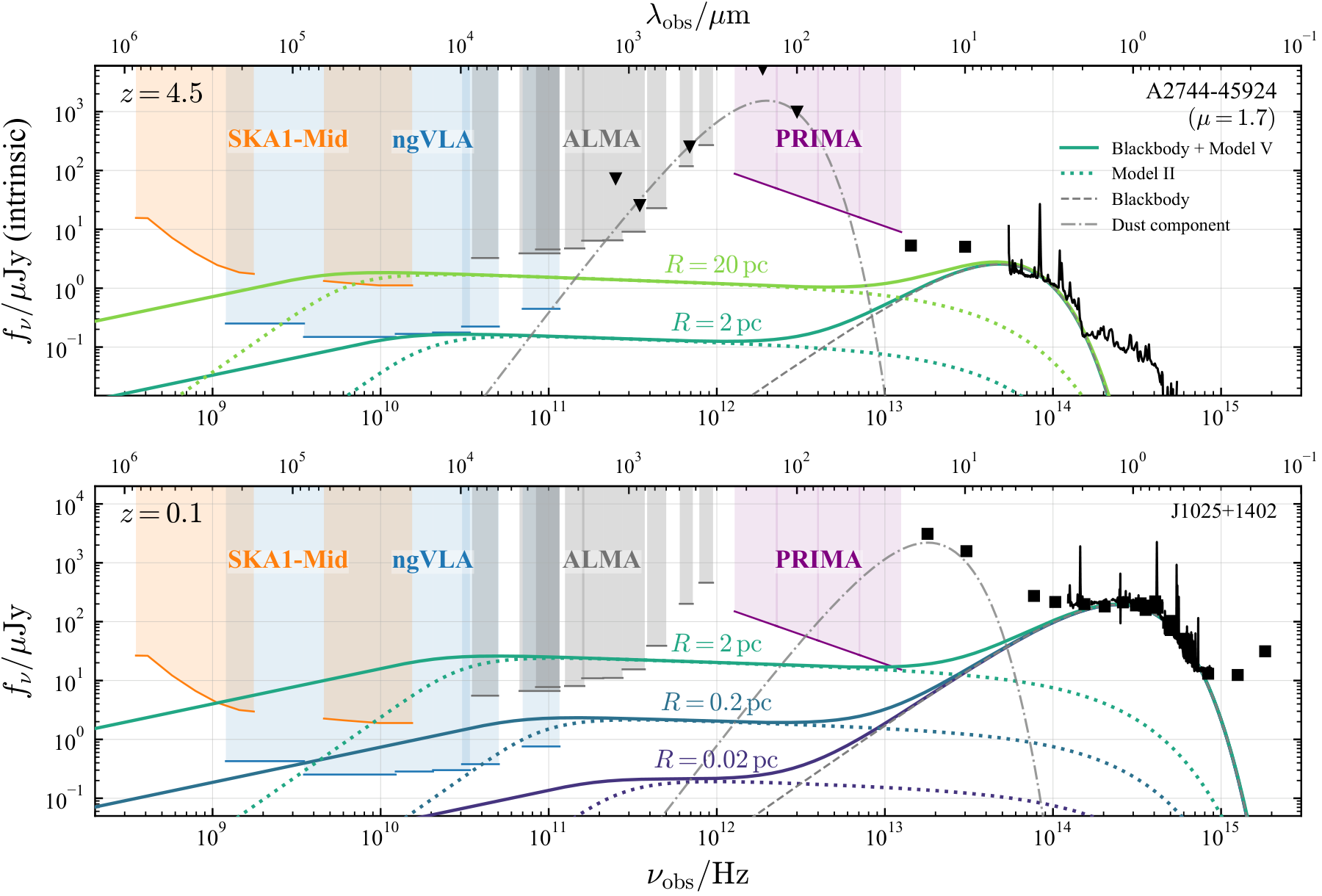
Forward-modelled z=6–9 zoom simulations find that an obscured accreting black hole plus stellar UV emission and dust geometry can produce selected LRD-like colours and compactness, but reproduce only the moderate-Balmer-break subset of observed LRDs.

Figure 1 from SN Helios: A Multiply Imaged Type II Supernova Opening Time-Delay Cosmography beyond redshift of 3

2026-09-28 · 2609.30440v1 · Research note

SN Helios: A Multiply Imaged Type II Supernova Opening Time-Delay Cosmography beyond redshift of 3

Seiji Fujimoto, Conor Larison, Justin D. R. Pierel, et al.

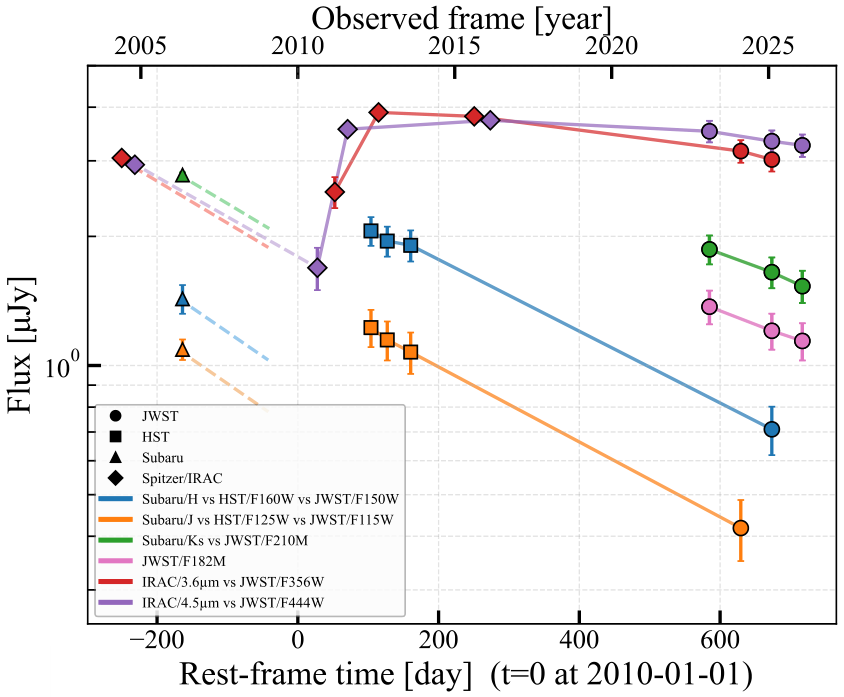
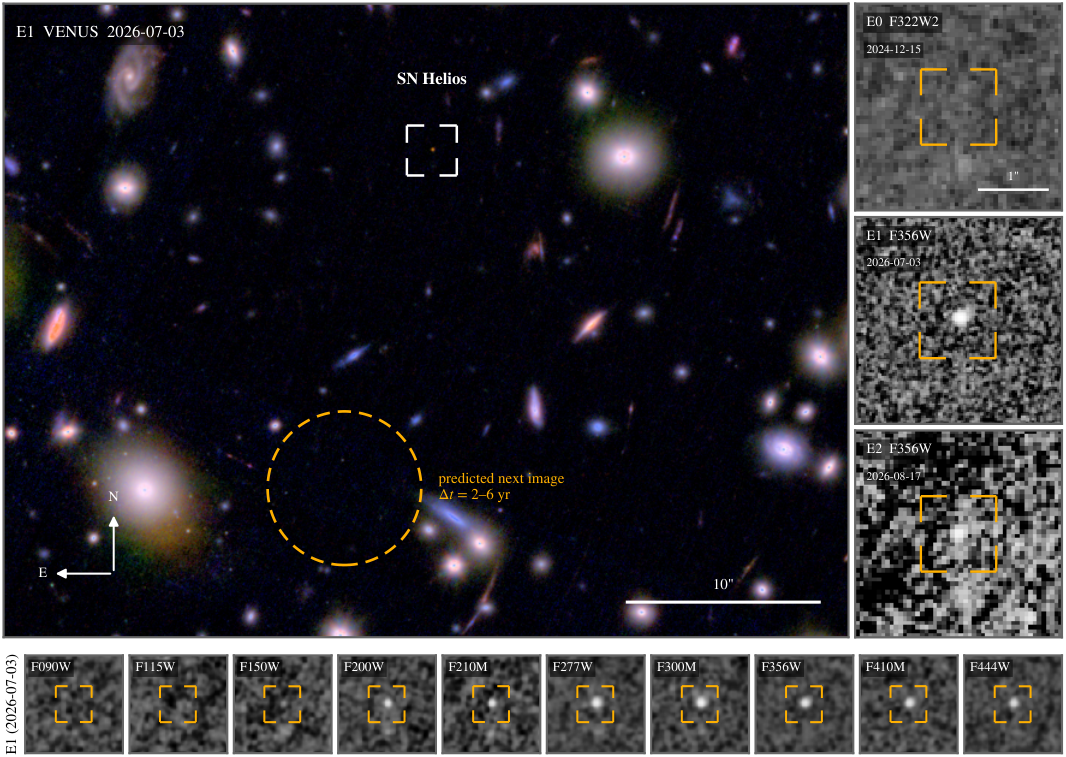
SN Helios is a spectroscopically confirmed, strongly lensed Type II supernova at z=3.34. Its predicted 2–6 yr reappearance could enable time-delay cosmography, but current lens-model spread and the absence of a measured delay preclude an H0 result.

Figure 1 from A sub-100 pc view at z~5 of a Multiply-Imaged Massive Quiescent Galaxy

2026-09-24 · 2609.28474v1 · Research note

A sub-100 pc view at z~5 of a Multiply-Imaged Massive Quiescent Galaxy

Richard Pan, Danilo Marchesini, Joseph F. V. Allingham, et al.

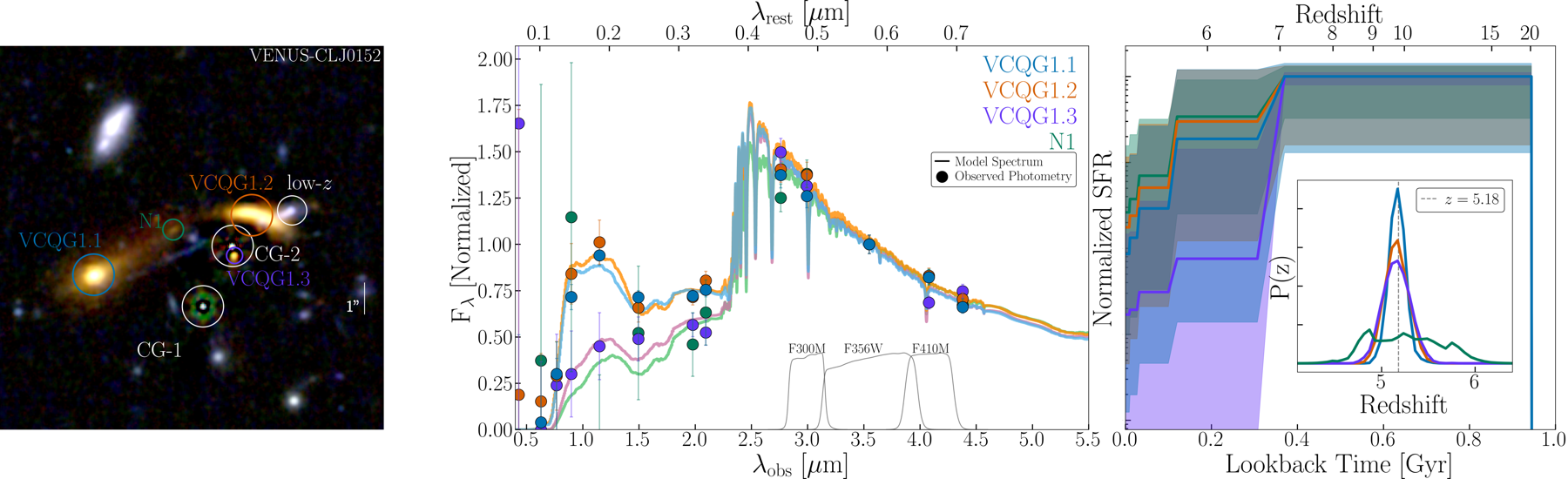
Strong lensing resolves the z=5.18 post-starburst VCQG1 to ~70 pc, revealing an extended stellar body and off-nuclear line-emitting clump. The authors argue these measurements disfavor a simple compaction-plus-unobscured-AGN quenching picture for this individual galaxy.

Figure 4 from Search for High-Ionization Nebular Emission (SHINE). I. A Systematically Selected [Ne V] Sample at z > 3 with JWST/NIRSpec PRISM

2026-09-24 · 2609.27130v1 · Research note

Search for High-Ionization Nebular Emission (SHINE). I. A Systematically Selected [Ne V] Sample at z > 3 with JWST/NIRSpec PRISM

Shobita Satyapal, Sara Doan, Daniel Schaerer, et al.

SHINE identifies 25 luminous [Ne V] emitters at z=3.06–9.44 from >9,000 JWST/NIRSpec PRISM galaxies. Their hard-ionization lines favor accretion, but heterogeneous selection and incomplete diagnostic overlap preclude an intrinsic AGN-incidence measurement.

Figure 3 from The lifetimes and properties of Little Red Dots in the AMBRA simulation

2026-09-24 · 2609.26999v1 · Research note

The lifetimes and properties of Little Red Dots in the AMBRA simulation

Patrick LaChance, Yihao Zhou, Aklant Kumar Bhowmick, et al.

Mock JWST selection in AMBRA suggests LRDs are transient appearances of existing black hole–galaxy systems: dim sources require a gas-enshrouded AGN model, while massive compact hosts yield longer-lived phases. Redshift counts remain model-sensitive.

2026-09-24 · 2609.26931v1 · Research note

Radio Quasars in the Cosmic Dawn: A Spectroscopic Sample from the DESI Survey

Anniek J. Gloudemans, Jinyi Yang, David M. Alexander, et al.

DESI spectroscopy plus 144-MHz LOFAR imaging identifies 83 radio-detected quasars at 4.7<z<6.7, including 26 radio-loud objects. Their UV spectra are broadly similar to non-detections; tentative weak-line excesses and BAL trends remain statistically inconclusive.

2026-09-23 · 2609.26553v1 · Research note

Constraining Inflation with Little Red Dots

Dionysios Karagiannis, P. Daniel Meerburg

A 14,000-deg² spectroscopic LRD survey at 4<z<9 is forecast to constrain local, equilateral, and orthogonal primordial non-Gaussianity at σ(fNL)=0.32, 32, and 10, respectively, if modeled clustering, abundance, and covariance assumptions hold.

Figure 4 from EPOCHS-DR2 I: Expanded data release and properties of $6.5<z<16.5$ photometrically selected galaxies across NIRCam deep fields covering $\sim700\,\rm arcmin^2$ with the galfind software

2026-09-22 · 2609.24987v1 · Research note

EPOCHS-DR2 I: Expanded data release and properties of $6.5<z<16.5$ photometrically selected galaxies across NIRCam deep fields covering $\sim700\,\rm arcmin^2$ with the galfind software

Duncan Austin, Christopher J. Conselice, Thomas Harvey, et al.

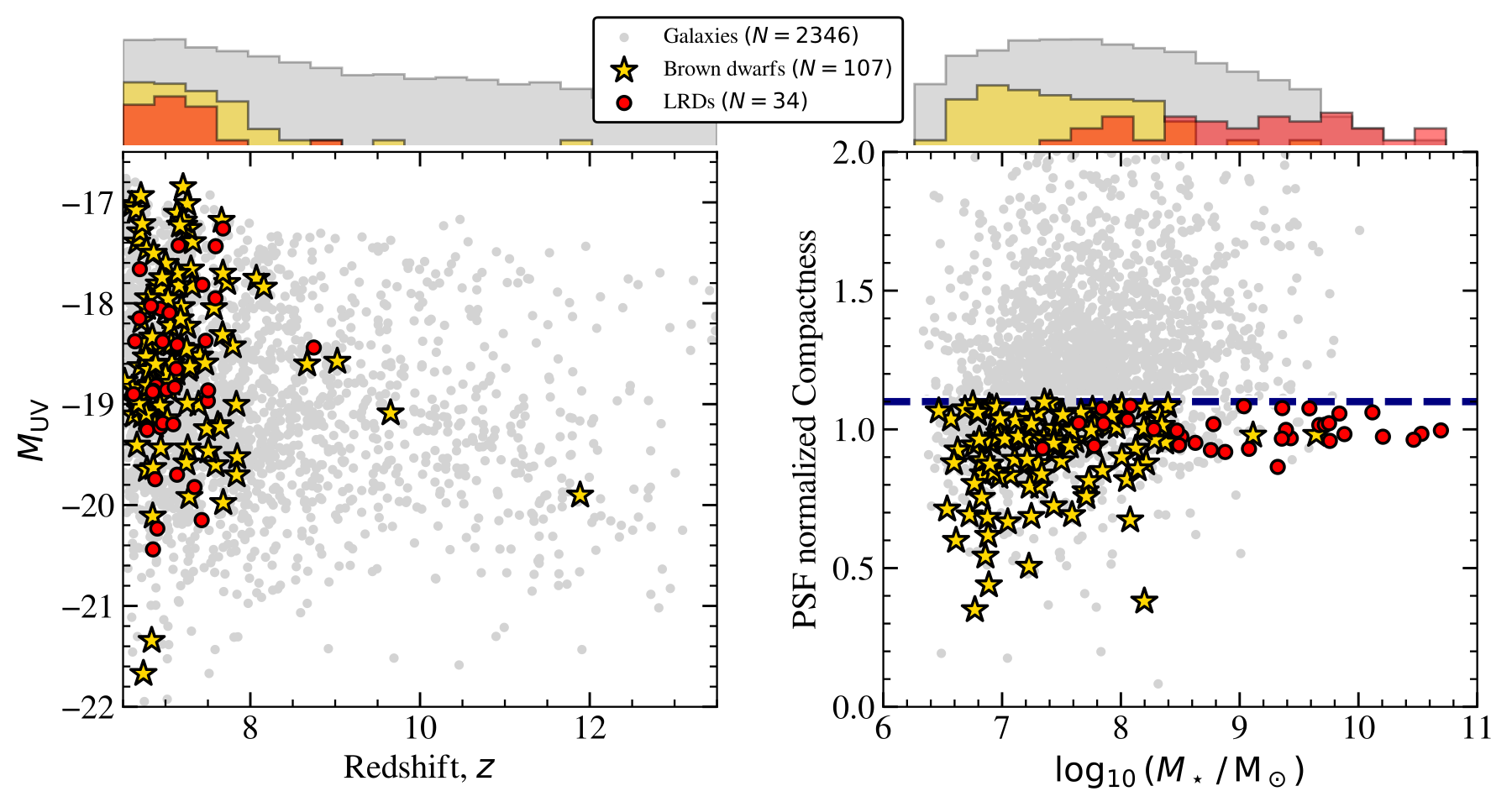
EPOCHS-DR2 releases a large JWST/NIRCam photometric census at 6.5<zphot<16.5, validated against NIRSpec but explicitly incomplete under its conservative selection. It identifies a small V-shaped-SED LRD subset and high-redshift candidates whose nature requires spectroscopy.

Figure 5 from LATED: Ly$α$-anchored photometric selection of candidate metal-free and extremely metal-poor star formation from the end of reionisation to cosmic noon

2026-09-22 · 2609.24588v1 · Research note

LATED: Ly$α$-anchored photometric selection of candidate metal-free and extremely metal-poor star formation from the end of reionisation to cosmic noon

Mingyu Li, Zheng Cai, Roberto Maiolino, et al.

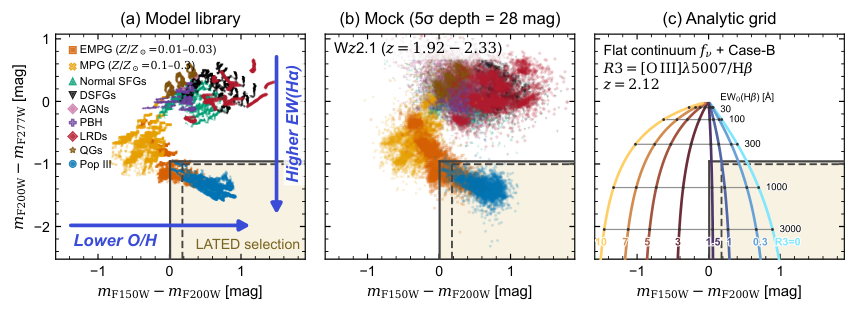
LATED uses Lyα-selected sources and three-band Hα/[O III]+Hβ/continuum colours to prioritize extremely metal-poor or Pop III-like candidates at z=1.92–6.60. Tests recover AMORE6 and identify three Abell 2744 candidates, but photometry cannot prove metal-free stars.

2026-09-22 · 2609.22623v1 · Research note

Balmer Absorption Series and Broad Metal Lines in Two Luminous Little Red Dots

Bingjie Wang, Jenny E. Greene, Hanpu Liu, et al.

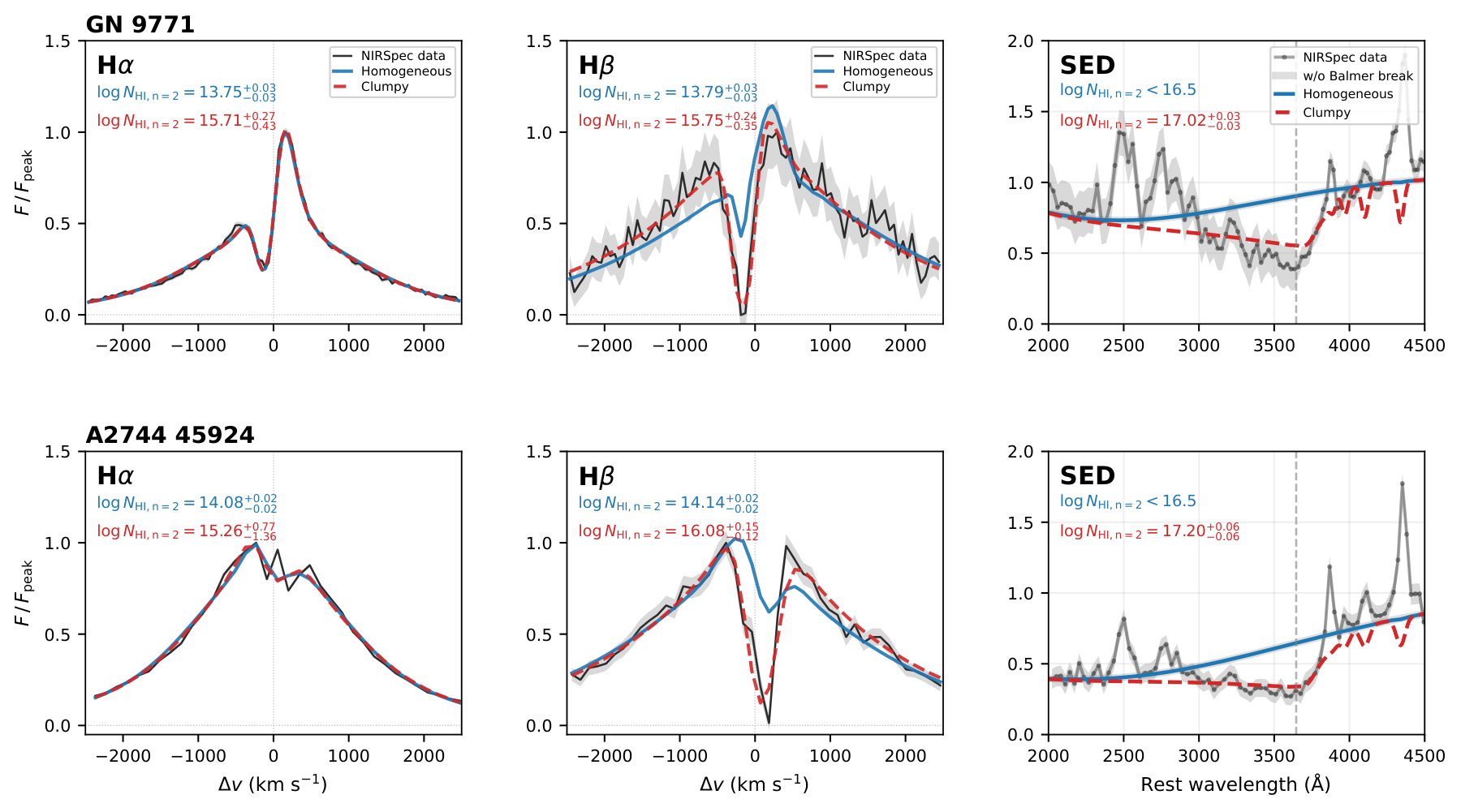
Deep JWST/NIRSpec spectra of two luminous LRDs resolve Hα–Hδ absorption near systemic velocity, with higher-order troughs redder and unexpectedly persistent. Broad metal lines and diagnostic ratios favor dense gas, while a stratified failed wind remains an interpretation rather than a detection.

Figure 9 from Inflated Supermassive Stars as Little Red Dots and Progenitors of Supermassive Black Holes

2026-09-22 · 2609.22507v1 · Research note

Inflated Supermassive Stars as Little Red Dots and Progenitors of Supermassive Black Holes

Wenbin Lu

One-dimensional equilibrium models suggest that metal-enriched, hydrogen-burning supermassive stars can attain LRD-like cool photospheres through Fe-opacity-driven envelope inflation, while general-relativistic collapse could leave massive black-hole remnants. The proposed interpretation remains sensitive to atmospheric physics and formation assumptions.

2026-09-21 · 2609.21337v1 · Research note

A large overdensity of LRD-like galaxies discovered by JWST in the SPT2349-56 protocluster at z=4.30

Scott C. Chapman, Kedar A. Phadke, Nikolaus Sulzenauer, et al.

JWST identifies 11 ultra-red, mostly resolved galaxies in the z=4.3 SPT2349-56 core. Their extreme concentration and ALMA-constrained low star formation suggest a likely protocluster population transitioning beyond the dusty-starburst phase, pending spectroscopy.

2026-09-18 · 2609.19459v1 · Research note

Extreme Enrichment at Cosmic Dawn: Three FeII-Strong Quasars at z > 6 from the JWST Aether survey

Anniek J. Gloudemans, Emanuele Paolo Farina, Roberto Decarli, et al.

JWST/NIRSpec IFU spectra identify three z>6 quasars with extreme optical Fe II relative to Hβ, supporting rapid early enrichment while leaving accretion rates and nearby line-emitting structures materially uncertain.

Figure 2 from A dense, metal-rich absorber driven by a heavily dust-obscured galaxy: The direct evidence of CGM enrichment at $z\sim7$

2026-09-17 · 2609.17680v1 · Research note

A dense, metal-rich absorber driven by a heavily dust-obscured galaxy: The direct evidence of CGM enrichment at $z\sim7$

Qinyue Fei, Seiji Fujimoto, Gabriel Brammer, et al.

A single z=7.03 galaxy–absorber pair links a dusty, intensely star-forming galaxy to unusually strong multiphase metal absorption at 16 kpc. Blueshifted gas is consistent with an outflow, while abundance evidence for Population III enrichment remains suggestive rather than decisive.

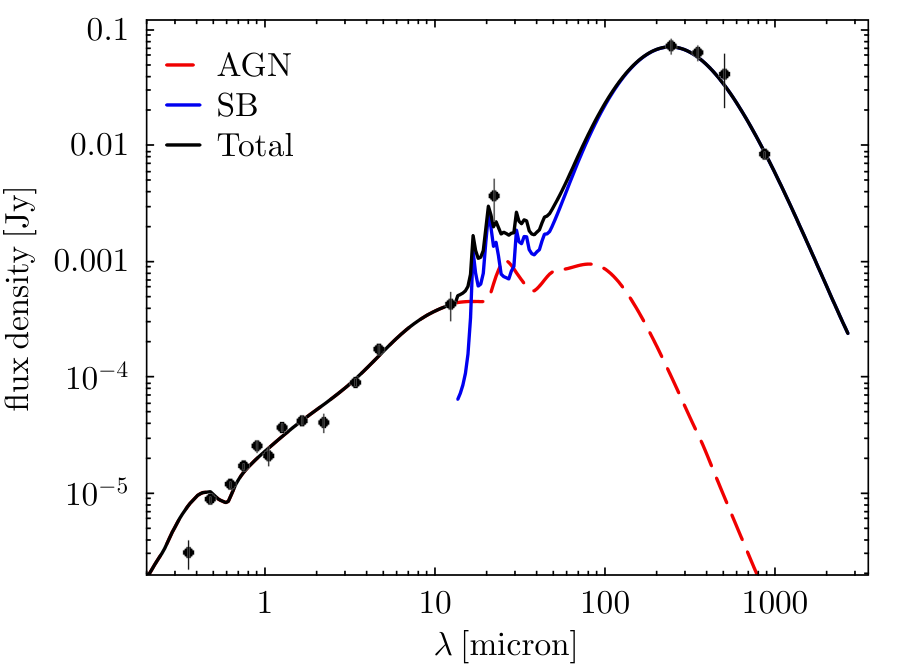
Figure 1 from An ALMA Band 7 survey of SDSS/Herschel quasars in Stripe 82: II. The nature of FIR-bright quasars

2026-09-16 · 2609.16951v1 · Research note

An ALMA Band 7 survey of SDSS/Herschel quasars in Stripe 82: II. The nature of FIR-bright quasars

Evanthia Hatziminaoglou, Hugo Messias, Duncan Farrah, et al.

For 142 optically unobscured, FIR-bright Stripe 82 quasars at z=1–4, ALMA deblending lowers inferred host SFRs yet leaves extreme starbursts. The authors find weak instantaneous starburst–accretion coupling and UV-line differences consistent with a transitional interpretation.

Figure 2 from A Dark-matter Origin of Little Red Dots: Early Seeding and Super-Bondi Accretion

2026-09-16 · 2609.16122v1 · Research note

A Dark-matter Origin of Little Red Dots: Early Seeding and Super-Bondi Accretion

Hua-Peng Gu, Fangzhou Jiang, Xian Chen, et al.

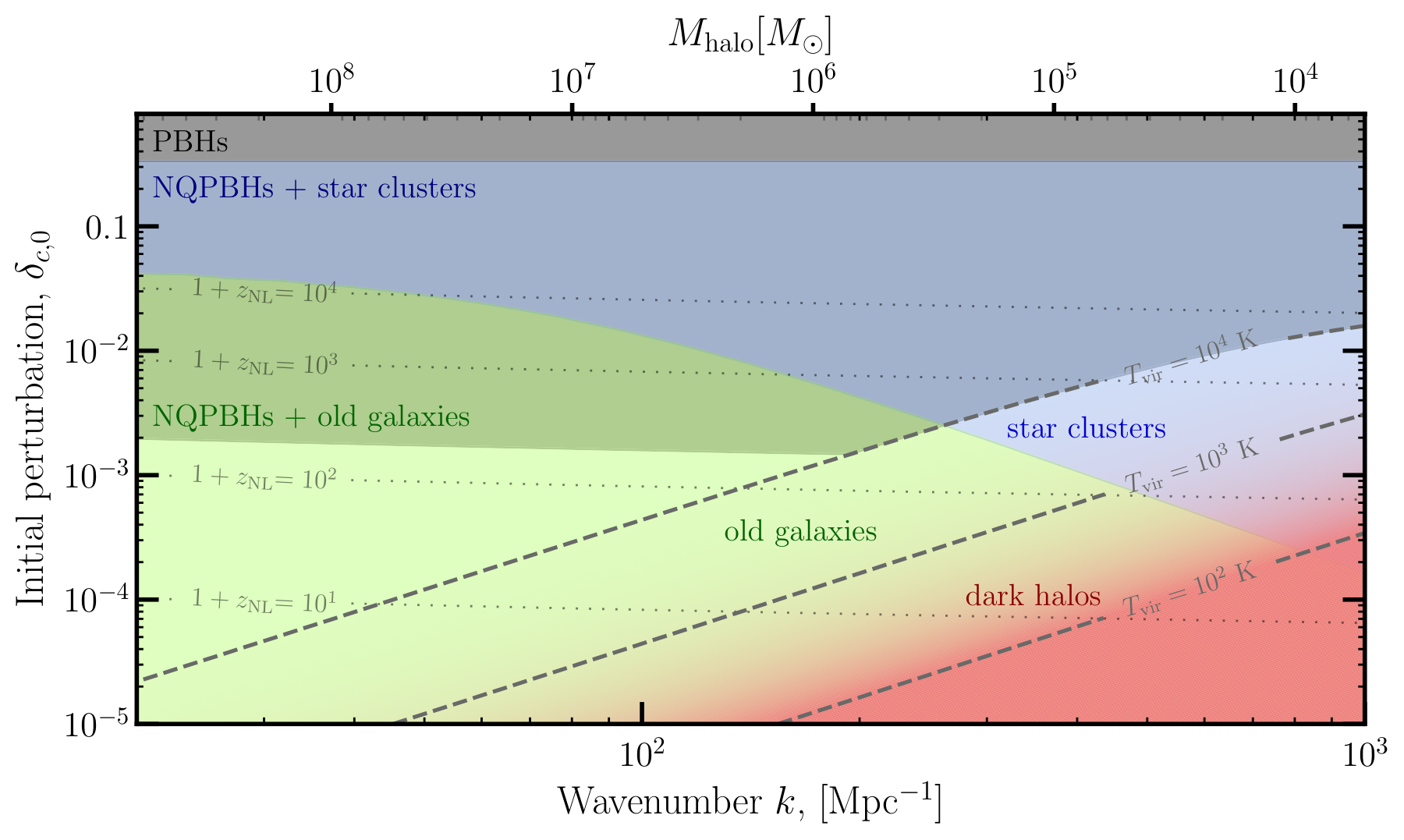
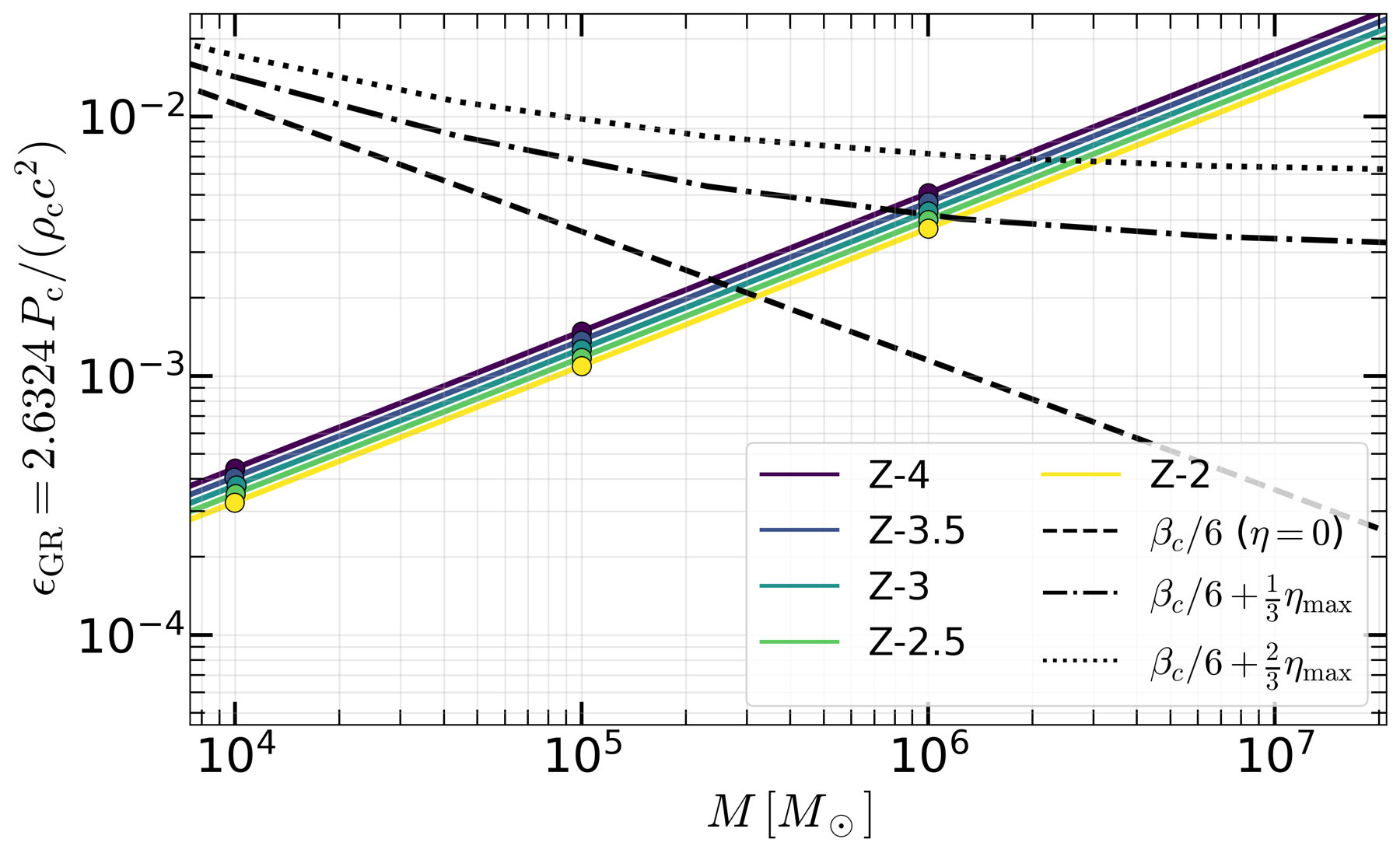
Using relativistic SIDM-halo evolution, the authors argue that pre-reionization, concentrated halos can make stellar-mass seeds and grow them through dark-matter inflow to LRD-like SMBHs by z≈6; late-time fluid-model breakdown makes final masses upper limits.

Figure 2 from Little Red Dots are Direct-Collapse Black Hole-Forming Galaxies

2026-09-14 · 2609.12049v1 · Research note

Little Red Dots are Direct-Collapse Black Hole-Forming Galaxies

Daniel J. Whalen, Muhammad A. Latif, Konstantinos Topalakis, et al.

Two-stage simulations and radiative-transfer spectral modeling suggest that LRDs could be direct-collapse black-hole hosts whose dense disks trap X-rays and generate Balmer absorption; fits spanning z=3.55–9.29 make this physically plausible, but not uniquely established.

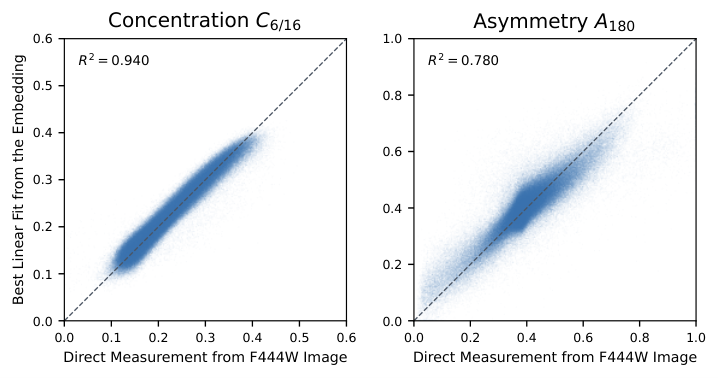
Figure 3 from Learning JWST. I. A Foundation Model for New Population Discoveries and Morphology-Aware Photometric Redshift Measurements in the JADES Survey

2026-09-11 · 2609.11879v1 · Research note

Learning JWST. I. A Foundation Model for New Population Discoveries and Morphology-Aware Photometric Redshift Measurements in the JADES Survey

Jiani Ding, Minghao Yue, Yongda Zhu, et al.

A self-supervised multimodal JADES model organizes high-redshift galaxies and Little Red Dots into embedding-space populations, retrieves LRD candidates from 19 broad-line seeds, and improves a controlled three-band photometric-redshift benchmark over template fitting.

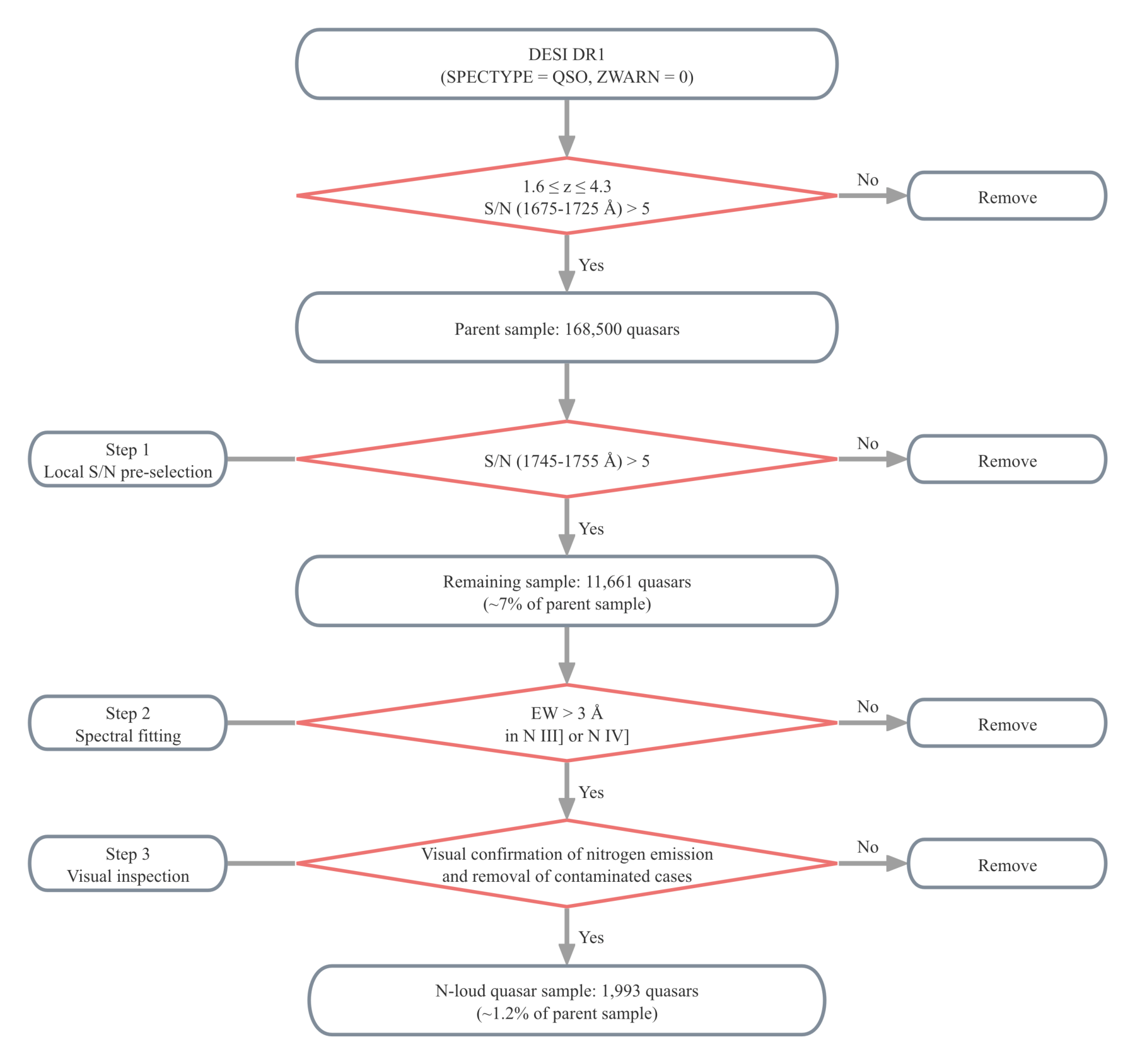
Figure 1 from Nitrogen-Loud Quasars from the Dark Energy Spectroscopic Instrument. I. Sample Selection and Basic Properties

2026-09-11 · 2609.11104v1 · Research note

Nitrogen-Loud Quasars from the Dark Energy Spectroscopic Instrument. I. Sample Selection and Basic Properties

Shuo Zhai, Wei-Jian Guo, Yong-Jie Chen, et al.

DESI DR1 yields 1,993 nitrogen-loud quasars at 1.6<z<4.3 (1.2% of the parent sample). Matched-control comparisons associate nitrogen-loud spectra with narrower broad lines, lower virial masses, and higher inferred Eddington ratios.

2026-09-11 · 2609.11094v1 · Research note

SPURS: An Ultra-deep View Inside the Compact, Nitrogen-Enriched Nuclei of Little Red Dots

Mengtao Tang, Daniel P. Stark, Charlotte A. Mason, et al.

Ultra-deep JWST/SPURS rest-UV spectra of four UV-bright Little Red Dots find dense, nitrogen-enhanced, neutral-gas-embedded nuclei and diverse broad-line/wind signatures. The authors infer compact nuclear activity, while stellar and AGN contributions remain degenerate.