2609.30441v1 · First listed 2026-09-28
A tidal disruption event in a quasar at redshift 7.19
Multi-epoch HST, Spitzer, and JWST observations identify an unusually luminous, chromatically fading nuclear transient in the z=7.19 quasar GNz7q. Its light-curve, spectroscopic, and infrared-echo properties support—rather than uniquely prove—a tidal-disruption interpretation. [1][7]
Evidence
The study concerns one object, GNz7q, a red quasar at z=7.19 with an estimated ~3×10^7 M⊙ black hole. Imaging over more than two decades from HST, Spitzer, and JWST yields a rapid rise followed by a smooth rest-UV fade of Δm≈1.1 mag over ~2 rest-frame years, with coherent wavelength-dependent behavior across observed 1–5 μm. A thermal-continuum plus t^−5/3 decline fit gives Lbol,peak≈3×10^45 erg s^−1 and radiated energy ≈1.5×10^53 erg. Nearby-source controls show no analogous chromatic long-term variation, strengthening the case that the signal is intrinsic. JWST/NIRSpec additionally finds a redshifted Balmer component (FWHM≈11,900 km s^−1; Δv≈+2,500 km s^−1), while MIRI data are interpreted as a delayed ~1500-K dust echo. The authors argue jointly that these observations are consistent with stellar tidal disruption and transient fueling. [1][3][7]
Earlier work
Against the SDSS quasar variability distribution, GNz7q lies in an extreme tail: the paper states that changes of this amplitude occur in roughly 0.1% of lower-redshift quasars. This is a concrete comparison, but it does not by itself distinguish accretion-state changes, obscuration, and episodic fueling. A relevant high-redshift contrast is AT 2023adya at z=5.274: it changed by only 0.19 mag in F356W over ~two rest-frame months, had no detected rest-UV change, and its nature remained indeterminate from sparse data. [6][21]
What changes
The paper combines a long rest-frame light curve, broad-line decomposition, and mid-IR monitoring for a nuclear transient in an already active z>7 quasar. Rather than relying only on photometric amplitude, it tests a panchromatic transient model, comparison-source stability, a superluminous-supernova template, and DRW-like AGN simulations. The reported DRW experiment uses MacLeod-based log-normal priors and finds an extremely low probability for a GNz7q-like smooth multiband event; the SLSN comparison fails in duration and has order-of-magnitude tension with typical SLSN luminosity and energy. [1][10][4]
Limits and open questions
The inference remains model-dependent: a t^−5/3 fit and a dust echo are consistent with a TDE but are not uniquely diagnostic. Early, pre-2010 variability is sparsely sampled and is excluded from the principal event interpretation. The broad Balmer component is stable between two epochs within uncertainties, so its transient association is suggestive rather than demonstrated through measured evolution. Dust-radius solutions are partly degenerate with geometry and reprocessing efficiency; continued mid-IR monitoring is needed. [1][8]
Evidence includes the target paper’s abstract plus selected HTML passages and figure captions; supplied extraction does not include full photometric-fitting, dust-echo, or host-property methodology, so those details are not assessed beyond the stated results.
Key figures
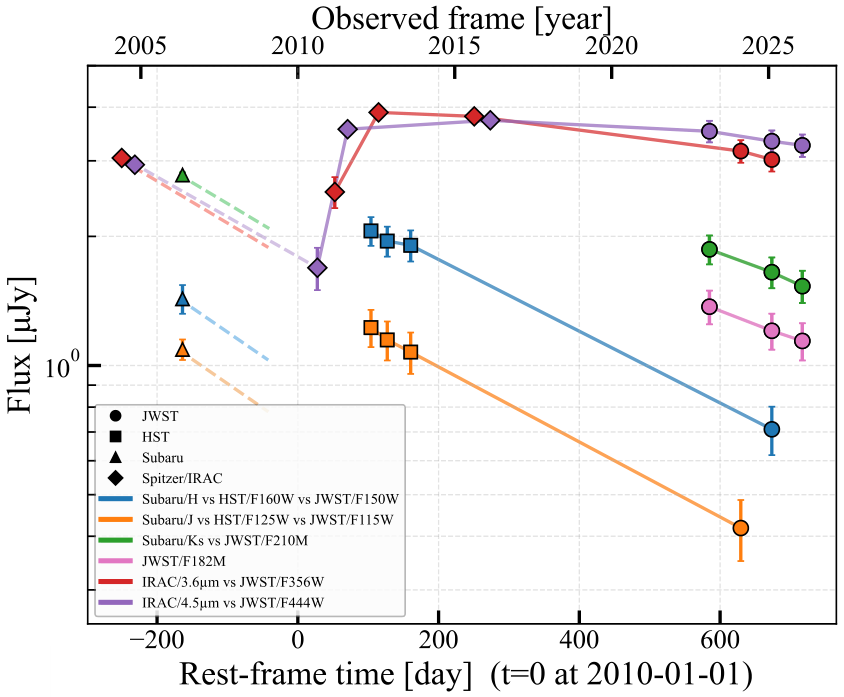
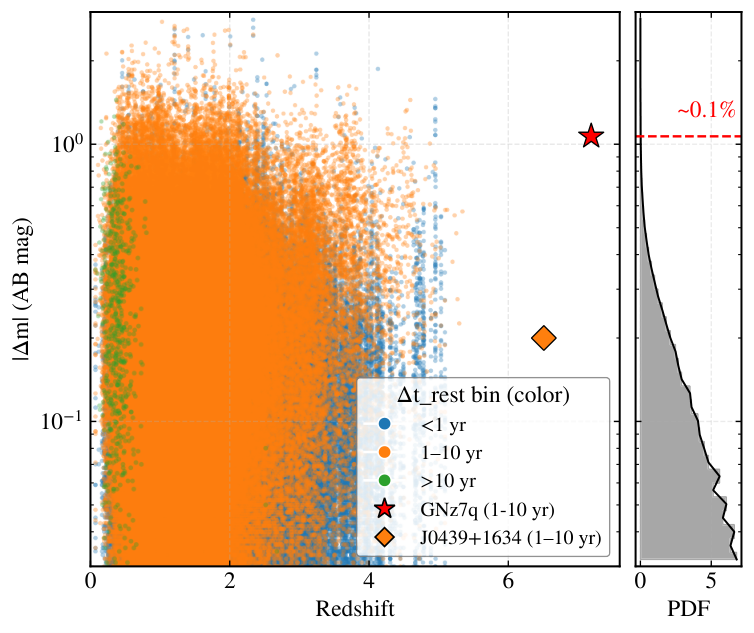
Tests whether the event is a large, coherent chromatic excursion rather than ordinary quasar scatter: the matched-filter photometry gives ~1.1 mag rest-UV fading, and the comparison places GNz7q beyond the SDSS variability tail.
Original caption
Figure 2: Multi-epoch, multi-wavelength photometry over two decades, confirming the long-term, outstanding variability of GNz7q. Left: Multi-epoch photometry compiled from all available imaging, using filters closely matched in effective wavelength across different instruments (e.g., HST /F160W versus JWST /NIRCam F150W). Since around 2012, the shorter-wavelength bands exhibit a consistent, smooth dimming of up to Δ m ≃ 1.1 \Delta m\simeq 1.1 mag over a rest-frame timescale of ∼ \sim 2 yr, while the fading amplitude is more modest at ∼ \sim 4–5 μ \mu m. This wavelength-dependent evolution is naturally expected for a cooling transient event. Data obtained prior to 2010 show additional variability and are not considered part of the main event discussed here (see text). Although such early variability could in principle arise from the same physical event (e.g., a multi-peaked TDE; Leloudas et al. 2016 ), the sparse temporal sampling prevents a firm interpretation, and we therefore focus on the better-sampled transient evolution observed after 2012. Calibration, reduction, and photometry systematics are firmly ruled out based on tests with nearby sources in the same field (Figure 9 ). Right: Comparison of the rest-UV variability amplitude with the SDSS quasar variability distribution ( MacLeod et al., 2010 ) , along with the probability density function (PDF) of | Δ m | |\Delta m| collapsed over redshift. Points are color-coded by rest-frame baseline. GNz7q exhibits > 1 >1 mag variability, above the 99th percentile of SDSS quasars. The orange diamond marks J0439+1634 at z = 6.51 z=6.51 , the clearest photometric variability detection among the known z > 5.3 z>5.3 quasars, with an amplitude of ≃ 0.2 \simeq 0.2 mag in the rest-frame ultraviolet over ≃ 2 \simeq 2 rest-frame years ( Leung et al., 2026a ) .
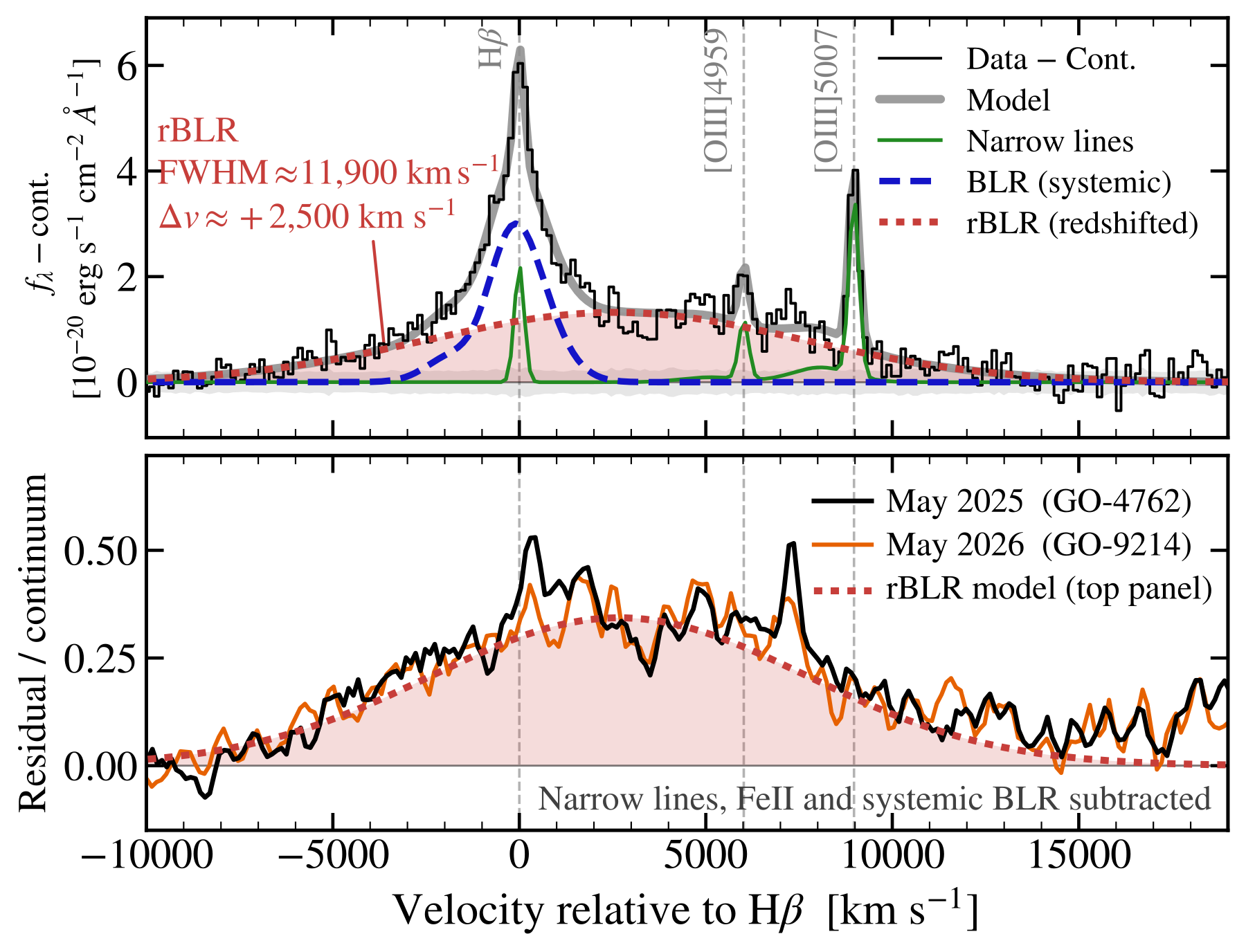
Tests spectroscopic support for an unusual transient broad-line component by decomposing two NIRSpec epochs. The redshifted component has FWHM≈11,900 km s^−1 and Δv≈+2,500 km s^−1, with no significant epoch-to-epoch change.
Original caption
Figure 5: Extremely broad, redshifted Balmer component of GNz7q in two JWST /NIRSpec epochs. Top: continuum-subtracted H β \beta spectrum from the deeper second epoch (GO-9214, 2026 May), decomposed into narrow lines, the systemic broad-line region (BLR) with its blueshifted absorption, and the redshifted broad component (rBLR; FWHM ≃ 11,900 {\rm FWHM}\simeq 11{,}900 km s -1 , Δ v ≃ + 2,500 \Delta v\simeq+2{,}500 km s -1 ). Bottom: the redshifted component in isolation, after removal of the narrow lines, FeII, and the systemic BLR from each epoch (GO-4762, 2025 May; GO-9214, 2026 May). The two epochs agree in profile, width, velocity offset, and strength within the uncertainties.
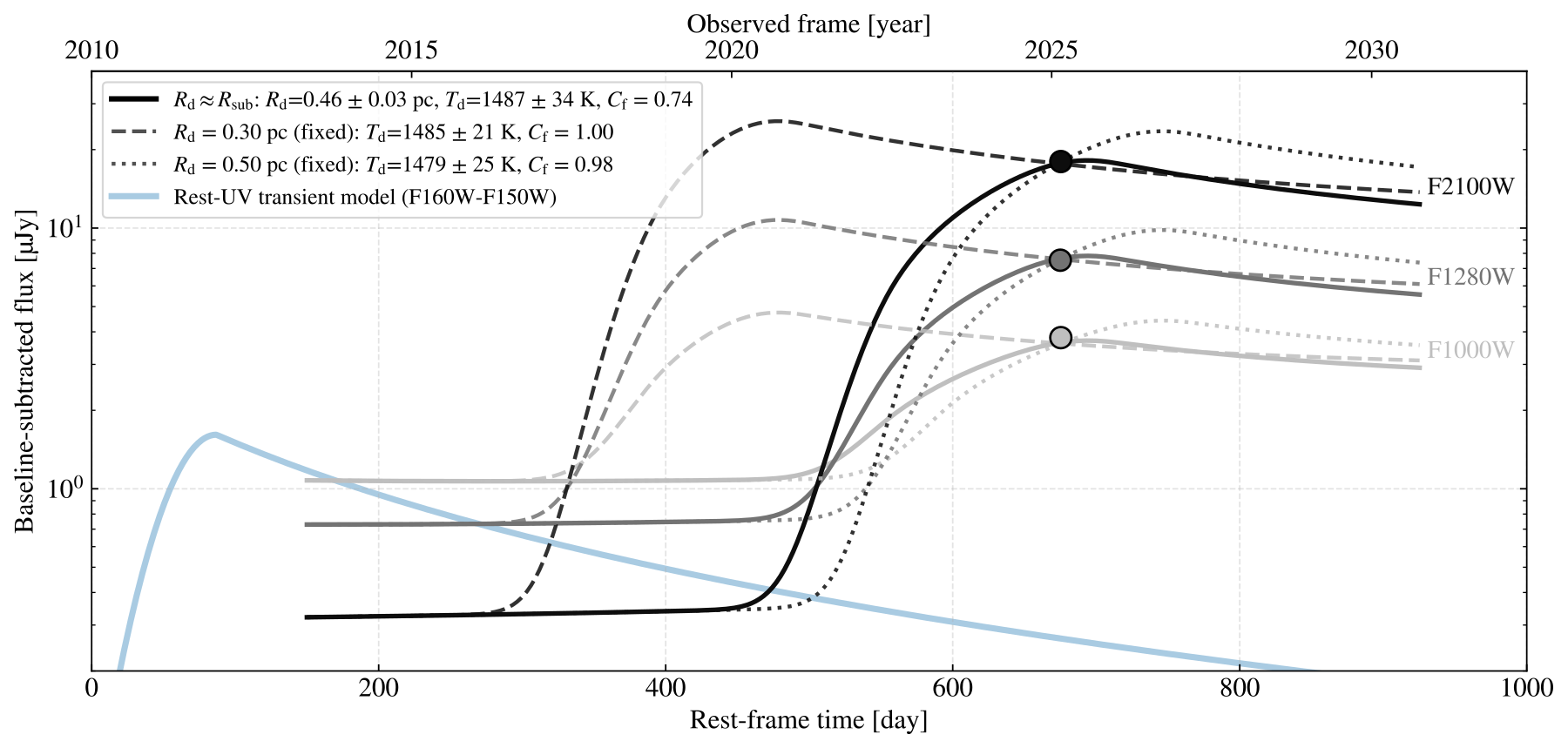
Tests whether delayed MIRI emission can be described as thermal reprocessing of the UV–optical flare. Its three-band spectral shape constrains dust temperature near 1500 K, but radius remains partly degenerate with geometry and efficiency.
Original caption
Figure 6: Dust-echo modeling of the JWST /MIRI photometry. JWST /MIRI F1000W, F1280W, and F2100W photometry modeled as thermal dust reprocessing of the UV–optical transient. The solid curves show the best-fit model assuming that the characteristic dust radius equals the sublimation radius ( R d = R sub R_{\rm d}=R_{\rm sub} ). Dashed and dotted curves illustrate representative solutions with fixed radii ( R d = 0.3 R_{\rm d}=0.3 and 0.5 0.5 pc), highlighting the partial degeneracy arising from uncertainties in dust geometry and reprocessing efficiency. The transparent blue curve shows the best-fit rest-frame ultraviolet transient model in the F160W–F150W band (identical to that in Figure 3 ), illustrating the delayed mid-infrared response to the ultraviolet flare. Importantly, future intensive mid-infrared monitoring will break the degeneracy, while the spectral shape across the current three MIRI bands already well constrains T dust ≃ 1500 T_{\rm dust}\simeq 1500 K.
Related research
Previous digest
Fujimoto et al. assemble more than two decades of HST, Spitzer, and JWST imaging to identify a long-lived nuclear flare in GNz7q, a dusty red quasar at z=7.19 hosting a roughly 3×10^7 M☉ black hole. Its smooth, chromatic ∼1.1 mag rest-UV decline over ∼2 rest-frame years is far more extreme than ordinary quasar variability, while a thermal t^-5/3 model implies a ∼3×10^45 erg s^-1 peak and ∼1.5×10^53 erg radiated energy, consistent with disruption of a several-solar-mass star. Independent NIRSpec detection of an extremely broad redshifted Balmer component and MIRI evidence for a delayed ∼1500 K dust echo provide an unusually complete picture of a TDE-like fueling episode and circumnuclear reprocessing only 700 Myr after the Big Bang.
Sources and evidence (22)
- 2609.30441v1: A tidal disruption event in a quasar at redshift 7.19
We report a long-lived nuclear transient in GNz7q, a red quasar at $z=7.19$ powered by a $\sim3\times10^{7}\,M_\odot$ black hole and hosted by a compact, dusty starburst galaxy. The transient was identified in more than two decades of imaging with HST, Spitzer, and JWST. After a rapid rise, the source faded smoothly by $Δm\simeq1.1$ mag in the rest-frame ultraviolet over $\sim2$ rest-frame yr, with coherent, wavelength-dependent evolution across 1--5 $μ$m that places GNz7q above the 99.9th percentile of the SDSS quasar variability distribution and is absent at $z\gtrsim5$. The duration and energetics disfavor superluminous supernovae, and stochastic quasar variability reproduces the multi-band evolution with a probability of $\lesssim10^{-5}$. A panchromatic model combining a thermal continuum with a $t^{-5/3}$ decline reproduces the light curves, yielding a peak bolometric luminosity of $\simeq3\times10^{45}$ erg s$^{-1}$ and a radiated energy of $\simeq1.5\times10^{53}$ erg, which imply the tidal disruption of a star of a few solar masses and place the event among the most energetic tidal disruption events (TDEs) known. A redshifted, extremely broad Balmer-line component in independent JWST/NIRSpec spectroscopy is consistent with a transient, non-virialized broad-line region. JWST/MIRI photometry further reveals delayed mid-infrared emission from $\simeq1500$ K dust at a sub-parsec radius, consistent with a dust echo of the flare. The relatively low black-hole mass and dense star-forming nucleus of GNz7q are conditions under which TDEs are expected to be most efficient. These observations provide a time-domain view of episodic black-hole fueling and its dusty nuclear environment 700 million years after the Big Bang. Wide-field surveys with Roman and Euclid in the near-infrared, complemented by LSST at lower redshifts, may uncover such transients in large numbers.
- 2609.30441v1: A tidal disruption event in a quasar at redshift 7.19
Table 1: Summary of available photometric data of GNz7q used in this study
- 2609.30441v1: A tidal disruption event in a quasar at redshift 7.19
Figure 9 shows the resulting normalized light curves for these comparison sources, including only measurements with S / N > 3 {\rm S/N}>3 . None of the control objects exhibits statistically significant long-term or wavelength-dependent variability comparable to that observed in GNz7q. The absence of correlated variability in these sources demonstrates that the observed behavior of GNz7q cannot be attributed to instrumental differences, filter-response mismatches, PSF variations, or details of the photometric extraction, and instead reflects genuine intrinsic variability of the source.
- 2609.30441v1: A tidal disruption event in a quasar at redshift 7.19
The left panel of Figure 10 shows the resulting comparison. Even after amplitude scaling, the SLSN template declines substantially faster than GNz7q-ENT and fails to reproduce the observed duration (rest-frame ∼ \sim 2 yr). Furthermore, the implied integrated radiated energy and peak luminosity remain inconsistent with typical SLSNe by an order of magnitude. The combined discrepancies in duration and energetics make a canonical SLSN origin unlikely ( Hinkle et al., 2025 ) .
- 2609.30441v1: A tidal disruption event in a quasar at redshift 7.19
Figure 10: Comparison of GNz7q-ENT light curve with representative SLSN and DRW/AGN variability. Left: GNz7q-ENT’s rest-frame UV (F160W–F150W; blue) and optical (IRAC4.5–F444W; purple) light curves, in the same color coding as Figure 3 . A representative slow-evolving SLSN (SN2015bn; Nicholl et al. 2016 ) is shown for comparison after normalizing the SN peak fluxes to match GNz7q in the rest-UV and optical bands separately (see Appendix B ). Right: The top panel shows a single example ‘standard’ Damped Random Walk (DRW) realization drawn from the median MacLeod et al. (2010) priors (median τ \tau , SF ∞ indicated in the inset). The bottom panel compares the GNz7q-ENT data (same color coding as Figure 3 ) to the DRW-based variability tests: the dashed curves represent the best-matched DRW realization selected from a 200,000 Monte Carlo ensemble with the MacLeod priors ( τ \tau and SF ∞ scatters) and constrained to pass a GNz7q-ENT-like event light curve (see Appendix B ). The probability of obtaining the GNz7q-ENT-like smooth multi-band light curves, due to the limited temporal baseline under the AGN/DRW-like variability, is vanishingly small ( ≪ 10 − 3 % \ll 10^{-3}\% ).
- 2609.30441v1: A tidal disruption event in a quasar at redshift 7.19
The amplitude of the observed variability places GNz7q among the most extreme nuclear transients observed in quasars. Compared with the SDSS quasar variability distribution ( MacLeod et al., 2010 ) , shown in the right panel of Figure 2 , GNz7q lies on the extreme tail, indicating that such large-amplitude changes occur in only ∼ \sim 0.1% of quasars even at lower redshift. At z ≲ 2 z\lesssim 2 , variability of this magnitude is associated with a range of physical mechanisms, including accretion-state changes, episodic fueling events such as TDEs, and, in some cases, variable obscuration ( Gezari, 2021 ) . Identifying and physically interpreting such events requires multi-year monitoring in the rest frame. At high redshift, these timescales are further stretched in the observed frame, making the detection of comparable variability increasingly difficult. The variability observed in GNz7q therefore represents a rare opportunity to probe a transient accretion episode in a quasar at z > 7 z>7 .
- 2609.30441v1: A tidal disruption event in a quasar at redshift 7.19
Independent support is provided by the JWST /NIRSpec spectroscopy, which reveals an additional redshifted, extremely broad Balmer-line component ( Fei et al., 2026 ) . To test whether this component varies between the two epochs described in Section 2.5 , we modeled each epoch with the same set of components as Fei et al. (2026) , namely a local power-law continuum, an FeII template, the narrow lines, the systemic broad-line region with its blueshifted absorption, and the redshifted broad component. In the fitting, we anchored the local continuum on FeII-subtracted windows so that both epochs are referred to a common continuum. In Figure 5 , we show the resulting decomposition of the deeper epoch and the redshifted component isolated in each epoch. We measure FWHM ≃ 11,900 {\rm FWHM}\simeq 11{,}900 km s -1 and Δ v ≃ + 2,500 \Delta v\simeq+2{,}500 km s -1 for this component in the deeper epoch.
- 2609.30441v1: A tidal disruption event in a quasar at redshift 7.19
Figure 5: Extremely broad, redshifted Balmer component of GNz7q in two JWST /NIRSpec epochs. Top: continuum-subtracted H β \beta spectrum from the deeper second epoch (GO-9214, 2026 May), decomposed into narrow lines, the systemic broad-line region (BLR) with its blueshifted absorption, and the redshifted broad component (rBLR; FWHM ≃ 11,900 {\rm FWHM}\simeq 11{,}900 km s -1 , Δ v ≃ + 2,500 \Delta v\simeq+2{,}500 km s -1 ). Bottom: the redshifted component in isolation, after removal of the narrow lines, FeII, and the systemic BLR from each epoch (GO-4762, 2025 May; GO-9214, 2026 May). The two epochs agree in profile, width, velocity offset, and strength within the uncertainties.
- 2609.30441v1: A tidal disruption event in a quasar at redshift 7.19
In this paper, we adopt cosmological parameters measured by the Planck mission ( Planck Collaboration et al., 2014 ) , i.e. a Λ \Lambda cold dark matter ( Λ \Lambda CDM) model with total matter, vacuum and baryonic densities in units of the critical density, Ω Λ = \Omega_{\Lambda}= 0.692, Ω m \Omega_{\rm m} = 0.308, Ω b = \Omega_{\rm b}= 0.0481, and Hubble constant, H 0 = 100 H_{0}=100 h h km s − 1 s^{-1} Mpc -1 , with h = 0.678 h=0.678 . Based on these parameters, we adopt the angular size distance of 5.26 kpc/arcsec at the source redshift of z = 7.1899 z=7.1899 in this paper.
- 2609.30441v1: A tidal disruption event in a quasar at redshift 7.19
Second for the DRW/AGN variability, We next evaluated whether the smooth, multi-band evolution of GNz7q-ENT could arise from stochastic AGN variability given the limited temporal baseline. We adopted the MacLeod et al. (2010) scaling relations to construct log-normal priors for the characteristic damping time τ \tau and asymptotic structure function SF ∞ , as functions of rest-frame wavelength, host absolute magnitude, and black-hole mass. We adopted intrinsic scatters of 0.30 dex in log 10 ( τ ) \log_{10}(\tau) and 0.20 dex in log 10 ( SF ∞ ) \log_{10}({\rm SF}_{\infty}) , consistent with MacLeod et al. (2010).
- 2602.12325v1: Direct pathway to the Early Supermassive Black Holes: A Red Super-Eddington Quasar in a Massive Starburst Host at $z=7.2$
In contrast to many JWST-identified faint AGNs and high- z z quasars discovered from all-sky surveys that appear over-massive relative to their hosts, GNz7q exhibits a mass ratio of M BH / M ∗ ≈ 0.1 % M_{\rm BH}/M_{*}\approx 0.1\% , placing it consistently on the local M BH − M ∗ M_{\rm BH}-M_{*} scaling relation. This alignment indicates that the BH-galaxy relation can be achieved as early as z = 7.1899 z=7.1899 .
- 2602.12325v1: Direct pathway to the Early Supermassive Black Holes: A Red Super-Eddington Quasar in a Massive Starburst Host at $z=7.2$
The inherent complexity and multi-component nature of quasar spectra can make the fitting results highly dependent on the adopted model. We therefore performed a model comparison, evaluating a suite of models with different combinations of components and parameter constraints. To identify the optimal description, we employed the Bayesian Information Criterion (BIC):
- 2609.01421v1: Extreme AGN Variability in WISE: Powerful Flares and Candidate Tidal Disruption Events in AGN
For J2244 + + 0816, we report an optical counterpart flare to the mid-infrared event that peaks at M opt , peak = − 23.4 M_{\rm opt,peak}=-23.4 with a rest-frame decay timescale of 77 days to reach 50% of its peak optical flux value. The mid-infrared decay is consistent with the canonical t − 5 / 3 t^{-5/3} fallback decline, although a partial disruption ( t − 9 / 4 t^{-9/4} ) cannot be excluded. The optical flare continues to decay to a level ∼ 0.6 \sim 0.6 mag below the pre-flare baseline, before eventually recovering. A similar post-flare depression of the mid-infrared luminosity is also detected. We argue that these properties are best explained by a TDE in an AGN. If the flare is due to a TDE by an SMBH, the post-flare depression implies that the star’s orbit was retrograde with respect to the accretion disk rotation, and the debris from the depression affected the inner accretion disk. We also note that the event could be due to a micro-TDE by a stellar- or intermediate-mass black hole embedded in the AGN accretion disk. This interpretation is supported by recent theoretical predictions of micro-TDEs in AGN disk environments [ 104 , e.g.,] .
- 2609.01421v1: Extreme AGN Variability in WISE: Powerful Flares and Candidate Tidal Disruption Events in AGN
This paper reports on two AGN candidates that showed strong mid-infrared flares during the NEOWISE mission, suggestive of mid-infrared selected TDEs: WISE J224443.55 + + 081606.4 (J2244 + + 0816 hereafter) at z = 0.1185 z=0.1185 and WISE J215016.59 − - 113257.0 (J2150 − - 1132 hereafter) at z = 0.2605 z=0.2605 . Table 1 lists their basic properties. Based on the variability metric distributions of the 99,634 AGN candidates in the filtered catalog, the two objects of interest are both extreme outliers: J2244 + + 0816 lies in the 99.99% percentile in terms of the combined score, while J2150 − - 1132 lies in the 99.98% percentile. In terms of individual scores, the color variability amplitude of J2244+0816 falls in the 98.51% percentile, while all other variability metrics for both sources are above the 99.3% percentile.
- 2606.31312v1: Dissecting the Obscured Core of GN20: an Active Galactic Nucleus Outshone by Young Stars
We investigate the relative contributions of star formation and AGN activity to the total energy budget of GN20, one of the most luminous dusty star-forming galaxies known at $z>4$, through spatially resolved spectral energy distribution decomposition. We perform Bayesian SED fitting with CIGALE on two spatially distinct apertures: the nuclear core (r=0.14", $\sim$1kpc physical) and the full galaxy (r=1.4", 9.9 kpc), combining JWST/NIRCam and MIRI broadband imaging, JWST/NIRSpec PRISM IFU pseudo-continuum photometry spanning 42 wavelength bins across rest-frame $0.12$--$1.05μ$m, and archival HST and millimeter interferometry data from NOEMA and PdBI. The integrated SED is dominated by stellar-heated dust, with only a marginal AGN contribution at galaxy-wide scales ($f_\mathrm{AGN}^\mathrm{int}=0.09\pm0.02$). The nuclear core, however, requires a significant AGN component ($f_\mathrm{AGN}=0.34\pm0.05$) to account for a mid-infrared excess at rest-frame $\sim$2.5--3.6$μ$m characteristic of AGN-heated torus dust. The AGN accounts for $\sim34\%$ of the nuclear infrared luminosity but only $\sim9\%$ of the total integrated $L_\mathrm{IR}$, explaining its weak signature in integrated diagnostics and its consistency with existing upper limits from Spitzer spectroscopy. The inferred black hole mass places GN20 within the local $M_\mathrm{BH}$--$M_\mathrm{bulge}$ relation at the Eddington limit, and in the overmassive regime at sub-Eddington accretion rates, suggesting early and rapid black hole assembly concurrent with the dominant starburst. GN20 exemplifies a class of systems where nuclear-scale SED decomposition, enabled by the angular resolution and infrared sensitivity of JWST, is the only means to uncover a buried AGN overwhelmed by galaxy-wide star formation.
- 2505.20821v1: A candidate for True Type-2 AGN without hidden central BLRs Identified by central Tidal Disruption Event
Based on the best descriptions to stellar absorption features, stellar velocity dispersion σ ∗ \sigma_{*} is well measured as 112 ± \pm 14km/s, leading the central BH mass to be estimated about 10.2 − 4.5 + 7.6 × 10 6 M ⊙ 10.2_{-4.5}^{+7.6}\times 10^{6}{\rm M_{\odot}} as shown in Fig. 3 through the well-known M B H − σ ∗ M_{BH}-\sigma_{*} relation (between BH mass and stellar velocity dispersion) [ 34 , 36 , 72 , 62 , 8 , 10 ] widely accepted in quiescent galaxies [ 83 ] , in active galaxies [ 101 ] and also in TDEs [ 115 ] . The M B H − σ ∗ M_{BH}-\sigma_{*} relation determined BH mass is well consistent with theoretical TDE model determined BH mass, providing further clues to support the central TDE and also support the SSP determined best descriptions in SDSS J2334. Here, in Fig. 3 , the 89 quiescent galaxies from G. A. D. Savorgnan & A. W. Graham [83] and the 29 reverberation mapped AGN from J.-H. Woo et al. [101] and the 12 TDEs from Z. Q. Zhou et al. [115] are considered to draw the linear correlation between stellar velocity dispersion and BH mass through the Least Trimmed Squares robust technique [ 23 ]
- 2505.20821v1: A candidate for True Type-2 AGN without hidden central BLRs Identified by central Tidal Disruption Event
Based on the theoretical TDE model determined results, the expected tidal disruption radius is about 7 R G R_{G} (Schwarzschild radius). Once the central TDE can be expected, spatial size of the geometric structure of TDE debris can be simply checked. The TDE debris in SDSS J2334 around MJD-53000=3000 5000 have outer distance [ 47 ]
- 2607.21587v1: XMM-Newton and Swift Unveil Another X-Ray Transient in NGC 4945, XMM J130514.64-493311.27
NGC 4945 hosts a Compton-thick, low luminosity AGN and a nuclear starburst in its core and has been the subject of many previous X-ray investigations of the AGN emission structure, nuclear starburst properties, and ultraluminous X-ray (ULX) source populations. Indeed, NGC 4945 has proven to be a rich system for ULX and X-ray transients, with at least four X-ray transients being reported over the last 15 years. Here we report the detection of an X-ray transient source, XMM J130514.64-493311.27, in NGC 4945 in the latest and deepest XMM-Newton observation of NGC 4945 to-date. The source lies $\sim5.5'$ south of the nucleus and was not detected in any previous XMM-Newton or Chandra imaging, but the source was detected by Swift-XRT in 2008, 2019, and in 2022, the latter of which coincides roughly with our new XMM-Newton imaging; we are therefore tracing the most recent outburst of this object with XMM-Newton. The source is soft with $Γ\approx3$, and our spectroscopic analysis suggests the source is best characterized by a multicolor disk + power law model or, alternatively, a multicolor disk + thermal plasma model, with a 0.3-10 keV X-ray luminosity of $\sim2.2-2.3\times10^{38}$. We find no evidence for a counterpart in the optical, near-infrared, ultraviolet, or in the radio, but we identify a candidate counterpart in NEOWISE mid-IR light curves. We propose that this X-ray source is an X-ray binary within NGC 4945 caught during its most recent active phase.
- 2606.18155v1: X-ray eclipse tomography: Resolving the extent of X-ray-emitting region(s) in the Seyfert galaxy ESO362-G18
X-ray spectral variability in active galactic nuclei (AGNs) can be either intrinsic or caused by external processes, such as variable absorption. Several transient occultation events from individual clouds or X-ray eclipses have been identified in a number of AGNs in the past two decades. We report results from the analysis of two Swift monitoring campaigns of the Seyfert galaxy ESO 362-G18, a changing-look AGN that showed transitions between optical spectral types 1.5 and 1.9 in the past, most likely induced by variable absorption. We identified two X-ray eclipses during the first Swift campaign, one of which we were able to follow almost entirely from ingress to egress. We used time-resolved spectroscopy to follow the evolution of the X-ray spectrum with time in order to derive the properties of the absorbing cloud and the size of the main X-ray-emitting region. The cloud is located towards the innermost dust sublimation zone, intermediate between the dust-free broad-line region and the dusty torus. The X-ray-emitting region is confined within ∼ 35 \sim 35 gravitational radii ( R g R_{g} ) from the centre. A deeper analysis indicated that the eclipsing cloud likely comprises a denser core and a more tenuous atmosphere. We were also able to estimate the size of the soft excess and hot corona X-ray-emitting regions separately. These are two of the most relevant continuum components in the X-ray spectra of unobscured AGNs. Our analysis suggests that the soft-excess-emitting region is ∼ 50 \sim 50 % more extended than the hot corona one. However, it appears to co-exist with and is not replaced by the hot corona one in the innermost ∼ 30 R g \sim 30\penalty\ R_{\rm g} . Our results highlight the potential of X-ray eclipse tomography for providing a clearer view of the innermost accretion flow geometry and of the AGN surroundings out to the torus scale.
- 2606.18155v1: X-ray eclipse tomography: Resolving the extent of X-ray-emitting region(s) in the Seyfert galaxy ESO362-G18
Our results suggest that the soft-excess-emitting region is about 50 50 % more extended than the hot corona, although with relatively large uncertainties. In Table 4 , the asymmetric uncertainties on r atm r_{\rm atm} and r SE r_{\rm SE} reflect the conditions r atm > r core r_{\rm atm}>r_{\rm core} (by definition of a structured cloud) and r SE > r HC r_{\rm SE}>r_{\rm HC} (to prevent C f , max ( SE ) > C f , max ( HC ) C_{\rm f,max}^{\rm(SE)}>C_{\rm f,max}^{\rm(HC)} at maximum coverage by the cloud core, which is not observed).
- 2504.17007v1: The First Photometric Evidence of a Transient/Variable Source at z>5 with JWST
The James Webb Space Telescope (JWST) discovered 79 transients out to $z$$\sim$4.8 through the JADES Transient Survey (JTS), but the JTS did not find any $z$$>$5 transients. Here, we present the first photometric evidence of a $z$$>$5 transient/variable source with JWST. The source, AT 2023adya, resides in a $z_{\mathrm{spec}}$$=$5.274 galaxy in GOODS-N, which dimmed from $m_{\rm F356W}$$=$26.05$\pm$0.02 mag to 26.24$\pm$0.02 mag in the rest-frame optical over approximately two rest-frame months, producing a clear residual signal in the difference image ($m_{\rm F356W}$$=$28.01$\pm$0.17 mag; SN$_\mathrm{var}$$=$6.09) at the galaxy center. Shorter-wavelength bands (F090W/F115W) show no rest-frame ultraviolet brightness change. Based on its rest-frame V-band absolute magnitude of M$_\mathrm{V}$$=$$-$18.48 mag, AT 2023adya could be any core-collapse supernova (SN) subtype or an SN Ia. However, due to low SN Ia rates at high redshift, the SN Ia scenario is unlikely. Alternatively, AT 2023adya may be a variable active galactic nucleus (AGN). However, the JWST NIRCam/Grism spectrum shows no broad H$α$ emission line (FWHM$=$130$\pm$26 km s$^{-1}$), disfavoring the variable AGN scenario. It is also unlikely that AT 2023adya is a tidal disruption event (TDE) because the TDE models matching the observed brightness changes have low event rates. Although it is not possible to determine AT 2023adya's nature based on the two-epoch single-band photometry alone, this discovery indicates that JWST can push the frontier of transient/variable science past $z$$=$5 and towards the epoch of reionization.
- 2507.07380v1: AT2019cmw: A highly luminous, cooling featureless TDE candidate from the disruption of a high mass star in an early-type galaxy
We present optical/UV photometric and spectroscopic observations, as well as X-ray and radio follow-up, of the extraordinary event AT2019cmw. With a peak bolometric luminosity of ~$\mathrm{10^{45.6}\,erg\,s^{-1}}$, it is one of the most luminous thermal transients ever discovered. Extensive spectroscopic follow-up post-peak showed only a featureless continuum throughout its evolution. This, combined with its nuclear location, blue colour at peak and lack of prior evidence of an AGN in its host lead us to interpret this event as a `featureless' tidal disruption event (TDE). It displays photometric evolution atypical of most TDEs, cooling from ~30 kK to ~10 kK in the first ~300 days post-peak, with potential implications for future photometric selection of candidate TDEs. No X-ray or radio emission is detected, placing constraints on the presence of on-axis jetted emission or a visible inner-accretion disk. Modelling the optical light curve with existing theoretical prescriptions, we find that AT2019cmw may be the result of the disruption of a star in the tens of solar masses by a supermassive black hole (SMBH). Combined with a lack of detectable star formation in its host galaxy, it could imply the existence of a localised region of star formation around the SMBH. This could provide a new window to probe nuclear star formation and the shape of the initial mass function (IMF) in close proximity to SMBHs out to relatively high redshifts.
Abstract
We report a long-lived nuclear transient in GNz7q, a red quasar at $z=7.19$ powered by a $\sim3\times10^{7}\,M_\odot$ black hole and hosted by a compact, dusty starburst galaxy. The transient was identified in more than two decades of imaging with HST, Spitzer, and JWST. After a rapid rise, the source faded smoothly by $Δm\simeq1.1$ mag in the rest-frame ultraviolet over $\sim2$ rest-frame yr, with coherent, wavelength-dependent evolution across 1--5 $μ$m that places GNz7q above the 99.9th percentile of the SDSS quasar variability distribution and is absent at $z\gtrsim5$. The duration and energetics disfavor superluminous supernovae, and stochastic quasar variability reproduces the multi-band evolution with a probability of $\lesssim10^{-5}$. A panchromatic model combining a thermal continuum with a $t^{-5/3}$ decline reproduces the light curves, yielding a peak bolometric luminosity of $\simeq3\times10^{45}$ erg s$^{-1}$ and a radiated energy of $\simeq1.5\times10^{53}$ erg, which imply the tidal disruption of a star of a few solar masses and place the event among the most energetic tidal disruption events (TDEs) known. A redshifted, extremely broad Balmer-line component in independent JWST/NIRSpec spectroscopy is consistent with a transient, non-virialized broad-line region. JWST/MIRI photometry further reveals delayed mid-infrared emission from $\simeq1500$ K dust at a sub-parsec radius, consistent with a dust echo of the flare. The relatively low black-hole mass and dense star-forming nucleus of GNz7q are conditions under which TDEs are expected to be most efficient. These observations provide a time-domain view of episodic black-hole fueling and its dusty nuclear environment 700 million years after the Big Bang. Wide-field surveys with Roman and Euclid in the near-infrared, complemented by LSST at lower redshifts, may uncover such transients in large numbers.
Discussion
Discussion access requires a security token. Register for the weekly digest.