2610.10522v1 · First listed 2026-10-08
Widespread steep X-ray spectra of luminous $z\simeq5.85-7.6$ quasars and their implications for future X-ray surveys
Across 28 luminous quasars at z=5.85–7.56, X-ray continua are systematically steep, yet show no significant dependence on black-hole growth indicators. The inferred spectral shapes could modestly to severely reduce high-redshift survey count rates. [1][10][4]
Evidence
The authors combine HYPERION quasars, luminous non-HYPERION objects, and moderately accreting targets from an XMM-Newton Large Programme, yielding 28 luminous QSOs at z=5.85–7.56; 26 enter correlation tests. They re-derived black-hole masses and growth indicators homogeneously, incorporating recent JWST spectroscopy, and used XMM-Newton spectral results where available while reprocessing Chandra and new XMM-Newton data. They report ⟨Γ⟩=2.4 with distribution σ=0.38. When Γ is fixed at 1.9, survival analysis gives a restricted mean cutoff energy ⟨Ec⟩KM=30.0±3.7 keV. A 10,000-realization Monte Carlo KS analysis that samples split-normal Γ uncertainties finds a median D=0.51+0.08−0.09 and 98% of realizations with 1−P>0.95 for the high-z versus z~2–4 Γ-distribution difference. [1][6][10][2]
Earlier work
The earlier HYPERION result had suggested that X-ray slope tracks long-term black-hole growth efficiency. Extending chiefly toward lower growth efficiencies, the present study finds no statistically significant correlation between coronal spectral parameters and growth indicators, so it does not reproduce that proposed connection in the expanded sample. It also reports cutoff measurements in a low-Ec, high-luminosity region distinct from lower-redshift luminous AGN, while αOX and X-ray bolometric corrections are broadly consistent with lower-z highly accreting AGN trends. [1][10][3]
What changes
The principal advance is a more growth-rate-diverse, comparably luminous EoR QSO sample with consistently updated mass/growth characterization, including ten JWST Balmer-line-based mass estimates. The result shifts the interpretation from steep spectra being peculiar to the most efficiently grown HYPERION black holes to their being widespread among these luminous z≳6 QSOs. Under the explicitly limiting assumption that this mean Γ≈2.4 applies to the broader EoR AGN population, soft-band count-rate reductions are ≲20% at fixed intrinsic L2–10 keV, but can exceed factors of ten for Γ~3–3.5 or observed hard-band measurements. [1][9][4]
Limits and open questions
The sample comprises luminous QSOs, so extending its spectral distribution to fainter or all EoR AGN remains an unverified hypothesis. The authors state that current data cannot decide whether apparently canonical-Γ objects are intrinsically steep but moderately absorbed, although absorbed fits are not statistically preferred. The reported ~8–14% X-ray-weak fraction has large statistical uncertainties and is likely a lower limit because the sample is count-selected. Low cutoff energies are inferred in fits with Γ fixed to 1.9, rather than constituting simultaneous unconstrained Γ–Ec measurements. [7][8][10][3]
Based on the supplied abstract and selected HTML excerpts plus figure captions. The extraction supports sample size, aggregate spectral results, selected uncertainty tests, and stated caveats, but not per-object measurements, full fitting setup, or tabulated correlation statistics.
Key figures
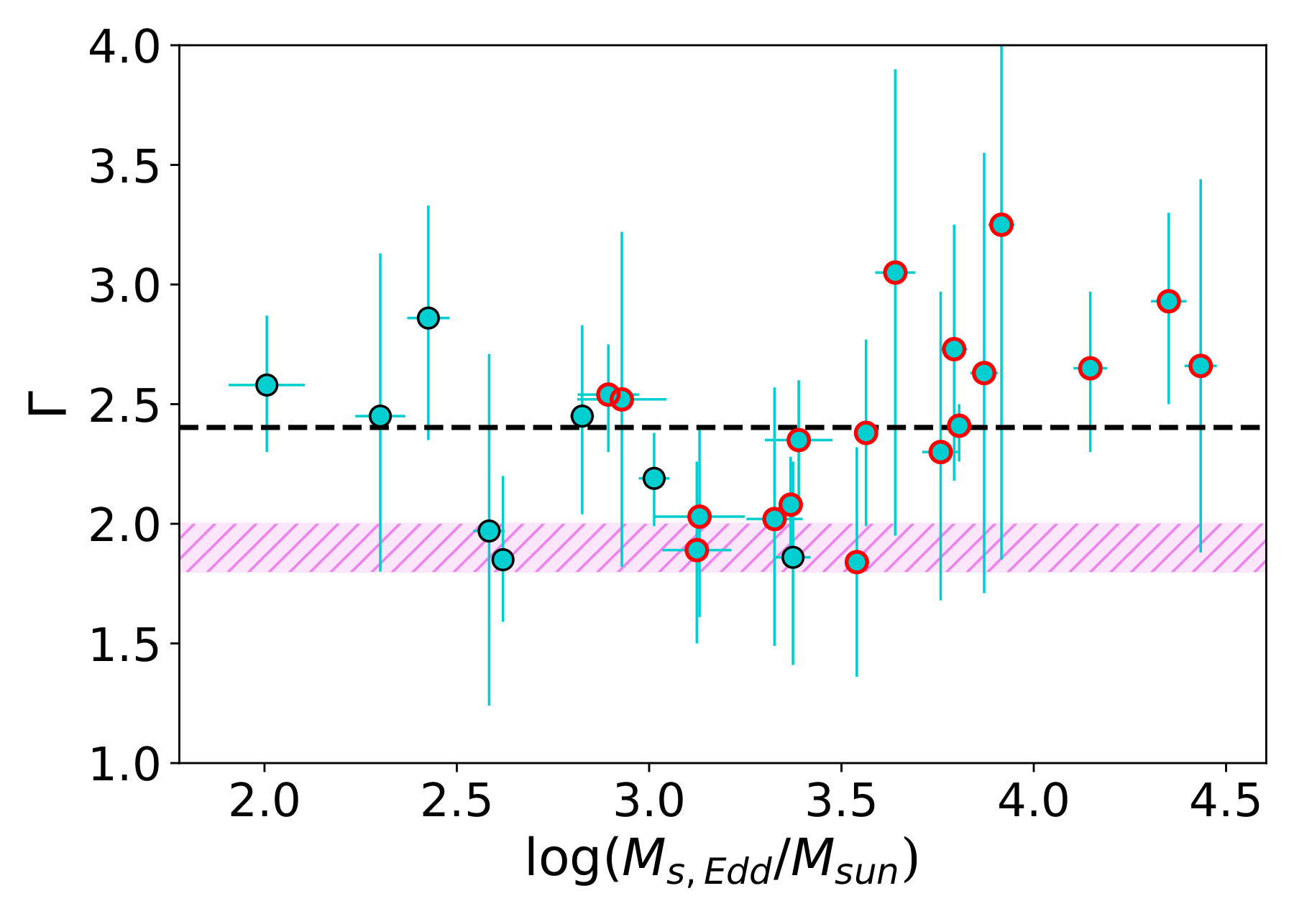
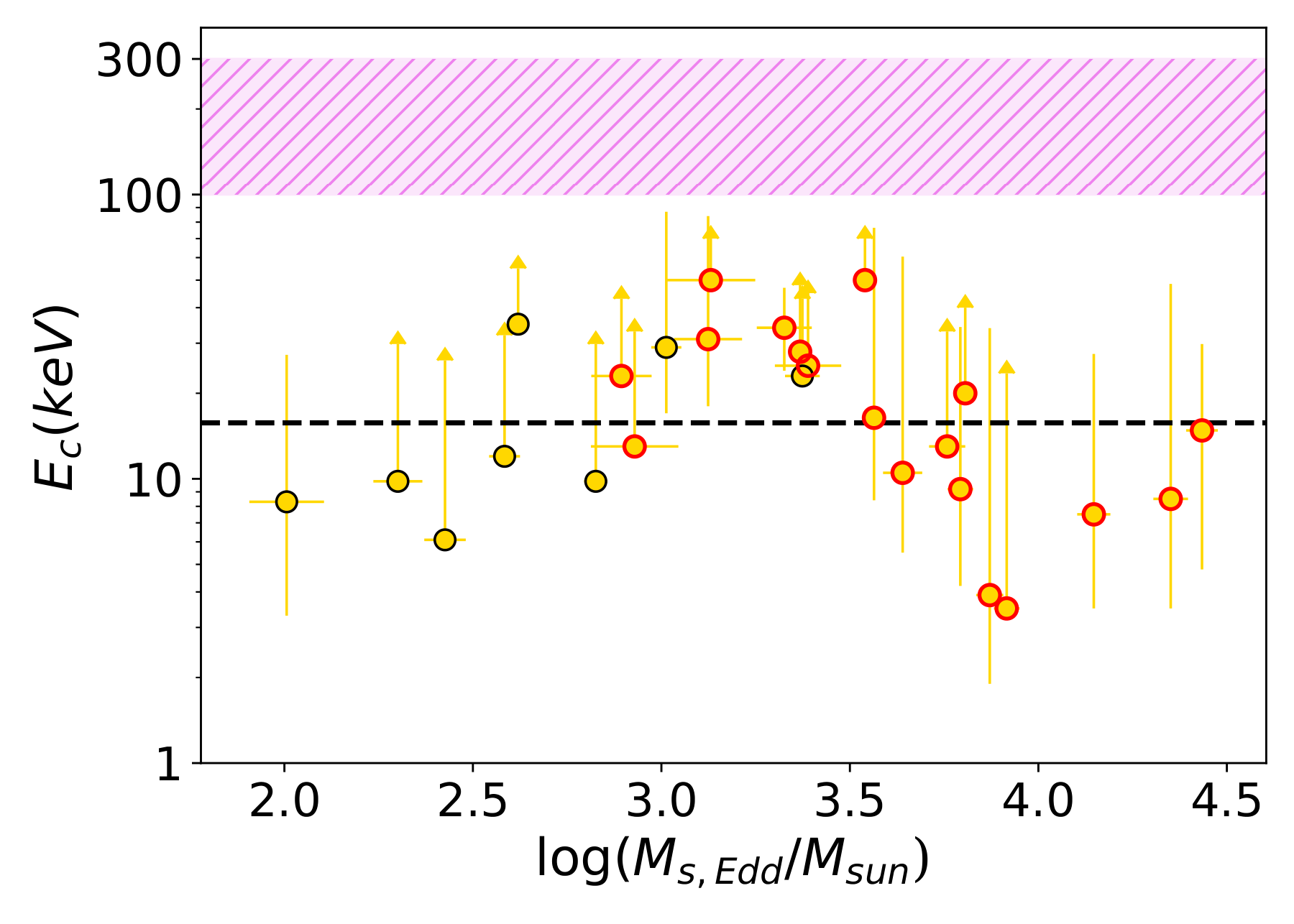
Tests whether photon index and cutoff energy vary with the adopted black-hole growth indicator, and visually compares the detected-QSO mean with typical low-z unobscured-AGN Γ and Ec ranges.
Original caption
Figure 2: Left panel : plot of Γ \Gamma vs. M s , Edd M_{\rm s,Edd} ; Right panel : plot of E c E_{\rm c} vs M s , Edd M_{\rm s,Edd} . The black horizontal dashed line marks the mean value of Γ \Gamma (top) and E c E_{\rm c} (bottom) for the sample of detected QSOs. Points with red edges are the one belonging to the HYPERION sample. Violet shaded region marks the typical range of Γ \Gamma ( ∼ 1.8 − 2 \sim 1.8-2 ; e.g. Piconcelli et al. 2005 ; Ricci et al. 2017 ) and E c E_{\rm c} ( ∼ 100 − 300 \sim 100-300 keV; e.g. Fabian et al. 2015 ; Ricci et al. 2018 ; Lanzuisi et al. 2019 ) observed in low- z z unobscured AGN. We note that the M s , Edd M_{\rm s,Edd} values plotted here are, for simplicity, the mean values derived using all the available values reported in Tab. 3 .
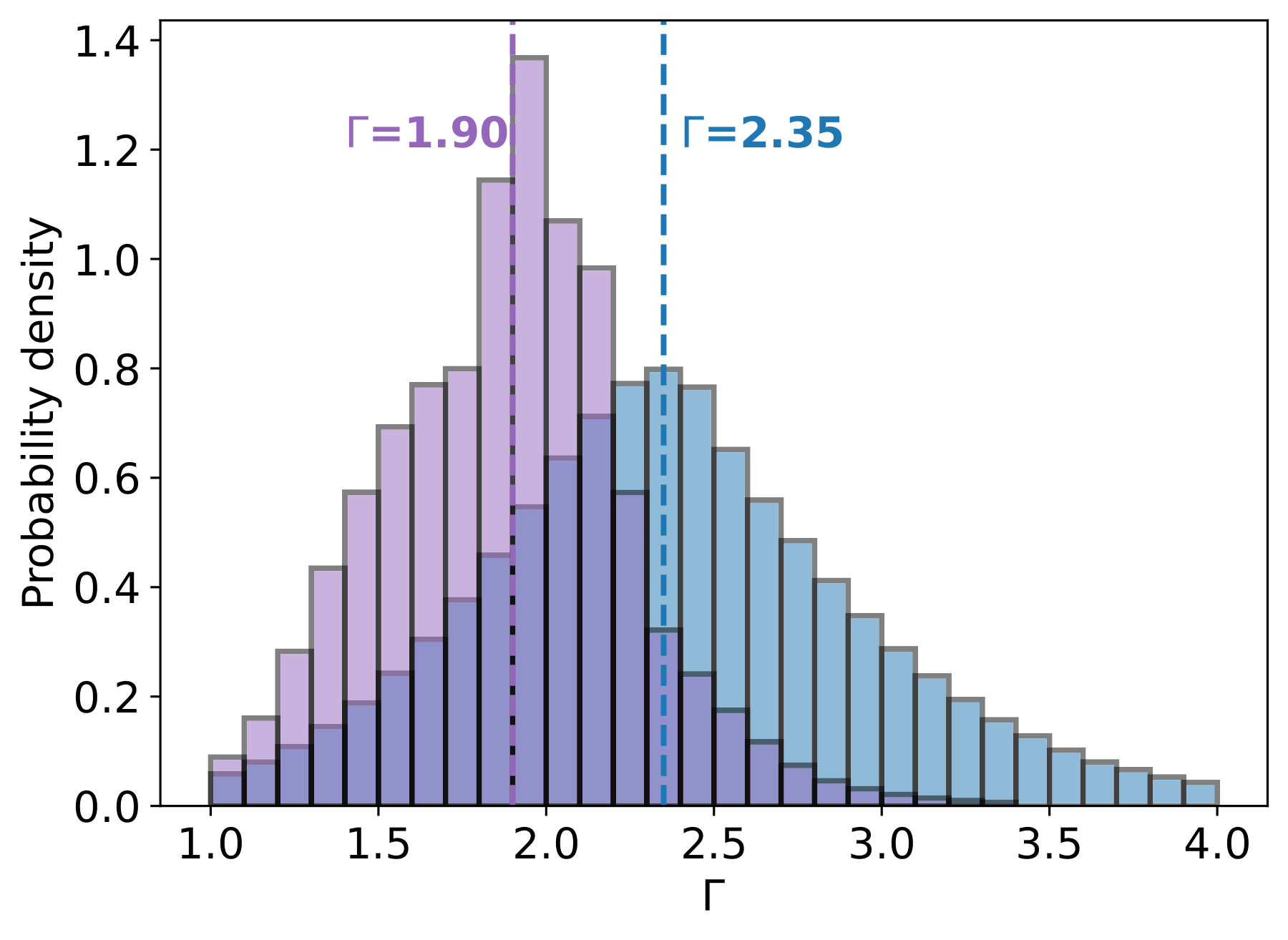
Directly compares the Γ probability distributions of this z≳6 sample and z~2–4 QSOs; the uncertainty-propagated KS exercise supports a statistically persistent difference between the distributions.
Original caption
Figure 4: Probability density distributions of Γ \Gamma for the z ≳ 6 z\gtrsim 6 QSOs (blue) from this work and for the z ∼ 2 − 4 z\sim 2-4 QSOs samples (purple) from Degli Agosti et al. 2025 . Dashed lines represent the median value of the distributions (see Tab. 7 ).
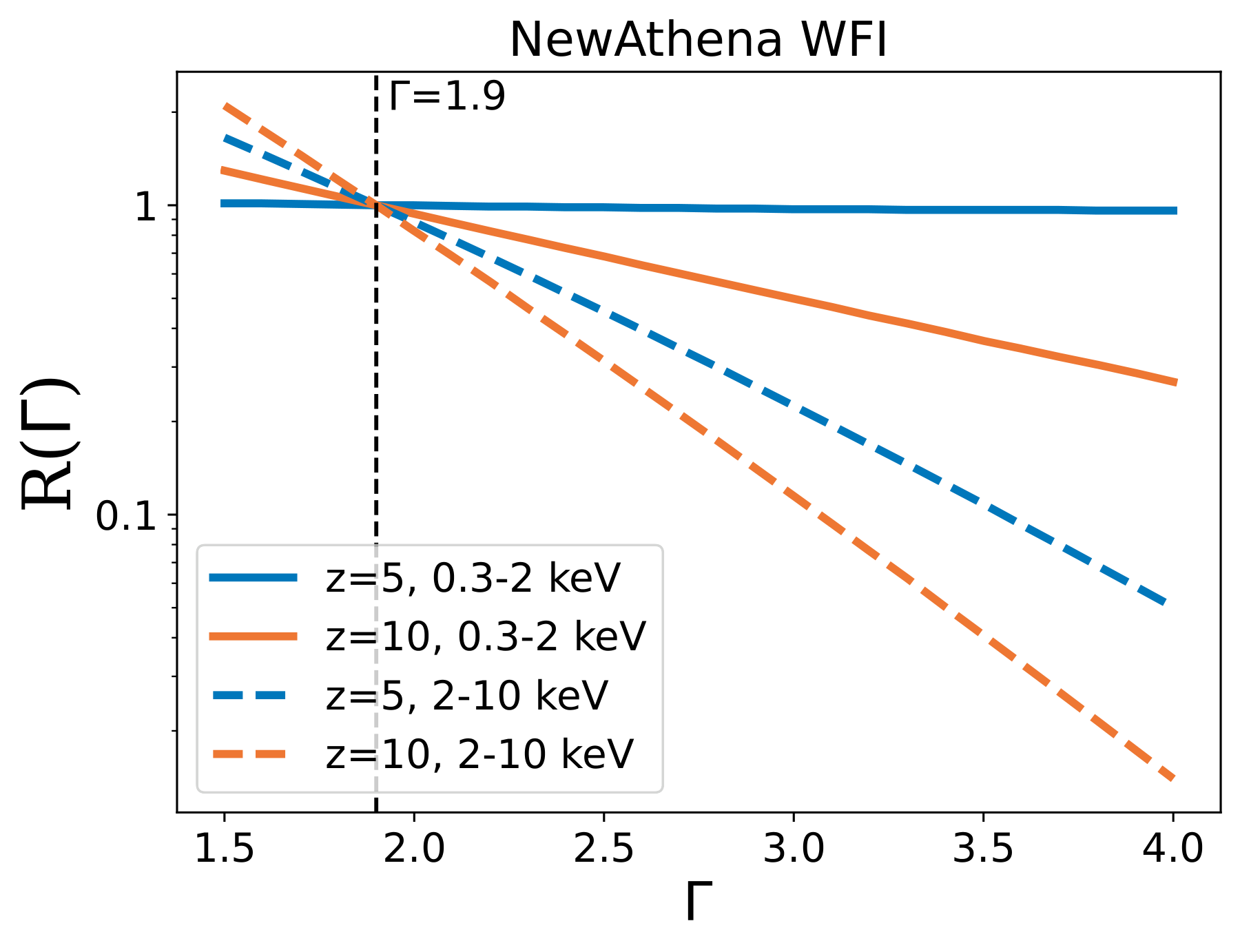
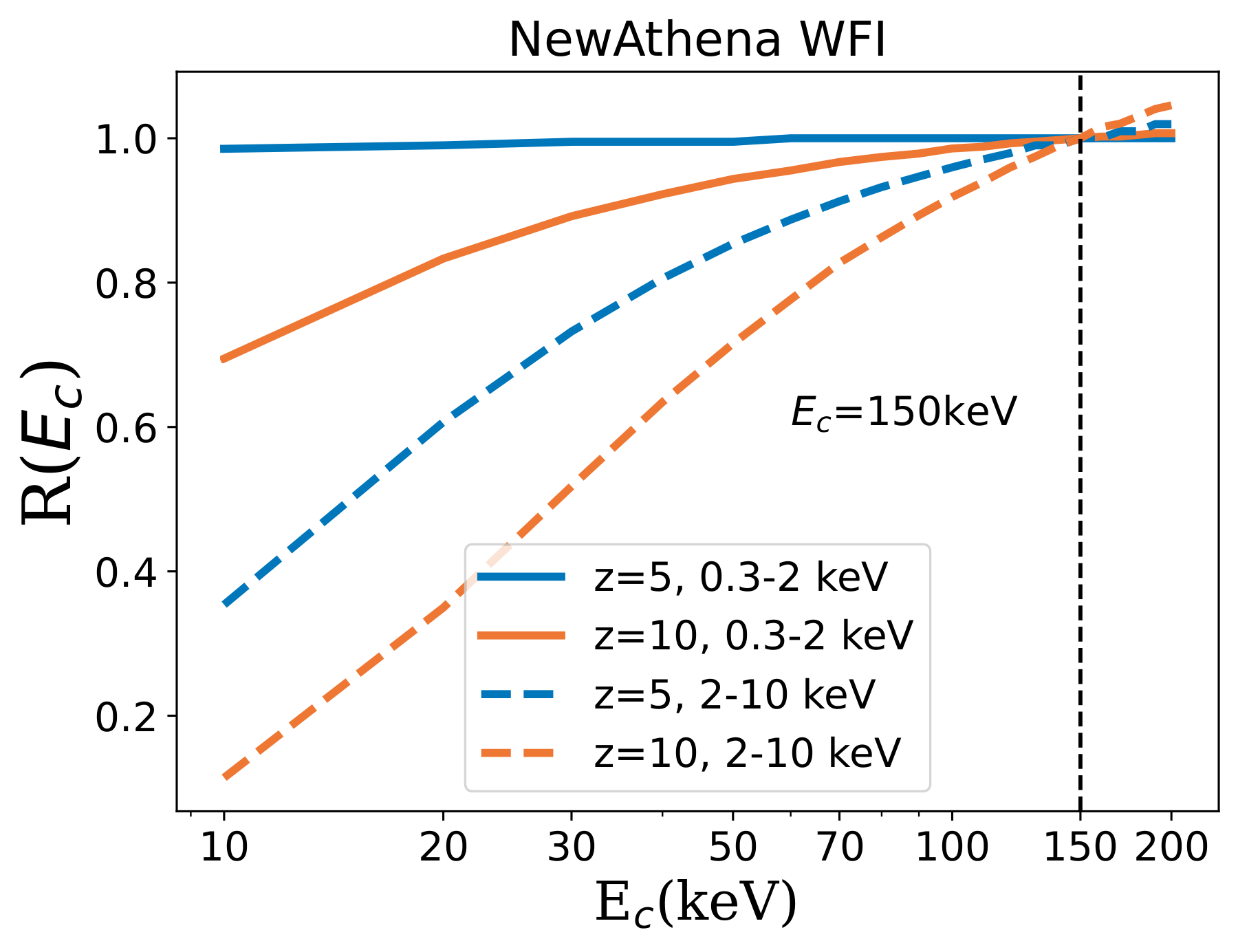
Tests the instrumental count-rate bias caused by steep Γ or low Ec for NewAthena/WFI at z=5 and z=10, separately in soft and hard observed bands.
Original caption
Figure 9: Left Panel: The "spectral steepness bias" as a function of photon index ( Γ \Gamma ) for NewAthena /WFI; Right Panel : The "spectral cutoff energy bias" as a function of high-energy cutoff ( E c E_{\rm c} ) for NewAthena /WFI. Count rates ratios in the 0.3–2 keV (solid lines) and 2–10 keV (dashed lines) bands are shown for redshift z = 5 z=5 (blue) and z = 10 z=10 (orange). More detailed curves are shown in Fig. 13 and Fig. 14
Related research
Previous digest
Tortosa et al. assemble the largest X-ray-sensitive sample yet of luminous quasars at z≈5.85–7.56, combining HYPERION sources, other luminous quasars, and moderately accreting targets from an XMM-Newton Large Programme, with black-hole masses and growth indicators re-derived consistently using updated JWST spectroscopy. Across 26 quasars suitable for correlation tests, they find no significant relation between coronal spectral properties and black-hole growth indicators, contrary to an interpretation in which steep spectra are confined to the most efficiently grown systems. Instead, steep continua, expressed as high photon indices and/or low high-energy cutoffs, appear widespread among luminous EoR quasars and point to comparatively cold coronae potentially associated with rapid accretion. The result also carries an instrumental consequence: at fixed intrinsic luminosity, such spectra can depress observed X-ray count rates and bias future surveys against steep-spectrum early AGN.
Sources and evidence (25)
- 2610.10522v1: Widespread steep X-ray spectra of luminous $z\simeq5.85-7.5$ quasars and their implications for future X-ray surveys
Luminous quasars (QSOs) at the Epoch of Reionization (EoR, $z\gtrsim6$) host billion-solar-mass black holes assembled within the first Gyr of cosmic time. Their X-ray emission probes the innermost accreting regions and constrains the physical state of the corona during early supermassive black hole (SMBH) growth. Previous results from the HYPerluminous quasars at the Epoch of ReionizatION (HYPERION) sample of $z \gtrsim 6$ QSOs, powered by the most rapidly accreted SMBHs, suggested a link between X-ray spectral slope and long-term growth efficiency. We test whether the steep X-ray spectra of luminous z>6 QSOs are a general property of early SMBH growth or a peculiarity of the most efficiently grown SMBHs, using a sample extended mainly to the lowest growth efficiencies. We analysed the largest and most X-ray sensitive sample of 28 luminous QSOs at $z \simeq 5.85-7.56$ (26 used in the correlation analysis), combining HYPERION targets, luminous non-HYPERION sources, and QSOs powered by moderately accreting SMBHs newly observed in our XMM-Newton Large Programme. We re-derived black hole masses and growth indicators for the entire sample homogeneously, incorporating the latest JWST-based spectroscopic measurements to ensure the most consistent and high-quality characterization across all targets. We found no statistically significant correlation between coronal spectral parameters and BH growth indicators: luminous $z \gtrsim 6$ QSOs systematically show steep X-ray continua, with high photon indices and/or low high-energy cutoffs, consistent with cold coronae, possibly linked to rapid accretion. Finally, if steep X-ray slopes are common among early AGN, they may significantly reduce count rates, at fixed intrinsic luminosity, in future surveys of the EoR, affecting the detectability of steep-spectrum X-ray sources and thus the census of the early AGN population.
- 2610.10522v1: Widespread steep X-ray spectra of luminous $z\simeq5.85-7.5$ quasars and their implications for future X-ray surveys
To account for the measurement uncertainties, we repeated the KS test over 10 000 10\,000 Monte Carlo realizations. At each iteration, one Γ \Gamma value was randomly drawn for each source from the corresponding split-normal distribution, and the KS statistic was recomputed. The resulting distribution of KS statistics has a median value of D = 0.51 − 0.09 + 0.08 D=0.51^{+0.08}_{-0.09} , while the median significance is 1 − P = 0.9906 1-P=0.9906 . Approximately 98 % 98\% of the realizations yield 1 − P > 0.95 1-P>0.95 , confirming that the difference between the two Γ \Gamma distributions remains statistically significant after fully propagating the individual measurement uncertainties.
- 2610.10522v1: Widespread steep X-ray spectra of luminous $z\simeq5.85-7.5$ quasars and their implications for future X-ray surveys
∙ \bullet The α OX \alpha_{\rm OX} and κ bol x \kappa^{x}_{\rm bol} of the z ≳ 6 z\gtrsim 6 QSOs analysed here are broadly consistent with the trends observed in highly accreting AGN at lower- z z (see Fig. 7 ). In particular, we identify an X-ray weakness fraction of ∼ 8 − 14 % \sim 8-14\% (2 secure detections plus two upper-limit sources that cannot be excluded as X-ray weak; Sect. 4.2 ), consistent within the large statistical uncertainties with the fractions reported for other highly accreting QSO samples, and likely a lower limit given the count-based selection of our sample.
- 2610.10522v1: Widespread steep X-ray spectra of luminous $z\simeq5.85-7.5$ quasars and their implications for future X-ray surveys
Under the limiting assumption that the bulk of the EoR AGN population shares the steep Γ \Gamma measured here, future X-ray surveys (e.g. with NewAthena ) could face count-rate reductions, at fixed intrinsic L 2 − 10 keV L_{2-10\,\rm keV} , with consequences for the detectability and census of early SMBH growth. For the sample average ( ⟨ Γ ⟩ ∼ 2.4 \langle\Gamma\rangle\sim 2.4 ), this reduction is modest ( ≲ 20 % \lesssim 20\% ) in the soft bands most relevant for detecting faint high- z z sources, while it can reach factors of 10 or more for the steepest spectra in our sample ( Γ ∼ 3 \Gamma\sim 3 –3.5) and/or in the hard 2–10 keV observed band. This bounding-case estimate, while not a forecast of the full EoR population, should be factored into the planning of future high- z z X-ray surveys.
- 2610.10522v1: Widespread steep X-ray spectra of luminous $z\simeq5.85-7.5$ quasars and their implications for future X-ray surveys
These results indicate that a substantial fraction of z ≳ 6 z\gtrsim 6 QSOs may host X-ray coronae characterised by intrinsically steep continua, possibly supporting the scenario in which high- z z quasars are preferentially observed in extreme accretion states, possibly associated with high Eddington ratios and efficient cooling of the corona. Overall, the analysis demonstrates that the steepness of the X-ray spectra is a robust property of the population and not an artifact of measurement uncertainties.
- 2610.10522v1: Widespread steep X-ray spectra of luminous $z\simeq5.85-7.5$ quasars and their implications for future X-ray surveys
The analysis of the XMM-Newton observations of the HYPERION sample available up to June 2024, together with that of additional non-HYPERION QSOs with archival, good–quality X-ray data, was first presented in 88 . In this work, we adopt the spectral results reported by 88 for the XMM-Newton sources, while we have reprocessed and re-analysed the Chandra data and the new XMM-Newton observations. The parameters derived from our spectral analysis are listed in Tab. 1 , alongside those reported in 88 .
- 2610.10522v1: Widespread steep X-ray spectra of luminous $z\simeq5.85-7.5$ quasars and their implications for future X-ray surveys
We further investigated whether the few QSOs with canonical photon indices could instead be intrinsically steep-spectrum sources affected by moderate intrinsic absorption. The results of these tests are presented in App. E . Absorbed models are not statistically preferred over a simple unabsorbed power-law, the current data quality does not allow us to establish whether these apparently flat-spectrum QSOs are intrinsically steep but moderately obscured systems.
- 2610.10522v1: Widespread steep X-ray spectra of luminous $z\simeq5.85-7.5$ quasars and their implications for future X-ray surveys
One of the main implications of our results concerns how the expected observed-band count rates of AGN at the EoR depend on their spectral shape, at fixed intrinsic luminosity, in future X-ray surveys. In the local Universe, numerous studies have shown that the X-ray photon index exhibits no significant dependence on AGN luminosity over several orders of magnitude in luminosity ( Piconcelli et al. 2005 ; Ricci et al. 2017 , e.g.) . Our results indicate that luminous QSOs at z ≳ 6 z\gtrsim 6 are characterised by systematically steeper X-ray continua than equally luminous QSOs at lower redshift. If the lack of a luminosity dependence of Γ \Gamma also holds in the early Universe, it is reasonable to expect that steep X-ray spectra are not restricted to the most luminous QSOs investigated here, but may characterise a substantial fraction of the AGN population at the EoR. Although this hypothesis remains to be verified observationally, it provides a physically motivated framework for evaluating how steep X-ray spectra change the expected observed-band count rates, at fixed intrinsic L 2 − 10 keV L_{2-10\,\rm keV} , of high-redshift AGN in future surveys targeting the z ≳ 6 z\gtrsim 6 Universe.
- 2610.10522v1: Widespread steep X-ray spectra of luminous $z\simeq5.85-7.5$ quasars and their implications for future X-ray surveys
We have presented an extended X-ray spectral analysis of luminous QSOs at z ≳ 6 z\gtrsim 6 , combining the original HYPERION sample, additional luminous non-HYPERION sources, and newly observed targets from a dedicated XMM-Newton Large Programme. This expanded dataset incorporates recent high-quality SMBH mass estimates, including 10 Balmer-line-based estimates from JWST. By significantly increasing the dynamic range in mass growth rate of the SMBH powering these QSOs, while preserving comparable bolometric luminosities, this dataset enable a robust reassessment of the connection between coronal properties and early SMBH growth. Our main results can be summarized as follows:
- 2610.10522v1: Widespread steep X-ray spectra of luminous $z\simeq5.85-7.5$ quasars and their implications for future X-ray surveys
∙ \bullet QSOs at the Epoch of Reionization exhibit systematically steep X-ray spectra, characterised either by high photon indices (average: ⟨ Γ ⟩ = 2.4 \langle\Gamma\rangle=2.4 , standard deviation of the distribution of Γ \Gamma : σ = 0.38 \sigma=0.38 ) or by relatively low high-energy cutoffs when modelled with fixed Γ = 1.9 \Gamma=1.9 (see Fig. 2 ). The restricted mean cutoff energy for our z ≳ 6 z\gtrsim 6 QSOs estimated via survival-analysis estimate is ⟨ E c ⟩ KM = 30.0 ± 3.7 \langle E_{\rm c}\rangle_{\rm KM}=30.0\pm 3.7 keV (see Fig. 5 ). The cutoff energies, when measurable, occupy the low- E c E_{\mathrm{c}} , high-luminosity region of the E c E_{\mathrm{c}} – L 2 − 10 keV L_{2-10\,\mathrm{keV}} plane (see Fig. 6 ), distinct from lower- z z luminous AGN.
- 2509.07064v1: GA-NIFS: an extended [OIII] halo around the sub-Eddington quasar J1342+0928 at z=7.54
In Section 2 we present the new JWST observations of ULAS J1342+0928 as well as previous observing campaigns. Sections 3 and 4 are dedicated to the analyses performed and the main results. We discuss our results in the context of high-redshift QSOs and AGN in Section 5 and collect our conclusions in Section 6. Throughout this paper, we adopt a flat Λ \Lambda CDM cosmology with H 0 = 70 H_{0}=70 km s -1 Mpc -1 , Ω Λ \Omega_{\Lambda} = 0.7, and Ω m \Omega_{m} = 0.3. Correlations are considered significant when yielding p-values lower than 0.01, corresponding to ∼ \sim 2.6 σ \sigma in the case of Normal approximation, under the null-hypothesis of non correlation.
- 2509.07064v1: GA-NIFS: an extended [OIII] halo around the sub-Eddington quasar J1342+0928 at z=7.54
Moreover, we detected another [O iii ] emitter at ∼ 1 . ′′ 8 \sim 1\aas@@fstack{\prime\prime}8 north of the QSO location (dubbed as N in Fig. 4 , see Fig. 12 ). For this region, we avoided performing the extraction close to the IFU edge as it would result in a noisier spectrum. Also in this case, the redshift of this structure is consistent with that of the QSO. The line width is close to the resolution limit ( ∼ \sim 200 km s -1 ). While in the NW region the detection of the rest-frame UV continuum in the low-resolution data was hampered by PSF extent which smears the QSO continuum on larger scales, for the N clump we measured a rest-frame UV luminosity between 2,500–3,000 Å of ( 5 ± 0.2 ) × 10 42 erg s − 1 \rm(5\pm 0.2)\times 10^{42}\,erg\,s^{-1} . Both clumps are also detected in [O ii ] λ 3728 \lambda 3728 , while this is not the case for the extended [O iii ] halo, as we discuss in Appendix D .
- 2503.16596v1: A "Black Hole Star" Reveals the Remarkable Gas-Enshrouded Hearts of the Little Red Dots
Table Extended Data 1: Summary of key properties.
- 2503.16596v1: A "Black Hole Star" Reveals the Remarkable Gas-Enshrouded Hearts of the Little Red Dots
We thank the PRIMER and EXCELS teams for designing JWST surveys that made this work possible. We acknowledge feedback on ”BH*” and illuminating discussions with Ivan Cabrera-Ziri, Mike McDonald, Roger Blandford, Susan Clark, Risa Wechsler, Tom Abel, Mike Liu, Dave Sanders, Sylvain Veilleux, Triana Almeyda, Adam Ginsburg, and Desika Narayanan. We thank Kohei Inayoshi for discussing details of their work modeling Balmer breaks in LRDs [ 8 ] . This work is based on observations made with the NASA/ESA/CSA James Webb Space Telescope. The data were obtained from the Mikulski Archive for Space Telescopes at the Space Telescope Science Institute, which is operated by the Association of Universities for Research in Astronomy, Inc., under NASA contract NAS 5-03127 for JWST. These observations are associated with programs 5224 and 3543. Some of the data products presented herein were retrieved from the Dawn JWST Archive (DJA). DJA is an initiative of the Cosmic Dawn Center (DAWN), which is funded by the Danish National Research Foundation under grant DNRF140. We acknowledge funding from JWST programs GO-3516, GO-5224, and GO-1837. Support for this work was provided by NASA through the NASA Hubble Fellowship grant HST-HF2-51515.001-A awarded by the Space Telescope Science Institute, which is operated by the Association of Universities for Research in Astronomy, Incorporated, under NASA contract NAS5-26555. Funded by the European Union (ERC AGENTS, 101076224; HEAVYMETAL, 101071865; RED CARDINAL, 101076080). Views and opinions expressed are however those of the author(s) only and do not necessarily reflect those of the European Union or the European Research Council. Neither the European Union nor the granting authority can be held responsible for them. This work has received funding from the Swiss State Secretariat for Education, Research and Innovation (SERI) under contract number MB22.00072, as well as from the Swiss National Science Foundation (SNSF) through project grant 200020_207349. This work was also supported by JSPS KAKENHI Grant Numbers 23H00131. The Cosmic Dawn Center is funded by the Danish National Research Foundation under grant DNRF140. P.N. acknowledges supp
- 2512.16981v1: The accretion of quasars at the epoch of reionisation: $JWST$ catches the primeval monsters slowly feasting
Quasars (QSOs) emit an enormous amount of light as a result of the accretion of gas onto supermassive black holes (SMBHs). Thanks to their luminosity, the most distant known QSOs allow us to trace the growth of SMBHs deep into the epoch of reionisation. In this work, we employed JWST /NIRSpec observations of eight luminous ( log ( L 3000 Å / ( erg s − 1 ) ) \log(L_{3000\,\AA}/(\rm erg\,s^{-1})) > > 45.7) QSOs at z z ≥ \geq 5.9 to constrain their accretion properties, namely black hole mass, accretion disc (AD) luminosity, and Eddington ratio ( M BH M_{\rm BH} , L AD L_{\rm AD} , λ Edd \lambda_{\rm Edd} ), by fitting the rest-frame UV and optical emission with different AD models. This method provided self-consistent measurements of both M BH M_{\rm BH} and L AD L_{\rm AD} . The uncertainties on M BH M_{\rm BH} and L AD L_{\rm AD} , obtained within the AD-modelling framework ( σ M BH AD \sigma^{\rm AD}_{M_{\rm BH}} ∼ \sim 0.2 dex; σ L AD AD \sigma^{\rm AD}_{L_{\rm AD}} ∼ \sim 0.1 dex), are significantly smaller than the systematic uncertainties associated with single-epoch M BH M_{\rm BH} ( ∼ \sim 0.4 dex) and L AD L_{\rm AD} derived via bolometric corrections ( ∼ \sim 0.2 dex). Based on these results, in our sample we found an average Eddington ratio of ⟨ log ( λ Edd ) ⟩ \langle\log(\lambda_{\rm Edd})\rangle = − 0.9 -0.9 , with a dispersion of ∼ \sim 0.2 dex. Assuming that our high- z z QSOs are representative of optically-selected bright blue QSOs, we derive a fraction of systems accreting above the Eddington limit of ∼ \sim 0.2%. In conclusion, this work i) demonstrates the suitability of JWST to test AD models on high-redshift ( z z ≳ \gtrsim 4) QSOs, thanks to the large NIRSpec spectral coverage; ii) shows that AD modelling can yield robust M BH M_{\rm BH} and L AD L_{\rm AD} measurements, with smaller uncertainties than the typical calibrations; and iii) provides compelling evidence for sub-Eddington accretion in bright high- z z QSOs, challenging the widespread paradigm of near- or super-Eddington accretion occurring in these sources.
- 2512.16981v1: The accretion of quasars at the epoch of reionisation: $JWST$ catches the primeval monsters slowly feasting
Our results align with those derived from other samples where M BH M_{\rm BH} and L AD L_{\rm AD} were self-consistently estimated via AD modelling ( Capellupo et al. 2015 ; Cheng et al. 2019 ; Campitiello et al. 2020 ). Also other works focusing on AD modelling of individual high-redshift QSOs, such as J2157 − - 3602 at z z = 4.7 ( Lai et al. 2023 ), J0100+2802 – the most luminous quasar known – at z z = 6.3 ( Wolf et al. 2024 ), ULAS J1120+0641 ( z z = 7.1), DELS J0038 − - 1527 ( z z = 7.0), and ULAS J1342+0928 ( z z = 7.5), provided evidence for sub-Eddington accretion (see Campitiello et al. 2019 and Trefoloni et al. 2025 . In this picture, the large fraction of super-Eddington sources, especially found in bright QSOs (e.g, Mazzucchelli et al. 2023 ; Yang et al. 2023 ), possibly stems from the combination of an overestimation of L AD L_{\rm AD} due to a fixed bolometric correction and the systematic errors on M BH M_{\rm BH} caused by the adoption of local SE calibrations. This suggests that, if either L AD L_{\rm AD} in QSOs samples were homogeneously re-evaluated using luminosity-dependent k bol k_{\rm bol} values, or also M BH M_{\rm BH} were estimated via AD modelling, a large fraction of the super-Eddington high- z z QSOs would vanish. According to our sample, the actual incidence of blue QSOs above the Eddington limit is likely to be ∼ \sim 0.2%, or even lower. Intriguingly, the lack of widespread super-Eddington accretion, among a large sample of optically-selected SDSS QSOs ( ≳ \gtrsim 100,000 objects), is also suggested by Risaliti, Salvati & Trefoloni (in prep.), who explain the Baldwin effect ( Baldwin 1977 ) in terms of an optically-thick, geometrically-thin accretion disc, assuming that most of optically thin broad lines are good proxies of L AD L_{\rm AD} . As λ Edd \lambda_{\rm Edd} is one of the free parameters in their model, the small dispersion found in the scaling relations across several lines points to an intrinsically narrow ( ≲ \lesssim 0.2 dex) λ Edd \lambda_{\rm Edd} distribution peaking at log ( λ Edd ) \log(\lambda_{\rm Edd}) ∼ \sim − 0.9 -0.9 . While the central value is in keeping with the results presented here, the narrow wi
- 2505.04826v1: Subaru High-z Exploration of Low-Luminosity Quasars (SHELLQs) XXII. Chandra observations of narrow-line quasar candidates at z>6
X-ray images of each target were constructed by stacking the repeat exposures. The total exposure times are and 56.7 ks for G01, 56.5 ks for G02, 57.0 ks for G03, and 60.0 ks for G04, respectively. We examined those images in the 1-5 keV band, where the signal to noise ratio is expected to be optimal owing to low instrumental background. None of the targets were detected (Fig. 4 ). With the point spread function (PSF) of the ACIS-S, 60% of counts from a point source are expected to fall within a 1-pixel ( = 0.49 ″ =0.49\arcsec ) radius (MARX document 5.2.2). No counts were observed within a 1-pixel radius from any of the four target positions. The background counts in the 1-5 keV band are 0.013-0.015 cts pixel -1 for these observations. Therefore no background count is expected (the probability of observing one or more background counts in the area is 4%), as observed. Detection of no counts sets the 95% upper limit to be 3 counts in each aperture, using a Bayesian formulation for a Poisson distribution of counts ( Kraft et al. 1991 ) . Assuming that each source has a photon-index Γ = 2 \Gamma=2 ( Huang et al. 2020 , e.g.) and absorbing column N H N_{\rm H} < 10 23 <10^{23} cm -2 , the corresponding rest-frame 2-10 keV luminosity at the median redshift of the four targets, z = 6.13 z=6.13 , is 2 × 10 44 2\times 10^{44} erg s -1 , which we adopt as the upper limit for each object for the discussion below.
- 2505.04826v1: Subaru High-z Exploration of Low-Luminosity Quasars (SHELLQs) XXII. Chandra observations of narrow-line quasar candidates at z>6
We note that one count was registered at 0.8 arcsec (within a 2-pixel radius) from the target position in the G03 image. Given the PSF, the probability of detecting one source count in the second radial pixel but none in the first is 10%. Given the background level, observing one background count within the same area has a probability of 12%, assuming a Poisson process. Since the Bayes factor is around unity, no preference is given whether it is a source or background count. Even if it is a source count, the one count does not constitutes a detection, but gives an increased upper limit of 4.7 counts for G03, corresponding to 3 × 10 44 3\times 10^{44} erg s -1 .
- 2505.04825v1: SHELLQs. Bridging the Gap: JWST Unveils Obscured Quasars in the Most Luminous Galaxies at z > 6
inally, we estimated the black hole mass (MBH) from the width and luminosity of the Hα BLR compo- nent, following the recipe of Greene & Ho (2005) and Reines et al. (2013). The resultant values (MBH = 107.8−9.1M⊙) overlap with the distributions of low- z SDSS quasars (e.g., Rakshit et al. 2020; Toba et al. 2021) and UV-luminous quasars at z ∼ 6 (e.g., Yang et al. 2021), but are at the lower end on av- erage. The Eddington ratios are in the range from λEdd = 0.5 to 1.1, suggesting that sub-Eddington to Ed- dington accretion takes place in the BL objects. Figure Figure 8. Black hole masses and bolometric lumi- nosities of luminous quasars (open squares; Willott et al. 2010; Shen et al. 2019; Yang et al. 2021, 2023) and SHEL- LQs low-luminosity quasars (grey dots; Onoue et al. 2019; Matsuoka et al. 2019b; Onoue et al. 2024, M. Onoue et al., in prep.) at z ∼ 6 −7. The dark blue sym- bols represent JWST BHEs at z > 4 (Harikane et al. 2023; ¨Ubler et al. 2023; Furtak et al. 2024; Greene et al. 2024; Juodˇzbalis et al. 2024, 2025; Maiolino et al. 2024b; Matthee et al. 2024; Schindler et al. 2024; Lin et al. 2025). The dotted lines represent constant Eddington ratios of λEdd = 1, 0.1, and 0.01, from top to bottom. 8 compares the estimated values with those of classical quasars and other JWST BHEs,4 demonstrating that the present objects bridge the two AGN populations. We also note the overall similarity of the present tar- gets with the SDSS type-II quasar candidates at lower redshifts (Alexandroffet al. 2013; Greene et al. 2014), both of which are characterized by black hole masses of MBH ∼108−9M⊙with sub-Eddington accretion, mild dust obscuration (AV ∼0 −3 mag), and high line lumi- nosities (L[OIII] ∼1043−45 erg s−1). However, we caution that our estimates reported above have large uncertainties. Black hole masses derived from single-epoch spectra are associated with statistical uncertainty of 0.3 – 0.5 dex (e.g., Vestergaard & Peterson 2006). The bolometric correc- tion to Hα luminosity has been derived from low-z AGNs, and we do not know how accurate it is when 4 This figure is a collection of heterogeneous measurements, since different works used different assumptions
- 2505.04825v1: SHELLQs. Bridging the Gap: JWST Unveils Obscured Quasars in the Most Luminous Galaxies at z > 6
nding the whole picture of SMBH activity during cosmic dawn. 4. SUMMARY We present the results from JWST/NIRSpec observa- tions of 13 objects in the EoR. The sample was originally selected by the HSC-SSP imaging survey over >1000 deg2, and all the objects have luminous Lyα emission
- 2609.19459v1: Extreme Enrichment at Cosmic Dawn: Three FeII-Strong Quasars at z > 6 from the JWST Aether survey
The Mg II line models resulted in redshifts of z Mg II = 6.307 ± 0.010 z_{\text{{Mg~II}}}=6.307\pm 0.010 for J0216 − - 5226 and z Mg II = 6.110 ± 0.005 z_{\text{{Mg~II}}}=6.110\pm 0.005 for J1429+5447, which indicates a blueshift (compared to the H α \alpha narrow components) of − 3480 ± 400 -3480\pm 400 and − 2010 ± 200 -2010\pm 200 km s -1 . These offsets are quite high compared to the average blueshift of − 480 -480 km s -1 for z ≳ 6 z\gtrsim 6 quasars found by [ 161 ] and [ 29 ] using [C II]. However, the standard deviations of these distributions are large (e.g., 630 km s -1 in Venemans et al. 161 ), and similar outliers are reported in those works.
- 2609.19459v1: Extreme Enrichment at Cosmic Dawn: Three FeII-Strong Quasars at z > 6 from the JWST Aether survey
with L λ , 5100 L_{\lambda,5100} , the monochromatic luminosity at 5100 Å in rest-frame. These relations result in a wide range of BH mass estimates between ∼ 2 × 10 8 \sim 2\times 10^{8} M ⊙ and ∼ 7 × 10 9 \sim 7\times 10^{9} M ⊙ as shown in Table 1 . Specifically, the H α \alpha -based BH masses derived from [ 24 ] are ∼ 1 − 7 × 10 9 \sim 1-7\times 10^{9} M ⊙ , similar to the general high- z z quasar population. It is important to note that the reported errors are calculated by propagating uncertainties, however, in reality these are dominated by systematic uncertainties from the derived empirical relations, which are typically ∼ 0.5 \sim 0.5 dex. The derived BH mass values depend on the scaling relations and the Fe II templates used, and therefore all values are quoted in Table 1 .
- 2603.10162v1: The X-ray weakness of Little Red Dots and JWST-selected AGN: comparison with local AGN in different accretion regimes
Table 1 : Summary of the AGN subsamples used in this work, including selection criteria, sample size, and the method adopted to derive key physical parameters. 2 2 2 References. (1) Mejía-Restrepo et al. (2022) ;(2) Ricci et al. (2017) ; (3) Gupta et al. (2024) ; (4) Wu and Shen (2022) ; (5) Webb et al. (2020) ; (6) Jin et al. (2012b) ; (7) Du et al. (2014) ; (8) Du et al. (2015) ; (9) Castelló-Mor et al. (2016) ; (10) Tortosa et al. (2023) ; (11) Yue et al. (2024) ; (12) Maiolino et al. (2025) ; (13) Lin et al. (2026) .
- 2603.10162v1: The X-ray weakness of Little Red Dots and JWST-selected AGN: comparison with local AGN in different accretion regimes
We note that in low-redshift comparison samples (BASS, SDSS–4XMM, NLS1s, and SEAMBHs), all sources have both broad H α \alpha and X-ray measurements as a natural consequence of the sample construction and survey depths, rather than as a result of additional selection cuts applied in this work. In particular, the SDSS–4XMM sources are optically classified as type I AGN based on the presence of a broad H α \alpha line component in their SDSS spectra, with no similarly broad [OIII] counterpart, while their X-ray detections arise from archival XMM- Newton observations of sufficient depth at low z z . Similarly, BASS AGN are bright, nearby systems with well-characterized optical broad-line emission and X-ray detections. In contrast, the LRDs and JWST-selected AGN are primarily selected via rest-frame UV and optical spectroscopy, and their X-ray measurements are almost exclusively limited to upper limits due to their observed X-ray weakness and current sensitivity constraints. Indeed, if their spectra are intrinsically steep (i.e., very soft), then at high z z much of the emission is redshifted out of the observed band, leading to a substantial loss of detected photons with current X-ray instruments. This difference reflects observational limitations rather than intrinsic selection biases and should be borne in mind when comparing the distributions.
- 2504.10581v1: Massive Black Hole Seed Formation in Strong X-ray Environments at High Redshift
Direct collapse of pristine gas in early galaxies is a promissing pathway for forming supermassive black holes (BHs) powering active galactic nuclei (AGNs) at the epoch of reionization (EoR). This seeding mechanism requires suppression of molecular hydrogen (H$_2$) cooling during primordial star formation via intense far-ultraviolet radiation from nearby starburst galaxies clustered in overdense regions. However, non-detection of 21 cm signals from the EoR reported by the Hydrogen Epoch of Reionization Array (HERA) experiment suggests that such galaxies may also emit X-rays more efficiently than in the local universe, promoting H$_2$ production and thereby potentially quenching massive BH seed formation. In this study, we examine the thermal and chemical evolution of collapsing gas in dark matter halos using a semi-analytic model incorporating observationally calibrated X-ray intensities. We find that strong X-ray irradiation, as suggested by HERA, significantly suppresses direct collapse and leads most halos to experience H$_2$ cooling. Nevertheless, massive BH seeds with $M_\mathrm{BH} \gtrsim 10^4~M_\odot$ still form by $z\simeq 15$, particularly in regions with baryonic streaming motion, and their abundance reaches $\sim 10^{-4}~\mathrm{Mpc}^{-3}$ sufficient to explain the SMBHs identified by JWST spectroscopy at $3<z<6$. While the formation of highly overmassive BHs with masses comparable to their host galaxies is prohibited by X-ray ionization, our model predicts that BH-to-stellar mass ratios of $\simeq 0.01-0.1$ were already established at seeding.
Abstract
Luminous quasars (QSOs) at the Epoch of Reionization (EoR, $z\gtrsim6$) host billion-solar-mass black holes assembled within the first Gyr of cosmic time. Their X-ray emission probes the innermost accreting regions and constrains the physical state of the corona during early supermassive black hole (SMBH) growth. Previous results from the HYPerluminous quasars at the Epoch of ReionizatION (HYPERION) sample of $z \gtrsim 6$ QSOs, powered by the most rapidly accreted SMBHs, suggested a link between X-ray spectral slope and long-term growth efficiency. We test whether the steep X-ray spectra of luminous z>6 QSOs are a general property of early SMBH growth or a peculiarity of the most efficiently grown SMBHs, using a sample extended mainly to the lowest growth efficiencies. We analysed the largest and most X-ray sensitive sample of 28 luminous QSOs at $z \simeq 5.85-7.56$ (26 used in the correlation analysis), combining HYPERION targets, luminous non-HYPERION sources, and QSOs powered by moderately accreting SMBHs newly observed in our XMM-Newton Large Programme. We re-derived black hole masses and growth indicators for the entire sample homogeneously, incorporating the latest JWST-based spectroscopic measurements to ensure the most consistent and high-quality characterization across all targets. We found no statistically significant correlation between coronal spectral parameters and BH growth indicators: luminous $z \gtrsim 6$ QSOs systematically show steep X-ray continua, with high photon indices and/or low high-energy cutoffs, consistent with cold coronae, possibly linked to rapid accretion. Finally, if steep X-ray slopes are common among early AGN, they may significantly reduce count rates, at fixed intrinsic luminosity, in future surveys of the EoR, affecting the detectability of steep-spectrum X-ray sources and thus the census of the early AGN population.
Discussion
Discussion access requires a security token. Register for the weekly digest.