2610.36089v1 · First listed 2026-10-28
Heavy Seeds and the Multi-scale Fueling of Early Supermassive Black Holes and Little Red Dots
Nested sub-pc cutouts suggest that a direct-collapse heavy seed, unlike a stellar-remnant seed in these simulations, can assemble dense nearby gas, undergo bursty super-Eddington accretion, and yield a Balmer-break LRD-like spectrum. This is a model-dependent result, not a demographic measurement. [1]
Evidence
The authors re-simulate targeted regions from a cosmological parent calculation at sub-pc resolution, comparing direct-collapse black-hole (DCBH) and stellar-remnant seed channels. They restrict interpretation to <8 Myr to limit vacuum-boundary artifacts, then post-process gas properties and predict spectra from accretion and the close-in gas environment. Both cases have average gas temperatures near 10^3 K, but the DCBH run develops much denser central gas; at five-times higher resolution its peak nearby density reaches about 10^8 cm^-3. A spectrum based on a 5.7-Myr super-Eddington episode and gas resolved to about 0.1 pc shows a strong Balmer break resembling normalized observed LRD spectra. [2][3][4][5][6]
Earlier work
The concrete comparison is to an earlier zoom-in DCBH spectral model whose approximately 300-pc treatment did not properly represent gas near the black hole: both models produce red AGN continua, but the authors report that only their higher-resolution cutout calculation produces the strong Balmer-break feature. Separately, supplied work has explored LRD demographics with both DCBH and light-seed populations under imposed Eddington or mildly super-Eddington growth prescriptions, rather than resolving the same close-in fueling calculation. [6][7][18]
What changes
The methodological contribution is a nested cutout experiment intended to bridge cosmological inflow and Bondi-scale gas behavior over short intervals. Within that setup, the paper directly contrasts heavy and light seeds: it attributes dense-gas buildup and rapid DCBH growth to the larger seed mass, while the stellar-remnant case remains weakly coupled to its gas. It then connects the resolved gas structure to a Cloudy spectral prediction rather than treating the LRD spectrum independently of the simulated nucleus. [1][6]
Limits and open questions
The cutouts use artificial vacuum outer boundaries, so the authors limit analysis to <8 Myr based on a sound-crossing estimate; conclusions therefore do not establish long-term growth histories. The high-resolution result is a controlled comparison of two seed scenarios, not a survey of seed environments or an observational estimate of heavy-seed prevalence. Although the higher-resolution DCBH run reaches higher central density, the reported temperature distribution changes little, leaving sensitivity to additional physical prescriptions and environments unquantified in the supplied extraction. [2][5]
Full-text excerpts support the cutout duration, gas, resolution, and spectral statements, but the supplied extraction does not include the complete numerical setup table, parameter choices, or uncertainty budget. Figure 1 details are available only through the supplied caption list.
Key figures
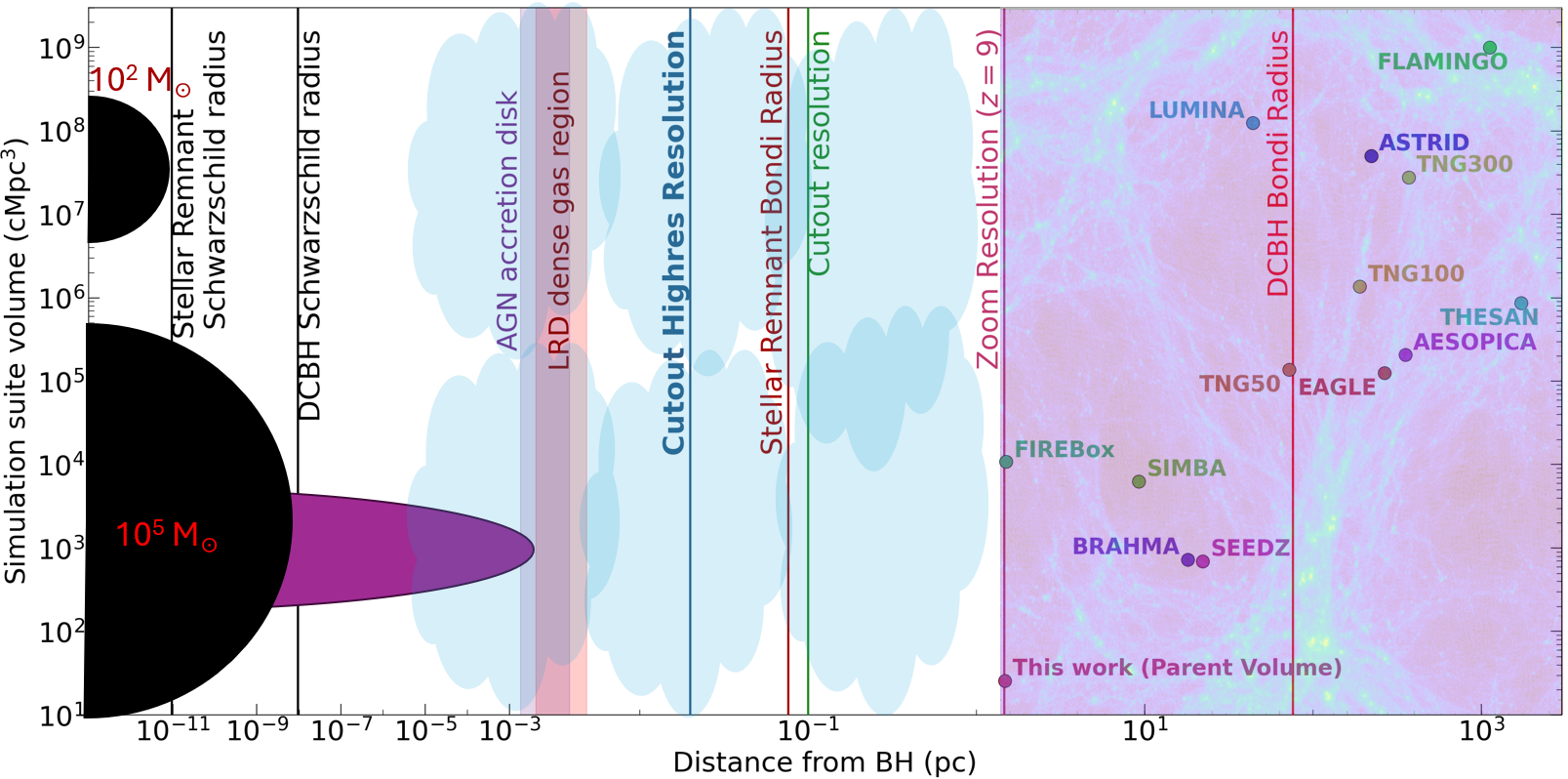
Tests the scale-resolution motivation: cosmological simulations remain far above black-hole scales, whereas the cutout is designed to approach and resolve the Bondi radius.
Original caption
Figure 1: Key spatial scales for BH evolution. We indicate the inferred size of the high-density regions in LRDs [ 62 , 90 ] , the AGN accretion disk [ 49 ] , as well as the Schwarzschild and Bondi radii (Eq. 10 ) for a 100 M ⊙ stellar remnant BH and 10 5 10^{5} M ⊙ DCBH, assuming average gas temperature of 10 3 10^{3} K (see Fig. 5 ). We also show the spatial resolutions (scaled to z = 9 z=9 ) and volumes achieved by other select simulations [ 33 , 120 , 159 , 34 , 131 , 43 , 80 , 158 , 14 , 91 , 123 ] , compared to this work (Table 1 ). All cosmological simulations have resolutions orders of magnitude above relevant BH scales, and thus cannot directly capture the detailed BH physics. The exploratory simulation in this work, while smaller in volume compared to other studies, is used to test the cutout method that can reach much closer to the scale of BH accretion and resolve the Bondi radius. We note that even the highest resolution obtained in the cosmological simulations is many orders-of-magnitude larger than the general-relativistic BH event horizon, but that resolving the Bondi radius is achievable.
Resolution-convergence check for the DCBH cutout: five-times finer resolution raises the maximum nearby density to about 10^8 cm^-3 while leaving the temperature distribution broadly similar.
Original caption
Figure 6: Phase plots of hydrogen gas density and temperature versus distance from the BH for the DCBH_Highres run after ∼ 4 \sim 4 Myr. Compared to the fiducial DCBH cutout run (left panels of Fig. 4 and 5 ), the 5 times higher resolution allows the gas to reach even higher densities near the BH, up to ∼ 10 8 \sim 10^{8} cm -3 , while the temperature distribution does not change significantly, other than comprising a larger number of gas particles closer in.

Tests the observational connection by passing a super-Eddington DCBH snapshot and its approximately 0.1-pc gas structure into Cloudy, then comparing the predicted spectrum with normalized LRD spectra and a lower-resolution model.
Original caption
Figure 8: Model spectra for the case of a strongly-accreting DCBH. We use results from the DCBH_Accrete cutout run, taken at ∼ 5.7 \sim 5.7 Myr, during a super-Eddington accretion episode as input for Cloudy . The spectral calculation uses the BH accretion rate and close-in gas structure from the cutout, resolved to ∼ 0.1 \sim 0.1 pc. We compare our prediction against normalized observed LRD spectra [ 39 , 37 , 142 , 110 ] , as well as a model DCBH spectrum from previous work, where the gas distribution near the BH was not properly represented, given a resolution of ∼ 300 \sim 300 pc [ 70 ] . With the cutout technique, on the other hand, the high-density region around the BH can be more fully resolved, which produces the strong Balmer breaks seen in observed LRD spectra.
Related research
Previous digest
Jeon et al. use nested cosmological cutouts to follow gas delivery from the cosmic web to sub-pc scales around either a light stellar-remnant seed or a heavy direct-collapse black hole (DCBH) seed. The DCBH builds a dense gaseous cocoon, undergoes bursty super-Eddington accretion, and produces a modeled spectrum with the red optical continuum and strong Balmer break characteristic of little red dots, whereas the stellar-remnant seed wanders, remains gas-starved, and barely grows. The work argues that seed mass is not merely an initial-condition detail: heavy seeds can gravitationally assemble the compact fuel reservoir needed to make rapidly growing early SMBHs and LRD-like sources. A caveat is that feedback in the cutout setup may be numerically overestimated, suppressing accretion in the feedback-enabled DCBH run.
Sources and evidence (26)
- 2610.36089v1: Heavy Seeds and the Multi-scale Fueling of Early Supermassive Black Holes and Little Red Dots
The formation of supermassive black holes (SMBHs) in the early Universe has been a longstanding mystery due to the brief period available to assemble them. More recently, the unexpected discovery with the James Webb Space Telescope (JWST) of Little Red Dots (LRDs), compact sources exhibiting signatures of active galactic nuclei (AGN), has accentuated this challenge. Cosmological simulations investigating their formation and evolution confront the limitation that the compact scale of SMBH/LRD physics cannot be simultaneously resolved with the larger-scale cosmological environment. We address this limitation by utilizing a cutout technique, selecting a targeted region around an SMBH seed from a cosmological parent simulation and re-running the cutout at higher (sub-pc) resolution for shorter periods. We explore two SMBH formation scenarios: the standard, light seed stellar-remnant case, and the heavy-seed, direct collapse black hole (DCBH) channel. Within the high-resolution achieved by the cutouts, the DCBH, due to its larger mass, is able to induce a buildup of high density gas nearby and accrete gas in bursts of super-Eddington phases, growing in mass and producing an LRD-like spectrum. In contrast, the stellar remnant cannot do so and remains dormant, unable to affect the nearby gas or significantly evolve by gas accretion alone. Therefore, we find that observed high-redshift SMBHs and LRDs require the existence of heavy seeds to assemble dense gas around themselves, enabling efficient growth and producing red optical spectra with strong Balmer breaks resembling LRDs.
- 2610.36089v1: Heavy Seeds and the Multi-scale Fueling of Early Supermassive Black Holes and Little Red Dots
The cutouts (see Sec. II.1.1 for details) are run for ≲ 10 \lesssim 10 Myr. We thus avoid unphysical edge effects, resulting from the artificial outer (vacuum) boundary conditions of the cutout region, where all external material has been removed. We can estimate the period over which this approximation is valid with the sound crossing time to traverse the cutout region. Given an average gas temperature of ∼ 10 3 − 10 4 \sim 10^{3}-10^{4} K, corresponding to a sound speed of ∼ 10 − 5 \sim 10^{-5} pc yr -1 , the distance corresponding to the 10 Myr period is ∼ 100 \sim 100 pc, half the size of the cutout region. We accordingly limit our analysis to < 8 <8 Myr periods. Table 1 summarizes the simulation setup and Figs. 1 and 2 illustrate the wide range of length scales involved. We further verify the validity of the cutout methodology with an idealized test case of a collapsing spherical gas cloud, as described in Appendix A .
- 2610.36089v1: Heavy Seeds and the Multi-scale Fueling of Early Supermassive Black Holes and Little Red Dots
After running the zoom-in and cutout simulations, we post-process the simulation output with the yt [ 146 ] and Meshoid [ 48 ] packages. We compare the gas environment at high resolution for BHs with different origins, see how BH accretion and feedback behaves close to the BH, and predict their spectra from the accretion and nearby gas environment.
- 2610.36089v1: Heavy Seeds and the Multi-scale Fueling of Early Supermassive Black Holes and Little Red Dots
Comparing the resulting gas temperature distribution in Fig. 5 , we find no significant differences in the temperature range between the DCBH and stellar remnant cutouts, both exhibiting average temperatures of ∼ 10 3 \sim 10^{3} K. We note that for the DCBH case, in difference from the substantially higher densities reached, the temperatures of the gas coalescing close to the BH are similar to those of the more widely distributed gas. In fact, the DCBH cutout region contains higher temperature gas ( > 10 4 >10^{4} K) from SNe in the original Zoom simulation. Still, despite the presence of such hotter gas, the DCBH is able to trigger a dense gas buildup.
- 2610.36089v1: Heavy Seeds and the Multi-scale Fueling of Early Supermassive Black Holes and Little Red Dots
To assess whether numerical resolution has any effect on the results, we examine the gas distribution in the DCBH_Highres cutout. Fig. 6 shows the gas density and temperature distributions versus the distance to the BH in the DCBH_Highres run. The gas behaves similarly to the lower resolution case, except that the gas density near the BH reaches even higher values, up to ∼ 10 8 \sim 10^{8} cm -3 . The higher resolution is able to resolve the buildup of dense gas even closer to the central BH seed, but overall, the difference in resolution does not significantly affect the resulting gas distribution.
- 2610.36089v1: Heavy Seeds and the Multi-scale Fueling of Early Supermassive Black Holes and Little Red Dots
Figure 8: Model spectra for the case of a strongly-accreting DCBH. We use results from the DCBH_Accrete cutout run, taken at ∼ 5.7 \sim 5.7 Myr, during a super-Eddington accretion episode as input for Cloudy . The spectral calculation uses the BH accretion rate and close-in gas structure from the cutout, resolved to ∼ 0.1 \sim 0.1 pc. We compare our prediction against normalized observed LRD spectra [ 39 , 37 , 142 , 110 ] , as well as a model DCBH spectrum from previous work, where the gas distribution near the BH was not properly represented, given a resolution of ∼ 300 \sim 300 pc [ 70 ] . With the cutout technique, on the other hand, the high-density region around the BH can be more fully resolved, which produces the strong Balmer breaks seen in observed LRD spectra.
- 2610.36089v1: Heavy Seeds and the Multi-scale Fueling of Early Supermassive Black Holes and Little Red Dots
The resulting spectra are shown in Fig. 8 . We further show in comparison the model spectrum from a zoom-in cosmological simulation with lower resolution [ 70 ] , as well as normalized observed LRD spectra, including the BH* object [ 110 ] , CAPERS-LRD-z9 [ 142 ] , and RUBIES-EGS-49140, with spectral data from the CANDELS-Area Prism Epoch of Reionization Survey [ 39 , 37 , CAPERS;] . Whereas both simulation spectra show a red AGN continuum, the strong Balmer-break feature, similar to that of observed LRDs, can only be seen when the high-density gas in the vicinity of the central BH is properly resolved. Here, the required high resolution is achieved through the cutout methodology.
- 2610.36089v1: Heavy Seeds and the Multi-scale Fueling of Early Supermassive Black Holes and Little Red Dots
On the basis of the BH evolution resulting from the cutout simulations, we consider the implications for the overall SMBH mass evolution and the possible origin of the compact LRDs.
- 2610.36089v1: Heavy Seeds and the Multi-scale Fueling of Early Supermassive Black Holes and Little Red Dots
This conclusion would imply that most of the observed high-redshift SMBHs originated from heavy seeds. While other channels such as BH mergers exist for BH mass growth besides gas accretion, previous studies have found that accretion significantly contributes to SMBH growth even when considering high merger rates [ 16 , 17 ] . Furthermore, there are multiple pathways for heavy seed formation in addition to the DCBH scenario, which is our main focus here, such as hierarchical mergers (see Sections 1 and IV.3 ). If the various heavy seed pathways place the BH into a largely similar environment, allowing for a period of time to lose memory of the specific seeding process, our cutout simulations would then be expected to exhibit similar behavior for the subsequent evolution, provided that the main factor determining the gas distribution and the resulting BH accretion is the BH mass, not the seed formation mechanism. However, the DCBH pathway naturally places a massive seed in a pristine and cold gas environment lacking stars, and may be more effective in inducing dense gas buildup and super-Eddington accretion. Scenarios like hierarchical mergers, on the other hand, will form heavy seeds within dense stellar environments, such that the gas may be heated and/or expelled by stellar feedback even in the presence of a deeper BH gravitational potential well.
- 2610.36089v1: Heavy Seeds and the Multi-scale Fueling of Early Supermassive Black Holes and Little Red Dots
We compare our results to select studies with a similar focus on early BH growth in a cosmological context, without aiming for completeness, to gauge the results’ robustness in terms of numerical methodology and different assumptions for the sub-grid physics.
- 2601.04955v1: Rapid emergence of overmassive black holes in the early Universe
Our results demonstrate that heavy-seed formation is a natural outcome of early structure formation in overdense regions, with profound implications for the observed abundance of early quasars and their gravitational-wave signatures. The overmassive BHs produced in these simulations represent plausible progenitors of the first quasars, bridging the gap between the birth of seed BHs and the luminous active nuclei observed by JWST.
- 2601.04955v1: Rapid emergence of overmassive black holes in the early Universe
The LW background is primarily contributed by Pop II stars, and its amplitude depends on assumptions regarding the IMF and the stellar models adopted. We note that uncertainties in the LW-intensity modeling have only a minor impact on our results, as we later test explicitly. A halo begins to form Pop III stars once its mass exceeds the critical threshold determined by the local LW intensity ( Kulkarni et al., 2021 ) . Under strong LW irradiation, star formation is delayed until the halo virial temperature reaches ∼ 8000 \sim 8000 K, at which point Ly α \alpha cooling triggers rapid collapse. Such halos typically experience high mass accretion rates and host more massive Pop III stars, extending to supermassive stars (SMSs) with M ∗ ∼ 10 5 M ⊙ M_{\ast}\sim 10^{5}~M_{\odot} , which subsequently collapse into heavy black-hole (BH) seeds. Indeed, Ishiyama and Hirano (2025) identified more than ∼ 10 4 \sim 10^{4} SMSs with the masses larger than 10 5 M ⊙ 10^{5}~M_{\odot} as heavy seed candidates in their simulation volume.
- 2507.07171v1: Little Red Dots from Small-Scale Primordial Black Hole Clustering
The James Webb Space Telescope (JWST) has recently discovered a class of compact, red-hued galaxies at high redshifts ( 4 ≲ z ≲ 11 4\lesssim z\lesssim 11 ), dubbed “little red dots” (LRDs) [ 1 , 2 , 3 , 4 , 5 ] , for which the origin remains open. Moreover, around 80% of these galaxies display broad Balmer emission lines, suggesting that they host active galactic nuclei (AGNs) with central supermassive black holes (SMBHs) of 10 5 – 8 M ⊙ 10^{5\textup{--}8}{\rm\,M}_{\odot} [ 6 , 7 , 8 , 9 , 10 , 11 , 12 , 13 , 14 , 15 ] .
- 2507.07171v1: Little Red Dots from Small-Scale Primordial Black Hole Clustering
Fig. 1 summarizes the parameter space in terms of the modulation strength | η | |\eta| and the comoving wavenumber ratio k l / k s k_{l}/k_{s} , where PBH clusters can form and potentially explain the origin of LRDs (light-gray region) via runaway mergers. The remaining regions represent parameter ranges where SMBHs at high redshift cannot form through mergers, as will be discussed in the following sections.
- 2510.09753v1: BEES: Quasar lifetime measurements from extended rest-optical emission line nebulae at $z\sim6$
This procedure results in a good fit for one of the objects, CFHQS J2229+1457, which exhibits pronounced narrow emission lines, while we need to implement further constraints to fit the rest of the spectra due to their relatively weak [O III ] lines that blend with the enhanced [Fe II ] emission. In particular, for all other quasars we model the complex line profiles of H α \alpha and H β \beta with two broad Gaussian components instead of one, and we also model the [S II ] λ λ \lambda\lambda 6718 , 6732 \,6718,6732 doublet (with shared linewidths and velocity offsets but without a fixed line ratio) in order to accurately fit the red wing of the broadest H α \alpha component. We further tie the linewidths and velocity offsets of the narrow H α \alpha component to the single-Gaussian components of the [N II ] λ λ \lambda\lambda 6549 , 6585 6549,6585 and [S II ] λ λ \lambda\lambda 6718 , 6732 6718,6732 emission lines. Similarly, we tie the narrow component of H β \beta to the narrow components of [O III ] λ λ \lambda\lambda 4959 , 5007 4959,5007 . The extracted quasar spectra as well as the resultant spectral fits are displayed in Fig. 1 .
- 2510.09753v1: BEES: Quasar lifetime measurements from extended rest-optical emission line nebulae at $z\sim6$
Table 4: A summary of H α \alpha and [O III ] nebular (non-)detections and their properties: the 5 σ 5\sigma detection limit over a 1 arcsec 2 1{\rm arcsec}^{2} aperture, SB 5 σ 1 {\rm SB}^{1}_{5\sigma} , the maximum extent of the nebula, d max Neb d_{\rm max}^{\rm Neb} , and the corresponding lifetime measurement, log t Q Neb \log{t_{\rm Q}^{\rm Neb}} .
- 2508.14155v1: Little Red Dots and their Progenitors from Direct Collapse Black Holes
We implement BH feedback through thermal energy injection, resulting from BH accretion. The energy injected to the nearby cold gas at each timestep δ t \delta t is determined as
- 2508.14155v1: Little Red Dots and their Progenitors from Direct Collapse Black Holes
We compare our model outputs with various LRD observations, specifically considering two classes of BH populations: heavy DCBH seeds, and light stellar-remnant seeds that are accreting at Eddington/super-Eddington rates. For the heavy seed models, we consider 4 cases - the Eddington-limited case, super-Eddington limited growth (up to 1.5 times Eddington), forced super-Eddington growth (where all DCBHs accrete at super-Eddington rates when gas is available with f edd = 1.5 f_{\rm edd}=1.5 ), and the case imposing a higher LW flux threshold for DCBH formation (up to J crit = 3000 − 10000 J_{\rm crit}=3000-10000 ). The default heavy DCBH case used for our analysis is the Eddington-limited model, unless stated otherwise. For the light seeds, we consider 2 cases - super-Eddington limited (up to 1.5 times) and forced super-Eddington growth ( f edd = 1.5 f_{\rm edd}=1.5 ). The default model for light seeds is the super-Eddington limited case unless stated otherwise.
- 2512.03331v1: Radio Detection of a Local Little Red Dot
The spectral index of − - 0.85 is typical of optically-thin synchrotron emission and favors a non-thermal mechanism to produce the radio emission and possibly energize the LRDs. The radio source is unresolved at a scale of 0 . 2 ′′ 0\hbox to0.0pt{.\hss}{{}^{\prime\prime}}2 (< 600 pc at d = 700 Mpc).
- 2512.03331v1: Radio Detection of a Local Little Red Dot
Another important result is the evidence of significant time variability in the radio emission. Correcting the 5.0 GHz flux density of 2010 by a factor ( 5.0 / 6.0 ) − 0.85 (5.0/6.0)^{-0.85} to compare with the 2018 flux density at 6.0 GHz, we find that the flux density has increased by a factor of 2.3 ± \pm 0.2 over this 7.5 yr time period. A detectable variability over a timescale of years is not uncommon in AGNs and again points to a SMBH, but as we will see, another explanation is favored. This important change in radio flux density contrasts with the lack of variability at r-band reported for J1047+0739 at the 3-4% level by Burke et al. (2025).
- 2505.04825v1: SHELLQs. Bridging the Gap: JWST Unveils Obscured Quasars in the Most Luminous Galaxies at z > 6
inally, we estimated the black hole mass (MBH) from the width and luminosity of the Hα BLR compo- nent, following the recipe of Greene & Ho (2005) and Reines et al. (2013). The resultant values (MBH = 107.8−9.1M⊙) overlap with the distributions of low- z SDSS quasars (e.g., Rakshit et al. 2020; Toba et al. 2021) and UV-luminous quasars at z ∼ 6 (e.g., Yang et al. 2021), but are at the lower end on av- erage. The Eddington ratios are in the range from λEdd = 0.5 to 1.1, suggesting that sub-Eddington to Ed- dington accretion takes place in the BL objects. Figure Figure 8. Black hole masses and bolometric lumi- nosities of luminous quasars (open squares; Willott et al. 2010; Shen et al. 2019; Yang et al. 2021, 2023) and SHEL- LQs low-luminosity quasars (grey dots; Onoue et al. 2019; Matsuoka et al. 2019b; Onoue et al. 2024, M. Onoue et al., in prep.) at z ∼ 6 −7. The dark blue sym- bols represent JWST BHEs at z > 4 (Harikane et al. 2023; ¨Ubler et al. 2023; Furtak et al. 2024; Greene et al. 2024; Juodˇzbalis et al. 2024, 2025; Maiolino et al. 2024b; Matthee et al. 2024; Schindler et al. 2024; Lin et al. 2025). The dotted lines represent constant Eddington ratios of λEdd = 1, 0.1, and 0.01, from top to bottom. 8 compares the estimated values with those of classical quasars and other JWST BHEs,4 demonstrating that the present objects bridge the two AGN populations. We also note the overall similarity of the present tar- gets with the SDSS type-II quasar candidates at lower redshifts (Alexandroffet al. 2013; Greene et al. 2014), both of which are characterized by black hole masses of MBH ∼108−9M⊙with sub-Eddington accretion, mild dust obscuration (AV ∼0 −3 mag), and high line lumi- nosities (L[OIII] ∼1043−45 erg s−1). However, we caution that our estimates reported above have large uncertainties. Black hole masses derived from single-epoch spectra are associated with statistical uncertainty of 0.3 – 0.5 dex (e.g., Vestergaard & Peterson 2006). The bolometric correc- tion to Hα luminosity has been derived from low-z AGNs, and we do not know how accurate it is when 4 This figure is a collection of heterogeneous measurements, since different works used different assumptions
- 2505.04825v1: SHELLQs. Bridging the Gap: JWST Unveils Obscured Quasars in the Most Luminous Galaxies at z > 6
nding the whole picture of SMBH activity during cosmic dawn. 4. SUMMARY We present the results from JWST/NIRSpec observa- tions of 13 objects in the EoR. The sample was originally selected by the HSC-SSP imaging survey over >1000 deg2, and all the objects have luminous Lyα emission
- 2606.05281v1: Little red dots as a cosmological probe: constraining $H_0$ with quasi-periodic pulsations
In this work, we propose a novel cosmological framework linking the quasi-periodic variability of LRDs to distance measurements via a physically motivated P P – L L – T eff T_{\rm eff} relation for idealized radiation-pressure-supported envelopes. Applying this framework to the lensed LRD R2211-RX1, we obtain a preliminary constraint of H 0 = 120.7 − 46.5 + 47.0 km s − 1 Mpc − 1 H_{0}=120.7^{+47.0}_{-46.5}\ \mathrm{km\ s^{-1}\ Mpc^{-1}} . Although the uncertainty remains large, it is dominated by the limited constraint on the pulsation period and serves as a critical proof-of-concept. Our forecast indicates that 10 years of monitoring can reduce H 0 H_{0} statistical uncertainty to 3–20%, depending on the intrinsic period.
- 2606.05281v1: Little red dots as a cosmological probe: constraining $H_0$ with quasi-periodic pulsations
The ultimate accuracy of this framework depends on quantifying systematic uncertainties in the P P – L L – T eff T_{\rm eff} relation, which remain to be fully characterized. Empirical calibration via low-redshift LRDs and improved modeling are essential to mitigate these effects and validate the theoretical baseline. Once calibrated, this method will provide a robust, independent H 0 H_{0} probe. Though nascent, this approach offers a complementary test for cosmological models, particularly at high redshifts where standard candles are scarce.
- 2507.12618v1: Supermassive Stars Match the Spectral Signatures of JWST's Little Red Dots
Successful Matching of Observed Spectra: By applying physically motivated broadening mechanisms, including a powerful stellar wind ( v ∞ ≈ 1500 km s − 1 v_{\infty}\approx 1500\,\mathrm{km\,s^{-1}} ) and large-scale macroturbulence ( σ v ≈ 1250 − 1500 km s − 1 \sigma_{v}\approx 1250-1500\,\mathrm{km\,s^{-1}} ), our model quantitatively reproduces the broad line profiles observed in both LRD targets, matching the measured FWHM of MoM-BH*-1 to within 4%.
- 2507.12618v1: Supermassive Stars Match the Spectral Signatures of JWST's Little Red Dots
We have presented a first-principles investigation into whether Population III supermassive stars (SMSs) can serve as the central engines for the enigmatic class of objects known as Little Red Dots (LRDs). By developing a novel pipeline that combines a GENEC stellar evolution model with a detailed radiative transfer and spectral synthesis code, we have demonstrated that a single, non-rotating 10 6 M ⊙ 10^{6}M_{\odot} SMS can successfully reproduce the key observational features of two prominent LRDs: MoM-BH*-1 at z = 7.76 z=7.76 and The Cliff at z = 3.55 z=3.55 .
Abstract
The formation of supermassive black holes (SMBHs) in the early Universe has been a longstanding mystery due to the brief period available to assemble them. More recently, the unexpected discovery with the James Webb Space Telescope (JWST) of Little Red Dots (LRDs), compact sources exhibiting signatures of active galactic nuclei (AGN), has accentuated this challenge. Cosmological simulations investigating their formation and evolution confront the limitation that the compact scale of SMBH/LRD physics cannot be simultaneously resolved with the larger-scale cosmological environment. We address this limitation by utilizing a cutout technique, selecting a targeted region around an SMBH seed from a cosmological parent simulation and re-running the cutout at higher (sub-pc) resolution for shorter periods. We explore two SMBH formation scenarios: the standard, light seed stellar-remnant case, and the heavy-seed, direct collapse black hole (DCBH) channel. Within the high-resolution achieved by the cutouts, the DCBH, due to its larger mass, is able to induce a buildup of high density gas nearby and accrete gas in bursts of super-Eddington phases, growing in mass and producing an LRD-like spectrum. In contrast, the stellar remnant cannot do so and remains dormant, unable to affect the nearby gas or significantly evolve by gas accretion alone. Therefore, we find that observed high-redshift SMBHs and LRDs require the existence of heavy seeds to assemble dense gas around themselves, enabling efficient growth and producing red optical spectra with strong Balmer breaks resembling LRDs.
Discussion
Discussion access requires a security token. Register for the weekly digest.