Local Analogs of Little Red Dots: Clues to the X-ray Weakness
Einstein Probe observations of six z≈0.3 local LRD analogs find an X-weak subgroup whose stacked soft-X-ray constraints favor modest intrinsic coronal weakness plus Compton-thin absorption, rather than the specific unobscured super-Eddington or local Compton-thick geometries tested.
What changes The study uses local analogs as an observational lever: the authors state that comparable signal-to-noise requires roughly 10^3–10^4 less exposure than at high redshift. It separates the six targets into two X-normal sources—type-1-AGN-like in X-rays and optical variability—and an X-weak subset with redder continua and no detected optical variability. By combining the X-ray stack with Balmer decrement/break behavior, the paper argues that modest coronal weakness plus Compton-thin obscuration is the simplest joint description. This is an interpretation of the tested models, not a unique measurement of corona physics or absorber geometry.
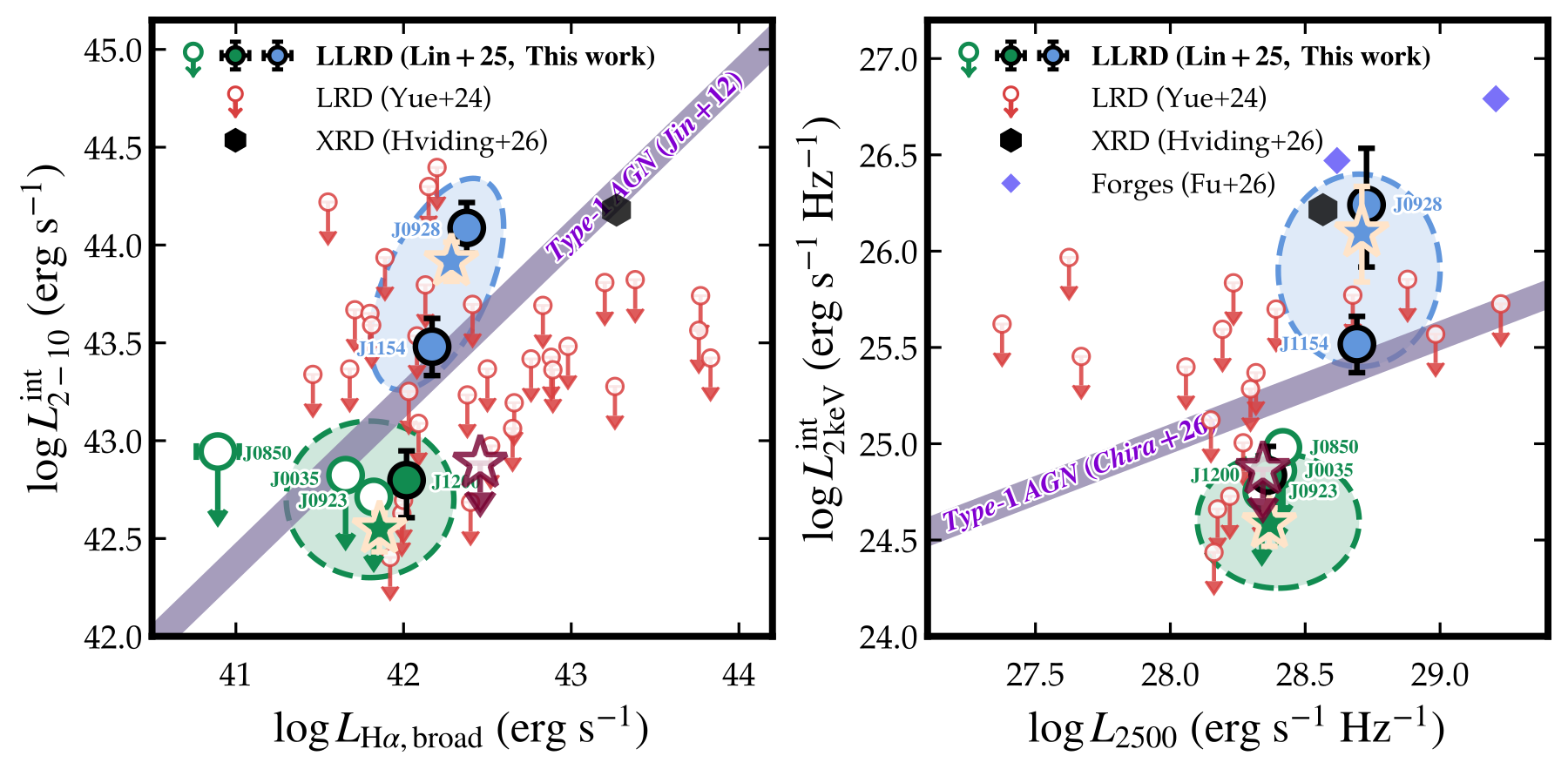 Figure 2 · Open paper
Figure notes (3)
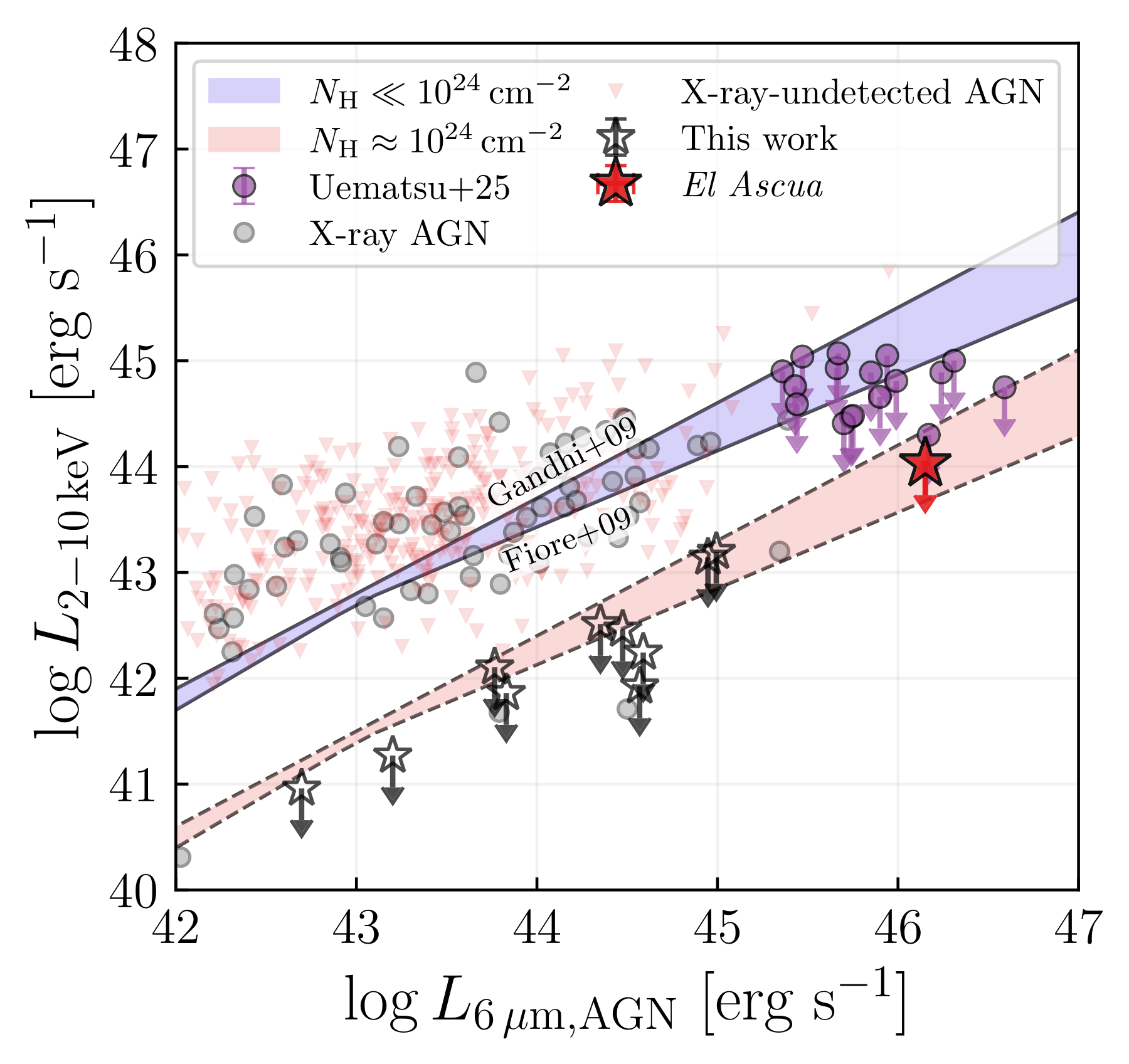
- Figure 2. Tests whether individual and stacked LLRDs are X-ray normal or deficient relative to broad-Hα and UV quasar scaling relations, while placing them against published high-redshift LRD limits.
- Figure 3. Tests which normalized UV-to-X-ray SED/model combinations resemble X-weak and X-normal LLRDs versus stacked LRD constraints, including unobscured super-Eddington, Compton-thick, Compton-thin, and mildly X-ray-weak cases.
- Figure 4. Tests whether broad/narrow Balmer ratios and Balmer-break strength independently support the X-normal/X-weak split and columns in the moderate-obscuration regime.