2610.33155v1 · First listed 2026-10-27
$El\ Ascua$: An ultra-luminous, radio-loud, Compton-thick AGN at $z\sim 3.8$ hiding in plain sight revealed by MINERVA multi-band MIRI observations
MINERVA/MIRI identifies el Ascua at z~3.8 as a mid-IR-dominant, X-ray-undetected Compton-thick AGN candidate. UV-to-radio SED fitting indicates rapid black-hole growth and a probable AGN radio excess, but obscuration and radio-loudness remain indirect inferences. [1][4]
Evidence
The study concerns one UDS source, el Ascua, selected with multi-band JWST/MIRI data and modeled from rest-UV through radio with CIGALE. The fit gives log(Lacc/erg s−1)=47.12±0.58, log(M⋆/M⊙)=10.82±0.57, and a 100-Myr-averaged SFR of 157±8 M⊙ yr−1. Its 3–30 μm AGN fraction is about 90%. Chandra provides a non-detection rather than an X-ray flux measurement; the authors infer Compton-thick obscuration by comparing the resulting 2–10 keV upper limit with the AGN 6-μm luminosity. ALMA detects 870-μm emission and the VLA detects 1.4-GHz emission. The IR-to-radio ratio is interpreted as a radio excess, hence as evidence that the radio emission is likely AGN-driven rather than star-formation-driven. [1][2][5][4]
Earlier work
The authors place el Ascua among similarly luminous z~4 Compton-thick AGN, while describing it as slightly less luminous than Hot DOGs and extremely red quasars; they further state it is one to two orders of magnitude more luminous than local Compton-thick AGN. For host–black-hole co-growth, their BHAR/SFR is 0.020±0.002 even under an efficiency ε=0.42, versus ~0.01 reported for a stack of local LIRGs with high AGN fractions. These are author-provided comparisons, not matched-sample measurements made anew here. [7][10]
What changes
The reported advance is the identification and multiwavelength characterization of this individual, very luminous, X-ray-faint MIRI source as a Compton-thick candidate at z~3.8. The analysis combines MIRI-constrained hot-dust emission with an X-ray upper limit, ALMA cold-dust imaging, and VLA radio information in a single SED framework. The host is spatially resolved in the reported NIRCam measurements: the F444W half-light radius is 1.20(+0.01/−0.02) kpc, so the authors explicitly distinguish it from little red dots, whose typical rest-optical sizes are stated to be <0.1 kpc. [4][2]
Limits and open questions
Compton-thickness is inferred from an X-ray non-detection and mid-IR/X-ray comparison, not from a direct X-ray spectral NH constraint in the supplied material. Several central quantities are SED-derived and depend on decomposition: the authors note that far-IR coverage of the dust peak is needed to separate AGN-heated from star-formation-heated cold dust. The inferred BHAR is also efficiency-sensitive, changing from 20.4±3.1 M⊙ yr−1 at ε≈0.1 to 3.23±0.24 M⊙ yr−1 at ε≈0.42. Finally, the redshift is photometric and the radio-excess interpretation is probabilistic (“likely” AGN-driven). [2][9][1]
Evidence includes the abstract and selected HTML extraction from the source-properties/discussion section, plus supplied captions. The supplied excerpts do not include full target selection, photometry, CIGALE configuration, X-ray upper-limit calculation, or uncertainty-propagation procedures.
Key figures
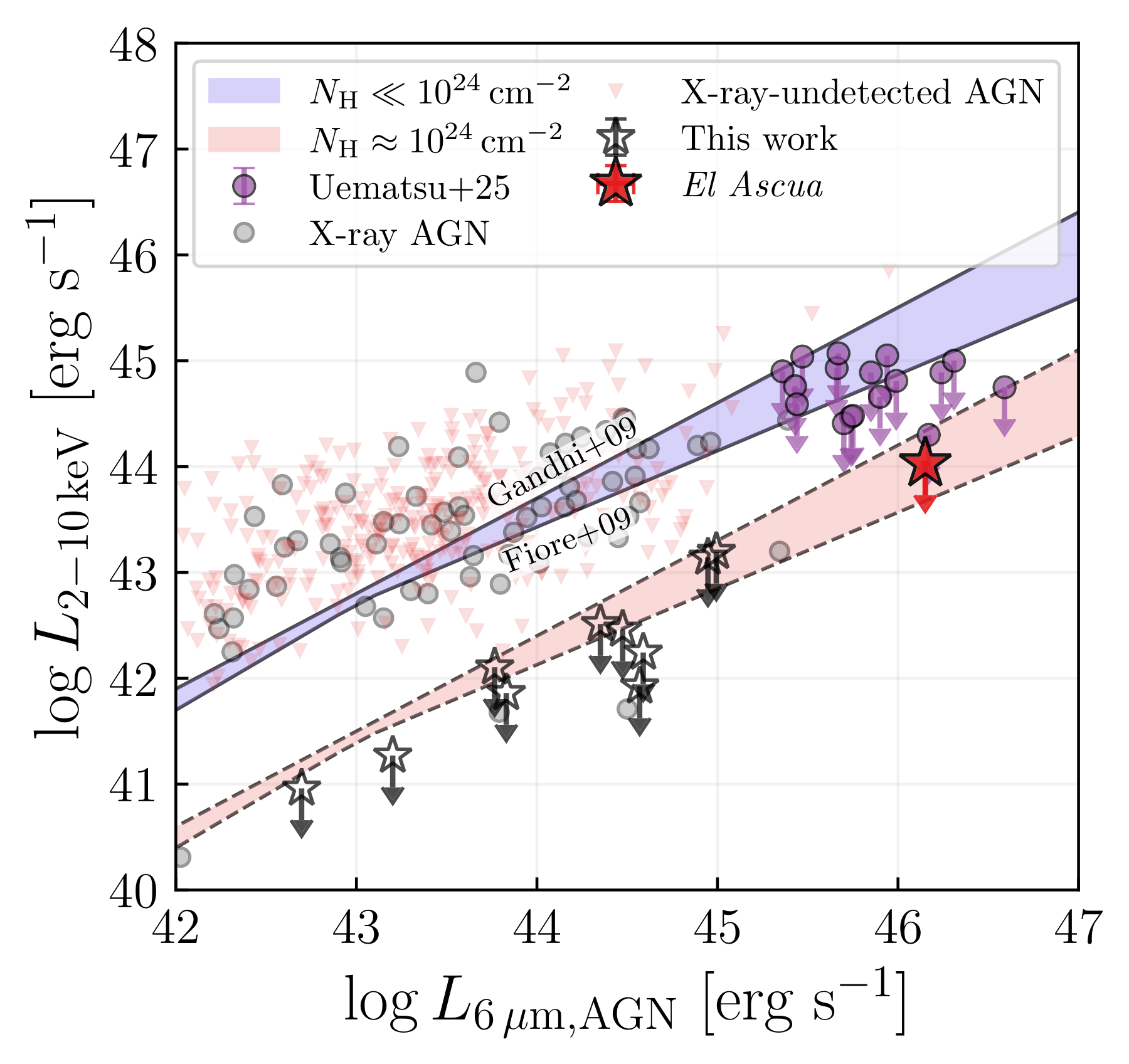
Tests the Compton-thick interpretation by locating el Ascua in observed X-ray luminosity versus SED-derived AGN 6-μm luminosity, relative to unobscured and NH≈10^24 cm−2 reference relations. Its diagnostic power rests on an X-ray upper limit rather than a detection.
Original caption
Figure 1: The discovery of a remarkably mid-IR bright ( L 6 μ m , AGN ≳ 10 46 erg s − 1 L_{6\,\rm\mu m,AGN}\gtrsim 10^{46}\,\rm erg\;s^{-1} ) CT AGN candidate ( el Ascua ; red star) from a larger sample of CT AGN (shown with black stars). This plot shows the observed X-ray luminosity as a function of the intrinsic 6 μ \mu m AGN luminosity as obtained from SED fitting. The log-linear relation for unobscured (or Compton-thin) AGN is shown in light blue, as a shaded region between two different estimates from Gandhi et al. [40] and Fiore et al. [39] . X-ray detected AGN in UDS which were detected with MINERVA MIRI imaging are shown as gray dots which roughly follows the shaded region for unobscured AGN. The relation for AGN with absorption of N H ≈ 10 24 cm − 2 N_{H}\approx 10^{24}\,\rm cm^{-2} is shown in light red, and it corresponds to a normalization factor of ≈ 20 \approx 20 fainter in the X-ray luminosity [ 68 ] . A sample of obscured candidate AGN in the COSMOS field are shown as purple dots [ 102 ] .
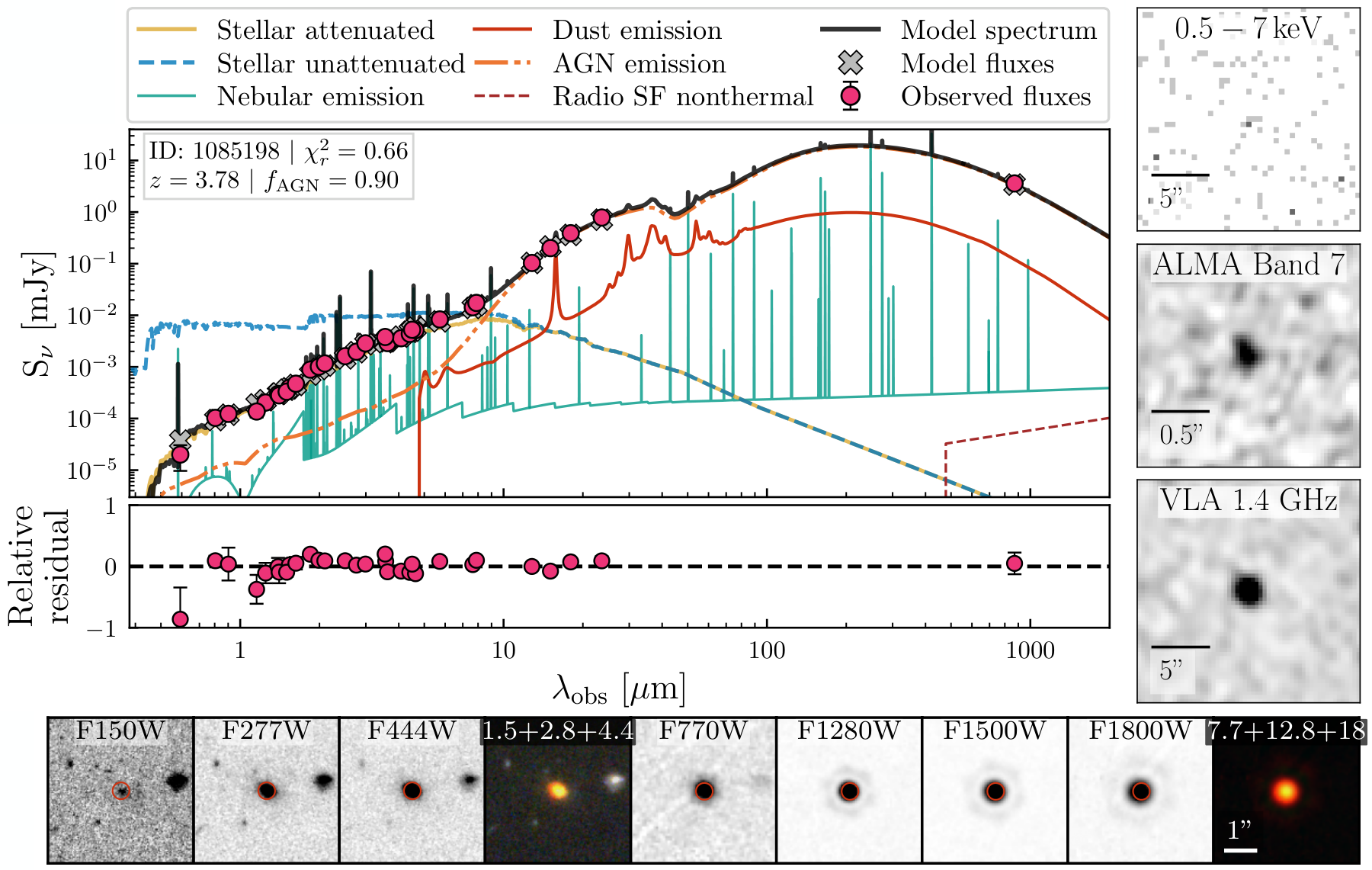
Tests whether one UV-to-radio SED and the resolved multi-band images consistently support a dust-obscured, mid-IR-luminous AGN: it juxtaposes the CIGALE fit with JWST, Chandra, ALMA, and VLA cutouts, including the Chandra non-detection.
Original caption
Figure 2: The best-fit SED from CIGALE and image cutouts in JWST filters, Chandra 0.5 − 2 keV 0.5-2\,\rm keV , ALMA Band 7, and VLA 1.4 GHz. We also present a NIRCam RGB image using F150W (1.5 μ \mu m), F277W (2.8 μ \mu m), and F444W (4.4 μ \mu m); and a MIRI RGB using F770W (7.7 μ \mu m), F1280W (12.8 μ \mu m), and F1800W (18 μ \mu m). Both the SED and the JWST cutouts show a luminous mid-IR AGN and dust-attenuated starlight in the rest-UV and optical. The ALMA Band 7 map shows compact cold dust emission, and the AGN is undetected by Chandra . The mid-IR brightness combined with the inferred X-ray flux upper limit suggest CT obscuration. We also find a radio excess at 1.4 GHz with our updated measurement of the total IR luminosity. This excess is likely AGN-driven, meaning that el Ascua may be a rare radio-loud CT AGN.

Tests the radio-excess claim by comparing the SED-derived star-formation IR luminosity to 1.4-GHz radio power through qTIR(z), against empirical star-forming and radiatively efficient AGN populations.
Original caption
Figure 3: The observed ratio for el Ascua between SF-driven IR luminosity and the 1.4 GHz radio power, measured with CIGALE , is consistent with an AGN-driven radio excess. We present empirical curves from Delhaize et al. [32] for the ratio q TIR ( z ) q_{\rm TIR}(z) as a function of redshift in different source populations. Star-forming galaxies are shown in blue and green, while all sources are shown in orange and ‘radiatively efficient’ AGN are shown in red. We note that this population of radiatively efficient AGN are mostly radio-quiet [ 33 , 93 ] .
Related research
Previous digest
Using MINERVA multi-band JWST/MIRI imaging in UDS, Cloonan et al. identify el Ascua, an exceptionally mid-IR-bright AGN at z≈3.8 that was missed in X-rays. UV-to-radio SED fitting finds a dusty, actively star-forming host with log(M⋆/M⊙)=10.82±0.57 and SFR=157±8 M⊙ yr⁻¹, alongside an intrinsic AGN accretion luminosity of log(Lacc/erg s⁻¹)=47.12±0.58. Its X-ray upper limit relative to the inferred 6 μm AGN luminosity supports Compton-thick obscuration, while a 1.4 GHz excess points to the rare combination of a radio-loud, Compton-thick quasar nearing the peak of buried black-hole growth.
Sources and evidence (26)
- 2610.33155v1: $El\ Ascua$: An ultra-luminous, radio-loud, Compton-thick AGN at $z\sim 3.8$ hiding in plain sight revealed by MINERVA multi-band MIRI observations
Heavily dust-obscured active galactic nuclei (AGN) are crucial for understanding supermassive black hole growth. Using multi-band MIRI photometry from the MINERVA survey, we report the discovery in the UDS field of an extremely mid-infrared bright Compton-thick AGN (CT AGN) at $z \sim 3.8$, \textit{el Ascua} (the Ember). The AGN and/or its host galaxy is detected at 870\,$μ$m with ALMA and at 1.4\,GHz with the VLA. With UV-to-radio spectral energy distribution modeling, we estimate that the dusty host galaxy has a stellar mass of $\log\left( M_\star / M_\odot \right)=10.82 \pm 0.57$ and a star formation rate of ${\rm{SFR}} =157 \pm 8 \,M_\odot\,{\rm yr^{-1}}$, and we confirm the presence of a powerful dusty AGN with an intrinsic accretion luminosity of $\log\left( L_{\rm{acc}} /{\rm erg\,s^{-1}} \right)=47.12 \pm 0.58$. CT obscuration is revealed by comparing the upper limit on the X-ray luminosity over $2-10 \,{\rm{keV}}$ with the $6 \,{\rmμ{m}}$ mid-IR AGN luminosity. We additionally find evidence for a radio excess by comparing its total IR-to-radio ratio to those of typical star-forming galaxies and radio-quiet AGN, implying that \textit{el Ascua} could be a rare radio-loud CT AGN. With an extremely high ratio between black hole accretion rate and SFR, the AGN is likely nearing the peak of a deeply obscured phase of black hole growth before AGN feedback blows away the obscuring material. Our work demonstrates the power of MIRI to reveal heavily obscured AGN missing from our supermassive black hole census.
- 2610.33155v1: $El\ Ascua$: An ultra-luminous, radio-loud, Compton-thick AGN at $z\sim 3.8$ hiding in plain sight revealed by MINERVA multi-band MIRI observations
We present the best-fit CIGALE SED from the rest-UV to the far-IR alongside image cutouts from X-ray to radio in Figure 2 . The SED fit to the rest-frame mid-IR (probed by MIRI and Spitzer 24 μ m \rm 24\,\mu m ) provides strong evidence of hot dust emission as found in obscured AGN [ 52 ] , with an estimated AGN fraction of ≈ 90 % \approx 90\% over 3 − 30 μ m 3-30\,\rm\mu m . The inferred AGN fraction is similarly large over the full IR. As is typical for buried AGN in dusty galaxies we see faint, attenuated starlight in the rest-UV and optical, and the absorbed starlight is reprocessed as IR dust emission. Observations of the far-IR spectral peak are necessary to study the extent to which the observed cold dust emission is driven by the AGN as opposed to star formation. The observed X-ray flux is below the detection limit from the background, while the source is strongly detected at 1.4 GHz 1.4\,\rm GHz . The half-light radius in F200W from the morphology catalog is 1.86 − 0.12 + 0.12 1.86^{+0.12}_{-0.12} kpc, which is near the median for massive star-forming galaxies at 3 < z < 4 3<z<4 [ 24 ] . In F444W the half-light radius is 1.20 − 0.02 + 0.01 1.20^{+0.01}_{-0.02} kpc, indicating that el Ascua is not a little red dot as its rest-optical flux is more extended than the typical < 0.1 kpc <0.1\,\rm kpc for LRDs [ 11 , 25 ] .
- 2610.33155v1: $El\ Ascua$: An ultra-luminous, radio-loud, Compton-thick AGN at $z\sim 3.8$ hiding in plain sight revealed by MINERVA multi-band MIRI observations
Table 1: A number of observables and physical properties of el Ascua , the extreme CT AGN reported in this work. The rows are in order as follows: the right ascension, the declination, the photometric redshift ( z phot z_{\rm phot} ), the AGN fraction over 3 − 30 μ m 3-30\,\rm\mu m ( f AGN f_{\rm AGN} ), the sub-mm flux at 870 μ \mu m from ALMA, the mid-IR continuum luminosity at 6 μ m \rm 6\,\mu m from the AGN component ( L 6 μ m , AGN L_{\rm 6\,\mu m,AGN} ) and the total SED ( L 6 μ m , tot L_{\rm 6\,\mu m,tot} ), the X-ray luminosity over 2 − 10 keV \rm 2-10\,keV ( L 2 − 10 keV L_{\rm 2-10\,keV} ), the accretion power (or the angle-averaged intrinsic disk luminosity; L acc L_{\rm acc} ), the black hole accretion rate ( BHAR {\rm BHAR} ) assuming a radiative efficiency of ϵ = 0.1 \epsilon=0.1 , the host galaxy stellar mass ( M ⋆ M_{\star} ), the star formation rate (SFR) over the last 100 Myr from the SED fitting, the integrated IR luminosity over 8 − 1000 μ m \rm 8-1000\,\mu m ( L IR L_{\rm IR} ), the component of L IR L_{\rm IR} from star formation ( L IR , SF L_{\rm IR,SF} ), the radio power at 1.4 GHz ( P 1.4 GHz P_{\rm 1.4\,GHz} ), and a log-ratio ( q TIR q_{\rm TIR} ) between L IR , SF L_{\rm IR,SF} and P 1.4 GHz P_{\rm 1.4\,GHz} .
- 2610.33155v1: $El\ Ascua$: An ultra-luminous, radio-loud, Compton-thick AGN at $z\sim 3.8$ hiding in plain sight revealed by MINERVA multi-band MIRI observations
Figure 2: The best-fit SED from CIGALE and image cutouts in JWST filters, Chandra 0.5 − 2 keV 0.5-2\,\rm keV , ALMA Band 7, and VLA 1.4 GHz. We also present a NIRCam RGB image using F150W (1.5 μ \mu m), F277W (2.8 μ \mu m), and F444W (4.4 μ \mu m); and a MIRI RGB using F770W (7.7 μ \mu m), F1280W (12.8 μ \mu m), and F1800W (18 μ \mu m). Both the SED and the JWST cutouts show a luminous mid-IR AGN and dust-attenuated starlight in the rest-UV and optical. The ALMA Band 7 map shows compact cold dust emission, and the AGN is undetected by Chandra . The mid-IR brightness combined with the inferred X-ray flux upper limit suggest CT obscuration. We also find a radio excess at 1.4 GHz with our updated measurement of the total IR luminosity. This excess is likely AGN-driven, meaning that el Ascua may be a rare radio-loud CT AGN.
- 2610.33155v1: $El\ Ascua$: An ultra-luminous, radio-loud, Compton-thick AGN at $z\sim 3.8$ hiding in plain sight revealed by MINERVA multi-band MIRI observations
The properties of el Ascua and its host galaxy are measured directly from the CIGALE SED fitting; the MIR AGN fraction ( f AGN f_{\rm AGN} ), the accretion power of the AGN ( L acc L_{\rm acc} ), the stellar mass ( M ⋆ M_{\star} ) and star formation rate (SFR; over the last 100 Myr 100$\mathrm{M}\mathrm{y}\mathrm{r}$ ) of the host galaxy, and the total IR luminosity of the source (galaxy + + AGN) over 8 − 1000 μ m 8-1000\,\rm\mu m . The values of these properties are listed in Table 1 , along with basic information including sky coordinates and photometric redshift. The accretion power ( L acc L_{\rm acc} ) provided by CIGALE is defined as the intrinsic (i.e., corrected for absorption) luminosity of the accretion disk averaged over viewing angle.
- 2610.33155v1: $El\ Ascua$: An ultra-luminous, radio-loud, Compton-thick AGN at $z\sim 3.8$ hiding in plain sight revealed by MINERVA multi-band MIRI observations
El Ascua is among the most extreme AGN at z ∼ 4 z\sim 4 which belong to the missing obscured population known from the cosmic X-ray background [ 101 , e.g.,] and from comparing MIR and X-ray luminosity functions [ 88 , 18 , LFs; e.g.,] . Unsurprisingly, with log ( L acc / erg s − 1 ) ∼ 47 \log\left(L_{\rm acc}/$\mathrm{e}\mathrm{r}\mathrm{g}$\;$\mathrm{s}$^{-1}\right)\sim 47 , it falls at the luminous end of the MIRI AGN LF at z ∼ 4 z\sim 4 . However, the MIR and X-ray LFs at z ∼ 4 z\sim 4 begin to converge around log ( L acc / erg s − 1 ) ∼ 47 \log\left(L_{\rm acc}/$\mathrm{e}\mathrm{r}\mathrm{g}$\;$\mathrm{s}$^{-1}\right)\sim 47 ; in other words, the fraction of missing X-ray-faint AGN decreases as L acc L_{\rm acc} increases toward log ( L acc / erg s − 1 ) ∼ 47 \log\left(L_{\rm acc}/$\mathrm{e}\mathrm{r}\mathrm{g}$\;$\mathrm{s}$^{-1}\right)\sim 47 [ 18 ] . We argue that while CT AGN are likely common overall at z ∼ 4 z\sim 4 , CT AGN of such high luminosity as el Ascua are statistically rare.
- 2610.33155v1: $El\ Ascua$: An ultra-luminous, radio-loud, Compton-thick AGN at $z\sim 3.8$ hiding in plain sight revealed by MINERVA multi-band MIRI observations
Additionally, el Ascua is of similar luminosity to other remarkably bright CT AGN at z ∼ 4 z\sim 4 [ 42 , 106 , 104 , e.g.,] , and it is slightly less luminous than hot dust-obscured galaxies [ 38 , 107 , 71 , hot DOGs;] and the rare ‘extremely red quasars’ [ 77 ] . Compared to local CT AGN, el Ascua is one or two orders of magnitude more luminous [ 94 , 95 , 6 , e.g.,] .
- 2610.33155v1: $El\ Ascua$: An ultra-luminous, radio-loud, Compton-thick AGN at $z\sim 3.8$ hiding in plain sight revealed by MINERVA multi-band MIRI observations
From L acc L_{\rm acc} , we compute the black hole accretion rate (BHAR) following the formalism used by Marconi et al. [79] and Yang et al. [110] :
- 2610.33155v1: $El\ Ascua$: An ultra-luminous, radio-loud, Compton-thick AGN at $z\sim 3.8$ hiding in plain sight revealed by MINERVA multi-band MIRI observations
where ϵ \epsilon is the radiative efficiency and c c is the speed of light. This formalism for BHAR is derived by subtracting the fraction of mass converted into radiation from the total accreted mass, assuming spherical accretion. For el Ascua , we estimate BHAR = 20.4 ± 3.1 M ⊙ yr − 1 \rm BHAR=20.4\pm 3.1\,M_{\odot}$\mathrm{y}\mathrm{r}$^{-1} assuming a population-average ϵ ≈ 0.1 \epsilon\approx 0.1 . If we instead assume a theoretical maximum of ϵ ≈ 0.42 \epsilon\approx 0.42 [ 99 , 5 ] for a rapidly rotating Kerr black hole, we find BHAR = 3.23 ± 0.24 M ⊙ yr − 1 \rm BHAR=3.23\pm 0.24\,M_{\odot}$\mathrm{y}\mathrm{r}$^{-1} .
- 2610.33155v1: $El\ Ascua$: An ultra-luminous, radio-loud, Compton-thick AGN at $z\sim 3.8$ hiding in plain sight revealed by MINERVA multi-band MIRI observations
The SMBH in el Ascua is growing more quickly than anticipated from the galaxy stellar mass and SFR. Even with the upper limit of ϵ ≈ 0.42 \epsilon\approx 0.42 from theory, we find a large ratio of BHAR / SFR = 0.020 ± 0.002 \rm BHAR/SFR=0.020\pm 0.002 . For reference, Stone et al. [98] find a characteristic BHAR / SFR \rm BHAR/SFR of ∼ 0.01 \sim 0.01 for a stack of LIRGs at z ∼ 0 z\sim 0 with f AGN ≈ 0.96 f_{\rm AGN}\approx 0.96 . A related metric, the specific BHAR (sBHAR), paints the same picture and can be defined as a modified ratio of AGN accretion power to galaxy stellar mass [ 48 ] :
- 2603.22393v1: MEOW: The increase in the obscured AGN fraction in mid-infrared from 0 < z < 6 with JWST MIRI
Based on the CIGALE SED fitting results, we further identify and characterize the parent AGN sample in the following subsection. We additionally visually inspected all sources and removed spurious objects (about ≈ 1 % \approx 1\% of the total objects), such as saturated stars, also confirmed by the high χ 2 \chi^{2} reported in CIGALE .
- 2603.22393v1: MEOW: The increase in the obscured AGN fraction in mid-infrared from 0 < z < 6 with JWST MIRI
The results of our study point towards high obscured fractions, as high as f obsc ≈ 98 − 99 % f_{\mathrm{obsc}}\approx 98-99\% in the highest redshift bin. Taken at face value, this could alleviate some of the tension raised by the short UV-luminous duty cycles of order ∼ 0.1 − 1 % \sim 0.1-1\% reported by recent studies at z ≳ 6 z\gtrsim 6 [ 36 , 94 , 103 , 53 ] , as it would imply that black hole accretion timescales are nearly two orders of magnitude larger.
- 2507.22206v1: The X-ray Link Between High Eddington Ratio Dust-Obscured Galaxies (DOGs) and Hot DOGs
Although the statistical λ Edd \lambda_{\mathrm{Edd}} uncertainties may not allow a firm conclusion on log λ Edd > − 0.5 \log\lambda_{\mathrm{Edd}}>-0.5 for individual sources, they are sufficiently small to prove that our sample as a whole can represent high- λ Edd \lambda_{\mathrm{Edd}} DOGs – if adopting 0.5 dex as the nominal uncertainty for J0825+3002’s log λ Edd \log\lambda_{\mathrm{Edd}} , the uncertainty of the weighted arithmetic mean log λ Edd \log\lambda_{\mathrm{Edd}} of our sample would be only 0.06. However, systematic uncertainties are not directly considered here and may be more prominent. The most relevant uncertainty is the viability of using broad lines to infer M BH M_{\mathrm{BH}} for DOGs. In fact, the origin of the broad lines in such heavily X-ray obscured systems has been under continuous investigation. Relevantly, it is not uncommon for Hot DOGs to show broad lines [ 52 , 57 , 17 , 26 , 34 ] . The broad lines of some Hot DOGs are suggested to be potentially from outflows instead of the broad-line region (e.g, L. Finnerty et al. 17 , H. D. Jun et al. 26 ). However, follow-up studies of a subpopulation of Hot DOGs that show significant excess blue emission [ 2 , 3 , 4 ] revealed that the blue emission and their broad lines should be the scattered light from central AGNs based on, e.g., multiwavelength and polarimetry observations. G. Li et al. [34] further argued that, for general Hot DOGs, their broad lines may also be mainly scattered emission, and hence these broad lines can be used to estimate M BH M_{\mathrm{BH}} . For our DOGs specifically, F. Zou et al. [60] showed that their broad Mg ii line profiles are generally different from the outflow [O iii ] profiles (see their Section 5.2 for more discussion). Therefore, the broad lines of our sources are highly likely also from scattered emission from the broad-line regions. Nevertheless, an outflow origin cannot be deterministically ruled out, and this is a fundamental caveat for not only our DOGs but also all the Hot DOGs and relevant works in general.
- 2507.22206v1: The X-ray Link Between High Eddington Ratio Dust-Obscured Galaxies (DOGs) and Hot DOGs
In this section, we will first present the new Chandra observations (Section III.1 ) and N H N_{\mathrm{H}} constraints (Section III.2 ) for four sources in our sample and then combine them with the remaining three archival sources in our sample to discuss the implications for high- λ Edd \lambda_{\mathrm{Edd}} DOGs (Section III.3 ).
- 2508.02792v1: Luminous Mid-IR Selected Obscured Quasars at Cosmic Noon in SDSS Stripe82 II: Spectroscopic Diversity and Broad H$α$ Emissions
The Gemini/GNIRS observation contains two ABBA sequences, eight exposures for every target. The Pypeit pipeline produces four 2-D spectra for each object. We check these 2-D spectra to find the object manually and then coadd the 2-D spectra using the object as a reference. This results in one coadded 2-D spectrum. The 1-D spectra are extracted manually or automatically from the coadded 2-D spectra. Then we apply the flux calibration and telluric correction on the 1-D spectra using the standard star.
- 2508.02792v1: Luminous Mid-IR Selected Obscured Quasars at Cosmic Noon in SDSS Stripe82 II: Spectroscopic Diversity and Broad H$α$ Emissions
In this section, we present the emission line fitting results. We discuss the spectral diversity based on the line width of Ly α \alpha and H α \alpha , and the relation between the bolometric luminosity and the [O III] line luminosity.
- 2504.13658v1: SRGAJ230631.0+155633: an extremely X-ray luminous, heavily obscured, radio-loud quasar at z=0.44 discovered by SRG/ART-XC
Of course, the Swift /BAT all-sky survey is a fairly shallow one, with a sensitivity of 1.3 × 10 − 11 1.3\times 10^{-11} erg s -1 or better in the 14–195 keV energy band over 90% of the sky for the 70-month survey ( Baumgartner et al., 2013 ) . This, assuming a power-law spectrum with Γ = 1.8 \Gamma=1.8 and a E cut = 150 E_{\rm cut}=150 keV, implies that quasars with L X > 3 × 10 45 L_{\rm X}>3\times 10^{45} erg s -1 (such as SRGA J2306+1556 in its high state) are robustly detectable by Swift /BAT out to z = 0.336 z=0.336 . Therefore, the presence of just one such high-luminosity AGN up to this redshift in the Swift /BAT catalog (Swift J1822.0+6421, z = 0.297 z=0.297 , L X ≈ 5.9 × 10 45 L_{\rm X}\approx 5.9\times 10^{45} erg s -1 , unobscured) means that it is indeed alone in the entire low-redshift Universe.
- 2504.13658v1: SRGAJ230631.0+155633: an extremely X-ray luminous, heavily obscured, radio-loud quasar at z=0.44 discovered by SRG/ART-XC
In fact, apart from X-ray surveys, luminous obscured quasars can also be discovered in low-frequency radio surveys, which are virtually unaffected by intrinsic absorption. A large sample of FR II galaxies selected from the 3CRR catalog ( Laing et al., 1983 ) up to z ∼ 2.5 z\sim 2.5 has been observed with modern soft X-ray telescopes ( Massaro et al., 2015 ; Jimenez-Gallardo et al., 2020 , see, e.g.) . Utilizing data from this sample Kuraszkiewicz et al. (2021) have shown that luminous narrow-line radio galaxies (NLRGs), resembling SRGA J2306+1556, are fairly frequent at 0.5 < z < 1 0.5<z<1 . This is consistent with AGN statistics inferred from deep (pencil-beam) X-ray surveys, which probe the high-redshift Universe. The measured AGN X-ray luminosity function (XLF) shows that the number density of luminous ( L X ≳ 10 45 L_{\rm X}\gtrsim 10^{45} erg s -1 ) quasars increases rapidly with redshift up to z ∼ 2 z\sim 2 and that ∼ 20 \sim 20 % (this fraction tends to decrease with increasing luminosity) of them are obscured (e.g. Ueda et al. 2014 ).
- 2603.17967v1: JWST Reveals Two Overmassive Black Hole Candidates in Dwarf Galaxies at z $\approx$ 0.7: Pushing Black Hole Searches into the Dwarf-Galaxy Regime
We report the values of sample variance, mean square error, excess variance, fractional variability (and 3 σ 3\sigma upperlimit) of our target Pelias in Table 5 . The resulting 3 σ 3\sigma upper limits on the intrinsic fractional variability range from F var , 3 σ < 0.18 F_{\rm var,3\sigma}<0.18 (F115W) to F var , 3 σ < 0.47 F_{\rm var,3\sigma}<0.47 (F277W), implying no evidence for significant variability at the ≤ 20 − 50 \leq 20-50 % level, depending on filter, thus ruling out any possible impact of transient phenomena at the origin of our target SED shape.
- 2603.17967v1: JWST Reveals Two Overmassive Black Hole Candidates in Dwarf Galaxies at z $\approx$ 0.7: Pushing Black Hole Searches into the Dwarf-Galaxy Regime
s on the order of log 10 ( M ∙ [ M ⊙ ] ) = 5.8 − 6.8 \log_{10}(M_{\bullet}\penalty\ [\rm M_{\odot}])=5.8-6.8 (see § 3.5 ), assuming λ = 1 \lambda=1 and 0.1, respectively. When compared to the total stellar mass of the host galaxies, such SMBH masses result in constituting from 6% to 60% of it. Even allowing for substantial systematic uncertainties in the SED-based M ∙ M_{\bullet} estimates, such ratios lie well above the extrapolation of the local M ∙ M_{\bullet} - M ⋆ M_{\star} relation into the dwarf regime, see Figure 7 . This suggests that either the black holes in these systems are already over-massive relative to their hosts, or that we are catching the galaxies at an early phase in which the stellar component has not yet “caught up” with the rapid black hole growth. Interestingly, similarly extreme black-hole-to-stellar mass ratios have been proposed in other low- z z dwarf galaxies. The Local Group dwarf Leo I ( McConnachie, 2012 , M ⋆ ≈ 10 6.7 M ⊙ M_{\star}\approx 10^{6.7}\penalty\ \rm M_{\odot} ) may host a black hole with mass comparable to that of its stellar component, implying M ∙ / M ⋆ ≈ 1 M_{\bullet}/M_{\star}\approx 1 , far above the local scaling relations and potentially reflecting the relic signature of an early heavy-seed black hole ( Bustamante-Rosell et al., 2021 ; Scoggins et al., 2025 , e.g.,) . Recently, also Young et al. (2026) reported the identification of two galaxies at z ≲ 1 z\lesssim 1 with candidate intermediate mass BHs that also lie above the local M ∙ − M ⋆ M_{\bullet}-M_{\star} relation, one of which at similar M ⋆ M_{\star} to our targets (ID 3976, z phot = 1.03 z_{\rm phot}=1.03 ).
- 2609.30441v1: A tidal disruption event in a quasar at redshift 7.19
Table 1: Summary of available photometric data of GNz7q used in this study
- 2609.30441v1: A tidal disruption event in a quasar at redshift 7.19
Figure 9 shows the resulting normalized light curves for these comparison sources, including only measurements with S / N > 3 {\rm S/N}>3 . None of the control objects exhibits statistically significant long-term or wavelength-dependent variability comparable to that observed in GNz7q. The absence of correlated variability in these sources demonstrates that the observed behavior of GNz7q cannot be attributed to instrumental differences, filter-response mismatches, PSF variations, or details of the photometric extraction, and instead reflects genuine intrinsic variability of the source.
- 2607.19491v1: Rapid growth in a dual AGN during a gas-rich merger at z~4.5
solating nuclear emission lines even when the underlying host galaxies are invisible. Our results suggest that close-separation (< 3 kpc) dual AGNs may have been missed in previous surveys owing to heavy obscuration, thereby biasing current census estimates. Systematic IFU studies with JWST, complemented by adaptive-optics (AO)-assisted near-infrared IFU spectroscopy from the ground (i.e., Gemini/GNIRS, Gemini/GIRMOS, Keck/OSIRIS, VLT/ERIS) and future 30-m class telescopes, will be essential for revealing this missing population and establishing the true role of mergers in driving rapid SMBH growth across cosmic time.
- 2607.19491v1: Rapid growth in a dual AGN during a gas-rich merger at z~4.5
M.V., G.H., F.C., A.G., A.F., S.O. helped with the interpretation of the results and provided comments on the analysis. All authors contributed to the discussion of the presented results and the preparation of the manuscript.
- 2509.15331v1: Modeling the JWST MIRI Counts, Insights Into the Source Properties and Role of Dust-Obscured AGN
We investigate the effects of cosmic variance by randomly placing MIRI-like pointings (FOV ∼ 2.3 arcmin 2 \sim 2.3\,\rm arcmin^{2} ) within the 2 deg 2 2\,\rm deg^{2} lightcones. We are able to reproduce the observed roughly factor of 2 field-to-field variation seen in L. Sajkov et al. [85] among individual MIRI pointings. We also quantify the fractional error σ AGN / N ¯ ( > S ) AGN \sigma_{\rm AGN}/\bar{N}(>S)_{\rm AGN} for bright, rare AGN as a function of survey area. This suggests that surveys of order 30-40 arcmin 2 such as SMILES have a roughly ∼ 30 % \sim 30\% cosmic variance error in the AGN counts.
- 2509.15331v1: Modeling the JWST MIRI Counts, Insights Into the Source Properties and Role of Dust-Obscured AGN
We repeat this process 5000 times, computing the median and 1 σ \sigma confidence interval of the redshift distribution across the samples. Fig 13 shows the resultant median and 1 σ \sigma spread relative to the measured redshift distribution from L. Sajkov et al. [85] . For each monte-carlo realization, we perform a two-sample Kolmogorov-Smirnov (KS) test against the observed distribution. The two distributions are qualitatively similar, and the median and 1 σ \sigma spread show good agreement. There is a spread in the KS p p values due to cosmic variance, but they suggest the simulated and observed redshift distributions are statistically distinct. Some of the differences can be attributed by 15% of the MIRI F560W sources in L. Sajkov et al. [85] not having matches in COSMOS2020. These sources would most likely boost the z ∼ 1 − 5 z\sim 1-5 portion of the observed redshift distribution, leading to closer agreement with the model. We are also affected by small number statistics where each count per bin in the observed redshift distribution has a non-negligible Poisson error.
Abstract
Heavily dust-obscured active galactic nuclei (AGN) are crucial for understanding supermassive black hole growth. Using multi-band MIRI photometry from the MINERVA survey, we report the discovery in the UDS field of an extremely mid-infrared bright Compton-thick AGN (CT AGN) at $z \sim 3.8$, \textit{el Ascua} (the Ember). The AGN and/or its host galaxy is detected at 870\,$μ$m with ALMA and at 1.4\,GHz with the VLA. With UV-to-radio spectral energy distribution modeling, we estimate that the dusty host galaxy has a stellar mass of $\log\left( M_\star / M_\odot \right)=10.82 \pm 0.57$ and a star formation rate of ${\rm{SFR}} =157 \pm 8 \,M_\odot\,{\rm yr^{-1}}$, and we confirm the presence of a powerful dusty AGN with an intrinsic accretion luminosity of $\log\left( L_{\rm{acc}} /{\rm erg\,s^{-1}} \right)=47.12 \pm 0.58$. CT obscuration is revealed by comparing the upper limit on the X-ray luminosity over $2-10 \,{\rm{keV}}$ with the $6 \,{\rmμ{m}}$ mid-IR AGN luminosity. We additionally find evidence for a radio excess by comparing its total IR-to-radio ratio to those of typical star-forming galaxies and radio-quiet AGN, implying that \textit{el Ascua} could be a rare radio-loud CT AGN. With an extremely high ratio between black hole accretion rate and SFR, the AGN is likely nearing the peak of a deeply obscured phase of black hole growth before AGN feedback blows away the obscuring material. Our work demonstrates the power of MIRI to reveal heavily obscured AGN missing from our supermassive black hole census.
Discussion
Discussion access requires a security token. Register for the weekly digest.