2611.07070v1 · First listed 2026-11-06
On the importance of medium-resolution continuum spectroscopy for JWST's extragalactic legacy
This planning paper argues that deep JWST/NIRSpec medium-resolution continuum spectroscopy can turn high-redshift galaxy surveys from emission-line detections into measurements of stellar populations, neutral gas, and kinematics; its empirical EXCELS-based exposure scaling motivates a 1,000-hour survey concept. [1][5]
Evidence
Rather than presenting new physical inferences for a defined science sample, the authors calibrate survey feasibility with EXCELS medium-resolution NIRSpec spectra. They measure rest-optical continuum S/N per pixel as the mean over rest-frame 0.51–0.64 μm, retaining objects with >50% coverage. EXCELS used roughly 4 h in each of G140M, G235M, and G395M (5.5 h in G235M); S/N is then fit against the NIRCam band nearest rest-frame 0.55 μm. The authors report a linear magnitude–S/N behavior independent of redshift/grating under these conditions. They adopt S/N ≥20 per pixel at R=1000, with two pixels per resolution element, as the threshold for approximately 0.1-dex age and stellar-metallicity constraints. [4][5]
Earlier work
The supplied evidence supports a concrete depth-use comparison, not a matched survey-performance comparison: CEERS medium-resolution observations reached emission-line limits of about 1–2×10⁻18 erg s⁻¹ cm⁻², while its prism data detected continuum to m≈26. This paper contends that much existing NIRSpec spectroscopy was designed chiefly for line detection and advocates substantially deeper medium-resolution continuum observations. For LRDs specifically, it notes that broad Balmer and metal absorption profiles require medium resolution to constrain dense cool gas near a proposed central engine; this is an author framing rather than a demonstrated result of the proposed survey. [19][1][2]
What changes
The distinctive contribution is an empirically derived mapping from rest-optical apparent magnitude and NIRSpec medium-resolution exposure time to continuum S/N, claimed to be redshift-independent, plus a sketch 1,000-hour MSA program for a representative z>1.5 sample. The proposed observing goal is continuum S/N=20 per pixel, aimed at population-level scaling relations rather than solely individual line measurements. The authors estimate that, for an assumed intrinsic scatter of 0.2 dex, about 25 galaxies per mass–redshift bin yield mean values precise to about 0.04 dex; roughly 100 well-selected galaxies per redshift bin would populate four 0.3-dex mass bins from log10(M*/M⊙)=10.3–11.5. [1][3][5]
Limits and open questions
The supplied extraction does not give the fitted S/N relation’s coefficients, scatter, EXCELS sample size, selection function, or the detailed 1,000-hour target allocation, so its predictive uncertainty cannot be independently assessed here. The adopted S/N=20 threshold is conditional on R=1000 and the cited modeling assumptions, not a universal guarantee for every parameter or spectral type. Medium resolution also has relevant kinematic limits: an earlier NIRSpec study found line-spread-function broadening makes outflows below 150 km s⁻¹ undetectable and can inflate inferred velocities. Thus deep continuum data improve information content but do not remove resolution-driven selection effects. [4][18]
The abstract and selected HTML blocks support the survey rationale and EXCELS S/N methodology, but the supplied extraction omits the fitted equation, its scatter, sample size, detailed target selection, and full 1,000-hour implementation.
Key figures
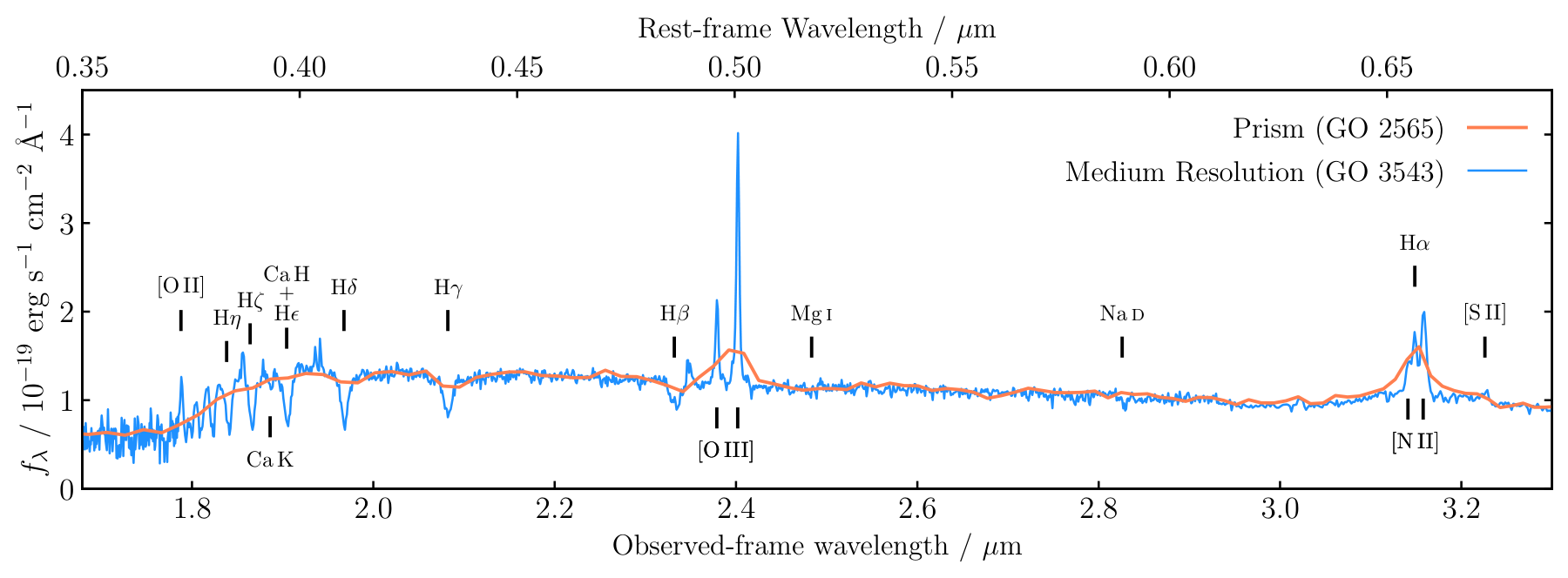
Tests the information lost at low resolution using a z=3.797 galaxy: prism R≈30–300 does not resolve Balmer-series structure around the 4000 Å break or the [O III]+Hβ and [N II]+Hα complexes, whereas medium resolution is intended to separate features used for ages, nebular properties, and kinematics.
Original caption
Figure 1: A direct comparison of NIRSpec prism and medium-resolution grating data for a galaxy at z = 3.797 z=3.797 . Key emission and absorption features necessary to derive physical properties are labelled. It can be seen that the R ≃ 30 − 300 R\simeq 30-300 prism data fails to resolve both the Balmer series lines in the 4000Å break region, crucial for age measurement, as well as the [O iii ]+H β \beta and [N ii ]+H α \alpha emission line complexes crucial for SFR, gas-phase metallicity, ionization state and kinematic measurements.
Tests the empirical exposure-planning premise by plotting EXCELS rest-optical S/N per pixel against the NIRCam magnitude closest to rest-frame 0.55 μm. The stated measurement averages 0.51–0.64 μm rest frame and assesses whether the relation holds across redshift/grating choices.
Original caption
Figure 2: NIRSpec medium resolution SNR per pixel in the rest-frame optical ( 0.51 < λ rest < 0.64 μ CLOSE (0.51<\lambda_{\mathrm{rest}}<0.64\,\mu m) as a function of apparent magnitude (taken as the closest NIRCam broad band to λ rest = 0.55 μ \lambda_{\mathrm{rest}}=0.55\,\mu m) for EXCELS survey galaxies. The form of grey line of best fit is given in Equation 1 .
Related research
Previous digest
Carnall et al. make the case for an urgently prioritized, extremely deep JWST/NIRSpec MSA medium-resolution survey of a large representative galaxy sample at z>1.5, designed for high-SNR rest-optical continuum rather than emission-line detections alone. They show that medium-resolution spectra resolve Balmer absorption and the [O III]+Hβ and [N II]+Hα complexes that prism data blends, enabling stellar ages and metallicities, gas diagnostics, and kinematics relevant to quenching, dynamical masses, reionization, and Little Red Dots. An empirical, redshift-independent continuum-SNR relation is used to sketch a 1000-hour program targeting SNR=20 per pixel, while emphasizing that sky-subtraction strategy is critical to realizing this continuum science.
Sources and evidence (25)
- 2611.07070v1: On the importance of medium-resolution continuum spectroscopy for JWST's extragalactic legacy
We argue for a significant investment of JWST time into an extremely deep medium-resolution NIRSpec MSA survey targeting a large, representative sample of high-redshift $(z>1.5)$ galaxies, specifically intended to obtain high-SNR continuum detections. This is only possible with JWST, and no planned future instrumentation has similar capabilities, meaning that obtaining such observations with JWST must be urgently prioritised. The vast majority of existing archival NIRSpec observations are not deep enough for continuum science, being focused on the detection of emission lines. Deeper continuum data opens up the ability to constrain a much wider range of key galaxy physical parameters, including stellar population ages and metallicities, stellar kinematics and neutral gas physical properties, inflows and outflows. Such measurements will provide crucial insight into quenching physics, galaxy dynamical masses, merger histories, pristine early star-formation, reionization and the physics of Little Red Dots, as well as enabling all of the emission-line science that can be achieved with shallower observations. To facilitate future survey planning, we present an empirically derived relationship between rest-optical continuum SNR in JWST NIRSpec medium-resolution data, rest-optical apparent magnitude and exposure time, which we show to be independent of redshift (and hence the grating used). We then provide a 1000-hour sketch survey plan based on achieving the continuum SNR $=20$/pixel necessary to constrain key physical properties and scaling relations for a large galaxy sample at $z>1.5$. We finally discuss NIRSpec sky subtraction strategies, which are of critical importance for continuum SNR.
- 2611.07070v1: On the importance of medium-resolution continuum spectroscopy for JWST's extragalactic legacy
Another area in which neutral gas absorption line studies have proven crucial is in unravelling the mystery of little red dots (LRDs). Such objects commonly display broad Balmer and metal absorption lines, thought to result from high-density cool gas in proximity to the central engine (e.g., Matthee et al. 35 , Kocevski et al. 31 , Wang et al. 57 , D’Eugenio et al. 18 ). Detailed absorption line profiles for LRDs, only available at medium resolution, are crucial for constraining the physical properties of their gas (e.g., Sneppen et al. 46 , Tang et al. 50 ). The extremely red colours of LRDs and the fact they are almost exclusively found at very high redshift mean that all further study without the λ > 2.5 μ \lambda>2.5\,\mu m spectroscopic capabilities of JWST will be impossible.
- 2611.07070v1: On the importance of medium-resolution continuum spectroscopy for JWST's extragalactic legacy
For example, such scaling relations typically exhibit intrinsic scatter at levels of ≃ 0.1 − 0.3 \simeq 0.1-0.3 dex (e.g., Schreiber and Wuyts 42 , Hamadouche et al. 23 ). Taking a representative scatter of 0.2 dex, approximately 25 objects per bin in stellar mass and redshift would be required to achieve average values robust to a ≃ 10 \simeq 10 per cent level (0.04 dex). Good constraints on such scaling relations might therefore be achieved with ≃ 100 \simeq 100 well-chosen galaxies per redshift bin, based on e.g., 4 × 0.3 − 4\,\times\,0.3- dex stellar mass bins from 10.3 < log 10 ( M ∗ / M ⊙ ) < 11.5 10.3<\mathrm{log}_{10}(M_{*}/\mathrm{M_{\odot}})<11.5 . Ideally, considerably more objects with deep continuum spectroscopy would be available, in order to begin constraining subtler co-dependencies between key parameters that each individually vary strongly with stellar mass. For example, multiple ≃ 25 − \simeq 25- object bins of galaxy size within a fixed redshift and stellar mass interval would allow investigation into how size correlates with properties such as stellar metallicity, providing deeper insight into the underlying physical processes.
- 2611.07070v1: On the importance of medium-resolution continuum spectroscopy for JWST's extragalactic legacy
Robust constraints on continuum-derived properties (e.g., ≃ 0.1 \simeq 0.1 dex precision measurements of stellar ages and metallicities) require rest-optical continuum SNR ≳ 20 \gtrsim 20 per pixel (assuming 2 pixels per resolution element) at R = 1000 R=1000 (e.g., Pacifici et al. 37 , Leung et al. 33 ). To quantify the integration times required to reach such rest-optical SNRs with the NIRSpec MSA, we conduct an empirical analysis using data from the EXCELS survey [ 7 ] as this spans the whole 1 − 5 μ 1-5\,\mu m observed wavelength range of NIRSpec at medium resolution, as well as containing galaxies with a wide range of magnitudes, redshifts and spectral types.
- 2611.07070v1: On the importance of medium-resolution continuum spectroscopy for JWST's extragalactic legacy
We calculate the rest-frame optical SNR per pixel from EXCELS spectra as the mean value across λ rest = 0.51 − 0.64 μ \lambda_{\mathrm{rest}}=0.51-0.64\,\mu m, retaining only galaxies that have > 50 >50 per cent coverage of this wavelength range. We show these values in Fig. 2 as a function of apparent magnitude in the NIRCam broad band closest to rest-frame λ = 0.55 μ \lambda=0.55\,\mu m for each object, m opt m_{\mathrm{opt}} . EXCELS observed for ≃ 4 \simeq 4 hours with all of G140M, G235M and G395M (The G235M integration time was ≃ 5.5 \simeq 5.5 hours, however this should only result in SNRs increased by ≲ 0.1 \lesssim 0.1 dex). Under these conditions it can be seen that SNR per pixel is a simple linear function of m opt m_{\mathrm{opt}} , irrespective of observed redshift (and hence the grating into which the rest-optical wavelength range falls). We thus derive the following relationship between rest-optical continuum SNR, NIRSpec medium resolution exposure time, t exp t_{\mathrm{exp}} , and m opt m_{\mathrm{opt}} , shown in gray in Fig. 2 :
- 2611.07070v1: On the importance of medium-resolution continuum spectroscopy for JWST's extragalactic legacy
We argue for a significant investment of JWST time into an extremely deep medium-resolution NIRSpec MSA survey targeting a large, representative sample of high-redshift ( z > 1.5 ) (z>1.5) galaxies, specifically intended to obtain high-SNR continuum detections. This is only possible with JWST, and no planned future instrumentation has similar capabilities, meaning that obtaining such observations with JWST must be urgently prioritised. The vast majority of existing archival NIRSpec observations are not deep enough for continuum science, being focused on the detection of emission lines. Deeper continuum data opens up the ability to constrain a much wider range of key galaxy physical parameters, including stellar population ages and metallicities, stellar kinematics and neutral gas physical properties, inflows and outflows. Such measurements will provide crucial insight into quenching physics, galaxy dynamical masses, merger histories, pristine early star-formation, reionization and the physics of Little Red Dots, as well as enabling all of the emission-line science that can be achieved with shallower observations. To facilitate future survey planning, we present an empirically derived relationship between rest-optical continuum SNR in JWST NIRSpec medium-resolution data, rest-optical apparent magnitude and exposure time, which we show to be independent of redshift (and hence the grating used). We then provide a 1000-hour sketch survey plan based on achieving the continuum SNR = 20 =20 /pixel necessary to constrain key physical properties and scaling relations for a large galaxy sample at z > 1.5 z>1.5 . We finally discuss NIRSpec sky subtraction strategies, which are of critical importance for continuum SNR.
- 2611.07070v1: On the importance of medium-resolution continuum spectroscopy for JWST's extragalactic legacy
The spectroscopic capabilities onboard JWST are the area in which it most thoroughly outclasses all previous instrumentation. Ground-based spectroscopy in the near infrared (NIR) is plagued by atmospheric emission and absorption processes, seriously limiting the depth and wavelength coverage that can be achieved. This becomes progressively worse with increasing wavelength, and observations at λ > 2.5 μ \lambda>2.5\,\mu m in particular are all but impossible from the ground. At these wavelengths, JWST is more sensitive by a factor of > 1000 >1000 . This has revolutionised the study of high-redshift galaxies, for which the crucial rest-frame optical spectral features typically used to infer physical properties are redshifted into the NIR (in particular at z > 1.5 z>1.5 ; see Section VI ).
- 2611.07070v1: On the importance of medium-resolution continuum spectroscopy for JWST's extragalactic legacy
Furthermore, observations deep enough to detect continuum emission at high SNR are guaranteed to detect all emission lines present, even where very weak, enabling all of the investigations into gas-phase properties listed above.
- 2611.07070v1: On the importance of medium-resolution continuum spectroscopy for JWST's extragalactic legacy
Continuum emission from stars, and the superimposed absorption lines from stellar atmospheres, provide a wealth of information about the stellar populations in galaxies. The most important quantities that can be constrained are the SFH and chemical enrichment history, often discussed in terms of their average values: the stellar age and stellar metallicity. Galaxy SFHs can be used to understand when the bulk of the stellar mass in a galaxy was formed, and to compare current levels of star formation with historical ones. In particular, the archaeological downsizing trend (stellar mass vs stellar age relationship) is a key test for the quenching physics employed by models and simulations of galaxy formation (e.g., Gallazzi et al. 21 , Nelson et al. 36 , Carnall et al. 8 , Leung et al. 33 ). More detailed comparisons of this nature between simulations and observations are now crucial, as a wide variety of models employing different physical recipes can now well reproduce the (more straightforward) galaxy stellar mass function (e.g., Somerville and Davé 47 ).
- 2611.07070v1: On the importance of medium-resolution continuum spectroscopy for JWST's extragalactic legacy
Chemical enrichment histories can be extracted by measuring the stellar metallicities of different-age populations, tracing the full history of the baryon cycle in galaxies, in contrast with the gas-phase metallicity, which provides a snapshot at the time of observation. These two quantities in combination can constrain a wide variety of key processes regulating the baryon cycle, such as gas inflow rates and stellar and AGN feedback , as well as providing constraints on star-formation timescales when the abundances of multiple elements are considered together (e.g., the [ α \alpha /Fe] ratio; Thomas et al. 52 , Beverage et al. 3 , Shapley et al. 43 ).
- 2606.11345v1: JADES: the mass-metallicity relation at $z=1-10$. New calibrations, extremely metal-poor galaxies, and chemical diversity
We normalise the individual spectra with respect to their [O iii ] λ \lambda 5007 fluxes and calculate the median flux value of the individual spectra at each common spectral pixel. This spectral stacking method reduces the influence of a small number of bright outliers, thereby enabling the resulting spectrum to represent general properties of the stacked sample. Indeed, Isobe et al. (2026) show that this stacking method produces stacked spectra whose [O iii ] λ \lambda 5007/H β \beta value is consistent with the median [O iii ] λ \lambda 5007/H β \beta ratio of the stacked sources, suggesting little bias towards a bright galaxy population. The error spectrum for the stack is estimated by calculating the standard deviation of 1000 stacked spectra at each wavelength, each constructed by perturbing the individual spectra according to their measurement errors. We limit the analysis of each stacked spectra to the wavelength range that is contributed by more than 70% of the input spectra, so that even the most widely separated emission lines in each stacked spectrum originate from averaging over similar parent galaxy samples. We refer to this wavelength range as a valid restframe wavelength ( λ rest \lambda_{\mathrm{rest}} ) range, which is shown in Table 5 . We confirm that the valid λ rest \lambda_{\mathrm{rest}} range of each stack adequately covers all the necessary emission lines from [O ii ] λ λ \lambda\lambda 3726,3729 to [Ar iii ] λ \lambda 7135. Figure 1 shows a representative stacked spectrum for the 12 + log ( O / H ) SL 12+\log(\mathrm{O/H})_{\mathrm{SL}} < 7.0 <7.0 bin, exhibiting a clear signal at the location of the [O iii ] λ \lambda 4363 emission line.
- 2606.11345v1: JADES: the mass-metallicity relation at $z=1-10$. New calibrations, extremely metal-poor galaxies, and chemical diversity
Of course, this consistency does not rule out the enriched outflow scenario. However, our results place constraints on such outflow models, requiring that log ( SFR 20 / SFR 100 ) \log(\mathrm{SFR_{20}/SFR_{100}}) remains positive even when some gas is lost through outflows.
- 2508.12599v1: SMILES Data Release II: Probing Galaxy Evolution during Cosmic Noon and Beyond with NIRSpec Medium-Resolution Spectra
Each slit-loss correction is visually validated to ensure consistency and to avoid biases from photometric contamination or aperture mis-centering. The resulting correction curve is then applied to the extracted 1D spectra. To verify the accuracy of this correction, we compare synthetic photometry generated from the corrected spectra with broadband photometric measurements. This procedure yields flux corrections with a typical uncertainty of ± 0.2 \pm 0.2 dex and a median offset of zero, confirming that the method effectively recovers the total galaxy light. The corrected spectra are suitable for line luminosity measurements; however, for line ratio analyses (e.g., BPT diagram) we recommend using the uncorrected spectra to avoid introducing wavelength-dependent systematics from the correction process.
- 2508.12599v1: SMILES Data Release II: Probing Galaxy Evolution during Cosmic Noon and Beyond with NIRSpec Medium-Resolution Spectra
To accelerate the fitting procedure, we use the ANN-based Parrot emulator [ 63 ] , which speeds up the SED fitting without introducing significant biases. The emulator produces results consistent with traditional spectral population synthesis models, with deviations of only 25-40% in stellar mass, metallicity, SFR, and stellar age. The fitting accuracy is validated through comparisons with independent SED models from Z. Ji et al. [45] , showing deviations of less than 0.15 dex, and with UV-based fits from J. Lyu et al. [59] , confirming consistency in the rest-frame UV spectral region.
- 2604.25991v1: The GlimmIr: Spectroscopic Variability in a z~7 LRD Indicates Rapid Changes in Both the Narrow and Broad Line Regions
Figure 5: The existence of direct sight-lines from the accretion indicates a covering fraction < 1 <1 of the broad-line gas.
- 2604.25991v1: The GlimmIr: Spectroscopic Variability in a z~7 LRD Indicates Rapid Changes in Both the Narrow and Broad Line Regions
In summary, we find a statistically significant flux increase of at least > 1.65 >1.65 for all strongly detected emission lines, and note a > 10 σ >10\sigma differences between the broad H α \mathrm{H}{\alpha} flux and [O iii ] λ λ 4960 , 5008 \lambda\lambda 4960,5008 between the epochs. These results imply several important constraints on the nature of this source:
- 2502.18310v1: High-velocity outflows in [OIII] emitters at z=2.5-9 from JWST NIRSpec medium-resolution spectroscopy
From the analysis and fitting of 1087 [O III ] 5007 emission lines, we obtain a sample of 40 galaxies which exhibit a secondary blue-shifted peak relative to the central [O III ] line. Out of these 40 galaxies, 34 are strong outflow host candidates whilst 6 sources have broadening potentially driven by rotating clumps. Our robust outflow fraction of 34 / 1007 ≃ 3.4 % 34/1007\simeq 3.4\% is considerably lower than other high redshift studies, which we account to the limitations of medium resolution spectra, and our stricter outflow selection criteria. When considering literature results from solely medium resolution spectra and increasing our S/N cut, our results become more inline with these other studies.
- 2502.18310v1: High-velocity outflows in [OIII] emitters at z=2.5-9 from JWST NIRSpec medium-resolution spectroscopy
The median outflow velocity of our sample is 531 − 159 + 146 {}^{+146}_{-159} km s -1 . This is higher than previous studies but is artificially boosted by the typical broadening of the medium resolution spectra through the line spread function. This broadening limits the overall detectability of lower outflow velocities and makes any detection at v < 150 <150 km s -1 impossible.
- 2501.04085v1: The Cosmic Evolution Early Release Science Survey (CEERS)
This 77.2 hour program generated imaging data with NIRCam and MIRI, and spectroscopic data with NIRSpec (MSA) and NIRCam (slitless). The NIRCam imaging data reaches point-source limiting magnitudes of ∼ \sim 29–29.5 across 1–5 μ \mu m. The MIRI imaging reaches a depth of ∼ \sim 26th mag at λ < \lambda< 10 μ \mu m, and ∼ \sim 22-23rd mag at λ ∼ \lambda\sim 20 μ \mu m. The NIRSpec spectroscopic data reach limiting emission line fluxes of ∼ \sim 1–2 × \times 10 -18 erg s -1 cm -2 with the medium-resolution gratings, while the prism detects continuum emission to m ∼ \sim 26 (as well as brighter emission lines). The NIRCam WFSS data detect emission lines to ∼ \sim 5–8 × \times 10 -18 erg s -1 cm -2 . These sensitivities are modestly deeper than pre-launch expectations, consistent with JWST post-launch documentation [ 160 ] .
- 2501.04085v1: The Cosmic Evolution Early Release Science Survey (CEERS)
One of the more surprising results to come from the CEERS observations is the detection of numerous faint, broad-line AGN at z > 5 z>5 . The first of these objects was identified photometrically as a candidate low-luminosity quasar by [ 142 ] and spectroscopically confirmed by [ 98 ] . Using the CEERS NIRSpec G395M/F290LP spectroscopy, [ 98 ] found broad H α \alpha emission in two sources at z ∼ 5 z\sim 5 and measured their BH masses to be 10 6 − 7 10^{6-7} M ⊙ , making these sources the least massive BHs known in the early universe. Soon thereafter, [ 112 ] reported broad H β \beta emission in a galaxy at z = 8.679 z=8.679 , making it, at the time, the most distant AGN ever identified. A subsequent survey of broad-line AGN in CEERS by [ 76 ] reported the number density of these sources to be 1–2 dex higher than that of bright quasars identified by ground-based surveys at similar redshifts (see also Matthee et al. 127 , Maiolino et al. 122 ).
- 2501.04912v1: Another piece to the puzzle: radio detection of a JWST detected AGN candidate
The radio non-detections are still consistent with expectations from empirical L X − L H α L_{X}-L_{\text{H}\alpha} and L X − L R L_{X}-L_{R} correlations. From their BH masses and H α \alpha luminosities, we determined an expected radio luminosity of ∼ \sim 10 39 erg s -1 at 1.4 GHz of the population if these empirical relations hold. Note, however, that previous X-ray observations suggest that these are not regular type I AGN. We conclude that our current constraints from radio observations are not deep enough to determine if these JWST discovered AGN candidates are radio-weak.
- 2501.04912v1: Another piece to the puzzle: radio detection of a JWST detected AGN candidate
This work focuses on five samples of AGN candidates in COSMOS, GOODS-N, and GOODS-S discovered by [ 32 ] , [ 34 ] , [ 26 ] , [ 1 ] , and [ 28 ] . A summary of the fields and samples is given in Table 1 . The sample of [ 32 ] contains 10 sources in GOODS-N and 2 sources in GOODS-S, which have been obtained from the JADES survey [ 10 ] with spectroscopic redshifts ranging from 4.1-6.8. We note that only ∼ \sim 20% of these sources would be photometrically selected as LRD from their colors. The samples of [ 34 ] have been obtained from the EIGER [ 24 ] and FRESCO [ 42 ] surveys in multiple fields including GOODS-N and -S. In their work, they present the discovery of 20 new AGN candidates at z = 4.2 − 5.5 z=4.2-5.5 , including 7 in GOODS-N and 2 in GOODS-S. The AGN candidate samples of [ 26 ] have been obtained from the PRIMER NIRCam survey in COSMOS and the JADES and NGDEEP survey [ 5 ] in GOODS-S. The sample of [ 26 ] contains 81 sources in COSMOS and 56 in GOODS-S, however, only 1 of these sources is spectroscopically confirmed in each field. The vast majority of sources in their sample therefore only have photometric redshifts, ranging from 2.4-11.9 (with a median z phot = 6.1 z_{\text{phot}}=6.1 ). The sample of [ 1 ] contains 434 candidate AGN that have been photometrically selected from the COSMOS-Web survey [ 7 ] with photometric redshift ranging from 4.5-9.4 (median z phot = z_{\text{phot}}= 6.3). Finally, we include 27 and 78 AGN candidates from [ 28 ] in the GOODS-S and COSMOS fields, respectively. These have also been photometrically selected using data from multiple JWST programs: PRIMER (in COSMOS), FRESCO, JADES, and JEMS ( Williams et al. 57 , in GOODS-S).
- 2509.02027v1: The ALPINE-CRISTAL-JWST Survey: Revealing Less Massive Black Holes in High-Redshift Galaxies
We present a systematic search for broad-line active galactic nuclei (AGNs) in the ALPINE-CRISTAL-JWST sample of 18 star-forming galaxies ($M_\star>10^{9.5}~M_{\odot}$) at redshifts $z=4.4-5.7$. Using JWST/NIRSpec IFU, we identify 7 AGN candidates through the detection of broad \Ha\ emission lines from 33 aperture spectra centred on photometric peaks. These candidates include one highly robust AGN detection with FWHM $\sim$ 2800 \kms\ and six showing broad components with FWHM $\sim 600-1600$ \kms, with two in a merger system. We highlight that only broad-line detection is effective since these candidates uniformly lie within narrow emission-line ratio diagnostic diagrams where star-forming galaxies and AGNs overlap. The broad-line AGN fraction ranges from 5.9\% to 33\%, depending on the robustness of the candidates. Assuming that the majority are AGNs, the relatively high AGN fraction is likely due to targeting high-mass galaxies, where simulations demonstrate that broad-line detection is more feasible. Their black hole masses range from $10^6$ to $10^{7.5}~M_{\odot}$ with $0.1 \lesssim L_{\rm bol}/L_{\rm Edd}\lesssim 1$. Counter to previous JWST studies at high redshift that found overmassive black holes relative to their host galaxies, our candidates lie close to or below the local $M_{\rm BH}-M_\star$ scaling relations, thus demonstrating the effect of selection biases. This study provides new insights into AGN-host galaxy co-evolution at high redshift by identifying faint broad-line AGNs in galaxy samples, highlighting the importance of considering mass-dependent selection biases and the likelihood of a large population of AGNs being undermassive and just now being tapped by JWST.
- 2503.01945v1: No [CII] or dust detection in two Little Red Dots at z$_{\rm spec}$ > 7
For the [C ii ] 158 μ m \,158\,{\rm\mu m} emission line, imaging was carried out using the tclean task with 0.4 ′′ pixels and a channel width of 50 km s -1 with a natural weighting. The natural weighting provides the best point-source sensitivity, which is optimal for source detection. The resulting data cube has a synthesized beam size of full width at half maximum (FWHM) ≃ \simeq 1 . ′′ \aas@@fstack{\prime\prime} 838 × \times 1 . ′′ \aas@@fstack{\prime\prime} 472 ( ∼ \sim 9.8 kpc × \times 7.8 kpc in physical scale) and 2 . ′′ \aas@@fstack{\prime\prime} 859 × \times 1 . ′′ \aas@@fstack{\prime\prime} 854 ( ∼ \sim 15.0 kpc × \times 9.7 kpc) with a root mean square (rms) sensitivity of ∼ \sim 0.45 and 0.84 mJy beam -1 per channel at the phase center, for ID9094 and ID2756, respectively.
- 2503.01945v1: No [CII] or dust detection in two Little Red Dots at z$_{\rm spec}$ > 7
For ID9094, without including an AGN component (Fig. 4 - t o p top ), we present three representative examples of best-fit SEDs with ( a a ) T dust = 40 T_{\rm dust}=40 K, ( b b ) T dust = 110 T_{\rm dust}=110 K, and ( c c ) T dust = 150 T_{\rm dust}=150 K. These correspond to results that the predicted flux density at 1.3 mm exceeds, matches, and falls below the observed 3 σ \sigma upper limits, respectively, under the energy balance assumption of CIGALE . At T dust = 40 T_{\rm dust}=40 K – a typical value for star-forming UV-bright galaxies in the REBELS survey at z ∼ 7 z\sim 7 ( Sommovigo et al., 2022 ) – the predicted 1.3 mm flux exceeds the observed 3 σ \sigma upper limit by nearly a factor of three. This discrepancy suggests that, with our current NOEMA observations, we should have detected the source at a significance level of ∼ 8 σ \sim 8\sigma , which is clearly not the case. As T dust T_{\rm dust} increases, the peak of the FIR SED moves towards the shorter wavelength and the fit improves. At T dust = 110 T_{\rm dust}=110 K (Fig. 4 - b b ), the predicted 1.3 mm flux aligns with the observed 3 σ \sigma upper limit. However, given that the actual signal-to-noise ratio at 1.3 mm is well below 3 σ \sigma , this implies that the real T dust T_{\rm dust} must be greater than 110 K.
Abstract
We argue for a significant investment of JWST time into an extremely deep medium-resolution NIRSpec MSA survey targeting a large, representative sample of high-redshift $(z>1.5)$ galaxies, specifically intended to obtain high-SNR continuum detections. This is only possible with JWST, and no planned future instrumentation has similar capabilities, meaning that obtaining such observations with JWST must be urgently prioritised. The vast majority of existing archival NIRSpec observations are not deep enough for continuum science, being focused on the detection of emission lines. Deeper continuum data opens up the ability to constrain a much wider range of key galaxy physical parameters, including stellar population ages and metallicities, stellar kinematics and neutral gas physical properties, inflows and outflows. Such measurements will provide crucial insight into quenching physics, galaxy dynamical masses, merger histories, pristine early star-formation, reionization and the physics of Little Red Dots, as well as enabling all of the emission-line science that can be achieved with shallower observations. To facilitate future survey planning, we present an empirically derived relationship between rest-optical continuum SNR in JWST NIRSpec medium-resolution data, rest-optical apparent magnitude and exposure time, which we show to be independent of redshift (and hence the grating used). We then provide a 1000-hour sketch survey plan based on achieving the continuum SNR $=20$/pixel necessary to constrain key physical properties and scaling relations for a large galaxy sample at $z>1.5$. We finally discuss NIRSpec sky subtraction strategies, which are of critical importance for continuum SNR.
Discussion
Discussion access requires a security token. Register for the weekly digest.