654 indexed papers · 430 research notes

Research archive

Reset

2026-09-21 · 2609.21337v1 · Research note

A large overdensity of LRD-like galaxies discovered by JWST in the SPT2349-56 protocluster at z=4.30

Scott C. Chapman, Kedar A. Phadke, Nikolaus Sulzenauer, et al.

JWST identifies 11 ultra-red, mostly resolved galaxies in the z=4.3 SPT2349-56 core. Their extreme concentration and ALMA-constrained low star formation suggest a likely protocluster population transitioning beyond the dusty-starburst phase, pending spectroscopy.

Figure 2 from A dense, metal-rich absorber driven by a heavily dust-obscured galaxy: The direct evidence of CGM enrichment at $z\sim7$

2026-09-17 · 2609.17680v1 · Research note

A dense, metal-rich absorber driven by a heavily dust-obscured galaxy: The direct evidence of CGM enrichment at $z\sim7$

Qinyue Fei, Seiji Fujimoto, Gabriel Brammer, et al.

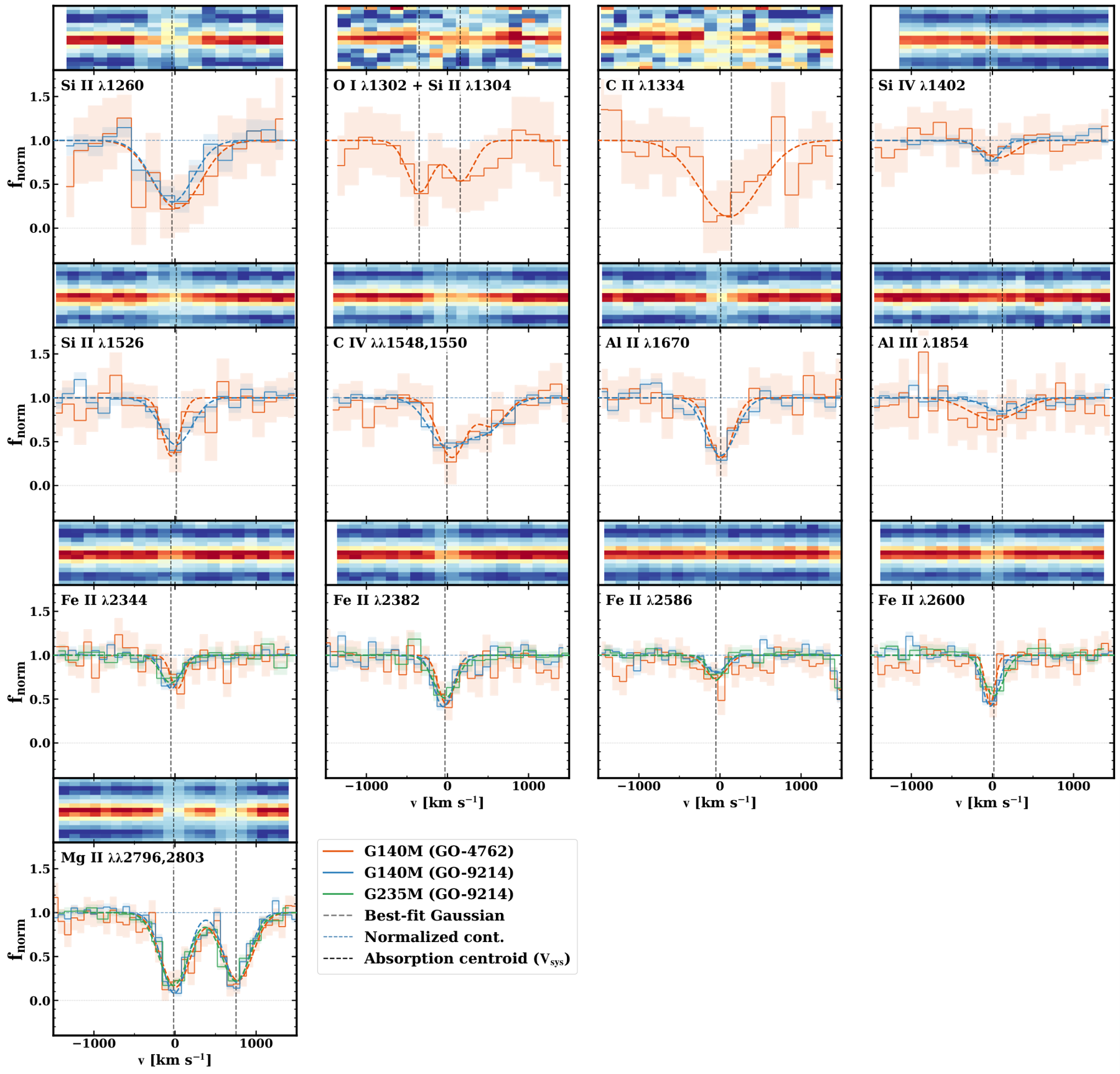
A single z=7.03 galaxy–absorber pair links a dusty, intensely star-forming galaxy to unusually strong multiphase metal absorption at 16 kpc. Blueshifted gas is consistent with an outflow, while abundance evidence for Population III enrichment remains suggestive rather than decisive.

Figure 1 from An ALMA Band 7 survey of SDSS/Herschel quasars in Stripe 82: II. The nature of FIR-bright quasars

2026-09-16 · 2609.16951v1 · Research note

An ALMA Band 7 survey of SDSS/Herschel quasars in Stripe 82: II. The nature of FIR-bright quasars

Evanthia Hatziminaoglou, Hugo Messias, Duncan Farrah, et al.

For 142 optically unobscured, FIR-bright Stripe 82 quasars at z=1–4, ALMA deblending lowers inferred host SFRs yet leaves extreme starbursts. The authors find weak instantaneous starburst–accretion coupling and UV-line differences consistent with a transitional interpretation.

2026-09-03 · 2609.01711v1 · Research note

JWST Reveals a Candidate Supermassive Black Hole Binary at z=4.3 in the Brightest Sub-millimeter Galaxy in COSMOS-Web

Jed McKinney, Ansh Gupta, Julian B. Munoz, et al.

JWST spectra of the single dusty galaxy AzTEC-1 at z=4.3419 reveal a broad Hα component blueshifted by 1245 km s⁻¹. The authors favor a candidate sub-pc SMBH binary or recoiling SMBH over an ionized outflow, but confirmation requires resolved follow-up.

Figure 2 from Dust and PAHs in late-stage galaxy evolution: Imprints of TP-AGB dust injection, grain growth and AGN feedback in high-z quiescent galaxies with JWST and ALMA

2026-08-31 · 2608.27571v1 · Research note

Dust and PAHs in late-stage galaxy evolution: Imprints of TP-AGB dust injection, grain growth and AGN feedback in high-z quiescent galaxies with JWST and ALMA

D. Donevski, A. Nanni, K. E. Whitaker, et al.

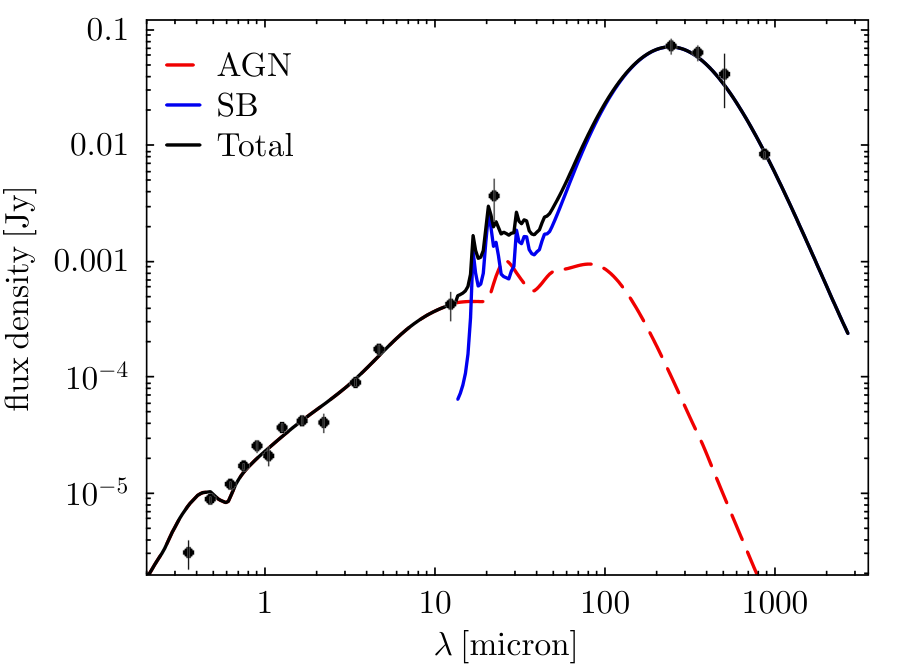
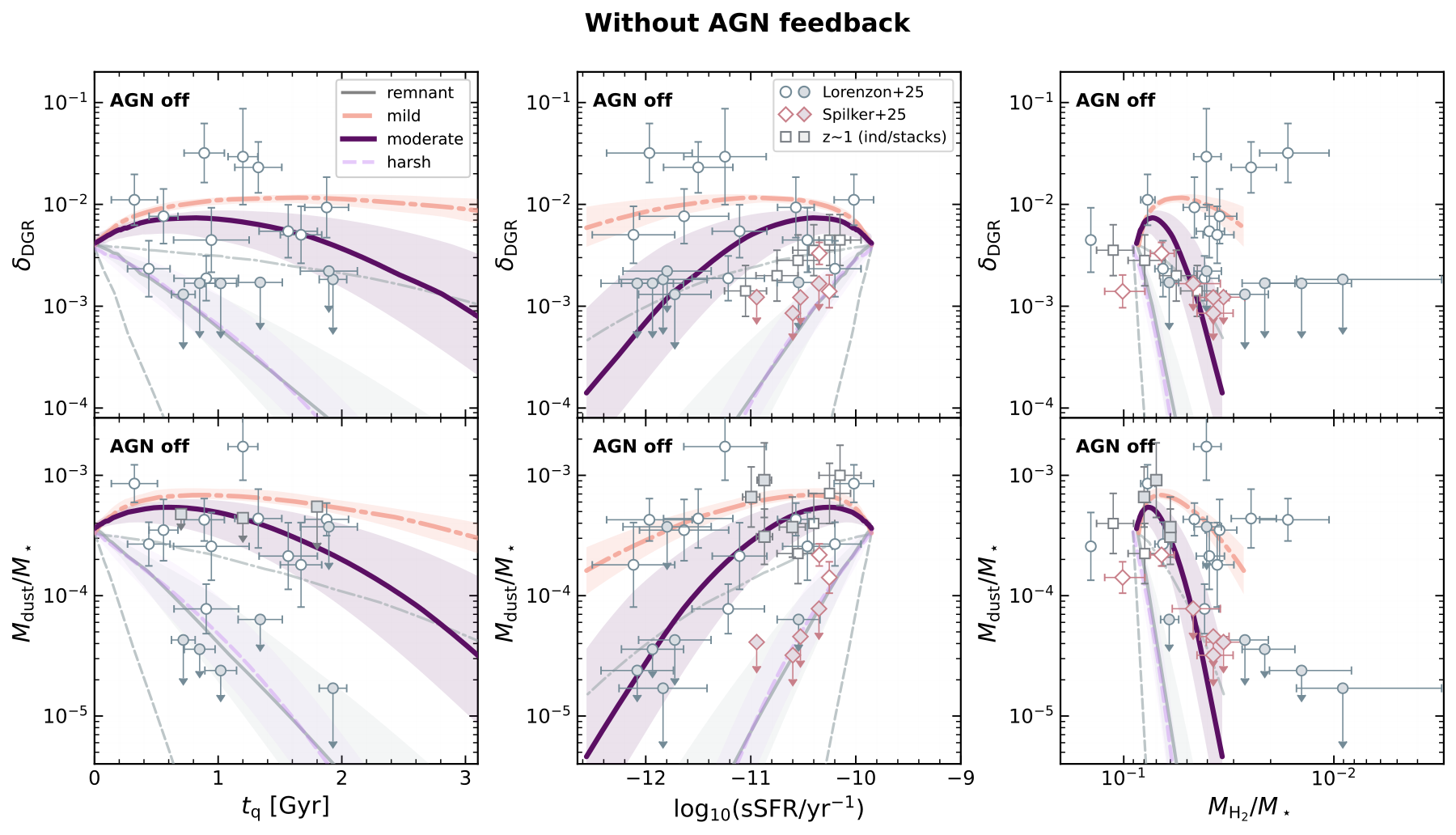
A semi-analytic post-quenching model predicts that delayed TP-AGB dust, grain growth, and AGN-regulated gas loss can produce wide dust and PAH diversity in z~1 quiescent galaxies, motivating joint ALMA–JWST constraints rather than any single ISM tracer.

2026-08-20 · 2608.18212v1 · Research note

Quasar Impostors: Two Extremely UV-Bright ($M_{\rm UV}\approx-23.5$) Reionisation-Epoch Galaxies Powered by Very Massive Stars

Daming Yang, Joseph F. Hennawi, Sarah E. I. Bosman, et al.

JWST and ALMA reclassify two z=6.63–6.80, MUV≈−23.5 SHELLQs “quasars” as extreme star-forming galaxies. Their UV wind and broad He II features are better matched by VMS-inclusive population models, although inferred IMF cutoffs remain strongly model dependent.

2026-07-01 · 2606.31312v1

Dissecting the Obscured Core of GN20: an Active Galactic Nucleus Outshone by Young Stars

M. Hamed, L. Colina, P. G. Pérez-González, et al.

This paper uses spatially resolved CIGALE SED fitting to separate the ∼1 kpc nuclear core of GN20 from the full 9.9 kpc galaxy, combining JWST NIRCam, MIRI, NIRSpec PRISM pseudo-continuum, HST, and millimeter data. The central result is that the galaxy-wide SED is overwhelmingly star-formation powered, with only a marginal integrated AGN fraction of 0.09 ± 0.02, while the nucleus requires a much stronger AGN contribution of 0.34 ± 0.05 to explain a rest-frame 2.5–3.6 μm mid-infrared excess from torus-heated dust. That means the AGN contributes about one-third of the nuclear infrared luminosity but only about 9% of the total L_IR, naturally explaining why integrated diagnostics and earlier Spitzer limits made the source look starburst-dominated. The broader significance is that GN20 looks like a buried-black-hole case where only JWST-resolution, nuclear-scale decomposition can uncover ongoing early SMBH growth inside an extreme z = 4.055 dusty starburst.

Figure 5 from The Multi-phase Biconical Outflow in the local IR-Luminous Merger IRASF01364-1042

2026-06-05 · 2606.06005v1 · Research note

The Multi-phase Biconical Outflow in the local IR-Luminous Merger IRASF01364-1042

Y. Song</name> <arxiv:affiliation>European Southern Observatory, Chile</arxiv:affiliation> <arxiv:affiliation>Joint ALMA Observatory, Chile</arxiv:affiliation> <arxiv:affiliation>Max-Planck-Institut für Radioastronomie, Germany</arxiv:affiliation> </author> <author> <name>V. U</name> <arxiv:affiliation>IPAC, California Institute of Technology, USA</arxiv:affiliation> <arxiv:affiliation>University of California, Irvine, USA</arxiv:affiliation> </author> <author> <name>J. Kader</name> <arxiv:affiliation>University of California, Irvine, USA</arxiv:affiliation> </author> <author> <name>M. Bianchin</name> <arxiv:affiliation>University of California, Irvine, USA</arxiv:affiliation> <arxiv:affiliation>Instituto de Astrof\' isica de Canarias, Spain</arxiv:affiliation> <arxiv:affiliation>Universidad de La Laguna, Spain</arxiv:affiliation> </author> <author> <name>J. Agostino</name> <arxiv:affiliation>Ritter Astrophysical Research Center and Department of Physics and Astronomy, University of Toledo, USA</arxiv:affiliation> </author> <author> <name>L. Barcos-Muñoz</name> <arxiv:affiliation>National Radio Astronomy Observatory, Charlottesville, USA</arxiv:affiliation> <arxiv:affiliation>Department of Astronomy, University of Virginia, Charlottesville, USA</arxiv:affiliation> </author> <author> <name>N. Torres-Albà</name> <arxiv:affiliation>Department of Astronomy, University of Virginia, Charlottesville, USA</arxiv:affiliation> </author> <author> <name>A. Medling</name> <arxiv:affiliation>Ritter Astrophysical Research Center and Department of Physics and Astronomy, University of Toledo, USA</arxiv:affiliation> </author> <author> <name>C. Ricci</name> <arxiv:affiliation>Department of Astronomy, University of Geneva, Switzerland</arxiv:affiliation> <arxiv:affiliation>Instituto de Estudios Astrofísicos, Facultad de Ingeniería y Ciencias, Universidad Diego Portales, Chile</arxiv:affiliation> </author> <author> <name>L. Armus</name> <arxiv:affiliation>IPAC, California Institute of Technology, USA</arxiv:affiliation> </author> <author> <name>T. Lai</name> <arxiv:affiliation>IPAC, California Institute of Technology, USA</arxiv:affiliation> </author> <author> <name>L. Ghodsi</name> <arxiv:affiliation>Hiroshima Astrophysical Science Center, Hiroshima University, Japan</arxiv:affiliation> </author> <author> <name>A. Evans</name> <arxiv:affiliation>National Radio Astronomy Observatory, Charlottesville, USA</arxiv:affiliation> <arxiv:affiliation>Department of Astronomy, University of Virginia, Charlottesville, USA</arxiv:affiliation> </author> <author> <name>H. Inami</name> <arxiv:affiliation>Occidental College, Physics Department, USA</arxiv:affiliation> </author> <author> <name>S. Stierwalt</name> <arxiv:affiliation>Leiden Observatory, Leiden University, The Netherlands</arxiv:affiliation> </author> <author> <name>T. Bohn</name> <arxiv:affiliation>Occidental College, Physics Department, USA</arxiv:affiliation> </author> <author> <name>K. L. Emig</name> <arxiv:affiliation>National Radio Astronomy Observatory, Charlottesville, USA</arxiv:affiliation> </author> <author> <name>V. Buiten</name> <arxiv:affiliation>Instituto de Alta Investigación, Universidad de Tarapacá, Chile</arxiv:affiliation> </author> <author> <name>G. Donnelly</name> <arxiv:affiliation>Ritter Astrophysical Research Center and Department of Physics and Astronomy, University of Toledo, USA</arxiv:affiliation> </author> <author> <name>E. Treister</name> <arxiv:affiliation>European Space Agency, c/o STScI, USA</arxiv:affiliation> </author> <author> <name>A. Jimenez-Gallardo</name> <arxiv:affiliation>European Southern Observatory, Chile</arxiv:affiliation> </author> <author> <name>T. Böker</name> <arxiv:affiliation>Centre for Astrophysics Research, University of Hertfordshire, UK</arxiv:affiliation> </author> <author> <name>D. Kakkad</name> <arxiv:affiliation>Steward Observatory, University of Arizona, USA</arxiv:affiliation> </author> <author> <name>S. Linden</name> <arxiv:affiliation>School of Sciences, European University Cyprus, Cyprus</arxiv:affiliation> </author> <author> <name>P. van der Werf</name> <arxiv:affiliation>Instituto de Alta Investigación, Universidad de Tarapacá, Chile</arxiv:affiliation> </author> <author> <name>V. Charmandaris</name> <arxiv:affiliation>Institute of Astrophysics, Foundation for Research and Technology-Hellas</arxiv:affiliation> <arxiv:affiliation>Department of Physics, University of Crete, Greece</arxiv:affiliation> <arxiv:affiliation>Department of Astronomy, University of Florida, USA</arxiv:affiliation> </author> <author> <name>R. Remigio</name> <arxiv:affiliation>University of California, Irvine, USA</arxiv:affiliation> </author> <author> <name>L. Lenkic</name> <arxiv:affiliation>IPAC, California Institute of Technology, USA</arxiv:affiliation> </author> <author> <name>C. Finlez</name> <arxiv:affiliation>European Southern Observatory, Chile</arxiv:affiliation> <arxiv:affiliation>Joint ALMA Observatory, Chile</arxiv:affiliation> </author> <author> <name>M. Sanchez-García</name> <arxiv:affiliation>Department of Physics, University of Crete, Greece</arxiv:affiliation> <arxiv:affiliation>Department of Astronomy, University of Florida, USA</arxiv:affiliation> </author> <author> <name>C. Lofaro</name> <arxiv:affiliation>Department of Physics, University of Crete, Greece</arxiv:affiliation> <arxiv:affiliation>Department of Astronomy, University of Florida, USA</arxiv:affiliation> </author> <author> <name>A. Saravia</name> <arxiv:affiliation>National Radio Astronomy Observatory, Charlottesville, USA</arxiv:affiliation> <arxiv:affiliation>Department of Astronomy, University of Virginia, Charlottesville, USA</arxiv:affiliation> </author> <author> <name>I. Yoon</name> <arxiv:affiliation>National Radio Astronomy Observatory, Charlottesville, USA</arxiv:affiliation> </author> <author> <name>G. C. Privon</name> <arxiv:affiliation>National Radio Astronomy Observatory, Charlottesville, USA</arxiv:affiliation> <arxiv:affiliation>Department of Astronomy, University of Virginia, Charlottesville, USA</arxiv:affiliation> <arxiv:affiliation>Research School of Astronomy and Astrophysics, Australian National University, Australia</arxiv:affiliation> </author> <author> <name>T. Gao</name> <arxiv:affiliation>ARC Centre of Excellence for All Sky Astrophysics in 3 Dimensions</arxiv:affiliation> <arxiv:affiliation>W. M. Keck Observatory, USA</arxiv:affiliation> </author> <author> <name>H. Aziz</name> <arxiv:affiliation>University of California, Irvine, USA</arxiv:affiliation> </author> <author> <name>R. McGurk</name> <arxiv:affiliation>Institute for Astronomy, University of Hawaii, USA</arxiv:affiliation> </author> <author> <name>T. Díaz-Santos</name> <arxiv:affiliation>Department of Physics, University of Crete, Greece</arxiv:affiliation> <arxiv:affiliation>Department of Astronomy, University of Florida, USA</arxiv:affiliation> </author> <author> <name>D. Kunneriath</name> <arxiv:affiliation>National Radio Astronomy Observatory, Charlottesville, USA</arxiv:affiliation> </author> <author> <name>David B. Sanders

Spatially resolved JWST, ALMA and KCWI data support a multiphase, minor-axis biconical outflow in the dusty local merger IRAS F01364-1042. The authors infer faster ionized than molecular gas and argue a nuclear starburst can energetically drive it despite an obscured AGN.
2026-05-14 · 2605.14922v1 · Research note

DREAMS. JWST Spectroscopy of a $z=8.3$ Galaxy with an ALMA Dust Continuum Detection: Early Dust, Very High $T_{\rm dust}$, and a Multi-wavelength [OIII] Ratio Discrepancy

Kana Takechi, Masami Ouchi, Kimihiko Nakajima, et al.

For the single z=8.312 galaxy MACS0416-Y1, deep JWST/NIRSpec plus archival IFU/ALMA data support a broad-line AGN interpretation, low metallicity and dust mass ratios, and a spatially non-coincident origin for optical and far-infrared [OIII].

Figure 3 from Constraints on the host galaxy and AGN properties of three z > 6 JWST AGN from NOEMA observations

2026-03-31 · 2603.29652v1 · Research note

Constraints on the host galaxy and AGN properties of three z > 6 JWST AGN from NOEMA observations

Giovanni Mazzolari, Hannah Übler, Rodrigo Herrera Camus, et al.

Deep NOEMA observations of three z>6 JWST AGN—two Little Red Dots and one blue Type-I source—yield no significant [C II] or dust-continuum detection, tightening host-galaxy and SED constraints while leaving the physical origin of their [C II] deficit unresolved.

Figure 1 from From Grism to IFU: Revising the Redshift and Nature of the Massive Dusty Galaxy S1 with JWST and ALMA

2026-02-03 · 2602.03030v1 · Research note

From Grism to IFU: Revising the Redshift and Nature of the Massive Dusty Galaxy S1 with JWST and ALMA

Mengyuan Xiao, Longji Bing, Gabriel Brammer, et al.

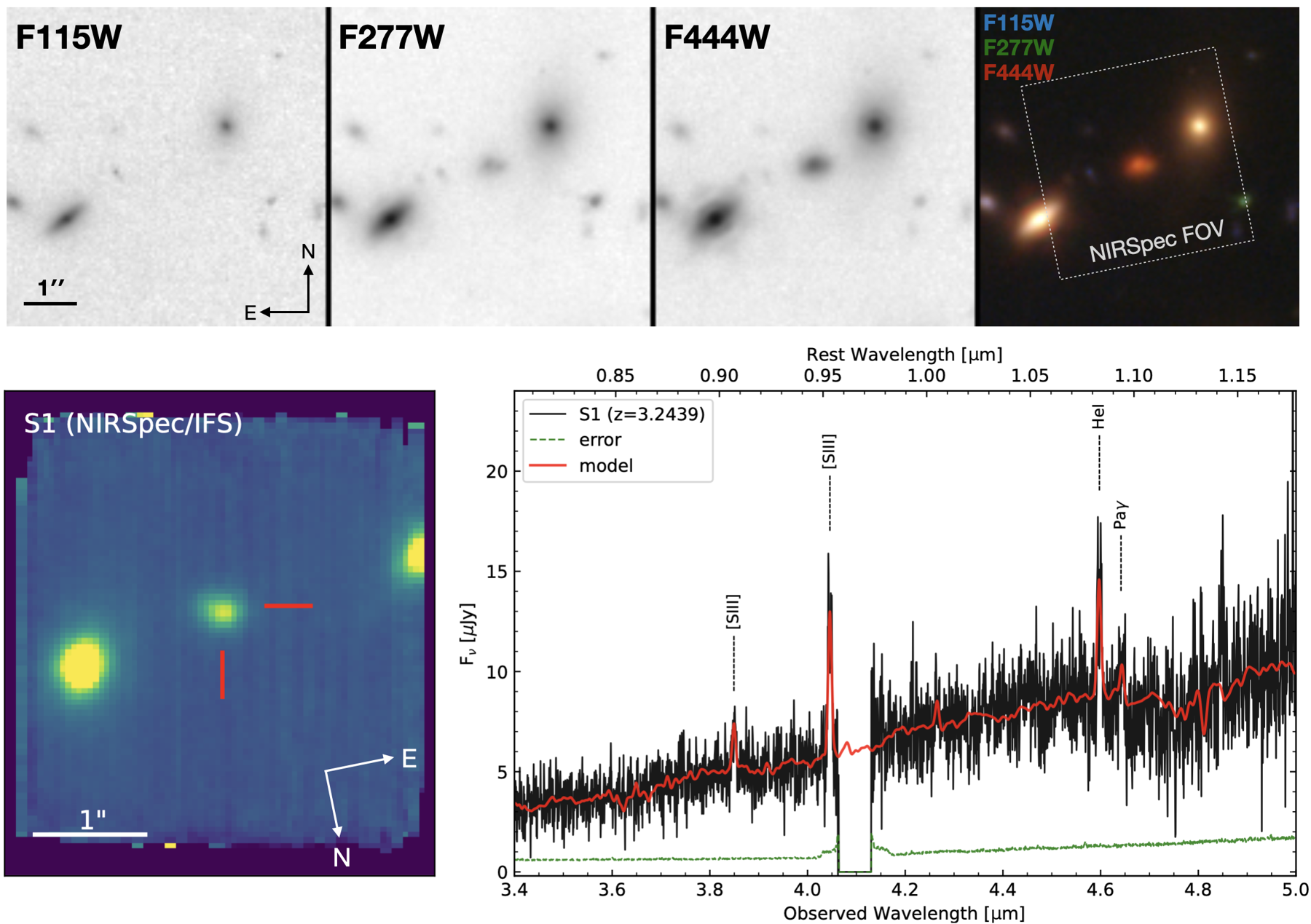
Multi-line JWST/NIRSpec IFU spectroscopy moves dusty massive galaxy S1 from z=5.58 to z=3.2439, tracing the earlier single-line grism assignment to spectral overlap. ALMA continuum and revised SED fitting instead describe a compact, obscured, massive star-forming galaxy.

Figure 10 from JWST Spectroscopic Census of ALMA Faint Submillimeter Galaxies in the Hubble Ultra Deep Field

2026-01-26 · 2601.18149v1 · Research note

JWST Spectroscopic Census of ALMA Faint Submillimeter Galaxies in the Hubble Ultra Deep Field

Tomokazu Kiyota, Masami Ouchi, Daisuke Iono, et al.

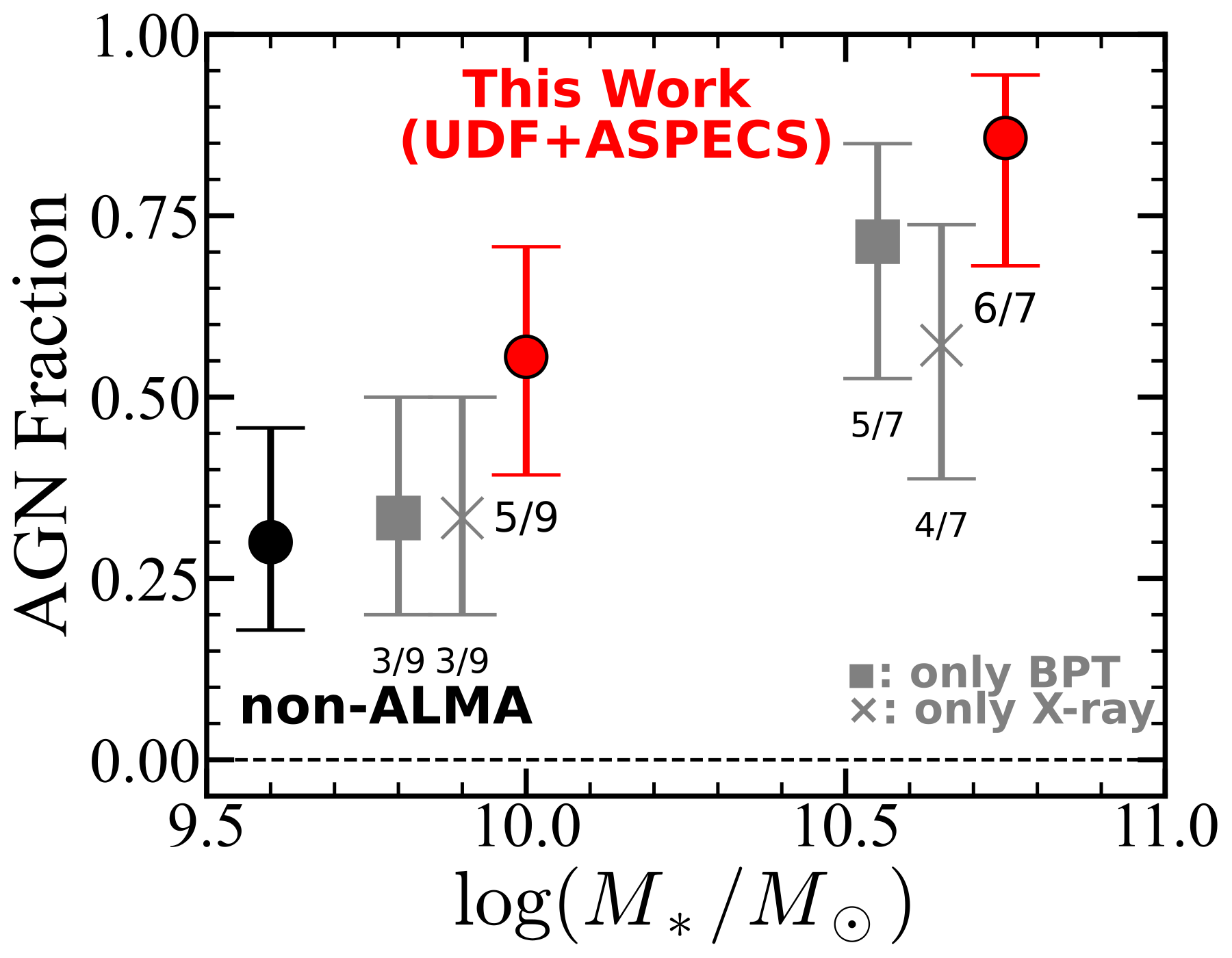
JWST/NIRSpec spectroscopy of 16 ALMA-selected HUDF faint SMGs finds dusty, massive z=1–4 galaxies with mostly obscured AGN classifications, yet star-formation, metallicity, and bulk-ISM properties broadly consistent with comparable high-redshift star-forming populations.

Figure 1 from Probing Heavily Obscured AGN in Major Galaxy Mergers Using the mm-X-ray Correlation

2026-01-21 · 2601.15186v1 · Research note

Probing Heavily Obscured AGN in Major Galaxy Mergers Using the mm-X-ray Correlation

M. Droguett-Callejas, E. Treister, L. Barcos-Muñoz, et al.

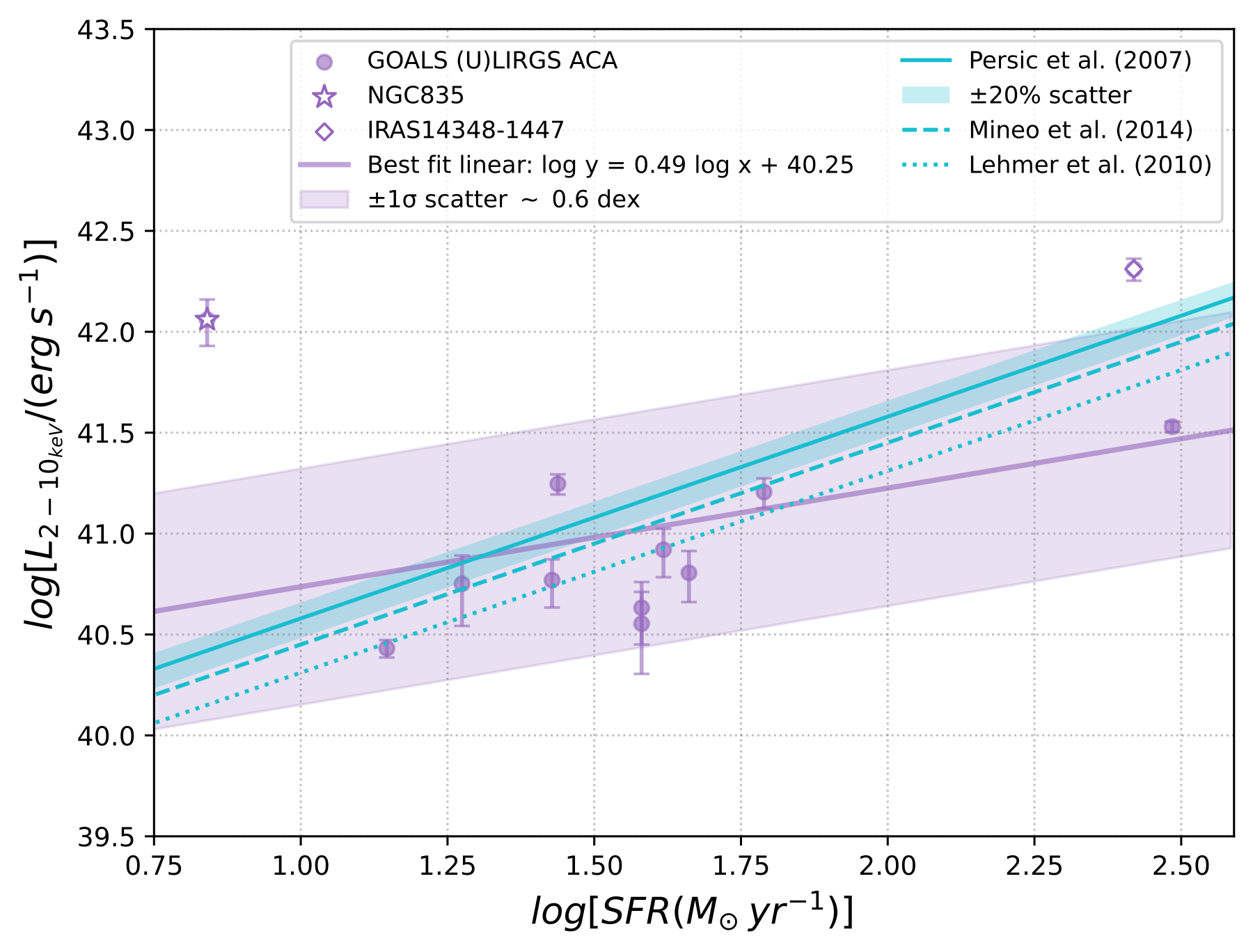
In local merging (U)LIRGs, 230-GHz continuum combined with X-ray luminosity and IR-based SFR can conservatively separate star-formation-compatible systems from candidate obscured AGN; the authors identify one confirmed AGN and two strong candidates, but calibration remains preliminary.

2026-01-06 · 2601.03338v1 · Research note

Fast rotations in galaxies at cosmic noon indicate central concentration of stars, dark matter or massive black holes

Fernanda Roman-Oliveira, Francesca Rizzo, Filippo Fraternali

Resolved ALMA gas kinematics and JWST stellar light in three ALPAKA discs reveal inner circular speeds exceeding fiducial mass-model predictions. The authors infer missing central mass, plausibly involving bulges, massive black holes, or non-standard inner halo concentrations.

Figure 1 from Little Red Dots: The Assembly of Early Supermassive Black Holes in the JWST Era

2025-12-31 · 2601.00089v1 · Research note

Little Red Dots: The Assembly of Early Supermassive Black Holes in the JWST Era

David D Vaida, Ryan Jeffrey Farber

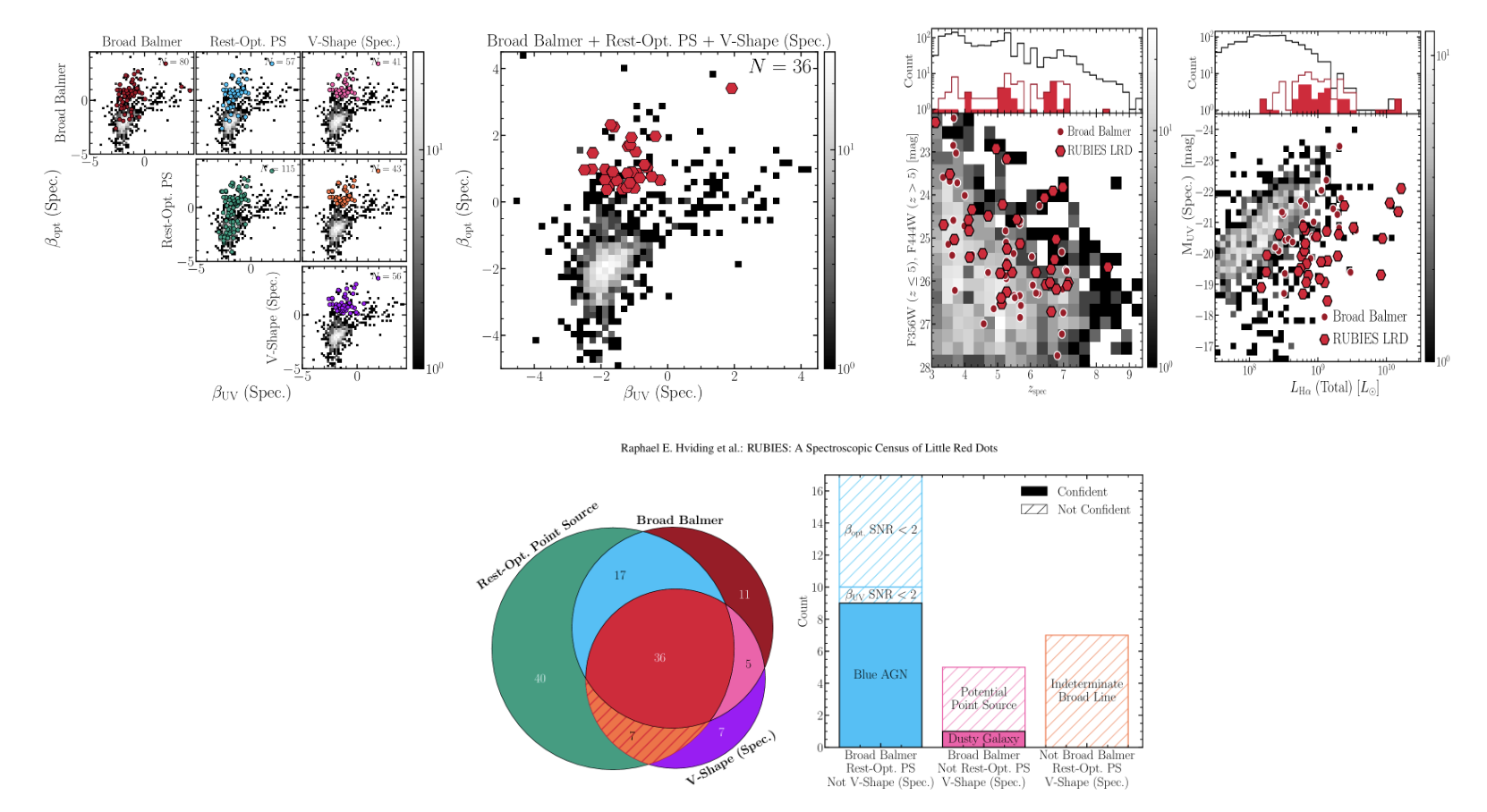
This mini-review argues that little red dots are probably heterogeneous: broad Balmer lines and compact, V-shaped SEDs support accretion in some, whereas pervasive multiwavelength non-detections and viable stellar fits prevent a population-wide AGN identification.

Figure 4 from From ASTRID to BRAHMA -- The role of overmassive black holes in little red dots in cosmological simulations

2025-12-15 · 2512.13957v1 · Research note

From ASTRID to BRAHMA -- The role of overmassive black holes in little red dots in cosmological simulations

Patrick LaChance, Aklant Kumar Bhowmick, Rupert A. C. Croft, et al.

BRAHMA mock observations suggest that overmassive, dense-gas-enshrouded AGN can yield AGN-dominated LRD colors and an LRD density of (2.04 ± 0.32) × 10^-4 Mpc^-3 at z=5–8; this is a model-dependent explanation, not a direct detection of the proposed environments.

2025-12-04 · 2512.05213v1 · Research note

GA-NIFS: A smouldering disk galaxy undergoing ordered rotation at z=4.26

Gareth C. Jones, Roberto Maiolino, Francesco D'Eugenio, et al.

JWST/NIRSpec plus ALMA data indicate that the single z=4.2603 galaxy DLA0817g1 has matched Hα–[C II] disk morphology and rotation, enriched but weakly excited gas, and a revised molecular-gas budget consistent with a dynamically relaxed “smouldering” system.

Figure 5 from Highly-ionized gas in lensed z = 6.027 Little Red Dot seen through [OIII] 88$μ$m with ALMA

2025-12-04 · 2512.05097v1 · Research note

Highly-ionized gas in lensed z = 6.027 Little Red Dot seen through [OIII] 88$μ$m with ALMA

Kirsten K. Knudsen, Johan Richard, Mathilde Jauzac, et al.

Deep ALMA spectroscopy detects [O III] 88 μm from the lensed z=6.027 Little Red Dot A383-5.1. Its high [O III]/[C II] ratio and dust-continuum limits favor a dust-poor, strongly ionized ISM, but do not directly measure ionizing-photon escape.

2025-12-01 · 2512.02117v1 · Research note

VENUS: When Red meets Blue -- A multiply imaged Little Red Dot with an apparent blue companion behind the galaxy cluster Abell 383

Miriam Golubchik, Lukas J. Furtak, Joseph F. V. Allingham, et al.

JWST resolves the lensed z=6.027 system A383-LRD1 into a compact red LRD candidate and a blue companion separated by ~380 pc. Lensing exposes a faint intrinsic LRD, but its AGN/BH* interpretation and association with the companion remain photometric inferences.

Figure 2 from Extremely UV-bright starbursts at the end of cosmic reionization

2025-10-14 · 2510.12411v1 · Research note

Extremely UV-bright starbursts at the end of cosmic reionization

R. Marques-Chaves, D. Schaerer, M. Dessauges-Zavadsky, et al.

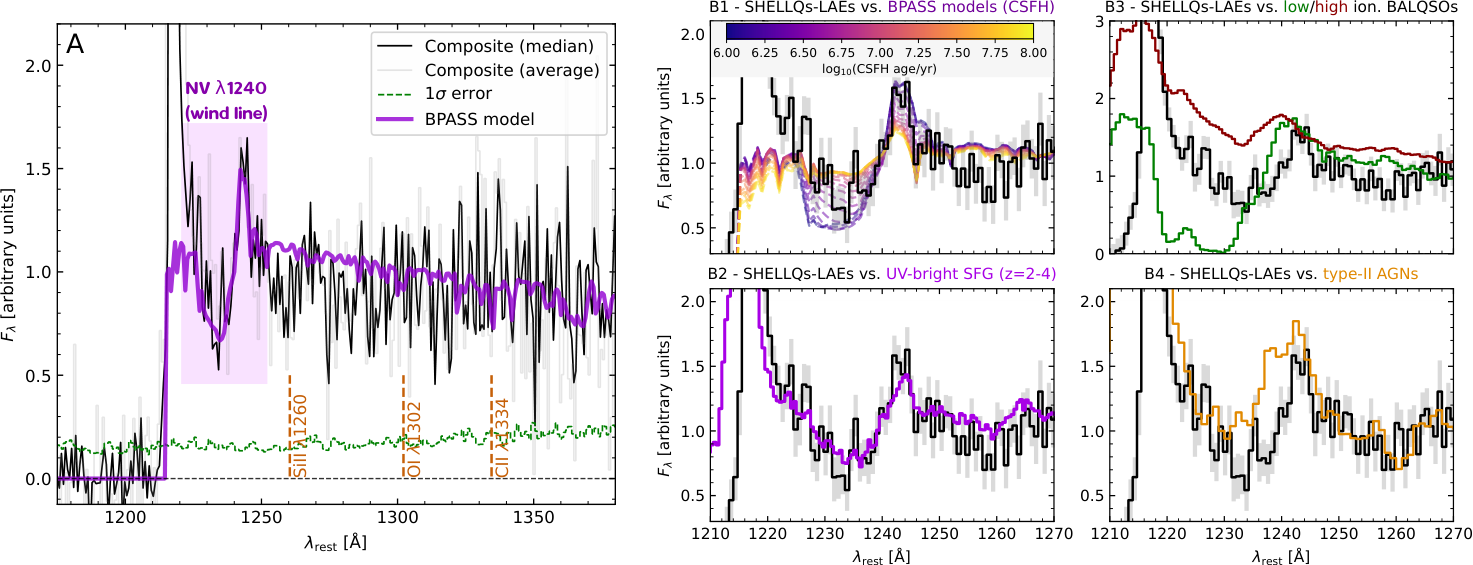
A 27-object z~6 SHELLQs sample is interpreted as very young, ionizing starbursts; JWST/ALMA observations of J0217-0208 link its exceptional UV brightness to compact star formation and a dusty ionized outflow, though the proposed causal link remains model-dependent.

2025-09-08 · 2509.07100v1

Active galactic nuclei-heated dust revealed in "little red dots"

I. Delvecchio, E. Daddi, B. Magnelli, et al.

This Letter median-stacks NIRCam, MIRI, and ALMA imaging for 302 photometrically selected little red dots across CEERS, JADES(+SMILES), and PRIMER (z≈2–11; median z≈6.2). The stacked SED rises to ≈3 µm in the rest frame, and CIGALE fits require a dusty AGN component in most (≳50%) LRDs; combined with ALMA non-detections and deep Chandra stack null results, this points to Compton-thick gas (NH>3×10^24 cm^-2) likely confined within Rsub≈0.1 pc. The inferred geometry leaves optical/UV and broad-line emission largely unobscured, matching blue UV slopes and strong Balmer features. While LRDs are heterogeneous, the prevalence of AGN-heated dust implies obscured black-hole growth is common in this population.

2025-09-05 · 2509.05434v1

What you see is what you get: empirically measured bolometric luminosities of Little Red Dots

Jenny E. Greene, David J. Setton, Lukas J. Furtak, et al.

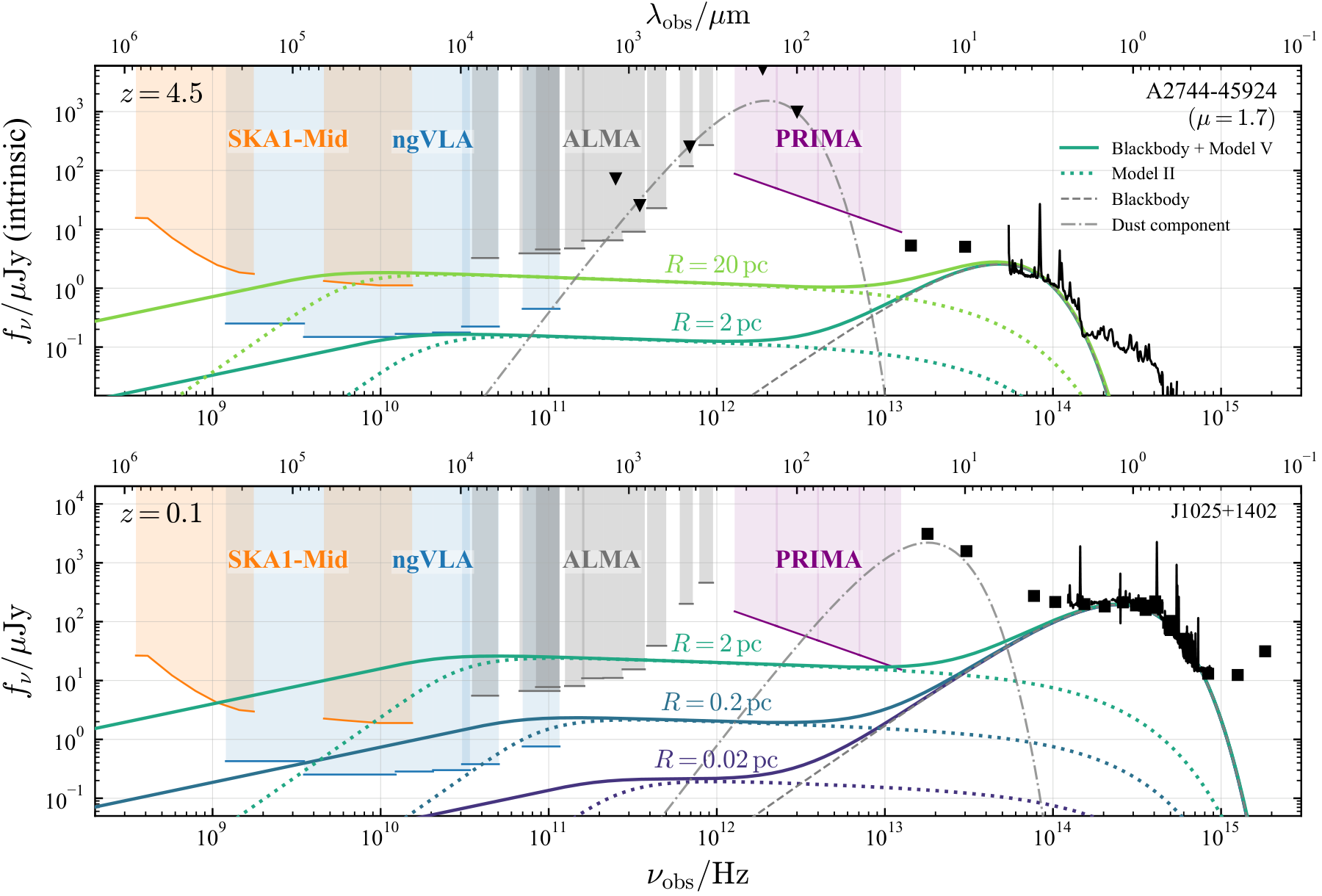
Empirically integrating X-ray–to–far-IR SEDs for two of the most luminous Little Red Dots (A2744-45924 and RUBIES-BLAGN-1), the authors directly measure bolometric luminosities rather than adopting standard AGN corrections. They find that over half of Lbol emerges in the rest-frame optical with Lbol/L5100≈5, while X-ray, UV, and reprocessed mid/far-IR components are sub-dominant, and deep ALMA/MIRI limits rule out a standard dust-reddened AGN SED. New bolometric corrections lower previously inferred luminosities by ~10×, implying BH masses of ~10^5–10^7 Msun (and ~10^8 Msun hosts) if radiating near Eddington and easing tensions with clustering and BH mass density. A key assumption is that far-IR luminosities lie well below current observational limits.

2025-09-01 · 2509.01674v1

Understanding the Evolution of Black Hole Accretion and Dust out to z=4 with a Deep Imaging Extragalactic Survey with PRIMA

Andreas L. Faisst, Chian-Chou Chen, Laure Ciesla, et al.

This Concept/Survey paper lays out PRIDES, a 1.6 deg^2 COSMOS-field program with PRIMA to fill the mid‑IR gap (24–240 μm) between JWST and ALMA and trace dust and black‑hole growth out to z≈4. With hyperspectral imaging and spectroscopy, PRIDES will constrain IR SED shapes, dust temperatures, and obscured SFRs while identifying dust‑obscured AGN via PAH and silicate features, detecting mid‑IR emission even beyond z>3. Simulations indicate photometric redshifts from PAH features with accuracy that degrades as the AGN contribution increases, and silicate strengths track AGN hardness. Together, these data will map the fraction of obscured star formation and the prevalence of buried SMBH accretion across environments in COSMOS.

2025-07-22 · 2507.16921v1

ALMA survey of a massive node of the Cosmic Web at $z\sim 3$. II. A dynamically cold and massive disk galaxy in the proximity of a hyperluminous quasar

A. Pensabene, S. Cantalupo, W. Wang, et al.

High-resolution (∼0.3″) ALMA Band-3 CO(4–3) and 3‑mm continuum mapping of the MQN01 node isolates a massive companion, MQN01‑QC, ∼10 kpc and −300 km s⁻¹ from the hyperluminous quasar CTS G18.01 (z=3.251). Kinematic modeling of the cold gas yields a dynamical mass of 2.5×10^11 M⊙ within ≈4 kpc and a dynamically cold disk with Vrot/σ≈11, establishing the first quasar companion confirmed as a massive rotating disk at this epoch. Despite the proximity, the disk shows no clear tidal disturbances, while the quasar’s CO(4–3) profile exhibits a broad blueshifted wing consistent with a powerful molecular outflow or interaction. The system suggests dynamically cold disks can persist even in dense, early cosmic‑web nodes and hints the quasar may be a satellite in an incipient merger.

2025-07-07 · 2507.05354v1

JWST MIRI/MRS observations of hot molecular gas in an AGN host galaxy at Cosmic Noon

D. Kakkad, V. Mainieri, Takumi S. Tanaka, et al.

Using JWST/MIRI MRS, the authors detect ro‑vibrational H2 in the z≈2.2 X‑ray AGN cid_346, measuring 1‑0 S(1) (and S(0)) and inferring a hot H2 mass of ≈8×10^5 M⊙. They map hot molecular emission and CO(3‑2) to >10 kpc, and NIRCam imaging reveals two nearby satellites at ≈3.3 and 7.4 kpc, pointing to an interacting environment. The hot phase is 10^5–10^6× less massive than the cold reservoir, but the authors argue H2 ro‑vibrational lines effectively trace locally heated/shocked gas where CO may be faint. Ionized gas shows [O III] extension and a blue wing toward the SE, consistent with outflow activity shaping the multiphase medium.

2025-06-30 · 2506.24128v1

Beneath the Surface: >85% of z>5.9 QSOs in Massive Host Galaxies are UV-Faint

R. J. Bouwens, E. Banados, R. Decarli, et al.

Ranks 190 z>5.9 QSOs by host mass using ALMA [CII] luminosity as a gas/host-mass proxy, boosted by CISTERN cycle-10 coverage of UV-faint sources, and defines “massive hosts” at L[CII]>1.8x10^9 Lsun. From the resulting UV-luminosity distribution and [CII] luminosity functions, only ~3% of massive-host QSOs are UV-bright (Muv<-26) while >85% are UV-faint (Muv>-24.5). At Muv≈-23 the median extrapolated log10(MBH/Msun)=8.1±0.4, implying UV-bright QSOs host SMBHs ~15x more massive than typical massive-host systems at z~6. This points to most SMBH growth in massive galaxies being missed by UV-bright QSO selections; spectroscopy is still needed to confirm the MBH interpretation.

2025-06-17 · 2506.14896v1

Overmassive Black holes live in compact galaxies in the early Universe

Yuxuan Wu, Tao Wang, Daizhong Liu, et al.

Uniform ALMA [CII] 158 μm size measurements for a curated sample of 22 z≈6 quasars show their hosts are systematically compact, with a median Re≈1.58 kpc versus 2.26 kpc for main-sequence SFGs measured in the same line. The hosts also have elevated MBH/M* and, for the most compact systems, reduced cold-gas content and sizes akin to massive quiescent galaxies at z≈4–5. Simple evolution over a gas-depletion timescale moves them toward the local MBH–M* relation as stellar mass builds. The compact, gas-poor subset likely marks the late stage of rapid BH growth and are prime progenitors of the first quiescent galaxies.

2025-06-06 · 2506.06418v1

The Identification of Two JWST/NIRCam-Dark Starburst Galaxies at $z=6.6$ with ALMA

Fengwu Sun, Jinyi Yang, Feige Wang, et al.

Two extreme, dust-enshrouded starbursts at z=6.6 are identified in ASPIRE quasar fields: they are bright in ALMA 1.2 mm continuum and [C II] 158 µm, yet essentially disappear in JWST/NIRCam (F356W >28 AB). SEDs anchored to ALMA fluxes imply heavier obscuration than Arp 220 and star formation rates of ≃80–250 M⊙ yr⁻¹. Their inferred star-formation histories make them plausible progenitors of massive quiescent galaxies at z≳4 and descendants of UV-luminous z>10 systems, with an abundance as high as n≈10⁻⁵⋅⁵ Mpc⁻³ under a light halo-occupation model (~30% of those comparison populations). A key caveat is that number densities come from quasar-companion fields; analogous z∼8 systems may remain undetected (“JWST-dark”) at current survey depths.

2025-05-28 · 2505.22600v1

Dust Budget Crisis in Little Red Dots

Kejian Chen, Zhengrong Li, Kohei Inayoshi, et al.

Re-assessing LRD dust, the authors forward-model UV–IR SEDs across multiple extinction laws and dust geometries, then demand consistency with JWST/MIRI, Herschel, and ALMA fluxes and limits. They find A_V ≲ 1.0–1.5 mag under an SMC law for A2744-45924, RUBIES-BLAGN-1, and stacked LRD SEDs, with only slightly weaker bounds for gray UV extinction. These moderate extinctions alleviate the “dust budget crisis” for hostless/low-mass systems and imply ≈10% radiative efficiencies, easing Sołtan-argument tension. The work predicts testable far-IR reprocessed spectra, reframing early black-hole growth pathways for LRDs.

2025-05-24 · 2505.18873v1

An upper limit of 10$^6$ M$_\odot$ in dust from ALMA observations in 60 Little Red Dots

Caitlin M. Casey, Hollis B. Akins, Steven L. Finkelstein, et al.

ALMA Band-6 (1.3 mm) continuum follow-up of 60 of the reddest and brightest COSMOS-Web little red dots—preselected with MIRI F770W detections—finds no individual detections and a non-detection in the stack. The data reach a mean σ_rms≈22 μJy, with a stacked flux of S_1.3mm=2.1±2.9 μJy, implying 3σ limits of Mdust<10^6 M⊙ and Ldust≲10^11 L⊙, about 10× deeper than previous submm stacks. These results disfavor large, cold dust reservoirs in typical LRDs. They are consistent with compact, modest dust columns (A_V~2–4) or extreme Balmer breaks from very dense gas (n>10^9 cm^-3) enshrouding a central black hole.

2025-05-14 · 2505.09703v1

SCUBADive II: Searching for $z>4$ Dust-Obscured Galaxies via F150W-Dropouts in COSMOS-Web

Sinclaire M. Manning, Jed McKinney, Katherine E. Whitaker, et al.

SCUBADive II systematically compiles 60 F150W-dropout, far-IR–bright galaxies in COSMOS-Web by cross-matching JWST non-detections at 1.5 μm with SCUBA-2 and ALMA counterparts, motivated by the benchmark AzTECC71. A core subset of 16 AzTECC71-like sources shows faint F444W (>24 mag) and no COSMOS2020 IDs. SED fits give ⟨SFR⟩=550+500−360 M⊙ yr⁻1 and ⟨log10(M⋆)⟩=11.2+0.5−0.4, with offsets indicating they are not unusually elevated above the star-forming main sequence. Crucially, such heavily obscured systems constitute roughly 20% across mass bins and could account for up to 60% of the z>4 high-mass end (log10 M⋆>11), quantifying a major, previously missed component of the early galaxy census.

2025-03-03 · 2503.02059v1

A confirmed deficit of hot and cold dust emission in the most luminous Little Red Dots

David J. Setton, Jenny E. Greene, Justin S. Spilker, et al.

Deep MIRI imaging plus new ALMA continuum and [C II] spectroscopy on two luminous LRDs at z=3.1 (A2744-45924) and z=4.47 (RUBIES-BLAGN-1) set the tightest IR constraints yet. Rest-frame 1–4 μm detections show a flat IR slope, excluding hot (T≳500 K) dust, while far-IR non-detections exclude a cold (T≲75 K) component and typical [C II]-bright dusty starbursts. Empirical maximal SEDs require log(L_IR/L_sun) ≲ 12.2 (3σ), in strong tension with energy-balance predictions from reddened galaxy, AGN, or composite fits. The authors favor intrinsically red LRD SEDs over heavily dust-reddened blue engines, reshaping how these compact sources are interpreted.

2025-03-03 · 2503.01945v1

No [CII] or dust detection in two Little Red Dots at z$_{\rm spec}$ > 7

Mengyuan Xiao, Pascal A. Oesch, Longji Bing, et al.

Two z_spec > 7 Little Red Dots in FRESCO GOODS-N (ID9094, ID2756) show v‑shape colors, compact morphologies, and broad Hβ (FWHM 2280±490 and 1070±240 km/s), marking them as Type‑I AGN candidates. Deep NOEMA follow-up finds no [CII] 158 μm or 1.3 mm continuum; a DSFG interpretation would have yielded strong detections (>16σ [CII] and >3σ 1.3 mm for ID9094; >5σ [CII] for ID2756). Using the 3σ FIR limits in UV–FIR SED fitting (with/without AGN) and comparison to the L_[CII]–SFR_tot relation, the data favor an AGN contribution, as a dust‑only model would require unusually high dust temperatures. The work shows FIR non‑detections can discriminate AGN‑dominated LRDs from DSFG impostors at z > 7, though a purely dusty origin cannot be fully excluded.

2025-03-02 · 2503.00998v1

Tentative detection of neutral gas in a Little Red Dot at $z=4.46$

Hollis B. Akins, Caitlin M. Casey, John Chisholm, et al.

ALMA Band 3/4/5 spectroscopy targets CO(7–6) and [CI](2–1) in three Little Red Dots at z=3.10, 4.46, and 7.04, finding no CO and no far-IR continuum, implying conservative molecular gas limits ≲1–5×10^10 Msun. A2744-45924 (z=4.4655) shows a tentative 4.9σ [CI](2–1) line with a narrow FWHM ~80 km s−1. The [CI]-inferred dynamical mass is ≲10^10 Msun for conservative size assumptions, well below the local MBH–Mdyn relation and an order of magnitude under SED-based stellar mass. If confirmed, this points to LRD hosts unlike massive, gas-rich quasar hosts and lends weight to a non-stellar origin for the Balmer break.