654 indexed papers · 430 research notes

Research archive

Reset

2026-09-18 · 2609.19459v1 · Research note

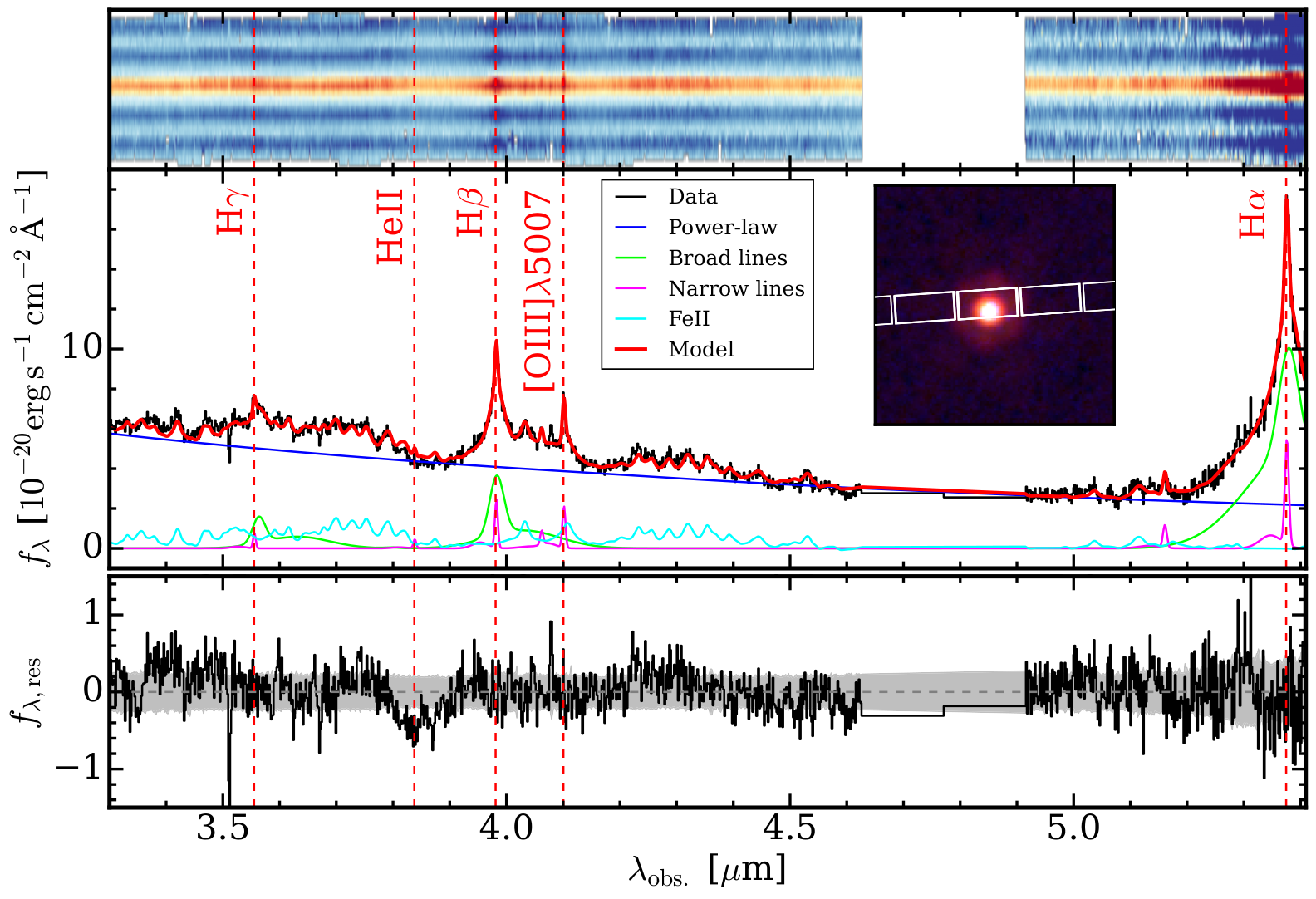
Extreme Enrichment at Cosmic Dawn: Three FeII-Strong Quasars at z > 6 from the JWST Aether survey

Anniek J. Gloudemans, Emanuele Paolo Farina, Roberto Decarli, et al.

JWST/NIRSpec IFU spectra identify three z>6 quasars with extreme optical Fe II relative to Hβ, supporting rapid early enrichment while leaving accretion rates and nearby line-emitting structures materially uncertain.

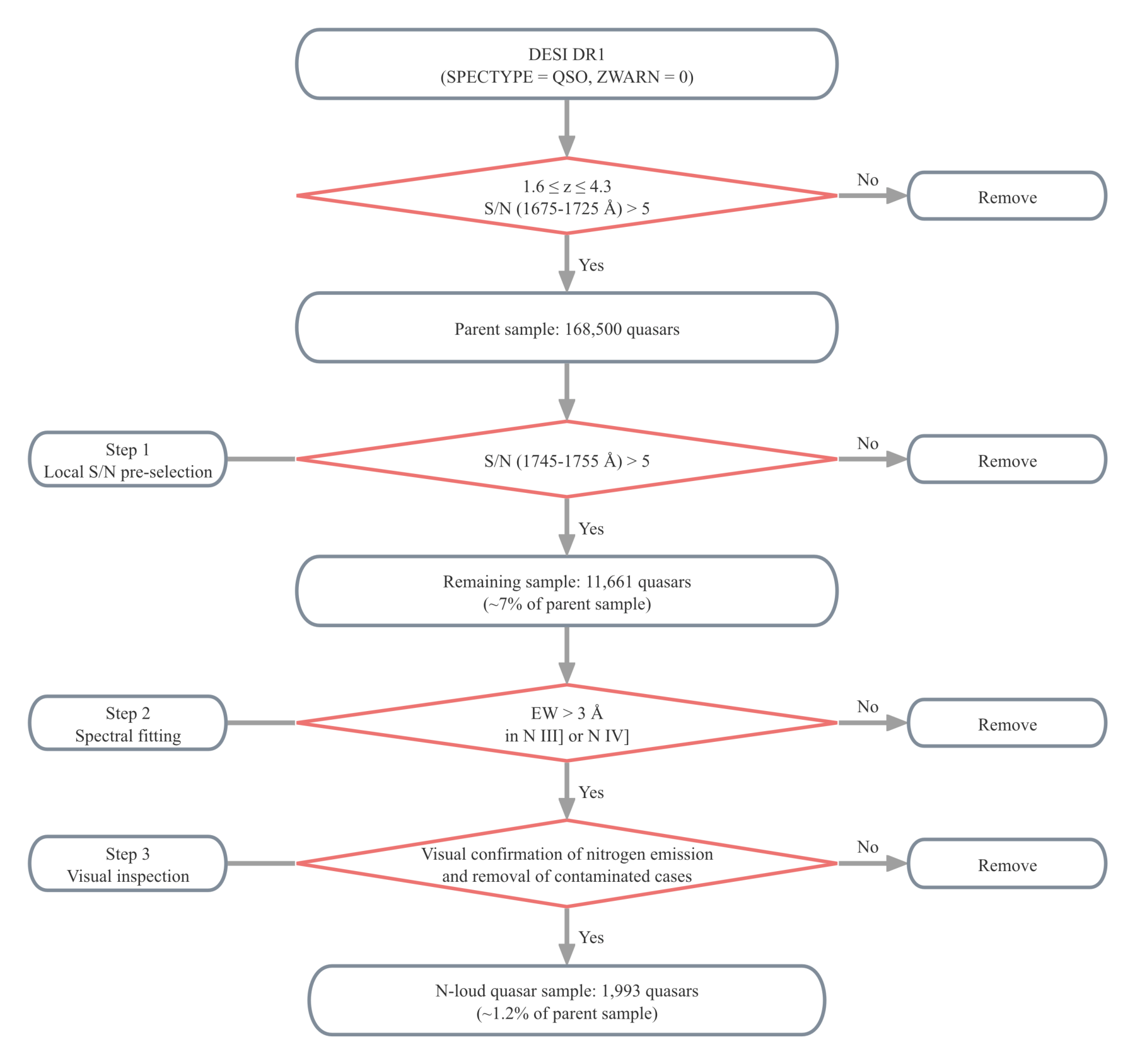
Figure 1 from Nitrogen-Loud Quasars from the Dark Energy Spectroscopic Instrument. I. Sample Selection and Basic Properties

2026-09-11 · 2609.11104v1 · Research note

Nitrogen-Loud Quasars from the Dark Energy Spectroscopic Instrument. I. Sample Selection and Basic Properties

Shuo Zhai, Wei-Jian Guo, Yong-Jie Chen, et al.

DESI DR1 yields 1,993 nitrogen-loud quasars at 1.6<z<4.3 (1.2% of the parent sample). Matched-control comparisons associate nitrogen-loud spectra with narrower broad lines, lower virial masses, and higher inferred Eddington ratios.

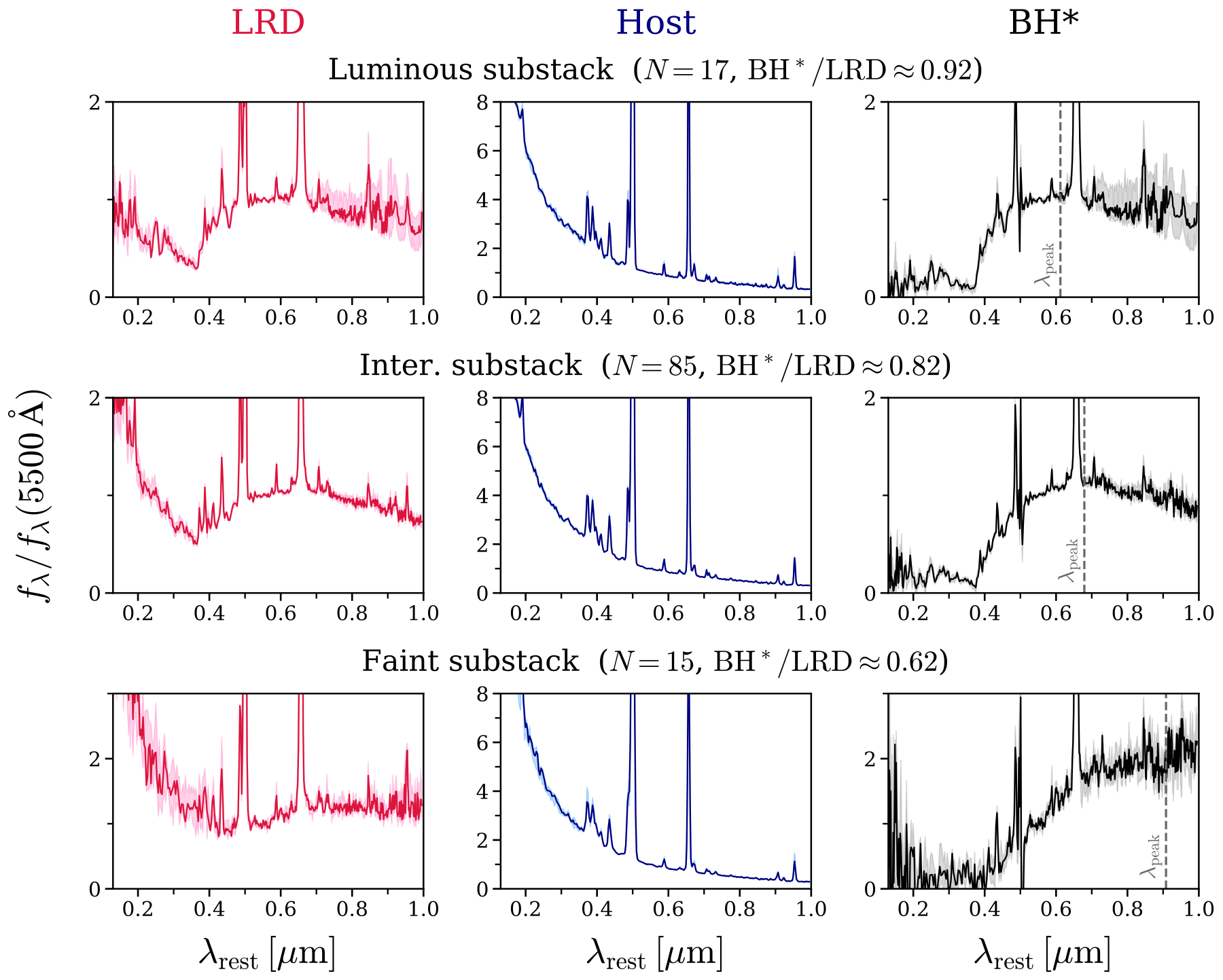
Figure 2 from Overmassive No More: The Case for Little Red Dots Hosting Black Hole Seeds as Massive as Single Supermassive Stars

2026-09-10 · 2609.09274v1 · Research note

Overmassive No More: The Case for Little Red Dots Hosting Black Hole Seeds as Massive as Single Supermassive Stars

Wendy Q. Sun, Rohan P. Naidu, Hanpu Liu, et al.

Using stacked, host-subtracted spectra of 117 little red dots, the authors infer cool, luminous pseudo-photospheres and non-virial central-engine masses of about 10^4–10^5 solar masses. They argue this removes the apparent overmassiveness and permits, but does not establish, a supermassive-star seed origin.

Figure 3 from SHELLQs. Black Hole Mass and Eddington Ratio Distributions of Intermediate-Luminosity Quasars at 6<z<7

2026-09-10 · 2609.09266v1 · Research note

SHELLQs. Black Hole Mass and Eddington Ratio Distributions of Intermediate-Luminosity Quasars at 6<z<7

Masafusa Onoue, John D. Silverman, Yoshiki Matsuoka, et al.

Near-IR spectroscopy of intermediate-luminosity SHELLQs quasars finds lower median virial black-hole masses and higher Eddington ratios than luminosity-matched z≈1.3 quasars, with 11–22% inferred near/super-Eddington depending on the single-epoch mass calibration.

2026-09-10 · 2609.09265v1 · Research note

A Spectral Framework for Testing the Quasi-Star Hypothesis in Little Red Dots I: Weighing LRDs by Their Super-Eddington Luminosity Ratios---No Signs of Overmassive Black Holes

Olivia Curtis, Nikko J. Cleri, Jakob M. Helton, et al.

Photospheric fits to 4 absorption-feature LRDs and 82 archival objects yield predominantly super-Eddington ratios. Coupled quasi-star envelope models place black-hole mass caps below local BH–host expectations, but the inference remains model- and host-prior-dependent.

Figure 5 from Early Supermassive Black Holes and Little Red Dots Require Free-Fall Growth

2026-09-02 · 2609.00115v1 · Research note

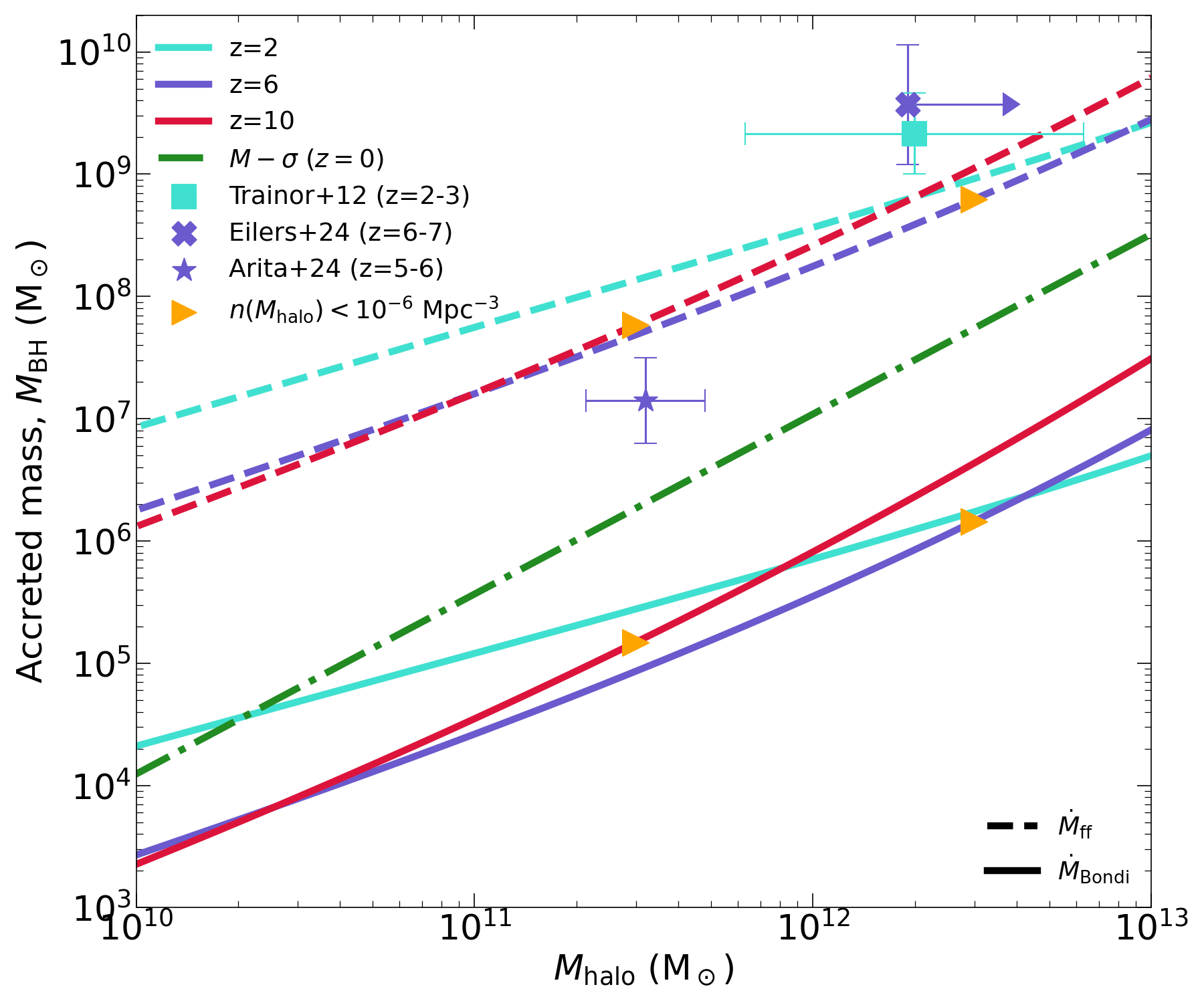
Early Supermassive Black Holes and Little Red Dots Require Free-Fall Growth

Junehyoung Jeon, Volker Bromm, Michael Boylan-Kolchin, et al.

An analytic halo-inflow model argues that observed early AGN and, conditionally, little red dots (LRDs) require near-free-fall cold gas supply rather than Bondi–Hoyle inflow; it treats this as an upper-limit fuel budget, not a direct measurement of black-hole accretion.

2026-09-02 · 2609.00033v1 · Research note

Lynx2030 Science Analysis Group: Final Report

Lynx2030 Science Analysis Group, Simon R. Bandler, Laura W. Brenneman, et al.

This strategic report argues that Lynx-class subarcsecond, high-throughput X-ray imaging spectroscopy would test why JWST little red dots are X-ray weak, while simulations illustrate broader gains for feedback, accretion, and circumgalactic-gas studies.

2026-09-01 · 2608.28745v1 · Research note

Super-Eddington Little Blue Dots May Reionize Helium Too Early

Christopher Cain, Brent Smith, Gibson B. Bowling, et al.

A reionization-budget calculation argues that, if faint z=3–7 Little Blue Dots are common and leak ionizing radiation efficiently, most cannot be highly super-Eddington: their hard EUV spectra would complete He II reionization earlier than allowed.

Figure 2 from How to raise a supermassive black hole: interpreting early JWST AGN with the AESOPICA simulations

2026-07-30 · 2607.26177v1 · Research note

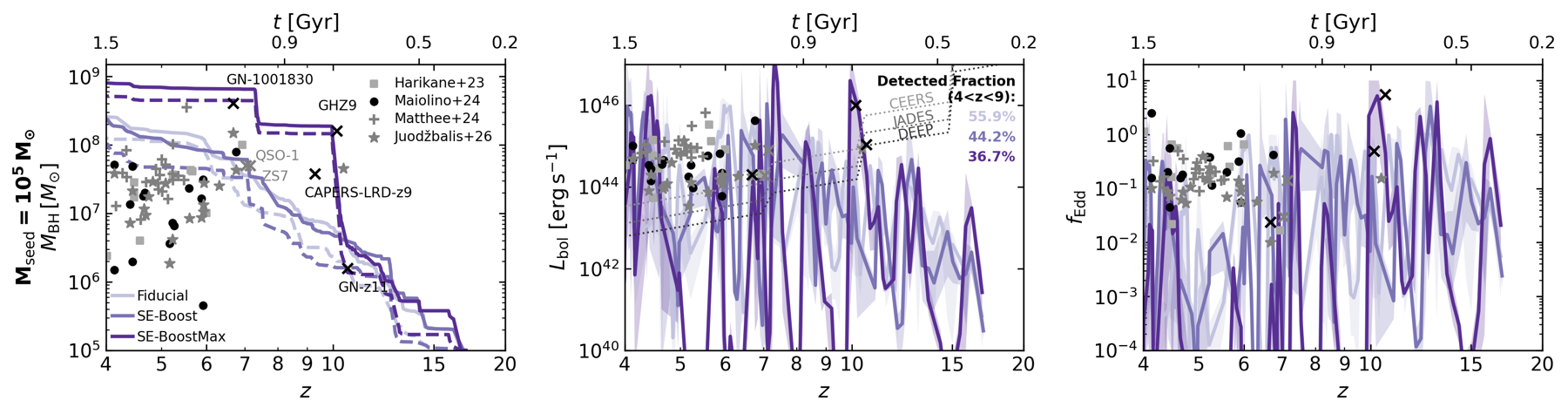
How to raise a supermassive black hole: interpreting early JWST AGN with the AESOPICA simulations

Sophie Koudmani, Jan Scholtz, Anthony J. Taylor, et al.

AESOPICA forward-models JWST broad-line selection in 12 cosmological simulations, finding that selection can yield apparently overmassive AGN from several seed scenarios; very light seeds nevertheless require unusually efficient, intermittently super-Eddington growth in the explored models.

Figure 2 from Outflows in super-Eddington quasars drive clumpy circumgalactic medium and extended H$α$ nebulae at $z \gtrsim 6$

2026-07-27 · 2607.21719v1 · Research note

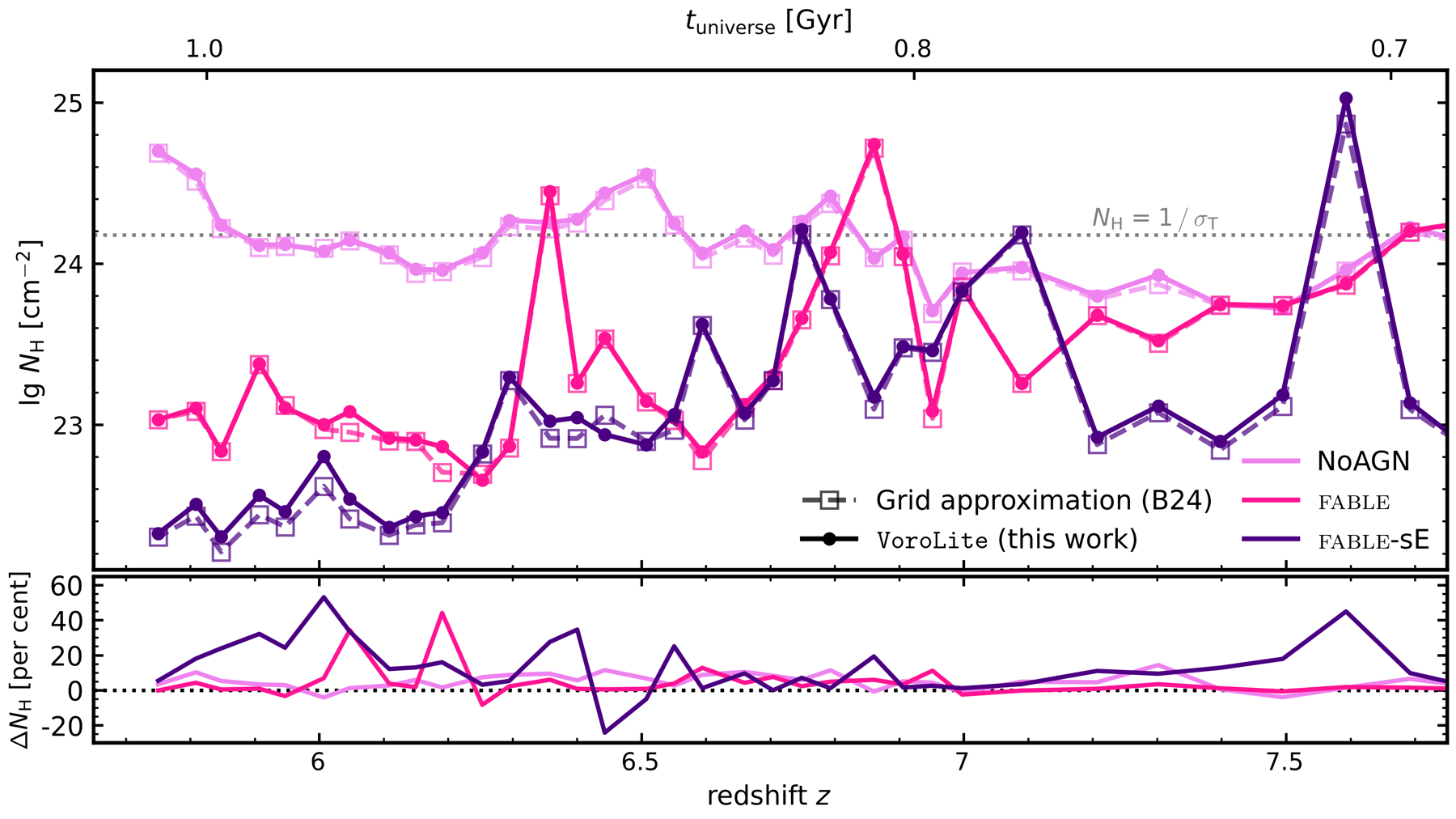
Outflows in super-Eddington quasars drive clumpy circumgalactic medium and extended H$α$ nebulae at $z \gtrsim 6$

Lucas Tortora, Tiago Costa, Debora Sijacki, et al.

In one extreme z~6 halo, simulations predict that earlier seeding plus mildly super-Eddington growth drives cold, fast, neutral CGM clumps and extended Hα after feedback clears nuclear sightlines; this is a model prediction, not a population measurement.

Figure 2 from Optically Thick Outflow Driven by Supercritical Accretion May Explain Little Red Dots

2026-07-21 · 2607.17448v1 · Research note

Optically Thick Outflow Driven by Supercritical Accretion May Explain Little Red Dots

Jun-Rong Liu, Hua Feng, Luis C. Ho

The authors argue that supercritical accretion can launch an optically thick LRD outflow whose red photosphere, line broadening, and Balmer-break properties are broadly compatible with observations, while its Balmer decrements remain underpredicted.

Figure 1 from Little Red Dots as Intermediate Mass, Super-Eddington Engines: Insights from Type IIn Supernovae and The 1837-1856 Great Eruption of $η$ Carinae

2026-07-01 · 2606.30711v1 · Research note

Little Red Dots as Intermediate Mass, Super-Eddington Engines: Insights from Type IIn Supernovae and The 1837-1856 Great Eruption of $η$ Carinae

Rohan P. Naidu, Jorryt Matthee, Anna de Graaff, et al.

The authors propose that Little Red Dots are dense-wind, super-Eddington engines analogous to Type IIn supernova interaction phases, rather than virial broad-line AGN. Their escape-velocity interpretation gives a typical-engine upper limit below 10^5 solar masses.

2026-06-10 · 2606.10455v1 · Research note

The Extreme Quasar Main Sequence of Super-Eddington DESI-DR1 NLSy1 Galaxies

Alberto Domínguez</name> <arxiv:affiliation>UCM</arxiv:affiliation> </author> <author> <name>Suvendu Rakshit, Vaidehi S. Paliya, D. J. Saikia, et al.

In 18,749 DESI-DR1 NLSy1s, stronger Fe II and lower single-epoch virial masses than SDSS-DR17 correspond to a larger inferred super-Eddington fraction. Two mass calibrations preserve the population difference, but virial-mass systematics remain consequential.

2026-06-01 · 2605.31077v1 · Research note

Super-Eddington accretion of black holes in early nuclear bursts gives birth to Little Red Dots

Yangyao Chen, Houjun Mo

A cosmological black-hole/galaxy model interprets z≈5 Little Red Dots as luminous, short super-Eddington nuclear-burst phases of previously seeded black holes. It reproduces the reported number-density shape, but the proposed triggering, seeding mix, and descendants remain model-dependent.

2026-05-06 · 2605.05074v1 · Research note

Little red dots as obscured little blue dots: relative abundances, luminosities, and black-hole masses

Piero Madau, Roberto Maiolino

A forward model treating little red dots as dust-intercepted, inclined counterparts of compact broad-line AGN matches the currently measured UV luminosity function, but dust covering fraction and cloud extinction remain substantially degenerate.

2026-04-22 · 2604.20966v1

Light, heavy, primordial: exploring the diversity of black hole seeding and growth mechanisms in the JWST era

Pratika Dayal

Dayal cross-compares astrophysical light (~100 M⊙) and heavy (~10^3–10^5 M⊙) seeds (via DELPHI) with cosmological primordial black holes (10^{0.5–6} M⊙; PHANES) against z≈5–10 observables. The only scenario the data rule out is Eddington-limited accretion onto light seeds; high black hole–to–stellar mass ratios (Mbh/M*≈0.3–1) are achievable with PBHs or heavy seeds under super-Eddington growth. Crucially, only PBHs and Eddington-limited heavy seeds can simultaneously recover the observed Mbh, M*, and extremely low host metallicities (Z≤0.01 Z⊙) at z≈7–10. PBHs also predict a distinctive decline of Mbh/M* with increasing halo mass and occupancy of 10^9–10^11 M⊙ halos, motivating a clustering-based test selecting z≈7 systems with Mbh/M*>0.1 and Lbol≈10^{44–46} erg s⁻¹.

Figure 3 from How I Wonder What You Are -- JWST's Little Red Dots do not TWINKLE

2026-04-14 · 2604.13000v1 · Research note

How I Wonder What You Are -- JWST's Little Red Dots do not TWINKLE

Zhaoran Liu, Rohan P. Naidu, Amy Secunda, et al.

Across a complete Hα-flux-limited GOODS-N sample, 18 LRDs and nine other broad-Hα emitters show no detected continuum, line-flux, or line-shape variability over 139–220 rest-frame days, challenging their interpretation as ordinary broad-line AGN.

Figure 5 from The X-ray weakness of Little Red Dots and JWST-selected AGN: comparison with local AGN in different accretion regimes

2026-03-10 · 2603.10162v1 · Research note

The X-ray weakness of Little Red Dots and JWST-selected AGN: comparison with local AGN in different accretion regimes

A. Tortosa, C. Ricci, P. Du, et al.

High-redshift LRDs and JWST-selected broad-line AGN are X-ray weak relative to broad Hα, plausibly resembling highly accreting local systems; however, predominantly upper-limit-based X-ray constraints leave intrinsic coronal suppression and obscuration unresolved.

Figure 2 from Synthetic Spectral Library of Optically Thick Atmospheres for Little Red Dots

2026-03-02 · 2603.02317v1 · Research note

Synthetic Spectral Library of Optically Thick Atmospheres for Little Red Dots

Hanpu Liu, Yan-Fei Jiang, Eliot Quataert, et al.

A new LRD-tailored atmosphere library finds that The Egg’s continuum curvature, weak 1.6-μm H− kink, and Ca II triplet jointly favor an exceptionally dilute photosphere, challenging hydrostatic interpretations and providing testable near-IR spectral diagnostics.

2026-02-25 · 2602.22386v1 · Research note

Little Red Dots as Obscured Little Blue Dots: A Super-Eddington Unification Model

Piero Madau, Roberto Maiolino

This modeling study argues that Little Red Dots are high-inclination, dust-reddened counterparts of super-Eddington Little Blue Dots. Anisotropic continua and modest BLR/dust covering factors can reproduce several LRD ensemble observables, but the proposed orientation unification remains model-dependent.

Figure 4 from You can't see me: super-Eddington growth hindering X-ray detection in high-z broad-line AGNs

2026-02-25 · 2602.22305v1 · Research note

You can't see me: super-Eddington growth hindering X-ray detection in high-z broad-line AGNs

Alessandro Trinca, Alessandro Lupi, Francesco Haardt, et al.

Joint modelling of broad lines and Chandra non-detections for 14 JWST high-redshift broad-line AGNs favors low-mass, highly super-Eddington black holes with over-cooled coronæ over massive, weakly accreting alternatives, but the inference remains model-dependent and bimodal.

2026-02-17 · 2602.15952v1

Gas Accretion versus BH Merger driven Growth Modes of Supermassive Black Holes and Implications for the Little Red Dots

Paramita Barai

Cosmological hydrodynamical boxes (50 Mpc)^3 are used to separate merger- from gas-accretion–driven SMBH growth and test feedback choices against SMBH–host coevolution. Seeded at 10^5 Msun, black holes first build up via BH–BH mergers to ~10^7 Msun; only after 7–9 Gyr does accretion reach Eddington, triggering 600–700 Myr bursts that amplify masses by 10^2–10^3 to 10^9–10^10 Msun. AGN-feedback-driven central gas depletion then curtails growth, keeping SMBHs below 10^10 Msun by z=0 and moving systems upward toward the M_BH–M_star relation from below. Implication for JWST little red dots: normal-mass objects are consistent with merger-dominated histories, while overmassive systems require Eddington or super-Eddington accretion episodes.

Figure 2 from Back to Normal Again: Possible Destinies of JWST overmassive SMBHs and "Little Red Dots" in the View of Shin-Uchuu Simulation

2026-02-16 · 2602.14496v1 · Research note

Back to Normal Again: Possible Destinies of JWST overmassive SMBHs and "Little Red Dots" in the View of Shin-Uchuu Simulation

Haojie Hu, Hiroto Yanagisawa, Moka Nishigaki, et al.

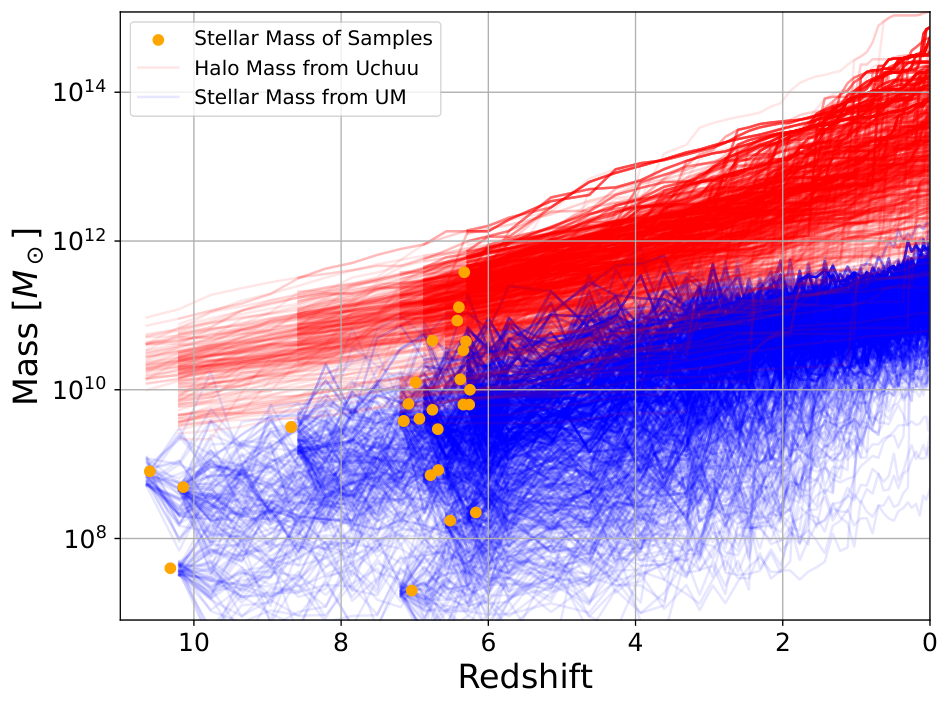
Using halo merger histories plus empirical prescriptions, the authors project 26 z>6 JWST overmassive SMBHs/LRDs toward lower BH-to-stellar mass ratios by z=0. This is a model-dependent extrapolation, not evidence that individual observed systems will converge.

Figure 1 from Direct pathway to the Early Supermassive Black Holes: A Red Super-Eddington Quasar in a Massive Starburst Host at $z=7.2$

2026-02-12 · 2602.12325v1 · Research note

Direct pathway to the Early Supermassive Black Holes: A Red Super-Eddington Quasar in a Massive Starburst Host at $z=7.2$

Qinyue Fei, Seiji Fujimoto, Gabriel Brammer, et al.

GNz7q at z=7.1899 combines a 10^7.55-M⊙, apparently super-Eddington black hole with a massive, rapidly star-forming host. The authors argue that its near-local BH-to-stellar mass ratio makes it a plausible progenitor channel for luminous z≈6 quasars.

2026-01-29 · 2601.22213v1 · Research note

Little Red Dots on FIRE: The Ability of Bursty Galaxies to Host an Abundant Population of High-Redshift AGN

Andrew Marszewski, Claude-André Faucher-Giguère, Guochao Sun, et al.

Post-processed FIRE-2 galaxies can yield enough intermittent AGN at z=5–7 to match LRD-scale abundances, but fiducial models overproduce faint sources. The authors’ conditional remedy selects super-Eddington inflow, Eddington-limited luminosities, and moderately massive hosts.

2026-01-08 · 2601.04955v1 · Research note

Rapid emergence of overmassive black holes in the early Universe

Sunmyon Chon, Shingo Hirano, Tomoaki Ishiyama, et al.

A cosmological radiation-hydrodynamic zoom simulation produces two unusually massive heavy seeds in an overdense, strongly irradiated environment; their growth and transient obscuring disks offer a proposed route to overmassive high-redshift black holes and an LRD-like phase.

Figure 4 from The accretion of quasars at the epoch of reionisation: $JWST$ catches the primeval monsters slowly feasting

2025-12-18 · 2512.16981v1 · Research note

The accretion of quasars at the epoch of reionisation: $JWST$ catches the primeval monsters slowly feasting

B. Trefoloni, E. Nardini, S. Carniani, et al.

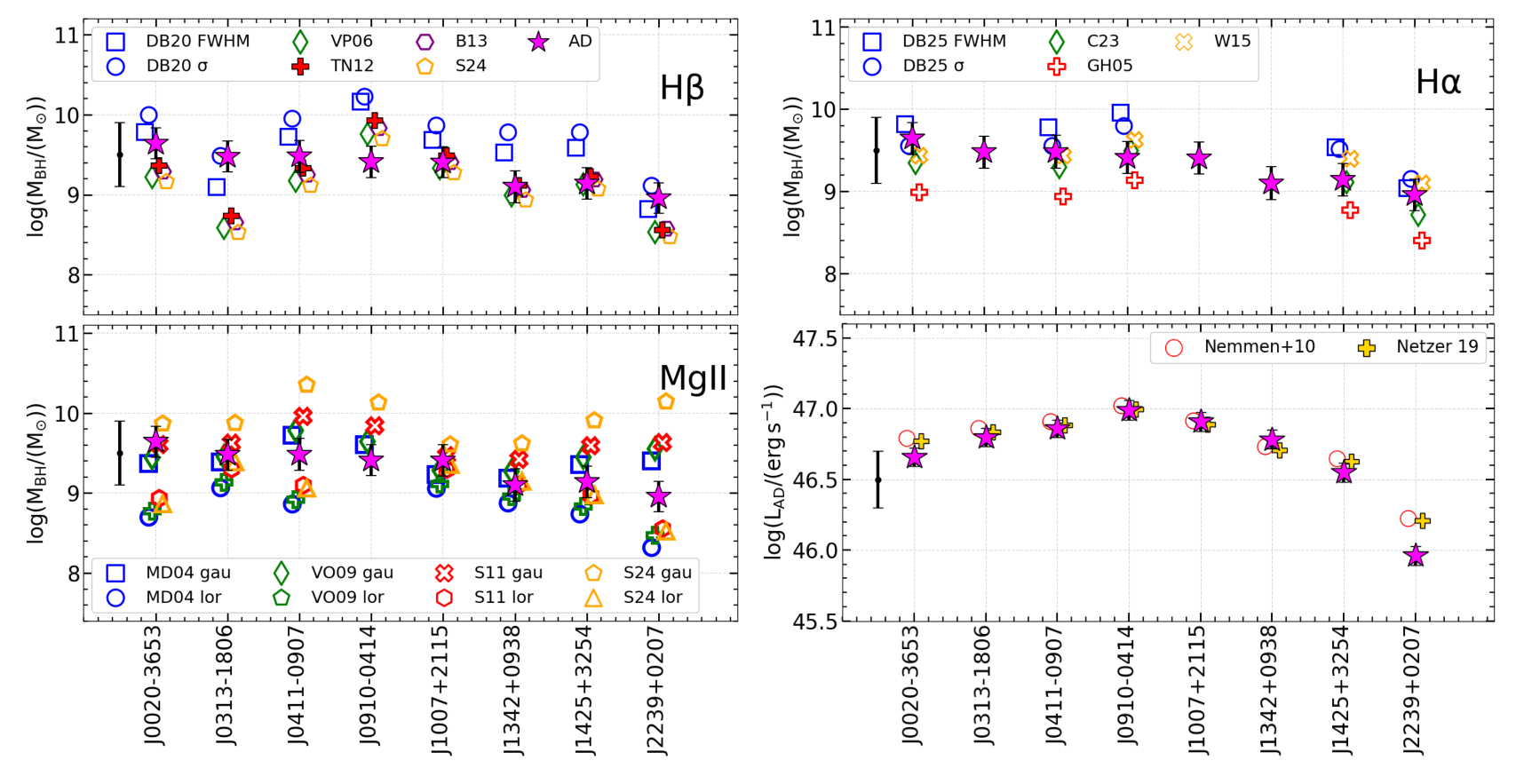
JWST/NIRSpec disc fits for eight luminous z≥5.9 quasars yield a sub-Eddington distribution, ⟨log λEdd⟩=−0.86. The authors argue that self-consistent disc luminosities and masses reduce apparent super-Eddington incidence relative to conventional single-epoch estimates.

Figure 2 from Too Quiet for Comfort: Local Little Red Dots Lack Variability over Decades

2025-11-20 · 2511.16082v1 · Research note

Too Quiet for Comfort: Local Little Red Dots Lack Variability over Decades

Colin J. Burke, Zachary Stone, Yue Shen, et al.

Three nearby proposed Little Red Dot analogs show <3–4% optical-continuum variability over rest-frame five years; two also have broad-Hα changes below a few percent over roughly 15 years, challenging ordinary variable, photoionized broad-line interpretations.

Figure 1 from Bridging scales: Modeling suppressed Bondi accretion on black holes and its impact on galaxy growth

2025-11-11 · 2511.08683v1 · Research note

Bridging scales: Modeling suppressed Bondi accretion on black holes and its impact on galaxy growth

Antonio J. Porras-Valverde, Priyamvada Natarajan, Angelo Ricarte, et al.

A semi-analytic test of GRMHD-motivated magnetic suppression finds that limiting suppression to low-Eddington accretion and rescaling AGN feedback can retain local galaxy and black-hole demographics while allowing rapid early black-hole growth.

2025-11-10 · 2511.07515v1 · Research note

The Deepest GLIMPSE of a Dense Gas Cocoon Enshrouding a Little Red Dot

Vasily Kokorev, John Chisholm, Rohan P. Naidu, et al.

Deep JWST spectroscopy of the lensed z=3.501 LRD GLIMPSE-17775 finds broad exponential line wings, Balmer absorption/break, and fluorescence-rich Fe II/O I emission consistent with a dense, partially ionized AGN cocoon; the super-Eddington inference remains model-dependent.

Figure 1 from Discovery of an X-ray Luminous Radio-Loud Quasar at $z=3.4$: A Possible Transitional Super-Eddington Phase

2025-11-07 · 2511.05029v1 · Research note

Discovery of an X-ray Luminous Radio-Loud Quasar at $z=3.4$: A Possible Transitional Super-Eddington Phase

Sakiko Obuchi, Kohei Ichikawa, Satoshi Yamada, et al.

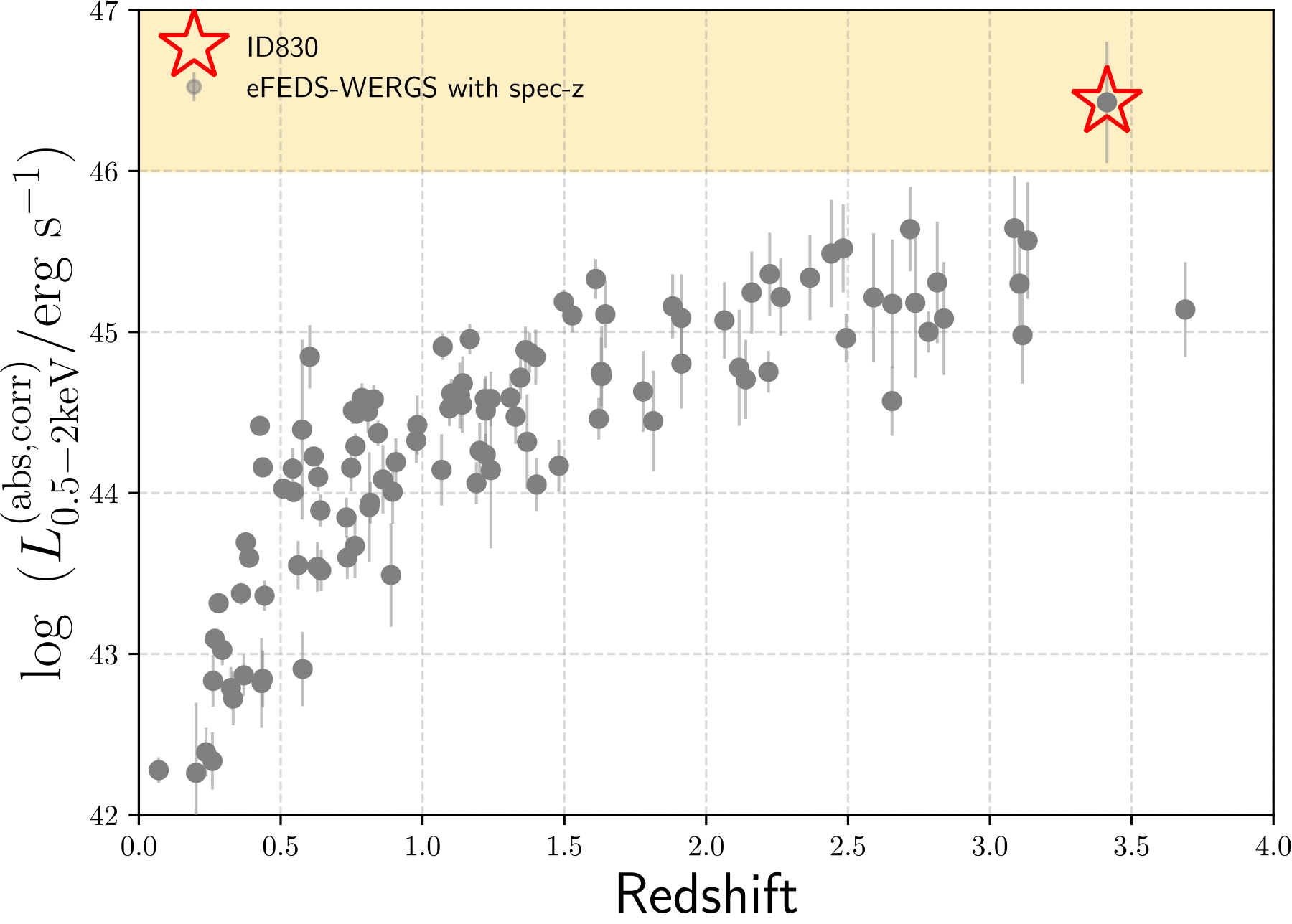
ID830 is a z=3.4351 radio-loud quasar with extreme, steep X-ray emission and a UV-based super-Eddington estimate. The authors interpret its X-ray excess as corona-plus-jet emission during a possible post-burst transition, not a demonstrated evolutionary state.

2025-10-12 · 2510.10772v1 · Research note

Black Holes in the Shadow: The Missing High-Ionization Lines in the Earliest JWST AGNs

Greta Zucchi, Xihan Ji, Piero Madau, et al.

Stacked JADES Type 1 AGN spectra at z>5 show strong Balmer emission but weak or absent high-ionization lines. Cloudy comparisons disfavour much of the tested sub-Eddington parameter space, motivating—but not uniquely establishing—soft, filtered, or anisotropic ionizing continua.

Figure 1 from Heavy seeds and the first black holes: Insights from the BRAHMA simulations

2025-10-01 · 2510.01322v1 · Research note

Heavy seeds and the first black holes: Insights from the BRAHMA simulations

Aklant K. Bhowmick, Laura Blecha, Paul Torrey, et al.

BRAHMA constrained simulations find that heavy-seed abundance and merger dynamics govern black-hole assembly above z≈9, whereas permissive late gas accretion is needed to reach z≈6 quasar masses; extreme z≈9–10 BH-to-stellar ratios remain difficult under subgrid dynamical friction.

2025-09-23 · 2509.19422v1

Spectral Uniformity of Little Red Dots: A Natural Outcome of Coevolving Seed Black Holes and Nascent Starbursts

Kohei Inayoshi, Kohta Murase, Kazumi Kashiyama

Proposes a two-component origin for LRD SEDs during assembly of Mh ≳ 1e10–11 Msun halos at z ≃ 4–10: a super-Eddington–fed seed BH (growing to ~1e6–1e7 Msun) inflates a dense envelope at Teff ≃ 5000 K that makes the red optical, while a coeval ~1e7 Msun nuclear starburst supplies the blue UV. This naturally yields the V-shaped UV–optical continuum and the weakness of X-ray/IR/radio signatures, with broad lines arising despite envelope scattering. A key prediction is a nearly constant Lopt/LUV ≃ 2–10 for ≃15 Myr (~one-third Salpeter) until SNe expel nuclear gas and quench the envelope. Population-wide, the ratio stays uniform at z ≃ 4–8 but declines toward lower z as red envelopes fail, linking LRD phases to later normal AGN states.

2025-09-18 · 2509.14555v1

Stratified wind from a super-Eddington X-ray binary is slower than expected

XRISM collaboration, Marc Audard</name> <arxiv:affiliation>Durham-CEA, UK</arxiv:affiliation> </author> <author> <name>Hisamitsu Awaki</name> <arxiv:affiliation>Durham-CEA, UK</arxiv:affiliation> </author> <author> <name>Ralf Ballhausen</name> <arxiv:affiliation>Durham-CEA, UK</arxiv:affiliation> </author> <author> <name>Aya Bamba</name> <arxiv:affiliation>Durham-CEA, UK</arxiv:affiliation> </author> <author> <name>Ehud Behar</name> <arxiv:affiliation>Durham-CEA, UK</arxiv:affiliation> </author> <author> <name>Rozenn Boissay-Malaquin</name> <arxiv:affiliation>Durham-CEA, UK</arxiv:affiliation> </author> <author> <name>Laura Brenneman</name> <arxiv:affiliation>Durham-CEA, UK</arxiv:affiliation> </author> <author> <name>Gregory V. Brown</name> <arxiv:affiliation>Durham-CEA, UK</arxiv:affiliation> </author> <author> <name>Lia Corrales</name> <arxiv:affiliation>Durham-CEA, UK</arxiv:affiliation> </author> <author> <name>Elisa Costantini</name> <arxiv:affiliation>Durham-CEA, UK</arxiv:affiliation> </author> <author> <name>Renata Cumbee</name> <arxiv:affiliation>Durham-CEA, UK</arxiv:affiliation> </author> <author> <name>Maria Diaz Trigo</name> <arxiv:affiliation>Durham-CEA, UK</arxiv:affiliation> </author> <author> <name>Chris Done</name> <arxiv:affiliation>Durham-CEA, UK</arxiv:affiliation> </author> <author> <name>Tadayasu Dotani</name> <arxiv:affiliation>Fukuoka, Japan</arxiv:affiliation> </author> <author> <name>Ken Ebisawa</name> <arxiv:affiliation>Fukuoka, Japan</arxiv:affiliation> </author> <author> <name>Megan Eckart</name> <arxiv:affiliation>Fukuoka, Japan</arxiv:affiliation> </author> <author> <name>Dominique Eckert</name> <arxiv:affiliation>Fukuoka, Japan</arxiv:affiliation> </author> <author> <name>Teruaki Enoto</name> <arxiv:affiliation>Fukuoka, Japan</arxiv:affiliation> </author> <author> <name>Satoshi Eguchi</name> <arxiv:affiliation>Fukuoka, Japan</arxiv:affiliation> </author> <author> <name>Yuichiro Ezoe</name> <arxiv:affiliation>Fukuoka, Japan</arxiv:affiliation> </author> <author> <name>Adam Foster</name> <arxiv:affiliation>Fukuoka, Japan</arxiv:affiliation> </author> <author> <name>Ryuichi Fujimoto</name> <arxiv:affiliation>Fukuoka, Japan</arxiv:affiliation> </author> <author> <name>Yutaka Fujita</name> <arxiv:affiliation>Fukuoka, Japan</arxiv:affiliation> </author> <author> <name>Yasushi Fukazawa</name> <arxiv:affiliation>Fukuoka, Japan</arxiv:affiliation> </author> <author> <name>Kotaro Fukushima</name> <arxiv:affiliation>Fukuoka, Japan</arxiv:affiliation> </author> <author> <name>Akihiro Furuzawa</name> <arxiv:affiliation>Fukuoka, Japan</arxiv:affiliation> </author> <author> <name>Luigi Gallo</name> <arxiv:affiliation>Fukuoka, Japan</arxiv:affiliation> </author> <author> <name>Javier A. Garcia</name> <arxiv:affiliation>Fukuoka, Japan</arxiv:affiliation> </author> <author> <name>Liyi Gu</name> <arxiv:affiliation>Fukuoka, Japan</arxiv:affiliation> </author> <author> <name>Matteo Guainazzi</name> <arxiv:affiliation>Fukuoka, Japan</arxiv:affiliation> </author> <author> <name>Kouichi Hagino</name> <arxiv:affiliation>Fukuoka, Japan</arxiv:affiliation> </author> <author> <name>Kenji Hamaguchi</name> <arxiv:affiliation>Fukuoka, Japan</arxiv:affiliation> </author> <author> <name>Isamu Hatsukade</name> <arxiv:affiliation>Fukuoka, Japan</arxiv:affiliation> </author> <author> <name>Katsuhiro Hayashi</name> <arxiv:affiliation>Fukuoka, Japan</arxiv:affiliation> </author> <author> <name>Takayuki Hayashi</name> <arxiv:affiliation>Fukuoka, Japan</arxiv:affiliation> </author> <author> <name>Natalie Hell</name> <arxiv:affiliation>Fukuoka, Japan</arxiv:affiliation> </author> <author> <name>Edmund Hodges-Kluck</name> <arxiv:affiliation>Fukuoka, Japan</arxiv:affiliation> </author> <author> <name>Ann Hornschemeier</name> <arxiv:affiliation>Fukuoka, Japan</arxiv:affiliation> </author> <author> <name>Yuto Ichinohe</name> <arxiv:affiliation>Fukuoka, Japan</arxiv:affiliation> </author> <author> <name>Manabu Ishida</name> <arxiv:affiliation>Fukuoka, Japan</arxiv:affiliation> </author> <author> <name>Kumi Ishikawa</name> <arxiv:affiliation>Fukuoka, Japan</arxiv:affiliation> </author> <author> <name>Yoshitaka Ishisaki</name> <arxiv:affiliation>Fukuoka, Japan</arxiv:affiliation> </author> <author> <name>Jelle Kaastra</name> <arxiv:affiliation>Fukuoka, Japan</arxiv:affiliation> </author> <author> <name>Timothy Kallman</name> <arxiv:affiliation>Fukuoka, Japan</arxiv:affiliation> </author> <author> <name>Erin Kara</name> <arxiv:affiliation>Fukuoka, Japan</arxiv:affiliation> </author> <author> <name>Satoru Katsuda</name> <arxiv:affiliation>Fukuoka, Japan</arxiv:affiliation> </author> <author> <name>Yoshiaki Kanemaru</name> <arxiv:affiliation>Fukuoka, Japan</arxiv:affiliation> </author> <author> <name>Richard Kelley</name> <arxiv:affiliation>Fukuoka, Japan</arxiv:affiliation> </author> <author> <name>Caroline Kilbourne</name> <arxiv:affiliation>Fukuoka, Japan</arxiv:affiliation> </author> <author> <name>Shunji Kitamoto</name> <arxiv:affiliation>Fukuoka, Japan</arxiv:affiliation> </author> <author> <name>Shogo Kobayashi</name> <arxiv:affiliation>Fukuoka, Japan</arxiv:affiliation> </author> <author> <name>Takayoshi Kohmura</name> <arxiv:affiliation>Fukuoka, Japan</arxiv:affiliation> </author> <author> <name>Aya Kubota</name> <arxiv:affiliation>Fukuoka, Japan</arxiv:affiliation> </author> <author> <name>Maurice Leutenegger</name> <arxiv:affiliation>Fukuoka, Japan</arxiv:affiliation> </author> <author> <name>Michael Loewenstein</name> <arxiv:affiliation>Fukuoka, Japan</arxiv:affiliation> </author> <author> <name>Yoshitomo Maeda</name> <arxiv:affiliation>Fukuoka, Japan</arxiv:affiliation> </author> <author> <name>Maxim Markevitch</name> <arxiv:affiliation>Fukuoka, Japan</arxiv:affiliation> </author> <author> <name>Hironori Matsumoto</name> <arxiv:affiliation>Fukuoka, Japan</arxiv:affiliation> </author> <author> <name>Kyoko Matsushita</name> <arxiv:affiliation>Fukuoka, Japan</arxiv:affiliation> </author> <author> <name>Dan McCammon</name> <arxiv:affiliation>Fukuoka, Japan</arxiv:affiliation> </author> <author> <name>Brian McNamara</name> <arxiv:affiliation>Fukuoka, Japan</arxiv:affiliation> </author> <author> <name>Francois Mernier</name> <arxiv:affiliation>Fukuoka, Japan</arxiv:affiliation> </author> <author> <name>Eric D. Miller</name> <arxiv:affiliation>Fukuoka, Japan</arxiv:affiliation> </author> <author> <name>Jon M. Miller</name> <arxiv:affiliation>Fukuoka, Japan</arxiv:affiliation> </author> <author> <name>Ikuyuki Mitsuishi</name> <arxiv:affiliation>Fukuoka, Japan</arxiv:affiliation> </author> <author> <name>Misaki Mizumoto</name> <arxiv:affiliation>Fukuoka, Japan</arxiv:affiliation> </author> <author> <name>Tsunefumi Mizuno</name> <arxiv:affiliation>Villanova, USA</arxiv:affiliation> </author> <author> <name>Koji Mori</name> <arxiv:affiliation>Villanova, USA</arxiv:affiliation> </author> <author> <name>Koji Mukai</name> <arxiv:affiliation>Villanova, USA</arxiv:affiliation> </author> <author> <name>Hiroshi Murakami</name> <arxiv:affiliation>Villanova, USA</arxiv:affiliation> </author> <author> <name>Richard Mushotzky</name> <arxiv:affiliation>Villanova, USA</arxiv:affiliation> </author> <author> <name>Hiroshi Nakajima</name> <arxiv:affiliation>Villanova, USA</arxiv:affiliation> </author> <author> <name>Kazuhiro Nakazawa</name> <arxiv:affiliation>Villanova, USA</arxiv:affiliation> </author> <author> <name>Jan-Uwe Ness</name> <arxiv:affiliation>Villanova, USA</arxiv:affiliation> </author> <author> <name>Kumiko Nobukawa</name> <arxiv:affiliation>Villanova, USA</arxiv:affiliation> </author> <author> <name>Masayoshi Nobukawa</name> <arxiv:affiliation>Villanova, USA</arxiv:affiliation> </author> <author> <name>Hirofumi Noda</name> <arxiv:affiliation>Villanova, USA</arxiv:affiliation> </author> <author> <name>Hirokazu Odaka</name> <arxiv:affiliation>Villanova, USA</arxiv:affiliation> </author> <author> <name>Shoji Ogawa</name> <arxiv:affiliation>Villanova, USA</arxiv:affiliation> </author> <author> <name>Anna Ogorzalek</name> <arxiv:affiliation>Villanova, USA</arxiv:affiliation> </author> <author> <name>Takashi Okajima</name> <arxiv:affiliation>Villanova, USA</arxiv:affiliation> </author> <author> <name>Naomi Ota</name> <arxiv:affiliation>Villanova, USA</arxiv:affiliation> </author> <author> <name>Stephane Paltani</name> <arxiv:affiliation>Villanova, USA</arxiv:affiliation> </author> <author> <name>Robert Petre</name> <arxiv:affiliation>Villanova, USA</arxiv:affiliation> </author> <author> <name>Paul Plucinsky</name> <arxiv:affiliation>Villanova, USA</arxiv:affiliation> </author> <author> <name>Frederick Scott Porter</name> <arxiv:affiliation>Villanova, USA</arxiv:affiliation> </author> <author> <name>Katja Pottschmidt</name> <arxiv:affiliation>Villanova, USA</arxiv:affiliation> </author> <author> <name>Kosuke Sato</name> <arxiv:affiliation>Villanova, USA</arxiv:affiliation> </author> <author> <name>Toshiki Sato</name> <arxiv:affiliation>Villanova, USA</arxiv:affiliation> </author> <author> <name>Makoto Sawada</name> <arxiv:affiliation>Villanova, USA</arxiv:affiliation> </author> <author> <name>Hiromi Seta</name> <arxiv:affiliation>Villanova, USA</arxiv:affiliation> </author> <author> <name>Megumi Shidatsu</name> <arxiv:affiliation>Villanova, USA</arxiv:affiliation> </author> <author> <name>Aurora Simionescu</name> <arxiv:affiliation>Villanova, USA</arxiv:affiliation> </author> <author> <name>Randall Smith</name> <arxiv:affiliation>Villanova, USA</arxiv:affiliation> </author> <author> <name>Hiromasa Suzuki</name> <arxiv:affiliation>Villanova, USA</arxiv:affiliation> </author> <author> <name>Andrew Szymkowiak</name> <arxiv:affiliation>Villanova, USA</arxiv:affiliation> </author> <author> <name>Hiromitsu Takahashi</name> <arxiv:affiliation>Villanova, USA</arxiv:affiliation> </author> <author> <name>Mai Takeo</name> <arxiv:affiliation>Villanova, USA</arxiv:affiliation> </author> <author> <name>Toru Tamagawa</name> <arxiv:affiliation>Villanova, USA</arxiv:affiliation> </author> <author> <name>Keisuke Tamura</name> <arxiv:affiliation>Villanova, USA</arxiv:affiliation> </author> <author> <name>Takaaki Tanaka</name> <arxiv:affiliation>Villanova, USA</arxiv:affiliation> </author> <author> <name>Atsushi Tanimoto</name> <arxiv:affiliation>Villanova, USA</arxiv:affiliation> </author> <author> <name>Makoto Tashiro</name> <arxiv:affiliation>Villanova, USA</arxiv:affiliation> </author> <author> <name>Yukikatsu Terada</name> <arxiv:affiliation>Villanova, USA</arxiv:affiliation> </author> <author> <name>Yuichi Terashima</name> <arxiv:affiliation>Villanova, USA</arxiv:affiliation> </author> <author> <name>Yohko Tsuboi</name> <arxiv:affiliation>Villanova, USA</arxiv:affiliation> </author> <author> <name>Masahiro Tsujimoto</name> <arxiv:affiliation>Villanova, USA</arxiv:affiliation> </author> <author> <name>Hiroshi Tsunemi</name> <arxiv:affiliation>Villanova, USA</arxiv:affiliation> </author> <author> <name>Takeshi G. Tsuru</name> <arxiv:affiliation>Villanova, USA</arxiv:affiliation> </author> <author> <name>Aysegul Tumer</name> <arxiv:affiliation>Villanova, USA</arxiv:affiliation> </author> <author> <name>Hiroyuki Uchida</name> <arxiv:affiliation>Villanova, USA</arxiv:affiliation> </author> <author> <name>Nagomi Uchida</name> <arxiv:affiliation>Villanova, USA</arxiv:affiliation> </author> <author> <name>Yuusuke Uchida</name> <arxiv:affiliation>Villanova, USA</arxiv:affiliation> </author> <author> <name>Hideki Uchiyama</name> <arxiv:affiliation>Villanova, USA</arxiv:affiliation> </author> <author> <name>Yoshihiro Ueda</name> <arxiv:affiliation>Villanova, USA</arxiv:affiliation> </author> <author> <name>Shinichiro Uno</name> <arxiv:affiliation>Villanova, USA</arxiv:affiliation> </author> <author> <name>Jacco Vink</name> <arxiv:affiliation>Villanova, USA</arxiv:affiliation> </author> <author> <name>Shin Watanabe</name> <arxiv:affiliation>Villanova, USA</arxiv:affiliation> </author> <author> <name>Brian J. Williams</name> <arxiv:affiliation>Villanova, USA</arxiv:affiliation> </author> <author> <name>Satoshi Yamada</name> <arxiv:affiliation>Villanova, USA</arxiv:affiliation> </author> <author> <name>Shinya Yamada</name> <arxiv:affiliation>Villanova, USA</arxiv:affiliation> </author> <author> <name>Hiroya Yamaguchi</name> <arxiv:affiliation>Villanova, USA</arxiv:affiliation> </author> <author> <name>Kazutaka Yamaoka</name> <arxiv:affiliation>Villanova, USA</arxiv:affiliation> </author> <author> <name>Noriko Yamasaki</name> <arxiv:affiliation>Villanova, USA</arxiv:affiliation> </author> <author> <name>Makoto Yamauchi</name> <arxiv:affiliation>Villanova, USA</arxiv:affiliation> </author> <author> <name>Shigeo Yamauchi</name> <arxiv:affiliation>Villanova, USA</arxiv:affiliation> </author> <author> <name>Tahir Yaqoob</name> <arxiv:affiliation>Villanova, USA</arxiv:affiliation> </author> <author> <name>Tomokage Yoneyama</name> <arxiv:affiliation>Villanova, USA</arxiv:affiliation> </author> <author> <name>Tessei Yoshida</name> <arxiv:affiliation>Villanova, USA</arxiv:affiliation> </author> <author> <name>Mihoko Yukita</name> <arxiv:affiliation>Villanova, USA</arxiv:affiliation> </author> <author> <name>Irina Zhuravleva</name> <arxiv:affiliation>Villanova, USA</arxiv:affiliation> </author> <author> <name>Joey Neilsen</name> <arxiv:affiliation>Villanova, USA</arxiv:affiliation> </author> <author> <name>Ryota Tomaru</name> <arxiv:affiliation>Osaka, Japan</arxiv:affiliation> </author> <author> <name>Missagh Mehdipour

XRISM/Resolve’s 2024-02-25 spectrum of the neutron-star binary GX 13+1 reveals a stratified, highly ionised, Compton-thick wind via dozens of narrow, slightly blueshifted lines from Si–Ni, including high-order Fe XXV/XXVI features above 7 keV. Photoionisation fits require a slow, very dense absorber plus a faster (~700 km/s), more ionised layer to reproduce the Fe XXVI Ly blue wing and residual core flux from wind reprocessing. After correcting for electron-scattering attenuation, the intrinsic luminosity is at or above Eddington, yet the outflow is extremely slow, favouring a thermal‑radiative outer-disc origin over an inner-disc radiation‑pressure (Eddington) wind. The contrast with ultrafast (~0.3c) SMBH winds at similar Eddington ratios points to fundamentally different launch mechanisms across mass scales.
2025-09-12 · 2509.10638v1

Radiation GRMHD Models of Accretion onto Stellar-Mass Black Holes: II. Super-Eddington Accretion

Lizhong Zhang, James M. Stone, Christopher J. White, et al.

A radiation–GRMHD suite with angle-discretized transport follows super‑Eddington inflow across accretion rates, spins a*≈0.3–0.94, and single/double‑loop fields, finding robust, radiation‑pressure supported thick disks. Inner‑disk radiation drives powerful outflows that carve conical funnels, trap photons, and keep radiative efficiencies low while thermal transport is dominated by advection. Angular momentum is carried mainly by Maxwell stress; jets occur in weak and strong modes, with strong jets (net vertical flux + high spin) evacuating the funnel and enabling geometrically beamed escape, whereas weak jets leave the funnel clogged and dimmer—implications for ULXs and little red dots. Spiral density waves appear in the plunging region, adding structure to the inner flow.

2025-09-03 · 2509.03576v1

How similar are narrow-line Seyfert 1 galaxies and high-z type 1 AGN?

M. Berton, E. Järvelä, A. Tortosa, et al.

Review draws a line between local narrow-line Seyfert 1s and the newly uncovered z>4 type 1 AGN/LRDs: both host low-mass (∼10^6–10^7 M⊙) black holes accreting near or above Eddington and often show features like steep, variable X-rays and, in a subset, relativistic jets. The authors argue jets can help shed angular momentum in super-Eddington flows, making NLS1s practical analogs for early SMBH growth. Radio examples underscore the wide range from host-dominated star-formation morphologies to blazar-like, large-scale jets. Key caveat: some systematic differences remain, plausibly tied to distinct environments and evolutionary paths at high redshift.

2025-09-03 · 2509.03571v1

Do Little Red Dots Vary?

Amy Secunda, Rachel S. Somerville, Yan-Fei Jiang, et al.

Simulated light curves for little red dots are generated under two variability prescriptions: an empirical sub‑Eddington DRW tuned to low‑z AGN and a radiation‑MHD–motivated super‑Eddington disk model. With today’s 2–4‑epoch JWST sampling, the DRW case would have produced far more rest‑UV/optical variability than is seen, while the super‑Eddington model naturally matches the near‑steady continua. The high‑cadence nexus imaging should yield Δm>1 mag if DRW holds, but only the lowest‑mass LRDs vary appreciably in the super‑Eddington scenario; meanwhile, twinkle spectroscopy is still expected to detect broad‑line variability if soft X‑rays can reach the BLR. Net result: super‑Eddington accretion neatly explains the missing continuum variability while allowing line changes.

2025-09-03 · 2509.03283v1

A two-phase model of galaxy formation: IV. Seeding and growing supermassive black holes in dark matter halos

Yangyao Chen, Houjun Mo, Huiyuan Wang

Builds a seed-to-SMBH pathway inside a two-phase (fast/slow halo growth) framework: Pop III remnants are bred in mini-halos at the H2- (or delayed atomic-) cooling thresholds, then grow via nuclear-burst super-Eddington episodes, SGC sub-cloud capture, and finally mergers. Implemented on subhalo merger trees, the model produces a broad seed spectrum (10–10^5 Msun at z≈20–30) and a multi-piece, redshift-dependent M_BH–M_* relation set by the dominant channel. A key result is that early nuclear bursts enable rapid mass gain, naturally yielding compact accretors reminiscent of JWST little red dots before merger-dominated quiescence. The framework links LW background and halo assembly rate to BH demographics and matches current constraints.

2025-07-29 · 2507.22206v1

The X-ray Link Between High Eddington Ratio Dust-Obscured Galaxies (DOGs) and Hot DOGs

Fan Zou, W. N. Brandt, Elena Gallo, et al.

Targets seven high-λEdd DOGs and combines new, deeper Chandra exposures with archival X-ray data to measure line-of-sight obscuration. Finds these systems are typically buried: 6/7 have N_H ≳ 10^23 cm^-2 and 3/7 are Compton-thick (N_H ≳ 10^24 cm^-2), with observed X-rays strongly suppressed relative to the mid-IR relation. Placing the sources on the λEdd–N_H plane shows they overlap the regime occupied by Hot DOGs. Authors argue both populations trace a post-merger phase where rapidly accreting SMBHs are enshrouded by dust-rich gas.

2025-07-12 · 2507.09085v1

Little Red Dots As Late-stage Quasi-stars

Mitchell C. Begelman, Jason Dexter

Begelman and Dexter propose that JWST “Little Red Dots” are late-stage quasi-stars: black holes embedded in massive envelopes accreting at super‑Eddington rates once the BH exceeds ~10% of the total mass. In this regime the models predict mass‑insensitive global properties, yielding reddish continua with a pronounced Balmer break and Balmer lines broadened primarily by electron scattering rather than Doppler motions. The enormous electron columns naturally quench X‑rays, while BHs grow roughly linearly in time; late-stage objects with MBH ≳10^6 Msun should dominate the quasi-star population. Given lifetimes of only tens of Myr yet high observed LRD number densities, the authors argue most SMBHs likely pass through this quasi‑star/LRD phase.

2025-07-09 · 2507.07190v1

The Balmer Break and Optical Continuum of Little Red Dots from Super-Eddington Accretion

Hanpu Liu, Yan-Fei Jiang, Eliot Quataert, et al.

Semi-analytic atmospheres plus radiative-transfer show that super-Eddington flows can reproduce LRDs’ red rest-optical continua and Balmer breaks without dust or an external absorbing shell. A cool, low-density photosphere (ρ < 10^{-9} g cm^{-3}) creates a strong opacity jump at the Balmer limit, yielding a break even at T_eff ≈ 5000 K. Thin disks match the color only with a fine-tuned inner truncation giving T_eff ~ 5000 K, whereas a geometrically thick, quasi-spherical flow naturally produces T_eff ≈ 4000–6000 K largely insensitive to Ṁ (Hayashi-line-like). The resulting continua agree with current LRD spectra and motivate predictions for future super-Eddington simulations.

2025-07-02 · 2507.02058v1

On the rapid growth of SMBHs in high-z galaxies: the aftermath of Population III.1 stars

Mahsa Sanati, Julien Devriendt, SergioMartin-Alvarez, et al.

High-resolution zoom-in simulations with Pop III.1 progenitor preheating follow 10^5 Msun seeds through a suite of AGN feedback modes (Eddington-limited thermal; non-Eddington thermal, kinetic, and radiative). Across all models the seeds grow efficiently to ~10^7 Msun by z≈8, with growth largely unimpeded by feedback; the radiative case shows brief super-Eddington bursts that launch fast, mass-loaded outflows (>2500 km s^-1) to ~50 kpc and slightly suppress stellar mass. The simulated systems resemble JWST moderate-luminosity quasars, yielding overmassive BHs, dynamical masses ~10^9.5 Msun, and short-lived high Eddington fractions. This argues that early AGN feedback coexists with rapid SMBH build-up while exporting energy and metals deep into the CGM/IGM.

2025-06-04 · 2506.04350v1

JWST Insights into Narrow-line Little Red Dots

Zijian Zhang, Linhua Jiang, Weiyang Liu, et al.

Using NIRSpec medium/high-resolution data and line-free photometry, the authors isolate five narrow-line LRDs at z≈5 (H-alpha FWHM ≈250 km/s; one ≈475 km/s) from 32 LRDs with H-alpha coverage, and show that about 20% of color-selected LRD candidates fake a V-shape continuum via strong lines. Relative to normal star-forming galaxies, these objects have higher H-alpha widths and luminosities but smaller equivalent widths. SED fits allow either dusty, compact, high-M* and high-SFR galaxies or low-mass AGN with MBH≈10^5–10^6 Msun, plausibly in an early, super-Eddington phase; the BHs are slightly overmassive vs MBH–M* yet consistent/undermassive vs MBH–sigma and MBH–Mdyn within large errors. Nearly half of high‑z broad-line AGN show V‑shape SEDs, underscoring that LRD-like photometry does not uniquely imply broad-line activity.

2025-06-02 · 2506.02289v1

Radiation GRMHD Models of Accretion onto Stellar-Mass Black Holes: I. Survey of Eddington Ratios

Lizhong Zhang, James M. Stone, Patrick D. Mullen, et al.

Exascale AthenaK GRRMHD simulations solve full radiation transport to survey stellar-mass black hole accretion from sub- to highly super-Eddington, spanning spins and initial magnetic topologies. Super-Eddington runs build geometrically thick, radiation-supported disks with a narrow inner funnel, drive powerful equatorial outflows, and remain radiatively inefficient; near/sub-Eddington structure hinges on net vertical flux—forming a thin dense midplane plus magnetically dominated corona when present, versus magnetically dominated throughout without it. Even short of MAD, net-flux high-spin cases launch relativistic jets, connecting to ULXs (Cyg X-3, SS433) and offering a framework for interpreting JWST little red dots. Caveat: results use simplified opacities tailored to stellar-mass systems.

2025-05-14 · 2505.09669v1

Chandra Rules Out Super-Eddington Accretion Models For Little Red Dots

Andrea Sacchi, Akos Bogdan

Stacks Chandra data for 55 JADES/NGDEEP-selected little red dots in the 7 Ms CDF-S, reaching ~390 Ms effective exposure, yet finds no soft- or hard-band signal. The resulting flux limits translate to bolometric luminosities more than an order of magnitude below those inferred from JWST, directly ruling out current super-Eddington SED models tailored for LRDs. The non-detections are instead consistent only with extreme obscuration, requiring NH ≳ 10^25 cm^-2. The authors therefore argue the SMBHs in LRDs are likely less massive and/or less luminous than currently claimed.

2025-05-11 · 2505.06965v1

Black Hole Envelopes in Little Red Dots

Daisaburo Kido, Kunihito Ioka, Kenta Hotokezaka, et al.

Proposes that little red dots host super-Eddington black holes wrapped in a massive, optically thick envelope that gravitationally confines otherwise destructive winds, effectively making outflows a no-go. The envelope radiates near the system Eddington limit with a photosphere at 5000–7000 K, naturally producing the red optical continuum and the hallmark V-shaped SED while explaining weak X-ray/radio and low short-term variability. A sustained ISM infall of ~1 M_sun/yr feeds the envelope, and a photospheric radius ~0.01 pc sets year-scale variability, linking LRD nuclear structure to Hayashi-limit physics. The envelope both regulates feedback and provides a reservoir enabling rapid early BH growth.

2025-05-08 · 2505.05556v1

Super-Eddington accretion in high-redshift quasar hosts: Black-hole driven outflows, galaxy quenching, and the nature of little red dots

Giada Quadri, Alessandro Trinca, Alessandro Lupi, et al.

Zoom-in cosmological simulations of a quasar host including super-Eddington accretion track how MBH feedback shapes gas, star formation, and emergent spectra. Outflows usually vent perpendicular to the disc and only moderately suppress the SFR, but after rapid super-Eddington growth the galaxy spends ≈10% of its lifetime in a distinct quenched state. This phase culminates in a powerful jet+disc-wind event that couples to the disc and excavates a central cavity. Across its history the system’s spectra can look like little red dots or quenched galaxies, implying both are transient stages in early quasar hosts.

2025-04-15 · 2504.11566v1

Tracking the assembly of supermassive black holes: a comparison of diverse models across cosmic time

Antonio J. Porras-Valverde, Angelo Ricarte, Priyamvada Natarajan, et al.

The authors cross-compare SMBH assembly across semi-analytic, empirical, and hydro frameworks (Dark Sage, Santa Cruz SAM, RN18, TRINITY, TNG300) over MBH ≈ 10^6–10^10 Msun. Physics-based models diverge from observationally inferred local BHMFs due to stellar-mass-function and scaling-relation systematics, but converge at z ~ 1–4 and broadly match JWST broad-line AGN BHMFs at z = 4–5. Dark Sage uniquely produces a strong knee in the bolometric AGN luminosity function near Lbol ~ 10^46 erg s^-1 that overlaps the inferred luminosities of JWST “Little Red Dots” at z = 5–6 if the emission is AGN-dominated. Within Dark Sage, SMBHs grow mainly via secular disk instabilities and merger-driven cold gas accretion, while BH–BH mergers contribute ~60% of the mass only for the most massive systems by z = 0; super-Eddington accretion is allowed.

2025-03-20 · 2503.16600v1

A remarkable Ruby: Absorption in dense gas, rather than evolved stars, drives the extreme Balmer break of a Little Red Dot at $z=3.5$

Anna de Graaff, Hans-Walter Rix, Rohan P. Naidu, et al.

JWST/NIRSpec+NIRCam+MIRI data on The Cliff, a luminous Little Red Dot at z=3.55, reveal an extreme Balmer break—about twice stronger than any previously seen at high-z—alongside broad Hα (FWHM∼1500 km s⁻¹) and He I emission but no significant metal lines. Stellar-population solutions (even with steep dust or IMF tweaks) fail, and their formal M*∼10^10.5 M⊙ with re∼40 pc would imply implausibly high stellar-collision rates. The spectra and continuum are instead best matched by a “black hole star” configuration: a powerful central ionizing source embedded in dense, absorbing gas that imprints the Balmer edge and Hα absorption while favoring an intrinsically red continuum over heavy dust. This makes The Cliff compelling evidence that at least some LRDs are not ultra-dense galaxies but compact, accretion-powered nuclei shrouded by dense gas.

2025-03-20 · 2503.16596v1

A "Black Hole Star" Reveals the Remarkable Gas-Enshrouded Hearts of the Little Red Dots

Rohan P. Naidu, Jorryt Matthee, Harley Katz, et al.

JWST/NIRSpec spectroscopy of the point-like source MoM-BH*-1, observed ~660 Myr after the Big Bang, reveals an enormous Balmer break, broad multi-peaked Hβ, and deep Balmer-line absorption. The authors model it as a “black hole star”: a supermassive black hole enshrouded by extremely dense, turbulent, dust-free gas whose atmosphere imprints the break and absorption while dominating the observed light; narrow [OIII] and residual UV are attributed to a faint host. The data are well matched by a simple Cloudy setup that reproduces the break strength, Balmer EWs, UV faintness, and MIRI continuum, with line ratios consistent with high densities that can collisionally suppress [OIII] and a hint of variability reinforcing the SMBH interpretation. They further argue that Little Red Dots can be explained as BH*s embedded in comparably bright hosts, implying current LRD black hole masses—derived with steep dust corrections and standard scaling relations—may be overestimated by orders of magnitude.

2025-03-20 · 2503.16595v1

Little red dots as young supermassive black holes in dense ionized cocoons

V. Rusakov, D. Watson, G. P. Nikopoulos, et al.

Using the highest-S/N JWST/NIRSpec spectra of LRD-like broad-line sources, the authors show that Balmer-line wings are exponential and symmetric, as expected from electron scattering in a compact, Compton-thick ionized cocoon. Convolving a narrow Doppler core with this scattering kernel yields intrinsic widths of only a few hundred km/s, implying black holes of ~10^5–10^7 M⊙ accreting near the Eddington limit within light‑day–scale gas with mild outflows. Accounting for scattering lowers previous mass estimates by ~2 dex and naturally explains LRD traits, including very weak X-ray/radio via nebular reprocessing. This reframes LRDs as young, rapidly growing SMBHs rather than overmassive quasars for their hosts.

2025-03-14 · 2503.11752v1

BlackTHUNDER strikes twice: rest-frame Balmer-line absorption and high Eddington accretion rate in a Little Red Dot at $z=7.04$

Francesco D'Eugenio, Roberto Maiolino, Michele Perna, et al.

BlackTHUNDER re-analyzes JWST/NIRSpec-IFS G395H data for the Little Red Dot Abell2744-QSO1 at z=7.04, focusing on the Hα region. The Hα profile is distinctly non-Gaussian, requiring at least two broad Gaussians plus a narrow component, and shows strong rest-frame Balmer-line absorption (EW ≈22 Å) centered at the systemic velocity of the broad line; the absorber’s dispersion (σ_abs ≈110 km s⁻¹) matches that inferred from the Balmer break, arguing for a long‑lived, non-flowing structure. An Hα-based virial mass of log(MBH/M⊙) ≈7.2 and a deconvolved narrow-line width σ_n ≈22 km s⁻¹ yield MBH/Mdyn = 0.15–1.2, confirming an overmassive black hole with limited room for a host galaxy. The revised mass implies high accretion, λ_Edd ≈0.7–1.6 (potentially super‑Eddington at the low‑mass end), tying Balmer-break strength directly to Balmer-line absorption in LRDs.

2025-03-07 · 2503.05537v1

Little Red Dots as the Very First Activity of Black Hole Growth

Kohei Inayoshi

Using 341 Little Red Dots (39 with spectroscopic redshifts) compiled from JWST surveys, this paper models their occurrence across cosmic time. The counts peak at z ~ 6–8 and fall steeply by z < 4, well described by a log‑normal distribution interpreted as the first one or two accretion episodes of newborn seed black holes. Dense circumnuclear gas naturally explains broad Balmer-line absorption, X‑ray weakness, and brief super‑Eddington bursts that yield overmassive BHs relative to local relations. Summing recurrent episodes reproduces the global AGN abundance evolution ∝ (1+z)^(−5/2) and provides an analytic form for the LRD redshift dependence for future tests.

2025-03-05 · 2503.03870v1

The Convergence of Heavy and Light Seeds to Overmassive Black Holes at Cosmic Dawn

Haojie Hu, Kohei Inayoshi, Zoltan Haiman, et al.

A semi-analytic growth model tied to dark-matter halo assembly follows M_BH/M_star for both heavy and light seeds under feedback-limited, episodic super-Eddington accretion. Despite mass loss in winds, the ratio first increases and then converges to a universal ~0.1–0.3 set by the balance between nuclear gas feeding and star-formation efficiency, forming an attractor in the M_BH–M_star plane. On this attractor, overmassive BHs grow more slowly than their hosts while undermassive seeds catch up rapidly, erasing seed-memory by z~4–6. The model predicts that 10^5–10^6 Msun BHs at higher redshift that deviate from this trend would reveal their birth conditions.

2025-02-06 · 2502.03684v1

Iron-corrected Single-epoch Black Hole Masses of DESI Quasars at low redshift

Zhiwei Pan, Linhua Jiang, Wei-Jian Guo, et al.

Using >55,000 type 1 DESI quasars at 0.25<z<0.8, the authors show that Fe emission strength (R_Fe) tracks Eddington ratio and derive iron-corrected R–L relations for Hβ, then calibrate Mg II masses against the Hβ-based results. Relative to canonical single-epoch scalings, black hole masses are overestimated by ~1.5× on average and up to ~5× for super-Eddington objects, which raises the super-Eddington fraction to ~5% (vs. 0.4%). The Mg II relation adds a −0.34 R_Fe term and is applied to build a ~0.5M-quasar DESI catalog at 0.6<z<1.6. If these iron-corrected relations hold at high z, z≥6 quasar masses would drop by a mean factor of ~2.3, easing early SMBH growth tension.