2609.35991v1 · First listed 2026-09-30
Enhanced density fluctuations: consequences for stellar dynamics and dark matter substructure
Toy primordial-power enhancements that can accommodate little-red-dot abundances may also yield unusually early, dense halos: depending strongly on enhancement shape, the authors predict low-mass stellar clusters and up to a 6.5-fold excess of massive dark subhalos over ΛCDM. [1][4]
Evidence
The study classifies outcomes of enhanced small-scale density fluctuations—dark halos, old galaxies, or star clusters—by whether gas forms stars, supernovae unbind them, and dynamical friction clusters surviving stars. It adopts toy narrow-peak and step-function primordial spectra and fiducial astrophysical inputs, then uses Galacticus to model substructure in a 10^12 M⊙ host. The authors report formation at 1+z ≳100; initial Milky-Way-captured cluster counts of 50 versus ~4.1×10^5 for narrow versus step-like enhancements; and initial stellar cluster masses of order 100 M⊙. Above 10^7 M⊙, subhalo abundance can rise by ~6.5 relative to ΛCDM. These are model predictions, not measurements of clusters or subhalos. [1][4][6]
Earlier work
The paper frames its spectra as ones previously shown to explain little-red-dot abundances, but the supplied extraction does not identify that earlier work, so a direct comparison of its spectrum parameters or fit quality is unavailable. A supplied alternative, PBH-dark-matter scenario instead uses dynamical friction of PBHs in early halos and estimates 3σ halo collapses from z=100 to 20; it is not a calculation of stellar dynamical-friction clustering. Thus the shared early-halo setting does not establish equivalent predictions. [13][14]
What changes
The new contribution is a unified phenomenological mapping from small-scale initial overdensity and wavenumber to stellar-system outcome, coupled to subhalo predictions. For amplitudes δc,0 ≳4×10^-3 at k~200 Mpc^-1, the authors estimate ~5,000 M⊙ stellar clusters under f*=0.04, at the low-mass end of observed globular clusters; lower-k or larger perturbations can make larger systems. They further argue that earlier-forming enhanced-spectrum subhalos are more compact, potentially improving stellar-stream sensitivity. [2][7]
Limits and open questions
Thresholds remain astrophysics-dependent: the adopted f*~0.04 is explicitly uncertain at high redshift, and supernova feedback shifts the dark-halo boundary. A single 1-M⊙ stellar mass neglects an uncertain high-redshift initial-mass function, mass segregation, and possible stellar mergers or supernova disruption. The cluster mass function also omits later cluster destruction and merging. The orbit calculation provides a partial robustness check: across tested density profiles, infall to r/r0~0.2 occurs in 0.10–0.12 ts, near the adopted 0.11 ts clustering time, but this does not remove the baryonic uncertainties. [7][9][5]
The supplied evidence includes the target paper’s abstract and selected HTML passages plus figure captions, but not extracted equations, full Galacticus setup, or the earlier paper claimed to motivate the little-red-dot-compatible spectra.
Key figures
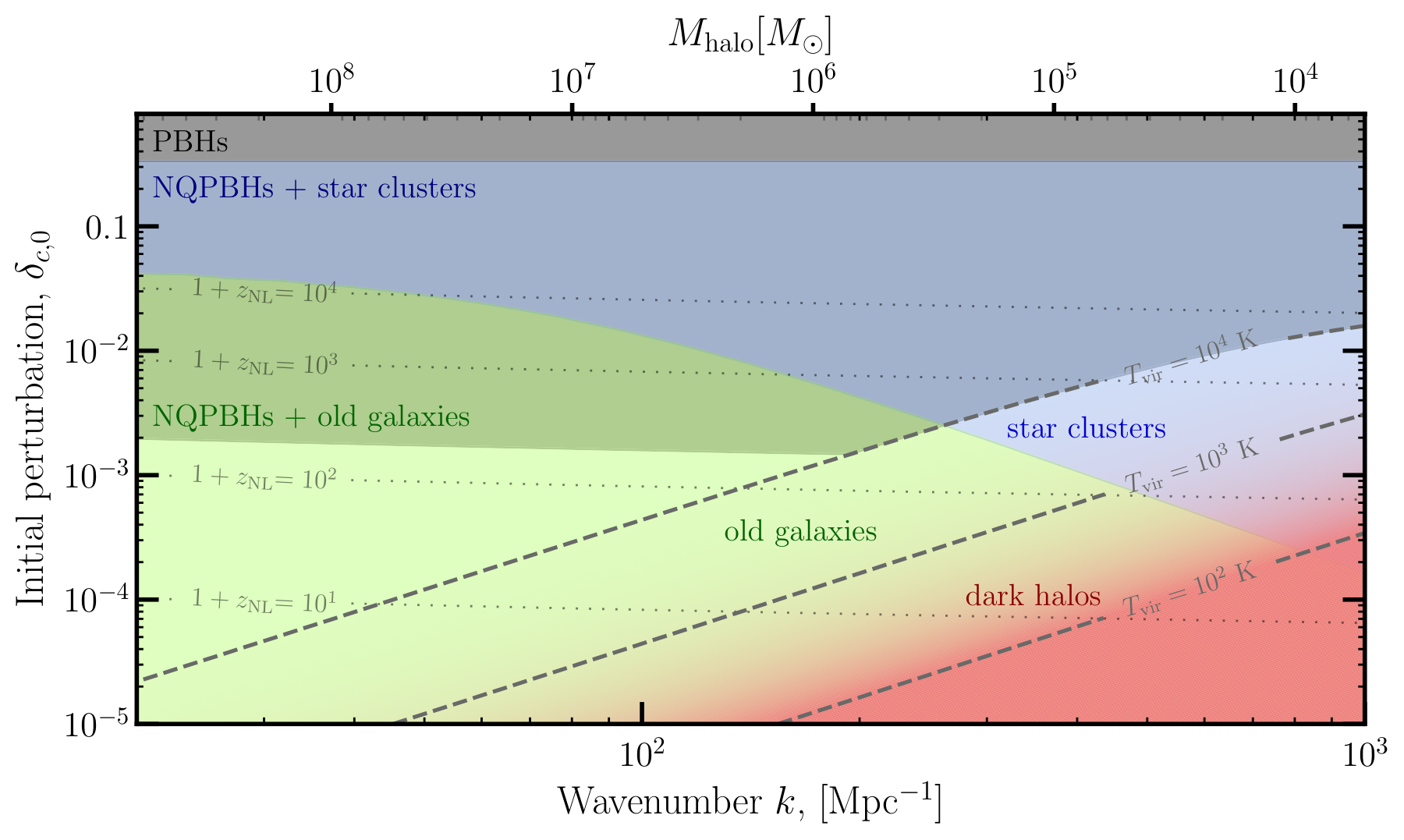
Tests the analytic regime classification in perturbation amplitude–wavenumber (or halo-mass) space: starless/disrupted halos versus bound old galaxies versus systems where dynamical friction forms star clusters. The fuzzy boundary visualizes supernova-feedback uncertainty.
Original caption
Figure 2: A summary of the stellar systems that may form, given the initial density perturbation and wavenumber k k (bottom axis) or corresponding halo mass M halo M_{\mathrm{halo}} (top axis). The regions are divided into dark halos, where stars are either unable to form or remain bound due to the effects of supernova (red); old galaxies, which form when stars are able to form and remain bound, but unable to cluster (green); and star clusters, which form when dynamical friction is efficient (blue). The fuzziness of the dark halos contour represents the variation in this curve due to several uncertainties in the level of supernovae feedback. We also show the parameter space where it is possible to form NQPBHs (gray) and PBHs (dark gray).

Tests how the assumed initial spectrum propagates into present-day substructure of a 10^12 M⊙ halo in Galacticus. It compares narrow-peak and step enhancements with ΛCDM; plotted error bars are 1σ Poisson uncertainties, and the narrow peak suppresses subhalos below ~10^7 M⊙ while enhancing higher masses.
Original caption
Figure 5: Results from Galacticus for the substructure of a 10 12 M ⊙ 10^{12}\,M_{\odot} halo using different initial power spectra. Top: The subhalo mass function, binned by the present-day mass of the subhalos. Black shows the predictions from Λ \Lambda CDM, blue shows the results for our fiducial narrow-peak enhancements, and purple shows the result of the fiducial step-function enhancement. The error bars correspond to 1 σ 1\sigma Poisson uncertainties. For reference, we also show measurements of the subhalo mass function from Ref. [ 8 ] . Bottom: Ratio of the subhalo mass function in the enhanced cases compared to the Λ \Lambda CDM case. For the narrow peak, the abundance of subhalos is suppressed below M sub ∼ 10 7 M ⊙ M_{\mathrm{sub}}\sim 10^{7}\,M_{\odot} and enhanced above this scale by as much as 6.5 6.5 compared to Λ \Lambda CDM. For the step-function, there is no suppression across the range of mass scales considered here.
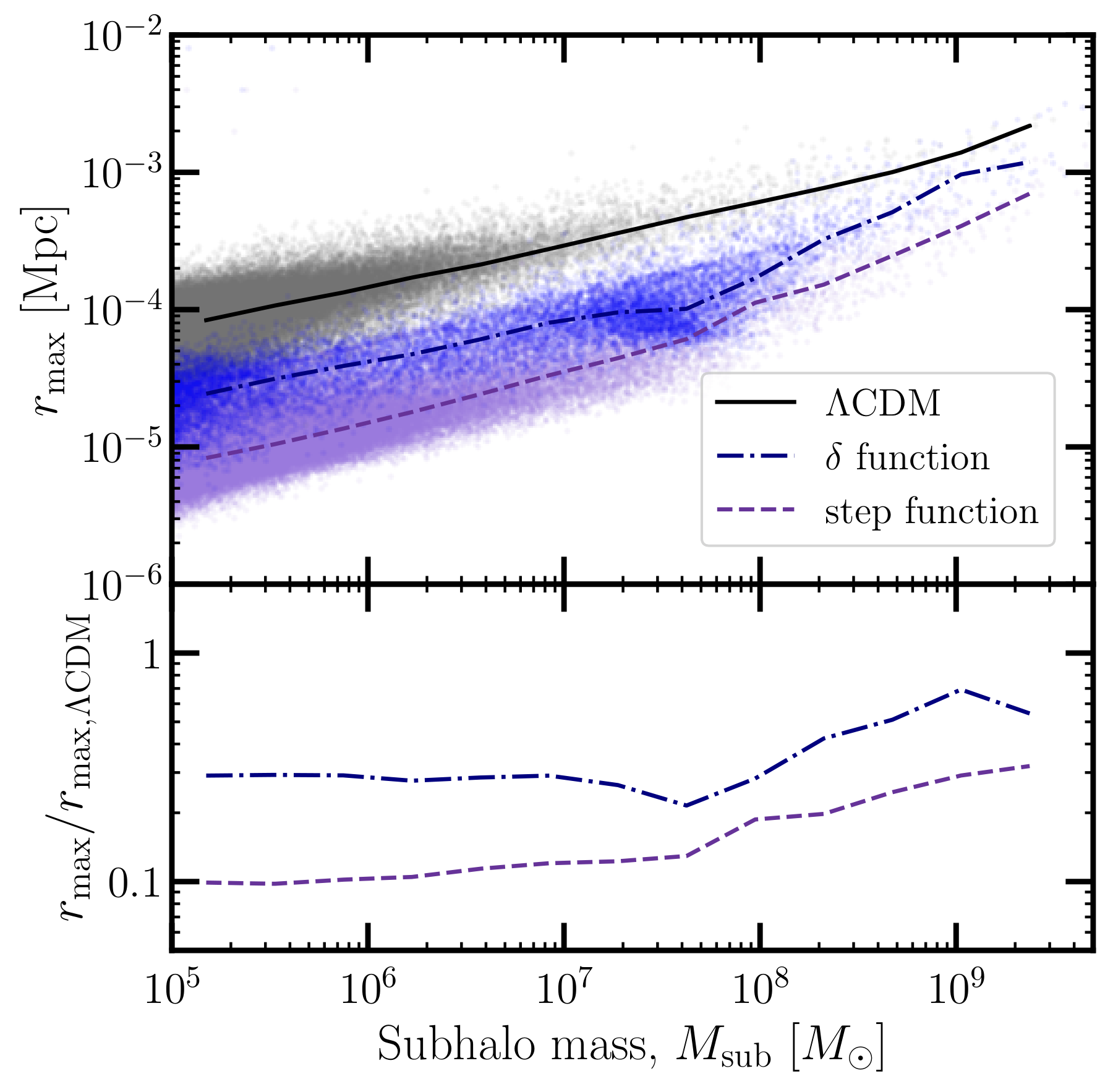
Tests the structural consequence behind the proposed observational handle by comparing maximum-circular-velocity radius with subhalo mass. Earlier formation in enhanced-power cases is interpreted as producing more compact subhalos, relevant to stellar-stream searches.
Original caption
Figure 7: Radius of maximum circular velocity for each subhalo compared to mass for the same halo as in Fig. 5 . We show both a scatter plot and curves for the median r max r_{\mathrm{max}} binned by mass. Because the subhalos in the enhanced power cosmologies form earlier, they are more compact than subhalos within Λ \Lambda CDM. This can enhance their detectability within e.g. stellar stream surveys.
Related research
Previous digest
Qin, Kaplan, and Weiner examine how small-scale primordial power-spectrum enhancements, including toy models motivated by little red dot abundances, create early dense halos that can host dark systems, ancient galaxies, star clusters, or black-hole seeds. Their fiducial models predict that Milky Way capture of early clusters depends dramatically on the enhancement shape, from roughly 50 clusters for a narrow peak to about 4.1 × 10^5 for a step-like enhancement, with initial stellar masses of order 100 solar masses. The same enhanced spectra raise the abundance of subhalos above 10^7 solar masses by up to a factor of about 6.5 and make them more compact than in ΛCDM, providing a stellar-stream test, although the compact-object and feedback thresholds remain astrophysically uncertain.
Sources and evidence (21)
- 2609.35991v1: Enhanced density fluctuations: consequences for stellar dynamics and dark matter substructure
Enhanced density fluctuations form early dark matter halos, which serve as early gravitational potential wells for baryons. These baryons can then condense to form stars and black holes at high redshifts, $1+z \gtrsim 100$. Larger density fluctuations result in denser halos with higher virial temperatures; hence, a halo at a mass that is below the threshold for forming stars under standard astrophysical expectations may form astrophysical objects if its initial density is higher than expected, although the exact threshold for compact object formation is subject to large astrophysical uncertainties. We outline the conditions under which enhanced density fluctuations form dark (star-less) halos, early galaxies, or even star clusters. Using toy model enhancements to the primordial power spectrum that have been shown to explain the abundances of ``little red dots", along with our fiducial set of astrophysical parameters, we show that the number of clusters initially captured by the Milky Way is highly sensitive to the shape of the enhancement, with the narrowly peaked enhancement resulting in $50$ clusters and the step-function enhancement resulting in $\sim 4.1 \times 10^5$. The initial stellar masses of the clusters is also $O (100) \,M_\odot$, although this range is also dependent on the shape of the enhancement. In addition, the abundance of dark matter subhalos with masses greater than $10^7 \, M_\odot$ can be enhanced by as much as a factor of $\sim 6.5$ and is denser than in $Λ$CDM, which will increase their detectability in future stellar stream surveys such as the Via Project.
- 2609.35991v1: Enhanced density fluctuations: consequences for stellar dynamics and dark matter substructure
The last region is interesting as a possible pathway to form globular clusters, whose formation is still not well understood. Our results show that overdensities forming with initial amplitudes greater than δ c , 0 ≳ 4 × 10 − 3 \delta_{c,0}\gtrsim 4\times 10^{-3} at a wavenumber of k ∼ 200 k\sim 200 Mpc -1 can form star clusters with stellar masses of approximately Ω b Ω m M halo f ∗ ∼ 5000 M ⊙ \frac{\Omega_{b}}{\Omega_{m}}M_{\mathrm{halo}}f_{*}\sim 5000\,M_{\odot} , which is at the low end of observed globular cluster masses [ 11 ] , although the cluster mass may be higher if f ∗ f_{*} is larger than the value of 0.04 assumed here—this uncertainty was discussed in Section III.2 . Larger clusters can also result if the overdensity forms from a lower wavenumber mode and higher initial value. This mechanism also links the formation of star clusters to dwarf galaxies, since both would be formed from relatively small dark matter halos, with efficient dynamical friction leading to the former. A link between the origins of these two classes of objects is an interesting consequence, given suggestions that the populations are not entirely separate [ 31 , 47 ] .
- 2609.35991v1: Enhanced density fluctuations: consequences for stellar dynamics and dark matter substructure
In this work, we have explored the formation of stellar systems from enhanced density fluctuations. We showed that the higher density of the resulting early halos raises their virial temperature, and therefore allows halos to form stars below the usual ∼ 10 8 M ⊙ \sim 10^{8}\,M_{\odot} threshold. If the effect of supernova feedback is also strong, then some of the halos that form stars will eject their stars and gas, leaving behind only a dark halo, with a density much higher than expected in Λ CDM \Lambda{\rm CDM} . In addition, the dynamical friction timescales for stars in these dense halos can be short enough that stars can come to dominate the gravitational potential, even for relatively modest density fluctuations at wavenumbers above k ∼ 200 k\sim 200 Mpc -1 ; hence, the stars in such halos will appear as old star clusters as opposed to old galaxies. We also discuss various astrophysical uncertainties associated with these calculations, which alter the amplitudes of the different thresholds but not their scalings with wavenumber or halo mass.
- 2609.35991v1: Enhanced density fluctuations: consequences for stellar dynamics and dark matter substructure
Enhanced density fluctuations form early dark matter halos, which serve as early gravitational potential wells for baryons. These baryons can then condense to form stars and black holes at high redshifts, 1 + z ≳ 100 1+z\gtrsim 100 . Larger density fluctuations result in denser halos with higher virial temperatures; hence, a halo at a mass that is below the threshold for forming stars under standard astrophysical expectations may form astrophysical objects if its initial density is higher than expected, although the exact threshold for compact object formation is subject to large astrophysical uncertainties. We outline the conditions under which enhanced density fluctuations form dark (star-less) halos, early galaxies, or even star clusters. Using toy model enhancements to the primordial power spectrum that have been shown to explain the abundances of “little red dots”, along with our fiducial set of astrophysical parameters, we show that the number of clusters initially captured by the Milky Way is highly sensitive to the shape of the enhancement, with the narrowly peaked enhancement resulting in 50 50 clusters and the step-function enhancement resulting in ∼ 4.1 × 10 5 \sim 4.1\times 10^{5} . The initial stellar masses of the clusters is also 𝒪 ( 100 ) M ⊙ \mathcal{O}(100)\,M_{\odot} , although this range is also dependent on the shape of the enhancement. In addition, the abundance of dark matter subhalos with masses greater than 10 7 M ⊙ 10^{7}\,M_{\odot} can be enhanced by as much as a factor of ∼ 6.5 \sim 6.5 and is denser than in Λ \Lambda CDM, which will increase their detectability in future stellar stream surveys such as the Via Project.
- 2609.35991v1: Enhanced density fluctuations: consequences for stellar dynamics and dark matter substructure
Fig. 8 shows the result of solving Eq. ( 17 ) for several different density profiles. Time is shown on the x x -axis and is normalized by t s = r s 2 σ / ( G M ∗ ) t_{s}=r_{s}^{2}\sigma/(GM_{*}) , where we reiterate that M ∗ M_{*} is the mass of a single star—in these units, the clustering time given in Eq. ( 21 ) is t cluster ∼ 0.11 t s t_{\mathrm{cluster}}\sim 0.11t_{s} . For a star beginning at a typical radius, we can see that the time it takes for a star to fall in to r / r 0 ∼ 0.2 r/r_{0}\sim 0.2 is quite similar across density profiles, with values falling between t ∈ [ 0.10 , 0.12 ] × t s t\in[0.10,0.12]\times t_{s} , and hence very near to t cluster t_{\mathrm{cluster}} . It is therefore justified to use t cluster t_{\mathrm{cluster}} as the clustering timescale no matter the density profile.
- 2609.35991v1: Enhanced density fluctuations: consequences for stellar dynamics and dark matter substructure
Here we will describe the physics necessary to understand the qualitative properties of the stellar systems resulting from early structure formation. Namely, we will focus on whether stars are able to form at all, whether the gas and stars that form in a halo are able to remain bound under the effect of supernovae, and also whether the stars and dark matter form in a sufficiently dense initial configuration such that gravitational scatters (and therefore kinetic energy transfer) become efficient—we will also discuss the astrophysical uncertainties relevant to each process.
- 2609.35991v1: Enhanced density fluctuations: consequences for stellar dynamics and dark matter substructure
Each of these astrophysical factors merits additional discussion. First, we take the value of the star formation efficiency to be f ∗ ∼ 0.04 f_{*}\sim 0.04 per the discussion from Refs. [ 53 , 54 ] , which studied the energy budget of the universe in all known forms of matter and radiation—this value is also on the higher end of present day observational constraints [ 79 ] and values inferred from stellar mass-halo mass relationships [ 15 ] , assuming the baryon fraction follows the cosmic value. The form we assumed for N ∗ N_{*} also assumes f ∗ f_{*} is independent of time, when in reality this quantity changes between different generations of star formation. In previous literature, it was believed that star formation peaks at z ∼ 2 z\sim 2 and decreases towards earlier redshifts [ 14 , 82 ] . Results from JWST for high-redshift galaxies change this picture, with recent works claiming that the efficiency should rise towards higher redshifts in order to account for the large masses of these galaxies [ 110 , 108 , 98 ] . Since the literature on f ∗ f_{*} has been evolving rapidly, we will proceed with a fiducial value of f ∗ ∼ 0.04 f_{*}\sim 0.04 and note that the astrophysical uncertainties on this quantity, particularly towards high redshifts, are large. Second, we take f SN = 0.0068 f_{\mathrm{SN}}=0.0068 . From the review of cosmic star formation history in Ref. [ 82 ] , the number of stars that undergo core-collapse supernova per unit mass is expected to be around k CC = 0.0068 M ⊙ − 1 k_{\mathrm{CC}}=0.0068\,M_{\odot}^{-1} —for solar mass stars, this is approximately one supernova per 150 stars. Lastly, we take M ∗ = 1 M ⊙ M_{*}=1\,M_{\odot} . Note that this mass scale is more appropriate for second or third generation stars forming from enriched gas—the first generation of stars in these early halos will more resemble Pop III stars, which are expected to have larger masses of M ∗ ∼ 100 M ⊙ M_{*}\sim 100\,M_{\odot} , smaller values of f ∗ f_{*} , and values of f SN f_{\mathrm{SN}} near unity. These effects compensate one another such that the contribution of this first generation is not more than the generation we consider here. Moreover, changes in
- 2609.35991v1: Enhanced density fluctuations: consequences for stellar dynamics and dark matter substructure
Although we assumed an isothermal profile in order to derive this result, we have checked that this result does not depend significantly on the choice of density profile. See Appendix A for details on this cross-check. Furthermore, comparing this expression to the relaxation time, we find that
- 2609.35991v1: Enhanced density fluctuations: consequences for stellar dynamics and dark matter substructure
In addition, we have assumed a single mass scale for the stars in these enhanced density halos. However, if there is a significant spread in the initial mass function of the high redshift stars, then higher mass stars will contract more quickly than the low mass stars, resulting in mass segregation. If this process is very efficient, then the fate of this system depends on whether the supernova rate or merger rate is dominant for the high-mass stars clustered at the halo’s core. Merging of high mass stars at the center of the cluster may lead to the formation of a central intermediate-mass black hole [ 96 , 97 ] , provided that collisions occur more rapidly than the infalling stars can go supernova. This provides a mechanism for forming SMBH seeds independent of the direct-collapse that leads to NQPBHs at high redshifts. On the other hand, if supernovae are efficient, then the stars will explode faster than they can assemble into a large central object. Estimating the effect of mass segregation requires knowing the initial mass function of these high redshift stars, which is highly uncertain and we consider to be outside of the scope of present work.
- 2609.35991v1: Enhanced density fluctuations: consequences for stellar dynamics and dark matter substructure
Figure 2: A summary of the stellar systems that may form, given the initial density perturbation and wavenumber k k (bottom axis) or corresponding halo mass M halo M_{\mathrm{halo}} (top axis). The regions are divided into dark halos, where stars are either unable to form or remain bound due to the effects of supernova (red); old galaxies, which form when stars are able to form and remain bound, but unable to cluster (green); and star clusters, which form when dynamical friction is efficient (blue). The fuzziness of the dark halos contour represents the variation in this curve due to several uncertainties in the level of supernovae feedback. We also show the parameter space where it is possible to form NQPBHs (gray) and PBHs (dark gray).
- 2506.17641v1: Dark Bondi Accretion Aided by Baryons and the Origin of JWST Little Red Dots
Discussion. There are several aspects that warrant further improvement. Our estimates of the initial seed mass and the SMFP mass are primarily based on fluid simulations. However, recent studies suggest that the fluid approximation may break down during the late stages of evolution—for instance, when the velocity dispersion becomes anisotropic [ 53 , 66 , 67 ] . At very late times, as the velocity dispersion increases significantly, dissipative processes associated with the mediator particle may also become important. More work is needed to assess the impact of these effects in the presence of a baryonic potential.
- 2506.17641v1: Dark Bondi Accretion Aided by Baryons and the Origin of JWST Little Red Dots
Conclusions. We have investigated the formation of the JWST LRDs in the SIDM framework, in which the central dark matter halo undergoes gravothermal collapse to form a seed black hole. Even if the initially collapsing region that triggers relativistic instability has a mass on the order of one solar mass, the resulting seed can grow into an intermediate-mass black hole via Eddington accretion of baryonic gas, and subsequently evolve into an SMBH through dark Bondi accretion of SIDM particles. In this scenario, the majority of the black hole’s mass originates from SIDM accretion rather than baryonic matter, naturally explaining the overmassive feature of the LRDs. In the future, dedicated numerical simulations are needed to test dark Bondi accretion and other SIDM accretion processes [ 68 , 69 ] . It will be important to investigate the predicted population of LRDs within this framework [ 23 ] and explore the associated gravitational wave signatures [ 24 ] .
- 2601.08936v1: A possible pathway to UHZ1-type systems at z~10 by heterogeneous mass primordial black holes as dark matter
We can now tie this discussion to Fig. 2 which indicates the halo mass range that can collapse at any z z , for various f PBH M PBH f_{\rm PBH}M_{\rm PBH} and ( 1 , 3 ) σ (1,3)\sigma density excursions. The figure shows that at the 3 σ \sigma level, halos of M H ≃ ( 1.5 × 10 5 , 3 × 10 5 , 7 × 10 5 , 2.5 × 10 6 , 10 7 ) M ⊙ M_{\rm H}\simeq(1.5\times 10^{5},3\times 10^{5},7\times 10^{5},2.5\times 10^{6},10^{7})M_{\odot} , can collapse at z = 100 , 70 , 50 , 30 , 20 z=100,70,50,30,20 , if f PBH M PBH = 20 M ⊙ f_{\rm PBH}M_{\rm PBH}=20M_{\odot} , decreasing to M H ≃ ( ≤ 10 5 , 1.7 × 10 5 , 4 × 10 5 , 1.3 × 10 6 , 5 × 10 6 ) M ⊙ M_{\rm H}\simeq(\leq 10^{5},1.7\times 10^{5},4\times 10^{5},1.3\times 10^{6},5\times 10^{6})M_{\odot} at z = 100 , 70 , 50 , 30 , 20 z=100,70,50,30,20 , if f PBH M PBH = 10 M ⊙ f_{\rm PBH}M_{\rm PBH}=10M_{\odot} . The Press-Schechter ( 66 ) formalism suggests that a sufficient fraction of such halos would exist at ( 3 − 5 ) σ (3-5)\sigma levels to produce - for suitable PBH mass functions - at least a few central objects of 10 7 − 10 8 M ⊙ 10^{7}-10^{8}M_{\odot} by z = 10 z=10 , as observed for UHZ1. E.g., at 3 σ 3\sigma we can expect ≃ 0.3 % \simeq 0.3\% of the density field to have the required parameters. Currently, theoretically-motivated PBH mass function proposals contain 10 to 20% by mass in PBHs of 10 M ⊙ 10M_{\odot} or higher ( 12 ) , i.e., those subject to dynamical friction, and 10-20% of them will have the required low angular momentum, λ ≤ 0.1 − 0.2 \lambda\leq 0.1-0.2 . Dynamical friction would therefore drive ∼ 1 − 2 % \sim 1-2\% of the total mass of the PBH component to the central 1 pc in ( 0.5 − 1 ) × t cosm (0.5-1)\times t_{\rm cosm} after halo collapse. These clusters of PBHs at the centers of low mass halos will merge into larger units as hierarchical clustering proceeds. At z ≃ 15 z\simeq 15 , halos of 10 9 M ⊙ 10^{9}M_{\odot} , corresponding to peaks of 3 − 4 σ 3-4\sigma , could have collapsed and given rise to concentrations of up to ∼ 10 7 M ⊙ \sim 10^{7}M_{\odot} in the central parsec by z = 10 z=10 , depending on the fraction, f PBH f_{\rm PBH} , of DM consisting of PBHs. Baryonic accret
- 2601.08936v1: A possible pathway to UHZ1-type systems at z~10 by heterogeneous mass primordial black holes as dark matter
Figure 3: Dynamical friction collapse time t df t_{\rm df} from solving numerically eqs. 6 , in units of the crossing/orbital time, R H / V 0 R_{\rm H}/V_{0} as a function of λ \lambda and 𝒞 {\cal C} . These results correspond to m ∙ ln Λ / M H = 0.01 m_{\bullet}\ln\Lambda/M_{\rm H}=0.01 and can be rescaled to other values since t df ∝ ( m ∙ ln Λ / M H ) − 1 t_{\rm df}\propto(m_{\bullet}\ln\Lambda/M_{\rm H})^{-1} . Dashed horizontal lines mark ( 1 , 2 , 3 ) × t cosm ( z ) (1,2,3)\times t_{\rm cosm}(z) , whereas the dotted line indicates the time for an individual halo to remain intact from z = 50 z=50 to z = 10 z=10 . Left: t df t_{\rm df} vs. λ \lambda ; NFW halo profiles with 𝒞 = 10 , 20 , 30 , 40 , 100 {\cal C}=10,20,30,40,100 , are shown with blue, orange, green, red, and purple solid lines, and isothermal halo profiles with the same concentrations are shown with corresponding dash-dotted lines. The isothermal, non-truncated distribution ℱ ( E ) {\cal F}(E) was adopted. Right: Same vertical axis vs. the concentration parameter, 𝒞 {\cal C} . Solid lines represent NFW profiles with λ = 0.05 , 0.1 , .0.15 , 0.2 , 0.3 \lambda=0.05,0.1,.0.15,0.2,0.3 in blue, orange, green, red, and purple, respectively, and dash-dotted lines correspond to isothermal profiles.
- 2601.21676v1: Little Red Dots and Supermassive Black Hole Seed Formation in Ultralight Dark Matter Halos
We investigate how supermassive black hole (SMBH) seeds form in the early Universe at the centers of ultralight dark matter (ULDM) halos. Focusing on the ULDM Jeans scale, we identify the critical conditions under which high-redshift baryonic gas, strongly confined by central solitonic cores of the halos, undergoes direct and monolithic collapse. The solitonic potential naturally drives rapid inflow and shock heating, allowing the gas temperature to exceed the critical atomic-cooling threshold of $\sim 10^4 \,{\rm K}$ required for fragmentation suppression without invoking an external UV background. We derive semi-analytic relations for the halo mass, soliton mass, baryonic core radius, and thermodynamic state of the gas, including the effects of baryonic contraction. These relations simultaneously determine the minimum and maximum SMBH seed masses as functions of redshift. In this framework, pristine gas clouds that satisfy the temperature threshold collapse without fragmentation, forming SMBH seeds with characteristic masses of order $ 10^5M_\odot$, while systems below the threshold are expected to form compact star clusters instead. Our model also implies an upper limit on the attainable SMBH mass, predicting a maximum mass scale of order $10^{10}M_\odot$, consistent with the most massive quasars observed to date.The ULDM particle mass required to reproduce the inferred seed mass scale, $m \simeq 10^{-22}{\rm eV}$, coincides with the value favored by galactic-scale observations, providing a unified explanation for the characteristic masses of both galactic cores and early SMBH seeds. Our model predicts efficient SMBH seed formation at redshifts $z \gtrsim 10$ and offers a natural interpretation of recently observed little red dots as SMBHs embedded in compact, hot, ionized gas clouds.
- 2507.03230v1: Little Red Dots from Ultra-Strongly Self-Interacting Dark Matter
We investigate the possibility that the recently identified population of high-redshift, obscured quasars - known as "Little Red Dots" (LRDs) - originates from early black hole seed formation driven by ultra-strongly self-interacting dark matter (uSIDM). In this framework, dark matter halos undergo gravothermal core collapse due to large self-interaction cross sections, resulting in the rapid formation of massive black hole (BH) seeds with masses $\gtrsim 10^{5} M_\odot$ at redshifts $z \gtrsim 5$. We develop a semi-analytic model that tracks the evolution of the dark matter halo population, the redshift of collapse $z_{\rm coll}$, and the corresponding BH mass function. Black hole growth is modeled stochastically via a log-normal Eddington ratio distribution and a finite duty cycle. We find that the uSIDM scenario naturally reproduces key observed properties of LRDs, including their abundance, compactness, and characteristic BH masses, while offering a mechanism for early, obscured black hole formation that is difficult to achieve in standard CDM-based models. The predicted SMBH mass function at $z \sim 5$ shows excellent agreement with LRD observational data and SIDM merger-tree simulations, particularly at the high-mass end $(m_{\rm BH} \gtrsim 10^{7} M_\odot)$. These results suggest that LRDs may serve as powerful observational tracers of exotic dark sector physics and that SMBH formation in the early universe could be significantly shaped by non-gravitational dark matter interactions.
- 2609.09271v1: The Ashes of Supermassive Stars: Globular Cluster-like Aluminum Enhancement in Little Red Dots
To assess the possible impact of unresolved saturation in Mg ii , we repeat the inference after increasing the measured [ Mg / Fe ] {\rm[Mg/Fe]} abundance by 0.5 dex. The resulting posterior distributions in T c T_{\rm c} and Δ Y \Delta Y become substantially broader, but remain consistent with the fiducial solution within the correspondingly larger uncertainties. This demonstrates that the inference is not driven solely by the extreme Mg depletion: the strong Al enhancement relative to ordinary star-forming galaxies which we show in Extended Data Figure 2 provides an independent constraint and remains the principal driver of the hot hydrogen-burning interpretation.
- 2609.09271v1: The Ashes of Supermassive Stars: Globular Cluster-like Aluminum Enhancement in Little Red Dots
We fit the resulting spectrum with a curved power-law continuum attenuated by a damped Ly α \alpha absorption profile. The continuum is parameterized by a normalization A A , slope β \beta , and curvature γ \gamma , while the absorption is described by the full Lorentzian natural-broadening profile with N HI N_{\rm HI} as a free parameter. Allowing continuum curvature is important because otherwise intrinsic spectral curvature can be absorbed into the inferred damping opacity and bias N HI N_{\rm HI} high. We allow | γ | ≤ 24 |\gamma|\leq 24 and marginalize over both β \beta and γ \gamma when deriving the N HI N_{\rm HI} posterior.
- 2609.16122v1: A Dark-matter Origin of Little Red Dots: Early Seeding and Super-Bondi Accretion
The "Little red dots" (LRDs) are a population of accreting supermassive black holes (SMBHs) in the early Universe which often exhibit undermassive or even undetectable stellar hosts. Their early emergence, high space density, and extremely large black-hole-to-stellar mass ratios pose a serious challenge to conventional seeding scenarios that rely on baryon for both the formation and growth of black holes. Here we demonstrate that the above anomalies can be naturally resolved if dark matter is self-interacting. We apply a fully relativistic, non-equilibrium halo-evolution model, first developed in our earlier work, to trace the complete gravothermal evolution of self-interacting dark matter (SIDM) halos, from the initial collapse into BH seeds to the subsequent accretion of dark matter. We find that in highly concentrated halos assembled before reionization, gravothermal collapse efficiently produces stellar-mass black-hole seeds within a few hundred million years. Remarkably, and contrary to standard expectations for dark-matter accretion, heat conduction in SIDM then sustains a prolonged super-Bondi inflow that drives these seeds to supermassive scale by the LRD epoch, without baryonic assistance. The halo conditions required for completing these processes, together with the probability of avoiding major mergers that disrupt gravothermal evolution, result in an SMBH population consistent with the observed abundance and redshift distribution of LRDs. Our findings establish a pathway in which SMBHs are seeded and assembled primarily from dark matter, well before substantial galaxies form around them, thereby offering both a compelling physical explanation for LRDs and a new observational probe of dark-matter microphysics.
- 2509.03283v1: A two-phase model of galaxy formation: IV. Seeding and growing supermassive black holes in dark matter halos
We present a theoretical framework for seeding and growing supermassive black holes (SMBHs) in dark matter halos along their assembly histories. Seeds are bred out of Pop-III stars formed during the first collapse of pristine gas in mini-halos that have reached the $\rm H_2$-cooling limit, modulated by UV radiation from star formation and dynamical heating from fast halo assembly. Such breeding persists until the enrichment of the intergalactic medium (IGM) enables Pop-II stars to form. Post-seeding growth of black holes (BHs) is driven by distinct channels, starting with episodic super-Eddington accretion associated with nuclear bursts induced by global disturbances of galaxies, followed by sustained sub-Eddington accretion via capturing sub-clouds formed in self-gravitating gas clouds (SGCs) in halos of fast assembly, and ending with merger-dominated, quiescent growth. We implement the model in subhalo merger trees to build a coherent framework to follow SMBH-galaxy-halo co-evolution across the whole history and structural hierarchy. BH seeds are bred with a broad mass spectrum of $M_{\rm BH} = 10 - 10^5\,{\rm M}_\odot$ at $z \approx 20 - 30$ in mini-halos with masses of $10^5 - 10^8\,{\rm M}_\odot$. Nuclear bursts provide the key condition for seeds to grow into SMBHs. The $M_{\rm BH}$-$M_*$ relation is a multi-piece, redshift-dependent function shaped by the interplay among different growth channels. Our model predictions are broadly consistent with existing observations; especially, a population of BHs reminiscent of 'little red dots' (LRDs) discovered by JWST naturally results from the seeding and growing processes. Potential future tests of the model are discussed.
- 2511.07578v1: From Feedback-Free Star Clusters to Little Red Dots via Compaction
We address the origin of the Little Red Dots (LRDs) seen by JWST at cosmic morning ($z \!=\! 4 \!-\! 8$) as compact stellar systems with over-massive black holes (BHs). We propose that LRDs form naturally after feedback-free starbursts (FFB) in thousands of star clusters and following wet compaction. Analytically, we show how the clusters enable efficient dry migration of stars and BHs to the galaxy center by two-body segregation and dynamical friction against the disk. The clusters merge to form compact central clusters as observed. Mutual tidal stripping does not qualitatively affect the analysis. The young, rotating clusters are natural sites for the formation of BH seeds via rapid core collapse. The migrating clusters carry the BH seeds, which merge into central super-massive BHs (SMBHs). Compactions are required to deepen the potential wells such that the SMBHs are retained after post-merger gravitational-wave recoils, locked to the galaxy centers. Using cosmological simulations at different epochs, with different codes and physical recipes, we evaluate the additional growth of LRD-matching compact central stellar systems by global compaction events. Adding to the dry growth by cluster mergers, the compactions can increase the escape velocities to retain the SMBHs. The LRDs appear at $z \!\sim\! 8$, after the formation of FFB clusters, and disappear after $z \!\sim\! 4$ when the stellar mass is above $10^9 M_\odot$ by growing post-compaction blue disks around the nuclear LRDs. The LRD abundance is expected to be $\sim\! 10^{-5} \!-\! 10^{-4}\,{\rm Mpc}^{-3}$, increasing from $z \!\sim\! 4$ to $z\!\sim\! 8$.
Abstract
Enhanced density fluctuations form early dark matter halos, which serve as early gravitational potential wells for baryons. These baryons can then condense to form stars and black holes at high redshifts, $1+z \gtrsim 100$. Larger density fluctuations result in denser halos with higher virial temperatures; hence, a halo at a mass that is below the threshold for forming stars under standard astrophysical expectations may form astrophysical objects if its initial density is higher than expected, although the exact threshold for compact object formation is subject to large astrophysical uncertainties. We outline the conditions under which enhanced density fluctuations form dark (star-less) halos, early galaxies, or even star clusters. Using toy model enhancements to the primordial power spectrum that have been shown to explain the abundances of ``little red dots", along with our fiducial set of astrophysical parameters, we show that the number of clusters initially captured by the Milky Way is highly sensitive to the shape of the enhancement, with the narrowly peaked enhancement resulting in $50$ clusters and the step-function enhancement resulting in $\sim 4.1 \times 10^5$. The initial stellar masses of the clusters is also $O (100) \,M_\odot$, although this range is also dependent on the shape of the enhancement. In addition, the abundance of dark matter subhalos with masses greater than $10^7 \, M_\odot$ can be enhanced by as much as a factor of $\sim 6.5$ and is denser than in $Λ$CDM, which will increase their detectability in future stellar stream surveys such as the Via Project.
Discussion
Discussion access requires a security token. Register for the weekly digest.