2609.37445v1 · First listed 2026-09-30
Caught in the act: diffuse stellar and Ly$α$ emission around a halo-less quasar in the assembling cluster CARLA J0800+4029 at z=2
KCWI and HST reveal that CARLA J0800+4029’s dominant Lyα reservoir is tidal and offset from its radio-loud quasar, while a matched-area quasar-halo limit is 3.4 times lower, consistent with spatially redistributed baryons during cluster assembly. [1][7]
Evidence
Deep KCWI wide-field spectroscopy plus HST/F140W imaging target the z=1.986±0.014 assembling cluster. A three-dimensional AKS decomposition identifies six connected Lyα components; one extended component dominates and coincides spatially with diffuse stellar continuum/IHL rather than the radio-loud quasar. Its Lyα luminosity is 1.42×10^43 erg s^-1, with surface brightness reaching ~10^-17 erg s^-1 cm^-2 arcsec^-2. Bright regions lie near systemic velocity and have FWHM ~300–500 km s^-1. A non-parametric imaging analysis gives an 18.8% IHL fraction for the associated tidal structure, though the authors stress that its exact value depends on methodology. [1][5][3][4][8]
Earlier work
Extended Lyα is commonly detected around luminous z~2–3 quasars and is used to trace circumgalactic cold gas. In contrast, this radio-loud quasar has no robust extended Lyα detection at its position. The paper’s comparison therefore is qualitative: this system departs from the usual quasar-centered-halo picture, not necessarily from all quasar-halo luminosity distributions; supplied text does not provide numerical measurements for the earlier samples plotted in Figure 8. [1][7]
What changes
The central observational result is the joint spatial association of offset Lyα, tidal stellar light, and IHL in a protocluster core, alongside a coherent absorption-like Lyα decrement near +1000 km s^-1. The authors interpret the alignment as evidence that gas and stars have been redistributed together, while treating ionization, depletion, or suppression near the AGN as possible—not uniquely established—explanations for the central Lyα deficit. [1][9][10]
Limits and open questions
The quasar constraint assumes a halo matched to the offset complex in projected area (149.8 arcsec²) and spectral support (50 channels): under that model, the 3σ luminosity limit is <4.20×10^42 erg s^-1. Lower-significance or spectrally distinct AKS components exist but do not dominate the morphology. Broader line widths occur preferentially in low-surface-brightness or less securely sampled pixels, and the IHL fraction is method-dependent. Thus the data establish an offset configuration, whereas its physical cause remains degenerate among gas availability, feedback, and Lyα radiative-transfer effects. [7][3][8][10]
The supplied evidence includes the target paper’s abstract and selected HTML passages, but not its full methods, tables, or quantitative literature values underlying Figure 8; figure interpretations are therefore limited to supplied captions and extracted text.
Key figures
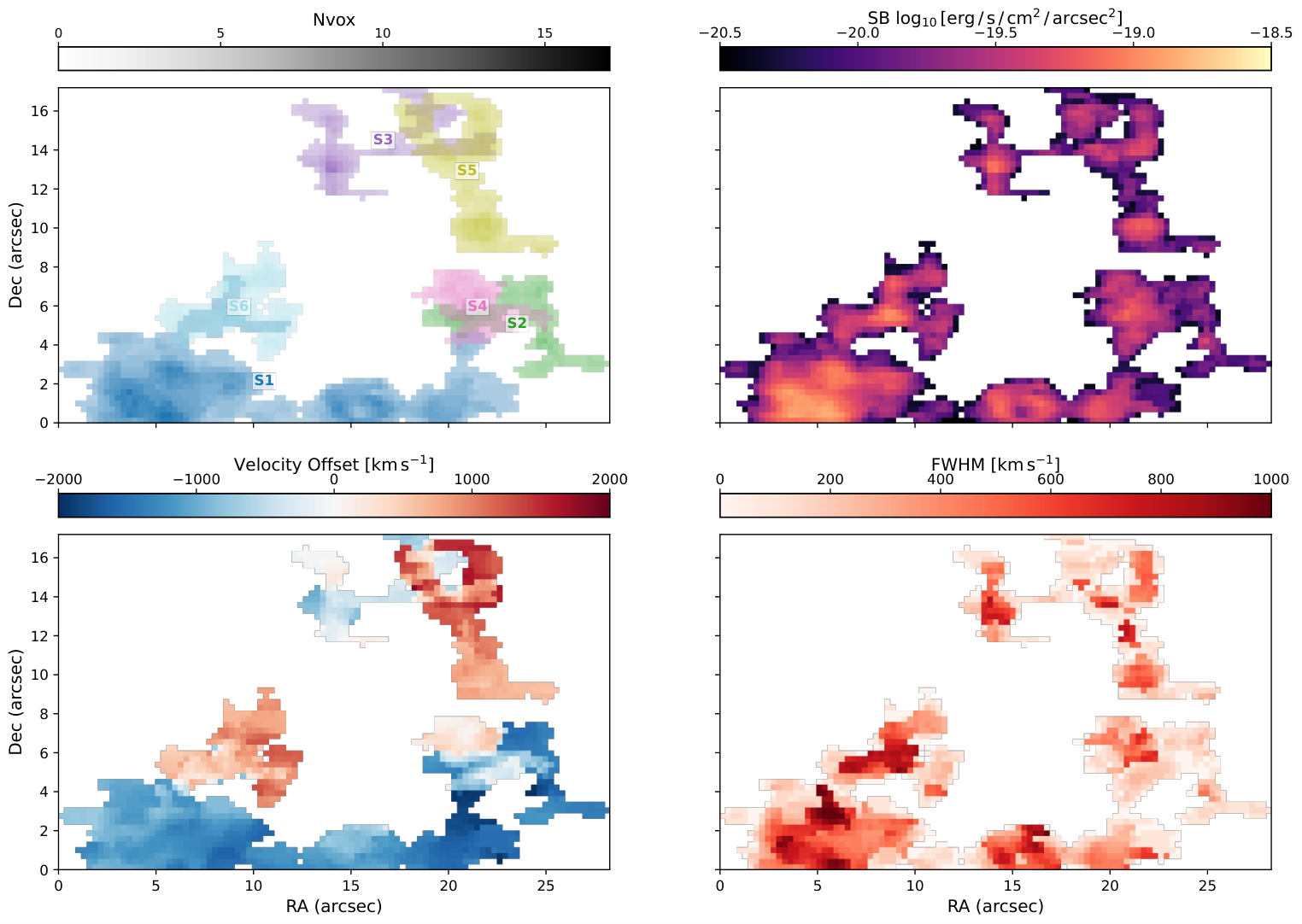
Tests the morphology and segmentation of the Lyα field: six connected 3D AKS components are labeled, allowing the dominant extended component to be distinguished from subsidiary structures.
Original caption
Figure 2: Combined moment maps of the detected Ly α \alpha field. Labels S1–S6 identify the six connected three-dimensional AKS components; S1 is the dominant extended component.
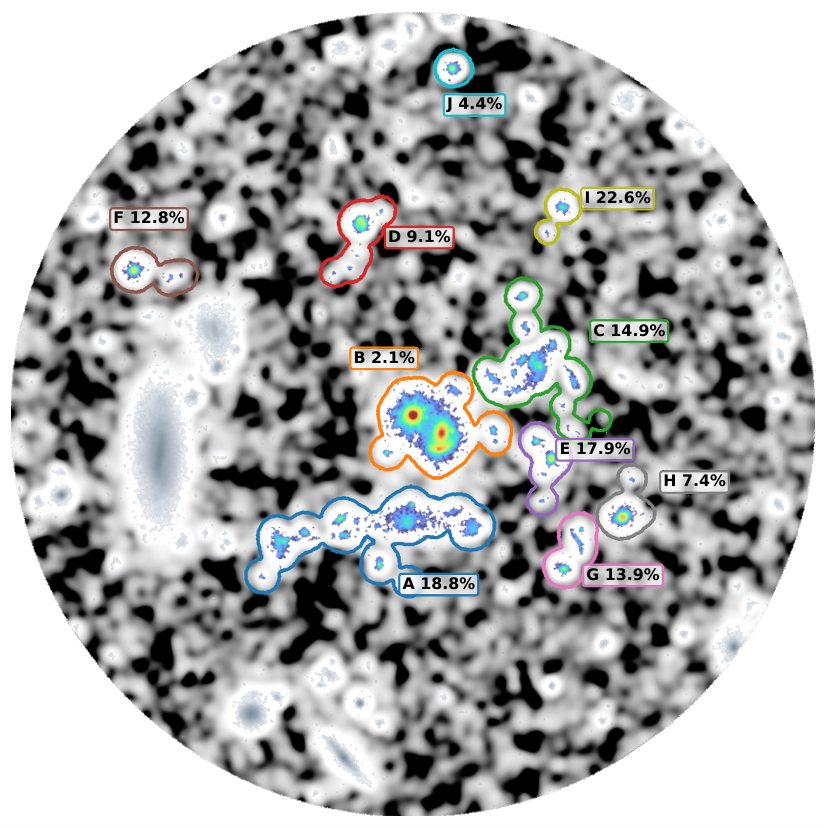
Tests whether the stellar counterpart is genuinely diffuse: galaxies are segmentation-masked, then the F140W image is background-subtracted and smoothed before defining IHL regions and measuring their fractions.
Original caption
Figure 4: IHL-selected regions in the HST F140W field. Galaxies are identified and masked using a segmentation map; the galaxy-masked image is then background-subtracted and smoothed to enhance the low-S/N diffuse signal. Colored contours delineate the selected diffuse regions summarized in Table 1 . Galaxies overlapping the selected IHL regions are shown in color, while the remaining galaxies are shown with a muted blue-gray scale for visual context. Labels indicate the region ID and measured IHL fraction.
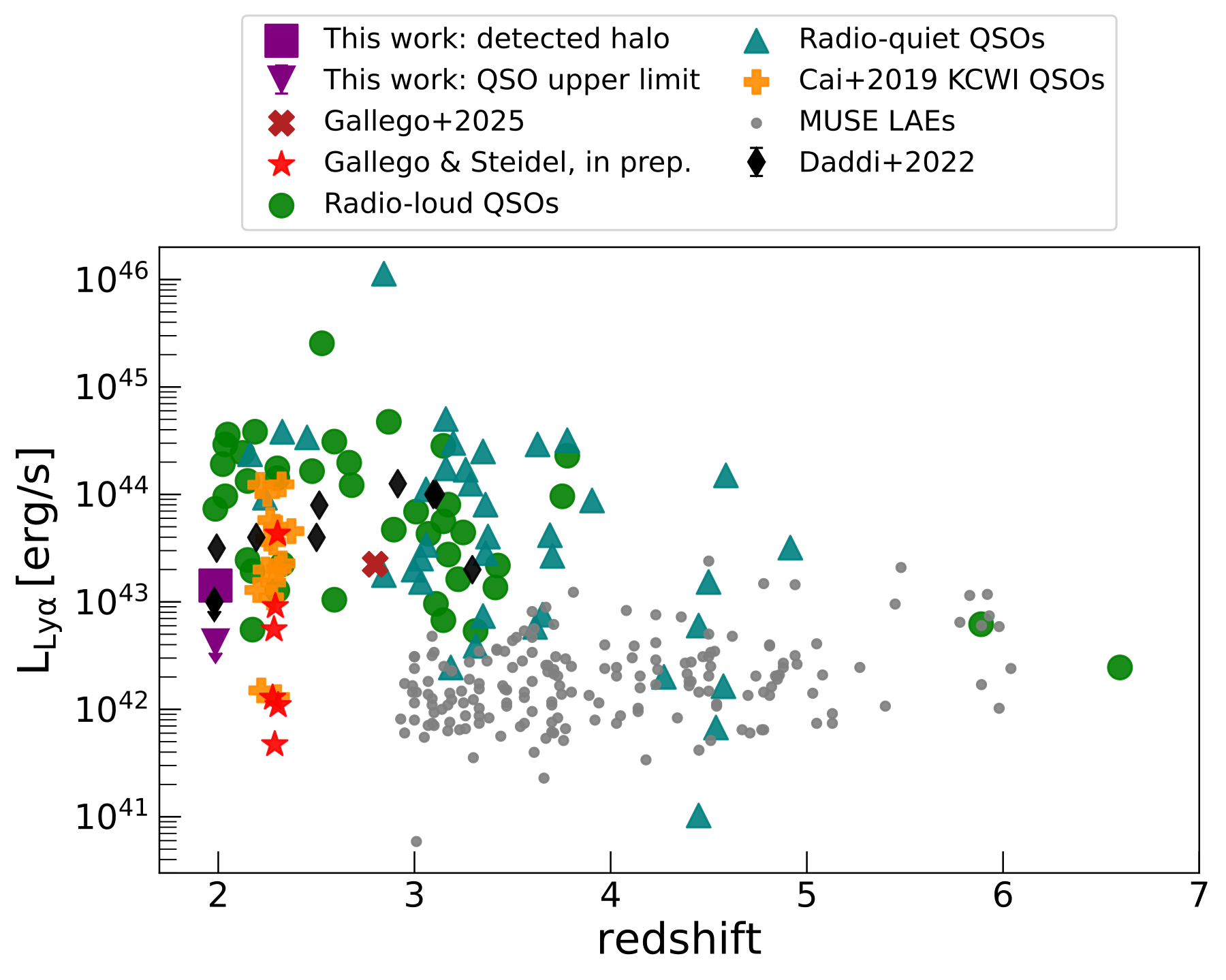
Tests the quasar-centered non-detection in context by plotting the offset/tidal halo and a matched-area, matched-width 3σ upper limit at the quasar against literature quasar, LAE, group, and cluster halo samples.
Original caption
Figure 8: Ly α \alpha halo luminosity as a function of redshift. The green circles and teal triangles correspond to Ly α \alpha halos detected around radio-loud and radio-quiet quasars, respectively. The orange plus symbols show the KCWI QSO halos at z ≈ 2 z\approx 2 from Cai et al. (2019) . The gray dots correspond to Ly α \alpha halos around LAEs observed with MUSE ( Leclercq et al., 2017 ) . The black diamonds show the galaxy groups and clusters compiled by Daddi et al. (2022) , with the downward-pointing limit corresponding to XLSSC 122. The red stars correspond to the halo complex detected in the J0103+1316 protocluster at z = 2.3 z=2.3 (Gallego & Steidel, in preparation). The dark red cross symbol marks the halo reported in Gallego et al. (2025) at z = 2.8 z=2.8 . The purple square shows the detected offset/tidal Ly α \alpha halo in this work, while the purple downward-pointing symbol marks the 3 σ 3\sigma upper limit at the quasar position, assuming a halo matched in projected area and spectral width to the detected complex.
Related research
Previous digest
Using deep Keck/KCWI integral-field spectroscopy and HST/F140W imaging, Gallego et al. map Lyα and diffuse stellar light in the z=1.986 assembling cluster CARLA J0800+4029 around the radio-loud quasar B3 0756+406. They find no robust extended Lyα halo at the quasar, setting a matched 3σ limit of L(Lyα)<4.20×10^42 erg s^-1, while a brighter offset complex with L(Lyα)=1.42×10^43 erg s^-1 follows disturbed galaxies, tidal debris, and intra-halo light. The main Lyα component lies near systemic velocity with FWHM ≈300–500 km s^-1 and contains a coherent absorption-like decrement near +1000 km s^-1, supporting a picture in which stars and gas are being redistributed together during cluster-core assembly even as the immediate AGN environment is unfavorable for observable Lyα emission.
Sources and evidence (20)
- 2609.37445v1: Caught in the act: diffuse stellar and Ly$α$ emission around a halo-less quasar in the assembling cluster CARLA J0800+4029 at z=2
Extended Ly$α$ emission is commonly detected around luminous quasars at $z\sim2$-3 and traces cold gas in the circumgalactic environment of the AGN. Together with the spatial distribution of galaxies, Ly$α$ probes gas and galaxy assembly in high-redshift overdensities. We use deep KCWI wide-field spectroscopy and HST/F140W imaging to investigate the assembling cluster CARLA J0800+4029 at $z=1.986\pm0.014$. No robust extended Ly$α$ emission is detected at the radio-loud quasar position. Instead, the dominant Ly$α$ emission is offset from the AGN and coincides with a disturbed structure composed of galaxies, tidal features, and diffuse intra-halo light (IHL). The detected structure has $L_{\rm Lyα}=1.42\times10^{43}$ erg/s and reaches surface-brightness levels of $\sim10^{-17}$ erg/s/cm$^2$/arcsec$^2$. At the quasar position, a matched $3σ$ limit gives $L_{\rm Lyα}<4.20\times10^{42}$ erg/s, a factor of $\sim3.4$ below the detected offset emission and among the most stringent constraints at similar redshift. The Ly$α$ emission is dominated by one extended region near systemic velocity, with FWHM $\sim300$-500 km/s. The associated tidal structure has an IHL fraction of 18.8%, and contains a spatially coherent absorption-like decrement at $\sim+1000$ km/s. The offset and alignment between Ly$α$ emission and IHL suggest that gas and stars have been redistributed together during assembly. The lack of a comparable Ly$α$ halo around the quasar further suggests that gas in the immediate AGN environment is ionized, depleted, or suppressed, while the offset region remains favorable for Ly$α$ emission. CARLA J0800+4029 reveals baryon redistribution during cluster assembly, with the dominant observable Ly$α$ reservoir decoupled from the central AGN and linked to ongoing tidal assembly.
- 2609.37445v1: Caught in the act: diffuse stellar and Ly$α$ emission around a halo-less quasar in the assembling cluster CARLA J0800+4029 at z=2
The paper is organized as follows: Section 2 describes the data, Section 3 the methods, Section 4 the results, Section 5 the discussion, and Section 6 the summary. We adopt a flat Λ \Lambda CDM cosmology with Ω m = 0.308 \Omega_{\rm m}=0.308 , Ω Λ = 0.691 \Omega_{\Lambda}=0.691 , and H 0 = 67.8 H_{0}=67.8 km s -1 Mpc -1 ( Planck Collaboration et al., 2016 ) . Magnitudes are in the AB system.
- 2609.37445v1: Caught in the act: diffuse stellar and Ly$α$ emission around a halo-less quasar in the assembling cluster CARLA J0800+4029 at z=2
The Ly α \alpha halo is kinematically disturbed but remains close to systemic in its brightest parts. Typical FWHM values are ∼ 300 \sim 300 – 500 500 km s -1 in the brightest regions, with broader values appearing mainly in lower-surface-brightness or less securely sampled pixels.
- 2609.37445v1: Caught in the act: diffuse stellar and Ly$α$ emission around a halo-less quasar in the assembling cluster CARLA J0800+4029 at z=2
Using a non-parametric analysis of the HST imaging, we measure an IHL fraction of 18.8 % 18.8\% for the tidal structure associated with the Ly α \alpha emission. Diffuse regions in the comparison sample do not show comparably clear Ly α \alpha counterparts in the current KCWI field and therefore provide a useful internal comparison.
- 2609.37445v1: Caught in the act: diffuse stellar and Ly$α$ emission around a halo-less quasar in the assembling cluster CARLA J0800+4029 at z=2
Figure 2: Combined moment maps of the detected Ly α \alpha field. Labels S1–S6 identify the six connected three-dimensional AKS components; S1 is the dominant extended component.
- 2609.37445v1: Caught in the act: diffuse stellar and Ly$α$ emission around a halo-less quasar in the assembling cluster CARLA J0800+4029 at z=2
Figure 3: Spectra of the detected Ly α \alpha components. The vertical line and shaded region mark the systemic Ly α \alpha wavelength and the corresponding redshift uncertainty. The labels S1–S6 correspond to the connected components shown in Fig. 2 .
- 2609.37445v1: Caught in the act: diffuse stellar and Ly$α$ emission around a halo-less quasar in the assembling cluster CARLA J0800+4029 at z=2
In the current KCWI analysis, no comparably robust extended Ly α \alpha signal is recovered at the position of the quasar itself, despite its strong radio output. Instead, the detected Ly α \alpha emission is dominated by one main spatially extended region offset from the quasar. This region spatially coincides with diffuse stellar continuum and intra-halo light in the HST /F140W imaging. Additional lower-significance or spectrally distinct components are present in the 3D AKS decomposition, but they do not dominate the morphology of the diffuse field. For a standard 1 ″ 1\arcsec -radius aperture at the quasar position and a 7-channel window around systemic Ly α \alpha , the raw-cube noise implies a conservative 1 σ 1\sigma surface-brightness sensitivity of 2.72 × 10 − 18 2.72\times 10^{-18} erg s − 1 cm − 2 arcsec − 2 \mathrm{erg\,s^{-1}\,cm^{-2}\,arcsec^{-2}} and a 3 σ 3\sigma limit of 8.16 × 10 − 18 8.16\times 10^{-18} erg s − 1 cm − 2 arcsec − 2 \mathrm{erg\,s^{-1}\,cm^{-2}\,arcsec^{-2}} . If we assume a quasar-centered halo with the same projected area as the detected offset/tidal complex ( 149.8 149.8 arcsec 2 ) and the same full spectral support (50 channels), the equivalent 3 σ 3\sigma total-halo luminosity limit is 4.20 × 10 42 4.20\times 10^{42} erg s -1 .
- 2609.37445v1: Caught in the act: diffuse stellar and Ly$α$ emission around a halo-less quasar in the assembling cluster CARLA J0800+4029 at z=2
These tests support the interpretation that the diffuse structure associated with the offset Ly α \alpha emission is astrophysically real, while also showing that the exact numerical value of f IHL f_{\rm IHL} remains method-dependent. The most robust conclusion is therefore not that the system has a uniquely extreme IHL fraction, but that the offset Ly α \alpha halo is associated with one of the most diffuse and tidally disturbed stellar structures in the protocluster core.
- 2609.37445v1: Caught in the act: diffuse stellar and Ly$α$ emission around a halo-less quasar in the assembling cluster CARLA J0800+4029 at z=2
The results presented above reveal a clear spatial decoupling between the active nucleus, the dominant diffuse Ly α \alpha emission region, and the intra-halo light in CARLA J0800+4029. Rather than a centrally concentrated gaseous halo obviously centered on the quasar, the current analysis is dominated by offset Ly α \alpha emission coincident with tidal stellar structures, together with a localized absorption-like feature tracing cold gas.
- 2609.37445v1: Caught in the act: diffuse stellar and Ly$α$ emission around a halo-less quasar in the assembling cluster CARLA J0800+4029 at z=2
This configuration points to a non-trivial redistribution of baryons within the protocluster core. The lack of a comparably robust extended Ly α \alpha detection at the quasar position, together with offset diffuse emission, IHL, and an embedded absorption-like feature, indicates that gas and stars do not respond uniformly to the same physical drivers. Interpreting these components jointly places this system within the broader context of gas availability, feedback efficiency, radiative transfer, and tidal processing at z ∼ 2 z\sim 2 .
- 2606.09970v1: Through the Veil: Ly$α$ Illuminates the Host Galaxies of Little Red Dots
Taken together, these results indicate that the Ly α \alpha and Balmer emission in LRDs are not simply scaled versions of the nebular emission seen in ordinary galaxies, but instead point to a different effective line-emitting and/or Ly α \alpha -escaping environment. As discussed in Section III.2.1 , the escaping Ly α \alpha is consistent with being dominated by host-galaxy star formation. If so, the Ly α \alpha -emitting gas should also produce H α \alpha and H β \beta , but with a Balmer ratio characteristic of normal H II regions rather than that of the dominant LRD component.
- 2606.09970v1: Through the Veil: Ly$α$ Illuminates the Host Galaxies of Little Red Dots
Figure 5 shows the resulting H α \alpha /H β \beta as a function of position. While the absolute decrement depends on the stacking weights, the trends are qualitatively consistent across the three stacks. The Ly α \alpha -undetected stack shows no clear spatial variation, remaining consistent with a constant decrement across the inner ± 0.2 ′′ \pm 0.2^{\prime\prime} . The Ly α \alpha -detected stack, however, shows evidence that H α \alpha /H β \beta decreases from the trace center toward off-trace positions.
- 2607.21719v1: Outflows in super-Eddington quasars drive clumpy circumgalactic medium and extended H$α$ nebulae at $z \gtrsim 6$
The results obtained in this work highlight that the central engine remains undetected and goes through obscured growth for most of its lifetime (see Fig. 3 ). We further show that H α \rm H\alpha nebular emission directly probes the obscuration stage of the accreting SMBH, with profiles remaining centrally concentrated and dropping off steeply when heavily obscured, even after a sustained bright quasar phase lasting around 1 Myr 1~{\rm Myr} . While the nebular emission shown in the left panel of Fig. 13 could be observationally attributed to short-lived quasar lifetimes, we rather find that it is associated with a period of intense accretion and radiation output that is heavily obscured. Such constant ‘lightbulb’ scenarios, however, are unlikely to be realistic because quasar light curves show significant variability. Nonetheless, Satyavolu et al. (2023) show that quasars with small duty cycle ( < 10 per cent <10~{\rm per~cent} ) and short active periods ( t quasar ∼ 10 4 yr t_{\rm quasar}\sim 10^{4}~{\rm yr} ) can reconcile measurements of both small and large proximity zones assuming that much of the black hole’s growth is obscured. Future radiative transfer simulations using realistic light curves from the simulations will enable us to study the effect of quasar variability (whose luminosity may vary rapidly by 1–2 dex) on lifetime estimates and provide further theoretical support for obscured growth and short but bright radiative phases in high-redshift quasars.
- 2607.21719v1: Outflows in super-Eddington quasars drive clumpy circumgalactic medium and extended H$α$ nebulae at $z \gtrsim 6$
Figure 8: Visual overview of the ionization state of the CGM in the suite of simulations at z = 6.01 z=6.01 . Here, gas is assumed to be in ionization equilibrium with a meta-galactic UVB. From left to right, the different columns show results for the NoAGN, fable and fable -sE simulations, respectively. The upper row displays the density-weighted neutral hydrogen fraction ( x H i x_{\text{H\,{i}}{}} ), while the lower row shows 2D bivariate projections of the neutral hydrogen column density ( N H i N_{\text{H\,{i}}{}} ) and density-weighted radial velocity ( v rad v_{\rm rad} ). This visualisation enables the simultaneous tracing of outflows and dense, neutral gas. The bivariate colourmap is shown as an inset in the bottom left panel, with the brightness/saturation reflecting the column density and the hue displaying the radial velocity. White contours delineate DLA sightlines ( N H i > 10 20.3 cm − 2 N_{\text{H\,{i}}{}}>10^{20.3}~{\rm cm^{-2}} ). In the lower panels, the full and dashed circles display the virial radius and R = 50 R=50 kpc, respectively. A large fraction of the CGM in the hot, diffuse phase is ionized by the UVB. Along the cosmic filaments and in the central galaxy, we have x H i > 0.1 x_{\text{H\,{i}}}{}>0.1 such that the column density is very high. We note that many more lines of sight are covered by dense and neutral gas in the fable -sE simulation, up to and beyond the virial radius. This excess of gas compared to the two other runs is almost entirely made up of outflowing gas clumps that arise from strong AGN feedback in fable -sE.
- 2505.09542v1: A weak Ly$α$ halo for an extremely bright Little Red Dot: Indications of enshrouded SMBH growth
The abundant population of "Little Red Dots" (LRDs)-compact objects with red UV to optical colors and broad Balmer lines at high redshift-is unveiling new insights into the properties of early active galactic nuclei (AGN). Perhaps the most surprising features of this population are the presence of Balmer absorption and ubiquitous strong Balmer breaks. Recent models link these features to an active supermassive black hole (SMBH) cocooned in very dense gas ($N_{\rm H}\sim10^{24}\,\rm cm^{-2}$). We present a stringent test of such models using VLT/MUSE observations of A2744-45924, the most luminous LRD known to date ($L_{\rm Hα}\approx10^{44}~\rm erg\,s^{-1}$), located behind the Abell-2744 lensing cluster at $z=4.464$ ($μ=1.8$). We detect a moderately extended Ly$α$ nebula ($h\approx5.7$ pkpc), spatially offset from the point-like H$α$ seen by JWST. The Ly$α$ emission is narrow ($\rm FWHM=270\pm 15~km\,s^{-1}$), spatially offset to H$α$, and faint ($\rm Lyα=0.07Hα$) compared to Ly$α$ nebulae typically observed around quasars of similar luminosity. We detect compact N$\,$IV]$λ$1486 emission, spatially aligned with H$α$, and a spatial shift in the far-UV continuum matching the Ly$α$ offset. We discuss that H$α$ and Ly$α$ have distinct physical origins: H$α$ originates from the AGN, while Ly$α$ is powered by star formation. In the environment of A2744-45924, we identify four extended Ly$α$ halos ($Δz<0.02$, $Δr<100$ pkpc). Their Ly$α$ luminosities match expectations based on H$α$ emission, indicating no evidence for radiation from A2744-45924 affecting its surroundings. The lack of strong, compact, and broad Ly$α$ and the absence of a luminous extended halo, suggest that the UV AGN light is obscured by dense gas cloaking the SMBH with covering factor close to unity.
- 2512.15881v1: Shedding the envelope: JWST reveals a kiloparsec-scale [OIII]-weak Balmer shell around a z=7.64 quasar
Luminous quasars at the redshift frontier z>7 serve as stringent probes of super-massive black hole formation and they are thought to undergo much of their growth obscured by dense gas and dust in their host galaxies. Fully characterizing the symbiotic evolution of SMBHs and hosts requires rest-frame optical observations that span spatial scales from the broad-line region to the ISM and CGM. JWST now provides the necessary spatially resolved spectroscopy to do so. But the physical conditions that regulate the interplay between SMBHs and their hosts at the highest redshifts, especially the nature of early feedback phases, remain unclear. We present JWST/NIRSpec IFU observations of J0313$-$1806 at z=7.64, the most distant luminous quasar known. From the restframe optical spectrum of the unresolved quasar, we derive a black hole mass of $M_\mathrm{BH}=(1.63 \pm 0.10)\times10^9 M_\odot$ based on H$β$ and an Eddington rate of $λ=L/L_\mathrm{Edd}=0.80\pm 0.05$, consistent with previous MgII-based estimates. J0313-1806 exhibits no detectable [O III] emission on nuclear scales. Most remarkably, we detect an ionized gas shell extending out to $\sim 1.8$ kpc traced by H$β$ emission that also lacks any significant [O III], with a $3σ$ upper limit on the [O III]$ λ$5007 to H$β$ flux ratio of $\log_{10} \left( F(\mathrm{[OIII]})/F(\mathrm{H}β)\right)=-1.15$. Through photoionization modelling, we demonstrate that the extended emission is consistent with a thin, clumpy outflowing shell where [OIII] is collisionally de-excited by dense gas. We interpret this structure as a fossil remnant of a recent blowout phase, providing evidence for episodic feedback cycles in one of the earliest quasars. These findings suggest that dense ISM phases may play a crucial role in shaping the spectral properties of quasars accross cosmic time.
- 2508.21748v1: A direct black hole mass measurement in a Little Red Dot at the Epoch of Reionization
Recent discoveries of faint active galactic nuclei (AGN) at the redshift frontier have revealed a plethora of broad \Halpha emitters with optically red continua, named Little Red Dots (LRDs), which comprise 15-30\% of the high redshift broad line AGN population. Due to their peculiar spectral properties and X-ray weakness, modeling LRDs with standard AGN templates has proven challenging. In particular, the validity of single-epoch virial mass estimates in determining the black hole (BH) masses of LRDs has been called into question, with some models claiming that masses might be overestimated by up to 2 orders of magnitude, and other models claiming that LRDs may be entirely stellar in nature. We report the direct, dynamical BH mass measurement in a strongly lensed LRD at $z = 7.04$. The combination of lensing with deep spectroscopic data reveals a rotation curve that is inconsistent with a nuclear star cluster, yet can be well explained by Keplerian rotation around a point mass of 50 million Solar masses, consistent with virial BH mass estimates from the Balmer lines. The Keplerian rotation leaves little room for any stellar component in a host galaxy, as we conservatively infer $M_{\rm BH}/M_{*}>2$. Such a ''naked'' black hole, together with its near-pristine environment, indicates that this LRD is a massive black hole seed caught in its earliest accretion phase.
- 2508.00209v1: Accretion disc reverberation mapping in a high-redshift quasar
Powered by supermassive black holes at their centers, quasars are among the most luminous objects in the Universe, serving as important probes of cosmic history and galaxy evolution. The size of the accretion disc surrounding the black hole is a critical parameter for understanding quasar physics and their potential use as standard candles in cosmology. However, direct measurements of accretion disc sizes have so far been confined to the Local Universe ($z<0.2$), limiting our understanding of quasars during the peak of cosmic activity. Here, we report the first direct measurement of the accretion disc size in the quasar QSO J0455-4216 at $z=2.66$, when the Universe was only $\sim2$ Gyrs old. Medium-band filters mounted on the MPG/ESO 2.2-metre telescope at La Silla Observatory were used to isolate continuum emission regions during a six-month monitoring campaign. The light curves exhibit pronounced variability features and enabled the detection of inter-band time delays from different parts of the disc. We mapped the disc and located its ultraviolet-emitting outermost region at $3.02^{+0.33}_{-0.57}$ light-days from the black hole ($\sim 500$ AU). Given a supermassive black hole 900 million times the mass of the Sun, these measurements validate accretion disc theory at an unprecedented redshift and pave the way for efficient black hole mass estimates, reducing decades-long spectroscopic reverberation campaigns to just a few years or less.
- 2510.09753v1: BEES: Quasar lifetime measurements from extended rest-optical emission line nebulae at $z\sim6$
Measurements of quasar lifetimes at high redshift indicate that the earliest billion-solar-mass supermassive black holes (SMBHs) have only been active as luminous quasars for less than a million years. Recently, extended Ly$α$ nebulae around $z\sim6$ quasars have revealed that these short observed lifetimes are unlikely a sightline-dependent effect. However, the interpretation of Ly$α$ emission is not straightforward due to its resonant nature. In this work, we use rest-frame optical emission lines, which more directly trace photoionization by the quasar, to unambiguously validate the short line-of-sight quasar lifetimes observed at early cosmic epochs. We use deep James Webb Space Telescope/NIRSpec IFU observations of five $z\sim 6$ quasars with small proximity zones to search for their extended emission line nebulae in H$α$ and [O III]$5007$, and detect extended emission in both emission lines around four quasars in our sample. We then use the light-crossing time of these nebulae to measure quasar lifetimes along transverse sightlines. Using their H$α$ nebulae, we also confirm that recombination is likely the dominant emission mechanism behind their previously detected Ly$α$ nebulae. Our results confirm the existence of high-redshift quasars with extremely short lifetimes, $t_{\rm Q} \lesssim 10^{5}\ {\rm yr}$, hosting billion-solar-mass black holes, indicating that rapid accretion is likely responsible for the assembly of SMBHs in the early Universe.
- 2607.22966v1: A quasar hatching from a buried red phase at z = 3.7
We present JADES-GS 209777, previously cataloged as CANDELS J033238.02-274626.2, hereafter "the Hatchling," a red quasar at $z=3.711$. While the source has been reported in earlier deep-field catalogs, our multiwavelength analysis reveals a visible active nucleus still embedded in a dense gas- and dust-rich environment. Red quasar continua are often attributed to dust attenuation, including non-standard extinction curves, but the highly comprehensive multiwavelength data for this source provide direct constraints on the material being cleared. Using JWST/NIRSpec, NIRCam, MIRI, HST, MUSE, Chandra, ALMA, and VLA data, we detect broad emission lines and strong X-ray emission, showing that the active nucleus is at least partially exposed. We also detect H$α$ and He I absorption, indicating dense gas close to the nucleus. Kinematically disturbed O I, Mg II, Na D, and [O III] features, together with extended Ly$α$ emission over $\gtrsim 20$ kpc, further show that multiphase gas is being accelerated from the nuclear region into the host-galaxy environment. The ALMA detection reveals strong dust emission, with the inferred infrared luminosity placing the system in the ULIRG regime. The continuum is red and sharply declining toward the rest-frame UV, resembling compact red AGNs, and may reflect extreme dust attenuation, gas reprocessing, possible BAL-like absorption, or a combination of these effects. Regardless of which mechanism dominates the continuum shape, the line diagnostics show that the visible nucleus remains partially obscured by nearby material. The Hatchling therefore represents a unique opportunity to explore a poorly known transition phase in which feedback is likely clearing an enshrouded quasar and allowing it to emerge toward a more unobscured active nucleus.
Abstract
Extended Ly$α$ emission is commonly detected around luminous quasars at $z\sim2$-3 and traces cold gas in the circumgalactic environment of the AGN. Together with the spatial distribution of galaxies, Ly$α$ probes gas and galaxy assembly in high-redshift overdensities. We use deep KCWI wide-field spectroscopy and HST/F140W imaging to investigate the assembling cluster CARLA J0800+4029 at $z=1.986\pm0.014$. No robust extended Ly$α$ emission is detected at the radio-loud quasar position. Instead, the dominant Ly$α$ emission is offset from the AGN and coincides with a disturbed structure composed of galaxies, tidal features, and diffuse intra-halo light (IHL). The detected structure has $L_{\rm Lyα}=1.42\times10^{43}$ erg/s and reaches surface-brightness levels of $\sim10^{-17}$ erg/s/cm$^2$/arcsec$^2$. At the quasar position, a matched $3σ$ limit gives $L_{\rm Lyα}<4.20\times10^{42}$ erg/s, a factor of $\sim3.4$ below the detected offset emission and among the most stringent constraints at similar redshift. The Ly$α$ emission is dominated by one extended region near systemic velocity, with FWHM $\sim300$-500 km/s. The associated tidal structure has an IHL fraction of 18.8%, and contains a spatially coherent absorption-like decrement at $\sim+1000$ km/s. The offset and alignment between Ly$α$ emission and IHL suggest that gas and stars have been redistributed together during assembly. The lack of a comparable Ly$α$ halo around the quasar further suggests that gas in the immediate AGN environment is ionized, depleted, or suppressed, while the offset region remains favorable for Ly$α$ emission. CARLA J0800+4029 reveals baryon redistribution during cluster assembly, with the dominant observable Ly$α$ reservoir decoupled from the central AGN and linked to ongoing tidal assembly.
Discussion
Discussion access requires a security token. Register for the weekly digest.