2609.36002v1 · First listed 2026-09-30
Connecting the Dots: Prospects for Detecting Multi-Source Inflation through Scale-Dependent and Stochastic Bias of Little Red Dots
This paper forecasts whether a purpose-built, wide space survey of LRD clustering at z=4–9 could jointly constrain local fNL and τNL and test the multi-source Suyama–Yamaguchi inequality; its conclusions remain conditional on idealised survey and covariance assumptions. [1][5][10]
Evidence
This is a feasibility forecast, not a clustering measurement. The proposed tracer sample comprises identifiable LRDs over 4<z<9, selected through compact morphology, a steep red continuum, and luminous broad Hα emission. The authors forecast joint constraints on local-type fNL and collapsed-trispectrum τNL using scale-dependent and stochastic bias. Their Fisher analysis assumes Gaussian covariance, Poisson shot noise, the universality relation, and photometric/spectroscopic redshift dispersion σz/(1+z)=0.03. Numerical derivatives use 5% fractional steps, except absolute 0.05 steps for fNL and τNL; the authors report first-decimal stability to that step choice. An idealised 2-m telescope with 2 deg² field of view is estimated to image and obtain spectroscopy over 14,000 deg² in about eight years, at mAB=27.5. The abstract reports high-significance multi-source detections across a large fiducial parameter region, but supplied excerpts provide no contour values or parameter errors. [1][3][5][7][9]
Earlier work
A supplied related LRD inflation forecast reports σ(fNLloc)=0.32 from a joint power-spectrum-plus-bispectrum analysis, whereas this paper targets the joint fNLloc–τNLloc plane and the inequality τNLloc>(6fNLloc/5)². The comparison is methodological rather than a direct precision ranking: the earlier analysis finds that including non-Gaussian covariance substantially degrades local-bispectrum constraints, while the present work assumes Gaussian covariance. Thus its advertised reach should not be read as directly comparable without a matched covariance treatment. [11][12][1]
What changes
The distinctive forecast target is multi-source inflation, operationalised through a strict departure from the Suyama–Yamaguchi single-source lower bound. Rather than forecasting fNL alone, the analysis uses the LRD power-spectrum response to both scale-dependent bias and stochasticity and evaluates detection significance over the fNL–τNL plane. It also connects the statistical forecast to a notional infrared survey architecture, including long-wavelength imaging and spectroscopy over a DESI-like footprint. This is a proposal-level assessment, not a concrete mission design. [1][4][8]
Limits and open questions
The authors explicitly describe survey requirements as order-of-magnitude estimates and state that no current telescope can construct the required sample. Forecasts are sensitive to the fiducial fNL and τNL because those values affect the data covariance. Moreover, Figure 2 does not impose the physical τNL−(6fNL/5)²≥0 prior, so Fisher significance can be overestimated near the boundary. The adopted Gaussian covariance, Poisson noise, fixed redshift dispersion, assumed universality relation, and uncertain LRD selection/bias therefore delimit—not establish—the claimed detectability. Although mAB=27.5 is assumed, the authors suggest a brighter subsample may retain much of the constraining power if sample variance dominates. [1][6][9][10]
Evidence includes the abstract and selected conclusion/method excerpts, plus captions for only Figures 1–2. Extracted material lacks forecast tables and numerical contour values, and the supplied survey-time section contains no usable values beyond the conclusion excerpt.
Key figures
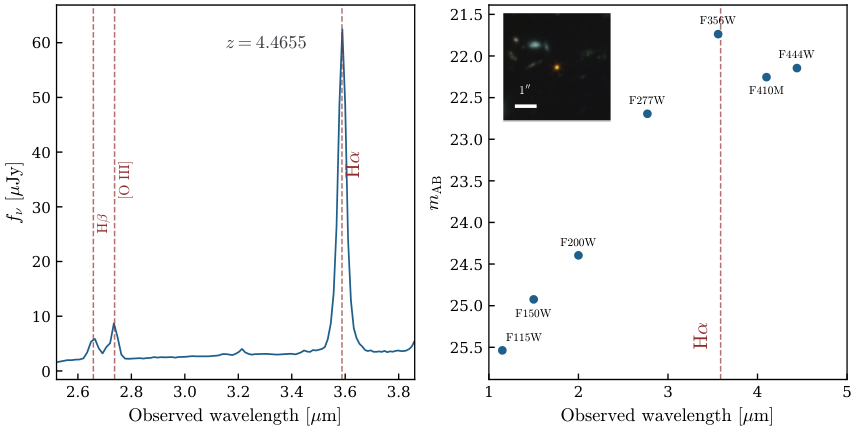
Shows the observational motivation for the proposed tracer: a luminous LRD with broad Hα, a rising red continuum, photometry, and imaging. It tests whether the advertised morphology and spectral signatures can identify LRD candidates, not inflationary parameters.
Original caption
Figure 1: Luminous Little Red Dot A2744-45924, discovered in [ 49 ] . Left: Spectrum of A2744-45924 featuring a broad luminous H α \alpha emission line. Right: Photometry exhibiting the characteristic steeply rising red continuum and stacked (F115W, F277W, F444W) cutout of A2744-45924.
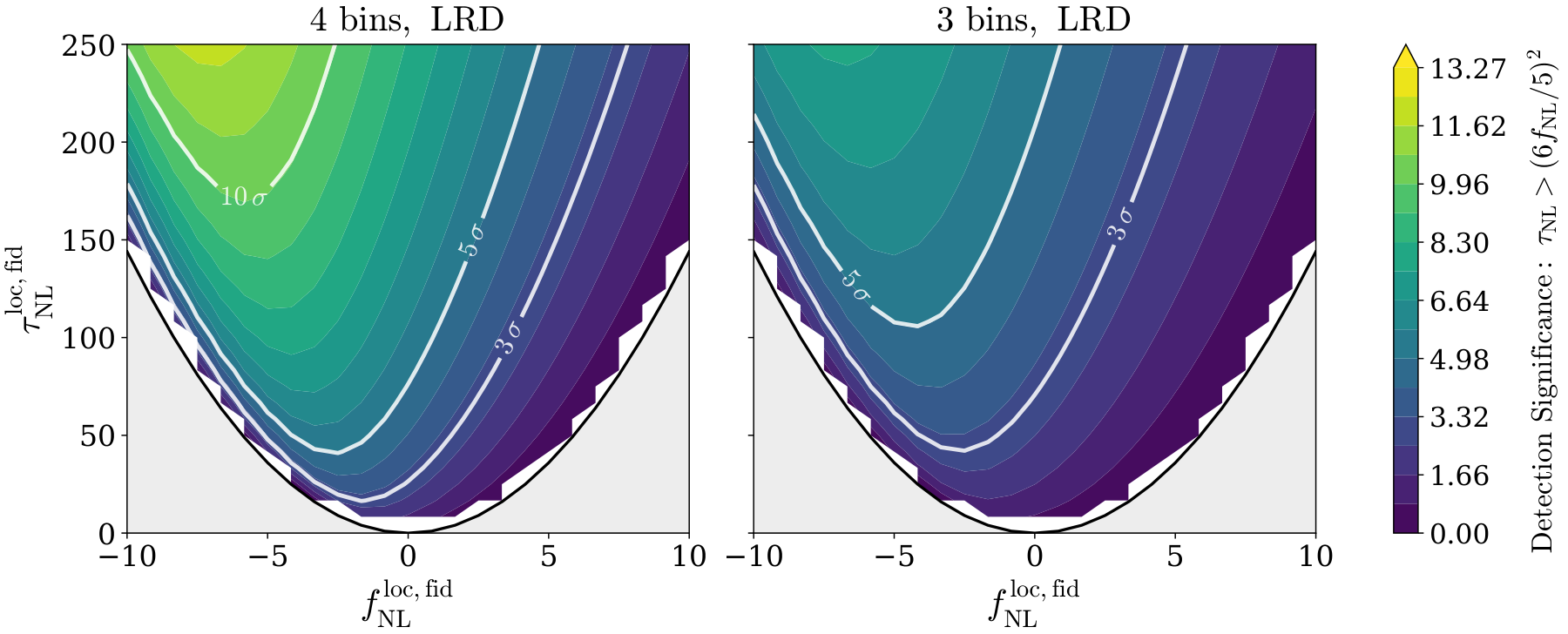
Maps Fisher detection significance for multi-source inflation under the Suyama–Yamaguchi relation, comparing a fiducial four-bin LRD analysis with a three-bin case. Its caption flags possible overestimation near the physical boundary because no prior is imposed.
Original caption
Figure 2: Multi-Source Inflation detection significance under the Suyama-Yamaguchi relation (see Sec. III.4 for details). Fisher detection significances may be overestimated near the A τ = 0 A_{\tau}=0 boundary, as we do not impose a physical prior, τ NL loc − ( 6 5 f NL loc ) 2 ≥ 0 \tau^{\rm loc}_{\rm NL}-\left(\frac{6}{5}f^{\rm loc}_{\rm NL}\right)^{2}\geq 0 . Left: Fiducial LRD four-bin analysis (case 1). Right: LRD three-bin analysis (case 2).
Related research
Previous digest
Taylor et al. forecast whether a future wide-area, space-based Little Red Dot survey could turn LRD clustering into a probe of local primordial non-Gaussianity and the collapsed-limit trispectrum. Their proposed selection exploits the population’s compact morphology, steep red continuum, and broad luminous Hα emission, then uses low-resolution spectroscopy to build redshift bins across a vast high-redshift volume. In idealised joint Fisher forecasts, the resulting scale-dependent and stochastic bias measurements could detect a strict Suyama–Yamaguchi inequality, τNLloc > (6fNLloc/5)^2, at high significance over a broad region of parameter space, outperforming previous and current experiments. The result positions LRDs as an unusually powerful test for multi-source inflation, while relying on Gaussian covariance, Poisson shot noise, and controlled redshift and large-scale clustering systematics.
Sources and evidence (20)
- 2609.36002v1: Connecting the Dots: Prospects for Detecting Multi-Source Inflation through Scale-Dependent and Stochastic Bias of Little Red Dots
Recent work has proposed using the spatial clustering of Little Red Dots (LRDs) as a high-redshift cosmological probe. In this paper, we investigate the feasibility of obtaining a LRD sample with a future space experiment, and forecast LRD constraints on primordial local-type non-Gaussianity, $f^{\rm loc}_{\rm NL}$, and the collapsed-limit trispectrum amplitude, $τ^{\rm loc}_{\rm NL}$. LRDs are ideally suited to probe these inflationary parameters because they span a large cosmological volume, have high bias and are easily identifiable. We perform idealised joint $f_{\rm NL}^{\rm loc}$--$τ_{\rm NL}^{\rm loc}$ Fisher forecasts assuming the universality relation, Gaussian covariance, Poisson shot-noise and a normalised redshift dispersion, $σ(z) / \left( {1+z} \right)= 0.03$. We quantify the significance at which one would detect multi-source inflation under the Suyama--Yamaguchi relation, $τ^{\rm loc}_{\rm NL} > \left( 6/5 f_{\rm NL}\right)^2$, across the $f_{\rm NL}^{\rm loc}$--$τ_{\rm NL}^{\rm loc}$ plane. We find that a LRD analysis could robustly detect multi-source inflation at high-significance over a large region of parameter space, and would be more constraining than all other past or present experiments.
- 2609.36002v1: Connecting the Dots: Prospects for Detecting Multi-Source Inflation through Scale-Dependent and Stochastic Bias of Little Red Dots
In summary, the total exposure times for case 1 and case 2 assuming 100 % 100\% throughput are
- 2609.36002v1: Connecting the Dots: Prospects for Detecting Multi-Source Inflation through Scale-Dependent and Stochastic Bias of Little Red Dots
We use a two-sided finite difference with a step size of 5 % 5\% (and absolute step size of 0.05 for f NL loc f_{\rm NL}^{\rm loc} and τ NL loc \tau_{\rm NL}^{\rm loc} ) to compute the derivatives in Eqn. 18 . We confirm that the results are insensitive to the exact choice of step size to first decimal precision.
- 2609.36002v1: Connecting the Dots: Prospects for Detecting Multi-Source Inflation through Scale-Dependent and Stochastic Bias of Little Red Dots
We investigated the possibility of using the scale-dependent bias of a Little Red Dot (LRD) tracer population to constrain multi-source inflation, using the Suyama-Yamaguchi relation.
- 2609.36002v1: Connecting the Dots: Prospects for Detecting Multi-Source Inflation through Scale-Dependent and Stochastic Bias of Little Red Dots
LRDs are ideally suited for this purpose as they trace a large cosmological volume between 4 < z < 9 4<z<9 , and are easily identifiable from their compact morphology, steeply rising red continuum, and luminous H α \alpha emission line.
- 2609.36002v1: Connecting the Dots: Prospects for Detecting Multi-Source Inflation through Scale-Dependent and Stochastic Bias of Little Red Dots
No telescope is currently capable of constructing such a sample, so we investigate the feasibility of obtaining this data with a future observatory. To avoid thermal backgrounds, this can only be achieved from space – although ground based data to identify e.g., the Lyman-break feature may be complimentary.
- 2609.36002v1: Connecting the Dots: Prospects for Detecting Multi-Source Inflation through Scale-Dependent and Stochastic Bias of Little Red Dots
In an idealised scenario, a two-meter telescope with a 2 deg 2 2\ \rm deg^{2} FoV could obtain the required imaging and spectroscopic data across 14,000 deg 2 14,000\ {\rm deg}^{2} in approximately eight years. About half the pointing time is spent imaging the long-wavelength band as the zodiacal background rises sharply with increasing wavelength.
- 2609.36002v1: Connecting the Dots: Prospects for Detecting Multi-Source Inflation through Scale-Dependent and Stochastic Bias of Little Red Dots
The survey estimates presented here should be viewed as an order-of-magnitude assessment of the needs for an LRD survey mission, rather than a concrete proposal. Nevertheless, some of the technology needs are already clear: (i) large mosaics of infrared detectors, with modestly more area than Euclid and Roman and with longer-wavelength sensitivity; (ii) cooling of a much larger focal plane than on previous passively cooled missions with 5 μ \mu m cutoff detectors; and (iii) mosaics of DMDs or other slit-forming technology, including buttability and cold qualification. The packaging of the optical path for such a mission will also present a challenge, given the large number of components and the small space if one is to compress the beam to ∼ f / 4.5 \sim f/4.5 to minimise detector and DMD area. One of the first tasks would be to examine the trade space of optical solutions (e.g., surveys in series, versus parallel with specialized channels; in the latter case, split fields versus dichroics) to assess the feasibility of the various options.
- 2609.36002v1: Connecting the Dots: Prospects for Detecting Multi-Source Inflation through Scale-Dependent and Stochastic Bias of Little Red Dots
These headlines results also assume a limiting magnitude m AB = 27.5 m_{\rm AB}=27.5 . As the relevant scales for our scientific objectives are dominated by sample-variance – not shot-noise – this may be too deep. Targeting a sub-sample of bright LRDs would substantially reduce the cost of the mission, with little loss in constraining power. Increasing the survey area would also improve constraints, and is worth investigating in a future study.
- 2609.36002v1: Connecting the Dots: Prospects for Detecting Multi-Source Inflation through Scale-Dependent and Stochastic Bias of Little Red Dots
Next, we reviewed the Fisher formalism and the theory of scale dependent and stochastic bias of the galaxy power spectrum – carefully outlining all simplifying assumptions in the analysis. We argued that the Fisher results are highly sensitive to the choice of fiducial cosmology, as the data covariance is sensitive to the underlying value of f NL loc f_{\rm NL}^{\rm loc} and τ NL loc \tau_{\rm NL}^{\rm loc} .
- 2609.26553v1: Constraining Inflation with Little Red Dots
The effect of the non-Gaussian covariance, shown in the right panel of Fig. 4 and in Table 4 , depends strongly on the shape of the bispectrum. For equilateral and orthogonal shapes the correction is 2 2 – 8 % 8\% : for these templates the non-Gaussian covariance remains close to diagonal. For the local shape, the bispectrum-only constraint degrades by a factor of 5.9 5.9 with a conservative scale cut and 9.0 9.0 for an optimistic cut. The larger factor does not mean more information is lost: the Gaussian diagonal errors keep shrinking with k max k_{\rm max} as added triangles are treated as independent, while the non-Gaussian errors barely change. The joint P + B P+B constraint degrades by less, factors of 3.7 3.7 and 5.8 5.8 respectively, because the scale-dependent bias in the power spectrum is unaffected by the bispectrum covariance. With the Gaussian diagonal covariance the bispectrum dominates the local constraint, while with the non-Gaussian covariance the power spectrum and the bispectrum provide similar constraining power ( Appendix D ).
- 2609.26553v1: Constraining Inflation with Little Red Dots
This analysis shows that a population first identified as compact red sources in JWST imaging could become a leading probe of inflation. Our forecast, σ ( f NL loc ) = 0.32 \sigma(f_{\mathrm{NL}}^{\mathrm{loc}})=0.32 , lies a factor of three below the σ ( f NL loc ) ≃ 1 \sigma(f_{\mathrm{NL}}^{\mathrm{loc}})\simeq 1 threshold between single- and multi-field inflation, while the equilateral and orthogonal constraints improve on Planck by factors of 1.5 1.5 and 2.3 2.3 . For local non-Gaussianity, similar constraints have only been forecast for hypothetical high-redshift 21 cm surveys, where foregrounds were mostly neglected [ 68 , 114 , 47 ] . Furthermore, such constraints would require an interferometer with baselines of order 1 1 – 10 10 km operating from the far side of the Moon, shielded from radio-frequency interference and the Earth’s ionosphere. 4 4 4 See, e.g., Figure 17 of [ 48 ] , which also neglects foregrounds and non-Gaussian covariance.
- 2603.15736v1: Halo assembly bias in the early Universe: a clustering probe of the origin of the Little Red Dots
Overall, we conclude that halo assembly bias persists into the early Universe, albeit with a reduced amplitude relative to later times. This underscores the importance of accounting for secondary bias when inferring halo masses of high- z z galaxies from clustering measurements. Neglecting assembly bias may lead to systematic offsets in halo mass estimates of up to 1 dex.
- 2603.15736v1: Halo assembly bias in the early Universe: a clustering probe of the origin of the Little Red Dots
Overall, we can safely conclude that the SIDM scenario features the lowest halo-mass distributions among the different scenarios considered here. Interestingly, the secondary bias associated with early formation and high concentration largely cancels out.
- 2609.06926v1: Little Red Dot Cosmology: A Matter-Era Baryon Acoustic Oscillations Probe of $Λ$CDM
The discovery of Little Red Dots (LRDs) with JWST provides a new source population for cosmology in a largely unmapped period of cosmic history. LRDs are most numerous at $4\lesssim z\lesssim9$, thereby bridging existing low-redshift large-scale-structure measurements and the cosmic microwave background. In this epoch, the Universe is deep in the matter-dominated era, where dark energy is dynamically negligible and the expansion history is tightly predicted in $Λ$CDM, making these redshifts a clean test of the standard cosmological model. Recent measurements indicate that LRDs have number densities of $\bar n\sim10^{-4}$ $h^3$ Mpc$^{-3}$, a bias rising from $b\sim 3$ to $\sim8$ over this interval, and distinctive spectrophotometric signatures -- a remarkably favorable combination for baryon acoustic oscillation (BAO) measurements. Using a Fisher forecast with these fiducial inputs, we find that a wide-field spectroscopic survey of LRDs over a DESI-like (14,000 deg$^2$) footprint delivers a percent-level isotropic distance scale measurement of $D_V/r_d$ across four bins spanning $4\lesssim z\lesssim9$. LRDs are therefore a compelling target for future wide-field near- to mid-infrared spectroscopy aimed at mapping large-scale structure deep into the matter-dominated era.
- 2512.19474v1: Low-redshift 3D Lyman-α Forest Correlations with China Space Station Telescope
While the Lyman-$α$ (Ly$α$) forest traces the large-scale matter distribution over a wide range of redshift, its three-dimensional (3D) clustering at $z < 2$ has not yet been measured. We investigate the prospects for measuring low-redshift Ly$α$ correlations with the UV slitless spectroscopic instrument of the China Space Station Telescope (CSST). We construct mock CSST quasar spectra that reproduce the expected survey depth, spectral resolution and noise properties, and derive Ly$α$ auto-correlation functions and cross-correlations with quasars (QSO) and emission-line galaxies (ELG) in the range $1.1 < z < 2.0$. We then interpret these three-dimensional correlation functions with a standard anisotropic redshift-space clustering model and obtain forecast constraints on the Ly$α$ and tracer parameters. At an effective redshift $z_{\rm eff}=1.59$ (1.58 for ELGs), the Ly$α$ bias parameters will be measured with a 10-30\% precision, depending on priors on other tracer's biases. We also forecast a marginal $2.5σ$ ($3.7σ$) detection of the BAO feature, corresponding to a $\sim$10\% (7\%) constraint on the isotropic BAO scale, from the combination of Ly$α$ auto- and Ly$α$-QSO (ELG) cross-correlations. These results show that CSST can provide the first three-dimensional characterization of the low-redshift Ly$α$ forest and a complementary Ly$α$-based BAO measurement at $z < 2$, helping to link galaxy clustering surveys with high-redshift Ly$α$ forest studies.
- 2607.21869v1: Stacked Reverberation Mapping of High Redshift Quasars in DESI. I. Feasibility Analysis
The broad line region of quasars has long been probed by reverberation mapping techniques that measure time lags between continuum and broad emission line variations. Stacked reverberation mapping has been proposed as a less observationally expensive alternative to traditional methods. This ensemble approach also reduces biases from small-number statistics. The Dark Energy Spectroscopic Instrument (DESI) is conducting the most extensive spectroscopic survey of quasars to date. We create mock light curves emulating expected DESI quasar observations at redshifts $1.48<z<5.2$ and luminosities $ 44.68 \leq \log L_{1350} λ/ \mathrm{erg\,s^{-1}} \leq 45.99 $ to test stacked reverberation mapping feasibility using sparse spectroscopic data paired with well-sampled photometric data. The pipeline, using the lag estimation code JAVELIN, successfully recovers the simulated C IV lags within one sigma of the true values using spectroscopic light curves composed of only a few spectral epochs (2-10) with irregular cadences. We investigate how observational factors, including C IV flux error magnitude, number of stacked quasars, and spectral epoch count, affect performance. This work motivates a pathway for future stacked reverberation mapping projects with large scale spectroscopic surveys of quasars having $\geq 2$ spectroscopic observations. Our results suggest an economical alternative for constraining and extending the radius-luminosity relation to higher redshifts and luminosities. Subsequently, this relation can be employed more reliably in single-epoch black hole mass measurements and quasar cosmology in these distant regimes.
- 2606.28296v1: Memoirs of the curvaton: non-perturbative non-Gaussianity and supermassive primordial black holes
The curvaton provides a simple mechanism for generating strongly non-Gaussian curvature perturbations after inflation, with potentially important consequences on small scales. We study curvaton dynamics beyond the standard quadratic potential and construct the local non-Gaussian map $ζ=F(ζ_{\rm G})$ relating the curvature perturbation to an auxiliary Gaussian field $ζ_{\rm G}$. Curvaton self-interactions make the onset of oscillations field dependent and modify the effective equation of state once the curvaton enters the adiabatic regime. We incorporate these effects using the abbreviated action, which provides a compact way to connect the frozen and oscillatory regimes and exposes sources of non-Gaussianity absent in the purely quadratic case. We apply the formalism to quadratic, monomial, quartic, and cosine potentials, for which we derive the mapping $F(ζ_{\rm G})$ and show that self-interactions can either enhance or suppress the resulting non-Gaussianity depending on the potential and initial conditions. We consider non-perturbative aspects in the strongly non-Gaussian regime, and show how strong non-Gaussianity can suppress the power spectrum. As an application, we provide a bottom-up scenario in which strongly positive curvaton non-Gaussianity allows primordial supermassive black hole seeds at peak amplitudes $\mathcal{A}_{\rm pk}\sim10^{-5}$, which are compatible with the COBE/FIRAS $μ$-distortion bounds. This opens a new primordial scenario for the Little Red Dots observed by the JWST. The axion-like curvaton provides a particularly natural setting for this mechanism.
- 2507.07171v1: Little Red Dots from Small-Scale Primordial Black Hole Clustering
The James Webb Space Telescope (JWST) observations have identified a class of compact galaxies at high redshifts ($4 \lesssim z \lesssim 11$), dubbed "little red dots" (LRDs). The supermassive black holes (SMBHs) of $10^{5-8}{\rm\,M}_{\odot}$ in LRDs favor a heavy-seed origin. We propose a mechanism for their formation: Clusters of primordial black holes, formed through long-short mode coupling on small scales in the early Universe, undergo sequential mergers over extended timescales. This mechanism can evade cosmic microwave background distortions and result in heavy-seed SMBHs via runaway mergers. We employ Monte Carlo simulations to solve the Smoluchowski coagulation equation and determine the runaway merging timescale. The resulting stochastic gravitational wave background offers a distinct signature of this process, and the forming SMBHs can be highly spinning at their formation due to the spin residual of the cluster from tidal fields. This mechanism may explain the rapidly spinning SMBHs in LRDs under the assumption of obscured active galactic nuclei.
- 2605.21574v1: (LRDs)$^2$: The Low-ReDshift Little Red Dots Survey. II. DESI DR1 Sample
JWST has revealed a substantial population of "Little Red Dots" (LRDs) at $z>4$, challenging conventional AGN frameworks. However, the low-redshift regime remains largely unexplored. In the second paper of the (LRDs)$^2$ series, we present a systematic selection from DESI DR1 and identify 27 LRDs at $z=0.2-0.9$, yielding a number density lower limit of $7.5 \times 10^{-10}$ cMpc$^{-3}$. We conducted near-IR spectroscopic follow-up observations for 18 of them, revealing their full SED shapes and emission lines. These low-$z$ LRDs share the hallmark properties of their high-$z$ counterparts: compact morphology, V-shaped UV-optical continua, broad Balmer emission with extreme decrements (median H$α$/H$β\sim 16$), frequent Balmer absorption (67%), and blackbody-like optical-to-near-IR continua. All have low metallicity, occupy the same regions in the BPT diagram as high-$z$ LRDs, and have softer ionizing spectra than typical AGNs. The consistency between low-$z$ and high-$z$ LRD properties indicates the same physical processes at work. The correlation between broad-line Balmer luminosity and $L_{5100}$ deviates from that of local type-1 AGNs, limiting the direct application of local BH mass calibrations. Ionized [O III] outflows are ubiquitous (78%). One LRD at $z=0.196$, J1717+3807, shows robust long-term variability in $i$ and WISE bands. The optical-to-NIR continua of LRDs reveal a wide range of temperatures $\sim 2000-4700$ K (peak $0.6-1.5$ $μ$m), with a subset showing cooler and larger envelopes than those at high $z$. Low-$z$ LRDs serve not only as proximate laboratories for probing the nature of LRDs, but also trace the cosmic evolution of this population from the cosmic dawn to the present day.
Abstract
Recent work has proposed using the spatial clustering of Little Red Dots (LRDs) as a high-redshift cosmological probe. In this paper, we investigate the feasibility of obtaining a LRD sample with a future space experiment, and forecast LRD constraints on primordial local-type non-Gaussianity, $f^{\rm loc}_{\rm NL}$, and the collapsed-limit trispectrum amplitude, $τ^{\rm loc}_{\rm NL}$. LRDs are ideally suited to probe these inflationary parameters because they span a large cosmological volume, have high bias and are easily identifiable. We perform idealised joint $f_{\rm NL}^{\rm loc}$--$τ_{\rm NL}^{\rm loc}$ Fisher forecasts assuming the universality relation, Gaussian covariance, Poisson shot-noise and a normalised redshift dispersion, $σ(z) / \left( {1+z} \right)= 0.03$. We quantify the significance at which one would detect multi-source inflation under the Suyama--Yamaguchi relation, $τ^{\rm loc}_{\rm NL} > \left( 6/5 f_{\rm NL}\right)^2$, across the $f_{\rm NL}^{\rm loc}$--$τ_{\rm NL}^{\rm loc}$ plane. We find that a LRD analysis could robustly detect multi-source inflation at high-significance over a large region of parameter space, and would be more constraining than all other past or present experiments.
Discussion
Discussion access requires a security token. Register for the weekly digest.