654 indexed papers · 430 research notes

Research archive

Reset

2026-03-04 · 2603.04358v1 · Research note

A Selection Aware View of Black Hole-Galaxy Coevolution at High Redshift

Francesco Ziparo, Stefano Carniani, Simona Gallerani, et al.

Forward-modeling broad-Hα selection in a JADES broad-line AGN sample at z≳4 yields an M_BH–M★ relation consistent in mean with local relations but with 0.63 dex intrinsic scatter, implying diverse early black-hole growth histories.

2026-03-02 · 2603.01668v1 · Research note

A Unified Explanation for JWST Little Red Dots and High-Redshift Low-Mass Disk-like Galaxies: Prolate Galaxies Viewed End-on vs Side-on

Yingjie Peng

Peng proposes that many JWST little red dots are ordinary low-mass prolate galaxies viewed close to their long axes: projection and maximal columns could jointly produce compact red continua and broadened Balmer profiles, while side-on counterparts appear elongated.

2026-02-23 · 2602.20247v1 · Research note

Little Red Dots: One Photometric Tag Concealing Diverse Spectroscopic Flavors of Massive Star Formation and Black Hole Activity

Pablo G. Pérez-González, Guillermo Barro, Stefano Carniani, et al.

A 249-object JWST spectroscopic compilation argues that photometrically selected Little Red Dots are spectroscopically heterogeneous composites of accreting black holes and young stars, but its mass, duty-cycle, and Wolf–Rayet interpretations remain model-dependent.

Figure 3 from MIDIS: The identification of deep MIRI-red sources as candidates for extreme Balmer-break and line emitting galaxies at high-z

2026-02-19 · 2602.17329v1 · Research note

MIDIS: The identification of deep MIRI-red sources as candidates for extreme Balmer-break and line emitting galaxies at high-z

I. Jermann, G. Brammer, S. Gillman, et al.

Ultra-deep MIDIS F560W imaging yields five robust red F444W–F560W candidates after reliability assessment. Their colors permit extreme nebular lines or strong Balmer breaks, rather than uniquely establishing Little Red Dots or any single physical origin.

2026-02-04 · 2602.04974v1 · Research note

Clustering of z~6.6 Quasars and [O III] Emitters Constrains Host Halo Masses and Duty Cycles in 25 ASPIRE Fields

Jiamu Huang, Joseph Hennawi, Elia Pizzati, et al.

JWST/ASPIRE clustering across 25 z≈6.6 quasar fields associates UV-bright quasars with substantially more massive minimum host halos than [O III] emitters, but the inferred ≈Myr quasar lifetime has a highly asymmetric, large uncertainty.

2026-01-30 · 2601.23250v1 · Research note

Too many or too massive? Investigating the high-$z$ demography of active SMBHs from JWST

Daniel Roberts, Francesco Shankar, Vieri Cammelli, et al.

A data-driven demographic consistency test finds that the abundant faint JWST AGN at z≈5.5 can be explained by moderately elevated black-hole–stellar-mass scaling relations and ∼50% duty cycles, without requiring the most extreme inferred black-hole masses.

Figure 9 from Obscured AGN at z < 1.5: X-ray to Far-Infrared SEDs and Host Galaxy Morphologies in the GOODS Fields

2026-01-29 · 2601.22227v1 · Research note

Obscured AGN at z < 1.5: X-ray to Far-Infrared SEDs and Host Galaxy Morphologies in the GOODS Fields

William W. H. Jarvis, Connor Auge, David Sanders, et al.

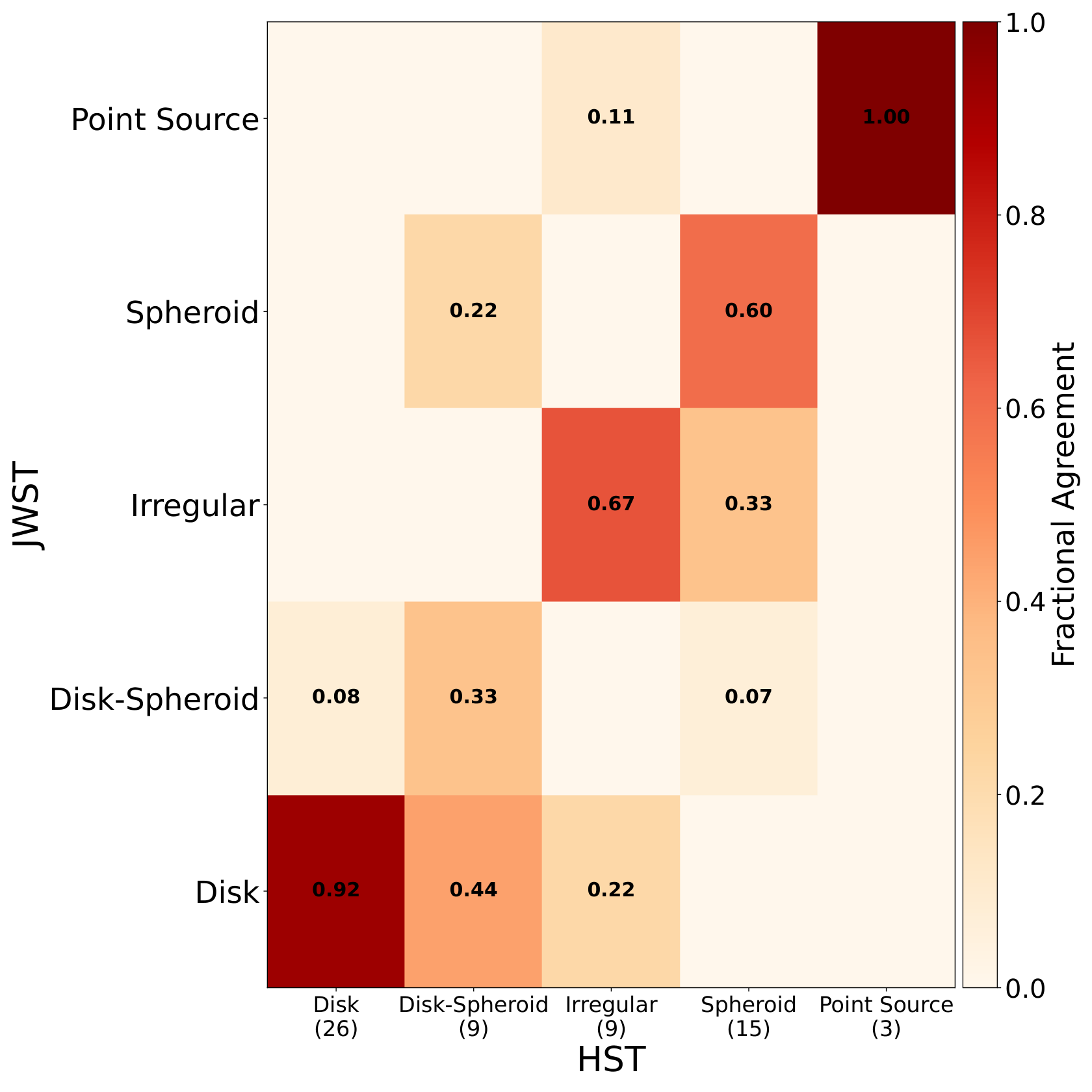
For 194 X-ray AGN at z<1.5 in GOODS, the authors find predominantly obscured SEDs and mainly disk-dominated hosts. A statistically distinct, faint obscured SED class is more spheroid-rich, while the observed interaction fraction does not establish triggering causality.

2026-01-29 · 2601.22213v1 · Research note

Little Red Dots on FIRE: The Ability of Bursty Galaxies to Host an Abundant Population of High-Redshift AGN

Andrew Marszewski, Claude-André Faucher-Giguère, Guochao Sun, et al.

Post-processed FIRE-2 galaxies can yield enough intermittent AGN at z=5–7 to match LRD-scale abundances, but fiducial models overproduce faint sources. The authors’ conditional remedy selects super-Eddington inflow, Eddington-limited luminosities, and moderately massive hosts.

Figure 1 from JADES: A Prominent Galaxy Overdensity Candidate within the First 500 Myr

2026-01-22 · 2601.15960v1 · Research note

JADES: A Prominent Galaxy Overdensity Candidate within the First 500 Myr

Zihao Wu, Daniel J. Eisenstein, Benjamin D. Johnson, et al.

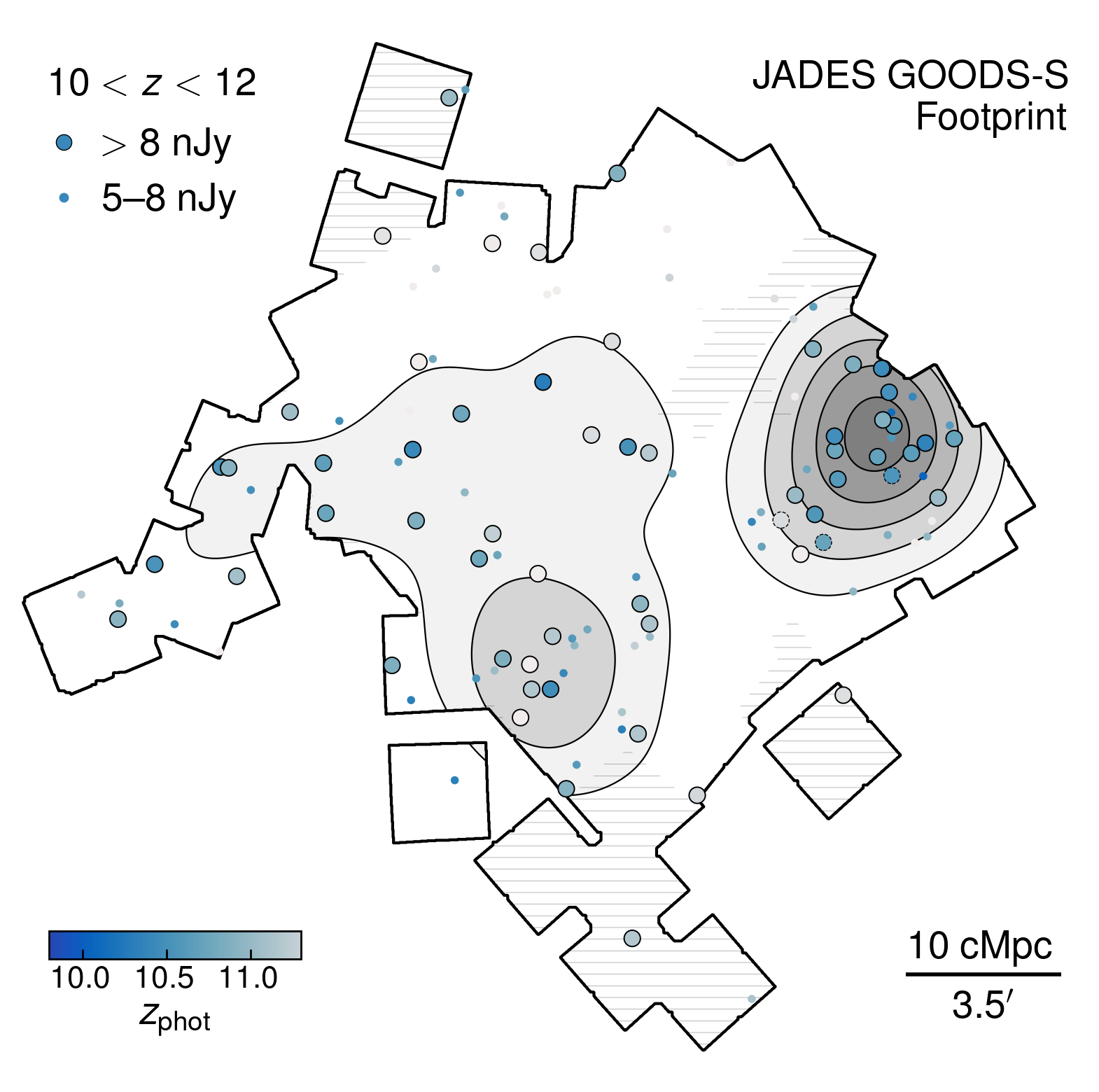
JADES identifies a photometric z≈10.5 concentration of 18 galaxies, four times the field surface density. Its compact, otherwise typical members show tentative environmental signatures—close associations, two optical-excess sources, and spatially varying inferred Lyα transmission.

2025-12-20 · 2512.18421v1 · Research note

The evolution of obscured AGN across cosmic time -- A large quasar survey for the 2040s

Tanya Urrutia, Darshan Kakkad, Paula Sánchez-Sáez, et al.

This is a survey proposal, not a new AGN measurement: it argues that repeat optical MOS spectroscopy of >50 million multi-selected candidates to z~6.5 could quantify obscuration demographics while exposing selection biases among obscured populations.

Figure 1 from HELM's deep: Highly Extincted Low-Mass galaxies seen by JWST

2025-12-16 · 2512.14822v1 · Research note

HELM's deep: Highly Extincted Low-Mass galaxies seen by JWST

L. Bisigello, G. Gandolfi, A. Grazian, et al.

JWST/CEERS SED fitting identifies 1,361 candidate low-mass galaxies with unexpectedly high attenuation. Their similar sizes and axis ratios to non-dusty dwarfs disfavor a simple edge-on explanation, while modest clustering and lower inferred sSFR motivate—but do not establish—environmental evolution.

Figure 4 from From ASTRID to BRAHMA -- The role of overmassive black holes in little red dots in cosmological simulations

2025-12-15 · 2512.13957v1 · Research note

From ASTRID to BRAHMA -- The role of overmassive black holes in little red dots in cosmological simulations

Patrick LaChance, Aklant Kumar Bhowmick, Rupert A. C. Croft, et al.

BRAHMA mock observations suggest that overmassive, dense-gas-enshrouded AGN can yield AGN-dominated LRD colors and an LRD density of (2.04 ± 0.32) × 10^-4 Mpc^-3 at z=5–8; this is a model-dependent explanation, not a direct detection of the proposed environments.

2025-12-03 · 2512.04208v1 · Research note

A Black-Hole Envelope Interpretation for Cosmological Demographics of Little Red Dots

Hiroya Umeda, Kohei Inayoshi, Yuichi Harikane, et al.

Fitting ∼400 COSMOS-Web little red dots with a black-hole-envelope SED model yields cool, 4000–6000 K photospheres and bolometric luminosities typically 1–2 dex below dusty-quasar estimates, reducing the inferred tension with established AGN demographic constraints.

Figure 1 from A Comprehensive JWST/NIRSpec Census of Broad-Line Active Galactic Nuclei: Faint, Tiny, but Highly Accreting Sources in the Remote Universe

2025-12-02 · 2512.03281v1 · Research note

A Comprehensive JWST/NIRSpec Census of Broad-Line Active Galactic Nuclei: Faint, Tiny, but Highly Accreting Sources in the Remote Universe

Caroline Baccus, Xinfeng Xu

A JWST/NIRSpec search of roughly 80,000 spectra identifies 252 broad-line AGN to z=7.2, extending census statistics to fainter, lower-mass systems. The authors find high-redshift objects commonly at inferred Eddington ratios of 0.1–1, subject to heterogeneous depth and line-detection limits.

2025-11-13 · 2511.10725v1 · Research note

Back to basics: Little Red Dots as galaxies and dust-obscured AGNs in a synthetic NIRCam sky simulated with L-GalaxiesBH

Diego Herrero-Carrión, Daniele Spinoso, David Izquierdo-Villalba, et al.

In an L-GalaxiesBH synthetic NIRCam lightcone, photometric LRDs are modeled as a mixed galaxy–AGN population: older low-mass stellar systems and higher-mass systems whose relatively faint AGN preserve a Balmer-break-driven V-shaped SED; torus obscuration is secondary.

Figure 1 from Bridging scales: Modeling suppressed Bondi accretion on black holes and its impact on galaxy growth

2025-11-11 · 2511.08683v1 · Research note

Bridging scales: Modeling suppressed Bondi accretion on black holes and its impact on galaxy growth

Antonio J. Porras-Valverde, Priyamvada Natarajan, Angelo Ricarte, et al.

A semi-analytic test of GRMHD-motivated magnetic suppression finds that limiting suppression to low-Eddington accretion and rescaling AGN feedback can retain local galaxy and black-hole demographics while allowing rapid early black-hole growth.

2025-10-30 · 2510.26990v1 · Research note

Faint active galactic nuclei supplied 31-75% of hydrogen-ionizing photons at z>5

Mainak Singha, Sangeeta Malhotra, James Ely Rhoads

A joint luminosity-function and escape-fraction model attributes 31–75% of z>5 ionizing photons to AGN, but the result depends on assumed galaxy escape fractions and an outflow-based AGN LyC-escape prescription available here only in the abstract.

2025-10-20 · 2510.17952v1 · Research note

Evolutionary Tracks and Spectral Properties of Quasi-stars and Their Correlation with Little Red Dots

Andrew D. Santarelli, Ebraheem Farag, Earl P. Bellinger, et al.

MESA quasi-star models predict a long-lived, cool late stage whose continuum broadly resembles two JWST Little Red Dots, including one measured Balmer break, but mismatched extreme breaks and simplified atmospheres prevent identification of LRDs as quasi-stars.

2025-10-13 · 2510.11780v1 · Research note

Cross-correlation of Luminous Red Galaxies with ML-selected AGN in HSC-SSP III: HOD Parameters for Type I and Type II Quasars

Rodrigo Córdova Rosado, Andy D. Goulding, Jenny E. Greene, et al.

LRG–AGN cross-correlations at z=0.7–1.0 imply that luminous unobscured quasars occupy roughly three-times more massive halos and far fewer satellite galaxies than reddened/obscured AGN, challenging a purely orientation-based unification picture.

2025-10-13 · 2510.11010v1 · Research note

The Relation Between AGN and Host Galaxy Properties in the JWST Era: II. The merger-driven evolution of Seyferts at Cosmic Noon

Nina Bonaventura, Jianwei Lyu, George H. Rieke, et al.

JWST/NIRCam morphologies and matched controls indicate that obscured, Seyfert-luminosity AGN hosts at cosmic noon are more disturbed than inactive galaxies. The authors interpret the combined trends with column density and X-ray/IR selection as a major-merger evolutionary branch.

2025-10-09 · 2510.08455v1 · Research note

A first look at quasar-galaxy clustering at $z\simeq7.3$

Jan-Torge Schindler, Joseph F. Hennawi, Frederick B. Davies, et al.

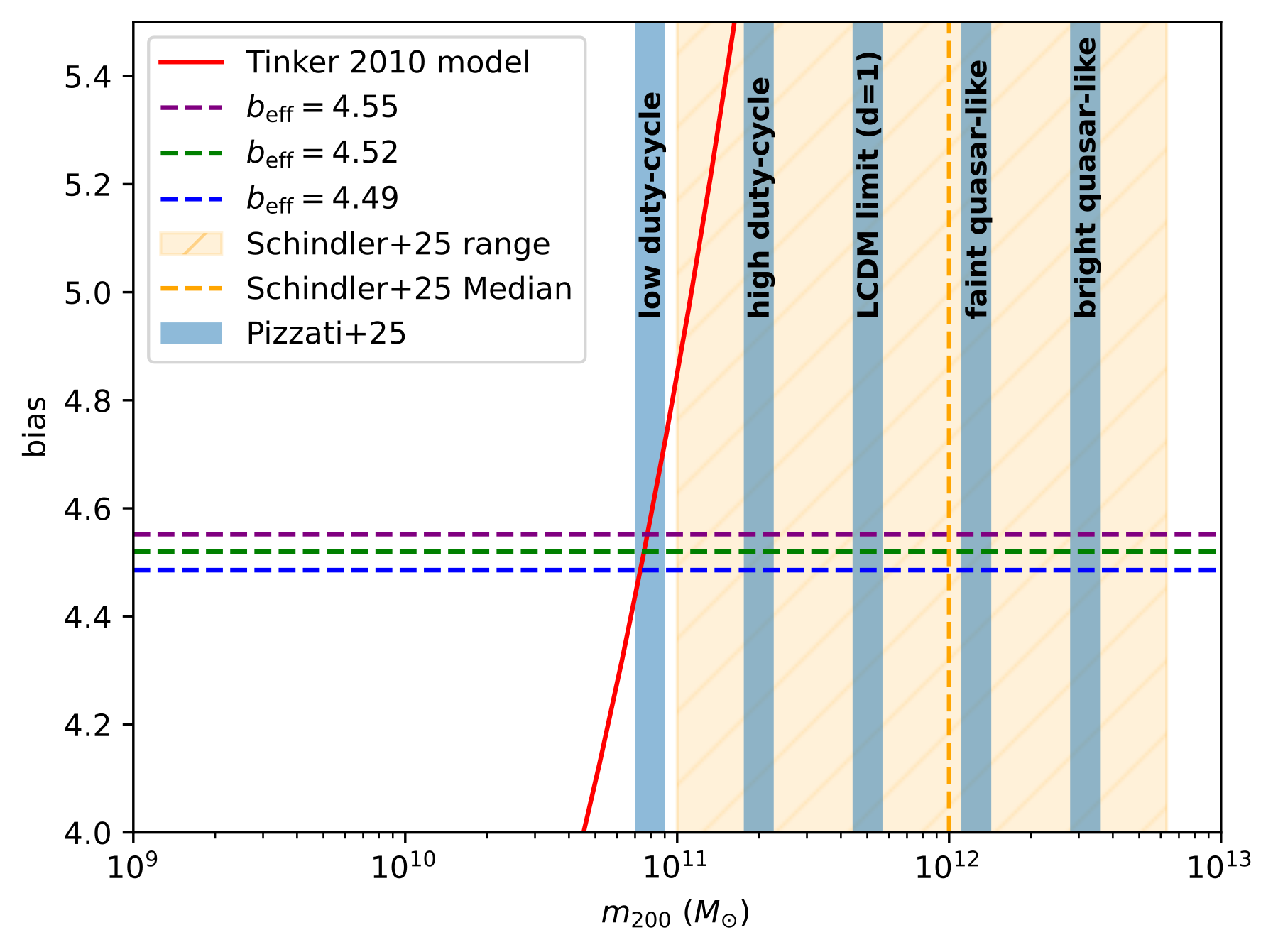
JWST spectroscopy of galaxies around two z=7.0–7.5 quasars yields a tentative z≈7.3 quasar–galaxy clustering measurement, implying comparatively modest halo masses and a short duty cycle, but only eight associated galaxies make cosmic variance and modeling assumptions consequential.

2025-10-07 · 2510.06325v1

Preferential Accretion onto the Secondary Black Hole Strengthens Gravitational Wave Signals

Julia M. Comerford, Joseph Simon

ApJ-accepted, this paper delivers the first observationally anchored test of how preferential accretion onto the secondary SMBH reshapes binary demographics and gravitational-wave output. Using SDSS close-pair merger rates and empirical SMBH scaling inputs, the authors show that modest differential growth raises mass ratios, converting many minor galaxy mergers into major SMBH mergers and boosting the major-merger fraction by a factor of 2–3. Only ~10% total SMBH mass growth onto the secondary brings the predicted nanohertz gravitational-wave background into agreement with PTA measurements and accelerates the first continuous-wave binary detection. The effect is even stronger for LISA-era binaries in gas-rich, higher‑z environments, offering a path toward the rapid build-up of overmassive black holes seen by JWST.

Figure 4 from JWST-discovered AGN: evidence for heavy obscuration in the type-2 sample from the first stacked X-ray detection

2025-09-30 · 2510.00112v1 · Research note

JWST-discovered AGN: evidence for heavy obscuration in the type-2 sample from the first stacked X-ray detection

Andrea Comastri, Giorgio Lanzuisi, Fabio Vito, et al.

Rest-frame Chandra stacking of 38 JWST Type-2 AGN yields a ≳3σ 10–30 keV signal but softer-band limits, a spectral pattern the authors interpret as population-average, high-covering-factor Compton-thick obscuration rather than an unobscured continuum.

2025-09-24 · 2509.20452v1

A GLIMPSE of Intermediate Mass Black holes in the epoch of reionization: Witnessing the Descendants of Direct Collapse?

Qinyue Fei, Seiji Fujimoto, Rohan P. Naidu, et al.

Ultra-deep JWST/NIRSpec G395M spectroscopy behind Abell S1063 enables a systematic search for faint broad-line nuclei, fitting narrow components with an [O III] λ5007 template and validating the method with mocks. The authors identify ten broad-line AGN at 4.5<z<7.0 (eight secure, two tentative) with broad Hα–based virial masses down to ~10^5.5 Msun; composite galaxy+AGN SEDs yield host masses implying M_BH/M_* ≲ 0.1% and placements consistent with the local M_BH–M_* relation. From these they build a BH mass function that agrees with prior results above ~10^6.5 Msun but shows an excess at ~10^5.5 Msun relative to a Schechter extrapolation. They interpret the low-mass excess as evidence for descendants of direct-collapse seeds in the reionization era.

2025-09-18 · 2509.15331v1

Modeling the JWST MIRI Counts, Insights Into the Source Properties and Role of Dust-Obscured AGN

Edgar P. Vidal, Anna Sajina, Amber R. Banks, et al.

The authors update the SIDES framework with revised star-forming, starburst, quiescent, and AGN SED templates plus a probabilistic assignment of the AGN contribution to the IR, applying it within pySIDES and the SC SAM lightcone. The model reproduces JWST/MIRI number counts, redshift distributions, and AGN fractions across the filters, finding AGN dominate at bright fluxes (Sν ≳ 20 μJy) while main-sequence galaxies set the faint-end counts. They quantify field-to-field variance, showing ≈30% uncertainty in bright AGN counts for survey areas <25 arcmin², and provide MIRI color–color and joint NIRCam+MIRI flux diagnostics for selecting obscured AGN. This delivers a practical forward model for interpreting MIRI-selected dusty AGN and for designing future mid/far-IR surveys.

2025-09-08 · 2509.07100v1

Active galactic nuclei-heated dust revealed in "little red dots"

I. Delvecchio, E. Daddi, B. Magnelli, et al.

This Letter median-stacks NIRCam, MIRI, and ALMA imaging for 302 photometrically selected little red dots across CEERS, JADES(+SMILES), and PRIMER (z≈2–11; median z≈6.2). The stacked SED rises to ≈3 µm in the rest frame, and CIGALE fits require a dusty AGN component in most (≳50%) LRDs; combined with ALMA non-detections and deep Chandra stack null results, this points to Compton-thick gas (NH>3×10^24 cm^-2) likely confined within Rsub≈0.1 pc. The inferred geometry leaves optical/UV and broad-line emission largely unobscured, matching blue UV slopes and strong Balmer features. While LRDs are heterogeneous, the prevalence of AGN-heated dust implies obscured black-hole growth is common in this population.

2025-09-02 · 2509.02662v1

No Luminous Little Red Dots: A Sharp Cutoff in Their Luminosity Function

Yilun Ma, Jenny E. Greene, Marta Volonteri, et al.

Wide-area imaging over 15.3 deg^2 targets the bright end of little red dots at 4.5<z<4.9 with K<23.7 and finds only one candidate (ECOSMOS-LumLRD-z5, z_phot≈4.6), implying n(M5100<-23.5)≈10^-8 cMpc^-3—about ten times below UV-selected quasars at the same optical luminosity. Combining with JWST-identified LRDs, the optical LF shows a sharp cutoff at λL5100≈2.5×10^44 erg s^-1, whereas the quasar LF turns over at ≳20× higher luminosity. The result confirms LRDs are exclusively low-luminosity rather than quasar counterparts. If the LF shape holds, it favors low-mass black holes accreting within a narrow Eddington-ratio range.

2025-09-02 · 2509.02027v1

The ALPINE-CRISTAL-JWST Survey: Revealing Less Massive Black Holes in High-Redshift Galaxies

Wenke Ren, John D. Silverman, Andreas L. Faisst, et al.

ALPINE-CRISTAL-JWST uses NIRSpec IFU aperture spectra at photometric peaks in 18 z=4.4–5.7 main-sequence galaxies and finds 7 broad-line AGN candidates via Hα, including one robust source (FWHM ≈ 2800 km/s) and six with 600–1600 km/s, two in a merger. Narrow-line diagnostics place these systems within the star-forming locus, so broad-line detection is the only reliable discriminator; the implied broad-line AGN fraction is 5.9–33% and is aided by targeting high-mass hosts. Virial estimates give MBH ≈ 10^6–10^{7.5} M⊙ with Lbol/LEdd ≈ 0.1–1, and candidates lie at or below the local MBH–M* relation, counter to prior JWST reports of overmassive BHs. The work highlights mass-dependent selection effects and points to a substantial, previously missed population of faint, undermassive broad-line AGN at early times.

2025-09-01 · 2509.01674v1

Understanding the Evolution of Black Hole Accretion and Dust out to z=4 with a Deep Imaging Extragalactic Survey with PRIMA

Andreas L. Faisst, Chian-Chou Chen, Laure Ciesla, et al.

This Concept/Survey paper lays out PRIDES, a 1.6 deg^2 COSMOS-field program with PRIMA to fill the mid‑IR gap (24–240 μm) between JWST and ALMA and trace dust and black‑hole growth out to z≈4. With hyperspectral imaging and spectroscopy, PRIDES will constrain IR SED shapes, dust temperatures, and obscured SFRs while identifying dust‑obscured AGN via PAH and silicate features, detecting mid‑IR emission even beyond z>3. Simulations indicate photometric redshifts from PAH features with accuracy that degrades as the AGN contribution increases, and silicate strengths track AGN hardness. Together, these data will map the fraction of obscured star formation and the prevalence of buried SMBH accretion across environments in COSMOS.

2025-08-29 · 2508.21678v1

Investigating Little Red Dots with UV Excess: Are They the High-Redshift Siblings of Blue Hot DOGs?

Lulu Bao, Chao-Wei Tsai, Jingwen Wu, et al.

The authors stack NIRCam+MIRI photometry for 326 “V-shape” LRDs (from Akins24 and Kokorev24) and compare their UV–NIR SEDs to median-stacked Blue-excess Hot DOGs (BHDs) to test the analog hypothesis. Despite superficially similar “V-shapes,” LRDs turn over at shorter wavelengths, have much bluer rest-IR continua, show F1800W non-detections in stacks, and require far lower dust attenuation in SED fits—indicating little or no AGN-heated hot dust. They also argue the UV excess in LRDs is unlikely to be scattered AGN light, and note compact morphologies plus lower X-ray detection frequencies. Bottom line: LRDs are not simply high‑z siblings of BHDs, pointing to a distinct early SMBH growth pathway from the super‑Eddington, merger-driven Hot DOG phase.

2025-08-19 · 2508.14164v1

The implications of overmassive black holes at $z > 5$ for quasar and black hole growth

Judah Luberto, Steven R. Furlanetto

Analyzing recent JWST reports of ~100× overmassive black holes at z>5, the authors show that if such BHs are common, the global black hole mass density at z≈5 would already rival today’s value—unless the overmassive systems are rare or accrete with very high radiative efficiencies (implying rapid spin). Tracking representative z≈5 detections forward using average growth rates from modern models keeps them overmassive relative to the local Mbh–M⋆ relation. To land within the local scatter by z≈0, these BHs must grow at least an order of magnitude more slowly than expected. This creates tension with the rapid early growth needed to assemble them and complicates standard expectations for quasar feedback on galaxies.

2025-08-19 · 2508.14155v1

Little Red Dots and their Progenitors from Direct Collapse Black Holes

Junehyoung Jeon, Boyuan Liu, Volker Bromm, et al.

Using the A-SLOTH semi-analytic framework, the authors generate a DCBH-seeded SMBH population and benchmark it against Little Red Dot (LRD) demographics and spectra. Heavy (DCBH) seeds reproduce the observed LRD BH mass functions, number densities, and host-halo trends better than stellar-remnant seeds. For the most extreme early LRDs (e.g., MoM-BH*-1), DCBH scenarios with either strong dust attenuation or dense, dust-free gas can match the distinctive V-shaped, Balmer-break–dominated SEDs, whereas even super-Eddington growth on light seeds cannot. The work points to gas metallicity as a crucial observable, beyond BH-to-stellar mass ratios, to pin down LRD progenitors.

2025-08-13 · 2508.09749v1

A dual AGN at z = 5.4 associated with a Lyman-alpha Nebula in the Center of a Cosmic Filament

Qiong Li, Christopher J. Conselice, Qiao Duan, et al.

A systematic JWST search flags a spectroscopically confirmed close pair at z≈5.4 (G1: JADES 32751; G2: JADES 32927) with 1.7″ (10.4 pkpc) separation; both components show AGN signatures. NIRSpec PRISM (G1) and NIRCam/F444W grism from FRESCO (G2) reveal rest‑optical line ratios consistent with AGN on BPT diagnostics, with SED fits preferring AGN+SF templates and high‑ionization features strengthening the case. VLT/MUSE maps a >22 kpc Lyα nebula around G2 whose morphology and high Lyα escape fraction point to anisotropic AGN photoionization and an outflow. The pair sits in an overdense filament/protocluster node at z∼5.4, hinting that dual AGNs may be more common at early times than simulations predict and offering a clean probe of CGM feedback during early black‑hole growth.

2025-08-04 · 2508.02792v1

Luminous Mid-IR Selected Obscured Quasars at Cosmic Noon in SDSS Stripe82 II: Spectroscopic Diversity and Broad H$α$ Emissions

Ben Wang, Yuzo Ishikawa, Joseph F. Hennawi, et al.

Survey of 24 WISE W4–bright, optically faint/red SDSS Stripe 82 candidates confirms 23 luminous Type‑2 quasars at z = 0.88–3.49 using Gemini/GNIRS plus Keck/LRIS and KCWI spectra. About one‑third (8/23) unexpectedly show broad Hα (FWHM > 2000 km/s) while sharing SEDs with JWST “little red dots,” marking them as lower‑z analogues of heavily obscured broad‑line AGN. The sample also exhibits relatively weak [O III] λ5007 given their high bolometric luminosities, and the authors construct a new Type‑2 QSO composite spectrum. Results demonstrate that simple mid‑IR plus extreme r−W4 color selection efficiently recovers a spectroscopically diverse obscured quasar population at cosmic noon, informing SMBH growth demographics that connect to the LRD population.

2025-07-31 · 2508.00057v1

Discovery of a Little Red Dot candidate at $z\gtrsim10$ in COSMOS-Web based on MIRI-NIRCam selection

Takumi S. Tanaka, Hollis B. Akins, Yuichi Harikane, et al.

Using COSMOS-Web’s joint NIRCam–MIRI imaging, the authors conduct the first targeted search for little red dots beyond z≈10, leveraging F770W to isolate the V‑shaped SED signature and cull Balmer‑break contaminants. They uncover one robust source, CW-LRD-z10, with zphot=10.5(+0.7/−0.6), MUV=−19.9(+0.1/−0.2), compact morphology, a clear V‑shaped SED, and an F115W non‑detection consistent with an LRD at z∼10. From this single detection they infer a number density at MUV≈−20 of 1.2(+2.7/−1.0)×10⁻⁶ Mpc⁻³ mag⁻¹, implying the LRD fraction rises with redshift to ≈3% at z∼10. If confirmed, this points to LRDs as a common early population potentially tied to the first SMBH growth; deep spectroscopy is still required to secure the redshift and nature of CW-LRD-z10.

2025-07-30 · 2507.23066v1

SHELLQs-JWST perspective on the intrinsic mass relation between supermassive black holes and their host galaxies at z > 6

John Silverman, Junyao Li, Xuheng Ding, et al.

Using nine SHELLQs quasars at 6.18<z<6.4 with NIRCam host detections and NIRSpec Balmer-line M_BH, the authors infer the intrinsic M_BH–M_* relation via forward modeling that accounts for selection and measurement systematics, with the slope fixed to 1.61 and acknowledging parameter degeneracies. The sample (log M_BH≈8–9; log M_*≈9.5–11) is consistent with a non-evolving relation but with markedly larger intrinsic scatter, σ≈0.80 dex. The preferred model implies an active UV-unobscured AGN fraction of ~2.3% at z≈6 and predicts many lower-mass AGN soon to be found. An overmassive normalization is disfavored, as it would require unrealistically small scatter (~0.22 dex) and a very low AGN fraction (~0.6%).

2025-07-28 · 2507.21230v1

Can high-redshift AGN observed by JWST explain the EDGES absorption signal?

Alexandra Nelander, Christopher Cain, Jordan C J DSilva, et al.

Tests whether a high‑z radio‑loud AGN population—calibrated to JWST UV luminosity functions and extrapolated to z≈20—can provide the excess radio background needed for the EDGES 78 MHz absorption. Matching the EDGES depth requires that essentially all UV‑bright sources down to M_UV ≳ −15 are radio‑loud AGN, with the UV number density declining by ≤1.5 dex from z=10→20, and an X‑ray escape fraction ≲1% to avoid pre‑heating that erases the trough. Only an extremely shallow UVLF evolution can achieve the amplitude, and reproducing the trough’s sharp edges and flat bottom demands fine‑tuned redshift dependence of the UVLF, AGN UV fraction, and X‑ray leakage. Verdict: physically possible but implausible given the extreme requirements.

2025-07-23 · 2507.17833v1

Not-quite-primordial black holes seeded by cosmic string loops

Bryce Cyr

This work builds an improved, unified framework for the halo mass function seeded by cosmic string loops, treating arbitrary loop-velocity distributions and capturing both spherical and filamentary growth. From this mass function, it isolates halos that meet direct-collapse conditions at high redshift, producing black-hole seeds of ~10^4–10^5 Msun. For reasonable string parameters, the predicted seed abundance reproduces the observed number density of JWST’s Little Red Dots, offering a non-Gaussian small-scale route to early SMBH growth. Because loop formation lacks large acoustic waves, the scenario avoids CMB spectral-distortion bounds, and a velocity–tension phase diagram (including fragmentation into “beads”) clarifies where this channel dominates.

2025-07-23 · 2507.17738v1

Beyond the Dot: an LRD-like nucleus at the Heart of an IR-Bright Galaxy and its implications for high-redshift LRDs

Pierluigi Rinaldi, George H. Rieke, Zihao Wu, et al.

The authors present WISEA J123635.56+621424.2 (“the Saguaro”) at z=2.0145 in GOODS‑North as an LRD analog: a compact, LRD‑like nucleus with a face‑on spiral host and a clear V‑shaped nuclear SED from NIRSpec. Redshifting the system to z≈7 renders the host undetectable via surface‑brightness dimming, reproducing a canonical LRD appearance and implying many high‑z LRDs could be visible galactic nuclei embedded in extended hosts. A stack of rest‑UV images for 99 photometrically selected LRDs reveals faint diffuse emission and mild radial growth with redshift, consistent with galaxy size evolution. A simple analytic model shows surface‑brightness dimming alone can explain the compact morphology, arguing LRDs are a short‑lived, AGN‑dominated phase rather than a distinct population.

2025-07-11 · 2507.08298v1

Obscured and unobscured X-ray AGNs I: Host galaxy properties

Carlos G. Bornancini, Gabriel A. Oio, Georgina Coldwell

X-ray selected AGNs from zCOSMOS (0.5<z<0.9) are split by obscuration (NH) and excitation (log[OIII]/Hβ>0.5) to compare host properties. Unobscured sources show a clearer rise of the ionization index O32=[OIII]/[OII] with L2–10 keV than obscured ones, while high-excitation obscured AGNs reach higher X-ray luminosities on average. High-excitation systems also have elevated R23, implying lower gas metallicities reminiscent of z~4–6 galaxies. λsBHAR positively correlates with NH, O32, and R23, linking high specific accretion to harder radiation fields in less enriched environments.

2025-07-05 · 2507.04011v1

Investigating the Growth of Little Red Dot Descendants at z<4 with the JWST

Jean-Baptiste Billand, David Elbaz, Fabrizio Gentile, et al.

Using CEERS imaging, the authors select z<4 “post-LRD” candidates by requiring a compact, very red core plus a blue star-forming envelope, then model inner/outskirts with stellar-only SED fits and single-Sérsic morphologies. The sample shows LRD-like cores with M* ~1e10 Msun, Σ* ~1e11 Msun kpc^-2, and compact sizes about 1 kpc below the size–mass relation, while adding an extended young component; their number density at z=3±0.5 (~10^-4.15 Mpc^-3) matches that of LRDs at 5<z<7, indicating an evolutionary link. Outskirts mass fraction and size increase toward lower redshift (≈250 pc at z=5 to ≈600 pc at z=3), as the core stays red/compact and the hallmark V-shaped SED fades, consistent with growth by cold accretion. This offers an explanation for the apparent decline of LRD counts at lower z, with the caveat that it assumes a single evolutionary path and stellar-only modeling.
2025-06-30 · 2506.24128v1

Beneath the Surface: >85% of z>5.9 QSOs in Massive Host Galaxies are UV-Faint

R. J. Bouwens, E. Banados, R. Decarli, et al.

Ranks 190 z>5.9 QSOs by host mass using ALMA [CII] luminosity as a gas/host-mass proxy, boosted by CISTERN cycle-10 coverage of UV-faint sources, and defines “massive hosts” at L[CII]>1.8x10^9 Lsun. From the resulting UV-luminosity distribution and [CII] luminosity functions, only ~3% of massive-host QSOs are UV-bright (Muv<-26) while >85% are UV-faint (Muv>-24.5). At Muv≈-23 the median extrapolated log10(MBH/Msun)=8.1±0.4, implying UV-bright QSOs host SMBHs ~15x more massive than typical massive-host systems at z~6. This points to most SMBH growth in massive galaxies being missed by UV-bright QSO selections; spectroscopy is still needed to confirm the MBH interpretation.

2025-06-24 · 2506.19589v1

Black Holes in the Red-sequence Elliptical Galaxies at Redshifts $\sim 0.7-2.5$: Not Dark Energy Source but Remanants of Little Red Dots

Lei Lei, Ze-Fan Wang, Yi-Ying Wang, et al.

Uses a JWST-selected set of very high‑z AGNs in red‑sequence ellipticals to test black‑hole cosmological coupling via the MBH–M* fundamental plane. The sample aligns with the local relation and yields a posterior on the coupling strength that rejects the “BHs as dark energy” scenario at >10σ, contradicting earlier claims of strong coupling. Simulations and data further show that low‑accretion Little Red Dots can evolve into the z≈0.7–2.5 red‑sequence ellipticals hosting relatively low‑mass BHs, eliminating the need for cosmological coupling. This links JWST LRD demographics to later ETG BH masses while removing BHs as a viable dark‑energy source.

2025-06-19 · 2506.16145v1

Measurements of the z=4-10 X-ray Luminosity Function: the high space density of moderate-luminosity, obscured AGN

C. L. Barlow-Hall, J. Aird

The authors measure the z=4–10 X-ray luminosity function at intermediate luminosities by combining UltraVISTA-selected COSMOS2020 galaxies with Chandra COSMOS imaging, using both blind detections and forced X-ray extraction (21 blind + 11 extracted). They find AGN space densities that exceed low‑z XLF extrapolations: consistent at z=4–5, but ~10× higher at z=5–7 and potentially up to ~220× at z=7–10. The sample indicates a dominantly obscured early AGN population with an obscured fraction of 0.982(+0.007/−0.008), and correcting for this further boosts the inferred densities. These results bridge bright-end quasar counts and JWST detections of faint AGN, implying a larger fraction of early galaxies hosted rapidly growing SMBHs than previously thought.

2025-06-17 · 2506.14896v1

Overmassive Black holes live in compact galaxies in the early Universe

Yuxuan Wu, Tao Wang, Daizhong Liu, et al.

Uniform ALMA [CII] 158 μm size measurements for a curated sample of 22 z≈6 quasars show their hosts are systematically compact, with a median Re≈1.58 kpc versus 2.26 kpc for main-sequence SFGs measured in the same line. The hosts also have elevated MBH/M* and, for the most compact systems, reduced cold-gas content and sizes akin to massive quiescent galaxies at z≈4–5. Simple evolution over a gas-depletion timescale moves them toward the local MBH–M* relation as stellar mass builds. The compact, gas-poor subset likely marks the late stage of rapid BH growth and are prime progenitors of the first quiescent galaxies.

2025-06-13 · 2506.12141v1

A big red dot at cosmic noon

Federica Loiacono, Roberto Gilli, Marco Mignoli, et al.

JWST reveals BiRD, a luminous little red dot at z=2.33 in the J1030 field, flagged as a bright outlier in the F200W−F356W vs F356W diagram. NIRCam/WFSS detects He I λ10830 and Paγ with both narrow and broad components (FWHM ≳ 2000 km s−1), plus a blueshifted He I absorption indicating dense outflowing gas with N(He I*, 2^3S) ≈ 0.5–1.2×10^14 cm−2 at Δv ≈ −830 km s−1; the source lacks X-ray and radio emission. The Paγ broad component implies MBH ≈ 10^8 M⊙ and Lbol ≈ 2.9×10^45 erg s−1, echoing GN-28074 and RUBIES-BLAGN-1 where similar He I absorption is seen. A first JWST-based census places the LRD space density at z<3 within a factor ∼2–3 of UV-selected quasars at comparable Lbol and MBH, arguing that LRDs contribute meaningfully to AGN demographics at cosmic noon and may trace rapid seed growth.

2025-06-05 · 2506.05459v1

RUBIES: A Spectroscopic Census of Little Red Dots; All V-Shaped Point Sources Have Broad Lines

Raphael E. Hviding, Anna de Graaff, Tim B. Miller, et al.

RUBIES delivers uniform NIRSpec PRISM+G395M spectroscopy for ~1500 z>3.1 sources, identifying 80 broad-Balmer emitters, including 28 (35%) at z>6. A coherent subpopulation of 36 shows v-shaped UV–to–optical continua with dominant rest‑optical point sources; these are defined as spectroscopic LRDs, the largest such sample to date. The key result is that every v‑shaped point source exhibits broad Balmer lines, tying continuum shape, compact morphology, and AGN kinematics together. Photometric LRD searches recover only 50–62% of these to F444W<26.5, implying current color cuts miss many due to faint rest‑UV, comparatively bluer rest‑optical colors, or uncertain photo‑z.

2025-06-04 · 2506.04004v1

Lonely Little Red Dots: Challenges to the AGN-nature of little red dots through their clustering and spectral energy distributions

María Carranza-Escudero, Christopher J. Conselice, Nathan Adams, et al.

Builds a 124-object little red dot sample at z≈3–10 from CEERS, NEP‑TDF, JADES, and JEMS, then tests SED fits with and without AGN components using BIC. Despite lower χ² when adding AGN templates, BIC generally prefers non‑AGN SEDs, especially when MIRI photometry is included. KS tests of projected environments show LRDs occupy sparser neighborhoods than comparison galaxies, and abundance matching yields conservative halo-mass upper limits. Together these point to most LRDs being compact galaxies or forming star clusters rather than AGN‑dominated, while allowing for a mixed population.

2025-06-03 · 2506.03244v1

Cosmic Outliers: Low-Spin Halos Explain the Abundance, Compactness, and Redshift Evolution of the Little Red Dots

Fabio Pacucci, Abraham Loeb

Proposes that Little Red Dots are the visible outcomes of galaxies forming in the extreme low-spin tail of the halo angular-momentum distribution, using Mo–Mao–White scaling to link halo spin to compact disk sizes. Assuming progenitors in the lowest ~1% of spins at z ~ 5 reproduces both the observed number densities and compact effective radii of ~80–300 pc, without requiring a choice between BH- or star-dominated power. The observed redshift trend arises from the competition between an increasing compact-halo fraction and cosmological surface-brightness dimming, yielding an “LRDs Era” at 4 < z < 8; at z < 4 they are bright but rare, while at z > 8 they are common but faint. Agreement with current counts, plus excess small-scale clustering and spectral signs of extreme core densities, supports the low-spin origin.

2025-05-30 · 2505.24308v1

Inferring Obscured Cosmic Black Hole Accretion History from AGN Found by JWST/MIRI CEERS Survey

Cheng-An Hsieh, Tomotsugu Goto, Chih-Teng Ling, et al.

Builds the obscured black hole accretion history from CEERS MIRI sources whose AGN components are identified via CIGALE SED fitting, then converts accretion power and MIR luminosity functions into BHAD across 0<z<4.25. By summing BHARs for composites+AGNs and by integrating LFs (modified Schechter and double power law) down to 1e7 L_sun—two orders fainter than pre-JWST—the authors find BHAD peaking at z≈1–2 (ρ_Ldisk, DPL) or z≈2–3 (modified Schechter). At z≈3 their MIR-inferred BHAD lies above X-ray estimates, hinting at obscured growth missed in X-rays. The new depth strengthens the census of faint, dusty accretion, though the z≈3 excess is within current uncertainties and awaits larger samples.