654 indexed papers · 430 research notes

Research archive

Reset

2025-11-17 · 2511.13650v1 · Research note

JWST observes the assembly of a massive galaxy at z~4

Aayush Saxena, Roderik A. Overzier, Catarina Aydar, et al.

JWST resolves TGSSJ1530+1049 at z=4 into a compact, massive, actively star-forming association around a radio AGN. Its geometry and kinematics support both jet–gas interaction and galaxy interactions, with the authors predicting merger into a massive galaxy within a few Gyr.

2025-11-11 · 2511.08671v1 · Research note

JWST/NIRSpec Reveals a Small Population of Dominant Dust-Obscured Ionizing Sources in Galaxies at 1 < z < 3

Si-Rui Ge, Nikko J. Cleri, Joel Leja, et al.

JWST/NIRSpec line-ratio comparisons find optical and near-IR ionizing-source classifications agree for 49/55 z<3 galaxies, but six mismatches identify plausible dust-hidden AGN or star formation; the proposed physical explanations require follow-up spectroscopy.

2025-10-30 · 2510.26884v1 · Research note

Constraining the AGN tori at cosmic noon using high-resolution JWST imaging and simultaneous SED fitting

Devang H. Liya, David J. Rosario, Matthaios Charidis

For 88 X-ray-selected CEERS AGN at 0.7≤z≤3.5, simultaneous central and integrated JWST/archival SED fitting yields tighter torus constraints. Among 66 luminous sources, torus covering fraction peaks near 0.25 and is not statistically distinguishable from a luminosity-matched local comparison.

Figure 2 from SHELLQs-JWST: Revealing the Spectra of Extended Emission in 12 z > 6 Quasar Host Galaxies using the JWST NIRSpec Fixed Slit

2025-10-25 · 2510.22403v1 · Research note

SHELLQs-JWST: Revealing the Spectra of Extended Emission in 12 z > 6 Quasar Host Galaxies using the JWST NIRSpec Fixed Slit

Camryn L. Phillips, Michael A. Strauss, Masafusa Onoue, et al.

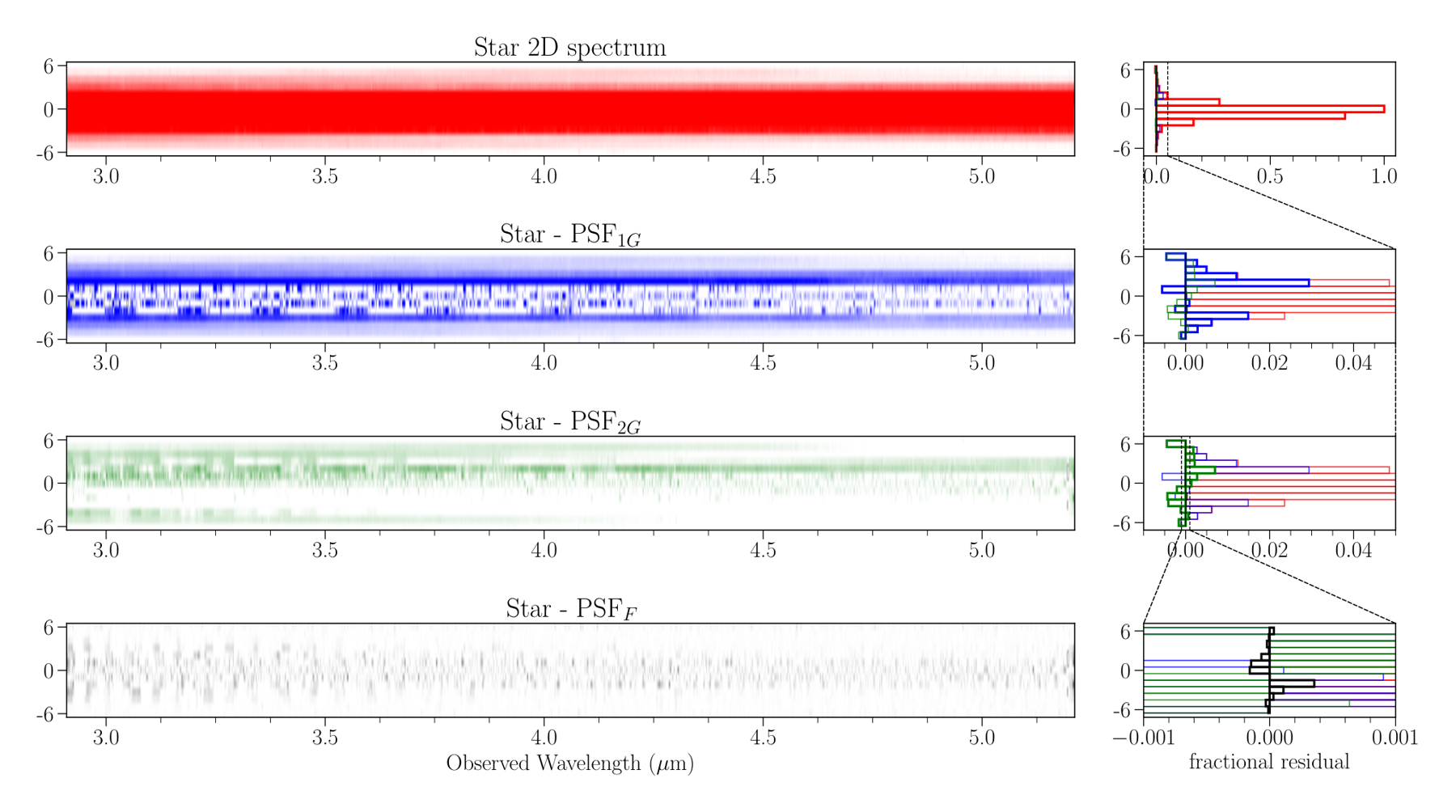
In twelve z=6.0–6.4 low-luminosity SHELLQs quasars, wavelength-dependent PSF subtraction isolates extended host emission. The authors report mostly main-sequence-consistent Hα upper-limit SFRs, one [O III] outflow, and one disk-like rotation, while narrow-line-region contamination complicates interpretation.

2025-10-13 · 2510.11010v1 · Research note

The Relation Between AGN and Host Galaxy Properties in the JWST Era: II. The merger-driven evolution of Seyferts at Cosmic Noon

Nina Bonaventura, Jianwei Lyu, George H. Rieke, et al.

JWST/NIRCam morphologies and matched controls indicate that obscured, Seyfert-luminosity AGN hosts at cosmic noon are more disturbed than inactive galaxies. The authors interpret the combined trends with column density and X-ray/IR selection as a major-merger evolutionary branch.

2025-10-12 · 2510.10772v1 · Research note

Black Holes in the Shadow: The Missing High-Ionization Lines in the Earliest JWST AGNs

Greta Zucchi, Xihan Ji, Piero Madau, et al.

Stacked JADES Type 1 AGN spectra at z>5 show strong Balmer emission but weak or absent high-ionization lines. Cloudy comparisons disfavour much of the tested sub-Eddington parameter space, motivating—but not uniquely establishing—soft, filtered, or anisotropic ionizing continua.

2025-10-08 · 2510.07303v1 · Research note

Confirming Near- to Mid-IR Photometrically-Identified Obscured AGNs in the JWST era

George H. Rieke, Yang Sun, Jianwei Lyu, et al.

Rest-optical spectroscopy generally supports 1–6 μm SED-selected obscured AGN in massive (log M⋆>9.5) galaxies to z≈3, but redshift errors can create false positives. For dwarfs, a Haro 11 limiting template is proposed to reduce warm-dust contamination.

2025-10-02 · 2510.02517v1 · Research note

Impact of AGN and nuclear star formation on the ISM turbulence of galaxies: Insights from JWST/MIRI spectroscopy

Rogemar A. Riffel, Luis Colina, José Henrique Costa-Souza, et al.

JWST/MIRI mapping of 54 nearby galaxies finds broader ionized than warm-H2 lines in AGN, especially radio-strong systems; line-ratio/model comparisons associate the most turbulent gas with shocks, while the authors cautiously propose AGN or stellar-feedback origins.

Figure 4 from JWST-discovered AGN: evidence for heavy obscuration in the type-2 sample from the first stacked X-ray detection

2025-09-30 · 2510.00112v1 · Research note

JWST-discovered AGN: evidence for heavy obscuration in the type-2 sample from the first stacked X-ray detection

Andrea Comastri, Giorgio Lanzuisi, Fabio Vito, et al.

Rest-frame Chandra stacking of 38 JWST Type-2 AGN yields a ≳3σ 10–30 keV signal but softer-band limits, a spectral pattern the authors interpret as population-average, high-covering-factor Compton-thick obscuration rather than an unobscured continuum.

2025-09-29 · 2509.25483v1 · Research note

Shocked, Heated, and Now Resolved: H$_2$ excitation in the low-luminosity AGN at M58 core with JWST

I. E. López, E. Bertola, V. Reynaldi, et al.

JWST spectroscopy of M58’s central kiloparsec resolves warm H₂ in dust lanes and a turbulent inner region; the authors infer predominantly low-velocity C-type shocks, with lower-density non-thermal excitation affecting rovibrational lines near the LLAGN.

2025-09-23 · 2509.19585v1

NEXUS: A Search for Nuclear Variability with the First Two JWST NIRCam Epochs

Zachary Stone, Yue Shen, Ming-Yang Zhuang, et al.

NEXUS uses two NIRCam epochs (Wide-1.1 in Sep 2024 and Deep-1 in Jun 2025; 9-month baseline) to run a nuclear-variability search across ~25k sources in F200W and F444W with PSF-matched difference imaging. The pipeline reaches ~0.18 mag (F200W) and ~0.15 mag (F444W) sensitivity at 28 mag (0.2″ aperture), improving to ~0.01–0.02 mag at <25 mag, and outperforms single-epoch aperture photometry by >30%. They flag 465 high-confidence extragalactic variables whose photo-z distribution mirrors the parent sample to zphot>10. Crucially, ten spectroscopically confirmed broad-line LRDs at 3≲z≲7 show no detectable variability, yielding 3σ F444W limits of ~3–10% (median ~5%), implying weak rest-optical continuum variability; rare nuclear transients remain to be confirmed with continued monitoring and spectroscopy.

2025-09-18 · 2509.15331v1

Modeling the JWST MIRI Counts, Insights Into the Source Properties and Role of Dust-Obscured AGN

Edgar P. Vidal, Anna Sajina, Amber R. Banks, et al.

The authors update the SIDES framework with revised star-forming, starburst, quiescent, and AGN SED templates plus a probabilistic assignment of the AGN contribution to the IR, applying it within pySIDES and the SC SAM lightcone. The model reproduces JWST/MIRI number counts, redshift distributions, and AGN fractions across the filters, finding AGN dominate at bright fluxes (Sν ≳ 20 μJy) while main-sequence galaxies set the faint-end counts. They quantify field-to-field variance, showing ≈30% uncertainty in bright AGN counts for survey areas <25 arcmin², and provide MIRI color–color and joint NIRCam+MIRI flux diagnostics for selecting obscured AGN. This delivers a practical forward model for interpreting MIRI-selected dusty AGN and for designing future mid/far-IR surveys.

2025-09-05 · 2509.05423v1

Another view into JWST-discovered X-ray weak AGNs via radiative dusty feedback

W. Ishibashi, A. C. Fabian, R. Maiolino, et al.

The authors revisit the X-ray weakness of JWST-selected AGN by mapping dusty gas dynamics onto the N_H–λ plane using the effective Eddington limit for dust. Varying metallicity, grain size, and composition shifts the critical boundary: low-Z, dust-poor gas resists radiation pressure, enabling long-lived nuclear absorption and heavy X-ray obscuration consistent with early JWST-AGN and LRDs. The blowout vs. stalling analysis shows that higher metallicity is needed to expel larger columns, whereas substantial columns stall at low Z, making metallicity a key regulator of obscuration. The framework also naturally links Balmer absorption features and weak radio emission to the same radiative dusty feedback physics.

2025-09-02 · 2509.02027v1

The ALPINE-CRISTAL-JWST Survey: Revealing Less Massive Black Holes in High-Redshift Galaxies

Wenke Ren, John D. Silverman, Andreas L. Faisst, et al.

ALPINE-CRISTAL-JWST uses NIRSpec IFU aperture spectra at photometric peaks in 18 z=4.4–5.7 main-sequence galaxies and finds 7 broad-line AGN candidates via Hα, including one robust source (FWHM ≈ 2800 km/s) and six with 600–1600 km/s, two in a merger. Narrow-line diagnostics place these systems within the star-forming locus, so broad-line detection is the only reliable discriminator; the implied broad-line AGN fraction is 5.9–33% and is aided by targeting high-mass hosts. Virial estimates give MBH ≈ 10^6–10^{7.5} M⊙ with Lbol/LEdd ≈ 0.1–1, and candidates lie at or below the local MBH–M* relation, counter to prior JWST reports of overmassive BHs. The work highlights mass-dependent selection effects and points to a substantial, previously missed population of faint, undermassive broad-line AGN at early times.

2025-08-29 · 2508.21818v1

First constraints on the local ionization topology in front of two quasars at z ~ 7.5

Timo Kist, Joseph F. Hennawi, Frederick B. Davies, et al.

Uses JWST/NIRSpec damping-wing fits and a three-parameter local model to extract the Lorentzian-weighted HI column N_HI^DW, the distance to the first neutral patch r_patch, and the quasar lifetime t_Q in front of two z ≈ 7.5 quasars. J1007+2115 favors a moderately ionized IGM with ⟨x_HI⟩ = 0.32^{+0.22}_{-0.20}, an exceptionally short lifetime log10 t_Q/yr = 4.14^{+0.74}_{-0.18}, r_patch ≈ 28.9 cMpc, and log10 N_HI^DW ≈ 19.70, while J1342+0928 implies a higher neutral fraction ⟨x_HI⟩ = 0.58^{+0.23}_{-0.23}, an intermediate lifetime log10 t_Q/yr = 5.64^{+0.25}_{-0.43}, r_patch ≈ 10.9 cMpc, and log10 N_HI^DW ≈ 20.24. Mapping these local constraints through topology-informed priors links the sightline-level topology to global reionization timing. The N_HI^DW metric also naturally captures potential contributions from foreground absorbers toward J1342+0928.

2025-08-18 · 2508.12599v1

SMILES Data Release II: Probing Galaxy Evolution during Cosmic Noon and Beyond with NIRSpec Medium-Resolution Spectra

Yongda Zhu, Nina Bonaventura, Yang Sun, et al.

SMILES DR2 releases medium-resolution NIRSpec MSA spectra for 166 GOODS-S/HUDF galaxies spanning 0<z<7.5, with a strong emphasis on cosmic noon (z~1–3). Using the G140M/F100LP and G235M/F170LP settings to provide contiguous ~1–3 µm coverage (split near 1.8 µm), the team delivers reduced 1D/2D spectra, robust redshifts, emission-line catalogs (GELATO) and pPXF fits for quiescents, plus ancillary SED results. The dataset is tuned to capture rest‑optical diagnostics for dusty and obscured systems, enabling work on AGN, multi‑phase outflows, excitation, and metallicity in environmental context. Public HLSP availability makes this a ready benchmark set for cosmic‑noon black‑hole growth and ISM studies.

2025-08-13 · 2508.09749v1

A dual AGN at z = 5.4 associated with a Lyman-alpha Nebula in the Center of a Cosmic Filament

Qiong Li, Christopher J. Conselice, Qiao Duan, et al.

A systematic JWST search flags a spectroscopically confirmed close pair at z≈5.4 (G1: JADES 32751; G2: JADES 32927) with 1.7″ (10.4 pkpc) separation; both components show AGN signatures. NIRSpec PRISM (G1) and NIRCam/F444W grism from FRESCO (G2) reveal rest‑optical line ratios consistent with AGN on BPT diagnostics, with SED fits preferring AGN+SF templates and high‑ionization features strengthening the case. VLT/MUSE maps a >22 kpc Lyα nebula around G2 whose morphology and high Lyα escape fraction point to anisotropic AGN photoionization and an outflow. The pair sits in an overdense filament/protocluster node at z∼5.4, hinting that dual AGNs may be more common at early times than simulations predict and offering a clean probe of CGM feedback during early black‑hole growth.

2025-07-30 · 2507.23066v1

SHELLQs-JWST perspective on the intrinsic mass relation between supermassive black holes and their host galaxies at z > 6

John Silverman, Junyao Li, Xuheng Ding, et al.

Using nine SHELLQs quasars at 6.18<z<6.4 with NIRCam host detections and NIRSpec Balmer-line M_BH, the authors infer the intrinsic M_BH–M_* relation via forward modeling that accounts for selection and measurement systematics, with the slope fixed to 1.61 and acknowledging parameter degeneracies. The sample (log M_BH≈8–9; log M_*≈9.5–11) is consistent with a non-evolving relation but with markedly larger intrinsic scatter, σ≈0.80 dex. The preferred model implies an active UV-unobscured AGN fraction of ~2.3% at z≈6 and predicts many lower-mass AGN soon to be found. An overmassive normalization is disfavored, as it would require unrealistically small scatter (~0.22 dex) and a very low AGN fraction (~0.6%).

2025-07-28 · 2507.21230v1

Can high-redshift AGN observed by JWST explain the EDGES absorption signal?

Alexandra Nelander, Christopher Cain, Jordan C J DSilva, et al.

Tests whether a high‑z radio‑loud AGN population—calibrated to JWST UV luminosity functions and extrapolated to z≈20—can provide the excess radio background needed for the EDGES 78 MHz absorption. Matching the EDGES depth requires that essentially all UV‑bright sources down to M_UV ≳ −15 are radio‑loud AGN, with the UV number density declining by ≤1.5 dex from z=10→20, and an X‑ray escape fraction ≲1% to avoid pre‑heating that erases the trough. Only an extremely shallow UVLF evolution can achieve the amplitude, and reproducing the trough’s sharp edges and flat bottom demands fine‑tuned redshift dependence of the UVLF, AGN UV fraction, and X‑ray leakage. Verdict: physically possible but implausible given the extreme requirements.

2025-07-23 · 2507.17738v1

Beyond the Dot: an LRD-like nucleus at the Heart of an IR-Bright Galaxy and its implications for high-redshift LRDs

Pierluigi Rinaldi, George H. Rieke, Zihao Wu, et al.

The authors present WISEA J123635.56+621424.2 (“the Saguaro”) at z=2.0145 in GOODS‑North as an LRD analog: a compact, LRD‑like nucleus with a face‑on spiral host and a clear V‑shaped nuclear SED from NIRSpec. Redshifting the system to z≈7 renders the host undetectable via surface‑brightness dimming, reproducing a canonical LRD appearance and implying many high‑z LRDs could be visible galactic nuclei embedded in extended hosts. A stack of rest‑UV images for 99 photometrically selected LRDs reveals faint diffuse emission and mild radial growth with redshift, consistent with galaxy size evolution. A simple analytic model shows surface‑brightness dimming alone can explain the compact morphology, arguing LRDs are a short‑lived, AGN‑dominated phase rather than a distinct population.

2025-07-07 · 2507.05354v1

JWST MIRI/MRS observations of hot molecular gas in an AGN host galaxy at Cosmic Noon

D. Kakkad, V. Mainieri, Takumi S. Tanaka, et al.

Using JWST/MIRI MRS, the authors detect ro‑vibrational H2 in the z≈2.2 X‑ray AGN cid_346, measuring 1‑0 S(1) (and S(0)) and inferring a hot H2 mass of ≈8×10^5 M⊙. They map hot molecular emission and CO(3‑2) to >10 kpc, and NIRCam imaging reveals two nearby satellites at ≈3.3 and 7.4 kpc, pointing to an interacting environment. The hot phase is 10^5–10^6× less massive than the cold reservoir, but the authors argue H2 ro‑vibrational lines effectively trace locally heated/shocked gas where CO may be faint. Ionized gas shows [O III] extension and a blue wing toward the SE, consistent with outflow activity shaping the multiphase medium.

2025-06-26 · 2506.20896v1

Blowing star formation away in AGN Hosts (BAH) -- IV: Feeding and feedback in 3C 293 observed with JWST NIRSpec

Maitê S. Z. de Mellos, Rogemar A. Riffel, Gabriel L. Souza-Oliveira, et al.

JWST/NIRSpec IFU mapping of 3C 293’s inner ~2 kpc separates the gas into a rotating disk (σ ~100 km s−1), a blueshifted broad outflow (σ ~250 km s−1), and a very broad ionized outflow (σ ~640 km s−1). H2 2.12 μm, [Fe II] 1.64 μm, and Paα trace multiphase flows through heavy dust (A_V up to ~35), with H2 inflow along dust lanes at Ṁ_in ~4×10⁻⁴ M⊙ yr−1. Peak outflow rates reach 0.08±0.02 M⊙ yr−1 (hot H2) and 6.5±1.7 M⊙ yr−1 (ionized), and the jet-driven outflow carries ≈5% of the radio-jet power—sufficient to suppress star formation. The stellar field is a rotating disk whose kinematic center is offset by ~0.5 arcsec from the NIR continuum peak, consistent with a disturbed, post-merger nucleus.

2025-06-24 · 2506.19589v1

Black Holes in the Red-sequence Elliptical Galaxies at Redshifts $\sim 0.7-2.5$: Not Dark Energy Source but Remanants of Little Red Dots

Lei Lei, Ze-Fan Wang, Yi-Ying Wang, et al.

Uses a JWST-selected set of very high‑z AGNs in red‑sequence ellipticals to test black‑hole cosmological coupling via the MBH–M* fundamental plane. The sample aligns with the local relation and yields a posterior on the coupling strength that rejects the “BHs as dark energy” scenario at >10σ, contradicting earlier claims of strong coupling. Simulations and data further show that low‑accretion Little Red Dots can evolve into the z≈0.7–2.5 red‑sequence ellipticals hosting relatively low‑mass BHs, eliminating the need for cosmological coupling. This links JWST LRD demographics to later ETG BH masses while removing BHs as a viable dark‑energy source.

2025-06-03 · 2506.03130v1

AGNBoost: A Machine Learning Approach to AGN Identification with JWST/NIRCam+MIRI Colors and Photometry

Kurt Hamblin, Allison Kirkpatrick, Bren E. Backhaus, et al.

Introduces AGNBoost, an XGBoostLSS framework that ingests NIRCam+MIRI magnitudes, colors, and color-squared terms to jointly predict the mid-IR AGN power-law fraction (frac_AGN) and photometric redshift, trained on 10^6 CIGALE-simulated galaxies. On idealized mocks it attains low scatter (RMSE 0.045 in frac_AGN; NMAD 0.004 in z) with 1.63% and 0.15% outliers, remaining robust under realistic photometric errors (outliers ≈4.38% and 3.35%). It generalizes to empirical templates (recovering 92.6% of AGN with frac_AGN>0.3 and 100% with >0.5) and, on MEGA sources with spectroscopic redshifts, achieves σ_NMAD ≈ 0.056 with 19.79% outliers while yielding frac_AGN consistent with CIGALE (RMSE 0.178; 11.96% outliers). Fast retraining and easy band augmentation make it practical for wide-area JWST catalogs needing rapid AGN screening and photo-zs.

2025-05-30 · 2505.24308v1

Inferring Obscured Cosmic Black Hole Accretion History from AGN Found by JWST/MIRI CEERS Survey

Cheng-An Hsieh, Tomotsugu Goto, Chih-Teng Ling, et al.

Builds the obscured black hole accretion history from CEERS MIRI sources whose AGN components are identified via CIGALE SED fitting, then converts accretion power and MIR luminosity functions into BHAD across 0<z<4.25. By summing BHARs for composites+AGNs and by integrating LFs (modified Schechter and double power law) down to 1e7 L_sun—two orders fainter than pre-JWST—the authors find BHAD peaking at z≈1–2 (ρ_Ldisk, DPL) or z≈2–3 (modified Schechter). At z≈3 their MIR-inferred BHAD lies above X-ray estimates, hinting at obscured growth missed in X-rays. The new depth strengthens the census of faint, dusty accretion, though the z≈3 excess is within current uncertainties and awaits larger samples.

2025-05-07 · 2505.04825v1

SHELLQs. Bridging the Gap: JWST Unveils Obscured Quasars in the Most Luminous Galaxies at z > 6

Yoshiki Matsuoka, Masafusa Onoue, Kazushi Iwasawa, et al.

From the SHELLQs wide-field UV survey, the team followed 13 z>6, Lyα-luminous galaxies with JWST/NIRSpec and uncovered obscured quasars. Seven of eleven narrow‑Lyα systems show broad H I Balmer and He I components—but not in [O III]—with Balmer decrements indicating mild obscuration (0<Av<3), identifying them as UV‑obscured counterparts of luminous EoR quasars. Virial lines imply MBH≈10^(7.8–9.1) Msun with sub‑Eddington to Eddington accretion; most BL sources are unresolved and display LRD‑like blue‑UV/red‑optical colors. The AGN incidence among similarly bright Lyα emitters (≥2×10^−8 Mpc^−3) is comparable to classical quasar densities, implying a substantial obscured SMBH population previously missed by UV‑bright surveys.

2025-04-10 · 2504.08039v1

Bridging Quasars and Little Red Dots: Insights into Broad-Line AGNs at $z=5-8$ from the First JWST COSMOS-3D Dataset

Xiaojing Lin, Xiaohui Fan, Feige Wang, et al.

From the first 10% (≈127 arcmin²) of COSMOS-3D NIRCam grism WFSS, the team identifies 13 broad-line AGNs at z=5–8 via Hα/Hβ, including a z=7.646 Hβ source at F444W=23.6, among the brightest z>7.5 BL AGN. Most (10/13) show reddened optical continua with β_opt>0, while three have quasar-like SEDs that are less blue than unobscured QSOs; two objects have 7.7–18 μm MIRI points constraining rest-NIR, and no significant F115W UV variability is seen over Δt_rest≈60 days. The Hα luminosity functions at z≈5–6 hint at evolution relative to z≈4–5. An Hβ LF at z∼8 implies number densities ~100× above UV-selected quasar LFs, pointing to a populous bridge between UV-bright quasars and LRD-like BL AGN.

2025-04-04 · 2504.03551v1

JADES: comprehensive census of broad-line AGN from Reionization to Cosmic Noon revealed by JWST

Ignas Juodžbalis, Roberto Maiolino, William M. Baker, et al.

Using JADES spectroscopy, the authors assemble a uniform census of 34 broad-line (Type 1) AGN spanning 1.5<z<9 with virial black-hole masses of 10^6–10^9 M⊙ and bolometric luminosities down to 10^43 erg s^-1, generally at sub-Eddington rates (<0.5 L_Edd). These AGN are typically in low-mass (M⋆≈10^8 M⊙) hosts whose black holes are overmassive relative to the local M_BH–M⋆ relation yet consistent with the local M_BH–σ⋆ relation, enabling a view of how these scalings emerge across cosmic time. The team shows that standard narrow-line diagnostics would miss many counterparts—especially at low metallicity or with attenuated/soft ionizing continua—complicating Type 2 selection. They also find strong cosmic-variance sensitivity in the UV luminosity function and rule out electron/Balmer scattering as the origin of broad Balmer components, arguing BH masses are not severely overestimated.

2025-04-02 · 2504.01852v1

Deciphering the Nature of Virgil: An Obscured AGN Lurking Within an Apparently Normal Lyman-α Emitter During Cosmic Reionization

Pierluigi Rinaldi, Pablo G. Pérez-González, George H. Rieke, et al.

JWST/MIRI imaging plus deep NIRSpec/PRISM place the LAE “Virgil” at z=6.6379 and reveal Little Red Dot–like photometry with an extreme color F444W−F1500W=2.84±0.04, and a strongly rising mid-IR SED. SED fits across multiple codes favor an obscured AGN whose IR slope and UV excess resemble blue-excess HotDOGs. The host shows subsolar metallicity, low–moderate dust, and high ionization/electron temperature; UV and Hα SFRs suggest Virgil is entering or fading a burst. High‑z line‑ratio diagnostics (e.g., O32–R23, Ne3O2) nominally flag AGN, though this is ambiguous after accounting for redshift evolution; a tentative broad Hα improves residuals only marginally, while the new 15 μm data strengthen the AGN case and highlight MIRI’s leverage on early black‑hole growth.

2025-04-01 · 2504.01103v1

JWST reveals the diversity of nuclear obscuring dust in nearby AGN: nuclear isolation of MIRI/MRS datacubes and continuum spectral fitting

Omaira González-Martín, Daniel J. Díaz-González, Mariela Martínez-Paredes, et al.

The authors PSF-isolate nuclear mid-IR emission in 21 nearby (z<0.05) AGN with a new tool (MRSPSFisol) and fit the continuum using multiple dust libraries. Twelve nuclei achieve good fits (chi2/dof<2), typically with a flared-disk model combining clumpy and smooth dust and allowing grain size to vary; two prefer disk+wind and one the classical clumpy torus. About 40% resist all models because of extreme silicate profiles plus pervasive water-ice and aliphatic hydrocarbon absorption, pointing to missing chemistry. This establishes JWST/MRS as a clean nuclear isolator and shows that next-generation dust models must capture more complex compositions.

2025-03-05 · 2503.03431v1

Self-Consistent JWST Census of Star Formation and AGN activity at z=5.5-13.5

Jordan C. J. D'Silva, Simon P. Driver, Claudia D. P. Lagos, et al.

Combining ≈400 arcmin^2 of JWST imaging from PEARLS, CEERS, NGDEEP, JADES, and PRIMER, this work jointly fits galaxy and AGN components with EAZY+ProSpect for ≈3.9k galaxies at z=5.5–13.5 to build SMF, SFRF, and AGNLF in four bins. Integrating these functions shows a ~1 dex rise in the CSFH from z≈13.5→5.5, while the CAGNH also increases and tentatively does so more rapidly, implying early SMBH accretion can outpace stellar mass growth. The results are stitched to z<5 measurements to provide a continuous, self-consistent census spanning >13 Gyr. This anchors the early coevolution picture and constrains the AGN contribution around reionization.

2025-02-06 · 2502.03683v1

AGN ruled out as the dominant source of cosmic reionization

Danyang Jiang, Linhua Jiang, Shengxiu Sun, et al.

JWST GOODS-S/N imaging is used to build a highly complete z=7.15–7.75 sample and decompose each source into a point-source (AGN) and extended component in F115W and F150W, yielding 93 faint AGNs down to M_UV ≈ −15. From the PSF-only UV magnitudes they measure the faint-end AGN UV luminosity function and integrate a 1–4 Ryd SED with f_esc=1 to set an absolute upper bound on AGN ionizing emissivity. The cumulative result is that AGNs provide at most one third of the LyC photon budget at z≈7.5, with the contribution dominated by the lowest-luminosity bins. This effectively rules out AGNs as the dominant drivers of reionization, implying galaxies supply most ionizing photons during the EoR.

2025-01-29 · 2501.17925v1

Possible environmental quenching in an interacting little red dot pair at $z\sim7$

Rosa M. Mérida, Gaia Gaspar, Marcin Sawicki, et al.

CANUCS NIRCam imaging behind Abell 370 reveals a compact z∼7 group with two little red dots only 3.3 kpc apart plus three satellites. SEDs show strong Balmer breaks implying recent (~100 Myr) quenching in the LRDs, while the satellites are consistent with a recent-onset (~100 Myr), ongoing burst. Modeling suggests a dust-free AGN produces the UV excess in LRD1 (with the optical dominated by an obscured post‑starburst and a subdominant AGN), and LRD2 is more ambiguous; in this picture the LRDs are massive (~10^10 M⊙, AV>1 mag) and the satellites are lower-mass (10^8–10^9 M⊙) with low attenuation. The tight configuration points to interaction-driven environmental bursting and quenching during reionization.

2025-01-20 · 2501.11491v1

MIDIS: Quantifying the AGN component of X-ray-detected galaxies

Steven Gillman, John P. Pye, Almudena Alonso-Herrero, et al.

Using MIDIS MIRI 5.6 μm imaging in the HUDF cross-matched to the CDF-S 7 Ms catalog, the authors morphologically decompose 31 X-ray sources (24 AGN; z≈0.5–3) with visual, Sérsic+PSF, and non-parametric classifiers to isolate unresolved nuclear emission at rest-frame ~2 μm. They find ≥70% show an unresolved MIRI component with unresolved-to-total 2 μm flux fractions spanning ~0.2–0.9, and at Lx>10^43 erg s^-1 the 2 μm point-source luminosities align with local AGN relations. At lower X-ray luminosities, they report an excess 2 μm nuclear component relative to pre-JWST expectations, plausibly linked to Compton-thick AGN and/or compact nuclear starburst/merger activity. The work demonstrates that MIRI can robustly quantify nuclear IR emission in faint X-ray sources and clarifies the AGN/host balance across Cosmic Noon.

2025-01-16 · 2501.09585v1

New Methods of Identifying AGN in the Early Universe using Spectroscopy and Photometry in the JWST Era

Flor Arevalo Gonzalez, Titanilla Braun, James Trussler, et al.

This paper stress-tests UV-line diagnostics and NIRCam SED selection to find early AGN, showing that classic optical BPT/VO87 fail in low-metallicity regimes. Using photoionization grids, the most effective discriminants emerge as (CIII]+CIV)/HeII λ1640, CIII]/HeII λ1640, and the EW of HeII λ1640, with HeII λ1640/Hβ also separating AGN from star-formers when dust is low. Applied to three JADES/NIRSpec sources (IDs 9422, 18846, 10058975), the diagnostics are promising but current spectra blend HeII λ1640 with OIII] λλ1661,1666 and optical lines are unreliable, limiting firm AGN claims. An EAZY-based NIRCam SED search flags one strong candidate with strong UV emission, and the authors argue longer integrations—especially at z>6—are needed to cleanly deblend key lines.

2025-01-09 · 2501.05512v1

JWST NIRCam simulations and observations of AGN ionization cones in cosmic noon galaxies

Sophie Lebowitz, Kevin Hainline, Stéphanie Juneau, et al.

Simulating JWST/NIRCam narrow- and medium-band [O III] maps at z≈2–3 using MUSE datacubes of nine nearby AGN, the authors show NIRCam can recover classic ionization-cone morphologies. They then apply this to 27 known AGN in GOODS-S (z=2.4–3.4), identifying six systems with [O III]+Hβ morphologies consistent with cones and characteristic NLR sizes of 1–2.5 kpc. The simulations quantify how cosmological dimming and instrument noise bias high‑z NLR size measurements low, depressing the local NLR size–AGN luminosity relation by about a factor of two. This establishes a practical medium-band imaging path to select cone candidates and calibrate NLR size trends at cosmic noon.

2025-01-09 · 2501.04912v1

Another piece to the puzzle: radio detection of a JWST detected AGN candidate

Anniek J. Gloudemans, Kenneth J. Duncan, Anna-Christina Eilers, et al.

Deep 0.144–3 GHz maps across COSMOS, GOODS-N, and GOODS-S are mined for radio counterparts to ~700 JWST-selected AGN candidates (including LRDs). Only PRIMER-COS 3866 at z=4.66 is individually detected; its spectrum (α=−0.76+0.11−0.09), modest radio-loudness (R≈0.5), and Tb≳10^3 K remain consistent with either AGN or star-formation power. Stacks of spectroscopic and photometric subsamples yield non-detections with 3σ limits L1.4GHz<8.6×10^39 erg s−1 and L1.3GHz<1.3×10^39 erg s−1, still compatible with local L_X–L_Hα and L_X–L_R relations. The authors argue present radio depths are insufficient to label the population radio-weak and forecast SKA/ngVLA detections within hours to enable brightness-temperature tests that separate AGN from starbursts.