654 indexed papers · 430 research notes

Research archive

Reset

2026-11-10 · 2611.10140v1 · Research note

Probing circumstellar interaction with spectroscopy of ZTF hydrogen-rich superluminous supernovae

Yang Hu, Ragnhild Lunnan, Priscila J. Pessi, et al.

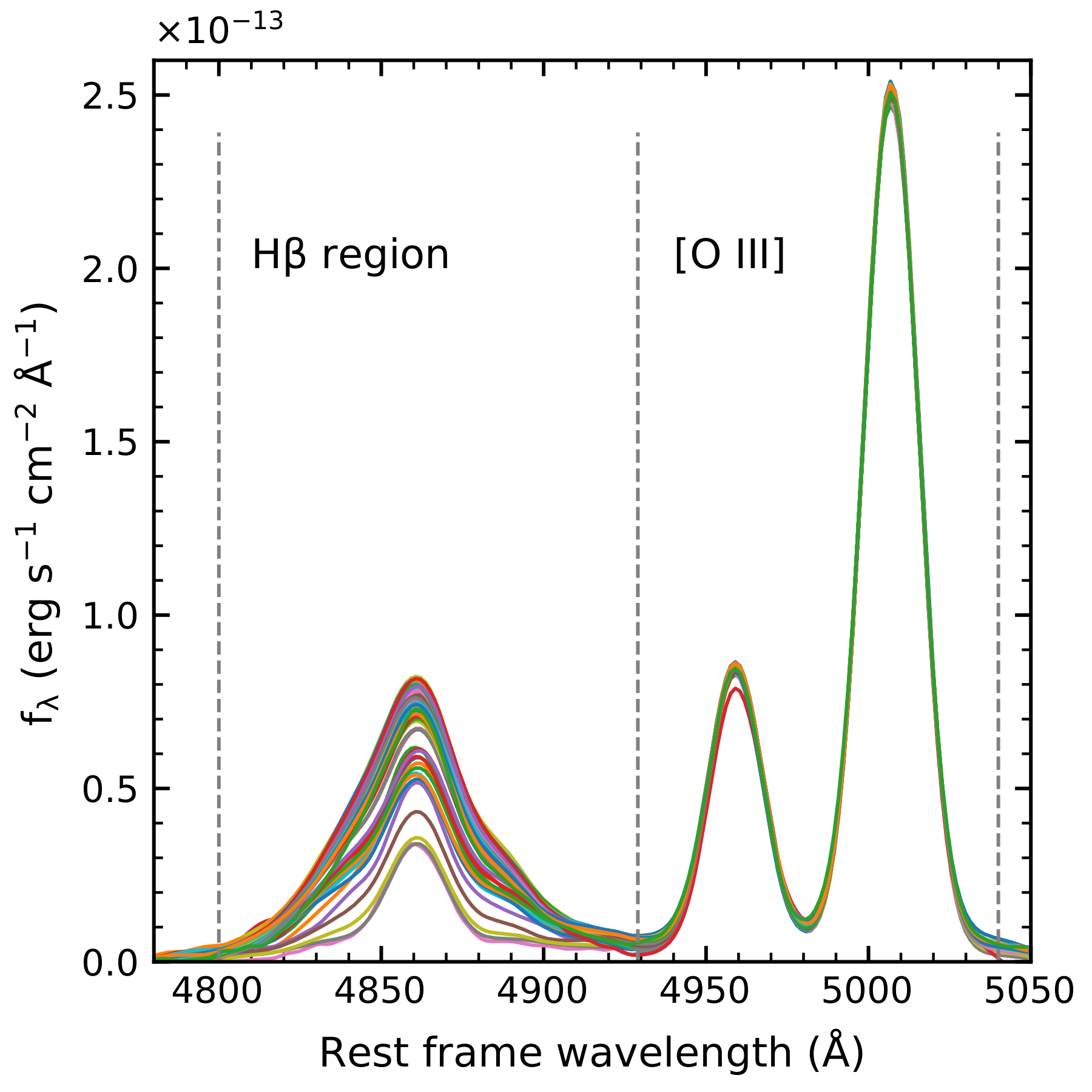
Across 304 ZTF optical spectra of 106 H-rich superluminous supernovae, Balmer-line modeling and comparisons support dense circumstellar interaction, but reveal no line morphology unique to SLSNe-IIn; blue-excess objects are typically fainter and favor faster fitted emitting shells.

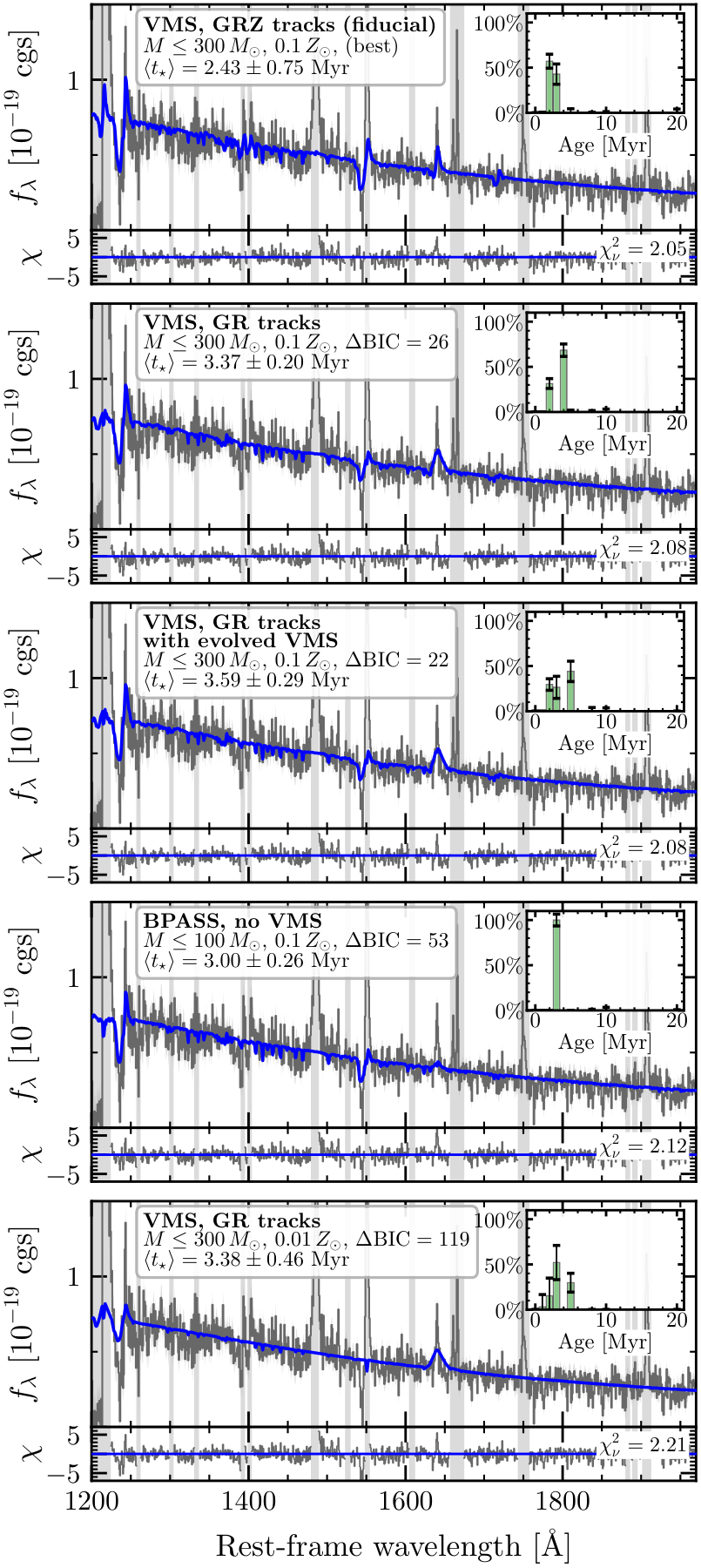
Figure 3 from A Little Red Dot emerging from a nitrogen-rich UV-luminous galaxy with Very Massive Stars

2026-10-22 · 2610.29887v1 · Research note

A Little Red Dot emerging from a nitrogen-rich UV-luminous galaxy with Very Massive Stars

Alberto Torralba, Jorryt Matthee, Rui Marques-Chaves, et al.

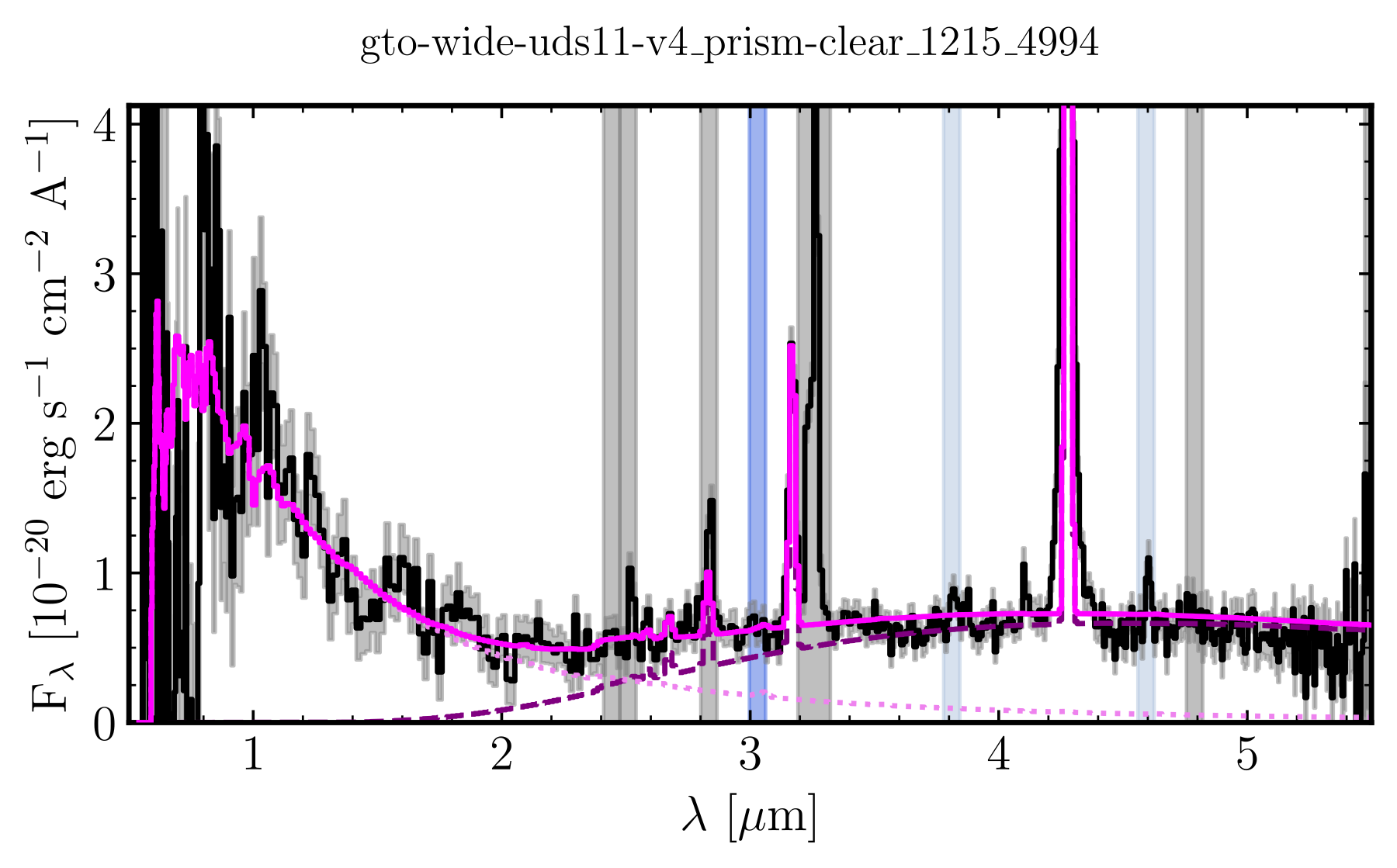
Medium-resolution JWST/NIRSpec spectroscopy of the single z=6.6 galaxy COLA1 links a very young, VMS-favored UV population, extreme nitrogen enrichment, and LRD-like optical Balmer structure; the proposed evolution into an LRD remains model-dependent.

2026-10-12 · 2610.13218v1 · Research note

The Population of Type~1 Active Galactic Nuclei in Dark Energy Spectroscopic Instrument. I. Profile-dependent Measurements of the Low-redshift Sample

Zhu-Heng Yao, Wei-Jian Guo, Shuo Zhai, et al.

DESI DR1 analysis of 114,754 z≤0.9 type 1 AGNs shows that broad-Balmer profile choice systematically shifts Hβ widths, virial masses, accretion rates, and narrow-line diagnostics, while preserving an apparent continuous NLS1-to-broader-line accretion sequence.

Figure 4 from Search for High-Ionization Nebular Emission (SHINE). I. A Systematically Selected [Ne V] Sample at z > 3 with JWST/NIRSpec PRISM

2026-09-24 · 2609.27130v1 · Research note

Search for High-Ionization Nebular Emission (SHINE). I. A Systematically Selected [Ne V] Sample at z > 3 with JWST/NIRSpec PRISM

Shobita Satyapal, Sara Doan, Daniel Schaerer, et al.

SHINE identifies 25 luminous [Ne V] emitters at z=3.06–9.44 from >9,000 JWST/NIRSpec PRISM galaxies. Their hard-ionization lines favor accretion, but heterogeneous selection and incomplete diagnostic overlap preclude an intrinsic AGN-incidence measurement.

2026-09-22 · 2609.22623v1 · Research note

Balmer Absorption Series and Broad Metal Lines in Two Luminous Little Red Dots

Bingjie Wang, Jenny E. Greene, Hanpu Liu, et al.

Deep JWST/NIRSpec spectra of two luminous LRDs resolve Hα–Hδ absorption near systemic velocity, with higher-order troughs redder and unexpectedly persistent. Broad metal lines and diagnostic ratios favor dense gas, while a stratified failed wind remains an interpretation rather than a detection.

2026-09-11 · 2609.10803v1 · Research note

The THRILS Factor: Investigating the properties of Little Red Dots (LRDs) at 3<z<6 with JWST/NIRSpec

Ananya Ganapathy, Rebecca L. Larson, Erini Lambrides, et al.

Deep JWST/NIRSpec spectra of nine z=3–6 LRDs favor electron-scattering-like broad-line profiles in five cases, implying substantial ionized columns but ∼50% covering fractions; this challenges unity-covering cocoon models while supporting an AGN-related origin.

Figure 3 from SHELLQs. Black Hole Mass and Eddington Ratio Distributions of Intermediate-Luminosity Quasars at 6<z<7

2026-09-10 · 2609.09266v1 · Research note

SHELLQs. Black Hole Mass and Eddington Ratio Distributions of Intermediate-Luminosity Quasars at 6<z<7

Masafusa Onoue, John D. Silverman, Yoshiki Matsuoka, et al.

Near-IR spectroscopy of intermediate-luminosity SHELLQs quasars finds lower median virial black-hole masses and higher Eddington ratios than luminosity-matched z≈1.3 quasars, with 11–22% inferred near/super-Eddington depending on the single-epoch mass calibration.

2026-09-02 · 2609.00033v1 · Research note

Lynx2030 Science Analysis Group: Final Report

Lynx2030 Science Analysis Group, Simon R. Bandler, Laura W. Brenneman, et al.

This strategic report argues that Lynx-class subarcsecond, high-throughput X-ray imaging spectroscopy would test why JWST little red dots are X-ray weak, while simulations illustrate broader gains for feedback, accretion, and circumgalactic-gas studies.

Figure 4 from Beyond orientation: Evidence for distinct physical regimes among Little Red Dots and Little Blue Dots

2026-08-25 · 2608.21522v1 · Research note

Beyond orientation: Evidence for distinct physical regimes among Little Red Dots and Little Blue Dots

L. Barrufet, J. S. Dunlop, M. L. Hamadouche, et al.

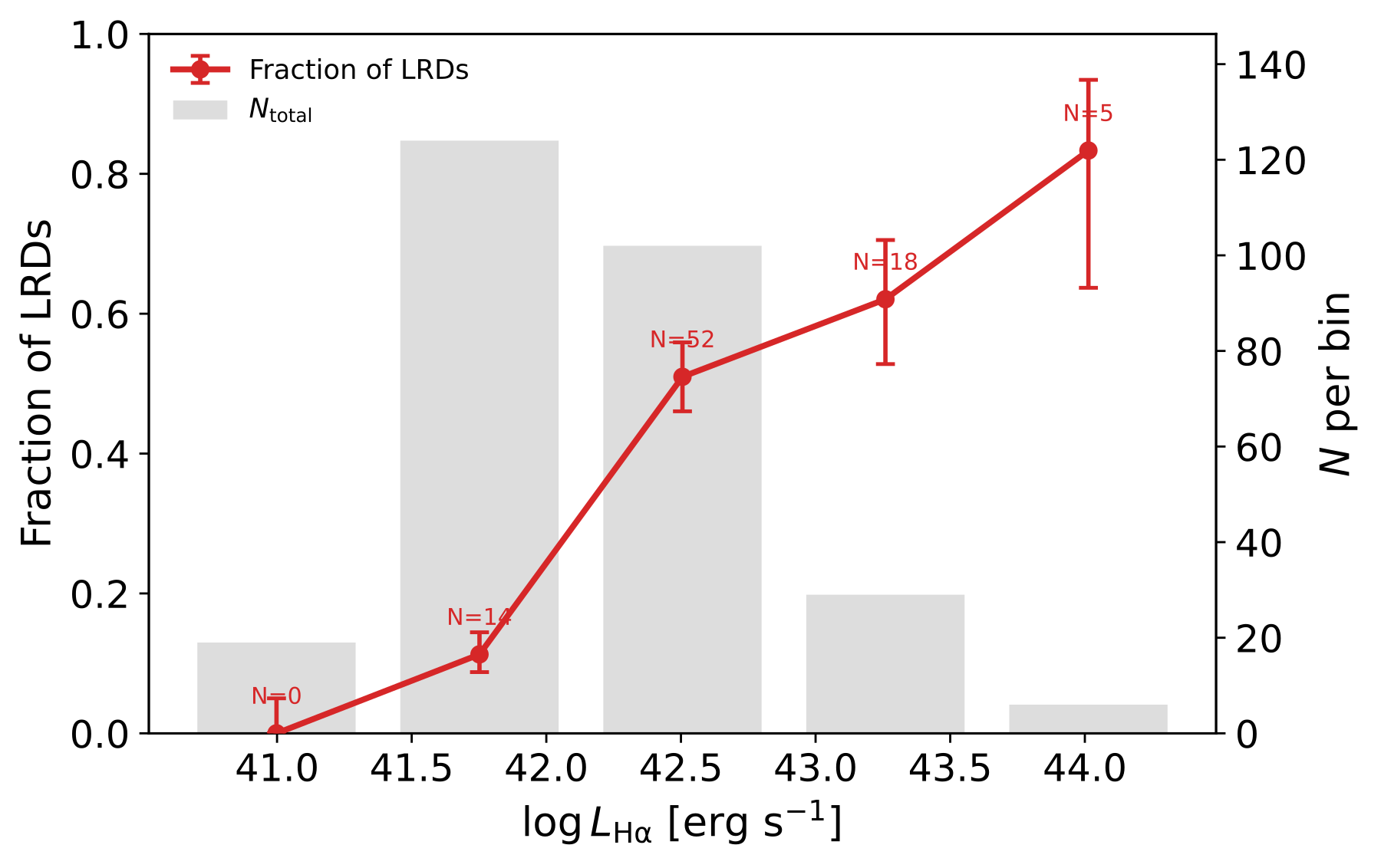
In 89 LRDs and 191 LBDs, LRDs have more luminous and broader Hα, larger Balmer decrements, and lower [O III]/Hβ. The authors argue these population-level differences strain luminosity-independent orientation alone, while not uniquely establishing a gas-cocoon mechanism.

Figure 3 from Ripples in the OCEANS: Broad Line Variability of Little Red Dots

2026-08-14 · 2608.12487v1 · Research note

Ripples in the OCEANS: Broad Line Variability of Little Red Dots

Madisyn Brooks, Kelcey Davis, Jonathan R. Trump, et al.

Across six z=4.95–6.68 little red dots, multi-epoch JWST spectroscopy yields only marginal broad-Hα variability in two objects and no significant continuum changes. The results offer tentative AGN support, but calibration-driven uncertainties and four non-detections preclude a definitive population-level conclusion.

Figure 3 from ATLAS. III. Dust Around Little Red Dots: Hydrogen Line Ratios beyond Dust-free Non-Case B Models

2026-08-12 · 2608.10832v1 · Research note

ATLAS. III. Dust Around Little Red Dots: Hydrogen Line Ratios beyond Dust-free Non-Case B Models

Tomokazu Kiyota, Masami Ouchi, Hiroto Yanagisawa, et al.

In 20 LRDs, extreme broad Balmer decrements require both dense, optically thick non-Case-B line formation and—when Hα/Hβ exceeds the model ceiling—additional broad-line-region-associated dust, rather than galaxy-wide extinction alone.

2026-08-07 · 2608.05283v1

Emission line formation in scattering dominated media: implications for LRDs

Elisha Modelevsky, Omri Nitzan, Re'em Sari, et al.

Modelevsky et al. develop an analytic radiative-transfer framework for Balmer lines produced intrinsically inside static, optically thick, scattering-dominated envelopes, a geometry directly relevant if LRD central engines are hidden by dense gas. Unlike externally broadened, backlit or reflected lines, which generically acquire exponential wings, an extended intrinsic photosphere produces a broken power-law profile, transitioning from v^{-α} to v^{-(α+1)} with 0<α<1; this form fits the Hα profiles of JADES-GN-73488 and JADES-GN-68797. The result offers a line-shape diagnostic for distinguishing intrinsic from extrinsic Thomson broadening in LRDs, although the LTE calculation cannot reproduce the observed high Hα-to-continuum contrast and ultimately requires non-LTE modeling.
2026-08-07 · 2608.05267v1 · Research note

Where did all the Little Red Dots go? The abundance of LRD analogues among objects with broad lines at $z < 0.35$

Lasse Seyberlich, Sarah E. I. Bosman

In an SDSS broad-line sample at z<0.35, the authors identify nine SED-selected local LRD analogues and infer an abundance of 0.08%, supporting rarity at late times but with important spectral-coverage and contamination caveats.

Figure 3 from NEXUS: Spectral Variability of Little Red Dots and Blue Active Galactic Nuclei at $2 \lesssim z \lesssim 6$

2026-08-04 · 2608.01647v1 · Research note

NEXUS: Spectral Variability of Little Red Dots and Blue Active Galactic Nuclei at $2 \lesssim z \lesssim 6$

Zachary Stone, Yue Shen, Ming-Yang Zhuang, et al.

Multi-epoch JWST/NIRSpec monitoring finds that 17 little red dots have large Balmer decrements but weak month-scale continuum and Hα variability. The authors interpret the variability contrast with ordinary AGNs as evidence for differing broad-line emission and/or ionizing-driver properties.

Figure 2 from Misaligned or chaotic? A strong break of axial symmetry in the local LRD J1025 revealed with VLT/FORS2 spectropolarimetry

2026-08-03 · 2607.28715v1 · Research note

Misaligned or chaotic? A strong break of axial symmetry in the local LRD J1025 revealed with VLT/FORS2 spectropolarimetry

Francesco D'Eugenio, Gabriele Pezzulli, Roberto Maiolino, et al.

VLT/FORS2 spectropolarimetry of the z≈0.1 LRD J1025 finds an intrinsically polarised, nearly grey continuum and a weaker, differently angled broad Hα component. The 48±4° angle offset robustly requires broken axial symmetry, but does not identify its physical cause.

Figure 2 from ATLAS. II. Extremely High Incidence of Balmer Line Absorption with Predominant Blueshifts in LRDs: Statistical Insights through Comparison with Type 1 AGNs

2026-07-30 · 2607.26269v1 · Research note

ATLAS. II. Extremely High Incidence of Balmer Line Absorption with Predominant Blueshifts in LRDs: Statistical Insights through Comparison with Type 1 AGNs

Hiroto Yanagisawa, Masami Ouchi, Tomokazu Kiyota, et al.

Among 40 JWST-selected LRDs, 14 show Hα absorption, far exceeding SDSS type-1 AGNs; the compiled absorbers are mostly blueshifted and kinematically narrower, consistent with line-of-sight outflows but not uniquely establishing their fate.

2026-07-24 · 2607.20617v1 · Research note

A dust-free hierarchically nested supermassive-star model for James Webb Space Telescope Little Red Dots

Pau Amaro Seoane

This letter proposes that a dust-poor subset of Little Red Dots are hierarchically nested supermassive stars: magnetic envelope inflation and exposed stellar light reproduce a V-shaped continuum, while a dense inner core supplies broad Balmer emission and hides X-rays.

Figure 3 from An (in)complete NIRSpec census of Balmer absorption in Type 1 AGN -- radiation-driven outflows in little red dots, quasars and variable stars

2026-07-22 · 2607.19057v1 · Research note

An (in)complete NIRSpec census of Balmer absorption in Type 1 AGN -- radiation-driven outflows in little red dots, quasars and variable stars

Ignas Juodžbalis, Xihan Ji, Francesco D'Eugenio, et al.

Completeness-corrected JWST/NIRSpec fits indicate strong Hα absorption is common in little red dots (LRDs) but not detected in little blue dots, favoring blueshifted, likely outflowing gas while leaving rest-frame absorption substantially incomplete.

Figure 1 from Two Peas in a Pod: The First Confirmed Dual Active Galactic Nucleus within a Green Pea Galaxy System

2026-07-21 · 2607.17729v1 · Research note

Two Peas in a Pod: The First Confirmed Dual Active Galactic Nucleus within a Green Pea Galaxy System

Konstantinos Kouroumpatzakis, Peter G. Boorman, Jiří Svoboda, et al.

Chandra and Keck/DEIMOS observations identify two obscured, broad-line AGN in the interacting Green Pea system J1622+3521, separated by 8.4 kpc. The authors therefore report a confirmed dual AGN in a compact low-mass Green Pea environment.

Figure 2 from Optically Thick Outflow Driven by Supercritical Accretion May Explain Little Red Dots

2026-07-21 · 2607.17448v1 · Research note

Optically Thick Outflow Driven by Supercritical Accretion May Explain Little Red Dots

Jun-Rong Liu, Hua Feng, Luis C. Ho

The authors argue that supercritical accretion can launch an optically thick LRD outflow whose red photosphere, line broadening, and Balmer-break properties are broadly compatible with observations, while its Balmer decrements remain underpredicted.

Figure 2 from Spatial decomposition of Little Red Dots with JWST/NIRSpec IFU into broad-line red cores and narrow-line blue host galaxies

2026-07-13 · 2607.09647v1 · Research note

Spatial decomposition of Little Red Dots with JWST/NIRSpec IFU into broad-line red cores and narrow-line blue host galaxies

Yuzo Ishikawa, Anna-Christina Eilers, Rohan P. Naidu, et al.

Spatially resolved NIRSpec spectroscopy of five z≈5 broad-Hα Little Red Dots supports a two-component morphology: compact red continuum/broad-line cores and generally extended blue continuum/narrow-line regions, while imperfect separation and small-sample limitations preclude a unique physical origin.

Figure 1 from The metallicities of little red dot host galaxies: LRDs are metal poor, but not pristine

2026-07-01 · 2606.31515v1 · Research note

The metallicities of little red dot host galaxies: LRDs are metal poor, but not pristine

G. P. Nikopoulos, D. Watson, C. L. Pollock, et al.

Medium/high-resolution JWST/NIRSpec spectroscopy of 24 LRDs finds host narrow-line gas is typically metal poor (about 0.08 solar) rather than pristine. The result disfavors pristine-collapse requirements for most objects, while two LRDs approach extremely low abundances.

Figure 1 from Little Red Dots as Intermediate Mass, Super-Eddington Engines: Insights from Type IIn Supernovae and The 1837-1856 Great Eruption of $η$ Carinae

2026-07-01 · 2606.30711v1 · Research note

Little Red Dots as Intermediate Mass, Super-Eddington Engines: Insights from Type IIn Supernovae and The 1837-1856 Great Eruption of $η$ Carinae

Rohan P. Naidu, Jorryt Matthee, Anna de Graaff, et al.

The authors propose that Little Red Dots are dense-wind, super-Eddington engines analogous to Type IIn supernova interaction phases, rather than virial broad-line AGN. Their escape-velocity interpretation gives a typical-engine upper limit below 10^5 solar masses.

Figure 9 from OzSSy1: The Australian Southern Seyfert-1 Spectroscopic Atlas and Catalogue at z < 0.1

2026-06-29 · 2606.27675v1 · Research note

OzSSy1: The Australian Southern Seyfert-1 Spectroscopic Atlas and Catalogue at z < 0.1

Neelesh Amrutha, Christian Wolf, Christopher A. Onken, et al.

OzSSy1 releases uniform WiFeS spectroscopy, decompositions, and line measurements for 887 southern broad-line AGNs at z<0.1, providing a local reference sample while retaining incompleteness from host dilution at the lowest redshifts.

Figure 1 from A Population of Little Red Dot-like Quasars in SDSS

2026-06-25 · 2606.26098v1 · Research note

A Population of Little Red Dot-like Quasars in SDSS

Quinn O. Casey, Ryan C. Hickox, Nikko J. Cleri, et al.

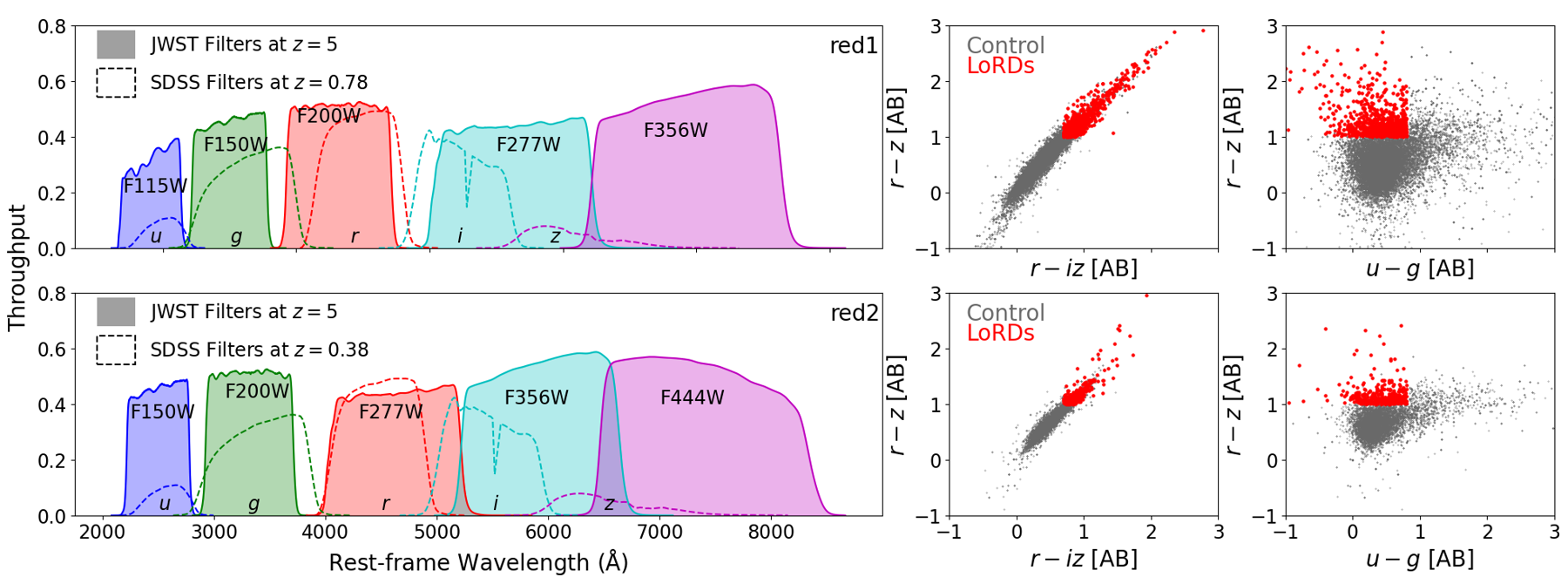
SDSS color selection identifies ~1,300 low-redshift “LoRD” quasars whose V-shaped subset resembles LRD spectral energy distributions, but host contamination, unresolved morphology, and weak high-z X-ray limits prevent establishing them as a uniformly faithful analog population.

Figure 3 from Two years of shock interaction tracing three phases of evolution: the explosion of a Type IIn supernova, SN 2019vxm

2026-06-25 · 2606.25896v1 · Research note

Two years of shock interaction tracing three phases of evolution: the explosion of a Type IIn supernova, SN 2019vxm

Gitika Rameshan, Rishabh Singh Teja, D. K. Sahu, et al.

Across >2 years of photometry and spectroscopy, SN 2019vxm is interpreted as an interaction-powered Type IIn whose UV-to-optical-to-IR evolution and increasingly blueshifted Balmer asymmetry are consistent with a late dust contribution, though its origin remains unresolved.

Figure 4 from Little Red Dots on FIRE: Exploring the formation and observational signatures of ultra-compact early galaxies

2026-06-23 · 2606.23683v1 · Research note

Little Red Dots on FIRE: Exploring the formation and observational signatures of ultra-compact early galaxies

Niranjan Chandra Roy, Daniel Anglés-Alcázar, Rachel K. Cochrane, et al.

FIRE simulations show that transient, inflow-built ultra-compact stellar cores can match several LRD observables without AGN, but fail for the reddest optical continua and most extreme lines, favoring heterogeneous hybrid stellar+AGN interpretations.

2026-06-22 · 2606.21614v1 · Research note

Little Red and Blue Dots: AGN-excited narrow lines, Lyman-$α$ emission, and resemblance to standard quasars

Sophia Geris, Roberto Maiolino, Xihan Ji, et al.

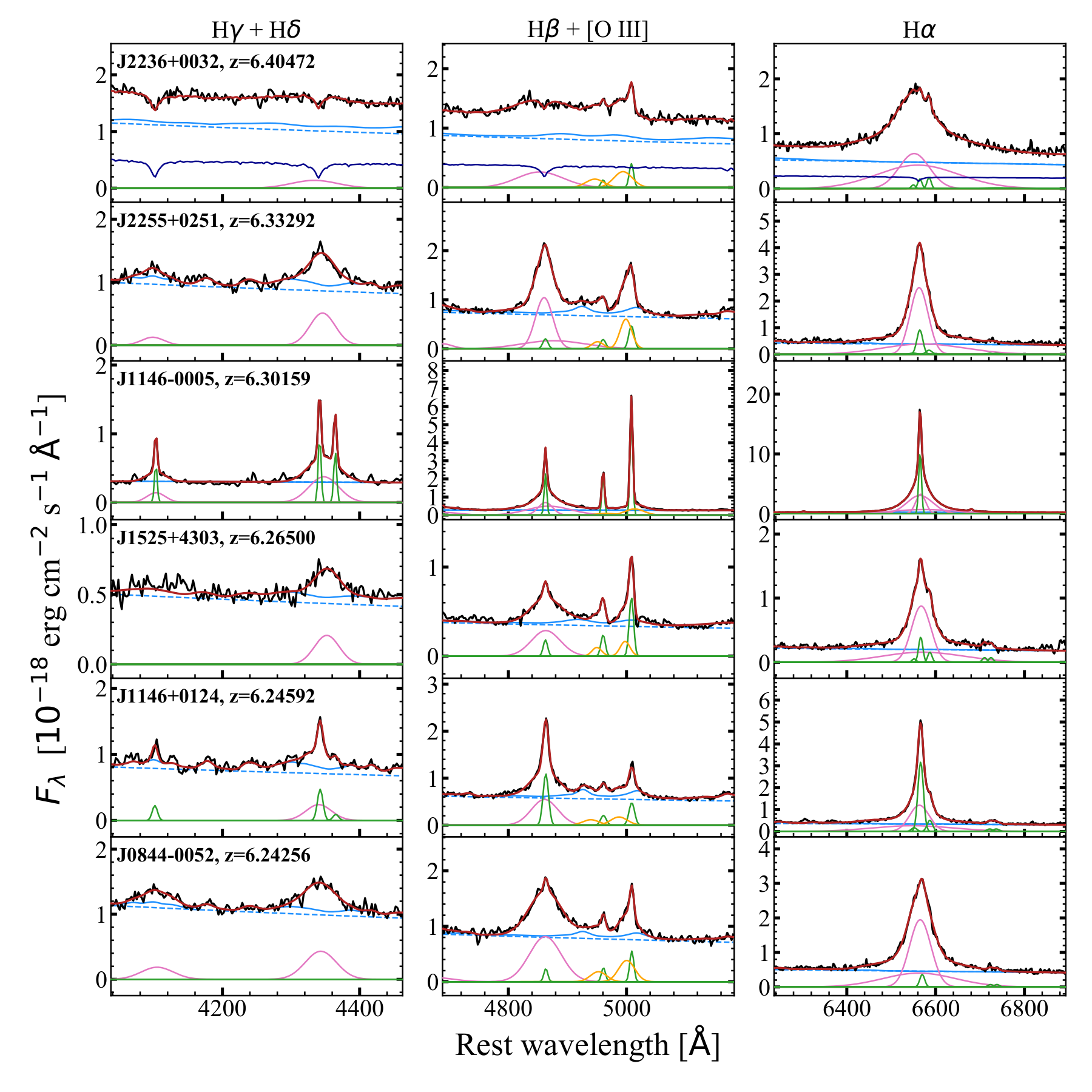
In 36 GOODS LRDs/LBDs at z=2.26–7.89, the authors find AGN-like narrow-line excitation, extreme X-ray weakness, and LRD Lyα excess with a broad component resembling Hα. They argue against completely enclosing cocoon geometries, while retaining obscured-LBD interpretations.

Figure 5 from Probing Direct Contributions of Galaxies and AGN to Cosmic Reionization in a Quasar Field J0226+0302 with JWST NIRCam and NIRSpec

2026-06-16 · 2606.14959v1 · Research note

Probing Direct Contributions of Galaxies and AGN to Cosmic Reionization in a Quasar Field J0226+0302 with JWST NIRCam and NIRSpec

Xiangyu Jin, Jinyi Yang, Feige Wang, et al.

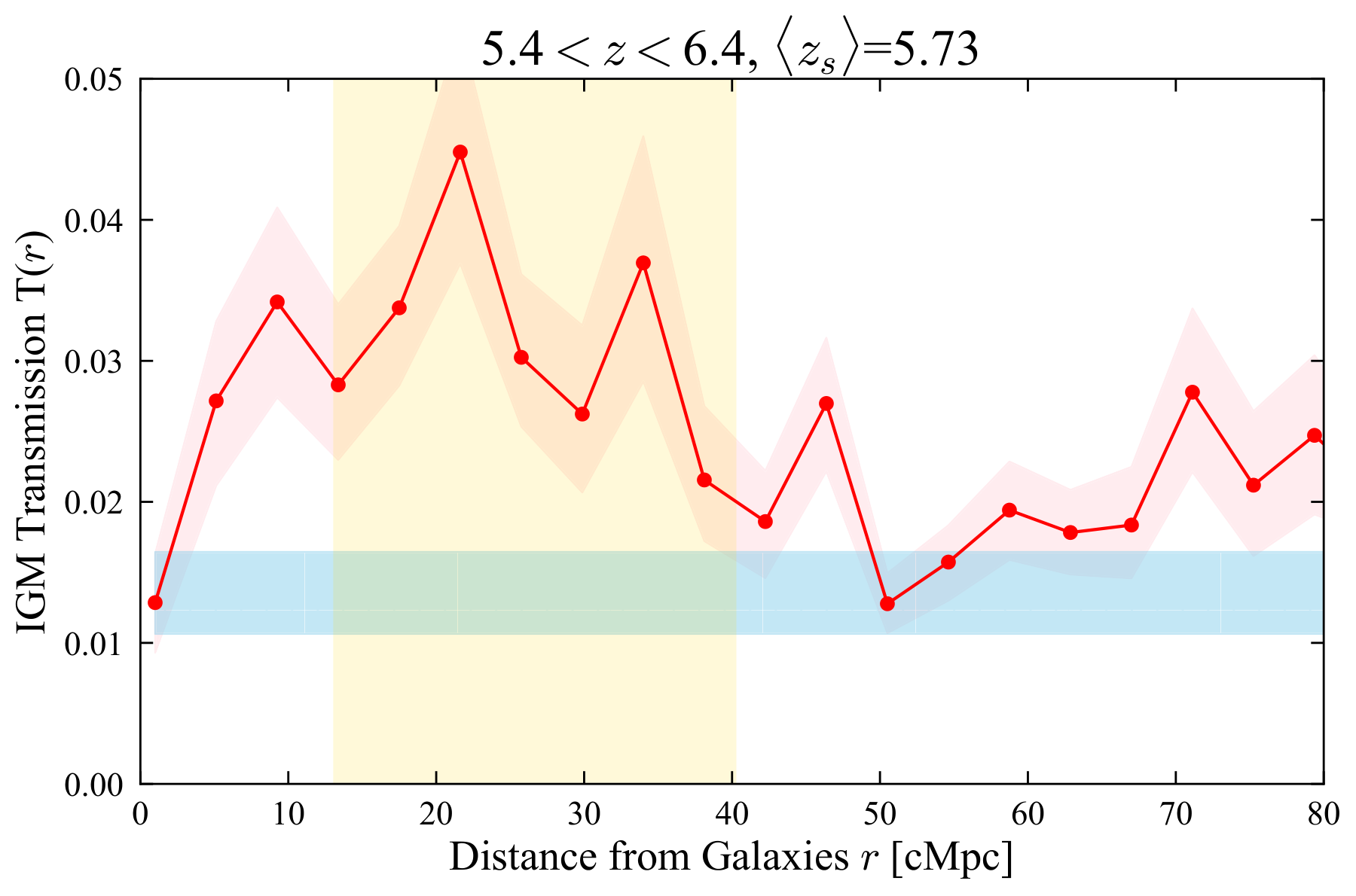
In the J0226+0302 quasar sightline, 73 line-emitting galaxies trace a tentative, 10–40 cMpc enhancement in IGM transmission, while four broad-line AGN show a possible smaller-scale enhancement. The results favor local ionizing-background variations but remain statistically and model limited.

Figure 5 from Through the Veil: Ly$α$ Illuminates the Host Galaxies of Little Red Dots

2026-06-10 · 2606.09970v1 · Research note

Through the Veil: Ly$α$ Illuminates the Host Galaxies of Little Red Dots

Zhiyuan Ji, Yang Sun, Mauro Giavalisco, et al.

In 110 z≥4 little red dots, 32 Lyα detections and resolved imaging of 13 higher-redshift systems indicate that escaping Lyα more plausibly traces extended host-scale gas than the compact red/Balmer-line component, although continuum-subtraction and depth limit morphology.

Figure 2 from A Scaling Relation of LRDs between Broad H$α$ and Bolometric Luminosities: Enhanced Broad H$α$ Emission Relative to Low-$z$ Type 1 AGN

2026-06-09 · 2606.09726v1 · Research note

A Scaling Relation of LRDs between Broad H$α$ and Bolometric Luminosities: Enhanced Broad H$α$ Emission Relative to Low-$z$ Type 1 AGN

Hiroto Yanagisawa, Masami Ouchi, Tomokazu Kiyota, et al.

Across 37 z=3–7 LRDs, broad Hα scales tightly with modified-blackbody bolometric luminosity yet is ∼40 times stronger than in low-z Type 1 AGN at fixed Lbol. The authors attribute this to unusually high-covering, high-column broad-line gas.

Figure 6 from NEXUS: Abundance, Environments, and Spectral Diversity of Little Red Dots from the NIRSpec MSA Sample

2026-06-09 · 2606.09721v1 · Research note

NEXUS: Abundance, Environments, and Spectral Diversity of Little Red Dots from the NIRSpec MSA Sample

Zhiwei Pan, Ming-Yang Zhuang, Yue Shen, et al.

NEXUS combines JWST imaging and PRISM spectroscopy to census LRDs at z=2.3–7.5. Its 36 confirmed objects are predominantly broad-line sources, while selection calibration, abundance, clustering, and continuum diversity remain limited by contamination, resolution, and sample size.

Figure 2 from The quasi-star model for Little Red Dots: potential and challenges

2026-06-08 · 2606.06575v1 · Research note

The quasi-star model for Little Red Dots: potential and challenges

Fabrizio Gentile, Mauro Giavalisco, Emanuele Daddi, et al.

Cloudy fits show that a host-plus-quasi-star model can reproduce several LRD continuum and hydrogen-line properties, but helium lines, hot dust, and model degeneracy prevent it from uniquely establishing quasi-stars as the explanation.

2026-06-04 · 2606.04712v1 · Research note

The Extreme Rarity and Physical Properties of Low-redshift AGNs with Balmer Absorption

Jinyi Shangguan, Chang-Hao Chen, Luis C. Ho, et al.

Among 14,584 SDSS type-1 AGNs at z<0.35, seven robust Balmer absorbers imply a ∼0.05% incidence. Joint, resolution-aware Balmer fitting finds narrow, generally saturated absorbers; a rare high-Eddington, weak-Fe II subset may be preferentially affected.

Figure 3 from ABCD: The Nuclear Structure of the Little Red Dots Revealted through Absorption, Break, Continuum, and Decrement

2026-06-04 · 2606.04711v1 · Research note

ABCD: The Nuclear Structure of the Little Red Dots Revealted through Absorption, Break, Continuum, and Decrement

Chang-Hao Chen, Jinyi Shangguan, Luis C. Ho, et al.

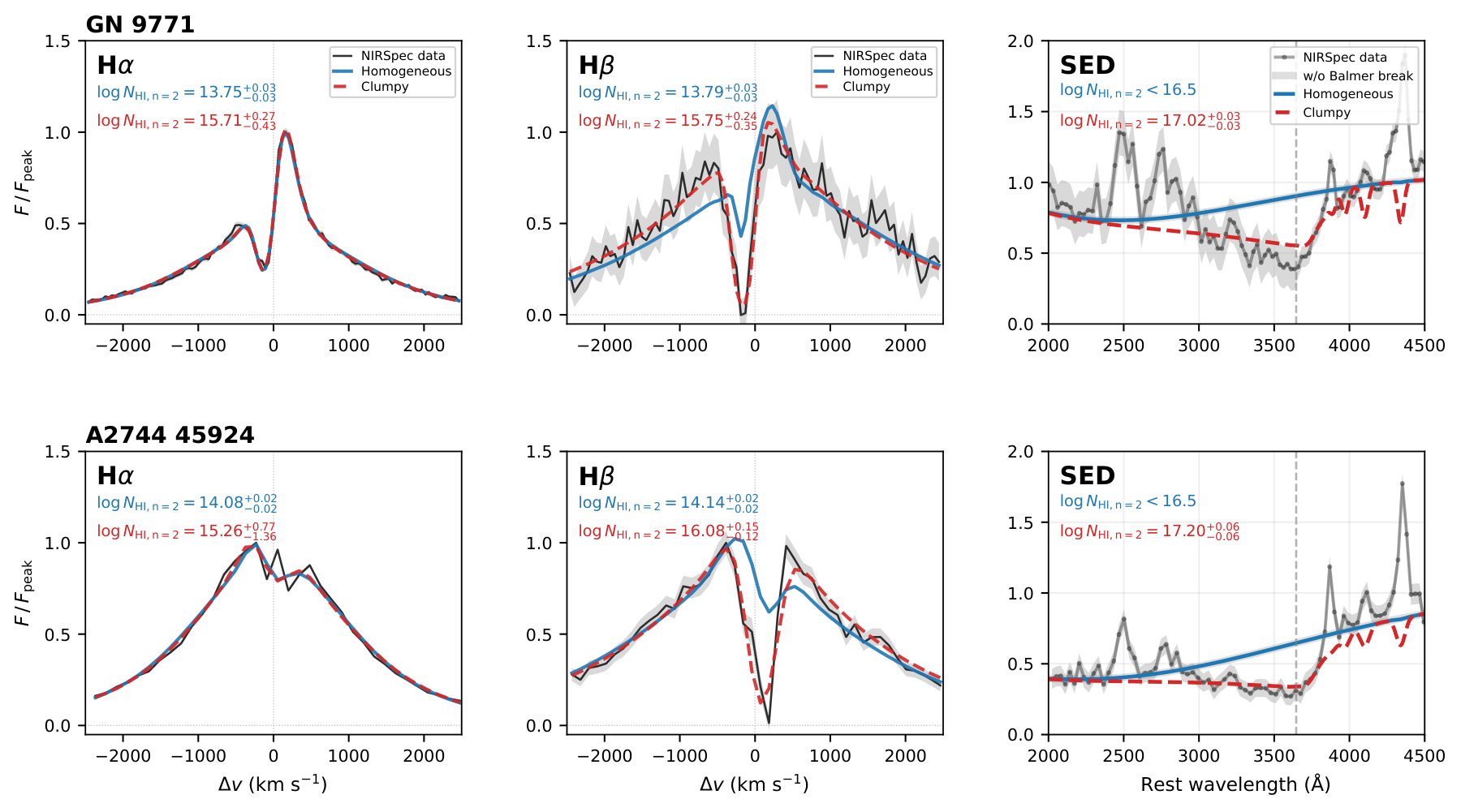
JWST/NIRSpec spectroscopy of 14 LRDs separates Balmer emission and absorption, favoring dense broad-line gas over dust as the main origin of elevated broad Balmer decrements. A clumpy, viewing-angle-dependent nuclear geometry is proposed, but velocity-profile fits succeed in only three of five high-S/N sources.

Figure 3 from OCEANS of Absorption: High-resolution NIRSpec Spectroscopy Reveals Diverse Balmer-line Absorption in Little Red Dots

2026-06-02 · 2606.00258v1 · Research note

OCEANS of Absorption: High-resolution NIRSpec Spectroscopy Reveals Diverse Balmer-line Absorption in Little Red Dots

Kelcey Davis, Madisyn Brooks, Raymond C. Simons, et al.

High-resolution JWST/NIRSpec spectra of 10 compact, color-selected LRDs at 3<z<7 recover Balmer absorption in four. The authors argue resolution exposes frequent, diverse excited-hydrogen absorption, but the small, selected sample limits population-level inferences.

Figure 2 from Transient Signatures of Star-Envelope Collisions in Little Red Dots

2026-05-29 · 2605.29895v1 · Research note

Transient Signatures of Star-Envelope Collisions in Little Red Dots

Tomoya Suzuguchi, Kohei Inayoshi

This modeling study predicts optical/UV transients when cluster stars strike proposed gaseous LRD envelopes. Red-supergiant impacts on envelopes near the SMBH mass are favored; rates could reach 0.3 yr⁻¹ per compact LRD, but detectability depends critically on low-redshift LRD abundance.

2026-05-20 · 2605.21589v1 · Research note

A Magnetized Black Hole Envelope Model for Little Red Dots

Shinsuke Takasao, Kohei Inayoshi

This theoretical magnetized black-hole-envelope model links cool LRD continua, broad-line shapes, and weak X-rays to super-Eddington spherical inflow onto a rotating envelope, but its quantitative success remains conditional on assumed envelope structure, opacity, magnetism, and line-scattering physics.

2026-05-20 · 2605.21574v1 · Research note

(LRDs)$^2$: The Low-ReDshift Little Red Dots Survey. II. DESI DR1 Sample

Xiaojing Lin, Xiaohui Fan, Zheng Cai, et al.

A DESI DR1 selection identifies 27 candidate low-redshift LRDs at z=0.2–0.9; near-IR spectra of 18 show broad, highly decremented Balmer lines and unusual continua, supporting—but not independently proving—continuity with high-redshift LRD phenomenology.

Figure 2 from A new sample of Little Red Dots at $z<0.45$ in DESI DR1: Broad Balmer lines, low ionization spectrum and no variability

2026-05-14 · 2605.14233v1 · Research note

A new sample of Little Red Dots at $z<0.45$ in DESI DR1: Broad Balmer lines, low ionization spectrum and no variability

Kevin Park, Alberto Torralba, Jorryt Matthee, et al.

A DESI DR1 line-selected search identifies eight compact z=0.20–0.44 LRD candidates with broad, steep-decrement Balmer emission, low-excitation spectra, and generally weak multi-year variability, extending detailed LRD tests to the nearby Universe.

Figure 2 from Non-LTE atmosphere models of very luminous sources and their applicability to Little Red Dots, quasi-stars, and similar objects

2026-05-12 · 2605.12141v1 · Research note

Non-LTE atmosphere models of very luminous sources and their applicability to Little Red Dots, quasi-stars, and similar objects

Fabrice Martins, Daniel Schaerer, Rui Marques-Chaves

Non-LTE, optically thick wind-atmosphere models at ∼10^10 L☉ can reproduce several LRD continuum and line properties after A_V≈1.9–2.7 attenuation, but cannot generally produce both strong emission lines and a genuine Balmer break.

Figure 6 from A Changing-Look Seyfert Discovered by eROSITA Reveals a Two-Component Broad-Line Region

2026-05-08 · 2605.07965v1 · Research note

A Changing-Look Seyfert Discovered by eROSITA Reveals a Two-Component Broad-Line Region

Alex Markowitz, Mirko Krumpe, David Homan, et al.

eROSITA-triggered monitoring of HE 1237-2252/J1240−2309 links a changing-look transition to intrinsic accretion-rate recovery and an evolving two-component Balmer-line profile. A diskline-like component strengthens with UV flux, while the proposed corona/illumination mechanism remains interpretive.

2026-05-06 · 2605.05301v1 · Research note

An X-ray and optical spectral study of the changing-look narrow-line Seyfert 1 2MASX J0413-0050

A. Vietri, A. Tortosa, D. Ilić, et al.

Across four optical and three X-ray epochs, J0413-0050 changed from broad Balmer emission in 2004 to an Hβ-free 2021 state and back to broad plus narrow Hβ in 2023. The authors favor changing accretion over obscuration, but X-ray column density is unconstrained.

2026-05-01 · 2605.00763v1 · Research note

Life After the Quasar: Overmassive Black Holes and Remnant Ionised Bubbles in and Around Two z~6.6 Galaxies

Romain A. Meyer, Pascal A. Oesch, Callum Witten, et al.

JWST/NIRSpec spectra of two z~6.6 ultra-luminous Lyα emitters reveal broad Balmer-line black-hole masses near 2×10^8 M⊙ and double-peaked Lyα, which the authors interpret as brief post-quasar phases inside relic ionised bubbles.

Figure 1 from The GlimmIr: Spectroscopic Variability in a z~7 LRD Indicates Rapid Changes in Both the Narrow and Broad Line Regions

2026-04-28 · 2604.25991v1 · Research note

The GlimmIr: Spectroscopic Variability in a z~7 LRD Indicates Rapid Changes in Both the Narrow and Broad Line Regions

Erini Lambrides, Taylor A. Hutchison, Rebecca L. Larson, et al.

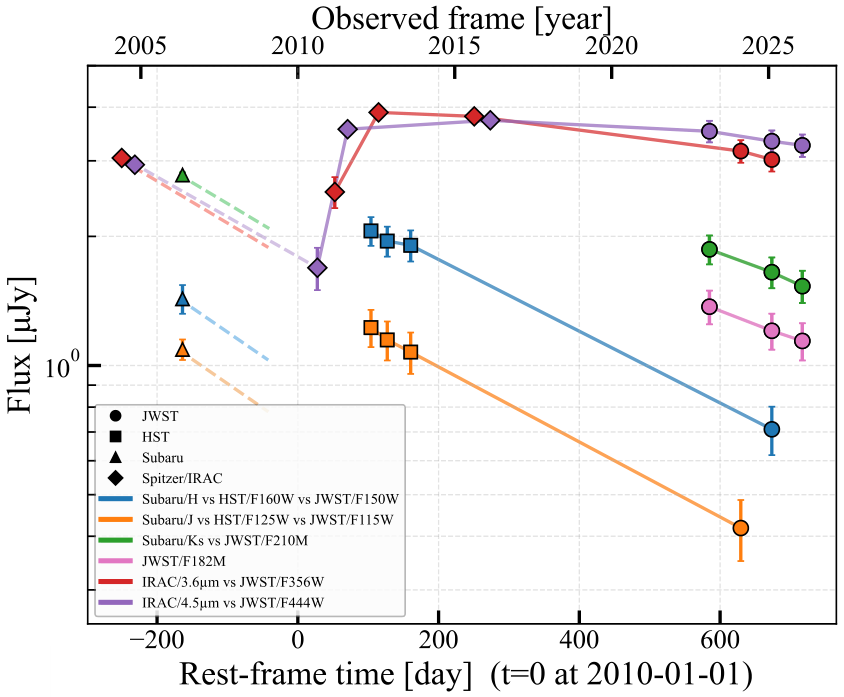
Multi-epoch JWST/NIRSpec spectra of one z~7 little red dot show coordinated continuum, broad-Balmer, and [O III] changes over ~13 rest-frame days. If intrinsic, the variability ties at least some narrow-line gas to the central engine and disfavors complete dense-gas coverage.

2026-04-16 · 2604.14551v1 · Research note

Discovery of low-redshift analogues to "Little Red Dots" in DESI: A later evolutionary stage of compact LRDs?

Weiyu Ding, Xu Kong, Wei-Jian Guo, et al.

Five DESI DR1 sources at z=0.2–0.4 reproduce LRD-like V-shaped SEDs and broad Balmer lines, but their AGN-like line ratios and substantially larger hosts make an evolutionary connection to z>4 LRDs plausible rather than established.

Figure 3 from How I Wonder What You Are -- JWST's Little Red Dots do not TWINKLE

2026-04-14 · 2604.13000v1 · Research note

How I Wonder What You Are -- JWST's Little Red Dots do not TWINKLE

Zhaoran Liu, Rohan P. Naidu, Amy Secunda, et al.

Across a complete Hα-flux-limited GOODS-N sample, 18 LRDs and nine other broad-Hα emitters show no detected continuum, line-flux, or line-shape variability over 139–220 rest-frame days, challenging their interpretation as ordinary broad-line AGN.

Figure 2 from Do little red dots really form a distinct class of astronomical objects?

2026-04-13 · 2604.11677v1 · Research note

Do little red dots really form a distinct class of astronomical objects?

Jean-Baptiste Billand, David Elbaz, Maximilien Franco, et al.

Across ∼48,000 photometric and ∼5,000 spectroscopic galaxies, the authors find LRD-like colour, compactness, and broad-Hα properties vary continuously, arguing that most LRDs are an extreme tail rather than a discrete class; only ∼3% show very strong Balmer breaks.

2026-04-04 · 2604.03563v1 · Research note

SPURS: Evidence for Clumpy Neutral Envelopes and Ionized IGM Surrounding Little Red Dots in Abell 2744 from Ultra-Deep Rest-UV Spectroscopy

Mengtao Tang, Daniel P. Stark, Charlotte A. Mason, et al.

Ultra-deep JWST/NIRSpec spectra of two Abell 2744 little red dots resolve a broad Lyα component in z=7.0364 Abell2744-QSO1. The authors argue its comparatively modest shift favors a clumpy, rather than uniform, neutral envelope and an ionized local environment.

Figure 3 from Constraints on the host galaxy and AGN properties of three z > 6 JWST AGN from NOEMA observations

2026-03-31 · 2603.29652v1 · Research note

Constraints on the host galaxy and AGN properties of three z > 6 JWST AGN from NOEMA observations

Giovanni Mazzolari, Hannah Übler, Rodrigo Herrera Camus, et al.

Deep NOEMA observations of three z>6 JWST AGN—two Little Red Dots and one blue Type-I source—yield no significant [C II] or dust-continuum detection, tightening host-galaxy and SED constraints while leaving the physical origin of their [C II] deficit unresolved.