654 indexed papers · 430 research notes

Research archive

Reset
Figure 1 from Spectroscopy-informed Deep Learning Searches for Photometric Little Red Dots in JWST Surveys

2026-11-05 · 2611.06026v1 · Research note

Spectroscopy-informed Deep Learning Searches for Photometric Little Red Dots in JWST Surveys

Chenxuan Zhang, Huanian Zhang, Qingwen Wu

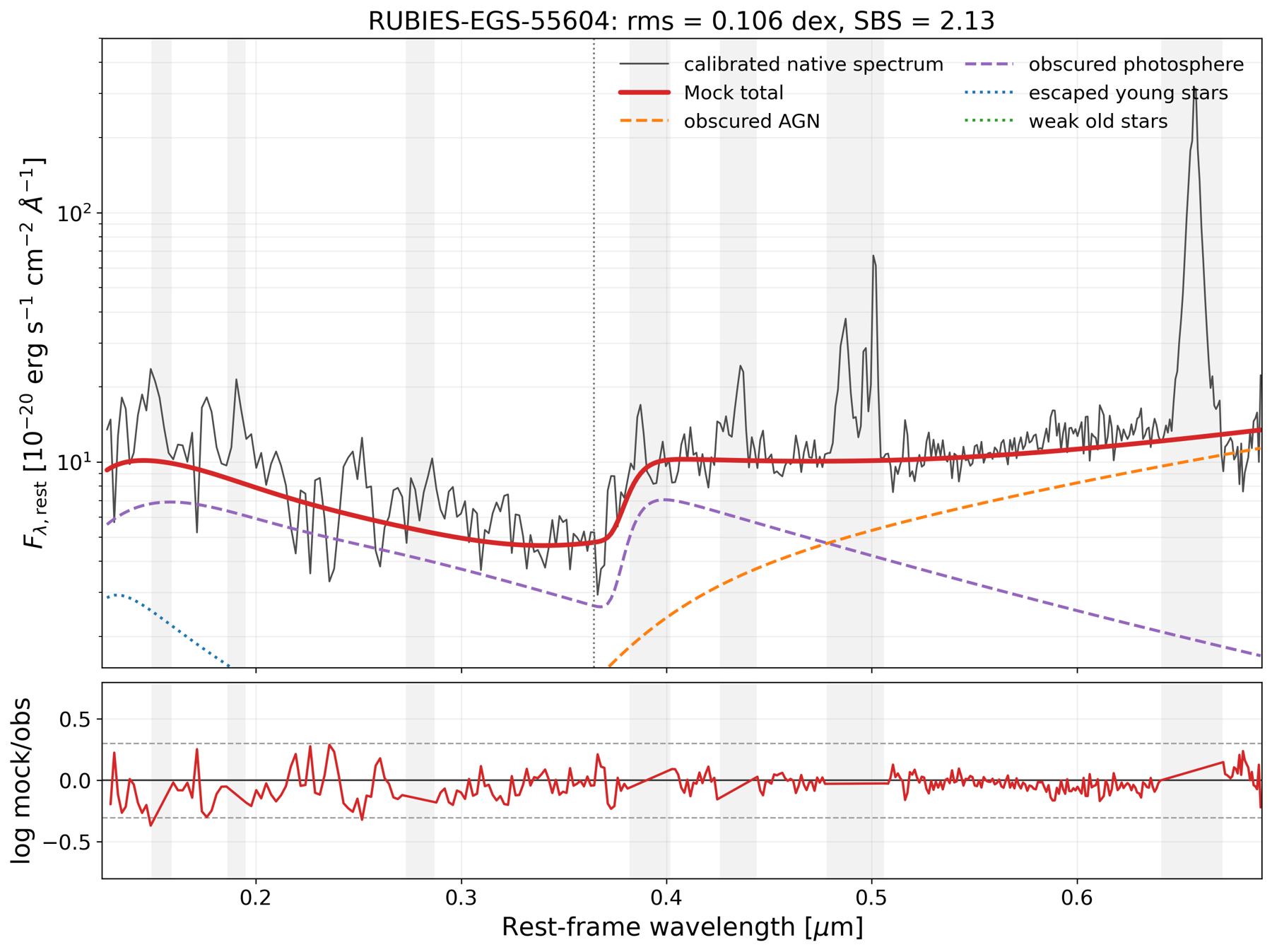
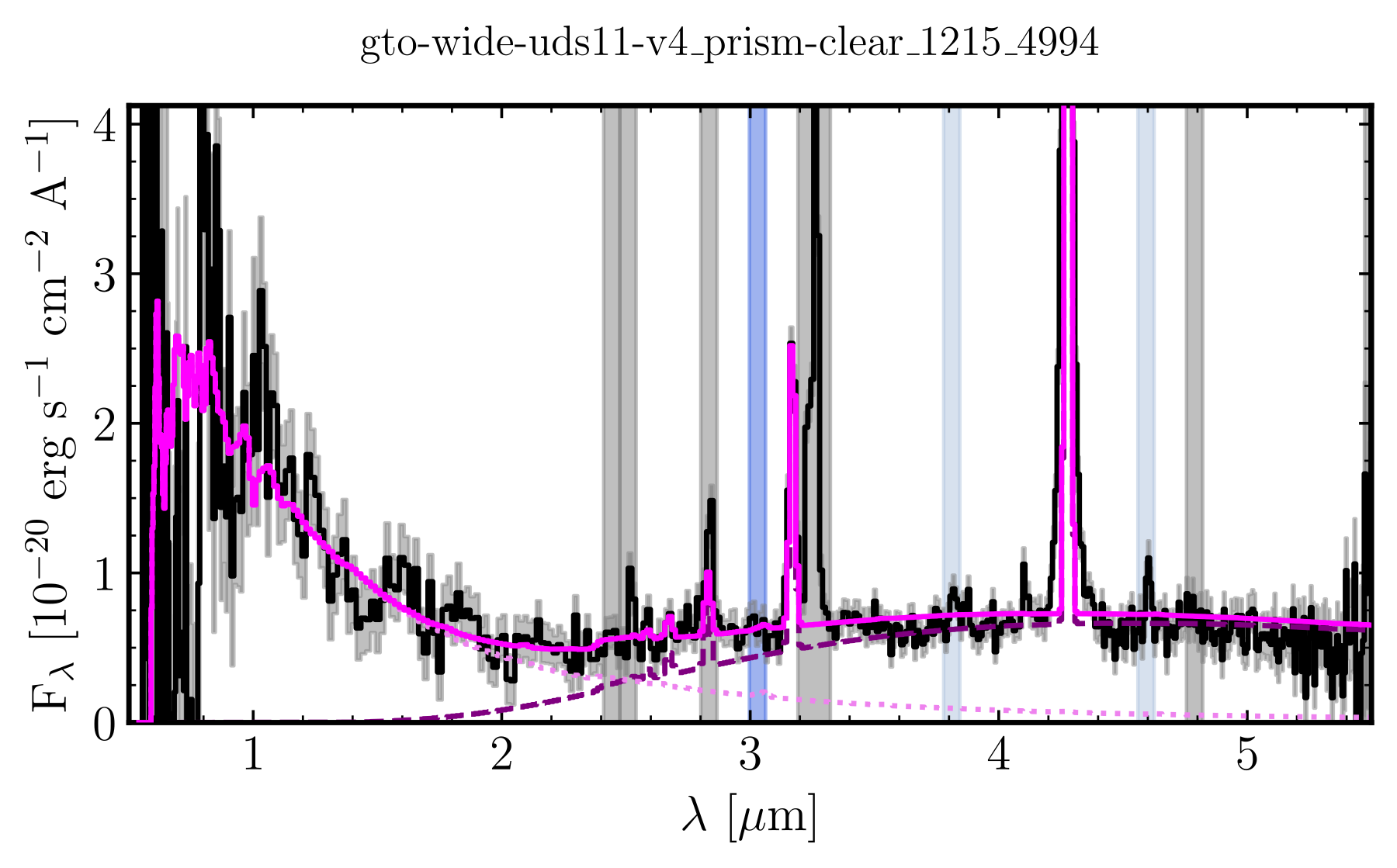
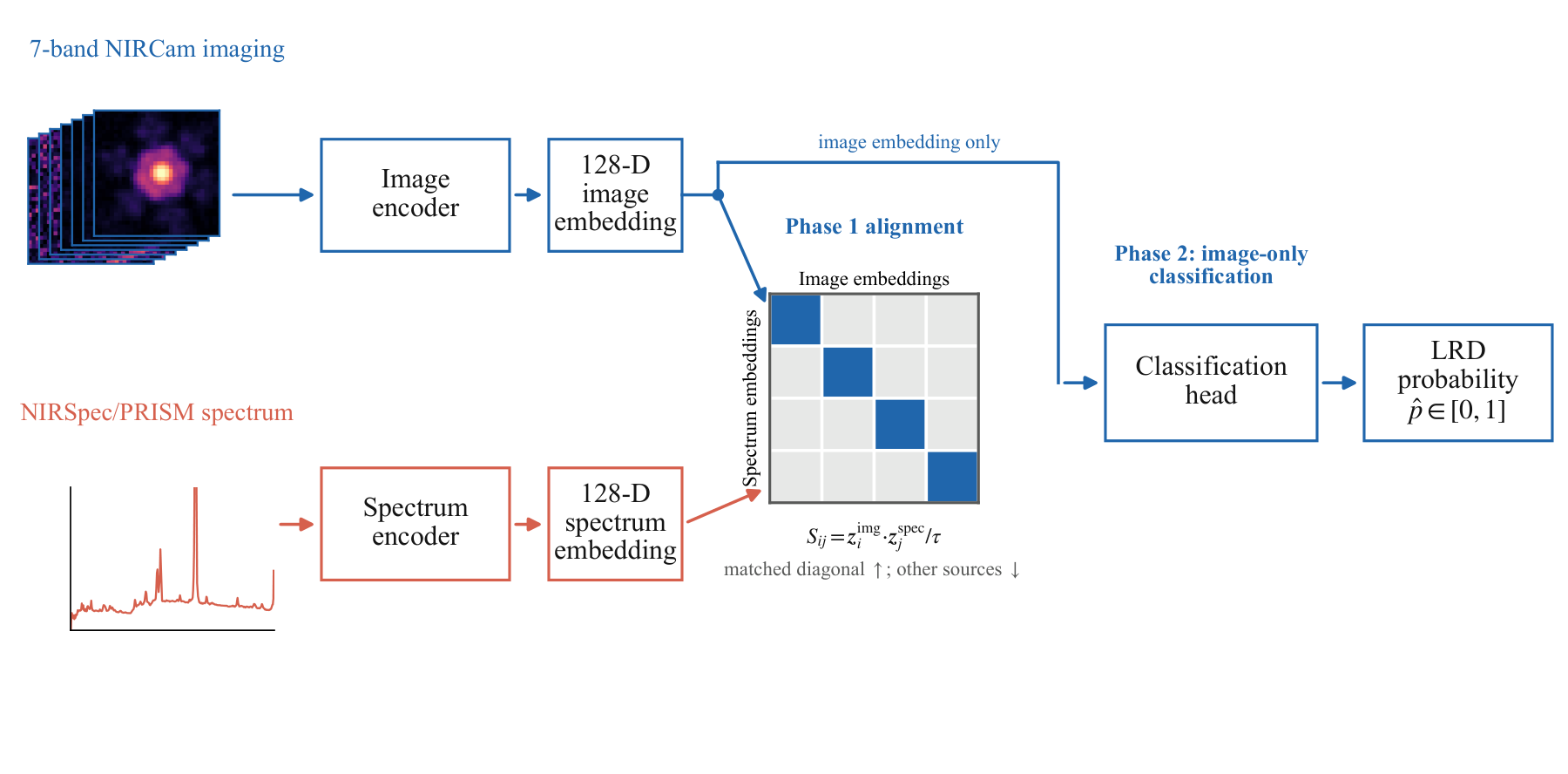
A two-stage, spectroscopy-informed NIRCam classifier finds LRD candidates beyond standard color selections. Held-out recall/precision are 0.92/0.79, while broad Hα in 10 of 13 grating-observed candidates supports—without confirming—the LRD interpretation of many new selections.

Figure 4 from EPOCHS-DR2 I: Expanded data release and properties of $6.5<z<16.5$ photometrically selected galaxies across NIRCam deep fields covering $\sim700\,\rm arcmin^2$ with the galfind software

2026-09-22 · 2609.24987v1 · Research note

EPOCHS-DR2 I: Expanded data release and properties of $6.5<z<16.5$ photometrically selected galaxies across NIRCam deep fields covering $\sim700\,\rm arcmin^2$ with the galfind software

Duncan Austin, Christopher J. Conselice, Thomas Harvey, et al.

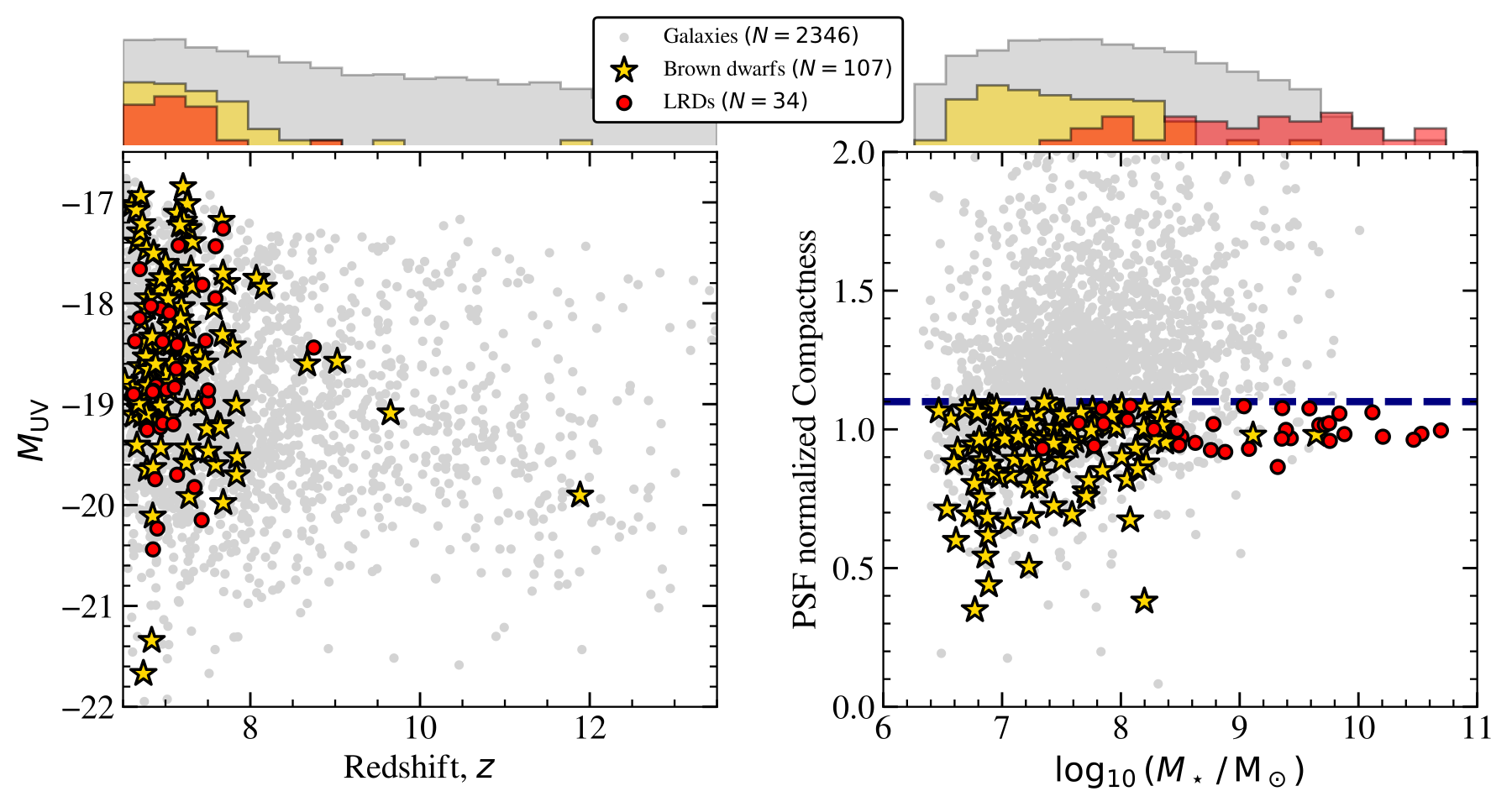
EPOCHS-DR2 releases a large JWST/NIRCam photometric census at 6.5<zphot<16.5, validated against NIRSpec but explicitly incomplete under its conservative selection. It identifies a small V-shaped-SED LRD subset and high-redshift candidates whose nature requires spectroscopy.

Figure 2 from Little Red Dots as a Transient Phase of Self-Interacting Dark Matter Assisted Black Hole Growth

2026-09-18 · 2609.20021v1 · Research note

Little Red Dots as a Transient Phase of Self-Interacting Dark Matter Assisted Black Hole Growth

Yu Rong, Shuang-Nan Zhang, Jian-Min Wang, et al.

This theory paper proposes that gas inflow compresses self-interacting dark matter (SIDM) around a pre-existing black hole while an optically thick nuclear disk obscures and reprocesses its emission. It reproduces two representative LRD continua, but does not establish SIDM observationally.

Figure 2 from Little Red Dots are Direct-Collapse Black Hole-Forming Galaxies

2026-09-14 · 2609.12049v1 · Research note

Little Red Dots are Direct-Collapse Black Hole-Forming Galaxies

Daniel J. Whalen, Muhammad A. Latif, Konstantinos Topalakis, et al.

Two-stage simulations and radiative-transfer spectral modeling suggest that LRDs could be direct-collapse black-hole hosts whose dense disks trap X-rays and generate Balmer absorption; fits spanning z=3.55–9.29 make this physically plausible, but not uniquely established.

Figure 4 from Extending the Little Red Dot population at intermediate redshift with VIPERS

2026-09-10 · 2609.10319v1 · Research note

Extending the Little Red Dot population at intermediate redshift with VIPERS

Krzysztof Lisiecki, Krzysztof Hryniewicz, Francesco Pistis, et al.

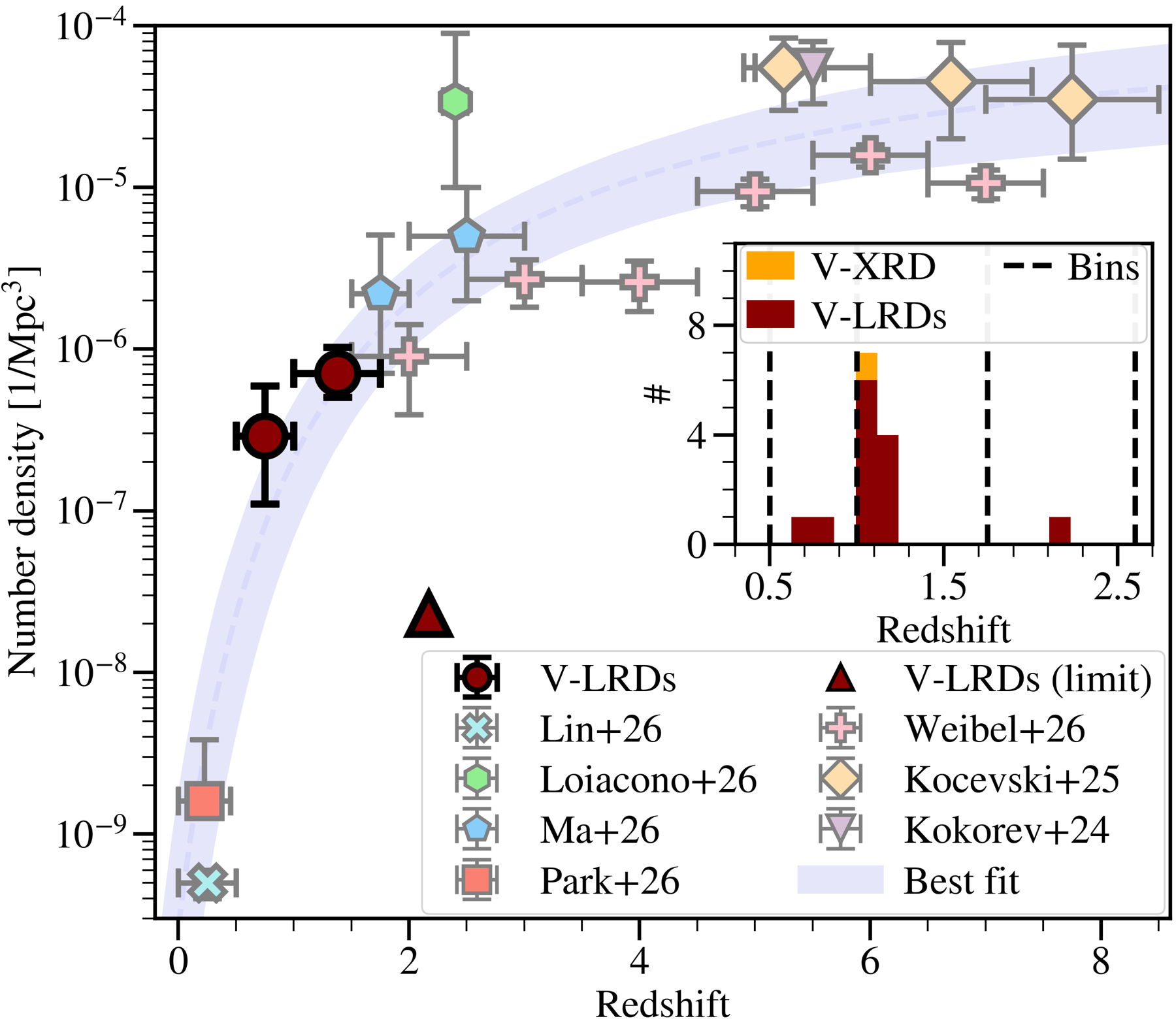
VIPERS yields 14 compact, LRD-like sources at 0.5<z<1.75 selected through V-shaped photometric slopes and broad lines. Their inferred abundance declines sharply below z~1, while one unresolved X-ray source is consistent with a low-inclination, radiatively efficient disk.

2026-09-02 · 2609.00437v1 · Research note

Formation of Heavy Seed Black Holes and Little Red Dots-like Compact Clusters in Metal-enriched Star-forming Regions

Sunmyon Chon, Shingo Hirano, Ke-Jung Chen, et al.

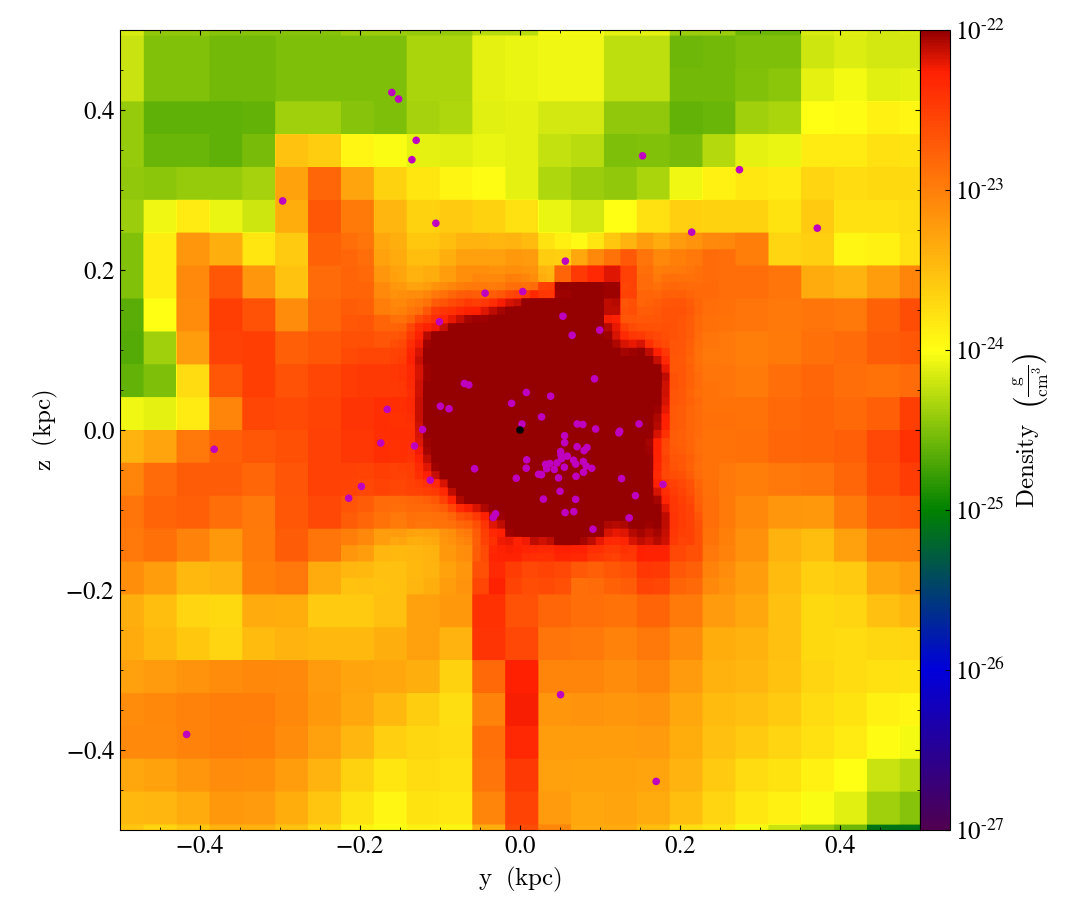
A radiation-hydrodynamic zoom-in simulation links locally intense LW fields, weakly enriched compact clusters, supermassive stars, and heavy seeds. Five of eight simulated >10^6 M⊙ clusters have intrinsic V-shaped, LRD-like continua, but the proposed observational connection remains model-dependent.

2026-08-07 · 2608.05267v1 · Research note

Where did all the Little Red Dots go? The abundance of LRD analogues among objects with broad lines at $z < 0.35$

Lasse Seyberlich, Sarah E. I. Bosman

In an SDSS broad-line sample at z<0.35, the authors identify nine SED-selected local LRD analogues and infer an abundance of 0.08%, supporting rarity at late times but with important spectral-coverage and contamination caveats.

Figure 2 from Spatial decomposition of Little Red Dots with JWST/NIRSpec IFU into broad-line red cores and narrow-line blue host galaxies

2026-07-13 · 2607.09647v1 · Research note

Spatial decomposition of Little Red Dots with JWST/NIRSpec IFU into broad-line red cores and narrow-line blue host galaxies

Yuzo Ishikawa, Anna-Christina Eilers, Rohan P. Naidu, et al.

Spatially resolved NIRSpec spectroscopy of five z≈5 broad-Hα Little Red Dots supports a two-component morphology: compact red continuum/broad-line cores and generally extended blue continuum/narrow-line regions, while imperfect separation and small-sample limitations preclude a unique physical origin.

Figure 1 from A Population of Little Red Dot-like Quasars in SDSS

2026-06-25 · 2606.26098v1 · Research note

A Population of Little Red Dot-like Quasars in SDSS

Quinn O. Casey, Ryan C. Hickox, Nikko J. Cleri, et al.

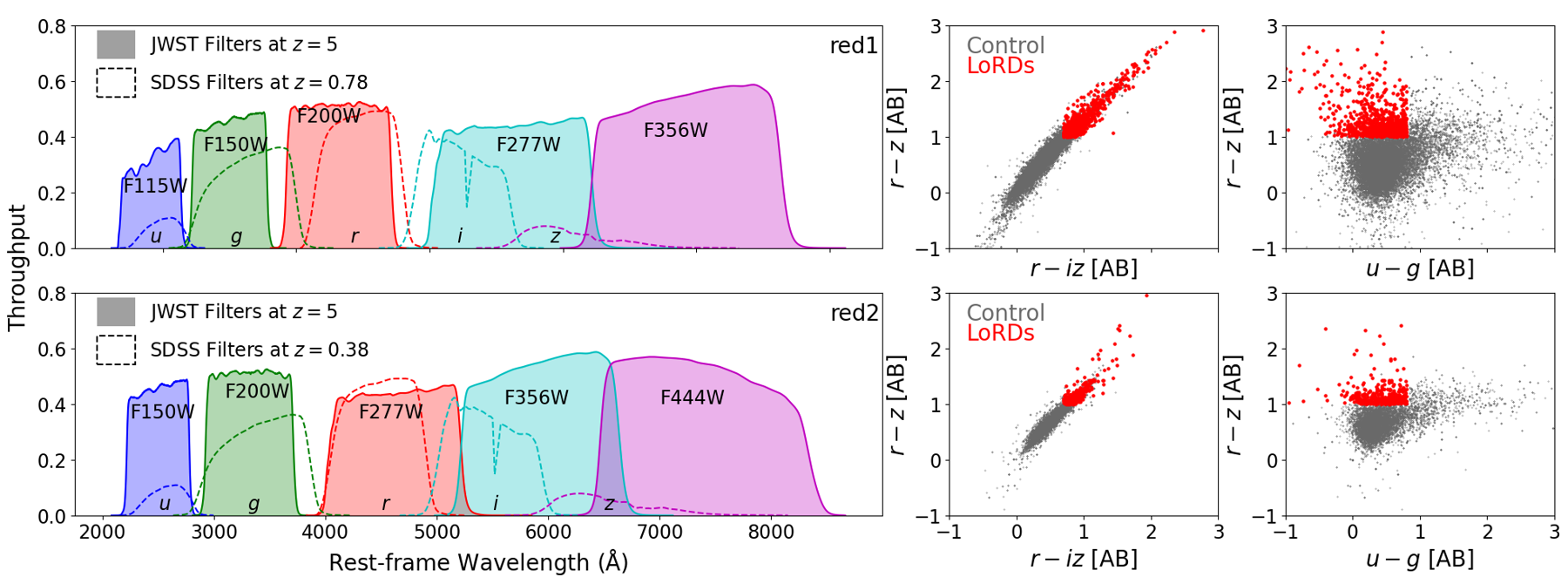
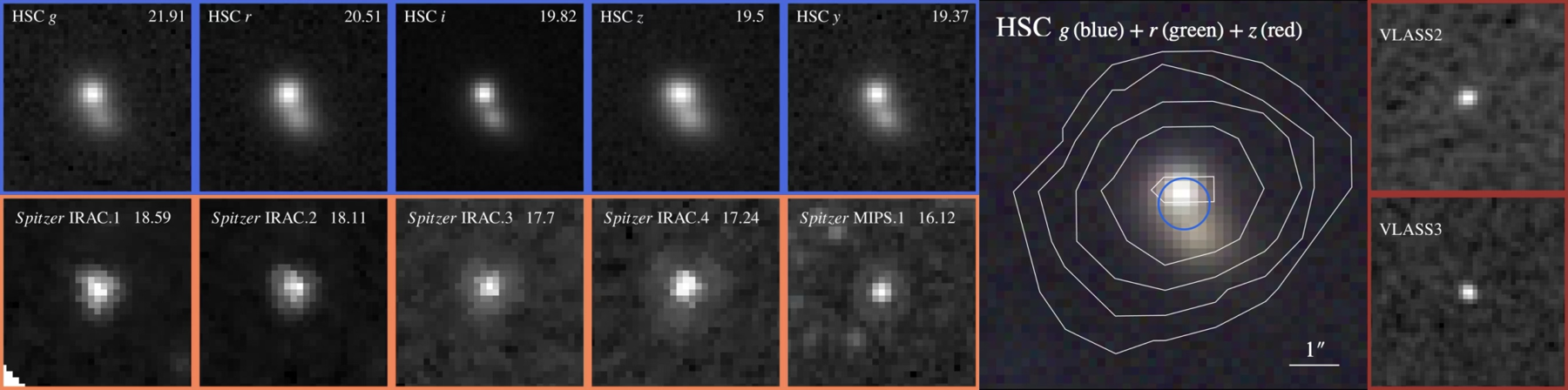
SDSS color selection identifies ~1,300 low-redshift “LoRD” quasars whose V-shaped subset resembles LRD spectral energy distributions, but host contamination, unresolved morphology, and weak high-z X-ray limits prevent establishing them as a uniformly faithful analog population.

2026-06-17 · 2606.17271v1 · Research note

Black Hole Stars Across the Universe: Identifying Central Engine Dominated Little Red Dots at $z\sim1.5-9.5$

Andrea Weibel, Rohan P. Naidu, Pascal A. Oesch, et al.

A BH*-template SED selection yields 241 compact, rest-optical central-engine-dominated candidates over z~1.7–9.3, extending beyond conventional V-shaped LRD criteria; inferred luminosities and Eddington-based masses remain model-dependent.

Figure 1 from Between Degeneracy and Evolution: UV-to-optical Insights into the BH$^*$ Model in Little Red Dots

2026-06-11 · 2606.12355v1 · Research note

Between Degeneracy and Evolution: UV-to-optical Insights into the BH$^*$ Model in Little Red Dots

Rosa M. Mérida, Marcin Sawicki, Chris J. Willott, et al.

UV-to-optical continuum fits to 66 JWST LRDs find BH* configurations in only about 6% of 52 robust broad-prior fits; suppressing AGN light raises this to about 40%, exposing severe model degeneracy rather than establishing BH* prevalence.

Figure 2 from The quasi-star model for Little Red Dots: potential and challenges

2026-06-08 · 2606.06575v1 · Research note

The quasi-star model for Little Red Dots: potential and challenges

Fabrizio Gentile, Mauro Giavalisco, Emanuele Daddi, et al.

Cloudy fits show that a host-plus-quasi-star model can reproduce several LRD continuum and hydrogen-line properties, but helium lines, hot dust, and model degeneracy prevent it from uniquely establishing quasi-stars as the explanation.

2026-06-03 · 2606.03522v1 · Research note

The UV Side of Little Red Dots: Red, Compact, and Iron-Enhanced Rest-UV Emission with a Strong Downturn around Ly$α$

Makoto Ando, Yuichi Harikane, Harley Katz, et al.

Across roughly 100 JWST-selected LRDs, rest-UV emission is redder and about four times more compact than matched star-forming galaxies. Stacked spectral trends and high Fe II/Mg II favor a substantial compact central component, although its physical origin remains model-dependent.

2026-05-28 · 2605.27903v1

Double Dots: Compact Pairs Mark Little Red Dots and High-Redshift Broad-line AGNs

A. J. Barger, L. L. Cowie

Using JWST imaging of the lensed A2744 field, this paper defines a sample of 31 sub-0.25 arcsecond compact pairs, or “Double Dots,” and shows their separations are strongly skewed to small values, consistent with most being physical systems rather than chance alignments. The main empirical result is that close pairs are extremely common among known broad-line high-redshift sources in the field: at least 16 of 24 published little red dots and both previously identified high-redshift BLAGNs are double systems, with a median observed separation of 0.15 arcseconds. The authors then show that unresolved companions can materially reshape the observed SED, including washing out the canonical LRD v-shape, and that 2D spectroscopy can place the broad-line emission on either the redder or bluer member of the pair. That makes compact pairing itself a powerful marker of broad-line activity at high redshift and points to merger-driven accretion as a plausible underlying trigger.

2026-05-20 · 2605.21574v1 · Research note

(LRDs)$^2$: The Low-ReDshift Little Red Dots Survey. II. DESI DR1 Sample

Xiaojing Lin, Xiaohui Fan, Zheng Cai, et al.

A DESI DR1 selection identifies 27 candidate low-redshift LRDs at z=0.2–0.9; near-IR spectra of 18 show broad, highly decremented Balmer lines and unusual continua, supporting—but not independently proving—continuity with high-redshift LRD phenomenology.

Figure 4 from Testing the BH$^*$ Model: a UV-to-Optical Spectral Fitting of The Cliff

2026-05-08 · 2605.07976v1 · Research note

Testing the BH$^*$ Model: a UV-to-Optical Spectral Fitting of The Cliff

Rosa M. Mérida, Marcin Sawicki, Gaia Gaspar, et al.

UV-to-optical fitting of one z=3.55 little red dot, The Cliff, admits a BH* envelope plus low-mass, dusty, metal-poor host. The result depends materially on Balmer-absorption and dust prescriptions, while AGN UV leakage remains unconstrained.

Figure 3 from How I Wonder What You Are -- JWST's Little Red Dots do not TWINKLE

2026-04-14 · 2604.13000v1 · Research note

How I Wonder What You Are -- JWST's Little Red Dots do not TWINKLE

Zhaoran Liu, Rohan P. Naidu, Amy Secunda, et al.

Across a complete Hα-flux-limited GOODS-N sample, 18 LRDs and nine other broad-Hα emitters show no detected continuum, line-flux, or line-shape variability over 139–220 rest-frame days, challenging their interpretation as ordinary broad-line AGN.

Figure 2 from Do little red dots really form a distinct class of astronomical objects?

2026-04-13 · 2604.11677v1 · Research note

Do little red dots really form a distinct class of astronomical objects?

Jean-Baptiste Billand, David Elbaz, Maximilien Franco, et al.

Across ∼48,000 photometric and ∼5,000 spectroscopic galaxies, the authors find LRD-like colour, compactness, and broad-Hα properties vary continuously, arguing that most LRDs are an extreme tail rather than a discrete class; only ∼3% show very strong Balmer breaks.

2026-03-18 · 2603.17967v1 · Research note

JWST Reveals Two Overmassive Black Hole Candidates in Dwarf Galaxies at z $\approx$ 0.7: Pushing Black Hole Searches into the Dwarf-Galaxy Regime

E. Iani, P. Rinaldi, A. Torralba, et al.

Two z≈0.7 compact dwarfs combine blue, burst-dominated UV–optical emission with a MIRI hot-dust excess. SED-inferred AGN luminosities imply candidate black holes disproportionately massive for ≈10^7 M⊙ hosts, but masses depend strongly on the assumed Eddington ratio.

2026-03-02 · 2603.01668v1 · Research note

A Unified Explanation for JWST Little Red Dots and High-Redshift Low-Mass Disk-like Galaxies: Prolate Galaxies Viewed End-on vs Side-on

Yingjie Peng

Peng proposes that many JWST little red dots are ordinary low-mass prolate galaxies viewed close to their long axes: projection and maximal columns could jointly produce compact red continua and broadened Balmer profiles, while side-on counterparts appear elongated.

2026-02-25 · 2602.22386v1 · Research note

Little Red Dots as Obscured Little Blue Dots: A Super-Eddington Unification Model

Piero Madau, Roberto Maiolino

This modeling study argues that Little Red Dots are high-inclination, dust-reddened counterparts of super-Eddington Little Blue Dots. Anisotropic continua and modest BLR/dust covering factors can reproduce several LRD ensemble observables, but the proposed orientation unification remains model-dependent.

2026-02-06 · 2602.06954v1 · Research note

Spectral Appearance of Self-gravitating AGN Disks Powered by Stellar Objects: Universal Effective Temperature in the Optical Continuum and Application to Little Red Dots

Yi-Xian Chen, Hanpu Liu, Ruancun Li, et al.

Chen et al. model LRD optical light as a dust-poor, self-gravitating AGN disk heated by embedded stellar objects. Their calculation yields an outer effective-temperature plateau near 4,000–4,500 K, while requiring strong inward mass depletion to avoid a variable inner-AGN UV/X-ray component.

2026-01-28 · 2601.20929v1 · Research note

Little Red Dot $-$ Host Galaxy $=$ Black Hole Star: A Gas-Enshrouded Heart at the Center of Every Little Red Dot

Wendy Q. Sun, Rohan P. Naidu, Jorryt Matthee, et al.

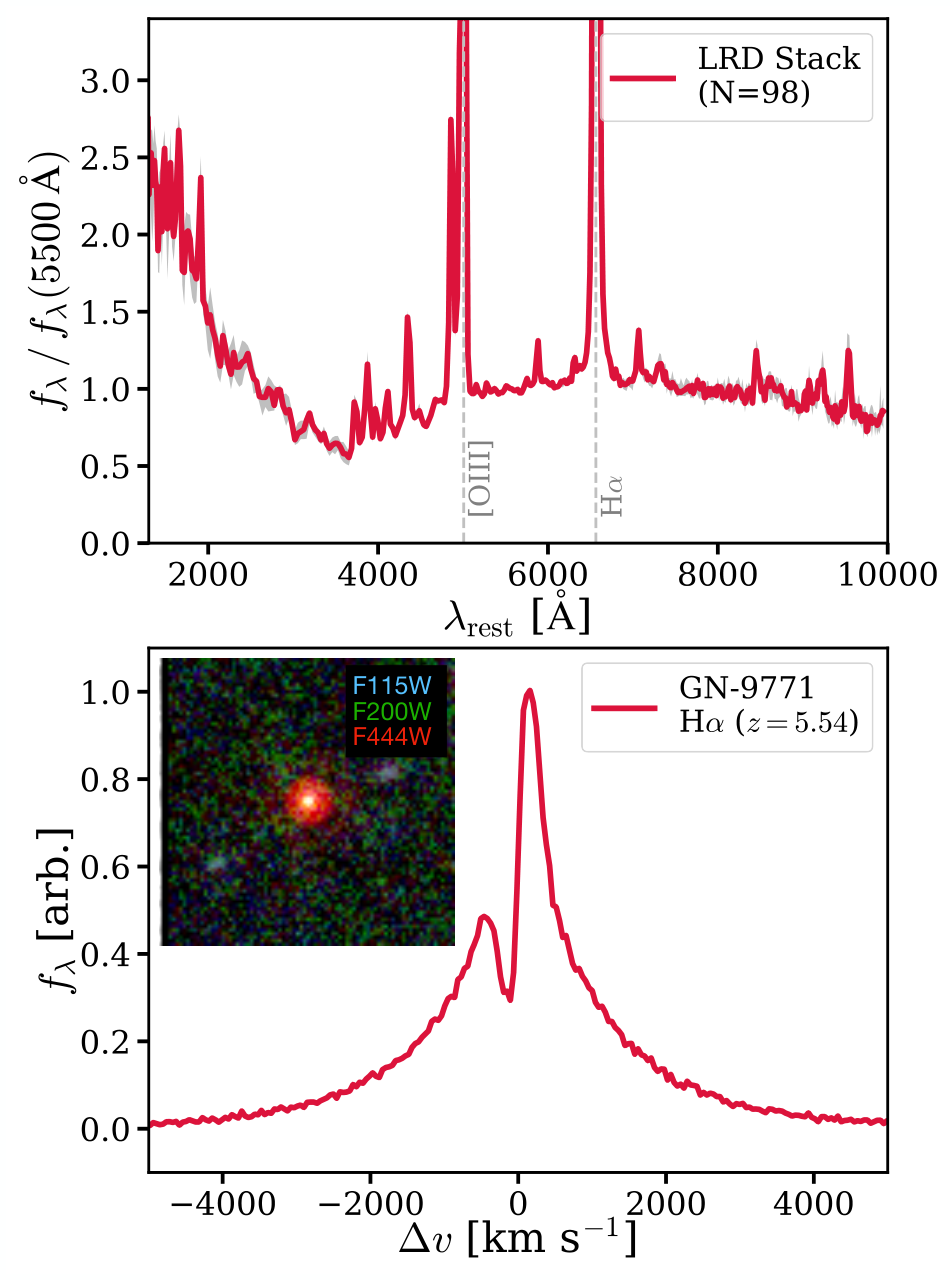
Using empirical [O III]-matched host subtraction for 98 JWST/NIRSpec LRDs, the authors infer a red, dense-envelope central component that dominates rest-optical light. The conclusion depends critically on assigning all [O III] to the host and on stack-based decomposition.

Figure 3 from The rest ultraviolet to infrared spectral energy distributions of heavily reddened quasars are "V-shaped" and hot-dust poor

2026-01-24 · 2601.17416v1 · Research note

The rest ultraviolet to infrared spectral energy distributions of heavily reddened quasars are "V-shaped" and hot-dust poor

Matthew Stepney, Manda Banerji, Shenli Tang, et al.

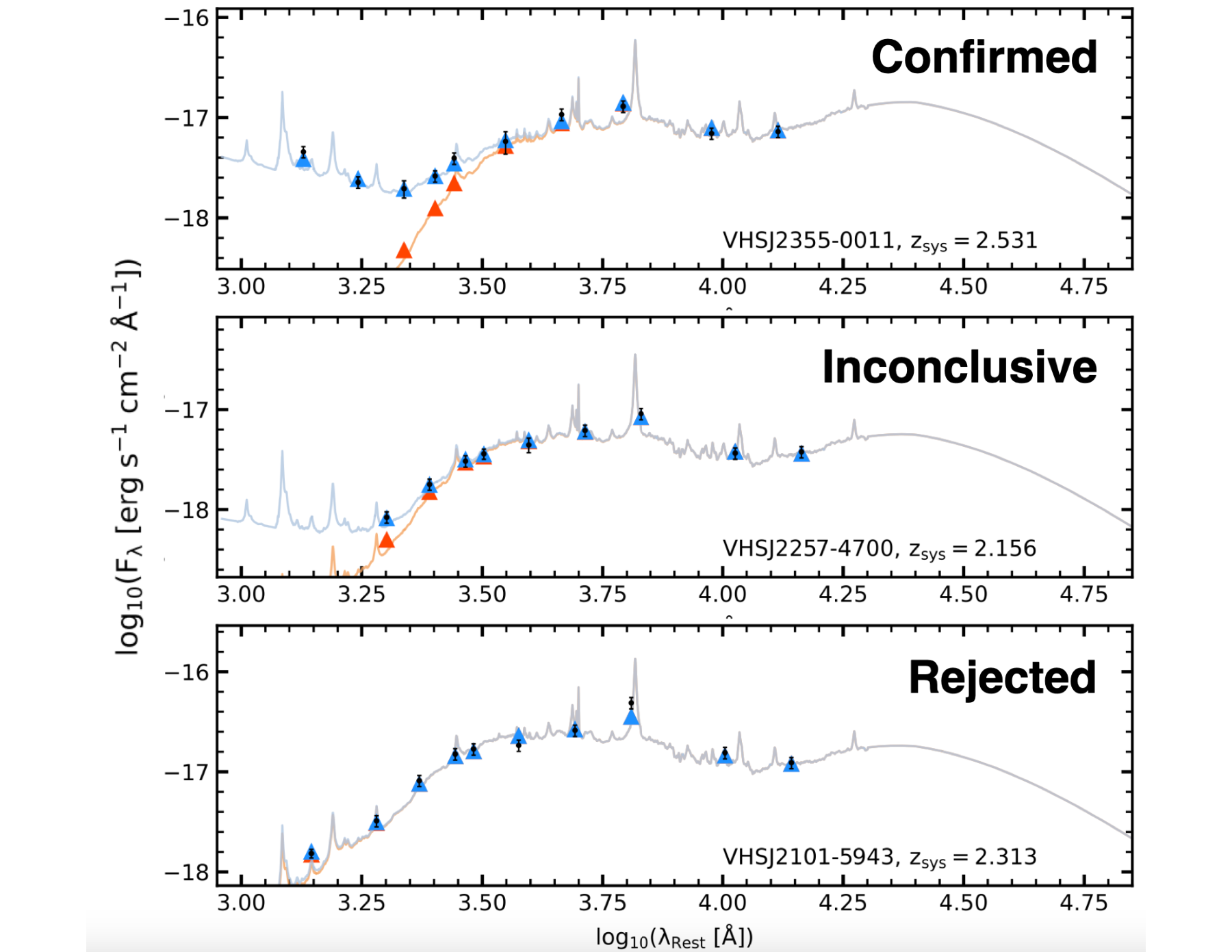
For 63 heavily reddened quasars at z=0.7–2.7, two-component UV–IR fits frequently yield V-shaped SEDs and comparatively weak hot dust. The authors identify four cosmic-noon objects meeting Little Red Dot continuum-slope selections, but do not uniquely establish the UV-emission mechanism.

2026-01-20 · 2601.14368v1 · Research note

The Little Red Dots Are Direct Collapse Black Holes

Fabio Pacucci, Andrea Ferrara, Dale D. Kocevski

A radiation-hydrodynamic direct-collapse black-hole model can fit one prototypical Little Red Dot spectrum with low residuals while producing Compton-thick obscuration. The result is a model-based explanation, not yet a population-level demonstration that all LRDs are DCBHs.

2026-01-15 · 2601.10573v1 · Research note

Origins of the UV continuum and Balmer emission lines in Little Red Dots: observational validation of dense gas envelope models enshrouding the AGN

Yoshihisa Asada, Kohei Inayoshi, Qinyue Fei, et al.

Across 28 z=5–7.2 LRDs, UV-to-Hα behavior resembles young starbursts rather than unobscured AGN, while nine blue broad-line controls resemble Type 1 AGN. The authors therefore favor opaque black-hole envelopes, but the correlations do not uniquely establish the ionizing mechanism.

Figure 1 from Little Red Dots: The Assembly of Early Supermassive Black Holes in the JWST Era

2025-12-31 · 2601.00089v1 · Research note

Little Red Dots: The Assembly of Early Supermassive Black Holes in the JWST Era

David D Vaida, Ryan Jeffrey Farber

This mini-review argues that little red dots are probably heterogeneous: broad Balmer lines and compact, V-shaped SEDs support accretion in some, whereas pervasive multiwavelength non-detections and viable stellar fits prevent a population-wide AGN identification.

Figure 1 from From "The Cliff" to "Virgil": Mapping the Spectral Diversity of Little Red Dots with JWST/NIRSpec

2025-12-17 · 2512.15853v1 · Research note

From "The Cliff" to "Virgil": Mapping the Spectral Diversity of Little Red Dots with JWST/NIRSpec

Guillermo Barro, Pablo G. Perez-Gonzalez, Dale Kocevski, et al.

JWST/NIRSpec spectroscopy of 118 little red dots reveals a continuum–line sequence: red, curved Balmer-break SEDs give way to bluer, power-law-like systems. A galaxy plus enshrouded-black-hole model can reproduce the trend, but its physical decomposition remains non-unique.

2025-12-03 · 2512.04208v1 · Research note

A Black-Hole Envelope Interpretation for Cosmological Demographics of Little Red Dots

Hiroya Umeda, Kohei Inayoshi, Yuichi Harikane, et al.

Fitting ∼400 COSMOS-Web little red dots with a black-hole-envelope SED model yields cool, 4000–6000 K photospheres and bolometric luminosities typically 1–2 dex below dusty-quasar estimates, reducing the inferred tension with established AGN demographic constraints.

2025-12-02 · 2512.03239v1 · Research note

(Re)solving the complex multi-scale morphology and V-shaped SED of a newly discovered strongly-lensed Little Red Dot in Abell 383

Josephine F. W. Baggen, Pieter van Dokkum, Ivo Labbé, et al.

JWST imaging of a z=6.027, doubly lensed Little Red Dot resolves red and blue compact components separated by about 300 pc. Their blended light can produce an LRD-like V-shaped SED, but the red component remains ambiguously stellar or AGN-powered.

Figure 1 from A Critical Evaluation of the Physical Nature of the Little Red Dots

2025-12-02 · 2512.03130v1 · Research note

A Critical Evaluation of the Physical Nature of the Little Red Dots

Kohei Inayoshi, Luis C. Ho

This review argues that LRD broad Balmer lines, red optical continua, Balmer absorption/breaks, and weak infrared/X-ray behavior favor embedded accreting black holes over a purely stellar origin, while leaving the gas geometry and evolutionary interpretation unresolved.

2025-12-01 · 2512.02117v1 · Research note

VENUS: When Red meets Blue -- A multiply imaged Little Red Dot with an apparent blue companion behind the galaxy cluster Abell 383

Miriam Golubchik, Lukas J. Furtak, Joseph F. V. Allingham, et al.

JWST resolves the lensed z=6.027 system A383-LRD1 into a compact red LRD candidate and a blue companion separated by ~380 pc. Lensing exposes a faint intrinsic LRD, but its AGN/BH* interpretation and association with the companion remain photometric inferences.

2025-12-01 · 2512.02096v1

Discovery of two little red dots transitioning into quasars

Shuqi Fu, Zijian Zhang, Danyang Jiang, et al.

Reports two COSMOS LRDs—Forge I (z=2.868) and Forge II (z=2.925)—whose V-shaped UV–optical SEDs, compact morphologies, and broad Paschen/He I lines meet LRD criteria. Unlike typical LRDs, they show strong X-ray, radio, and mid-IR emission, moderate X-ray obscuration, a 6.4 keV Fe K line in Forge II, and unusually large year-scale X-ray variability while UV broad lines remain weak/absent. The spectra reveal strong He I absorption in both and rare Pa absorption in Forge II, indicating dense, low-ionization gas with mixed inflow/outflow kinematics as the envelope thins. Authors argue these hybrids are LRDs in transition, with dispersing dense gas and an emerging dust torus, implying some LRDs evolve into normal AGN/quasars.

2025-12-01 · 2512.02093v1 · Research note

COSMOS-3D: Dense Circumnuclear Gas across Black Hole Growth Phases at z ~ 3

Zi-Jian Li, Siwei Zou, Jianwei Lyu, et al.

Two z~3 X-ray AGNs with He I λ10830 absorption indicate dense, broad-line-region-scale circumnuclear gas, but their contrasting obscuration, accretion rates, and outflow signatures provide only a two-object, model-dependent case for an evolutionary sequence.

2025-11-26 · 2511.21820v1 · Research note

Little Red Dots host Black Hole Stars: A unified family of gas-reddened AGN revealed by JWST/NIRSpec spectroscopy

Anna de Graaff, Raphael E. Hviding, Rohan P. Naidu, et al.

A 116-object JWST LRD sample shows narrowly peaked, thermal-like optical continua and coordinated line–continuum trends. The authors interpret these correlations as evidence for AGN embedded in dense gas envelopes, while assigning [O III] largely to faint star-forming hosts.

2025-11-12 · 2511.09278v1 · Research note

Little red dots as embryos of active galactic nuclei

Jian-Min Wang, Yi-Lin Wang, Yong-Jie Chen, et al.

This abstract-only paper proposes that little red dots are nascent AGN systems containing sub-million-solar-mass central black holes plus a more massive embedded stellar-mass-black-hole population, attributing their V-shaped SEDs and Balmer absorption to distinct, model-dependent components.

Figure 1 from A z ~ 0.4 Galaxy Reflecting the high-redshift Little Red Dots: An Extended Starburst with an Overmassive Black Hole

2025-10-03 · 2510.02801v1 · Research note

A z ~ 0.4 Galaxy Reflecting the high-redshift Little Red Dots: An Extended Starburst with an Overmassive Black Hole

Xiaoyang Chen, Kohei Ichikawa, Masayuki Akiyama, et al.

Gemini/GMOS IFU plus archival SED data identify J2048 at z=0.4330 as an LRD-like AGN with spatially extended young-starburst and ionized-outflow signatures; the authors infer a ~400 M⊙ yr⁻¹ SFR and an unusually high inferred black-hole-to-stellar-mass ratio.

2025-09-23 · 2509.19422v1

Spectral Uniformity of Little Red Dots: A Natural Outcome of Coevolving Seed Black Holes and Nascent Starbursts

Kohei Inayoshi, Kohta Murase, Kazumi Kashiyama

Proposes a two-component origin for LRD SEDs during assembly of Mh ≳ 1e10–11 Msun halos at z ≃ 4–10: a super-Eddington–fed seed BH (growing to ~1e6–1e7 Msun) inflates a dense envelope at Teff ≃ 5000 K that makes the red optical, while a coeval ~1e7 Msun nuclear starburst supplies the blue UV. This naturally yields the V-shaped UV–optical continuum and the weakness of X-ray/IR/radio signatures, with broad lines arising despite envelope scattering. A key prediction is a nearly constant Lopt/LUV ≃ 2–10 for ≃15 Myr (~one-third Salpeter) until SNe expel nuclear gas and quench the envelope. Population-wide, the ratio stays uniform at z ≃ 4–8 but declines toward lower z as red envelopes fail, linking LRD phases to later normal AGN states.

2025-09-03 · 2509.03571v1

Do Little Red Dots Vary?

Amy Secunda, Rachel S. Somerville, Yan-Fei Jiang, et al.

Simulated light curves for little red dots are generated under two variability prescriptions: an empirical sub‑Eddington DRW tuned to low‑z AGN and a radiation‑MHD–motivated super‑Eddington disk model. With today’s 2–4‑epoch JWST sampling, the DRW case would have produced far more rest‑UV/optical variability than is seen, while the super‑Eddington model naturally matches the near‑steady continua. The high‑cadence nexus imaging should yield Δm>1 mag if DRW holds, but only the lowest‑mass LRDs vary appreciably in the super‑Eddington scenario; meanwhile, twinkle spectroscopy is still expected to detect broad‑line variability if soft X‑rays can reach the BLR. Net result: super‑Eddington accretion neatly explains the missing continuum variability while allowing line changes.

2025-08-29 · 2508.21678v1

Investigating Little Red Dots with UV Excess: Are They the High-Redshift Siblings of Blue Hot DOGs?

Lulu Bao, Chao-Wei Tsai, Jingwen Wu, et al.

The authors stack NIRCam+MIRI photometry for 326 “V-shape” LRDs (from Akins24 and Kokorev24) and compare their UV–NIR SEDs to median-stacked Blue-excess Hot DOGs (BHDs) to test the analog hypothesis. Despite superficially similar “V-shapes,” LRDs turn over at shorter wavelengths, have much bluer rest-IR continua, show F1800W non-detections in stacks, and require far lower dust attenuation in SED fits—indicating little or no AGN-heated hot dust. They also argue the UV excess in LRDs is unlikely to be scattered AGN light, and note compact morphologies plus lower X-ray detection frequencies. Bottom line: LRDs are not simply high‑z siblings of BHDs, pointing to a distinct early SMBH growth pathway from the super‑Eddington, merger-driven Hot DOG phase.

2025-08-22 · 2508.16795v1

On the Variability Features of Active Galactic Nuclei in Little Red Dots

Shuying Zhou, Mouyuan Sun, Zijian Zhang, et al.

Applies the CHAR (corona-heated disk reprocessing) model to the Tee et al. (2025) 22-object LRD sample to interpret their multi-epoch photometry. Finds that the measured |Δm| is dominated by photometric uncertainties; within CHAR the non-detections are consistent with either AGN light fractions ≲30% or intrinsically luminous AGN whose fractional variability is small. Simulations specify what it would take to break this degeneracy: ≈200 LRDs, two epochs separated by ≥2 years (observed frame), and σ_phot ≤0.07 mag. If variability still fails to appear, it would point to accretion modes unlike those of low‑z quasars, offering independent constraints on what powers LRDs.

2025-08-19 · 2508.14155v1

Little Red Dots and their Progenitors from Direct Collapse Black Holes

Junehyoung Jeon, Boyuan Liu, Volker Bromm, et al.

Using the A-SLOTH semi-analytic framework, the authors generate a DCBH-seeded SMBH population and benchmark it against Little Red Dot (LRD) demographics and spectra. Heavy (DCBH) seeds reproduce the observed LRD BH mass functions, number densities, and host-halo trends better than stellar-remnant seeds. For the most extreme early LRDs (e.g., MoM-BH*-1), DCBH scenarios with either strong dust attenuation or dense, dust-free gas can match the distinctive V-shaped, Balmer-break–dominated SEDs, whereas even super-Eddington growth on light seeds cannot. The work points to gas metallicity as a crucial observable, beyond BH-to-stellar mass ratios, to pin down LRD progenitors.

2025-07-31 · 2508.00057v1

Discovery of a Little Red Dot candidate at $z\gtrsim10$ in COSMOS-Web based on MIRI-NIRCam selection

Takumi S. Tanaka, Hollis B. Akins, Yuichi Harikane, et al.

Using COSMOS-Web’s joint NIRCam–MIRI imaging, the authors conduct the first targeted search for little red dots beyond z≈10, leveraging F770W to isolate the V‑shaped SED signature and cull Balmer‑break contaminants. They uncover one robust source, CW-LRD-z10, with zphot=10.5(+0.7/−0.6), MUV=−19.9(+0.1/−0.2), compact morphology, a clear V‑shaped SED, and an F115W non‑detection consistent with an LRD at z∼10. From this single detection they infer a number density at MUV≈−20 of 1.2(+2.7/−1.0)×10⁻⁶ Mpc⁻³ mag⁻¹, implying the LRD fraction rises with redshift to ≈3% at z∼10. If confirmed, this points to LRDs as a common early population potentially tied to the first SMBH growth; deep spectroscopy is still required to secure the redshift and nature of CW-LRD-z10.

2025-07-31 · 2507.23774v1

Lord of LRDs: Insights into a "Little Red Dot" with a low-ionization spectrum at z = 0.1

Xihan Ji, Francesco D'Eugenio, Ignas Juodžbalis, et al.

A nearby LRD analog is uncovered: the broad-line AGN SDSS J102530.29+140207.3 at z=0.1 shows the hallmark V-shaped SED, broad Balmer emission (FWHM 1000–2000 km/s), and deep Balmer absorption. New GTC optical spectra reveal a G–K-giant-like continuum with a clear CH G-band and unusually deep low-ionization absorption, plus a series of [Fe II] emission lines; similar [Fe II] features are identified in a JWST-selected LRD at z=2.26. Multi-epoch data show small but significant Hα variability, and NuSTAR confirms extreme X-ray weakness consistent with Compton-thick obscuration (NH>10^24 cm^-2). Together these point to a dense, complex nuclear environment that reproduces LRD hallmarks locally and informs early black-hole growth, though the strength of the ionic/atomic/molecular absorptions remains challenging for standard stellar/AGN models.

2025-07-29 · 2507.22014v1

Little Red Dots as self-gravitating discs accreting on supermassive stars: Spectral appearance and formation pathway of the progenitors to direct collapse black holes

Lorenz Zwick, Christopher Tiede, Lucio Mayer

Models little red dots as supermassive stars fed by massive self‑gravitating discs assembled in gas‑rich major mergers, reproducing the V‑shaped SED as two blackbodies and attributing Balmer broadening to disc rotation—without invoking extra AGN, stellar, or dust components. MCMC fits to two representative LRDs (J0647‑1045 and COS‑756434) yield sub‑Eddington disc accretion and SMS masses of a few ×10^6 Msun with physically motivated parameters. The framework predicts a luminosity cut‑off of order few ×10^44 erg/s and ties the observed redshift distribution of LRDs to merger rates, matching current trends. Acknowledged caveat: reproducing the absolute abundance of LRDs remains challenging, though the fits are robust to observed diversity.

2025-07-23 · 2507.17738v1

Beyond the Dot: an LRD-like nucleus at the Heart of an IR-Bright Galaxy and its implications for high-redshift LRDs

Pierluigi Rinaldi, George H. Rieke, Zihao Wu, et al.

The authors present WISEA J123635.56+621424.2 (“the Saguaro”) at z=2.0145 in GOODS‑North as an LRD analog: a compact, LRD‑like nucleus with a face‑on spiral host and a clear V‑shaped nuclear SED from NIRSpec. Redshifting the system to z≈7 renders the host undetectable via surface‑brightness dimming, reproducing a canonical LRD appearance and implying many high‑z LRDs could be visible galactic nuclei embedded in extended hosts. A stack of rest‑UV images for 99 photometrically selected LRDs reveals faint diffuse emission and mild radial growth with redshift, consistent with galaxy size evolution. A simple analytic model shows surface‑brightness dimming alone can explain the compact morphology, arguing LRDs are a short‑lived, AGN‑dominated phase rather than a distinct population.

2025-07-16 · 2507.12618v1

Supermassive Stars Match the Spectral Signatures of JWST's Little Red Dots

Devesh Nandal, Abraham Loeb

First-principles synthetic spectra for non-rotating, metal-free supermassive stars (up to 10^6 M⊙) are used to test whether LRDs are direct photospheres of SMSs. The model’s luminosity at 4050 Å (Lλ ≈ 1.7×10^44 erg s^-1 μm^-1) and NLTE physics reproduce hallmark LRD traits—a V-shaped Balmer break and strong Hβ emission with other Balmer lines in absorption—with wind/macroturbulent broadening matching observed profiles. Quantitative fits to sources at z=7.76 and z=3.55 include an Hβ width match for MoM‑BH*-1 to within 4%, offering a self-consistent alternative to multi-component obscured AGN. A luminosity-dependent visibility window of ~10^4 yr for the brightest systems and 10^5–10^6 yr for objects 1–2 dex fainter implies LRDs may capture brief, pre-collapse stages of SMBH progenitors.

2025-07-14 · 2507.10659v1

The Discovery of Little Red Dots in the Local Universe: Signatures of Cool Gas Envelopes

Xiaojing Lin, Xiaohui Fan, Zheng Cai, et al.

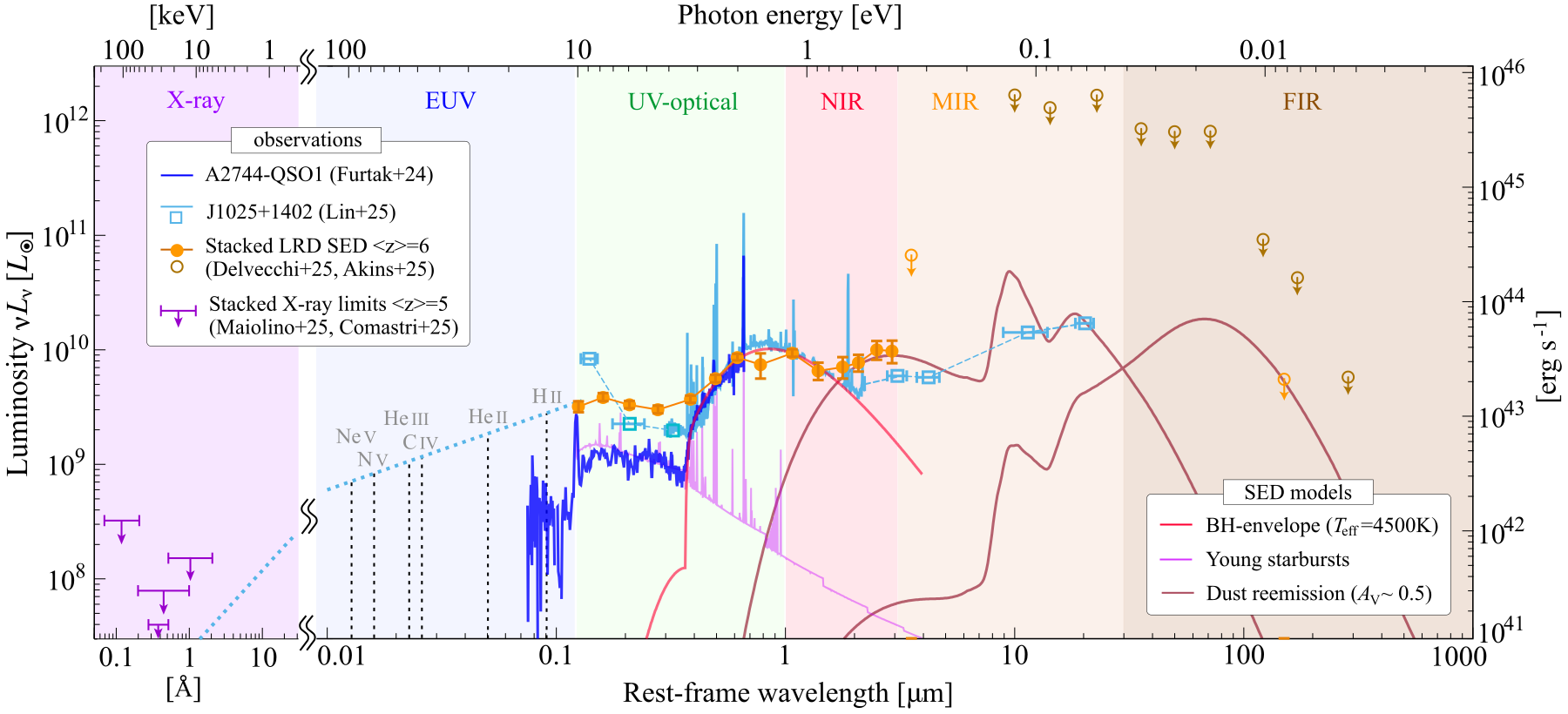
Reports three SDSS-selected local little red dots at z=0.1–0.2 with LBT/MODS and Magellan/FIRE follow-up, showing the same hallmarks as high‑z LRDs: compact morphologies, V‑shaped UV–optical SEDs with declining NIR continua, broad H/He lines, full Balmer+Paschen series, and minimal variability. All display blue‑shifted He I absorption; two show Hα and Na D absorption, and two have abundant narrow [Fe II]; J1025+1402 (The Egg) further exhibits extreme Na D, K I, and Ca II triplet absorption consistent with a cool (~5000 K), metal‑enriched envelope. Line diagnostics point to AGN‑powered, metal‑poor narrow lines with little dust, very high‑density inner regions for the broad lines (or unusual dust), and [Fe II] from dense gas between them; two targets are X‑ray non‑detections and WISE photometry implies only weak dust (T ~10^2–10^3 K). The authors propose a largely thermalized cool‑gas envelope plus an extended, high‑density outflow to unify these features, positioning local LRDs as resolvable analogs of early BH growth.
2025-07-05 · 2507.04011v1

Investigating the Growth of Little Red Dot Descendants at z<4 with the JWST

Jean-Baptiste Billand, David Elbaz, Fabrizio Gentile, et al.

Using CEERS imaging, the authors select z<4 “post-LRD” candidates by requiring a compact, very red core plus a blue star-forming envelope, then model inner/outskirts with stellar-only SED fits and single-Sérsic morphologies. The sample shows LRD-like cores with M* ~1e10 Msun, Σ* ~1e11 Msun kpc^-2, and compact sizes about 1 kpc below the size–mass relation, while adding an extended young component; their number density at z=3±0.5 (~10^-4.15 Mpc^-3) matches that of LRDs at 5<z<7, indicating an evolutionary link. Outskirts mass fraction and size increase toward lower redshift (≈250 pc at z=5 to ≈600 pc at z=3), as the core stays red/compact and the hallmark V-shaped SED fades, consistent with growth by cold accretion. This offers an explanation for the apparent decline of LRD counts at lower z, with the caveat that it assumes a single evolutionary path and stellar-only modeling.

2025-06-05 · 2506.05459v1

RUBIES: A Spectroscopic Census of Little Red Dots; All V-Shaped Point Sources Have Broad Lines

Raphael E. Hviding, Anna de Graaff, Tim B. Miller, et al.

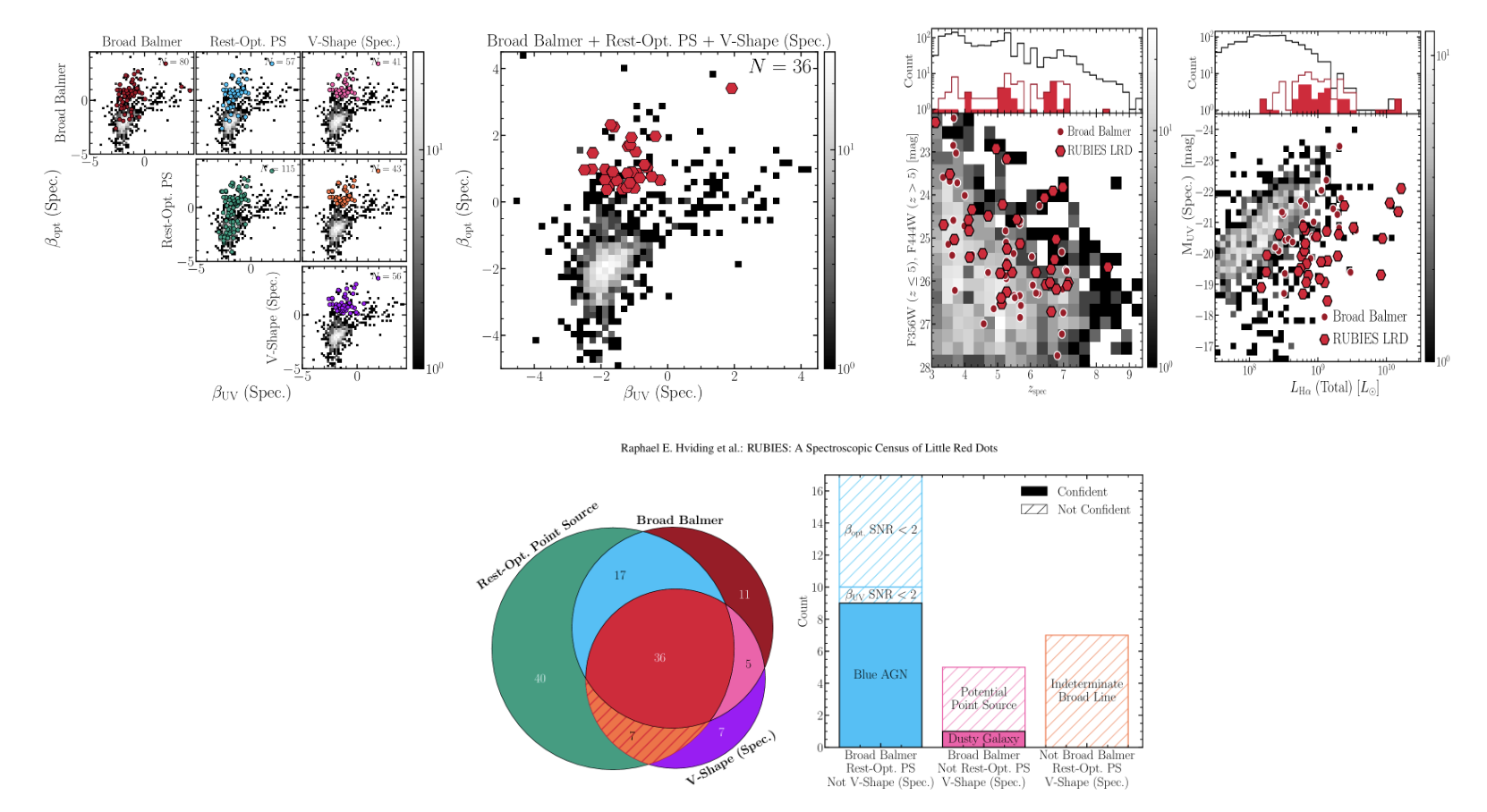
RUBIES delivers uniform NIRSpec PRISM+G395M spectroscopy for ~1500 z>3.1 sources, identifying 80 broad-Balmer emitters, including 28 (35%) at z>6. A coherent subpopulation of 36 shows v-shaped UV–to–optical continua with dominant rest‑optical point sources; these are defined as spectroscopic LRDs, the largest such sample to date. The key result is that every v‑shaped point source exhibits broad Balmer lines, tying continuum shape, compact morphology, and AGN kinematics together. Photometric LRD searches recover only 50–62% of these to F444W<26.5, implying current color cuts miss many due to faint rest‑UV, comparatively bluer rest‑optical colors, or uncertain photo‑z.

2025-06-04 · 2506.04350v1

JWST Insights into Narrow-line Little Red Dots

Zijian Zhang, Linhua Jiang, Weiyang Liu, et al.

Using NIRSpec medium/high-resolution data and line-free photometry, the authors isolate five narrow-line LRDs at z≈5 (H-alpha FWHM ≈250 km/s; one ≈475 km/s) from 32 LRDs with H-alpha coverage, and show that about 20% of color-selected LRD candidates fake a V-shape continuum via strong lines. Relative to normal star-forming galaxies, these objects have higher H-alpha widths and luminosities but smaller equivalent widths. SED fits allow either dusty, compact, high-M* and high-SFR galaxies or low-mass AGN with MBH≈10^5–10^6 Msun, plausibly in an early, super-Eddington phase; the BHs are slightly overmassive vs MBH–M* yet consistent/undermassive vs MBH–sigma and MBH–Mdyn within large errors. Nearly half of high‑z broad-line AGN show V‑shape SEDs, underscoring that LRD-like photometry does not uniquely imply broad-line activity.

2025-05-19 · 2505.12719v1

Composite spectrum of Little Red Dot from a standard inner disk and an unstable outer disk

Chenxuan Zhang, Qingwen Wu, Xiao Fan, et al.

Builds SEDs for 29 broad-line LRDs and finds uniformly V-shaped continua with a narrow break around ν_b ≃ 10^{14.96±0.06} Hz (λ ≈ 2600–3800 Å). Models the SEDs as a composite of an inner standard thin disk plus an outer gravitationally unstable disk (Q≈1) that self-regulates to T≈2000–4000 K, naturally producing the near-IR/optical bump without invoking extreme dust. MCMC fits anchored by MBH from broad lines reproduce individual SEDs, including UNCOVER 25119 and PRIMER 33823 (whose MIRI 4.9–27.9 μm points trace the bump). Allowing for dense gas to explain strong Balmer breaks suppresses intrinsic optical–UV by only ≲2–3×, implying most LRDs are sub-Eddington and intrinsically weak.