654 indexed papers · 430 research notes

Research archive

Reset

2026-08-12 · 2608.10070v1 · Research note

A cosmic collision in the making: JWST/NIRISS reveals a merging and maturing protocluster core at z~3 around a red quasar

C. Bertemes, D. Wylezalek, G. Noirot, et al.

JWST/NIRISS spectroscopy identifies an exceptionally dense z≈3 protocluster around quasar J1652, with 18 robust members, two quiescent galaxies, and position–velocity substructure consistent with—though not proving—a merger of two haloes.

Figure 1 from JWST observations and a model for the extremely luminous obscured quasar W2246-0526 at z=4.6

2026-05-09 · 2605.09078v1 · Research note

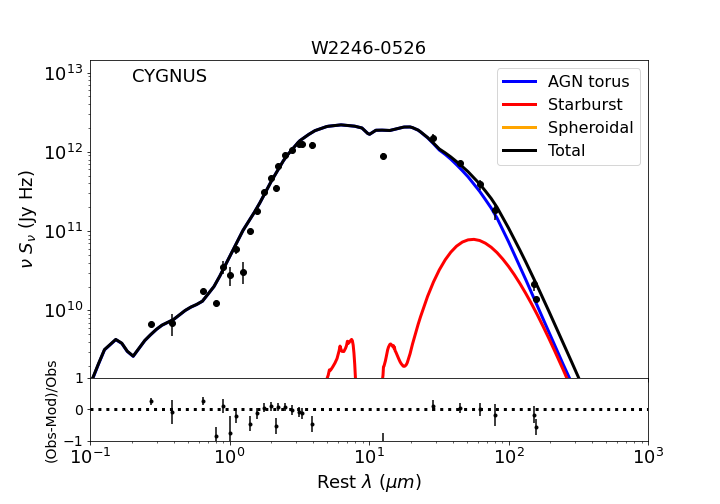
JWST observations and a model for the extremely luminous obscured quasar W2246-0526 at z=4.6

Charalambia Varnava, Andreas Efstathiou, Tanio Díaz-Santos, et al.

JWST/MIRI-MRS-informed SED fits to the single z=4.601 Hot DOG W2246-0526 favor an added hot-dust component interpreted as polar dust. This changes inferred AGN luminosity, but its geometry and physical association with an outflow remain model-dependent.

2026-02-04 · 2602.04974v1 · Research note

Clustering of z~6.6 Quasars and [O III] Emitters Constrains Host Halo Masses and Duty Cycles in 25 ASPIRE Fields

Jiamu Huang, Joseph Hennawi, Elia Pizzati, et al.

JWST/ASPIRE clustering across 25 z≈6.6 quasar fields associates UV-bright quasars with substantially more massive minimum host halos than [O III] emitters, but the inferred ≈Myr quasar lifetime has a highly asymmetric, large uncertainty.

Figure 4 from The accretion of quasars at the epoch of reionisation: $JWST$ catches the primeval monsters slowly feasting

2025-12-18 · 2512.16981v1 · Research note

The accretion of quasars at the epoch of reionisation: $JWST$ catches the primeval monsters slowly feasting

B. Trefoloni, E. Nardini, S. Carniani, et al.

JWST/NIRSpec disc fits for eight luminous z≥5.9 quasars yield a sub-Eddington distribution, ⟨log λEdd⟩=−0.86. The authors argue that self-consistent disc luminosities and masses reduce apparent super-Eddington incidence relative to conventional single-epoch estimates.

Figure 1 from Shedding the envelope: JWST reveals a kiloparsec-scale [OIII]-weak Balmer shell around a z=7.64 quasar

2025-12-17 · 2512.15881v1 · Research note

Shedding the envelope: JWST reveals a kiloparsec-scale [OIII]-weak Balmer shell around a z=7.64 quasar

Julien Wolf, Eduardo Bañados, Xiaohui Fan, et al.

JWST/NIRSpec IFU data reveal Hβ emission to ~1.8 kpc around the z=7.64 quasar J0313−1806 but no significant [O III]. The authors favor dense, clumpy fossil-outflow gas, while the single-object data leave its geometry and evolutionary interpretation uncertain.

Figure 2 from A JWST/NIRSpec Integral Field Unit Survey of Luminous Quasars at z ~ 5-6 (Q-IFU): Rest-frame Optical Nuclear Properties and Extended Nebulae

2025-11-08 · 2511.06085v1 · Research note

A JWST/NIRSpec Integral Field Unit Survey of Luminous Quasars at z ~ 5-6 (Q-IFU): Rest-frame Optical Nuclear Properties and Extended Nebulae

Weizhe Liu, Xiaohui Fan, Huan Li, et al.

JWST/NIRSpec IFU observations of 27 luminous z≈5–6 quasars find ≈10^9 M⊙ actively accreting black holes and extended [O III] in six systems; nuclear optical properties broadly resemble lower-redshift quasars, while shallow data limit environmental inferences.

2025-11-04 · 2511.02902v1 · Research note

A close look at the black hole masses and hot dusty toruses of the first quasars with MIRI-MRS

Sarah E. I. Bosman, Javier Álvarez-Márquez, Frederick B. Davies, et al.

JWST/MIRI-MRS spectroscopy of four luminous type-1 quasars at z=7.08–7.64 yields mutually consistent broad-line black-hole masses of (4–15)×10^8 M⊙ and directly detects hot-torus emission, without resolving the early-SMBH growth tension.

2025-10-10 · 2510.09753v1 · Research note

BEES: Quasar lifetime measurements from extended rest-optical emission line nebulae at $z\sim6$

Dominika Ďurovčíková, Anna-Christina Eilers, Yuzo Ishikawa, et al.

JWST/NIRSpec IFU observations of five z~6 small-proximity-zone quasars find extended Hα and [O III] around four, using nebular light-travel scales to support very short UV-luminous episodes (tQ≲10^5 yr) independently of resonant Lyα interpretation.

2025-10-09 · 2510.08455v1 · Research note

A first look at quasar-galaxy clustering at $z\simeq7.3$

Jan-Torge Schindler, Joseph F. Hennawi, Frederick B. Davies, et al.

JWST spectroscopy of galaxies around two z=7.0–7.5 quasars yields a tentative z≈7.3 quasar–galaxy clustering measurement, implying comparatively modest halo masses and a short duty cycle, but only eight associated galaxies make cosmic variance and modeling assumptions consequential.

Figure 1 from Heavy seeds and the first black holes: Insights from the BRAHMA simulations

2025-10-01 · 2510.01322v1 · Research note

Heavy seeds and the first black holes: Insights from the BRAHMA simulations

Aklant K. Bhowmick, Laura Blecha, Paul Torrey, et al.

BRAHMA constrained simulations find that heavy-seed abundance and merger dynamics govern black-hole assembly above z≈9, whereas permissive late gas accretion is needed to reach z≈6 quasar masses; extreme z≈9–10 BH-to-stellar ratios remain difficult under subgrid dynamical friction.

2025-09-08 · 2509.07064v1

GA-NIFS: an extended [OIII] halo around the sub-Eddington quasar J1342+0928 at z=7.54

Bartolomeo Trefoloni, Stefano Carniani, Elena Bertola, et al.

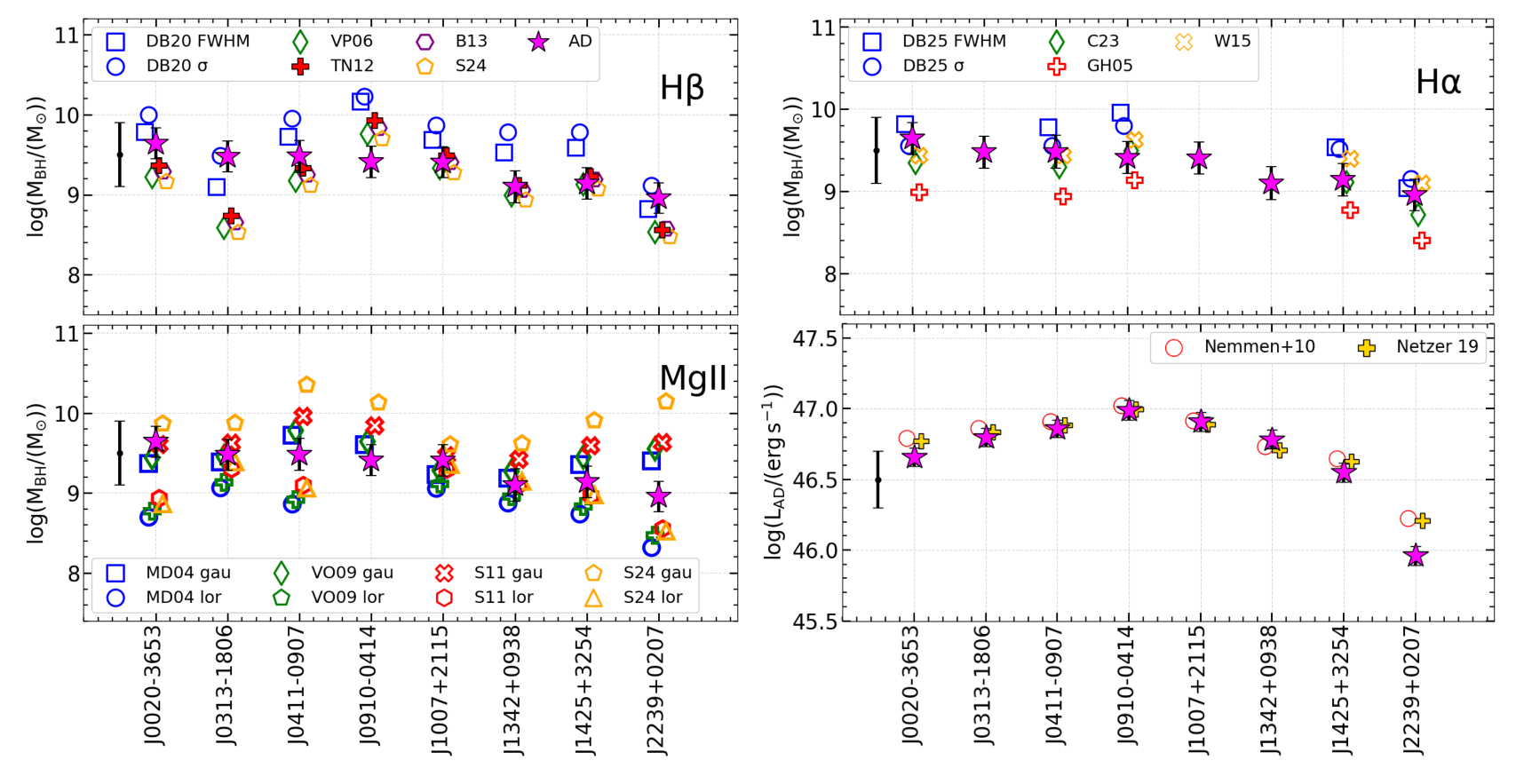
JWST/NIRSpec IFS (GA-NIFS) observations of ULAS J1342+0928 (z=7.54) combine prism (R~100) and high-resolution grating (R~2700) to map rest-UV–optical emission and kinematics. The prism cube reveals [O III] λ5007 extended over ~7 kpc—well beyond typical galaxy sizes—consistent with a relic from a past outflow, while the grating data resolve a compact (≤0.6 kpc) nuclear ionized outflow with a mass-loss rate of 50–300 Msun/yr, comparable to the host SFR of 85–545 Msun/yr. Accretion-disk modeling yields log(MBH/Msun)=9.2±0.2 and log(Lbol/erg s−1)=46.8±0.1, implying λEdd≈0.4 and pointing to sub-Eddington growth at the epoch of reionization. The most distant BLR ratios (Fe II UV/Mg II and Fe II opt/Hβ) indicate early metal enrichment; the outflow-rate range is chiefly set by uncertain ne.

2025-09-05 · 2509.05417v1

The Light Echo of a High-Redshift Quasar mapped with Lyman-$α$ Tomography

Anna-Christina Eilers, Minghao Yue, Jorryt Matthee, et al.

Deep JWST/NIRSpec MSA spectroscopy of twelve background galaxies behind the z_QSO ≈ 6.3 quasar J0100+2802 yields the first spectroscopic Lyα-tomography map of a quasar “light echo” in the transverse direction. Clear excess Lyα transmission at the quasar’s systemic redshift appears along multiple sightlines, enabling a 3D reconstruction of the ionized bubble and its ionization-cone orientation/inclination, and setting f_obsc < 91%. Modeling the light-travel geometry implies a UV-on timescale t_QSO = 10^{5.6+0.1}_{-0.3} yr (≈2–5×10^5 yr), far shorter than required for continuous thin-disk growth to the observed SMBH mass. This disfavors purely geometric obscuration as the sole cause of short lifetimes and points to radiatively inefficient or initially enshrouded accretion phases in early SMBH growth.

2025-08-29 · 2509.00153v1

Quasar Radiative Feedback May Suppress Galaxy Growth on Intergalactic Scales at $z = 6.3$

Yongda Zhu, Eiichi Egami, Xiaohui Fan, et al.

Using JWST/NIRCam grism WFSS from the SAPPHIRES and EIGER programs, the authors map [O III] emitters around the z=6.3 quasar J0100+2802 and analyze 130 sources to test radiative feedback. They find a clear decline in [O III] λ5008-to-UV luminosity (L5008/L1500) toward the quasar over ~8–10 cMpc: L1500 stays flat with distance while L5008 rises away from the quasar, and the trend tracks the projected photoionization-rate profile Γ_qso, with a weaker but consistent signal along the line of sight. The inferred transverse suppression radius implies a recent radiative episode of ~4.5 Myr, favoring rapid H2 photodissociation over slower thermal photoheating as the mechanism. Environmental effects alone cannot reproduce the signal, offering geometry-based constraints on intergalactic quasar feedback and recent quasar lifetimes.

2025-08-29 · 2508.21818v1

First constraints on the local ionization topology in front of two quasars at z ~ 7.5

Timo Kist, Joseph F. Hennawi, Frederick B. Davies, et al.

Uses JWST/NIRSpec damping-wing fits and a three-parameter local model to extract the Lorentzian-weighted HI column N_HI^DW, the distance to the first neutral patch r_patch, and the quasar lifetime t_Q in front of two z ≈ 7.5 quasars. J1007+2115 favors a moderately ionized IGM with ⟨x_HI⟩ = 0.32^{+0.22}_{-0.20}, an exceptionally short lifetime log10 t_Q/yr = 4.14^{+0.74}_{-0.18}, r_patch ≈ 28.9 cMpc, and log10 N_HI^DW ≈ 19.70, while J1342+0928 implies a higher neutral fraction ⟨x_HI⟩ = 0.58^{+0.23}_{-0.23}, an intermediate lifetime log10 t_Q/yr = 5.64^{+0.25}_{-0.43}, r_patch ≈ 10.9 cMpc, and log10 N_HI^DW ≈ 20.24. Mapping these local constraints through topology-informed priors links the sightline-level topology to global reionization timing. The N_HI^DW metric also naturally captures potential contributions from foreground absorbers toward J1342+0928.

2025-08-27 · 2508.19618v1

The BlueDOG at Cosmic Noon: A Possible Analog to Little Red Dots?

Seongjae Kim, Woong-Seob Jeong, Minjin Kim, et al.

Spectro-photometry of the hyperluminous BlueDOG ADFS-KMTDOG-102 (z=2.604) in ADF-S shows an extremely massive, heavily obscured system (log M*=12.3) with SED shape akin to JWST little red dots. Gemini-S GMOS+FLAMINGOS-2 spectra indicate AGN-dominated UV line ratios, a double-peaked, ~2″-extended Lyα, and an extinction-corrected broad Hα giving an enormous black hole (log MBH=10.2). The source thus links DOG-like hyperluminous systems to LRD-like SEDs at cosmic noon, suggesting rapid black-hole growth in a mature stellar host. The blue-excess UV continuum remains unresolved—consistent with either recent star formation or AGN-scattered light, with the Lyα escape fraction sitting near LAE relations.

2025-07-22 · 2507.16921v1

ALMA survey of a massive node of the Cosmic Web at $z\sim 3$. II. A dynamically cold and massive disk galaxy in the proximity of a hyperluminous quasar

A. Pensabene, S. Cantalupo, W. Wang, et al.

High-resolution (∼0.3″) ALMA Band-3 CO(4–3) and 3‑mm continuum mapping of the MQN01 node isolates a massive companion, MQN01‑QC, ∼10 kpc and −300 km s⁻¹ from the hyperluminous quasar CTS G18.01 (z=3.251). Kinematic modeling of the cold gas yields a dynamical mass of 2.5×10^11 M⊙ within ≈4 kpc and a dynamically cold disk with Vrot/σ≈11, establishing the first quasar companion confirmed as a massive rotating disk at this epoch. Despite the proximity, the disk shows no clear tidal disturbances, while the quasar’s CO(4–3) profile exhibits a broad blueshifted wing consistent with a powerful molecular outflow or interaction. The system suggests dynamically cold disks can persist even in dense, early cosmic‑web nodes and hints the quasar may be a satellite in an incipient merger.

2025-07-17 · 2507.13489v1

The $z=7.08$ quasar ULAS J1120+0641 May Never Reach a "Normal" Black Hole to Stellar Mass Ratio

Meredith A. Stone, George H. Rieke, Jianwei Lyu, et al.

JWST/NIRCam narrow–medium–wide imaging selects [O III] 5007 emitters at z≈7.08 around ULAS J1120+0641 across two 4.4 arcmin² fields, revisiting a site previously deemed underdense. The team finds 22 candidates near the quasar redshift, demonstrating a strong overdensity relative to field expectations, and sums the stellar+gas masses of the host plus neighbors with incompleteness corrections to estimate the merger-fed growth budget. Even if the black hole ceases accretion, the system is projected to retain an elevated MBH/M* ≳2.5% by z=0, far above the local relation. This implies some descendants could hide as quiescent black holes in faint galaxies at low redshift.

2025-07-07 · 2507.05381v1

Escape fractions from unattenuated Ly$α$ emitters around luminous $z>6$ quasars

Minghao Yue, Anna-Christina Eilers, Jorryt Matthee, et al.

JWST/NIRSpec-MSA spectroscopy in the J0100+2802 and J1148+5251 fields measures Lyα for 50 galaxies at 6<z<7 (median M_UV=−19.97), including 15 within Δv<2500 km s−1 of the quasars. Galaxies in the quasar proximity zones show clear blue-side Lyα flux and higher equivalent widths than similar-redshift field galaxies, implying little to no evolution in the LAE fraction from z≈6.4 to z≈5. Using the low IGM opacity near the quasars, the authors infer an average Lyα escape fraction of 0.14±0.04 at ⟨z⟩≈6.4. This supports reionization scenarios with low LyC escape in luminous galaxies (f_esc^LyC≲0.1), suggesting bright galaxies contribute modestly to the ionizing budget.

2025-06-26 · 2506.21658v1

Euclid and Roman with JWST Could Reveal Quasars at up to $z \sim$ 15

Muhammad A. Latif, Daniel J. Whalen

Normalizing a thin-disk+corona spectrum to a J1120-like quasar grown in the Smidt et al. (2018) simulation, the authors predict continuum NIR AB magnitudes from z = 6–15 in Euclid, Roman, and JWST bands. They find Euclid can photometrically select such SMBHs to z ≈ 11 (Wide), z ≈ 13 (Deep), and z ≈ 14 (Ultra Deep), while Roman reaches z ≈ 14.5 in Y/J/H and its F213 band extends selection to z ≈ 18. JWST’s sensitivity enables spectroscopic redshift confirmation to z ≈ 15 and even detects ≳10^6 M⊙ BHs accreting near Eddington. This Euclid/Roman discovery plus JWST follow-up pipeline could inventory early SMBHs (including analogs of UHZ1 and GHZ9) and discriminate their growth channels beyond z > 10.

2025-06-17 · 2506.14896v1

Overmassive Black holes live in compact galaxies in the early Universe

Yuxuan Wu, Tao Wang, Daizhong Liu, et al.

Uniform ALMA [CII] 158 μm size measurements for a curated sample of 22 z≈6 quasars show their hosts are systematically compact, with a median Re≈1.58 kpc versus 2.26 kpc for main-sequence SFGs measured in the same line. The hosts also have elevated MBH/M* and, for the most compact systems, reduced cold-gas content and sizes akin to massive quiescent galaxies at z≈4–5. Simple evolution over a gas-depletion timescale moves them toward the local MBH–M* relation as stellar mass builds. The compact, gas-poor subset likely marks the late stage of rapid BH growth and are prime progenitors of the first quiescent galaxies.

2025-06-16 · 2506.13945v1

Euclid: The potential of slitless infrared spectroscopy: A z=5.4 quasar and new ultracool dwarfs

E. Bañados, V. Le Brun, S. Belladitta, et al.

Euclid NISP slitless spectra demonstrate blind, space-based identification of both high‑z quasars and their chief photometric contaminants, ultracool dwarfs. The team reports a bright z=5.404 quasar, EUCL J181530.01+652054.0, flagged by strong broad CIII] and MgII in RGE (1206–1892 nm) with CIV/CIII] also in BGE (926–1366 nm) and confirmed by LBT optical data. It is a high‑excitation BAL quasar detected by LOFAR at 144 MHz (L144≈4×10^25 W/Hz), with Lbol≈3×10^12 Lsun and MBH≈3.4×10^9 Msun—an unexpectedly luminous find within only ~20 deg2. Cross-correlation of NISP spectra likewise yields new ultracool dwarfs (e.g., T3 EUCL J002516.31+491618.5; M6 EUCL J174429.80+672728.1), underscoring RGE’s ability to uncover bright quasars at z~5.5 and z>7 where photometric selection struggles.

2025-05-21 · 2505.15923v1

Discovery and characterization of 25 new quasars at 4.6 < z < 6.9 from wide-field multi-band surveys

Silvia Belladitta, Eduardo Bañados, Zhang-Liang Xie, et al.

Targeted optical/IR/radio selections across wide-area surveys yield 25 new luminous quasars at 4.6<z<6.9 (six at z≥6.5; M1450 −25.4 to −27.0), plus new spectra for six independently discovered z>6.5 sources. Three are strong radio emitters, including a z=4.71 object with blazar-like traits (flat spectrum, radio-loudness ~1000, multi-frequency variability) and an SRG/eROSITA X-ray detection (f0.2–2.3 keV ≈1.3×10^−13 erg s^−1 cm^−2). NIR spectroscopy for seven 6.3<z<6.9 quasars gives MgII-based black hole masses of 10^8.58–10^9.14 Msun and Eddington ratios 0.74–2.2, with one source showing an extreme CIV–MgII velocity offset of ~9000 km s^−1. The sample also includes three HiBALs, one with a potential 48,000 km s^−1 outflow, expanding the rare jetted/outflowing quasar census that constrains early SMBH growth and feedback.

2025-05-07 · 2505.04826v1

Subaru High-z Exploration of Low-Luminosity Quasars (SHELLQs) XXII. Chandra observations of narrow-line quasar candidates at z>6

K. Iwasawa, R. Gilli, F. Vito, et al.

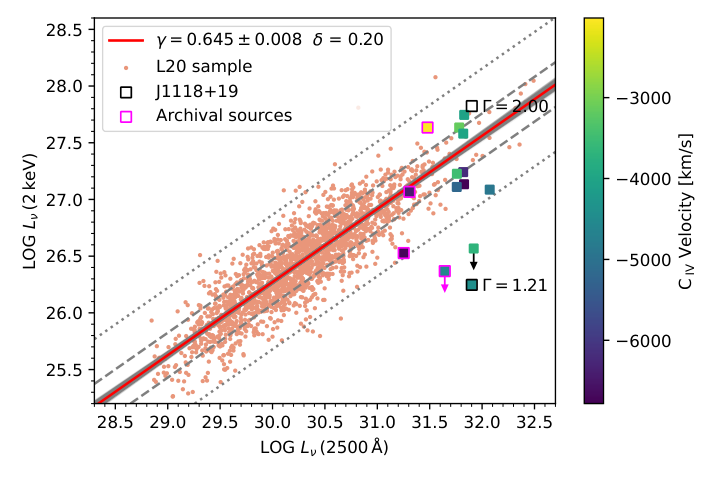
Chandra followed up four z>6 SHELLQs narrow-line quasar candidates chosen for luminous Lyα and faint UV continua, and found no X-ray detections, placing L2–10 keV < 2×10^44 erg/s (2σ; Γ=2). JWST/NIRSpec reveals weak broad Balmer bases beneath narrow cores, while strong [O III] would predict Lx ≈ 10^45 erg/s from low‑z scaling, in stark tension with the Chandra limits. The authors argue for heavily buried nuclei—either Compton-thick columns in dense ISM or an inclined, inflated inner disc in supercritical accretion—making these sources higher-luminosity analogs of JWST-selected broad-line AGN at reionization. The work clarifies how extreme Lyα–bright, UV-faint quasars can hide powerful engines early on.

2025-05-07 · 2505.04825v1

SHELLQs. Bridging the Gap: JWST Unveils Obscured Quasars in the Most Luminous Galaxies at z > 6

Yoshiki Matsuoka, Masafusa Onoue, Kazushi Iwasawa, et al.

From the SHELLQs wide-field UV survey, the team followed 13 z>6, Lyα-luminous galaxies with JWST/NIRSpec and uncovered obscured quasars. Seven of eleven narrow‑Lyα systems show broad H I Balmer and He I components—but not in [O III]—with Balmer decrements indicating mild obscuration (0<Av<3), identifying them as UV‑obscured counterparts of luminous EoR quasars. Virial lines imply MBH≈10^(7.8–9.1) Msun with sub‑Eddington to Eddington accretion; most BL sources are unresolved and display LRD‑like blue‑UV/red‑optical colors. The AGN incidence among similarly bright Lyα emitters (≥2×10^−8 Mpc^−3) is comparable to classical quasar densities, implying a substantial obscured SMBH population previously missed by UV‑bright surveys.

2025-04-22 · 2504.15913v1

A Massive Gas Outflow Outside the Line-of-Sight: Imaging Polarimetry of the Blue Excess Hot Dust Obscured Galaxy W0204-0506

Roberto J. Assef, Marko Stalevski, Lee Armus, et al.

VLT/FORS2 imaging polarimetry of the blue-excess Hot DOG WISE J020446.13–050640.8 (W0204–0506) finds a spatially integrated UV polarization of 24.7 ± 0.7% in R_Special, clinching a scattered-light origin for the faint blue continuum. The source is resolved, showing a polarization fraction and angle gradient aligned with the HST/WFC3 morphology, which SKIRT radiative-transfer models reproduce with a dusty conical polar outflow that starts at the sublimation radius, has half-opening angle ≤50°, and is viewed at inclination ≥45°, favoring graphite-rich dust. Inferred gas mass and outflow velocity fall within ranges seen for [O III] outflows in other Hot DOGs, though the feedback impact on the host remains uncertain. The work showcases imaging polarimetry as a geometry probe for dusty quasar outflows complementary to spectroscopy.

2025-04-18 · 2504.13658v1

SRGAJ230631.0+155633: an extremely X-ray luminous, heavily obscured, radio-loud quasar at z=0.44 discovered by SRG/ART-XC

Grigory Uskov, Sergey Sazonov, Igor Lapshov, et al.

SRGA J230631.0+155633 is a z=0.4389, type 2, radio‑loud quasar uncovered by SRG/ART‑XC (4–12 keV) and followed up near‑simultaneously with ART‑XC and Swift/XRT in June 2023, revealing heavy absorption with N_H ≈ 2×10^23 cm^-2. Its intrinsic 2–10 keV luminosity declined from (6^{+6}_{−3})×10^45 erg s^-1 during the 2020–2021 all‑sky scans to (1.0^{+0.8}_{−0.3})×10^45 erg s^-1 in 2023, indicating strong rest‑frame ~1 yr variability while remaining quasar‑luminous. Radio imaging shows a core plus two extended lobes consistent with a giant FR II radio galaxy. Multi‑wavelength constraints imply L_bol ~6×10^46 erg s^-1 and M_BH ~1.4×10^9 M_⊙ (λ_Edd ~0.3), making this one of the most luminous obscured quasars out to z ≈ 0.5 and a nearby laboratory for buried SMBH growth.

2025-04-14 · 2504.10596v1

An obscured quasar census with the 4MOST IR AGN survey: design, predicted properties, and scientific goals

Carolina Andonie, David M. Alexander, Claire Greenwell, et al.

Introduces the 4MOST IR AGN survey, a ~10,000 deg^2, rAB≤22.8 program targeting ≈212k mid-IR–selected obscured AGN via unWISE colors plus an r−W2≥5.9 mag cut. Using X-ray spectral constraints and UV–far-IR SEDs in four deep fields, they forecast 80–87% AGN purity with ≈70% obscured (NH>10^22 cm−2) and that ≈80% of targets will evade even the deepest eROSITA exposures. About 55% will be quasar-luminous (LAGN,IR>10^45 erg s−1) at z≈0.5–3.5 in massive (10^10–10^12 M⊙) hosts, with ≈33% in starbursts. This 100× expansion over prior spectroscopic obscured-IR samples will deliver a uniform census of heavily absorbed, X-ray–faint quasars complementing the 4MOST X-ray AGN survey.

2025-04-14 · 2504.10573v1

High-$z$ radio Quasars in RACS I: Selection, identification, and multi-wavelength properties

L. Ighina, A. Caccianiga, A. Moretti, et al.

Cross-matching RACS-low (888 MHz) with DES and Pan-STARRS, the authors selected 45 bright radio/optical-dropout candidates (S_888MHz>1 mJy, z_mag<21.3) over 16,000 deg^2 and spectroscopically confirmed 24 new quasars, 13 at 4.5<z<5 and 11 at z>5. Including comparable literature objects, the z>5 RACS set reaches 33 powerful radio quasars with νL_1.4GHz≈10^41.5–10^44.4 erg s^-1 and is ~90% complete at the stated flux and magnitude limits. Multi-band radio plus new X-ray coverage (Chandra, uGMRT, MeerKAT, ATCA) reveal predominantly flat spectra (22 with −0.5<α_r<0.5) and X-ray luminosities exceeding coronal expectations. The combined evidence points to many blazar-like, jet-aligned systems, delivering a bright, homogeneous anchor sample for population studies of early SMBH growth.
2025-02-27 · 2502.20550v1

JWST's PEARLS: A z=6 quasar in a train-wreck galaxy merger system

Madeline A. Marshall, Rogier A. Windhorst, Giovanni Ferrami, et al.

JWST/NIRSpec IFU prism data (0.6–5.3 μm, R≈100) on the z=5.89 quasar NDWFS J1425+3254 capture rest-UV/optical lines and spatially resolve its host environment. Broad Hα and Hβ yield MBH≈1.4×10^9 M⊙ and Lbol/LEdd≈0.3, while [O III] exposes a quasar-driven outflow with v≈6050 km s−1 and an ionized outflow rate ≈1650 M⊙ yr−1. The cube maps a “train-wreck” triple merger: an older, massive NE companion (M⋆≈3.6×10^11 M⊙, age≈65 Myr) linked to the host by a gas bridge, plus a very young SE companion (age≈6.7 Myr, M⋆≈1.9×10^10 M⊙) with ongoing star formation. These results argue for merger-triggered early SMBH growth; a likely foreground z=1.135 galaxy may modestly lens the quasar (1<μ<2; <0.75 mag).

2025-01-23 · 2501.14026v1

Luminous Mid-IR Selected Type-2 Quasars at Cosmic Noon in SDSS Stripe82 I: Selection, Composite Photometry, and Spectral Energy Distributions

Ben Wang, Joseph F. Hennawi, Zheng Cai, et al.

WISE W4>5 mJy selection in SDSS Stripe 82 yielded 24 candidates, with GNIRS (all) plus LRIS (18/24) confirming 23 luminous Type‑2 QSOs at 0.88<z<2.99, including 12 at z>2. Multi‑band photometry (DESI Legacy, PS1, UKIDSS, Spitzer, WISE) enables rest‑frame 0.1–10 μm composite photometry and AGNfitter SEDs. The IR is torus‑dominated with average L_torus ≈10^46.84 erg s−1; inferred L_bol spans 10^46.28–10^47.49 erg s−1 and Eddington masses ~10^8.18–10^9.39 M⊙, and the sample is redder with brighter tori than earlier Type‑2 SEDs. Their SED shapes closely resemble JWST “little red dots,” highlighting mid‑IR selection as an efficient path to luminous z>2 Type‑2s; a key open point is the origin of the rest‑UV/optical light (scattered, stellar, or a reddened disk).