654 indexed papers · 430 research notes

Research archive

Reset
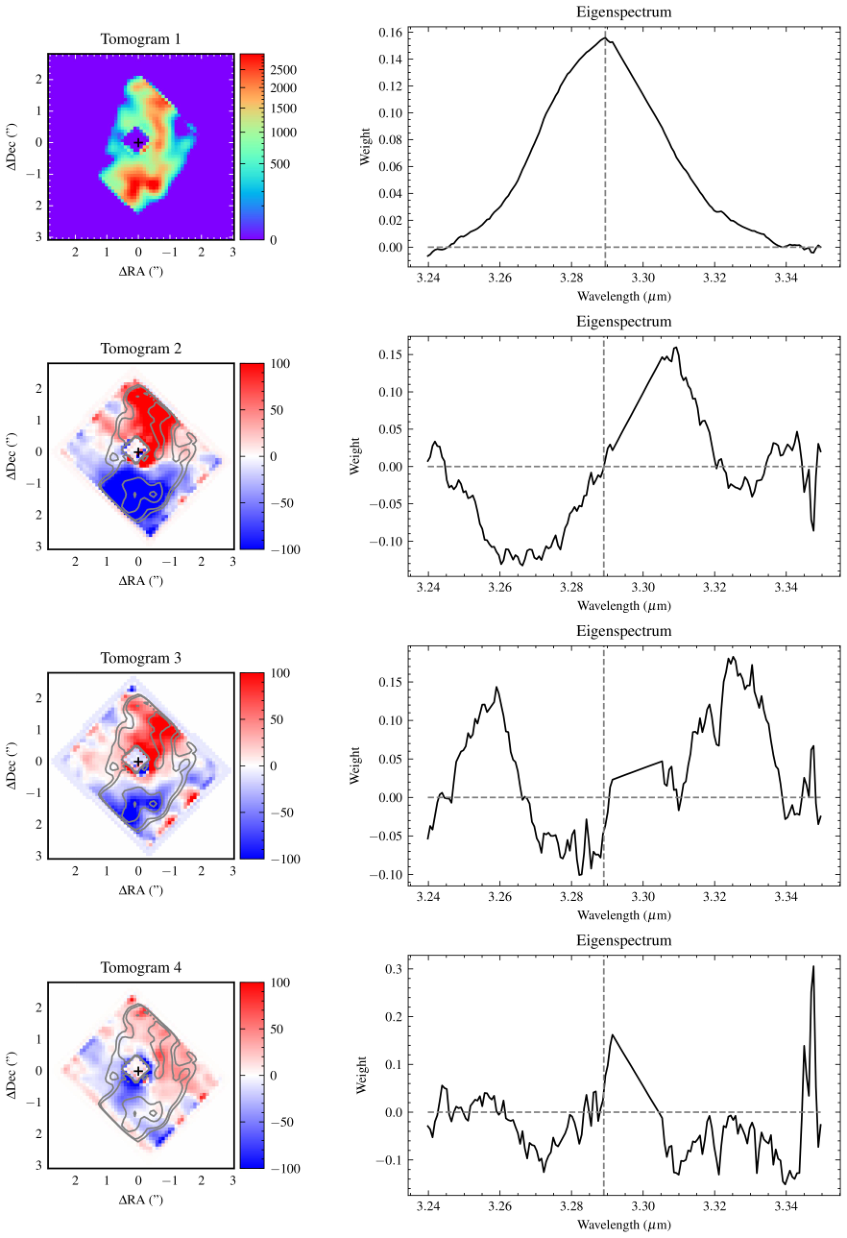
Figure 4 from Resolving the Multiphase Outflow, Shock Signatures, and PAHs in the AGN-Starburst Composite ULIRG F10565+2448 with JWST MIRI/MRS

2026-05-04 · 2605.03016v1 · Research note

Resolving the Multiphase Outflow, Shock Signatures, and PAHs in the AGN-Starburst Composite ULIRG F10565+2448 with JWST MIRI/MRS

Kylie Yui Dan, Jerome Seebeck, Sylvain Veilleux, et al.

JWST/MIRI-MRS resolves a warm-H₂ outflow in the composite ULIRG F10565+2448: it is hotter than the disk but apparently sub-escape-speed, while a faster unresolved ionized component and localized shock candidates support multiphase feedback.

2026-05-04 · 2605.02663v1 · Research note

Jet-driven shocks and turbulence in radio-loud Active Galactic Nuclei observed with JWST MIRI/MRS

Rogemar A. Riffel, Gabriel L. Souza-Oliveira, Luis Colina, et al.

JWST/MIRI-MRS mapping of seven nearby radio-loud AGN links elevated warm-H2 excitation and broadened multiphase gas to radio-jet environments, including transverse regions. The authors interpret the correlations as predominantly jet-driven shocks, while recognizing source-dependent exceptions.

Figure 3 from PEARLS: Two Distinct Populations of AGN Hosts Moving Between Star Formation and Quiescence

2026-05-01 · 2605.00822v1 · Research note

PEARLS: Two Distinct Populations of AGN Hosts Moving Between Star Formation and Quiescence

Gibson B. Bowling, Rafael Ortiz, S. P. Willner, et al.

After image decomposition and host-only SED fitting, 36 NIRCam-selected NEP-TDF AGN candidates separate into a likely AGN “branch” and an ambiguous, largely early-type “bridge” near quenching; the reported SFR–AGN-fraction trend is weakly explanatory.

2026-05-01 · 2605.00763v1 · Research note

Life After the Quasar: Overmassive Black Holes and Remnant Ionised Bubbles in and Around Two z~6.6 Galaxies

Romain A. Meyer, Pascal A. Oesch, Callum Witten, et al.

JWST/NIRSpec spectra of two z~6.6 ultra-luminous Lyα emitters reveal broad Balmer-line black-hole masses near 2×10^8 M⊙ and double-peaked Lyα, which the authors interpret as brief post-quasar phases inside relic ionised bubbles.

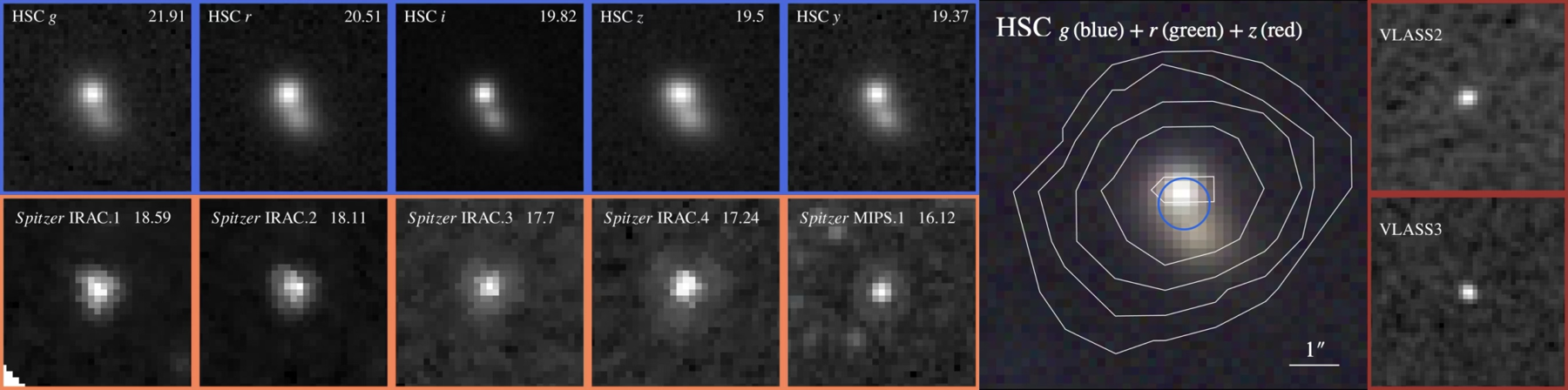
Figure 1 from A Rare Eddington-Limited, Heavily Obscured Low-Mass Active Galactic Nucleus Likely Triggered by a Galaxy Merger

2026-04-29 · 2604.26743v1 · Research note

A Rare Eddington-Limited, Heavily Obscured Low-Mass Active Galactic Nucleus Likely Triggered by a Galaxy Merger

Shouyi Wang, Fan Zou, Chang-Hao Chen, et al.

For the single $M_\star\sim10^{10}\,M_\odot$ host GAMA 376183, NuSTAR and multiwavelength data support a heavily obscured, rapidly accreting AGN in a disturbed system; the proposed merger-triggered starburst/accretion connection remains suggestive rather than demonstrated.

Figure 1 from The GlimmIr: Spectroscopic Variability in a z~7 LRD Indicates Rapid Changes in Both the Narrow and Broad Line Regions

2026-04-28 · 2604.25991v1 · Research note

The GlimmIr: Spectroscopic Variability in a z~7 LRD Indicates Rapid Changes in Both the Narrow and Broad Line Regions

Erini Lambrides, Taylor A. Hutchison, Rebecca L. Larson, et al.

Multi-epoch JWST/NIRSpec spectra of one z~7 little red dot show coordinated continuum, broad-Balmer, and [O III] changes over ~13 rest-frame days. If intrinsic, the variability ties at least some narrow-line gas to the central engine and disfavors complete dense-gas coverage.

Figure 5 from Decoupling the AGN outflow and star-forming disk kinematics in the nuclear region of NGC 7582 with JWST NIRSpec and MIRI/MRS

2026-04-27 · 2604.24892v1 · Research note

Decoupling the AGN outflow and star-forming disk kinematics in the nuclear region of NGC 7582 with JWST NIRSpec and MIRI/MRS

Oscar Veenema, Niranjan Thatte, Dimitra Rigopoulou, et al.

JWST IFU spectroscopy of NGC 7582 separates rotating circumnuclear-disk gas from an AGN bicone by ionisation potential and line-profile decomposition, finding distinct kinematic axes and broader outflow lines; mixed-ionisation tracers require two components.

Figure 1 from Supermassive stars with embedded stellar black hole cores: dense assembling star clusters as faint multiple Little Red Dot systems

2026-04-24 · 2604.22924v1 · Research note

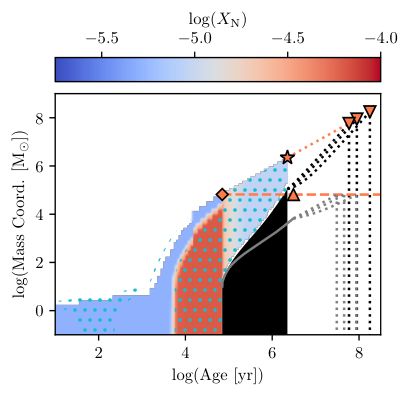
Supermassive stars with embedded stellar black hole cores: dense assembling star clusters as faint multiple Little Red Dot systems

Antti Rantala

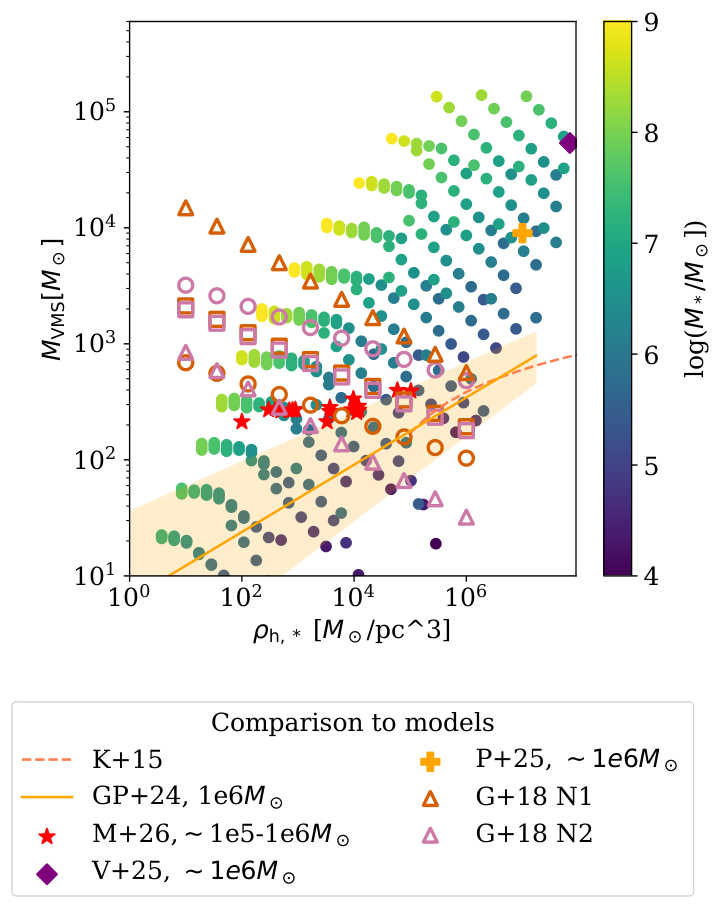
Direct cluster simulations suggest that stellar-mass black holes can enter collision-built extremely/supermassive stars in ultra-dense, low-metallicity clusters, creating longer-lived quasi-star-like objects. The authors propose these as faint, companion-rich multiple Little Red Dots, not typical bright LRDs.

2026-04-22 · 2604.20966v1

Light, heavy, primordial: exploring the diversity of black hole seeding and growth mechanisms in the JWST era

Pratika Dayal

Dayal cross-compares astrophysical light (~100 M⊙) and heavy (~10^3–10^5 M⊙) seeds (via DELPHI) with cosmological primordial black holes (10^{0.5–6} M⊙; PHANES) against z≈5–10 observables. The only scenario the data rule out is Eddington-limited accretion onto light seeds; high black hole–to–stellar mass ratios (Mbh/M*≈0.3–1) are achievable with PBHs or heavy seeds under super-Eddington growth. Crucially, only PBHs and Eddington-limited heavy seeds can simultaneously recover the observed Mbh, M*, and extremely low host metallicities (Z≤0.01 Z⊙) at z≈7–10. PBHs also predict a distinctive decline of Mbh/M* with increasing halo mass and occupancy of 10^9–10^11 M⊙ halos, motivating a clustering-based test selecting z≈7 systems with Mbh/M*>0.1 and Lbol≈10^{44–46} erg s⁻¹.

2026-04-21 · 2604.19988v1

Pulsational mass loss from supermassive stars creates the compact shells of Little Red Dots

Devesh Nandal, Igor Chilingarian, Chris Nagele, et al.

This paper asks whether late pulsational mass loss from supermassive stars can naturally create the compact dense shells inferred around little red dots. The main result is that the final pre-collapse ejection episode can leave behind an optically thick shell on sub-parsec scales, while earlier episodes expand away and become dynamically unimportant for the observed cocoon. The paper matters because it turns the dense-gas requirement of LRDs into a concrete stellar-evolution prediction rather than an external assumption.

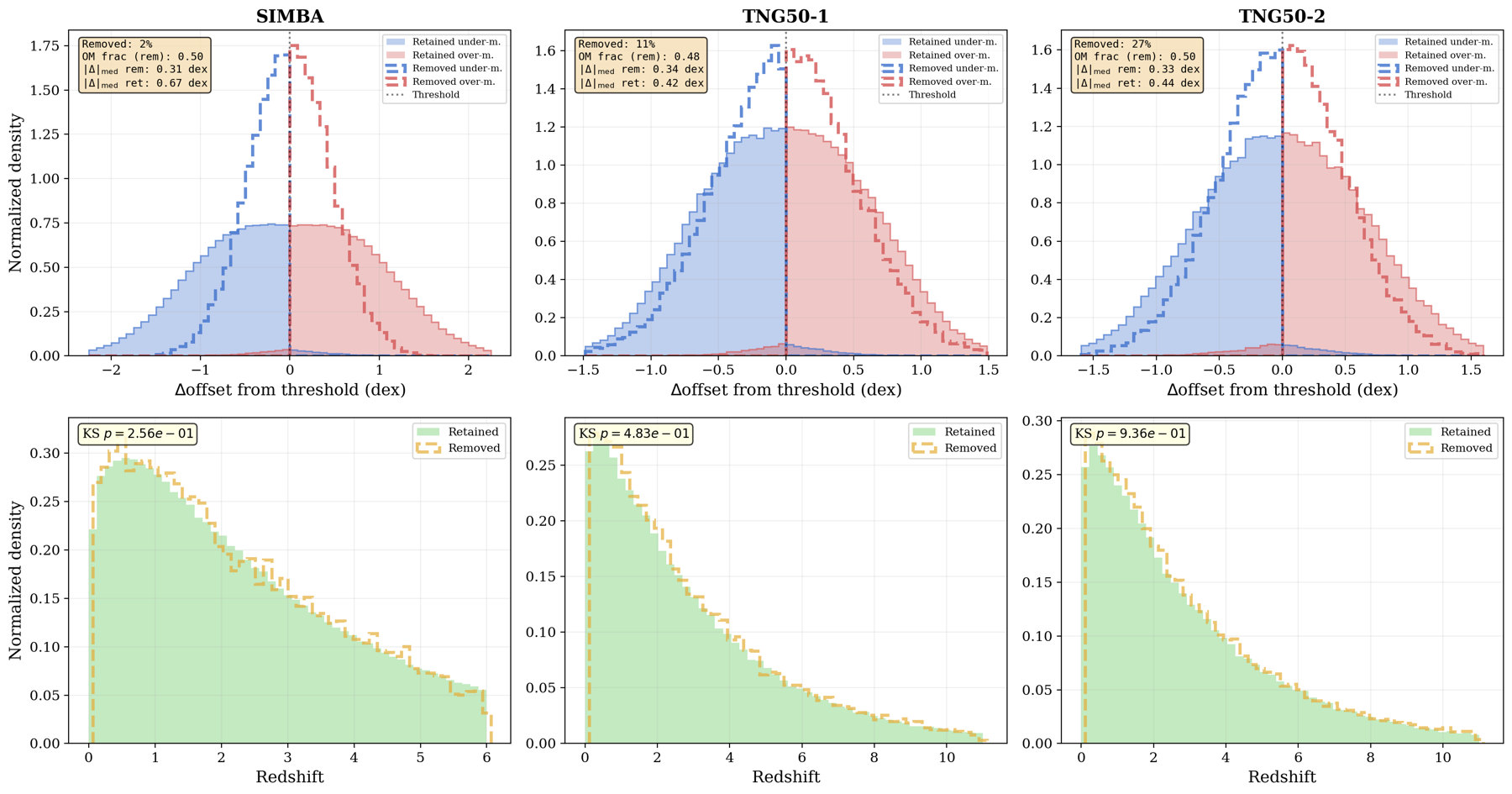
Figure 1 from Classifying Supermassive Black Hole Growth Regimes to Observables Across Cosmological Simulations with Forecasts for LSST

2026-04-16 · 2604.16539v1 · Research note

Classifying Supermassive Black Hole Growth Regimes to Observables Across Cosmological Simulations with Forecasts for LSST

Hitaishi Chillara

Forward-modelled LSST photometry from cosmological simulations can classify simulated black holes as over- or under-massive relative to their host relation at 91–94% accuracy, but transfer and forward-model assumptions remain material obstacles to applying this result to survey galaxies.

2026-04-16 · 2604.14551v1 · Research note

Discovery of low-redshift analogues to "Little Red Dots" in DESI: A later evolutionary stage of compact LRDs?

Weiyu Ding, Xu Kong, Wei-Jian Guo, et al.

Five DESI DR1 sources at z=0.2–0.4 reproduce LRD-like V-shaped SEDs and broad Balmer lines, but their AGN-like line ratios and substantially larger hosts make an evolutionary connection to z>4 LRDs plausible rather than established.

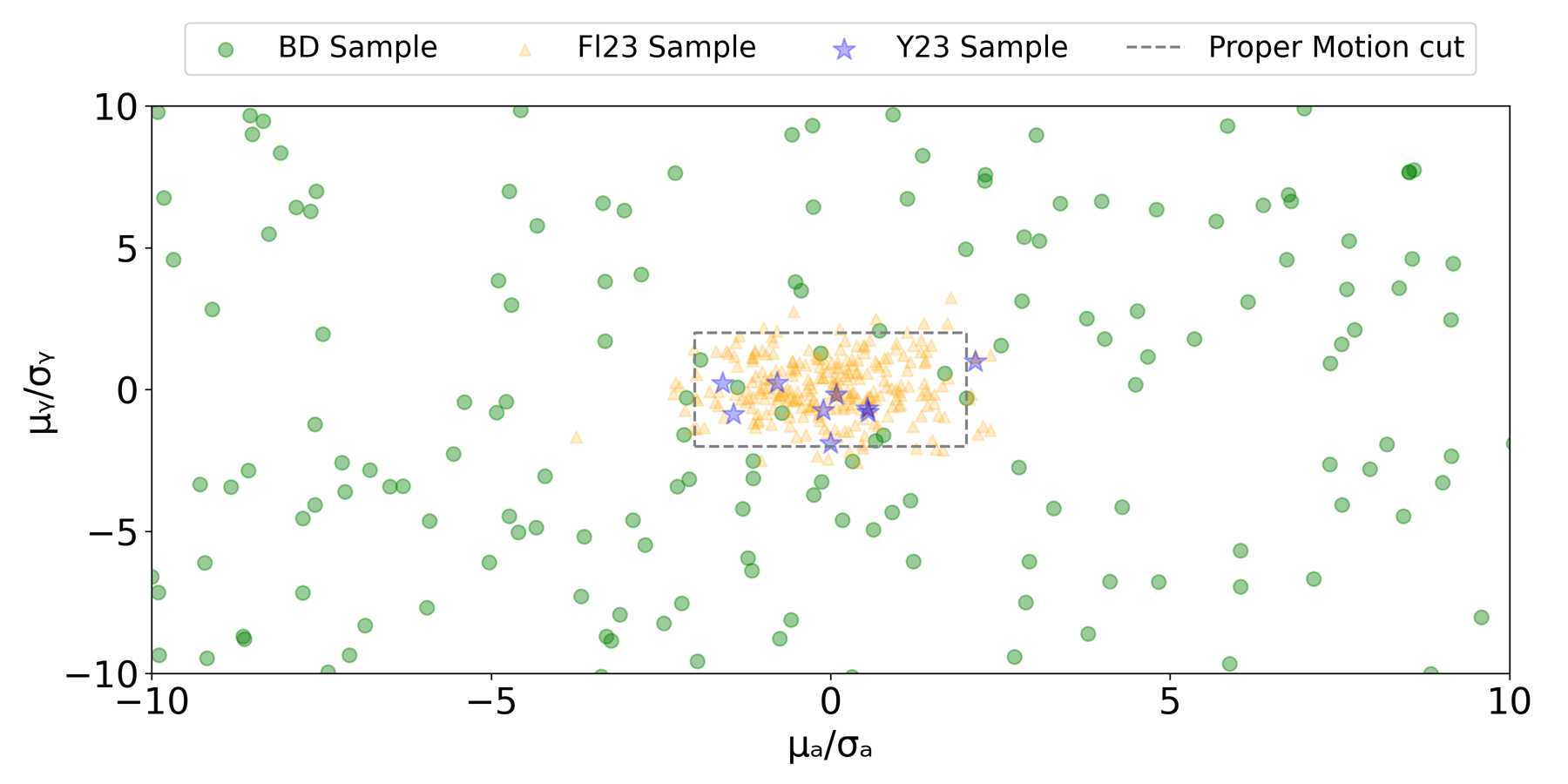
Figure 3 from 4MOST ChANGES: Catalog of high-redshift quasar candidates (4.5 < $z$ < 7) selected with SED fitting

2026-04-14 · 2604.13178v1 · Research note

4MOST ChANGES: Catalog of high-redshift quasar candidates (4.5 < $z$ < 7) selected with SED fitting

T. Mkrtchyan, C. Mazzucchelli, R. J. Assef, et al.

Using southern-sky multi-band photometry and quasar-versus-brown-dwarf SED fitting, the authors compile 6,104 z=4.5–7 quasar candidates. Three of six bright, visually screened follow-up targets are confirmed at z>5, but catalog-wide purity remains weakly constrained.

Figure 3 from How I Wonder What You Are -- JWST's Little Red Dots do not TWINKLE

2026-04-14 · 2604.13000v1 · Research note

How I Wonder What You Are -- JWST's Little Red Dots do not TWINKLE

Zhaoran Liu, Rohan P. Naidu, Amy Secunda, et al.

Across a complete Hα-flux-limited GOODS-N sample, 18 LRDs and nine other broad-Hα emitters show no detected continuum, line-flux, or line-shape variability over 139–220 rest-frame days, challenging their interpretation as ordinary broad-line AGN.

Figure 2 from Do little red dots really form a distinct class of astronomical objects?

2026-04-13 · 2604.11677v1 · Research note

Do little red dots really form a distinct class of astronomical objects?

Jean-Baptiste Billand, David Elbaz, Maximilien Franco, et al.

Across ∼48,000 photometric and ∼5,000 spectroscopic galaxies, the authors find LRD-like colour, compactness, and broad-Hα properties vary continuously, arguing that most LRDs are an extreme tail rather than a discrete class; only ∼3% show very strong Balmer breaks.

2026-04-10 · 2604.09177v1 · Research note

The Cliff: A Metal-Poor Little Red Dot Hosting an Overmassive Black Hole at $z = 3.55$

Lucy R. Ivey, Francesco D'Eugenio, Roberto Maiolino, et al.

JWST/NIRSpec-IFU spectroscopy of the single z=3.55 Little Red Dot The Cliff yields a very low narrow-line metallicity, Z=0.017±0.004 Z⊙, while broad Hβ-based virial estimates place its black hole above local host-scaling expectations.

Figure 1 from GLIMPSED: Direct evidence for a fast AGN-driven outflow from a z=6.64 Little Red Dot host galaxy

2026-04-09 · 2604.08687v1 · Research note

GLIMPSED: Direct evidence for a fast AGN-driven outflow from a z=6.64 Little Red Dot host galaxy

Damien Korber, Rui Marques-Chaves, Daniel Schaerer, et al.

Medium-resolution JWST/NIRSpec data spatially separate an LRD-like AGN and its host at z=6.64, revealing exceptionally broad ionised gas consistent with AGN driving but a low inferred mass-loading factor and therefore limited immediate star-formation impact.

2026-04-08 · 2604.07138v1 · Research note

The Way We Tally Becomes the Tale: the Impact of Selection Strategies on the Inferred Evolution of Little Red Dots Across Cosmic Time

Pierluigi Rinaldi, Kevin Hainline, Francesco D'Eugenio, et al.

A broad JADES photometric census finds that extreme-red color cuts recover at most one quarter of compact LRD candidates, so inferred luminosity functions and number-density evolution depend strongly on selection rather than necessarily on population evolution.

2026-04-04 · 2604.03563v1 · Research note

SPURS: Evidence for Clumpy Neutral Envelopes and Ionized IGM Surrounding Little Red Dots in Abell 2744 from Ultra-Deep Rest-UV Spectroscopy

Mengtao Tang, Daniel P. Stark, Charlotte A. Mason, et al.

Ultra-deep JWST/NIRSpec spectra of two Abell 2744 little red dots resolve a broad Lyα component in z=7.0364 Abell2744-QSO1. The authors argue its comparatively modest shift favors a clumpy, rather than uniform, neutral envelope and an ionized local environment.

2026-04-03 · 2604.03370v1 · Research note

Holes in the BH$^\star$? AGN signatures in the FUV spectrum of a black-hole dominated Little Red Dot at $z=7.04$

Xihan Ji, Gabriele Pezzulli, Francesco D'Eugenio, et al.

JWST/NIRSpec FUV spectroscopy of the single z=7.04 LRD Abell2744-QSO1 resolves extended narrow and unresolved broad Lyα components. The authors interpret broad Lyα/Balmer ratios as evidence for lower-column-density sightlines through otherwise dense, clumpy BLR-scale gas.

2026-04-03 · 2604.02726v1 · Research note

A Five-Stage Framework for Slitless Grism Spectra: Demonstrated on Euclid Q1 Strong-Lens Candidates and Ported to CEERS NIRCam

R. Tata

A five-stage extraction and deblending pipeline yields reliable slitless-spectroscopic measurements for 461 Euclid Q1 lens candidates, including 178 source–deflector redshift pairs. Dual grism orientations strengthen validation, but incomplete deflector spectroscopy and unmeasured real-data deblending performance constrain inference.

Figure 2 from Smoluchowski Coagulation Equation and the Evolution of Primordial Black Hole Clusters

2026-04-02 · 2604.01684v1 · Research note

Smoluchowski Coagulation Equation and the Evolution of Primordial Black Hole Clusters

Borui Zhang, Wei-Xiang Feng, Haipeng An

Monte Carlo solutions of a Smoluchowski merger model predict three-stage evolution and possible runaway growth in dense primordial-black-hole clusters within the first billion years. The result is a model-dependent route to early massive black-hole seeds, not a direct measurement of little red dots.

Figure 3 from Constraints on the host galaxy and AGN properties of three z > 6 JWST AGN from NOEMA observations

2026-03-31 · 2603.29652v1 · Research note

Constraints on the host galaxy and AGN properties of three z > 6 JWST AGN from NOEMA observations

Giovanni Mazzolari, Hannah Übler, Rodrigo Herrera Camus, et al.

Deep NOEMA observations of three z>6 JWST AGN—two Little Red Dots and one blue Type-I source—yield no significant [C II] or dust-continuum detection, tightening host-galaxy and SED constraints while leaving the physical origin of their [C II] deficit unresolved.

2026-03-30 · 2603.28682v1

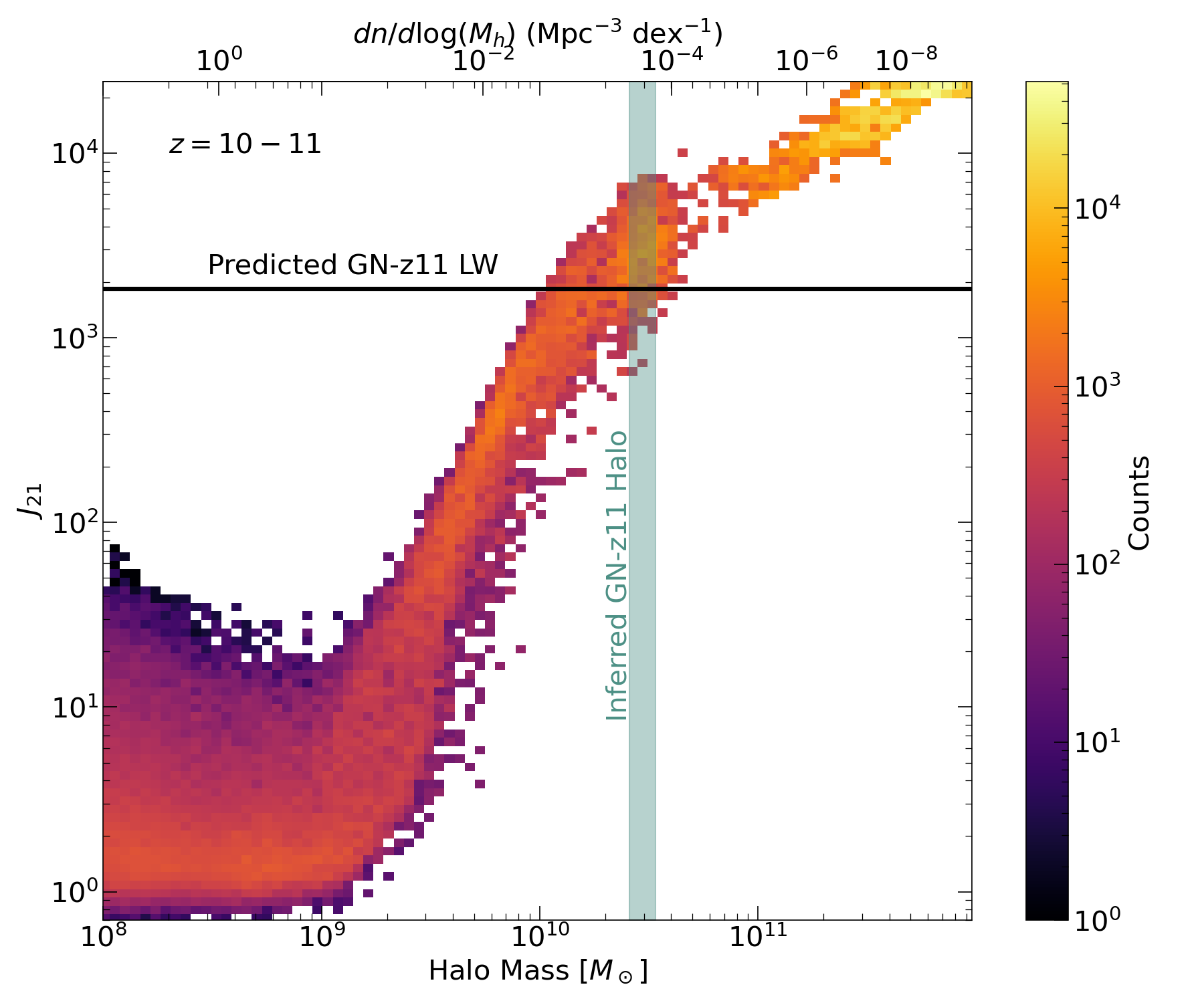
How Overmassive Black Holes Formed at Cosmic Dawn

Muhammad A. Latif, Daniel J. Whalen, Sadegh Khochfar, et al.

This paper asks whether the newly discussed overmassive black hole galaxies at cosmic dawn can arise naturally from early direct-collapse black-hole formation rather than from a more exotic late-time assembly path. The main result is that a 70,000-solar-mass DCBH formed at very high redshift can grow into a system with the black-hole-to-stellar-mass ratio, metallicity, star-formation rate, and broad spectral properties seen in objects like UHZ1 and GHZ9 by z around 10. The paper matters because it offers a concrete physical channel for the broader JWST overmassive-black-hole population that sits adjacent to the little-red-dot and early-AGN discussion.

Figure 1 from A Black Hole Star at Cosmic Noon: Extreme Balmer break, photospheric continuum, and broad absorption by thick winds in a Little Red Dot at z=1.7

2026-03-30 · 2603.28335v1 · Research note

A Black Hole Star at Cosmic Noon: Extreme Balmer break, photospheric continuum, and broad absorption by thick winds in a Little Red Dot at z=1.7

Alberto Torralba, Jorryt Matthee, Andrea Weibel, et al.

PAN-BH*-1 is a single z=1.731 Little Red Dot at cosmic noon with an extreme Balmer break, compact red continuum, and broad Hα absorption. Its data are consistent with—but do not establish—a thick, rotating photospheric disk wind.

Figure 13 from XRISM spectroscopy of a crowded Galactic center region -- II. Narrow emission lines in the Black Hole candidate MAXI J1744-294/Swift J174540.2-290037

2026-03-28 · 2603.27235v1 · Research note

XRISM spectroscopy of a crowded Galactic center region -- II. Narrow emission lines in the Black Hole candidate MAXI J1744-294/Swift J174540.2-290037

Maxime Parra, Shifra Mandel, Kai Matsunaga, et al.

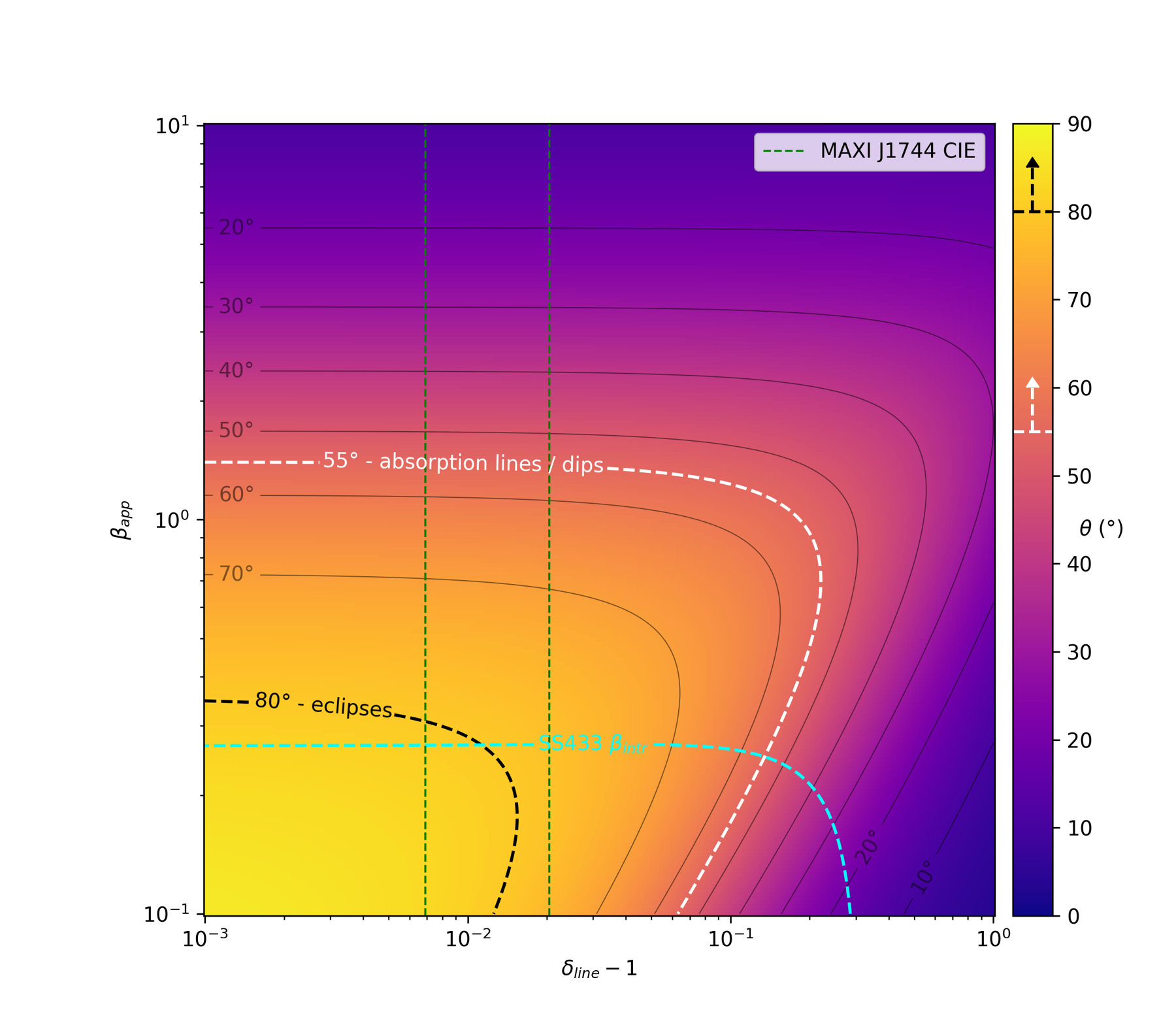
XRISM Resolve spectroscopy of the crowded Galactic-centre field isolates narrow iron-line emission attributed to the black-hole candidate MAXI J1744-294, including static highly ionized gas and atypical features consistent with blueshifted material, though plasma origin and background systematics remain unresolved.

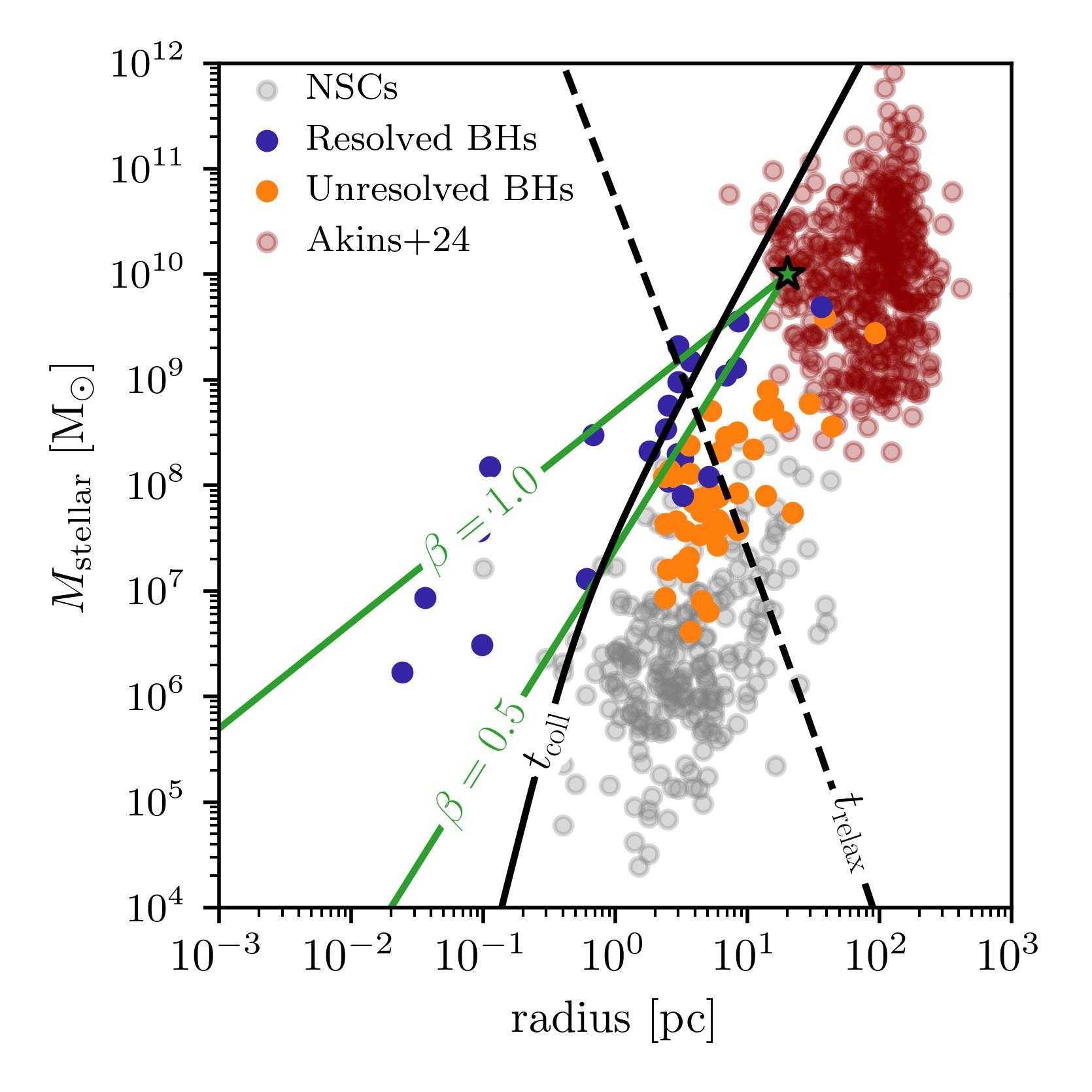
Figure 4 from A cosmological framework for stellar collisions at high redshift in proto-globular clusters, nuclear star clusters, and Little Red Dots

2026-03-27 · 2603.26872v1 · Research note

A cosmological framework for stellar collisions at high redshift in proto-globular clusters, nuclear star clusters, and Little Red Dots

Claire E. Williams, Smadar Naoz, Sanaea C. Rose, et al.

A radially resolved analytic framework predicts that stellar collisions can shape compact z≈5–12 clusters: constructive mergers may build very massive stars, whereas destructive encounters near central black holes may create dense gas potentially relevant to Little Red Dots.

2026-03-26 · 2603.24893v1 · Research note

Revisiting the Claim for a Direct-Collapse Black Hole in UHZ1 at $z=10.05$

Fan Zou, Elena Gallo, Zihao Zuo, et al.

A reanalysis of UHZ1’s full Chandra exposure and new MIRI non-detections reduces the evidence for its proposed luminous, Compton-thick direct-collapse black hole: the X-ray excess is marginal and non-persistent, while infrared limits exclude the originally inferred luminosity scale.

Figure 2 from A striking excess of red quasars with steep radio spectral slopes: a dusty blow-out phase revealed through AGN-driven shocks?

2026-03-25 · 2603.24739v1 · Research note

A striking excess of red quasars with steep radio spectral slopes: a dusty blow-out phase revealed through AGN-driven shocks?

Ciera L. Sargent, David M. Alexander, Claire L. Greenwell, et al.

Across SDSS quasars at 0.2<z<2.4, compact red quasars show an excess near α1.4–3 GHz≈−1 that strengthens with dust extinction. The authors interpret this as wind/jet–ISM shocks during a dusty blow-out phase, but radio spectra alone do not establish that mechanism.

2026-03-25 · 2603.24700v1 · Research note

A PANORAMIC of UV-optical morphologies of "Little Red Dots": Two groups of LRDs distinguished by UV half-light radius

Aidan P. Cloonan, Katherine E. Whitaker, Sinclaire M. Manning, et al.

Across 181 photometrically selected PANORAMIC LRDs, rest-optical emission is generally unresolved (<100 pc) while UV sizes vary. Splitting by Balmer-break size yields compact-UV and extended-UV groups, a pattern also seen less significantly in spectroscopic RUBIES LRDs.

2026-03-23 · 2603.22425v1 · Research note

A large population of over-massive black hole quasars at z=0.3-0.8 revealed by eROSITA

Johannes Buchner, Isabelle Gauger, Qiaoya Wu, et al.

In a 140 deg² eROSITA field, the authors identify eight z=0.3–0.8/1 quasars with inferred M•/M⋆>5%. Their abundance supports recurrent black-hole/host offsets among rapidly accreting AGN, but single-epoch masses and often upper-limited host masses temper the conclusion.

2026-03-23 · 2603.22393v1 · Research note

MEOW: The increase in the obscured AGN fraction in mid-infrared from 0 < z < 6 with JWST MIRI

Teodora-Elena Bulichi, Gene C. K. Leung, Anna-Christina Eilers, et al.

Using JWST/MIRI-selected sources, MEOW infers that obscured AGN become increasingly dominant with redshift: its SED-based luminosity functions imply a 98–99% obscured fraction at z=4.5–6 for luminous AGN, relative to UV type-1 quasars.

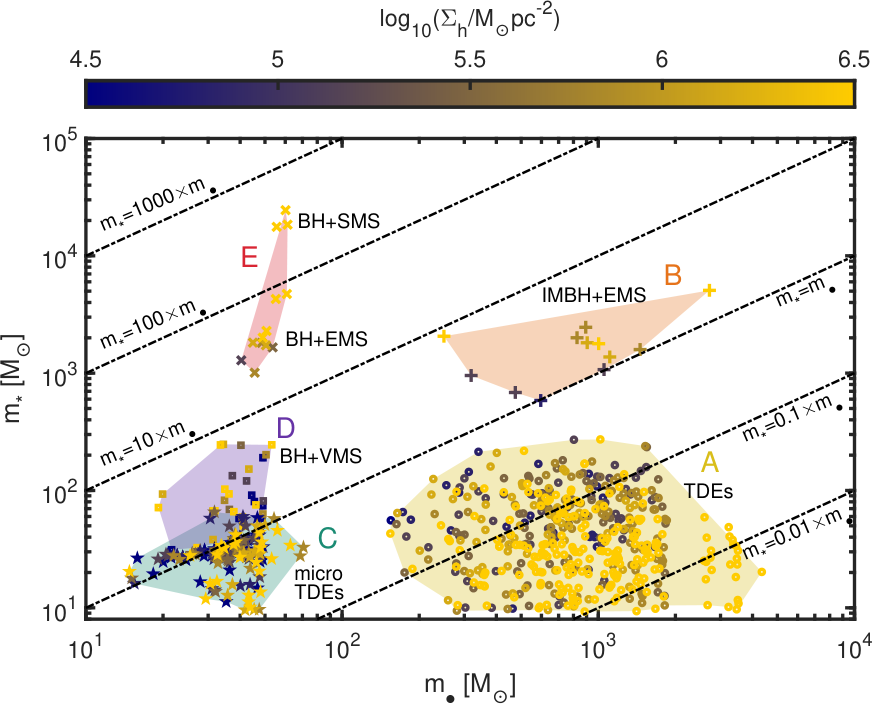
Figure 1 from A quasi-star is born: formation and evolution of accreting quasi-stars as a metallicity-independent pathway to Little Red Dots

2026-03-23 · 2603.21714v1 · Research note

A quasi-star is born: formation and evolution of accreting quasi-stars as a metallicity-independent pathway to Little Red Dots

J. Roman-Garza, D. Schaerer, C. Charbonnel, et al.

Stellar-evolution calculations suggest rapidly accreting supermassive stars can undergo relativistic collapse into long-lived quasi-stars whose cool, luminous envelopes overlap Little Red Dot optical properties across modeled metallicities; the LRD interpretation remains model-dependent rather than a direct identification.

2026-03-18 · 2603.17967v1 · Research note

JWST Reveals Two Overmassive Black Hole Candidates in Dwarf Galaxies at z $\approx$ 0.7: Pushing Black Hole Searches into the Dwarf-Galaxy Regime

E. Iani, P. Rinaldi, A. Torralba, et al.

Two z≈0.7 compact dwarfs combine blue, burst-dominated UV–optical emission with a MIRI hot-dust excess. SED-inferred AGN luminosities imply candidate black holes disproportionately massive for ≈10^7 M⊙ hosts, but masses depend strongly on the assumed Eddington ratio.

2026-03-18 · 2603.17667v1 · Research note

The Engine and its Flows: Little Red Dot spectra are shaped by the column densities of their gas envelopes

Jorryt Matthee, Alberto Torralba, Gabriele Pezzulli, et al.

In 18 z≈3–7 broad-Hα emitters, Balmer cores progress from narrow emission to P-Cygni-like and absorption-dominated profiles as UV–optical colour reddens. The authors interpret this as changing envelope column density and optical depth, not purely dynamical line broadening.

2026-03-16 · 2603.15761v1 · Research note

Out of oxygen: Extremely metal-poor galaxy candidates identified at $2.5 < z < 6.5$ with deep JADES medium-band imaging

James A. A. Trussler, Daniel J. Eisenstein, Andrew J. Bunker, et al.

Deep JADES medium-band photometry identifies 22 candidate near-pristine starbursts at 2.5<z<6.5 from strong Hα but weak [O III]+Hβ. Their inferred metallicities are photometric, however, and dust, dense gas, or obscured AGN can mimic the selection.

2026-03-16 · 2603.15736v1 · Research note

Halo assembly bias in the early Universe: a clustering probe of the origin of the Little Red Dots

Zihao Wang, Fangzhou Jiang, Haonan Zheng, et al.

Shin-Uchuu predictions indicate that early halo assembly bias can materially alter LRD clustering interpretations: DCBH hosts should be most biased, whereas low-spin and SIDM channels are weaker for different reasons. Forthcoming LRD cross-correlations could therefore discriminate host selections.

Figure 1 from GATOS N: The first direct kinematic evidence of dusty outflows from AGN via PAH kinematics of local Seyfert galaxies with JWST

2026-03-12 · 2603.12200v1 · Research note

GATOS N: The first direct kinematic evidence of dusty outflows from AGN via PAH kinematics of local Seyfert galaxies with JWST

Fergus R. Donnan, Ismael García-Bernete, Dimitra Rigopoulou, et al.

JWST IFU observations of 10 local Seyferts use PCA tomography of broad PAH bands to map dust-phase kinematics. The authors report neutral, larger PAHs sharing molecular and ionised-outflow signatures in NGC 5728 and NGC 7582, while 3.3 μm PAHs trace disks.

Figure 4 from Merger-driven buildup of the $M_{\rm BH}$ - $M_*$ relation bridging high-$z$ overmassive black holes with the local relation

2026-03-12 · 2603.11747v1 · Research note

Merger-driven buildup of the $M_{\rm BH}$ - $M_*$ relation bridging high-$z$ overmassive black holes with the local relation

Takumi S. Tanaka, John D. Silverman, Kazuhiro Shimasaku, et al.

Monte Carlo merger evolution can reduce an assumed 0.8–1.0 dex scatter in the z~6 black-hole–stellar-mass relation to the ~0.3 dex local scatter, but the result depends strongly on merger mass ratios and rates; major mergers alone are insufficient.

Figure 5 from The X-ray weakness of Little Red Dots and JWST-selected AGN: comparison with local AGN in different accretion regimes

2026-03-10 · 2603.10162v1 · Research note

The X-ray weakness of Little Red Dots and JWST-selected AGN: comparison with local AGN in different accretion regimes

A. Tortosa, C. Ricci, P. Du, et al.

High-redshift LRDs and JWST-selected broad-line AGN are X-ray weak relative to broad Hα, plausibly resembling highly accreting local systems; however, predominantly upper-limit-based X-ray constraints leave intrinsic coronal suppression and obscuration unresolved.

2026-03-04 · 2603.04358v1 · Research note

A Selection Aware View of Black Hole-Galaxy Coevolution at High Redshift

Francesco Ziparo, Stefano Carniani, Simona Gallerani, et al.

Forward-modeling broad-Hα selection in a JADES broad-line AGN sample at z≳4 yields an M_BH–M★ relation consistent in mean with local relations but with 0.63 dex intrinsic scatter, implying diverse early black-hole growth histories.

Figure 2 from Synthetic Spectral Library of Optically Thick Atmospheres for Little Red Dots

2026-03-02 · 2603.02317v1 · Research note

Synthetic Spectral Library of Optically Thick Atmospheres for Little Red Dots

Hanpu Liu, Yan-Fei Jiang, Eliot Quataert, et al.

A new LRD-tailored atmosphere library finds that The Egg’s continuum curvature, weak 1.6-μm H− kink, and Ca II triplet jointly favor an exceptionally dilute photosphere, challenging hydrostatic interpretations and providing testable near-IR spectral diagnostics.

2026-03-02 · 2603.01668v1 · Research note

A Unified Explanation for JWST Little Red Dots and High-Redshift Low-Mass Disk-like Galaxies: Prolate Galaxies Viewed End-on vs Side-on

Yingjie Peng

Peng proposes that many JWST little red dots are ordinary low-mass prolate galaxies viewed close to their long axes: projection and maximal columns could jointly produce compact red continua and broadened Balmer profiles, while side-on counterparts appear elongated.

2026-03-02 · 2603.01473v1 · Research note

Local Analogs of Little Red Dots: Optical Variability and Evidence for an AGN Origin

Ruqiu Lin, Zhen-Ya Zheng, Junxian Wang, et al.

Six-year ZTF monitoring of seven z~0.3 LRD analogs detects multiband excess variance in three and DRW-like variability in two, supporting—but not establishing—an AGN interpretation. Simulations suggest present JWST high-z variability upper limits can be biased low by short baselines.

Figure 2 from Extreme Emission Line Galaxies in CEERS Are Powered by Star Formation, not AGN

2026-02-26 · 2602.23310v1 · Research note

Extreme Emission Line Galaxies in CEERS Are Powered by Star Formation, not AGN

Kelcey Davis, Madisyn Brooks, Jonathan R. Trump, et al.

JWST/NIRSpec follow-up of CEERS extreme emission-line galaxies finds broad-line AGN contamination, but for spectroscopically extreme sources the narrow Hα component dominates. The authors therefore attribute the most extreme nebular emission primarily to young star formation, not AGN.

2026-02-25 · 2602.22386v1 · Research note

Little Red Dots as Obscured Little Blue Dots: A Super-Eddington Unification Model

Piero Madau, Roberto Maiolino

This modeling study argues that Little Red Dots are high-inclination, dust-reddened counterparts of super-Eddington Little Blue Dots. Anisotropic continua and modest BLR/dust covering factors can reproduce several LRD ensemble observables, but the proposed orientation unification remains model-dependent.

Figure 4 from You can't see me: super-Eddington growth hindering X-ray detection in high-z broad-line AGNs

2026-02-25 · 2602.22305v1 · Research note

You can't see me: super-Eddington growth hindering X-ray detection in high-z broad-line AGNs

Alessandro Trinca, Alessandro Lupi, Francesco Haardt, et al.

Joint modelling of broad lines and Chandra non-detections for 14 JWST high-redshift broad-line AGNs favors low-mass, highly super-Eddington black holes with over-cooled coronæ over massive, weakly accreting alternatives, but the inference remains model-dependent and bimodal.

Figure 3 from Constraints on dynamically-formed massive black holes in Little Red Dots from X-ray non-detections

2026-02-24 · 2602.21002v1 · Research note

Constraints on dynamically-formed massive black holes in Little Red Dots from X-ray non-detections

M. Liempi, D. R. G. Schleicher, M. A. Latif, et al.

Using X-ray non-detections of Little Red Dots, the authors model collisionally formed black-hole seeds and argue that heavy-seed evolutionary tracks can meet flux limits, conditional on degenerate assumptions about structural evolution, accretion, metallicity, and absorption.

2026-02-23 · 2602.20247v1 · Research note

Little Red Dots: One Photometric Tag Concealing Diverse Spectroscopic Flavors of Massive Star Formation and Black Hole Activity

Pablo G. Pérez-González, Guillermo Barro, Stefano Carniani, et al.

A 249-object JWST spectroscopic compilation argues that photometrically selected Little Red Dots are spectroscopically heterogeneous composites of accreting black holes and young stars, but its mass, duty-cycle, and Wolf–Rayet interpretations remain model-dependent.