654 indexed papers · 430 research notes

Research archive

Reset

2025-12-05 · 2512.06159v1

From the Intergalactic to the Interstellar Scales -- EQUALS: a High-resolution Legacy Survey of Gas in the Distant Universe Using ESPRESSO

Trystyn Berg, Valentina D'Odorico, Elisa Boera, et al.

EQUALS is an ESPRESSO Large Programme delivering R ≈ 140,000 spectra for 23 bright z ≈ 4 QUBRICS quasars, reaching ~20 per 1 km s−1 pixel in the Lyα forest and ~40 redward via hour-long, Fabry–Pérot–calibrated blocks. The survey is tuned to the small-scale Lyα forest (k > 0.1 s km−1), promising a ~20× tighter IGM temperature measurement at z ~ 4 and, consequently, 5–15× stronger constraints on dark-matter particle mass. The resolution enables weak-line work (e.g., Mg II) to separate thermal from turbulent broadening, and isotopic C II shifts (~3 km s−1) in ~8 high-N(H I) systems to probe early stellar yields. Data products will be released via CANFAR and the ESO Archive as a legacy benchmark for future epoch measurements.

2025-12-04 · 2512.05213v1 · Research note

GA-NIFS: A smouldering disk galaxy undergoing ordered rotation at z=4.26

Gareth C. Jones, Roberto Maiolino, Francesco D'Eugenio, et al.

JWST/NIRSpec plus ALMA data indicate that the single z=4.2603 galaxy DLA0817g1 has matched Hα–[C II] disk morphology and rotation, enriched but weakly excited gas, and a revised molecular-gas budget consistent with a dynamically relaxed “smouldering” system.

Figure 9 from Probing AGN Feedback in Dwarf Galaxies with Spatially Resolved NIR Coronal Lines from JWST

2025-12-04 · 2512.05041v1 · Research note

Probing AGN Feedback in Dwarf Galaxies with Spatially Resolved NIR Coronal Lines from JWST

Archana Aravindan, Thomas Bohn, Gabriela Canalizo, et al.

JWST/NIRSpec IFU maps of four dwarf AGN with [O III] outflows find extended, predominantly AGN-photoionized near-IR coronal emission and compact broad components. The results link coronal-line visibility to outflows, but small-sample correlations do not establish causation.

Figure 1 from A Comprehensive JWST/NIRSpec Census of Broad-Line Active Galactic Nuclei: Faint, Tiny, but Highly Accreting Sources in the Remote Universe

2025-12-02 · 2512.03281v1 · Research note

A Comprehensive JWST/NIRSpec Census of Broad-Line Active Galactic Nuclei: Faint, Tiny, but Highly Accreting Sources in the Remote Universe

Caroline Baccus, Xinfeng Xu

A JWST/NIRSpec search of roughly 80,000 spectra identifies 252 broad-line AGN to z=7.2, extending census statistics to fainter, lower-mass systems. The authors find high-redshift objects commonly at inferred Eddington ratios of 0.1–1, subject to heterogeneous depth and line-detection limits.

2025-12-01 · 2512.02096v1

Discovery of two little red dots transitioning into quasars

Shuqi Fu, Zijian Zhang, Danyang Jiang, et al.

Reports two COSMOS LRDs—Forge I (z=2.868) and Forge II (z=2.925)—whose V-shaped UV–optical SEDs, compact morphologies, and broad Paschen/He I lines meet LRD criteria. Unlike typical LRDs, they show strong X-ray, radio, and mid-IR emission, moderate X-ray obscuration, a 6.4 keV Fe K line in Forge II, and unusually large year-scale X-ray variability while UV broad lines remain weak/absent. The spectra reveal strong He I absorption in both and rare Pa absorption in Forge II, indicating dense, low-ionization gas with mixed inflow/outflow kinematics as the envelope thins. Authors argue these hybrids are LRDs in transition, with dispersing dense gas and an emerging dust torus, implying some LRDs evolve into normal AGN/quasars.

Figure 2 from OzDES Reverberation Mapping of Active Galactic Nuclei: Final Data Release, Black-Hole Mass Results, & Scaling Relations

2025-12-01 · 2512.01261v1 · Research note

OzDES Reverberation Mapping of Active Galactic Nuclei: Final Data Release, Black-Hole Mass Results, & Scaling Relations

H. McDougall, T. M. Davis, Z. Yu, et al.

Final OzDES analysis uses multi-year optical monitoring to calibrate high-redshift BLR radius–luminosity relations from Hβ, Mg II, and C IV reverberation lags, yielding 62 RM black-hole masses and single-epoch estimates for 246 additional AGN.

2025-11-26 · 2511.21820v1 · Research note

Little Red Dots host Black Hole Stars: A unified family of gas-reddened AGN revealed by JWST/NIRSpec spectroscopy

Anna de Graaff, Raphael E. Hviding, Rohan P. Naidu, et al.

A 116-object JWST LRD sample shows narrowly peaked, thermal-like optical continua and coordinated line–continuum trends. The authors interpret these correlations as evidence for AGN embedded in dense gas envelopes, while assigning [O III] largely to faint star-forming hosts.

2025-11-24 · 2511.19602v1 · Research note

Tracing AGN-Galaxy Co-Evolution with UV Line-Selected Obscured AGN

Luigi Barchiesi, Lucia Marchetti, Mattia Vaccari, et al.

A 184-object COSMOS sample selected through [Ne V] or C IV combines X-ray–radio SED fitting with Simba analogues. The authors infer obscured, high-accretion transitional populations, with [Ne V] hosts pre-quenching and C IV hosts more often quenched.

2025-11-22 · 2511.18133v1 · Research note

Full calibration of the tomographic redshift distribution from the HSC PDR3 Shape Catalog with DESI

J. Choppin de Janvry, S. Gontcho A Gontcho, U. Seljak, et al.

DESI DR1+DR2 clustering redshifts calibrate all four HSC PDR3 shear-source bins, extending spectroscopic leverage beyond z≈1.2. The authors infer modest high-redshift-bin shifts relative to earlier HSC calibration, after bias and magnification corrections.

2025-11-19 · 2511.15359v1 · Research note

Changing-look Active Galactic Nuclei from the Dark Energy Spectroscopic Instrument. V. Dramatic Variability in High-Ionization Broad Emission Lines

Zhi-Qiang Chen, Jun-Jie Jin, Wei-Jian Guo, et al.

A DESI–SDSS comparison identifies 97 z>0.9 changing-look quasars with high-ionization broad-line transitions. Their lower Eddington ratios, line–luminosity co-variability, and ∼3-year rest-frame transition times are consistent with—though do not prove—accretion-state changes.

2025-11-17 · 2511.13650v1 · Research note

JWST observes the assembly of a massive galaxy at z~4

Aayush Saxena, Roderik A. Overzier, Catarina Aydar, et al.

JWST resolves TGSSJ1530+1049 at z=4 into a compact, massive, actively star-forming association around a radio AGN. Its geometry and kinematics support both jet–gas interaction and galaxy interactions, with the authors predicting merger into a massive galaxy within a few Gyr.

Figure 2 from A Fleeting GLIMPSE of N/O Enrichment at Cosmic Dawn: Evidence for Wolf Rayet N Stars in a z = 6.1 Galaxy

2025-11-17 · 2511.13591v1 · Research note

A Fleeting GLIMPSE of N/O Enrichment at Cosmic Dawn: Evidence for Wolf Rayet N Stars in a z = 6.1 Galaxy

Danielle A. Berg, Rohan P. Naidu, John Chisholm, et al.

Deep JWST/NIRSpec spectroscopy of the compact, lensed z=6.1025 galaxy RXCJ2248-ID3 finds high N/O, low metallicity, and WN-like Wolf–Rayet signatures. The authors interpret these jointly as short-lived, WN-dominated nitrogen enrichment after a recent burst.

2025-11-12 · 2511.09304v1 · Research note

Variability of optical spectral index to support a central sub-parsec binary black hole system in quasar SDSS J001224-102226.51

Zhang XueGuang

Using two SDSS epochs of the z=0.228 quasar SDSS J0012-1022, the authors argue that an anomalous luminosity–optical-slope change is consistent with phase-dependent obscuration of two accreting black holes. It supports, but does not establish, a sub-parsec binary interpretation.

2025-11-11 · 2511.08671v1 · Research note

JWST/NIRSpec Reveals a Small Population of Dominant Dust-Obscured Ionizing Sources in Galaxies at 1 < z < 3

Si-Rui Ge, Nikko J. Cleri, Joel Leja, et al.

JWST/NIRSpec line-ratio comparisons find optical and near-IR ionizing-source classifications agree for 49/55 z<3 galaxies, but six mismatches identify plausible dust-hidden AGN or star formation; the proposed physical explanations require follow-up spectroscopy.

Figure 1 from Probing the Physical Origin of the Balmer Decrement in the Broad-line Region of Nearby Active Galactic Nuclei via Spectral Variability

2025-11-11 · 2511.07714v1 · Research note

Probing the Physical Origin of the Balmer Decrement in the Broad-line Region of Nearby Active Galactic Nuclei via Spectral Variability

Suyeon Son, Minjin Kim, Luis C. Ho, et al.

Multi-epoch SDSS spectroscopy of 1,116 nearby type-1 AGNs finds broad-line Hα/Hβ decreases as individual AGNs brighten. The authors argue continuum-driven BLR radiative-transfer and excitation changes, rather than variable intrinsic dust reddening, predominantly drive this variability.

2025-11-10 · 2511.07515v1 · Research note

The Deepest GLIMPSE of a Dense Gas Cocoon Enshrouding a Little Red Dot

Vasily Kokorev, John Chisholm, Rohan P. Naidu, et al.

Deep JWST spectroscopy of the lensed z=3.501 LRD GLIMPSE-17775 finds broad exponential line wings, Balmer absorption/break, and fluorescence-rich Fe II/O I emission consistent with a dense, partially ionized AGN cocoon; the super-Eddington inference remains model-dependent.

Figure 2 from A JWST/NIRSpec Integral Field Unit Survey of Luminous Quasars at z ~ 5-6 (Q-IFU): Rest-frame Optical Nuclear Properties and Extended Nebulae

2025-11-08 · 2511.06085v1 · Research note

A JWST/NIRSpec Integral Field Unit Survey of Luminous Quasars at z ~ 5-6 (Q-IFU): Rest-frame Optical Nuclear Properties and Extended Nebulae

Weizhe Liu, Xiaohui Fan, Huan Li, et al.

JWST/NIRSpec IFU observations of 27 luminous z≈5–6 quasars find ≈10^9 M⊙ actively accreting black holes and extended [O III] in six systems; nuclear optical properties broadly resemble lower-redshift quasars, while shallow data limit environmental inferences.

2025-11-04 · 2511.02902v1 · Research note

A close look at the black hole masses and hot dusty toruses of the first quasars with MIRI-MRS

Sarah E. I. Bosman, Javier Álvarez-Márquez, Frederick B. Davies, et al.

JWST/MIRI-MRS spectroscopy of four luminous type-1 quasars at z=7.08–7.64 yields mutually consistent broad-line black-hole masses of (4–15)×10^8 M⊙ and directly detects hot-torus emission, without resolving the early-SMBH growth tension.

2025-11-04 · 2511.02523v1 · Research note

Dynamical Masses and Radiative Transfer Modeling of HD 698: a Be Binary in Evolutionary Transition

Ilfa A. Gabitova, Alex C. Carciofi, Tajan H. de Amorim, et al.

HD 698 is modeled as a 55.927-day post-mass-transfer Be binary with precisely measured component masses and a luminous, inflated probable stripped donor. The authors argue that this system samples a short-lived transition before the donor becomes a subdwarf.

2025-10-29 · 2510.25089v1 · Research note

XRISM Spectroscopy of the Stellar-mass Black Hole GRS 1915+105

Jon M. Miller, Liyi Gu, John Raymond, et al.

XRISM/Resolve resolves a Compton-thick, warm-obscured yet sub-Eddington GRS 1915+105 into narrow photoionized emission zones, supporting outer-disk occultation. A warped, precessing disk is favored over inner-disk thickening, but residual spectral structure and geometry remain unresolved.

Figure 2 from SHELLQs-JWST: Revealing the Spectra of Extended Emission in 12 z > 6 Quasar Host Galaxies using the JWST NIRSpec Fixed Slit

2025-10-25 · 2510.22403v1 · Research note

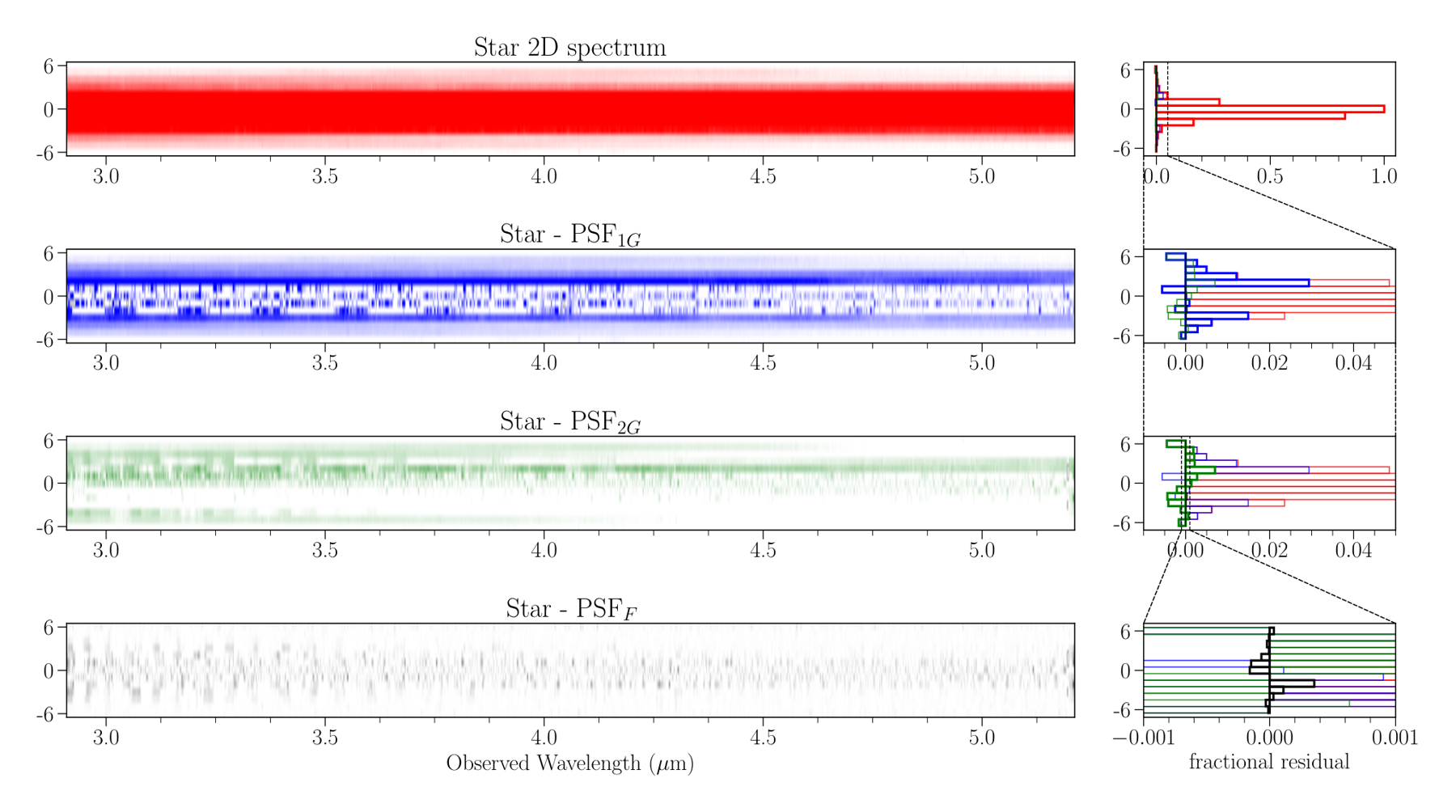
SHELLQs-JWST: Revealing the Spectra of Extended Emission in 12 z > 6 Quasar Host Galaxies using the JWST NIRSpec Fixed Slit

Camryn L. Phillips, Michael A. Strauss, Masafusa Onoue, et al.

In twelve z=6.0–6.4 low-luminosity SHELLQs quasars, wavelength-dependent PSF subtraction isolates extended host emission. The authors report mostly main-sequence-consistent Hα upper-limit SFRs, one [O III] outflow, and one disk-like rotation, while narrow-line-region contamination complicates interpretation.

2025-10-22 · 2510.19904v1 · Research note

The Synthetic Absorption Line Spectral Almanac (SALSA)

Dylan Nelson, Celine Peroux, Philipp Richter, et al.

SALSA publicly releases synthetic absorption-line spectra from cosmological simulations, using Voronoi-mesh ray tracing to connect ISM, CGM, and IGM gas to survey-like observables. Its principal value is controlled mock-survey and galaxy–absorber analyses, bounded by ionization, yield, and dust-model assumptions.

2025-10-16 · 2510.14779v1 · Research note

The dark side of early galaxies: $\texttt{geko}$ uncovers dark-matter fractions at $z\sim4-6$

A. Lola Danhaive, Sandro Tacchella, Andrew J. Bunker, et al.

Forward modelling of JWST grism Hα morpho-kinematics for 163 z≈4–6 galaxies yields predominantly gas-rich, dark-matter-dominated inner regions. The inferred fractions decline with stellar mass, while the nascent stellar Tully–Fisher relation has substantial scatter.

Figure 2 from Extremely UV-bright starbursts at the end of cosmic reionization

2025-10-14 · 2510.12411v1 · Research note

Extremely UV-bright starbursts at the end of cosmic reionization

R. Marques-Chaves, D. Schaerer, M. Dessauges-Zavadsky, et al.

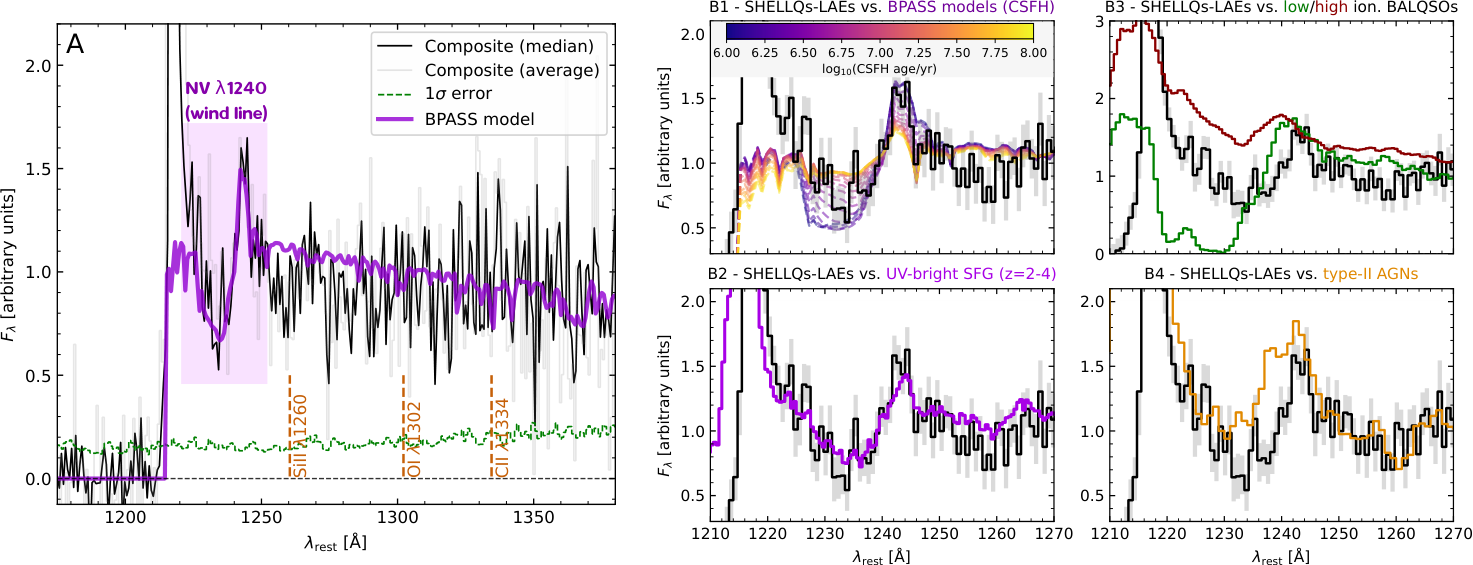
A 27-object z~6 SHELLQs sample is interpreted as very young, ionizing starbursts; JWST/ALMA observations of J0217-0208 link its exceptional UV brightness to compact star formation and a dusty ionized outflow, though the proposed causal link remains model-dependent.

2025-10-12 · 2510.10772v1 · Research note

Black Holes in the Shadow: The Missing High-Ionization Lines in the Earliest JWST AGNs

Greta Zucchi, Xihan Ji, Piero Madau, et al.

Stacked JADES Type 1 AGN spectra at z>5 show strong Balmer emission but weak or absent high-ionization lines. Cloudy comparisons disfavour much of the tested sub-Eddington parameter space, motivating—but not uniquely establishing—soft, filtered, or anisotropic ionizing continua.

Figure 4 from Resolving stellar populations, star formation, and ISM conditions with JWST in a large spiral galaxy at z $\sim$ 2

2025-10-10 · 2510.09820v1 · Research note

Resolving stellar populations, star formation, and ISM conditions with JWST in a large spiral galaxy at z $\sim$ 2

Eleonora Parlanti, Giulia Tozzi, Natascha M. Förster Schreiber, et al.

JWST and ERIS resolve K20-ID7, a z=2.2 spiral, into dusty central and lower-extinction clumpy star-forming components. The authors interpret older inner populations, chemical abundances, and known inflows as evidence consistent with inside-out growth and gas dilution.

2025-10-10 · 2510.09753v1 · Research note

BEES: Quasar lifetime measurements from extended rest-optical emission line nebulae at $z\sim6$

Dominika Ďurovčíková, Anna-Christina Eilers, Yuzo Ishikawa, et al.

JWST/NIRSpec IFU observations of five z~6 small-proximity-zone quasars find extended Hα and [O III] around four, using nebular light-travel scales to support very short UV-luminous episodes (tQ≲10^5 yr) independently of resonant Lyα interpretation.

2025-10-09 · 2510.08455v1 · Research note

A first look at quasar-galaxy clustering at $z\simeq7.3$

Jan-Torge Schindler, Joseph F. Hennawi, Frederick B. Davies, et al.

JWST spectroscopy of galaxies around two z=7.0–7.5 quasars yields a tentative z≈7.3 quasar–galaxy clustering measurement, implying comparatively modest halo masses and a short duty cycle, but only eight associated galaxies make cosmic variance and modeling assumptions consequential.

Figure 3 from The $M_{\rm BH}-M_{*}$ Relationship at $3<z<7$: Big Black Holes in Little Red Dots

2025-10-08 · 2510.07376v1 · Research note

The $M_{\rm BH}-M_{*}$ Relationship at $3<z<7$: Big Black Holes in Little Red Dots

Brenda L. Jones, Dale D. Kocevski, Fabio Pacucci, et al.

For 70 JWST broad-line AGN at 3<z<7, the authors infer black holes overmassive relative to local broad-line AGN, with the offset and BH-to-stellar-mass ratio increasing toward high redshift; LRD-rich sample composition contributes substantially.

2025-10-08 · 2510.07365v1 · Research note

A JWST MIRI LRS Survey of 37 Massive Star-Forming Galaxies and AGN at Cosmic Noon -- Overview and First Results

Jed McKinney, Miriam Eleazer, Alexandra Pope, et al.

JWST/MIRI LRS plus archival Spitzer spectra of 37 luminous, massive galaxies at z=0.65–2.46 yield widespread 3.3 μm PAH detections and a low-scatter SFR relation, while ice-aware decomposition reveals PAH-ratio differences from local LIRGs.

2025-10-08 · 2510.07303v1 · Research note

Confirming Near- to Mid-IR Photometrically-Identified Obscured AGNs in the JWST era

George H. Rieke, Yang Sun, Jianwei Lyu, et al.

Rest-optical spectroscopy generally supports 1–6 μm SED-selected obscured AGN in massive (log M⋆>9.5) galaxies to z≈3, but redshift errors can create false positives. For dwarfs, a Haro 11 limiting template is proposed to reduce warm-dust contamination.

Figure 2 from Evidence of violation of Case B recombination in Little Red Dots

2025-10-07 · 2510.06362v1 · Research note

Evidence of violation of Case B recombination in Little Red Dots

G. P. Nikopoulos, D. Watson, A. Sneppen, et al.

JWST/NIRSpec Balmer decompositions in seven Little Red Dots generally support Case B recombination plus strong broad-line extinction, but RUBIES EGS-49140 is inconsistent at >5σ, plausibly indicating optically thick, very dense gas rather than an ordinary dust law.

Figure 1 from A z ~ 0.4 Galaxy Reflecting the high-redshift Little Red Dots: An Extended Starburst with an Overmassive Black Hole

2025-10-03 · 2510.02801v1 · Research note

A z ~ 0.4 Galaxy Reflecting the high-redshift Little Red Dots: An Extended Starburst with an Overmassive Black Hole

Xiaoyang Chen, Kohei Ichikawa, Masayuki Akiyama, et al.

Gemini/GMOS IFU plus archival SED data identify J2048 at z=0.4330 as an LRD-like AGN with spatially extended young-starburst and ionized-outflow signatures; the authors infer a ~400 M⊙ yr⁻¹ SFR and an unusually high inferred black-hole-to-stellar-mass ratio.

2025-10-02 · 2510.02517v1 · Research note

Impact of AGN and nuclear star formation on the ISM turbulence of galaxies: Insights from JWST/MIRI spectroscopy

Rogemar A. Riffel, Luis Colina, José Henrique Costa-Souza, et al.

JWST/MIRI mapping of 54 nearby galaxies finds broader ionized than warm-H2 lines in AGN, especially radio-strong systems; line-ratio/model comparisons associate the most turbulent gas with shocks, while the authors cautiously propose AGN or stellar-feedback origins.

Figure 7 from The warm outer layer of a Little Red Dot as the source of [Fe II] and collisional Balmer lines with scattering wings

2025-09-30 · 2510.00103v1 · Research note

The warm outer layer of a Little Red Dot as the source of [Fe II] and collisional Balmer lines with scattering wings

Alberto Torralba, Jorryt Matthee, Gabriele Pezzulli, et al.

Deep JWST spectra of the single z=5.535 LRD GN-9771 reveal optical [Fe II] and unusual Balmer profiles consistent with a dense, ∼7000 K radiative-transfer layer; if scattering dominates the wings, standard virial black-hole masses may be biased high.

Figure 4 from Irony at z=6.68: a bright AGN with forbidden Fe emission and multi-component Balmer absorption

2025-09-30 · 2510.00101v1 · Research note

Irony at z=6.68: a bright AGN with forbidden Fe emission and multi-component Balmer absorption

Francesco D'Eugenio, Erica Nelson, Xihan Ji, et al.

Deep JWST/NIRSpec spectroscopy of the z=6.68 Little Red Dot Irony supports an AGN viewed through dense, stratified, multi-component gas: Balmer absorption covers both continuum and broad-line emission, while black-hole inferences remain profile-dependent.

2025-09-29 · 2509.25483v1 · Research note

Shocked, Heated, and Now Resolved: H$_2$ excitation in the low-luminosity AGN at M58 core with JWST

I. E. López, E. Bertola, V. Reynaldi, et al.

JWST spectroscopy of M58’s central kiloparsec resolves warm H₂ in dust lanes and a turbulent inner region; the authors infer predominantly low-velocity C-type shocks, with lower-density non-thermal excitation affecting rovibrational lines near the LLAGN.

2025-09-24 · 2509.20597v1 · Research note

The X-ray Emission of NGC 5005: An Unobscured Low-Luminosity AGN with a Weakly Accreting Broad-Line Region

Anna Trindade Falcão, R. Middei, G. Fabbiano, et al.

A 255 ks Chandra study resolves NGC 5005’s soft, extended gas from a faint hard nucleus. The authors infer a lightly absorbed, intrinsically weak AGN whose reported broad Hα line persists at an exceptionally low inferred Eddington ratio.

2025-09-24 · 2509.20455v1

BlackTHUNDER: Shedding light on a dormant and extreme little red dot at z=8.50

Gareth C. Jones, Hannah Übler, Roberto Maiolino, et al.

BlackTHUNDER presents JWST/NIRSpec IFU spectroscopy of UNCOVER_20466 (z=8.50), confirming its LRD nature and an overmassive central black hole. Balmer decrements indicate little dust, yielding an Hβ-based bolometric output and Eddington ratio only ~10% of earlier estimates—consistent with a currently subdued/dormant phase. Strong Lyα (f_esc ≈ 30%) and an extreme [O III]4363/Hγ imply AGN photoionization with ultra-dense gas (n_e ~ 10^7 cm^-3). The source sits on local M_BH–σ_* and M_BH–M_dyn relations and is compatible with growth from a heavy seed (~10^3 M⊙), marking it as a likely progenitor core of a later galaxy.

2025-09-24 · 2509.20452v1

A GLIMPSE of Intermediate Mass Black holes in the epoch of reionization: Witnessing the Descendants of Direct Collapse?

Qinyue Fei, Seiji Fujimoto, Rohan P. Naidu, et al.

Ultra-deep JWST/NIRSpec G395M spectroscopy behind Abell S1063 enables a systematic search for faint broad-line nuclei, fitting narrow components with an [O III] λ5007 template and validating the method with mocks. The authors identify ten broad-line AGN at 4.5<z<7.0 (eight secure, two tentative) with broad Hα–based virial masses down to ~10^5.5 Msun; composite galaxy+AGN SEDs yield host masses implying M_BH/M_* ≲ 0.1% and placements consistent with the local M_BH–M_* relation. From these they build a BH mass function that agrees with prior results above ~10^6.5 Msun but shows an excess at ~10^5.5 Msun relative to a Schechter extrapolation. They interpret the low-mass excess as evidence for descendants of direct-collapse seeds in the reionization era.

2025-09-18 · 2509.14555v1

Stratified wind from a super-Eddington X-ray binary is slower than expected

XRISM collaboration, Marc Audard</name> <arxiv:affiliation>Durham-CEA, UK</arxiv:affiliation> </author> <author> <name>Hisamitsu Awaki</name> <arxiv:affiliation>Durham-CEA, UK</arxiv:affiliation> </author> <author> <name>Ralf Ballhausen</name> <arxiv:affiliation>Durham-CEA, UK</arxiv:affiliation> </author> <author> <name>Aya Bamba</name> <arxiv:affiliation>Durham-CEA, UK</arxiv:affiliation> </author> <author> <name>Ehud Behar</name> <arxiv:affiliation>Durham-CEA, UK</arxiv:affiliation> </author> <author> <name>Rozenn Boissay-Malaquin</name> <arxiv:affiliation>Durham-CEA, UK</arxiv:affiliation> </author> <author> <name>Laura Brenneman</name> <arxiv:affiliation>Durham-CEA, UK</arxiv:affiliation> </author> <author> <name>Gregory V. Brown</name> <arxiv:affiliation>Durham-CEA, UK</arxiv:affiliation> </author> <author> <name>Lia Corrales</name> <arxiv:affiliation>Durham-CEA, UK</arxiv:affiliation> </author> <author> <name>Elisa Costantini</name> <arxiv:affiliation>Durham-CEA, UK</arxiv:affiliation> </author> <author> <name>Renata Cumbee</name> <arxiv:affiliation>Durham-CEA, UK</arxiv:affiliation> </author> <author> <name>Maria Diaz Trigo</name> <arxiv:affiliation>Durham-CEA, UK</arxiv:affiliation> </author> <author> <name>Chris Done</name> <arxiv:affiliation>Durham-CEA, UK</arxiv:affiliation> </author> <author> <name>Tadayasu Dotani</name> <arxiv:affiliation>Fukuoka, Japan</arxiv:affiliation> </author> <author> <name>Ken Ebisawa</name> <arxiv:affiliation>Fukuoka, Japan</arxiv:affiliation> </author> <author> <name>Megan Eckart</name> <arxiv:affiliation>Fukuoka, Japan</arxiv:affiliation> </author> <author> <name>Dominique Eckert</name> <arxiv:affiliation>Fukuoka, Japan</arxiv:affiliation> </author> <author> <name>Teruaki Enoto</name> <arxiv:affiliation>Fukuoka, Japan</arxiv:affiliation> </author> <author> <name>Satoshi Eguchi</name> <arxiv:affiliation>Fukuoka, Japan</arxiv:affiliation> </author> <author> <name>Yuichiro Ezoe</name> <arxiv:affiliation>Fukuoka, Japan</arxiv:affiliation> </author> <author> <name>Adam Foster</name> <arxiv:affiliation>Fukuoka, Japan</arxiv:affiliation> </author> <author> <name>Ryuichi Fujimoto</name> <arxiv:affiliation>Fukuoka, Japan</arxiv:affiliation> </author> <author> <name>Yutaka Fujita</name> <arxiv:affiliation>Fukuoka, Japan</arxiv:affiliation> </author> <author> <name>Yasushi Fukazawa</name> <arxiv:affiliation>Fukuoka, Japan</arxiv:affiliation> </author> <author> <name>Kotaro Fukushima</name> <arxiv:affiliation>Fukuoka, Japan</arxiv:affiliation> </author> <author> <name>Akihiro Furuzawa</name> <arxiv:affiliation>Fukuoka, Japan</arxiv:affiliation> </author> <author> <name>Luigi Gallo</name> <arxiv:affiliation>Fukuoka, Japan</arxiv:affiliation> </author> <author> <name>Javier A. Garcia</name> <arxiv:affiliation>Fukuoka, Japan</arxiv:affiliation> </author> <author> <name>Liyi Gu</name> <arxiv:affiliation>Fukuoka, Japan</arxiv:affiliation> </author> <author> <name>Matteo Guainazzi</name> <arxiv:affiliation>Fukuoka, Japan</arxiv:affiliation> </author> <author> <name>Kouichi Hagino</name> <arxiv:affiliation>Fukuoka, Japan</arxiv:affiliation> </author> <author> <name>Kenji Hamaguchi</name> <arxiv:affiliation>Fukuoka, Japan</arxiv:affiliation> </author> <author> <name>Isamu Hatsukade</name> <arxiv:affiliation>Fukuoka, Japan</arxiv:affiliation> </author> <author> <name>Katsuhiro Hayashi</name> <arxiv:affiliation>Fukuoka, Japan</arxiv:affiliation> </author> <author> <name>Takayuki Hayashi</name> <arxiv:affiliation>Fukuoka, Japan</arxiv:affiliation> </author> <author> <name>Natalie Hell</name> <arxiv:affiliation>Fukuoka, Japan</arxiv:affiliation> </author> <author> <name>Edmund Hodges-Kluck</name> <arxiv:affiliation>Fukuoka, Japan</arxiv:affiliation> </author> <author> <name>Ann Hornschemeier</name> <arxiv:affiliation>Fukuoka, Japan</arxiv:affiliation> </author> <author> <name>Yuto Ichinohe</name> <arxiv:affiliation>Fukuoka, Japan</arxiv:affiliation> </author> <author> <name>Manabu Ishida</name> <arxiv:affiliation>Fukuoka, Japan</arxiv:affiliation> </author> <author> <name>Kumi Ishikawa</name> <arxiv:affiliation>Fukuoka, Japan</arxiv:affiliation> </author> <author> <name>Yoshitaka Ishisaki</name> <arxiv:affiliation>Fukuoka, Japan</arxiv:affiliation> </author> <author> <name>Jelle Kaastra</name> <arxiv:affiliation>Fukuoka, Japan</arxiv:affiliation> </author> <author> <name>Timothy Kallman</name> <arxiv:affiliation>Fukuoka, Japan</arxiv:affiliation> </author> <author> <name>Erin Kara</name> <arxiv:affiliation>Fukuoka, Japan</arxiv:affiliation> </author> <author> <name>Satoru Katsuda</name> <arxiv:affiliation>Fukuoka, Japan</arxiv:affiliation> </author> <author> <name>Yoshiaki Kanemaru</name> <arxiv:affiliation>Fukuoka, Japan</arxiv:affiliation> </author> <author> <name>Richard Kelley</name> <arxiv:affiliation>Fukuoka, Japan</arxiv:affiliation> </author> <author> <name>Caroline Kilbourne</name> <arxiv:affiliation>Fukuoka, Japan</arxiv:affiliation> </author> <author> <name>Shunji Kitamoto</name> <arxiv:affiliation>Fukuoka, Japan</arxiv:affiliation> </author> <author> <name>Shogo Kobayashi</name> <arxiv:affiliation>Fukuoka, Japan</arxiv:affiliation> </author> <author> <name>Takayoshi Kohmura</name> <arxiv:affiliation>Fukuoka, Japan</arxiv:affiliation> </author> <author> <name>Aya Kubota</name> <arxiv:affiliation>Fukuoka, Japan</arxiv:affiliation> </author> <author> <name>Maurice Leutenegger</name> <arxiv:affiliation>Fukuoka, Japan</arxiv:affiliation> </author> <author> <name>Michael Loewenstein</name> <arxiv:affiliation>Fukuoka, Japan</arxiv:affiliation> </author> <author> <name>Yoshitomo Maeda</name> <arxiv:affiliation>Fukuoka, Japan</arxiv:affiliation> </author> <author> <name>Maxim Markevitch</name> <arxiv:affiliation>Fukuoka, Japan</arxiv:affiliation> </author> <author> <name>Hironori Matsumoto</name> <arxiv:affiliation>Fukuoka, Japan</arxiv:affiliation> </author> <author> <name>Kyoko Matsushita</name> <arxiv:affiliation>Fukuoka, Japan</arxiv:affiliation> </author> <author> <name>Dan McCammon</name> <arxiv:affiliation>Fukuoka, Japan</arxiv:affiliation> </author> <author> <name>Brian McNamara</name> <arxiv:affiliation>Fukuoka, Japan</arxiv:affiliation> </author> <author> <name>Francois Mernier</name> <arxiv:affiliation>Fukuoka, Japan</arxiv:affiliation> </author> <author> <name>Eric D. Miller</name> <arxiv:affiliation>Fukuoka, Japan</arxiv:affiliation> </author> <author> <name>Jon M. Miller</name> <arxiv:affiliation>Fukuoka, Japan</arxiv:affiliation> </author> <author> <name>Ikuyuki Mitsuishi</name> <arxiv:affiliation>Fukuoka, Japan</arxiv:affiliation> </author> <author> <name>Misaki Mizumoto</name> <arxiv:affiliation>Fukuoka, Japan</arxiv:affiliation> </author> <author> <name>Tsunefumi Mizuno</name> <arxiv:affiliation>Villanova, USA</arxiv:affiliation> </author> <author> <name>Koji Mori</name> <arxiv:affiliation>Villanova, USA</arxiv:affiliation> </author> <author> <name>Koji Mukai</name> <arxiv:affiliation>Villanova, USA</arxiv:affiliation> </author> <author> <name>Hiroshi Murakami</name> <arxiv:affiliation>Villanova, USA</arxiv:affiliation> </author> <author> <name>Richard Mushotzky</name> <arxiv:affiliation>Villanova, USA</arxiv:affiliation> </author> <author> <name>Hiroshi Nakajima</name> <arxiv:affiliation>Villanova, USA</arxiv:affiliation> </author> <author> <name>Kazuhiro Nakazawa</name> <arxiv:affiliation>Villanova, USA</arxiv:affiliation> </author> <author> <name>Jan-Uwe Ness</name> <arxiv:affiliation>Villanova, USA</arxiv:affiliation> </author> <author> <name>Kumiko Nobukawa</name> <arxiv:affiliation>Villanova, USA</arxiv:affiliation> </author> <author> <name>Masayoshi Nobukawa</name> <arxiv:affiliation>Villanova, USA</arxiv:affiliation> </author> <author> <name>Hirofumi Noda</name> <arxiv:affiliation>Villanova, USA</arxiv:affiliation> </author> <author> <name>Hirokazu Odaka</name> <arxiv:affiliation>Villanova, USA</arxiv:affiliation> </author> <author> <name>Shoji Ogawa</name> <arxiv:affiliation>Villanova, USA</arxiv:affiliation> </author> <author> <name>Anna Ogorzalek</name> <arxiv:affiliation>Villanova, USA</arxiv:affiliation> </author> <author> <name>Takashi Okajima</name> <arxiv:affiliation>Villanova, USA</arxiv:affiliation> </author> <author> <name>Naomi Ota</name> <arxiv:affiliation>Villanova, USA</arxiv:affiliation> </author> <author> <name>Stephane Paltani</name> <arxiv:affiliation>Villanova, USA</arxiv:affiliation> </author> <author> <name>Robert Petre</name> <arxiv:affiliation>Villanova, USA</arxiv:affiliation> </author> <author> <name>Paul Plucinsky</name> <arxiv:affiliation>Villanova, USA</arxiv:affiliation> </author> <author> <name>Frederick Scott Porter</name> <arxiv:affiliation>Villanova, USA</arxiv:affiliation> </author> <author> <name>Katja Pottschmidt</name> <arxiv:affiliation>Villanova, USA</arxiv:affiliation> </author> <author> <name>Kosuke Sato</name> <arxiv:affiliation>Villanova, USA</arxiv:affiliation> </author> <author> <name>Toshiki Sato</name> <arxiv:affiliation>Villanova, USA</arxiv:affiliation> </author> <author> <name>Makoto Sawada</name> <arxiv:affiliation>Villanova, USA</arxiv:affiliation> </author> <author> <name>Hiromi Seta</name> <arxiv:affiliation>Villanova, USA</arxiv:affiliation> </author> <author> <name>Megumi Shidatsu</name> <arxiv:affiliation>Villanova, USA</arxiv:affiliation> </author> <author> <name>Aurora Simionescu</name> <arxiv:affiliation>Villanova, USA</arxiv:affiliation> </author> <author> <name>Randall Smith</name> <arxiv:affiliation>Villanova, USA</arxiv:affiliation> </author> <author> <name>Hiromasa Suzuki</name> <arxiv:affiliation>Villanova, USA</arxiv:affiliation> </author> <author> <name>Andrew Szymkowiak</name> <arxiv:affiliation>Villanova, USA</arxiv:affiliation> </author> <author> <name>Hiromitsu Takahashi</name> <arxiv:affiliation>Villanova, USA</arxiv:affiliation> </author> <author> <name>Mai Takeo</name> <arxiv:affiliation>Villanova, USA</arxiv:affiliation> </author> <author> <name>Toru Tamagawa</name> <arxiv:affiliation>Villanova, USA</arxiv:affiliation> </author> <author> <name>Keisuke Tamura</name> <arxiv:affiliation>Villanova, USA</arxiv:affiliation> </author> <author> <name>Takaaki Tanaka</name> <arxiv:affiliation>Villanova, USA</arxiv:affiliation> </author> <author> <name>Atsushi Tanimoto</name> <arxiv:affiliation>Villanova, USA</arxiv:affiliation> </author> <author> <name>Makoto Tashiro</name> <arxiv:affiliation>Villanova, USA</arxiv:affiliation> </author> <author> <name>Yukikatsu Terada</name> <arxiv:affiliation>Villanova, USA</arxiv:affiliation> </author> <author> <name>Yuichi Terashima</name> <arxiv:affiliation>Villanova, USA</arxiv:affiliation> </author> <author> <name>Yohko Tsuboi</name> <arxiv:affiliation>Villanova, USA</arxiv:affiliation> </author> <author> <name>Masahiro Tsujimoto</name> <arxiv:affiliation>Villanova, USA</arxiv:affiliation> </author> <author> <name>Hiroshi Tsunemi</name> <arxiv:affiliation>Villanova, USA</arxiv:affiliation> </author> <author> <name>Takeshi G. Tsuru</name> <arxiv:affiliation>Villanova, USA</arxiv:affiliation> </author> <author> <name>Aysegul Tumer</name> <arxiv:affiliation>Villanova, USA</arxiv:affiliation> </author> <author> <name>Hiroyuki Uchida</name> <arxiv:affiliation>Villanova, USA</arxiv:affiliation> </author> <author> <name>Nagomi Uchida</name> <arxiv:affiliation>Villanova, USA</arxiv:affiliation> </author> <author> <name>Yuusuke Uchida</name> <arxiv:affiliation>Villanova, USA</arxiv:affiliation> </author> <author> <name>Hideki Uchiyama</name> <arxiv:affiliation>Villanova, USA</arxiv:affiliation> </author> <author> <name>Yoshihiro Ueda</name> <arxiv:affiliation>Villanova, USA</arxiv:affiliation> </author> <author> <name>Shinichiro Uno</name> <arxiv:affiliation>Villanova, USA</arxiv:affiliation> </author> <author> <name>Jacco Vink</name> <arxiv:affiliation>Villanova, USA</arxiv:affiliation> </author> <author> <name>Shin Watanabe</name> <arxiv:affiliation>Villanova, USA</arxiv:affiliation> </author> <author> <name>Brian J. Williams</name> <arxiv:affiliation>Villanova, USA</arxiv:affiliation> </author> <author> <name>Satoshi Yamada</name> <arxiv:affiliation>Villanova, USA</arxiv:affiliation> </author> <author> <name>Shinya Yamada</name> <arxiv:affiliation>Villanova, USA</arxiv:affiliation> </author> <author> <name>Hiroya Yamaguchi</name> <arxiv:affiliation>Villanova, USA</arxiv:affiliation> </author> <author> <name>Kazutaka Yamaoka</name> <arxiv:affiliation>Villanova, USA</arxiv:affiliation> </author> <author> <name>Noriko Yamasaki</name> <arxiv:affiliation>Villanova, USA</arxiv:affiliation> </author> <author> <name>Makoto Yamauchi</name> <arxiv:affiliation>Villanova, USA</arxiv:affiliation> </author> <author> <name>Shigeo Yamauchi</name> <arxiv:affiliation>Villanova, USA</arxiv:affiliation> </author> <author> <name>Tahir Yaqoob</name> <arxiv:affiliation>Villanova, USA</arxiv:affiliation> </author> <author> <name>Tomokage Yoneyama</name> <arxiv:affiliation>Villanova, USA</arxiv:affiliation> </author> <author> <name>Tessei Yoshida</name> <arxiv:affiliation>Villanova, USA</arxiv:affiliation> </author> <author> <name>Mihoko Yukita</name> <arxiv:affiliation>Villanova, USA</arxiv:affiliation> </author> <author> <name>Irina Zhuravleva</name> <arxiv:affiliation>Villanova, USA</arxiv:affiliation> </author> <author> <name>Joey Neilsen</name> <arxiv:affiliation>Villanova, USA</arxiv:affiliation> </author> <author> <name>Ryota Tomaru</name> <arxiv:affiliation>Osaka, Japan</arxiv:affiliation> </author> <author> <name>Missagh Mehdipour

XRISM/Resolve’s 2024-02-25 spectrum of the neutron-star binary GX 13+1 reveals a stratified, highly ionised, Compton-thick wind via dozens of narrow, slightly blueshifted lines from Si–Ni, including high-order Fe XXV/XXVI features above 7 keV. Photoionisation fits require a slow, very dense absorber plus a faster (~700 km/s), more ionised layer to reproduce the Fe XXVI Ly blue wing and residual core flux from wind reprocessing. After correcting for electron-scattering attenuation, the intrinsic luminosity is at or above Eddington, yet the outflow is extremely slow, favouring a thermal‑radiative outer-disc origin over an inner-disc radiation‑pressure (Eddington) wind. The contrast with ultrafast (~0.3c) SMBH winds at similar Eddington ratios points to fundamentally different launch mechanisms across mass scales.

2025-09-11 · 2509.09607v1

Discovery of Multiply Ionized Iron Emission Powered by an Active Galactic Nucleus in a z~7 Little Red Dot

Erini Lambrides, Rebecca Larson, Taylor Hutchison, et al.

THRILS spectroscopy of the z~7 Little Red Dot THRILS_46403 (CEERS-10444/RUBIES_49140) reveals bona fide AGN tracers: multiple Fe lines including a 4.5σ [Fe VII] and several [Fe II], plus an auroral [N II] detection at 3.1σ. Three Balmer lines show broad emission with superposed narrow absorption whose small widths and depths imply a partially covering absorber at or beyond the broad-line region. Electron-temperature diagnostics indicate O++ is markedly hotter than N+ across densities, pointing to a powerful, hard central ionizing source. Together these features establish multiply ionized iron emission from an accreting SMBH within the first 800 Myr and suggest direct sight-lines from the disk to gas at or beyond the BLR.

2025-09-09 · 2509.07611v1

Balmer Absorption in Iron Low-Ionization Broad Absorption Line Quasars

Karen M. Leighly, Sarah C. Gallagher, Hyunseop Choi, et al.

Analyzes Balmer absorption in 14 FeLoBAL quasars (8 new), measuring velocities, widths, and apparent optical depths, and correcting for partial covering to infer true H(n=2) columns. Finds only a weak Eddington ratio–outflow speed trend because most objects are low‑speed “loitering” outflows; dN/dv peaks at low velocities and anticorrelates with luminosity and Eddington ratio. Reports a correlation between Balmer-line width and the optical–IR slope αoi, tying absorber kinematics to SED/accretion state. Notes parallels with Little Red Dots—V‑shaped continua, steep reddening with a scattered blue component, weak hot dust, and X‑ray weakness—hinting at shared conditions that elevate the n=2 population.

2025-09-08 · 2509.07064v1

GA-NIFS: an extended [OIII] halo around the sub-Eddington quasar J1342+0928 at z=7.54

Bartolomeo Trefoloni, Stefano Carniani, Elena Bertola, et al.

JWST/NIRSpec IFS (GA-NIFS) observations of ULAS J1342+0928 (z=7.54) combine prism (R~100) and high-resolution grating (R~2700) to map rest-UV–optical emission and kinematics. The prism cube reveals [O III] λ5007 extended over ~7 kpc—well beyond typical galaxy sizes—consistent with a relic from a past outflow, while the grating data resolve a compact (≤0.6 kpc) nuclear ionized outflow with a mass-loss rate of 50–300 Msun/yr, comparable to the host SFR of 85–545 Msun/yr. Accretion-disk modeling yields log(MBH/Msun)=9.2±0.2 and log(Lbol/erg s−1)=46.8±0.1, implying λEdd≈0.4 and pointing to sub-Eddington growth at the epoch of reionization. The most distant BLR ratios (Fe II UV/Mg II and Fe II opt/Hβ) indicate early metal enrichment; the outflow-rate range is chiefly set by uncertain ne.

2025-09-05 · 2509.05417v1

The Light Echo of a High-Redshift Quasar mapped with Lyman-$α$ Tomography

Anna-Christina Eilers, Minghao Yue, Jorryt Matthee, et al.

Deep JWST/NIRSpec MSA spectroscopy of twelve background galaxies behind the z_QSO ≈ 6.3 quasar J0100+2802 yields the first spectroscopic Lyα-tomography map of a quasar “light echo” in the transverse direction. Clear excess Lyα transmission at the quasar’s systemic redshift appears along multiple sightlines, enabling a 3D reconstruction of the ionized bubble and its ionization-cone orientation/inclination, and setting f_obsc < 91%. Modeling the light-travel geometry implies a UV-on timescale t_QSO = 10^{5.6+0.1}_{-0.3} yr (≈2–5×10^5 yr), far shorter than required for continuous thin-disk growth to the observed SMBH mass. This disfavors purely geometric obscuration as the sole cause of short lifetimes and points to radiatively inefficient or initially enshrouded accretion phases in early SMBH growth.

2025-09-02 · 2509.02027v1

The ALPINE-CRISTAL-JWST Survey: Revealing Less Massive Black Holes in High-Redshift Galaxies

Wenke Ren, John D. Silverman, Andreas L. Faisst, et al.

ALPINE-CRISTAL-JWST uses NIRSpec IFU aperture spectra at photometric peaks in 18 z=4.4–5.7 main-sequence galaxies and finds 7 broad-line AGN candidates via Hα, including one robust source (FWHM ≈ 2800 km/s) and six with 600–1600 km/s, two in a merger. Narrow-line diagnostics place these systems within the star-forming locus, so broad-line detection is the only reliable discriminator; the implied broad-line AGN fraction is 5.9–33% and is aided by targeting high-mass hosts. Virial estimates give MBH ≈ 10^6–10^{7.5} M⊙ with Lbol/LEdd ≈ 0.1–1, and candidates lie at or below the local MBH–M* relation, counter to prior JWST reports of overmassive BHs. The work highlights mass-dependent selection effects and points to a substantial, previously missed population of faint, undermassive broad-line AGN at early times.

2025-08-29 · 2509.00153v1

Quasar Radiative Feedback May Suppress Galaxy Growth on Intergalactic Scales at $z = 6.3$

Yongda Zhu, Eiichi Egami, Xiaohui Fan, et al.

Using JWST/NIRCam grism WFSS from the SAPPHIRES and EIGER programs, the authors map [O III] emitters around the z=6.3 quasar J0100+2802 and analyze 130 sources to test radiative feedback. They find a clear decline in [O III] λ5008-to-UV luminosity (L5008/L1500) toward the quasar over ~8–10 cMpc: L1500 stays flat with distance while L5008 rises away from the quasar, and the trend tracks the projected photoionization-rate profile Γ_qso, with a weaker but consistent signal along the line of sight. The inferred transverse suppression radius implies a recent radiative episode of ~4.5 Myr, favoring rapid H2 photodissociation over slower thermal photoheating as the mechanism. Environmental effects alone cannot reproduce the signal, offering geometry-based constraints on intergalactic quasar feedback and recent quasar lifetimes.

2025-08-29 · 2508.21818v1

First constraints on the local ionization topology in front of two quasars at z ~ 7.5

Timo Kist, Joseph F. Hennawi, Frederick B. Davies, et al.

Uses JWST/NIRSpec damping-wing fits and a three-parameter local model to extract the Lorentzian-weighted HI column N_HI^DW, the distance to the first neutral patch r_patch, and the quasar lifetime t_Q in front of two z ≈ 7.5 quasars. J1007+2115 favors a moderately ionized IGM with ⟨x_HI⟩ = 0.32^{+0.22}_{-0.20}, an exceptionally short lifetime log10 t_Q/yr = 4.14^{+0.74}_{-0.18}, r_patch ≈ 28.9 cMpc, and log10 N_HI^DW ≈ 19.70, while J1342+0928 implies a higher neutral fraction ⟨x_HI⟩ = 0.58^{+0.23}_{-0.23}, an intermediate lifetime log10 t_Q/yr = 5.64^{+0.25}_{-0.43}, r_patch ≈ 10.9 cMpc, and log10 N_HI^DW ≈ 20.24. Mapping these local constraints through topology-informed priors links the sightline-level topology to global reionization timing. The N_HI^DW metric also naturally captures potential contributions from foreground absorbers toward J1342+0928.

2025-08-29 · 2508.21748v1

A direct black hole mass measurement in a Little Red Dot at the Epoch of Reionization

Ignas Juodžbalis, Cosimo Marconcini, Francesco D'Eugenio, et al.

Strong lensing plus JWST/NIRSpec IFS resolves narrow Hα kinematics and spectroastrometric shifts in the lensed Little Red Dot Abell2744‑QSO1 at z=7.04, enabling a direct rotation curve from ~10–200 pc. The curve is Keplerian and rules out compact extended mass profiles (e.g., MW‑like nuclear star cluster, Plummer, or a DM cusp), implying a central point mass of order 5×10^7 M⊙ consistent with Balmer‑line virial estimates. The inferred stellar content is minimal, with MBH/M* > 2, pointing to a near‑“naked” black hole in a pristine environment. This result validates virial BH masses for LRDs at the EoR and captures a massive BH seed in its earliest growth phase.

2025-08-27 · 2508.20177v1

MEGA: Spectrophotometric SED Fitting of Little Red Dots Detected in JWST MIRI

Kaila Ronayne, Casey Papovich, Allison Kirkpatrick, et al.

MEGA fits JWST/NIRCam+NIRSpec+MIRI SEDs for eight spectroscopically confirmed Little Red Dots at z=5.1–8.7 using CIGALE and Prospector across star-forming, AGN-dominated, and composite scenarios. By BIC, six of eight prefer AGN-dominated solutions, consistent with red F150W–F444W > 1 but flat F444W–F770W and −1.0 < F1000W–F1500W < 1.1 colors that imply weak hot dust. Two Balmer-break LRDs with broad Hα are matched by hot, dense-gas (log T=5–5.7; log n=9–11) plus an added 800–1400 K thermal component, with total Lbol/L_sun < 10^12 and consistency with far-IR/radio limits. However, no single template reproduces all observables—the dense-gas fits miss the rest-UV and narrow [O III]—arguing for non-standard gas conditions and mixed AGN–star-formation.

2025-08-27 · 2508.19618v1

The BlueDOG at Cosmic Noon: A Possible Analog to Little Red Dots?

Seongjae Kim, Woong-Seob Jeong, Minjin Kim, et al.

Spectro-photometry of the hyperluminous BlueDOG ADFS-KMTDOG-102 (z=2.604) in ADF-S shows an extremely massive, heavily obscured system (log M*=12.3) with SED shape akin to JWST little red dots. Gemini-S GMOS+FLAMINGOS-2 spectra indicate AGN-dominated UV line ratios, a double-peaked, ~2″-extended Lyα, and an extinction-corrected broad Hα giving an enormous black hole (log MBH=10.2). The source thus links DOG-like hyperluminous systems to LRD-like SEDs at cosmic noon, suggesting rapid black-hole growth in a mature stellar host. The blue-excess UV continuum remains unresolved—consistent with either recent star formation or AGN-scattered light, with the Lyα escape fraction sitting near LAE relations.

2025-08-25 · 2508.18358v1

The Missing Hard Photons of Little Red Dots: Their Incident Ionizing Spectra Resemble Massive Stars

Bingjie Wang, Joel Leja, Harley Katz, et al.

Using recombination lines rather than continuum, the authors analyze uniformly selected RUBIES LRDs plus an 8 hr G395M spectrum of RUBIES‑EGS‑49140 to infer the incident ionizing spectra. They find a strong tension: very large Hα equivalent widths demand abundant H-ionizing photons, yet HeII is only marginally detected with HeII/Hβ ~10^-2, far below local AGN, implying an unusually soft spectrum missing hard photons. Cloudy modeling rules out standard AGN accretion-disk SEDs and favors soft, star-like ionizing fields (e.g., cold disks or AGN+stars composites) and/or high gas/dust optical depths, with HeII remaining an optically thin, robust tracer even in dense neutral hydrogen “black-hole star” envelopes. The HeII-based diagnostic reframes the LRD central-engine debate by highlighting missing hard photons and incident spectra that resemble massive stars.

2025-08-18 · 2508.12599v1

SMILES Data Release II: Probing Galaxy Evolution during Cosmic Noon and Beyond with NIRSpec Medium-Resolution Spectra

Yongda Zhu, Nina Bonaventura, Yang Sun, et al.

SMILES DR2 releases medium-resolution NIRSpec MSA spectra for 166 GOODS-S/HUDF galaxies spanning 0<z<7.5, with a strong emphasis on cosmic noon (z~1–3). Using the G140M/F100LP and G235M/F170LP settings to provide contiguous ~1–3 µm coverage (split near 1.8 µm), the team delivers reduced 1D/2D spectra, robust redshifts, emission-line catalogs (GELATO) and pPXF fits for quiescents, plus ancillary SED results. The dataset is tuned to capture rest‑optical diagnostics for dusty and obscured systems, enabling work on AGN, multi‑phase outflows, excitation, and metallicity in environmental context. Public HLSP availability makes this a ready benchmark set for cosmic‑noon black‑hole growth and ISM studies.

2025-08-14 · 2508.10986v1

Population III star formation near high-redshift active galactic nuclei

Ethan M. Fisk, Madeline A. Marshall, Phoebe R. Upton Sanderbeck, et al.

Cosmological radiation‑hydrodynamical simulations test quasar SEDs (near‑UV to hard X‑ray) impinging from 10–1000 kpc onto a neighboring halo and quantify how AGN radiation regulates primordial collapse. X‑rays keep the free‑electron fraction high, catalyzing H2 despite LW dissociation, so collapse is delayed until ≲10^7 Msun of pristine gas accumulates—yielding a massive Pop III cluster for the weaker two fields and a DCBH for the strongest. Runaway collapse occurs at z ≃ 24.99, 15.46, and 12.63 (A→C), directly tying radiation intensity to later collapse and larger available gas reservoirs. Predicted He II 1640 luminosities match the GN‑z11 Pop III candidate and should be detectable with NIRSpec to z ≈ 15, outlining an AGN‑proximity pathway to luminous Pop III clusters or early DCBH seeds.

2025-08-13 · 2508.09749v1

A dual AGN at z = 5.4 associated with a Lyman-alpha Nebula in the Center of a Cosmic Filament

Qiong Li, Christopher J. Conselice, Qiao Duan, et al.

A systematic JWST search flags a spectroscopically confirmed close pair at z≈5.4 (G1: JADES 32751; G2: JADES 32927) with 1.7″ (10.4 pkpc) separation; both components show AGN signatures. NIRSpec PRISM (G1) and NIRCam/F444W grism from FRESCO (G2) reveal rest‑optical line ratios consistent with AGN on BPT diagnostics, with SED fits preferring AGN+SF templates and high‑ionization features strengthening the case. VLT/MUSE maps a >22 kpc Lyα nebula around G2 whose morphology and high Lyα escape fraction point to anisotropic AGN photoionization and an outflow. The pair sits in an overdense filament/protocluster node at z∼5.4, hinting that dual AGNs may be more common at early times than simulations predict and offering a clean probe of CGM feedback during early black‑hole growth.