654 indexed papers · 430 research notes

Research archive

Reset
Figure 2 from Weighing Little Red Dots with Transient Events

2026-09-02 · 2609.00113v1 · Research note

Weighing Little Red Dots with Transient Events

Vinh Tran, Xuejian Shen, Oliver Zier, et al.

This modelling study proposes tidal-disruption and quasi-periodic-eruption event rates as population-level probes of LRD black-hole masses. Its predictions depend strongly on assumed stellar cusps, black-hole–stellar-mass relations, and the possibility that most LRDs are obscured.

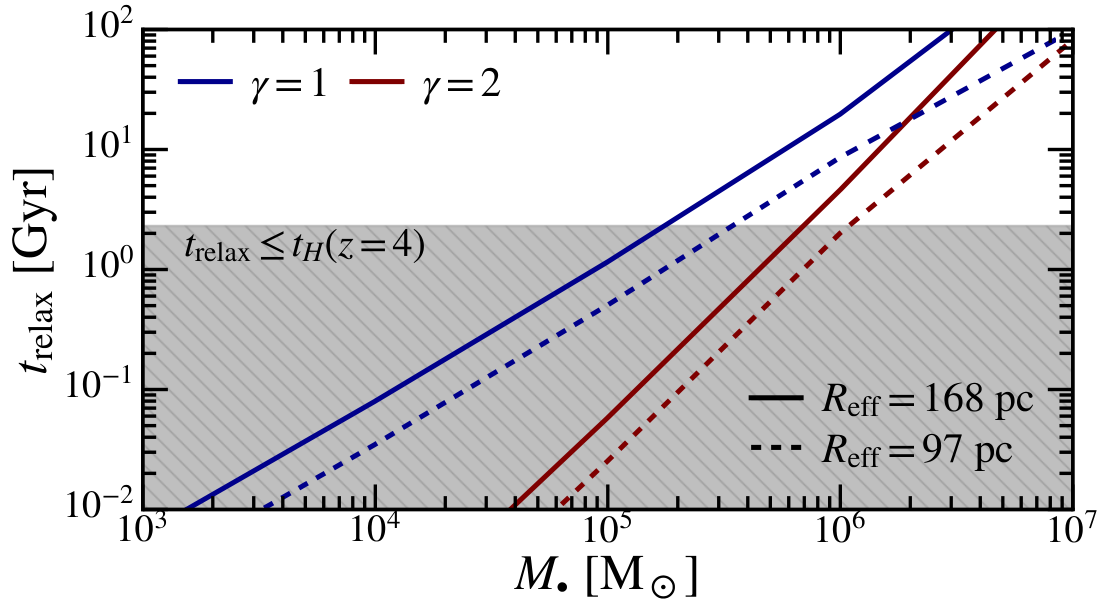
Figure 3 from Skyfire: A Spectroscopic Census of Little Red Dots and Broad-Line AGN in the CEERS Field

2026-09-02 · 2609.00112v1 · Research note

Skyfire: A Spectroscopic Census of Little Red Dots and Broad-Line AGN in the CEERS Field

Dale D. Kocevski, Anthony J. Taylor, Masafusa Onoue, et al.

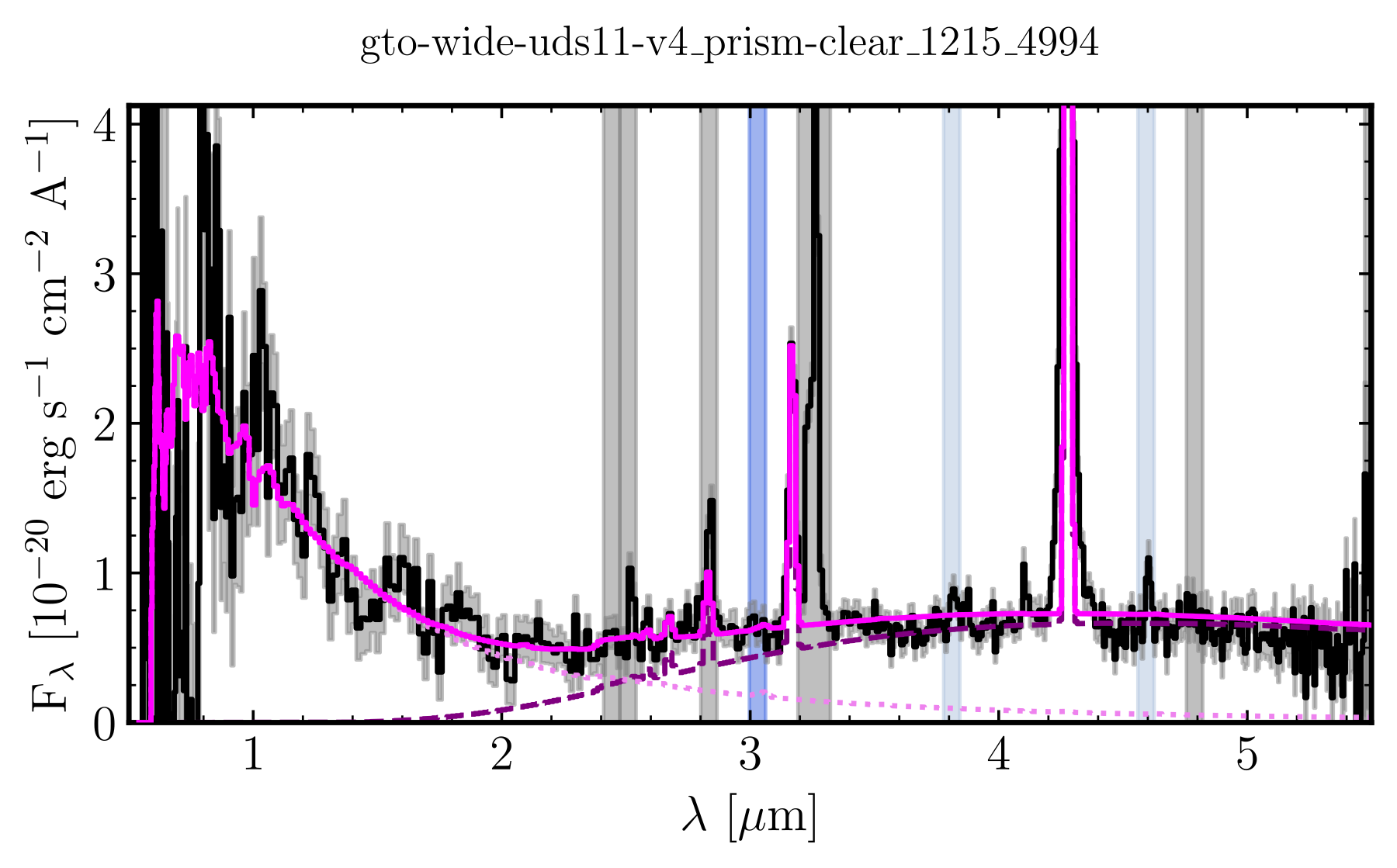
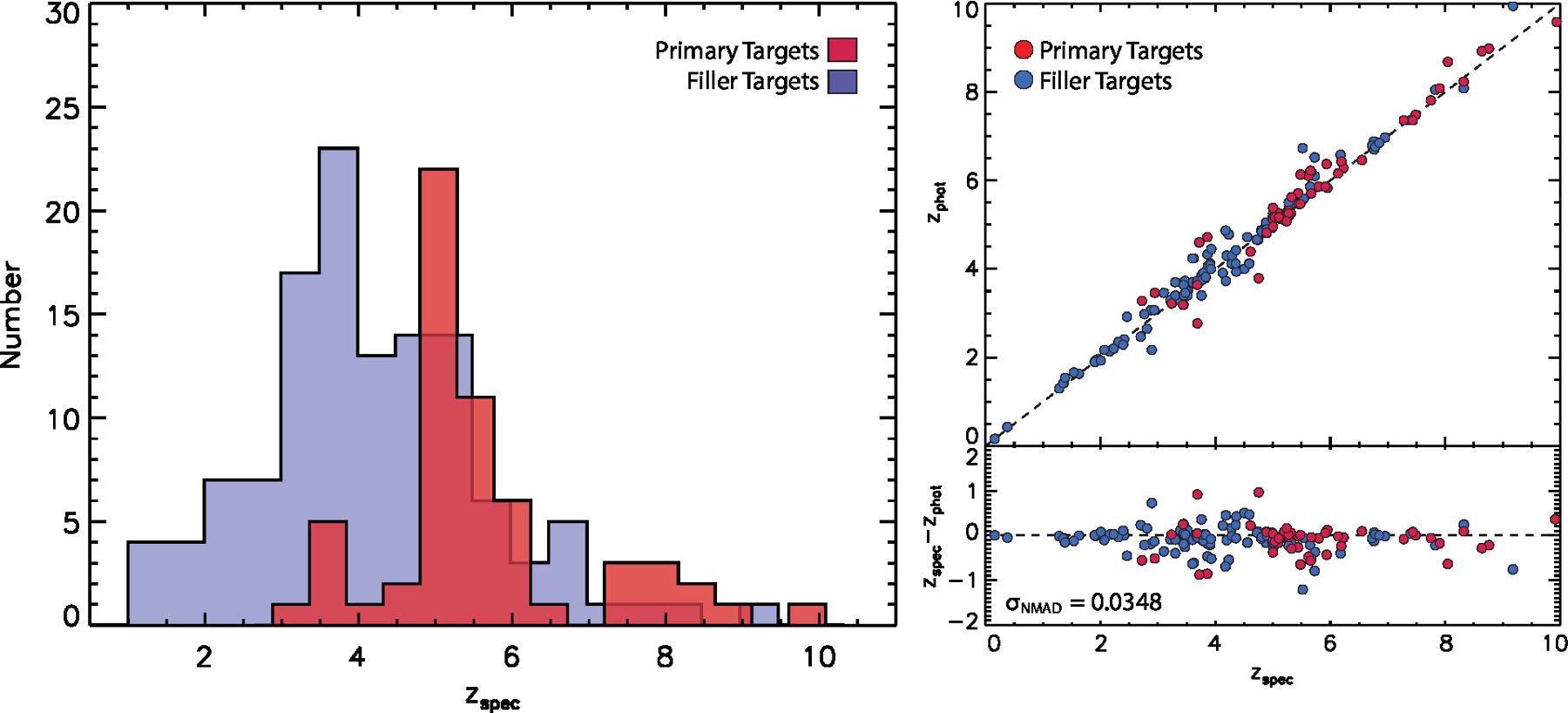
Skyfire’s CEERS NIRSpec census finds broad Balmer emission across redder LRDs and somewhat bluer candidates, motivating an expanded continuum-slope selection. The color trend is suggestive of continuity with blue broad-line sources, but uneven targeting prevents a definitive population-unification claim.

2026-09-02 · 2609.00033v1 · Research note

Lynx2030 Science Analysis Group: Final Report

Lynx2030 Science Analysis Group, Simon R. Bandler, Laura W. Brenneman, et al.

This strategic report argues that Lynx-class subarcsecond, high-throughput X-ray imaging spectroscopy would test why JWST little red dots are X-ray weak, while simulations illustrate broader gains for feedback, accretion, and circumgalactic-gas studies.

2026-09-01 · 2608.30459v1 · Research note

Broad-band host measurements of little red dots and similar compact nuclei require source-conditioned polychromatic PSFs

Sergio Bonaque-González

For unresolved LRD nuclei, stellar broad-band PSFs can create wavelength-dependent residuals that a Sérsic fit misassigns to a host. Source-conditioned polychromatic PSFs sharply reduce false host detections in point-only simulations, but do not yet establish corrected host properties for a defined real-LRD sample.

2026-08-26 · 2608.23671v1 · Research note

More Numerous and Bluer: Companions of the Brightest Little Red Dots Differ from Control Galaxies at $>3σ$, Hinting at Synchronized Black Hole Seed Formation

Fabio Pacucci, C. Megan Urry

Among 253 JWST-selected LRDs, only the brightest quartile shows a statistically significant excess of very close blue companions: 18/65 within 0.5–2 kpc. The association supports, but does not establish, synchronized seed formation.

2026-08-25 · 2608.23498v1 · Research note

The Road to Normalcy: Environment-Driven Evolutionary Pathways for Primordial Black Holes

Saiyang Zhang, Junehyoung Jeon, Boyuan Liu, et al.

Cosmological hydrodynamical simulations suggest PBH-seeded hosts can briefly be compact and BH dominated, then become more conventional galaxy–AGN systems when overdense environments accelerate stellar assembly. The result is pathway-dependent rather than a unique prediction for Little Red Dots.

Figure 4 from Beyond orientation: Evidence for distinct physical regimes among Little Red Dots and Little Blue Dots

2026-08-25 · 2608.21522v1 · Research note

Beyond orientation: Evidence for distinct physical regimes among Little Red Dots and Little Blue Dots

L. Barrufet, J. S. Dunlop, M. L. Hamadouche, et al.

In 89 LRDs and 191 LBDs, LRDs have more luminous and broader Hα, larger Balmer decrements, and lower [O III]/Hβ. The authors argue these population-level differences strain luminosity-independent orientation alone, while not uniquely establishing a gas-cocoon mechanism.

Figure 3 from Ripples in the OCEANS: Broad Line Variability of Little Red Dots

2026-08-14 · 2608.12487v1 · Research note

Ripples in the OCEANS: Broad Line Variability of Little Red Dots

Madisyn Brooks, Kelcey Davis, Jonathan R. Trump, et al.

Across six z=4.95–6.68 little red dots, multi-epoch JWST spectroscopy yields only marginal broad-Hα variability in two objects and no significant continuum changes. The results offer tentative AGN support, but calibration-driven uncertainties and four non-detections preclude a definitive population-level conclusion.

Figure 3 from ATLAS. III. Dust Around Little Red Dots: Hydrogen Line Ratios beyond Dust-free Non-Case B Models

2026-08-12 · 2608.10832v1 · Research note

ATLAS. III. Dust Around Little Red Dots: Hydrogen Line Ratios beyond Dust-free Non-Case B Models

Tomokazu Kiyota, Masami Ouchi, Hiroto Yanagisawa, et al.

In 20 LRDs, extreme broad Balmer decrements require both dense, optically thick non-Case-B line formation and—when Hα/Hβ exceeds the model ceiling—additional broad-line-region-associated dust, rather than galaxy-wide extinction alone.

2026-08-07 · 2608.05283v1

Emission line formation in scattering dominated media: implications for LRDs

Elisha Modelevsky, Omri Nitzan, Re'em Sari, et al.

Modelevsky et al. develop an analytic radiative-transfer framework for Balmer lines produced intrinsically inside static, optically thick, scattering-dominated envelopes, a geometry directly relevant if LRD central engines are hidden by dense gas. Unlike externally broadened, backlit or reflected lines, which generically acquire exponential wings, an extended intrinsic photosphere produces a broken power-law profile, transitioning from v^{-α} to v^{-(α+1)} with 0<α<1; this form fits the Hα profiles of JADES-GN-73488 and JADES-GN-68797. The result offers a line-shape diagnostic for distinguishing intrinsic from extrinsic Thomson broadening in LRDs, although the LTE calculation cannot reproduce the observed high Hα-to-continuum contrast and ultimately requires non-LTE modeling.
2026-08-07 · 2608.05267v1 · Research note

Where did all the Little Red Dots go? The abundance of LRD analogues among objects with broad lines at $z < 0.35$

Lasse Seyberlich, Sarah E. I. Bosman

In an SDSS broad-line sample at z<0.35, the authors identify nine SED-selected local LRD analogues and infer an abundance of 0.08%, supporting rarity at late times but with important spectral-coverage and contamination caveats.

Figure 3 from NEXUS: Spectral Variability of Little Red Dots and Blue Active Galactic Nuclei at $2 \lesssim z \lesssim 6$

2026-08-04 · 2608.01647v1 · Research note

NEXUS: Spectral Variability of Little Red Dots and Blue Active Galactic Nuclei at $2 \lesssim z \lesssim 6$

Zachary Stone, Yue Shen, Ming-Yang Zhuang, et al.

Multi-epoch JWST/NIRSpec monitoring finds that 17 little red dots have large Balmer decrements but weak month-scale continuum and Hα variability. The authors interpret the variability contrast with ordinary AGNs as evidence for differing broad-line emission and/or ionizing-driver properties.

Figure 2 from Misaligned or chaotic? A strong break of axial symmetry in the local LRD J1025 revealed with VLT/FORS2 spectropolarimetry

2026-08-03 · 2607.28715v1 · Research note

Misaligned or chaotic? A strong break of axial symmetry in the local LRD J1025 revealed with VLT/FORS2 spectropolarimetry

Francesco D'Eugenio, Gabriele Pezzulli, Roberto Maiolino, et al.

VLT/FORS2 spectropolarimetry of the z≈0.1 LRD J1025 finds an intrinsically polarised, nearly grey continuum and a weaker, differently angled broad Hα component. The 48±4° angle offset robustly requires broken axial symmetry, but does not identify its physical cause.

Figure 2 from ATLAS. II. Extremely High Incidence of Balmer Line Absorption with Predominant Blueshifts in LRDs: Statistical Insights through Comparison with Type 1 AGNs

2026-07-30 · 2607.26269v1 · Research note

ATLAS. II. Extremely High Incidence of Balmer Line Absorption with Predominant Blueshifts in LRDs: Statistical Insights through Comparison with Type 1 AGNs

Hiroto Yanagisawa, Masami Ouchi, Tomokazu Kiyota, et al.

Among 40 JWST-selected LRDs, 14 show Hα absorption, far exceeding SDSS type-1 AGNs; the compiled absorbers are mostly blueshifted and kinematically narrower, consistent with line-of-sight outflows but not uniquely establishing their fate.

Figure 3 from Unsupervised selection and characterisation of Little Red Dots in JWST surveys with manifold learning

2026-07-28 · 2607.22835v1 · Research note

Unsupervised selection and characterisation of Little Red Dots in JWST surveys with manifold learning

Michele Ginolfi, Filippo Mannucci, Alessandro Marconi, et al.

UMAP applied to 242,327 JWST sources localises spectroscopic LRDs into two colour-linked regions and selects roughly 100 candidates. Against the available spectroscopic subset, the main region attains ~0.78 purity and ~0.82 completeness, but preprocessing disfavors the reddest high-z objects.

2026-07-24 · 2607.20617v1 · Research note

A dust-free hierarchically nested supermassive-star model for James Webb Space Telescope Little Red Dots

Pau Amaro Seoane

This letter proposes that a dust-poor subset of Little Red Dots are hierarchically nested supermassive stars: magnetic envelope inflation and exposed stellar light reproduce a V-shaped continuum, while a dense inner core supplies broad Balmer emission and hides X-rays.

Figure 3 from An (in)complete NIRSpec census of Balmer absorption in Type 1 AGN -- radiation-driven outflows in little red dots, quasars and variable stars

2026-07-22 · 2607.19057v1 · Research note

An (in)complete NIRSpec census of Balmer absorption in Type 1 AGN -- radiation-driven outflows in little red dots, quasars and variable stars

Ignas Juodžbalis, Xihan Ji, Francesco D'Eugenio, et al.

Completeness-corrected JWST/NIRSpec fits indicate strong Hα absorption is common in little red dots (LRDs) but not detected in little blue dots, favoring blueshifted, likely outflowing gas while leaving rest-frame absorption substantially incomplete.

Figure 2 from Optically Thick Outflow Driven by Supercritical Accretion May Explain Little Red Dots

2026-07-21 · 2607.17448v1 · Research note

Optically Thick Outflow Driven by Supercritical Accretion May Explain Little Red Dots

Jun-Rong Liu, Hua Feng, Luis C. Ho

The authors argue that supercritical accretion can launch an optically thick LRD outflow whose red photosphere, line broadening, and Balmer-break properties are broadly compatible with observations, while its Balmer decrements remain underpredicted.

Figure 2 from Spatial decomposition of Little Red Dots with JWST/NIRSpec IFU into broad-line red cores and narrow-line blue host galaxies

2026-07-13 · 2607.09647v1 · Research note

Spatial decomposition of Little Red Dots with JWST/NIRSpec IFU into broad-line red cores and narrow-line blue host galaxies

Yuzo Ishikawa, Anna-Christina Eilers, Rohan P. Naidu, et al.

Spatially resolved NIRSpec spectroscopy of five z≈5 broad-Hα Little Red Dots supports a two-component morphology: compact red continuum/broad-line cores and generally extended blue continuum/narrow-line regions, while imperfect separation and small-sample limitations preclude a unique physical origin.

2026-07-02 · 2607.00084v1 · Research note

Little Red Dots at z~2 in EIGER reveal a gentle decline with respect to their peak number density at z~5

Shrriya Kapoor, Jorryt Matthee, Alberto Torralba, et al.

EIGER slitless spectroscopy identifies five z=1.93–3.18 little red dots among 19 near-infrared broad-line emitters. Their inferred z≈2 density is ≈7×10⁻⁶ cMpc⁻³, supporting a decline from z≈5, but less sharply than prior photometric work suggested.

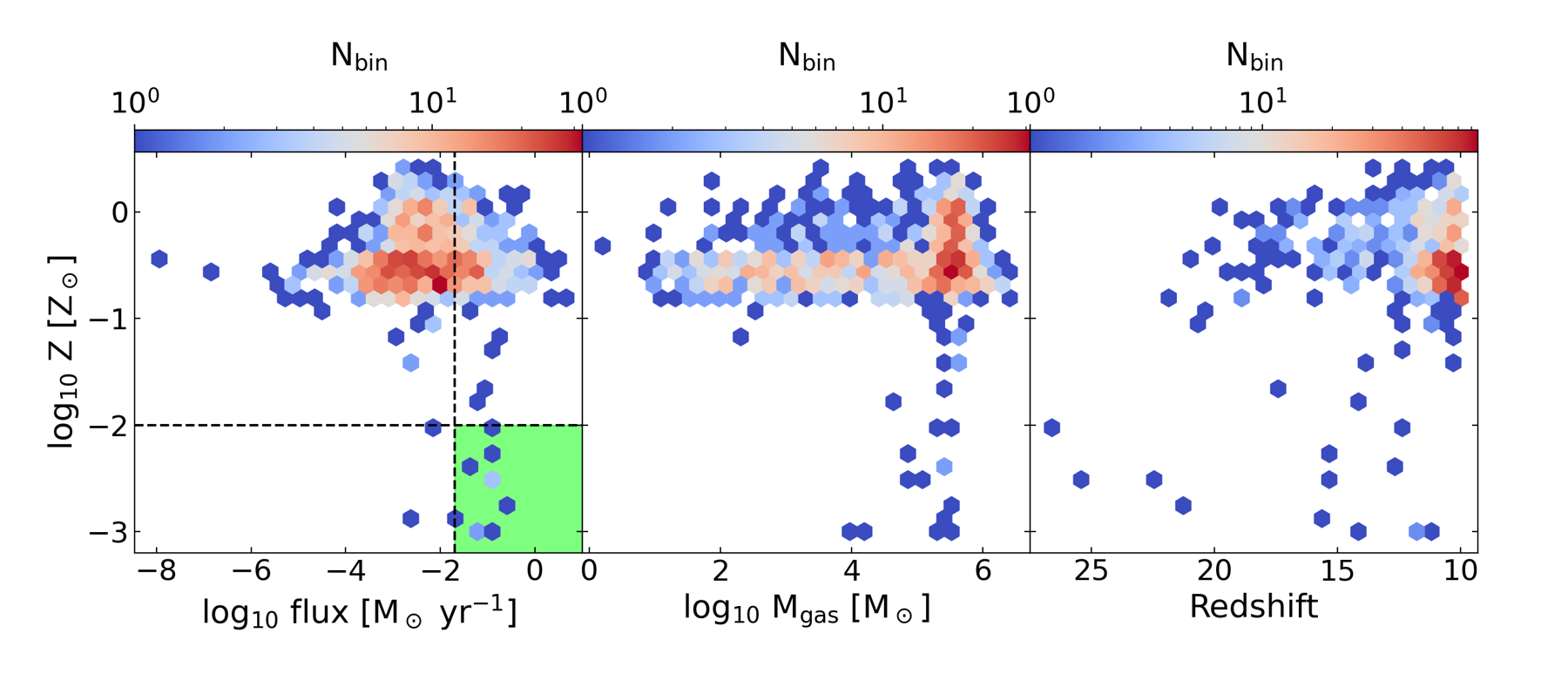
Figure 1 from The metallicities of little red dot host galaxies: LRDs are metal poor, but not pristine

2026-07-01 · 2606.31515v1 · Research note

The metallicities of little red dot host galaxies: LRDs are metal poor, but not pristine

G. P. Nikopoulos, D. Watson, C. L. Pollock, et al.

Medium/high-resolution JWST/NIRSpec spectroscopy of 24 LRDs finds host narrow-line gas is typically metal poor (about 0.08 solar) rather than pristine. The result disfavors pristine-collapse requirements for most objects, while two LRDs approach extremely low abundances.

2026-07-01 · 2606.30757v1 · Research note

Unveil the nature of JWST-AGN and Little Red Dots with SKAO continuum surveys

Giovanni Mazzolari, Dharam V. Lal, Isabella Prandoni, et al.

This forecasting study argues that multi-frequency SKAO continuum observations could separate intrinsically weak, Compton-thick, and ionized-cocoon interpretations of radio-faint JWST AGN and LRDs, but it presents sensitivity-based predictions rather than new radio detections.

Figure 1 from Little Red Dots as Intermediate Mass, Super-Eddington Engines: Insights from Type IIn Supernovae and The 1837-1856 Great Eruption of $η$ Carinae

2026-07-01 · 2606.30711v1 · Research note

Little Red Dots as Intermediate Mass, Super-Eddington Engines: Insights from Type IIn Supernovae and The 1837-1856 Great Eruption of $η$ Carinae

Rohan P. Naidu, Jorryt Matthee, Anna de Graaff, et al.

The authors propose that Little Red Dots are dense-wind, super-Eddington engines analogous to Type IIn supernova interaction phases, rather than virial broad-line AGN. Their escape-velocity interpretation gives a typical-engine upper limit below 10^5 solar masses.

Figure 3 from No evolution in the number density of little red dots from cosmic dawn to cosmic noon

2026-06-30 · 2606.30253v1 · Research note

No evolution in the number density of little red dots from cosmic dawn to cosmic noon

Federica Loiacono, Roberto Gilli, Marco Mignoli, et al.

In one EIGER/J1030 field, five X-ray-undetected broad-line candidates imply an LRD density at z≈2.4 consistent with no decline from z≈7 above Lbol=3×10^44 erg s−1, but the large counting uncertainty and small sample preclude a precise evolutionary constraint.

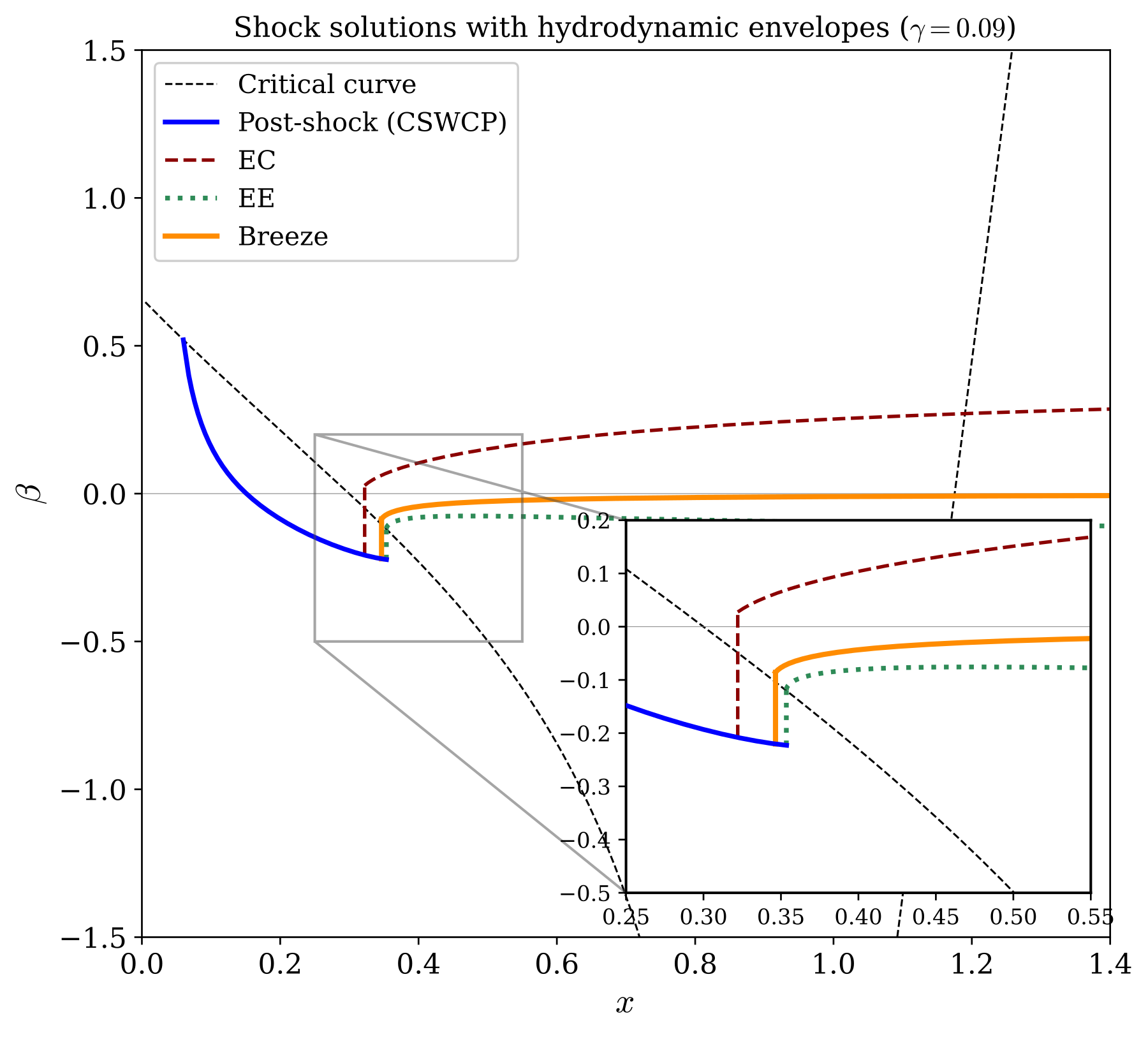
Figure 2 from General Relativistic Shock Wave Solutions with Black Hole Formation: The Singular Isothermal Sphere Case

2026-06-30 · 2606.29607v1 · Research note

General Relativistic Shock Wave Solutions with Black Hole Formation: The Singular Isothermal Sphere Case

Chien-Ting J. Chen, Michael J. Cai, Fabio Pacucci

This analytic study derives relativistic, self-similar shocks during singular-isothermal-sphere collapse to a black hole. In this idealized isothermal model, shocks connect collapsing interiors to several envelope states, reduce central supply relative to smooth collapse, and can release appreciable binding energy.

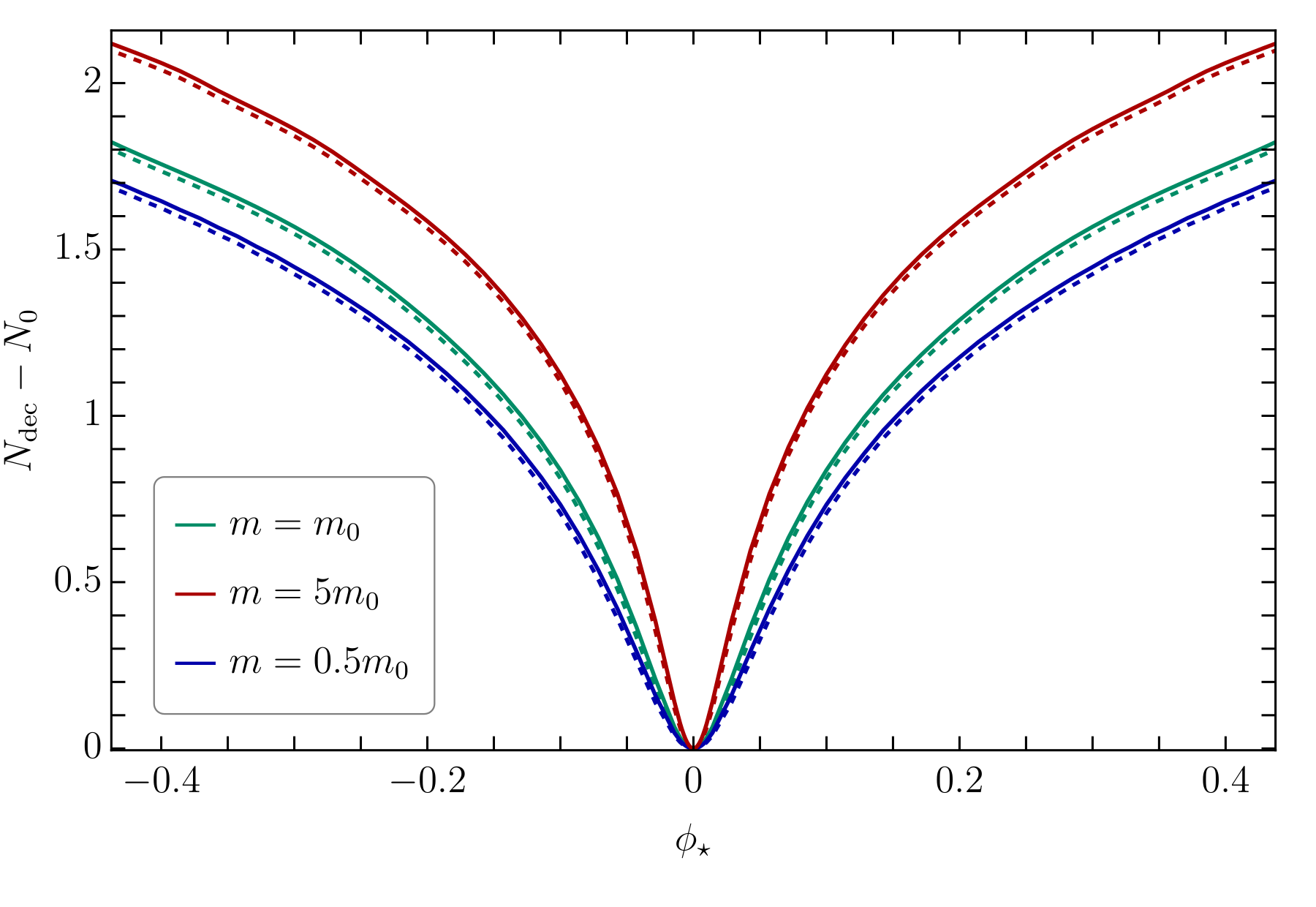
Figure 3 from Memoirs of the curvaton: non-perturbative non-Gaussianity and supermassive primordial black holes

2026-06-29 · 2606.28296v1 · Research note

Memoirs of the curvaton: non-perturbative non-Gaussianity and supermassive primordial black holes

S. Allegrini, A. J. Iovino, G. Perna, et al.

This theoretical study builds non-perturbative curvaton mappings for several potentials and argues that positive non-Gaussianity can yield supermassive primordial-black-hole seeds compatible with μ-distortion limits, offering a proposed—not observationally tested—route to JWST Little Red Dots.

Figure 6 from SEEDZ: Rapid Galaxy Assembly as a Pathway to Supermassive Stars, Dense Stellar Environments and Massive Black Hole Seeds

2026-06-29 · 2606.27427v1 · Research note

SEEDZ: Rapid Galaxy Assembly as a Pathway to Supermassive Stars, Dense Stellar Environments and Massive Black Hole Seeds

Lewis R. Prole, John A. Regan, Daxal Mehta, et al.

In SEEDZ high-resolution cosmological simulations, rapidly assembling halos preferentially meet a prescribed central-inflow criterion for heavy seeds. The authors infer that low-metallicity, sustained-accretion SMS candidates are rare, making any Little Red Dot connection conditional on model assumptions.

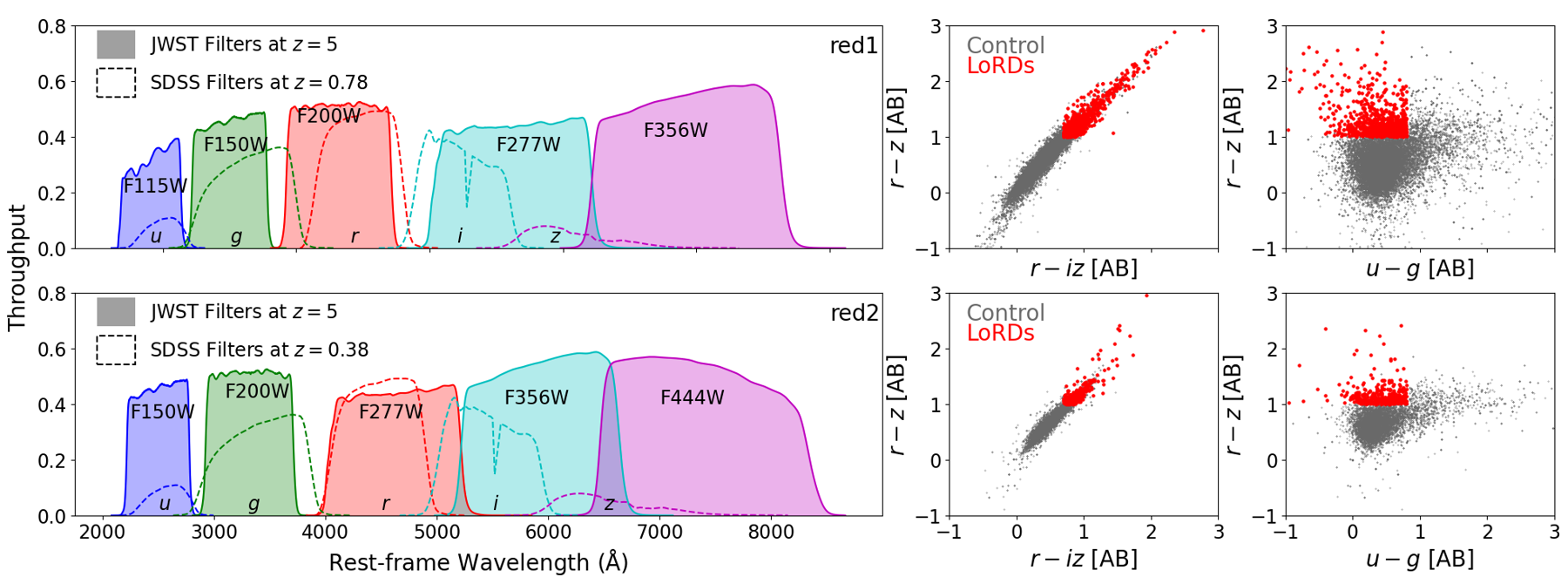
Figure 1 from A Population of Little Red Dot-like Quasars in SDSS

2026-06-25 · 2606.26098v1 · Research note

A Population of Little Red Dot-like Quasars in SDSS

Quinn O. Casey, Ryan C. Hickox, Nikko J. Cleri, et al.

SDSS color selection identifies ~1,300 low-redshift “LoRD” quasars whose V-shaped subset resembles LRD spectral energy distributions, but host contamination, unresolved morphology, and weak high-z X-ray limits prevent establishing them as a uniformly faithful analog population.

Figure 2 from Constraints on the Gas Geometry Surrounding Little Red Dots through Narrow-Line Diagnostics

2026-06-24 · 2606.23778v1 · Research note

Constraints on the Gas Geometry Surrounding Little Red Dots through Narrow-Line Diagnostics

Visal Sok, Erica J. Nelson, Mitchell C. Begelman, et al.

Narrow-line ratios in roughly 20 high-S/N JWST/NIRSpec LRD spectra challenge a uniformly opaque, unity-covering gas envelope: at least 40% require extreme ionization conditions, while weak He II indicates an ionizing spectrum softer than standard AGN.

Figure 4 from Little Red Dots on FIRE: Exploring the formation and observational signatures of ultra-compact early galaxies

2026-06-23 · 2606.23683v1 · Research note

Little Red Dots on FIRE: Exploring the formation and observational signatures of ultra-compact early galaxies

Niranjan Chandra Roy, Daniel Anglés-Alcázar, Rachel K. Cochrane, et al.

FIRE simulations show that transient, inflow-built ultra-compact stellar cores can match several LRD observables without AGN, but fail for the reddest optical continua and most extreme lines, favoring heterogeneous hybrid stellar+AGN interpretations.

2026-06-22 · 2606.21614v1 · Research note

Little Red and Blue Dots: AGN-excited narrow lines, Lyman-$α$ emission, and resemblance to standard quasars

Sophia Geris, Roberto Maiolino, Xihan Ji, et al.

In 36 GOODS LRDs/LBDs at z=2.26–7.89, the authors find AGN-like narrow-line excitation, extreme X-ray weakness, and LRD Lyα excess with a broad component resembling Hα. They argue against completely enclosing cocoon geometries, while retaining obscured-LBD interpretations.

2026-06-18 · 2606.18342v1 · Research note

Compact Core, Extended Reach: A Bipolar kpc-Scale Elongation in a Little Red Dot at $z \approx 5.5$

Zhiyuan Ji, Yang Sun, Mauro Giavalisco, et al.

For the single z=5.482 Little Red Dot LRD-204851, aligned UV, optical-line, and Lyα structures indicate a narrow bipolar channel extending several kpc. Lyα transfer fitting favors slow expansion, but cannot distinguish an outflow from a quasi-static ionization cone.

2026-06-17 · 2606.17271v1 · Research note

Black Hole Stars Across the Universe: Identifying Central Engine Dominated Little Red Dots at $z\sim1.5-9.5$

Andrea Weibel, Rohan P. Naidu, Pascal A. Oesch, et al.

A BH*-template SED selection yields 241 compact, rest-optical central-engine-dominated candidates over z~1.7–9.3, extending beyond conventional V-shaped LRD criteria; inferred luminosities and Eddington-based masses remain model-dependent.

Figure 1 from Between Degeneracy and Evolution: UV-to-optical Insights into the BH$^*$ Model in Little Red Dots

2026-06-11 · 2606.12355v1 · Research note

Between Degeneracy and Evolution: UV-to-optical Insights into the BH$^*$ Model in Little Red Dots

Rosa M. Mérida, Marcin Sawicki, Chris J. Willott, et al.

UV-to-optical continuum fits to 66 JWST LRDs find BH* configurations in only about 6% of 52 robust broad-prior fits; suppressing AGN light raises this to about 40%, exposing severe model degeneracy rather than establishing BH* prevalence.

Figure 1 from JADES: the mass-metallicity relation at $z=1-10$. New calibrations, extremely metal-poor galaxies, and chemical diversity

2026-06-11 · 2606.11345v1 · Research note

JADES: the mass-metallicity relation at $z=1-10$. New calibrations, extremely metal-poor galaxies, and chemical diversity

Yuki Isobe, Mirko Curti, Roberto Maiolino, et al.

Stacked JWST/NIRSpec spectra of roughly 2,500 z=1–10 galaxies yield Te-anchored strong-line metallicity calibrations and MZRs. The authors find declining metallicity with redshift, 50 EMPG candidates, and two broad-Hα Little Red Dots in this metal-poor sample.

Figure 5 from Through the Veil: Ly$α$ Illuminates the Host Galaxies of Little Red Dots

2026-06-10 · 2606.09970v1 · Research note

Through the Veil: Ly$α$ Illuminates the Host Galaxies of Little Red Dots

Zhiyuan Ji, Yang Sun, Mauro Giavalisco, et al.

In 110 z≥4 little red dots, 32 Lyα detections and resolved imaging of 13 higher-redshift systems indicate that escaping Lyα more plausibly traces extended host-scale gas than the compact red/Balmer-line component, although continuum-subtraction and depth limit morphology.

Figure 2 from A Scaling Relation of LRDs between Broad H$α$ and Bolometric Luminosities: Enhanced Broad H$α$ Emission Relative to Low-$z$ Type 1 AGN

2026-06-09 · 2606.09726v1 · Research note

A Scaling Relation of LRDs between Broad H$α$ and Bolometric Luminosities: Enhanced Broad H$α$ Emission Relative to Low-$z$ Type 1 AGN

Hiroto Yanagisawa, Masami Ouchi, Tomokazu Kiyota, et al.

Across 37 z=3–7 LRDs, broad Hα scales tightly with modified-blackbody bolometric luminosity yet is ∼40 times stronger than in low-z Type 1 AGN at fixed Lbol. The authors attribute this to unusually high-covering, high-column broad-line gas.

Figure 6 from NEXUS: Abundance, Environments, and Spectral Diversity of Little Red Dots from the NIRSpec MSA Sample

2026-06-09 · 2606.09721v1 · Research note

NEXUS: Abundance, Environments, and Spectral Diversity of Little Red Dots from the NIRSpec MSA Sample

Zhiwei Pan, Ming-Yang Zhuang, Yue Shen, et al.

NEXUS combines JWST imaging and PRISM spectroscopy to census LRDs at z=2.3–7.5. Its 36 confirmed objects are predominantly broad-line sources, while selection calibration, abundance, clustering, and continuum diversity remain limited by contamination, resolution, and sample size.

2026-06-08 · 2606.06585v1 · Research note

A Population of Red Galaxies with Very Strong Emission Lines at $z > 5$ Revealed by the NIRCam Medium Bands: ''Classic'' LRDs, Dusty Star-Forming Galaxies, and a Missing Population of LRDs

Sunna Withers, Adam Muzzin, Swara Ravindranath, et al.

Medium-band NIRCam colors identify 26 red, strong-line galaxies at z=5.01–8.60. Nine unresolved objects evade common Little Red Dot cuts; the authors favor a missed LRD population, but dusty star formation and AGN remain viable alternatives.

Figure 2 from The quasi-star model for Little Red Dots: potential and challenges

2026-06-08 · 2606.06575v1 · Research note

The quasi-star model for Little Red Dots: potential and challenges

Fabrizio Gentile, Mauro Giavalisco, Emanuele Daddi, et al.

Cloudy fits show that a host-plus-quasi-star model can reproduce several LRD continuum and hydrogen-line properties, but helium lines, hot dust, and model degeneracy prevent it from uniquely establishing quasi-stars as the explanation.

2026-06-05 · 2606.05281v1 · Research note

Little red dots as a cosmological probe: constraining $H_0$ with quasi-periodic pulsations

Zijian Zhang, Kohei Inayoshi, Masamune Oguri, et al.

Using one lensed, decades-variable little red dot, the authors turn an idealized pulsation period–luminosity–temperature relation into a preliminary, period-limited H0 estimate. Ten-year monitoring could improve statistical precision, but calibration of the relation remains the decisive uncertainty.

Figure 3 from ABCD: The Nuclear Structure of the Little Red Dots Revealted through Absorption, Break, Continuum, and Decrement

2026-06-04 · 2606.04711v1 · Research note

ABCD: The Nuclear Structure of the Little Red Dots Revealted through Absorption, Break, Continuum, and Decrement

Chang-Hao Chen, Jinyi Shangguan, Luis C. Ho, et al.

JWST/NIRSpec spectroscopy of 14 LRDs separates Balmer emission and absorption, favoring dense broad-line gas over dust as the main origin of elevated broad Balmer decrements. A clumpy, viewing-angle-dependent nuclear geometry is proposed, but velocity-profile fits succeed in only three of five high-S/N sources.

2026-06-03 · 2606.03522v1 · Research note

The UV Side of Little Red Dots: Red, Compact, and Iron-Enhanced Rest-UV Emission with a Strong Downturn around Ly$α$

Makoto Ando, Yuichi Harikane, Harley Katz, et al.

Across roughly 100 JWST-selected LRDs, rest-UV emission is redder and about four times more compact than matched star-forming galaxies. Stacked spectral trends and high Fe II/Mg II favor a substantial compact central component, although its physical origin remains model-dependent.

Figure 3 from Little Red Dot progenitors from Compact Starbursts: A Natural Path to Early AGN Formation

2026-06-03 · 2606.03375v1 · Research note

Little Red Dot progenitors from Compact Starbursts: A Natural Path to Early AGN Formation

Matías Liempi, Muhammad A. Latif, Dominik R. G. Schleicher

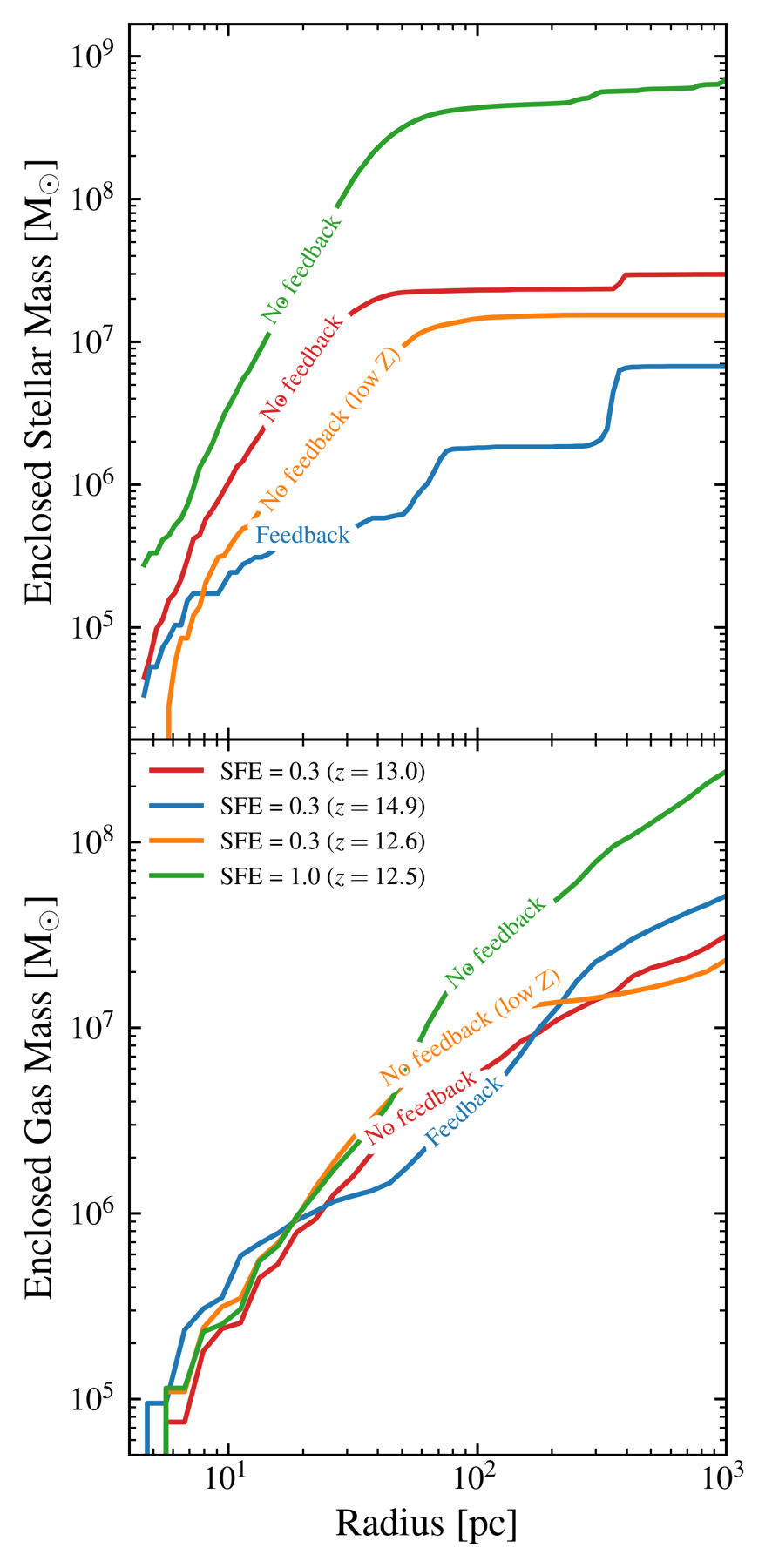
Cosmological simulations of compact z≈12.5–14.9 starbursts find centrally concentrated stellar and gas reservoirs. The authors argue that rapid inflow and transport could, under an assumed 10% retained efficiency, assemble conditions for a ∼10^6 M⊙ black hole and an AGN phase.

2026-06-02 · 2606.01870v1 · Research note

Mass and Spin Growth of Very Massive Stars in Star Clusters Potentially Associated with Little Red Dots

Ataru Tanikawa, Masaru Shibata, Kunihito Ioka

Four N-body cluster models produce collision-grown very massive stars of 10^3–10^4 M⊙; a collision-maintained bloated phase can substantially increase growth, but its duration and the resulting masses/spins remain sensitive to idealized collision and stellar-evolution assumptions.

Figure 3 from OCEANS of Absorption: High-resolution NIRSpec Spectroscopy Reveals Diverse Balmer-line Absorption in Little Red Dots

2026-06-02 · 2606.00258v1 · Research note

OCEANS of Absorption: High-resolution NIRSpec Spectroscopy Reveals Diverse Balmer-line Absorption in Little Red Dots

Kelcey Davis, Madisyn Brooks, Raymond C. Simons, et al.

High-resolution JWST/NIRSpec spectra of 10 compact, color-selected LRDs at 3<z<7 recover Balmer absorption in four. The authors argue resolution exposes frequent, diverse excited-hydrogen absorption, but the small, selected sample limits population-level inferences.

2026-06-02 · 2606.00205v1 · Research note

Ultraviolet diversity of Little Red Dots as a probe for direct-collapse black hole ages

Elia Cenci, Melanie Habouzit, Dale D. Kocevski

In MELIORA simulations at z>8.5, the host-to-DCBH UV–optical balance declines over roughly 30 Myr after direct collapse, offering a model-dependent relative age indicator: UV-faint/red LRDs are younger, whereas UV-bright systems have more developed stellar hosts.