654 indexed papers · 430 research notes

Research archive

Reset
Figure 9 from Inflated Supermassive Stars as Little Red Dots and Progenitors of Supermassive Black Holes

2026-09-22 · 2609.22507v1 · Research note

Inflated Supermassive Stars as Little Red Dots and Progenitors of Supermassive Black Holes

Wenbin Lu

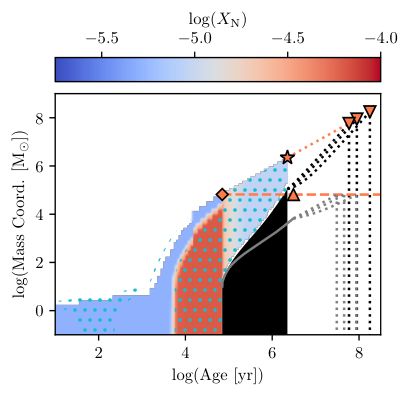
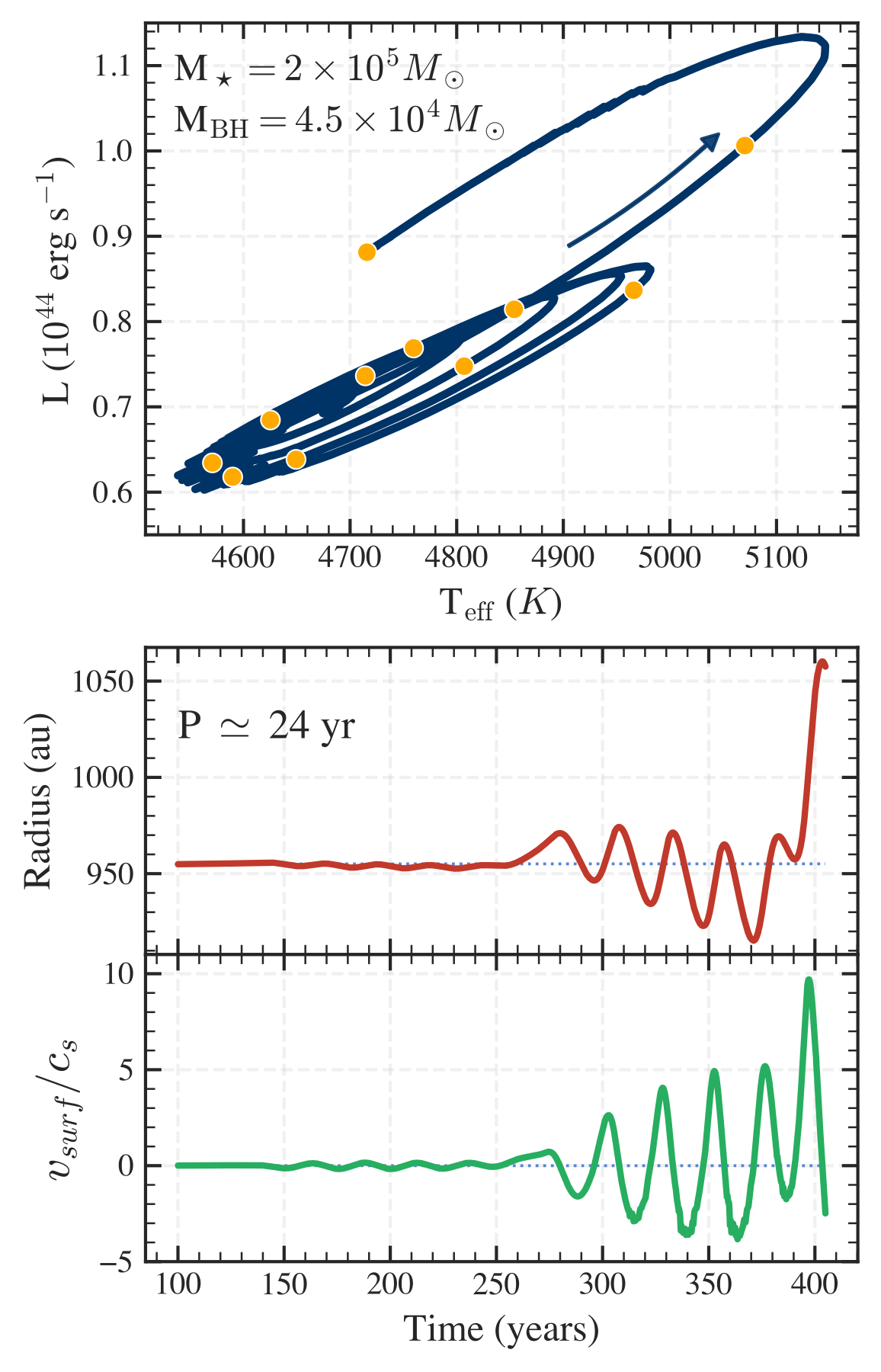
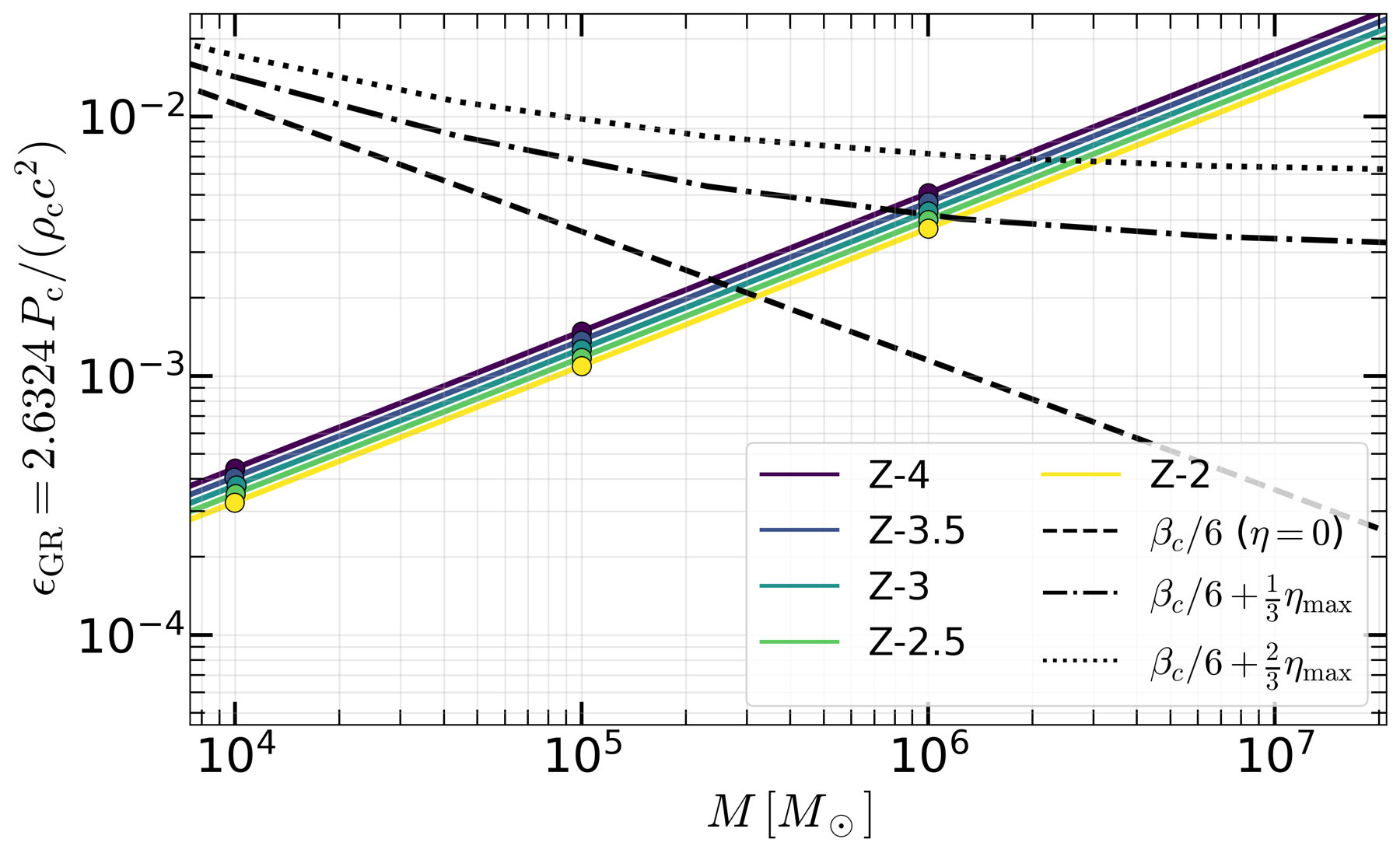
One-dimensional equilibrium models suggest that metal-enriched, hydrogen-burning supermassive stars can attain LRD-like cool photospheres through Fe-opacity-driven envelope inflation, while general-relativistic collapse could leave massive black-hole remnants. The proposed interpretation remains sensitive to atmospheric physics and formation assumptions.

Figure 2 from Overmassive No More: The Case for Little Red Dots Hosting Black Hole Seeds as Massive as Single Supermassive Stars

2026-09-10 · 2609.09274v1 · Research note

Overmassive No More: The Case for Little Red Dots Hosting Black Hole Seeds as Massive as Single Supermassive Stars

Wendy Q. Sun, Rohan P. Naidu, Hanpu Liu, et al.

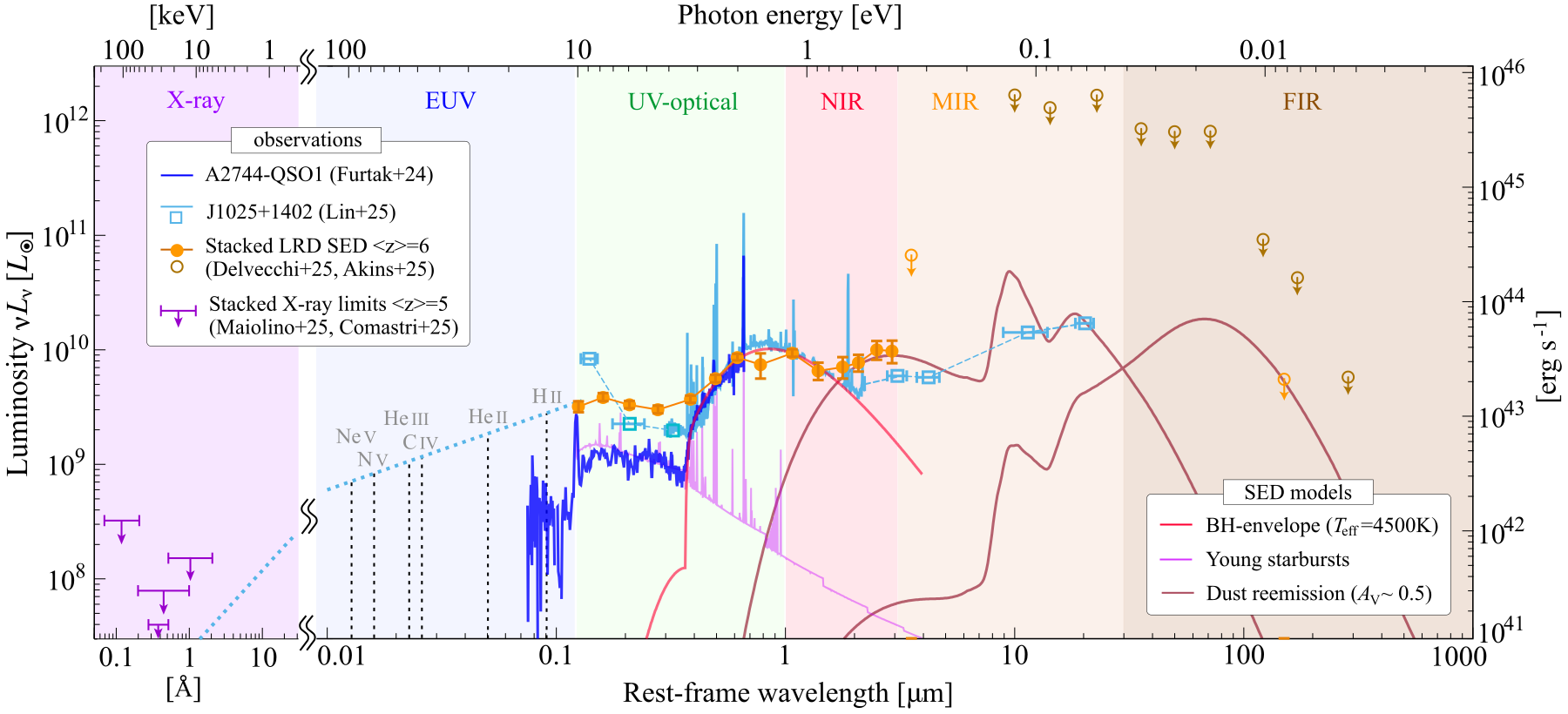
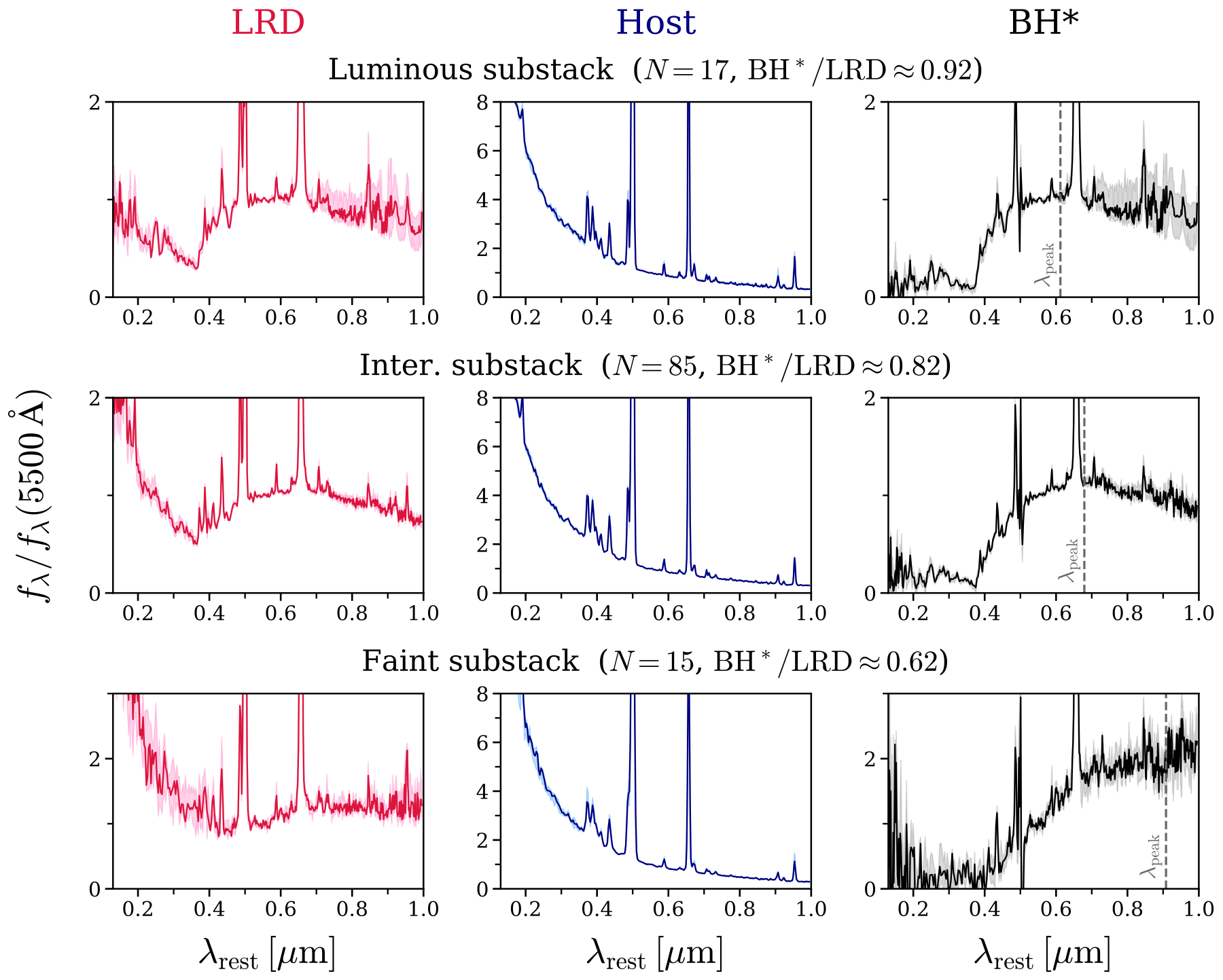
Using stacked, host-subtracted spectra of 117 little red dots, the authors infer cool, luminous pseudo-photospheres and non-virial central-engine masses of about 10^4–10^5 solar masses. They argue this removes the apparent overmassiveness and permits, but does not establish, a supermassive-star seed origin.

2026-09-10 · 2609.09265v1 · Research note

A Spectral Framework for Testing the Quasi-Star Hypothesis in Little Red Dots I: Weighing LRDs by Their Super-Eddington Luminosity Ratios---No Signs of Overmassive Black Holes

Olivia Curtis, Nikko J. Cleri, Jakob M. Helton, et al.

Photospheric fits to 4 absorption-feature LRDs and 82 archival objects yield predominantly super-Eddington ratios. Coupled quasi-star envelope models place black-hole mass caps below local BH–host expectations, but the inference remains model- and host-prior-dependent.

2026-07-24 · 2607.20617v1 · Research note

A dust-free hierarchically nested supermassive-star model for James Webb Space Telescope Little Red Dots

Pau Amaro Seoane

This letter proposes that a dust-poor subset of Little Red Dots are hierarchically nested supermassive stars: magnetic envelope inflation and exposed stellar light reproduce a V-shaped continuum, while a dense inner core supplies broad Balmer emission and hides X-rays.

Figure 2 from Optically Thick Outflow Driven by Supercritical Accretion May Explain Little Red Dots

2026-07-21 · 2607.17448v1 · Research note

Optically Thick Outflow Driven by Supercritical Accretion May Explain Little Red Dots

Jun-Rong Liu, Hua Feng, Luis C. Ho

The authors argue that supercritical accretion can launch an optically thick LRD outflow whose red photosphere, line broadening, and Balmer-break properties are broadly compatible with observations, while its Balmer decrements remain underpredicted.

Figure 1 from Little Red Dots as Intermediate Mass, Super-Eddington Engines: Insights from Type IIn Supernovae and The 1837-1856 Great Eruption of $η$ Carinae

2026-07-01 · 2606.30711v1 · Research note

Little Red Dots as Intermediate Mass, Super-Eddington Engines: Insights from Type IIn Supernovae and The 1837-1856 Great Eruption of $η$ Carinae

Rohan P. Naidu, Jorryt Matthee, Anna de Graaff, et al.

The authors propose that Little Red Dots are dense-wind, super-Eddington engines analogous to Type IIn supernova interaction phases, rather than virial broad-line AGN. Their escape-velocity interpretation gives a typical-engine upper limit below 10^5 solar masses.

Figure 2 from Constraints on the Gas Geometry Surrounding Little Red Dots through Narrow-Line Diagnostics

2026-06-24 · 2606.23778v1 · Research note

Constraints on the Gas Geometry Surrounding Little Red Dots through Narrow-Line Diagnostics

Visal Sok, Erica J. Nelson, Mitchell C. Begelman, et al.

Narrow-line ratios in roughly 20 high-S/N JWST/NIRSpec LRD spectra challenge a uniformly opaque, unity-covering gas envelope: at least 40% require extreme ionization conditions, while weak He II indicates an ionizing spectrum softer than standard AGN.

2026-06-17 · 2606.17271v1 · Research note

Black Hole Stars Across the Universe: Identifying Central Engine Dominated Little Red Dots at $z\sim1.5-9.5$

Andrea Weibel, Rohan P. Naidu, Pascal A. Oesch, et al.

A BH*-template SED selection yields 241 compact, rest-optical central-engine-dominated candidates over z~1.7–9.3, extending beyond conventional V-shaped LRD criteria; inferred luminosities and Eddington-based masses remain model-dependent.

Figure 1 from Between Degeneracy and Evolution: UV-to-optical Insights into the BH$^*$ Model in Little Red Dots

2026-06-11 · 2606.12355v1 · Research note

Between Degeneracy and Evolution: UV-to-optical Insights into the BH$^*$ Model in Little Red Dots

Rosa M. Mérida, Marcin Sawicki, Chris J. Willott, et al.

UV-to-optical continuum fits to 66 JWST LRDs find BH* configurations in only about 6% of 52 robust broad-prior fits; suppressing AGN light raises this to about 40%, exposing severe model degeneracy rather than establishing BH* prevalence.

Figure 2 from The quasi-star model for Little Red Dots: potential and challenges

2026-06-08 · 2606.06575v1 · Research note

The quasi-star model for Little Red Dots: potential and challenges

Fabrizio Gentile, Mauro Giavalisco, Emanuele Daddi, et al.

Cloudy fits show that a host-plus-quasi-star model can reproduce several LRD continuum and hydrogen-line properties, but helium lines, hot dust, and model degeneracy prevent it from uniquely establishing quasi-stars as the explanation.

2026-06-05 · 2606.05281v1 · Research note

Little red dots as a cosmological probe: constraining $H_0$ with quasi-periodic pulsations

Zijian Zhang, Kohei Inayoshi, Masamune Oguri, et al.

Using one lensed, decades-variable little red dot, the authors turn an idealized pulsation period–luminosity–temperature relation into a preliminary, period-limited H0 estimate. Ten-year monitoring could improve statistical precision, but calibration of the relation remains the decisive uncertainty.

Figure 2 from Transient Signatures of Star-Envelope Collisions in Little Red Dots

2026-05-29 · 2605.29895v1 · Research note

Transient Signatures of Star-Envelope Collisions in Little Red Dots

Tomoya Suzuguchi, Kohei Inayoshi

This modeling study predicts optical/UV transients when cluster stars strike proposed gaseous LRD envelopes. Red-supergiant impacts on envelopes near the SMBH mass are favored; rates could reach 0.3 yr⁻¹ per compact LRD, but detectability depends critically on low-redshift LRD abundance.

2026-05-20 · 2605.21589v1 · Research note

A Magnetized Black Hole Envelope Model for Little Red Dots

Shinsuke Takasao, Kohei Inayoshi

This theoretical magnetized black-hole-envelope model links cool LRD continua, broad-line shapes, and weak X-rays to super-Eddington spherical inflow onto a rotating envelope, but its quantitative success remains conditional on assumed envelope structure, opacity, magnetism, and line-scattering physics.

2026-05-14 · 2605.15263v1 · Research note

On the quenching of LRD X-ray emission by both Compton-thick gas and high accretion rates

Albert Sneppen, Darach Watson, James H. Matthews, et al.

Sirocco cocoon models suggest that current LRD X-ray non-detections require both moderately enriched, Compton-thick gas and intrinsically X-ray-weak/soft AGN emission. The inference is conditional on assumed intrinsic SEDs, metallicities, columns, and redshift-dependent observing bandpasses.

Figure 2 from Non-LTE atmosphere models of very luminous sources and their applicability to Little Red Dots, quasi-stars, and similar objects

2026-05-12 · 2605.12141v1 · Research note

Non-LTE atmosphere models of very luminous sources and their applicability to Little Red Dots, quasi-stars, and similar objects

Fabrice Martins, Daniel Schaerer, Rui Marques-Chaves

Non-LTE, optically thick wind-atmosphere models at ∼10^10 L☉ can reproduce several LRD continuum and line properties after A_V≈1.9–2.7 attenuation, but cannot generally produce both strong emission lines and a genuine Balmer break.

Figure 4 from Testing the BH$^*$ Model: a UV-to-Optical Spectral Fitting of The Cliff

2026-05-08 · 2605.07976v1 · Research note

Testing the BH$^*$ Model: a UV-to-Optical Spectral Fitting of The Cliff

Rosa M. Mérida, Marcin Sawicki, Gaia Gaspar, et al.

UV-to-optical fitting of one z=3.55 little red dot, The Cliff, admits a BH* envelope plus low-mass, dusty, metal-poor host. The result depends materially on Balmer-absorption and dust prescriptions, while AGN UV leakage remains unconstrained.

Figure 1 from Supermassive stars with embedded stellar black hole cores: dense assembling star clusters as faint multiple Little Red Dot systems

2026-04-24 · 2604.22924v1 · Research note

Supermassive stars with embedded stellar black hole cores: dense assembling star clusters as faint multiple Little Red Dot systems

Antti Rantala

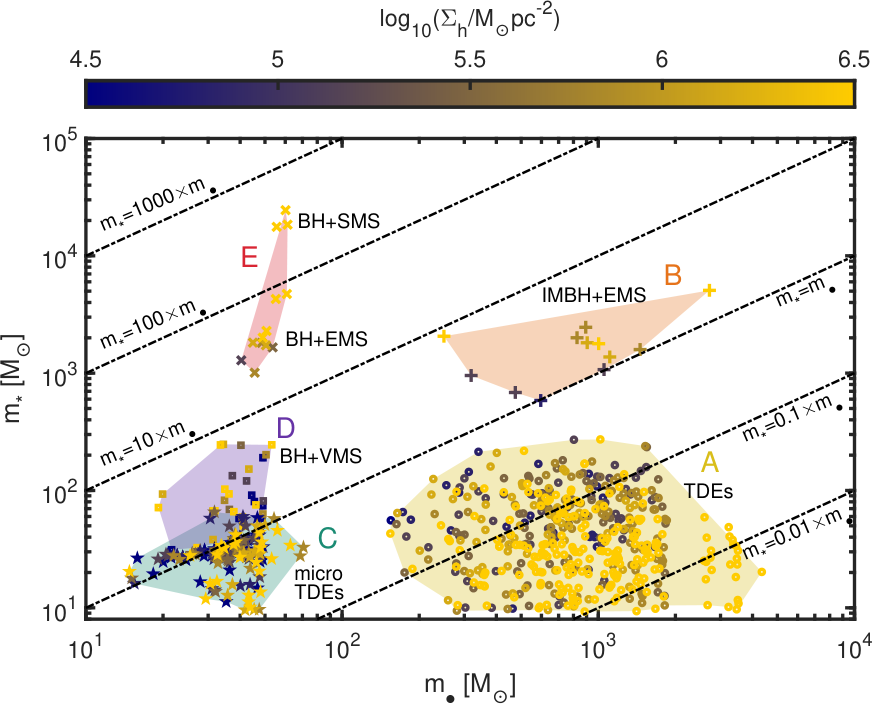
Direct cluster simulations suggest that stellar-mass black holes can enter collision-built extremely/supermassive stars in ultra-dense, low-metallicity clusters, creating longer-lived quasi-star-like objects. The authors propose these as faint, companion-rich multiple Little Red Dots, not typical bright LRDs.

2026-04-21 · 2604.19988v1

Pulsational mass loss from supermassive stars creates the compact shells of Little Red Dots

Devesh Nandal, Igor Chilingarian, Chris Nagele, et al.

This paper asks whether late pulsational mass loss from supermassive stars can naturally create the compact dense shells inferred around little red dots. The main result is that the final pre-collapse ejection episode can leave behind an optically thick shell on sub-parsec scales, while earlier episodes expand away and become dynamically unimportant for the observed cocoon. The paper matters because it turns the dense-gas requirement of LRDs into a concrete stellar-evolution prediction rather than an external assumption.

Figure 1 from A Black Hole Star at Cosmic Noon: Extreme Balmer break, photospheric continuum, and broad absorption by thick winds in a Little Red Dot at z=1.7

2026-03-30 · 2603.28335v1 · Research note

A Black Hole Star at Cosmic Noon: Extreme Balmer break, photospheric continuum, and broad absorption by thick winds in a Little Red Dot at z=1.7

Alberto Torralba, Jorryt Matthee, Andrea Weibel, et al.

PAN-BH*-1 is a single z=1.731 Little Red Dot at cosmic noon with an extreme Balmer break, compact red continuum, and broad Hα absorption. Its data are consistent with—but do not establish—a thick, rotating photospheric disk wind.

2026-03-25 · 2603.24700v1 · Research note

A PANORAMIC of UV-optical morphologies of "Little Red Dots": Two groups of LRDs distinguished by UV half-light radius

Aidan P. Cloonan, Katherine E. Whitaker, Sinclaire M. Manning, et al.

Across 181 photometrically selected PANORAMIC LRDs, rest-optical emission is generally unresolved (<100 pc) while UV sizes vary. Splitting by Balmer-break size yields compact-UV and extended-UV groups, a pattern also seen less significantly in spectroscopic RUBIES LRDs.

Figure 1 from A quasi-star is born: formation and evolution of accreting quasi-stars as a metallicity-independent pathway to Little Red Dots

2026-03-23 · 2603.21714v1 · Research note

A quasi-star is born: formation and evolution of accreting quasi-stars as a metallicity-independent pathway to Little Red Dots

J. Roman-Garza, D. Schaerer, C. Charbonnel, et al.

Stellar-evolution calculations suggest rapidly accreting supermassive stars can undergo relativistic collapse into long-lived quasi-stars whose cool, luminous envelopes overlap Little Red Dot optical properties across modeled metallicities; the LRD interpretation remains model-dependent rather than a direct identification.

2026-03-18 · 2603.17667v1 · Research note

The Engine and its Flows: Little Red Dot spectra are shaped by the column densities of their gas envelopes

Jorryt Matthee, Alberto Torralba, Gabriele Pezzulli, et al.

In 18 z≈3–7 broad-Hα emitters, Balmer cores progress from narrow emission to P-Cygni-like and absorption-dominated profiles as UV–optical colour reddens. The authors interpret this as changing envelope column density and optical depth, not purely dynamical line broadening.

Figure 2 from Synthetic Spectral Library of Optically Thick Atmospheres for Little Red Dots

2026-03-02 · 2603.02317v1 · Research note

Synthetic Spectral Library of Optically Thick Atmospheres for Little Red Dots

Hanpu Liu, Yan-Fei Jiang, Eliot Quataert, et al.

A new LRD-tailored atmosphere library finds that The Egg’s continuum curvature, weak 1.6-μm H− kink, and Ca II triplet jointly favor an exceptionally dilute photosphere, challenging hydrostatic interpretations and providing testable near-IR spectral diagnostics.

2026-02-17 · 2602.15929v1 · Research note

Toward Black Hole Stars: supermassive black hole growth in nuclear clusters via stellar-object and gas accretion

Konstantinos Kritos, Joseph Silk

This nuclear-star-cluster model attributes high-redshift electromagnetic and gravitational-wave signatures to stellar feeding of growing SMBHs, but concludes gas accretion dominates their mass assembly. Its LRD connection is a proposed interpretation rather than a direct fit to an observed LRD sample.

2026-02-13 · 2602.12548v1 · Research note

The Structure and Evolution of LRDs: Insights from JWST NIRSpec Medium and High Resolution Spectroscopy at $z\sim4$

Yuxuan Pang, Xin Wang, Cheng Cheng, et al.

Medium/high-resolution JWST/NIRSpec spectra of 11 z~4 little red dots separate broad and narrow Balmer emission, linking broad Hα to the optical continuum while [O III] tracks UV light. The authors infer rapidly accreting 10^6–10^8 M⊙ black holes and propose a clumpy envelope.

2026-01-28 · 2601.20929v1 · Research note

Little Red Dot $-$ Host Galaxy $=$ Black Hole Star: A Gas-Enshrouded Heart at the Center of Every Little Red Dot

Wendy Q. Sun, Rohan P. Naidu, Jorryt Matthee, et al.

Using empirical [O III]-matched host subtraction for 98 JWST/NIRSpec LRDs, the authors infer a red, dense-envelope central component that dominates rest-optical light. The conclusion depends critically on assigning all [O III] to the host and on stack-based decomposition.

2026-01-15 · 2601.10573v1 · Research note

Origins of the UV continuum and Balmer emission lines in Little Red Dots: observational validation of dense gas envelope models enshrouding the AGN

Yoshihisa Asada, Kohei Inayoshi, Qinyue Fei, et al.

Across 28 z=5–7.2 LRDs, UV-to-Hα behavior resembles young starbursts rather than unobscured AGN, while nine blue broad-line controls resemble Type 1 AGN. The authors therefore favor opaque black-hole envelopes, but the correlations do not uniquely establish the ionizing mechanism.

Figure 5 from Pulsational Instability of Quasi-Stars: Interpreting the Variability of Little Red Dots

2025-12-19 · 2512.17997v1 · Research note

Pulsational Instability of Quasi-Stars: Interpreting the Variability of Little Red Dots

Matteo Cantiello, Jake B. Hassan, Rosalba Perna, et al.

Stellar-evolution and pulsation models place cool quasi-star envelopes in an instability strip whose radial-mode timescales are compatible with R2211-RX1, but sparse monitoring and unresolved nonlinear mass loss prevent a demonstrated periodic or uniquely quasi-star interpretation.

Figure 3 from Little red dot variability over a century reveals black hole envelope via a giant Einstein cross

2025-12-04 · 2512.05180v1 · Research note

Little red dot variability over a century reveals black hole envelope via a giant Einstein cross

Zijian Zhang, Mingyu Li, Masamune Oguri, et al.

Four lensed views of the z≈4.3 LRD RX1 provide an ≈80–130-year observed-frame baseline and show up to 0.7-mag intrinsic color/brightness differences. Blackbody fits are consistent with a changing, ∼2000-AU photosphere, but do not yet establish pulsation over accretion variability.

2025-12-03 · 2512.04208v1 · Research note

A Black-Hole Envelope Interpretation for Cosmological Demographics of Little Red Dots

Hiroya Umeda, Kohei Inayoshi, Yuichi Harikane, et al.

Fitting ∼400 COSMOS-Web little red dots with a black-hole-envelope SED model yields cool, 4000–6000 K photospheres and bolometric luminosities typically 1–2 dex below dusty-quasar estimates, reducing the inferred tension with established AGN demographic constraints.

Figure 1 from A Critical Evaluation of the Physical Nature of the Little Red Dots

2025-12-02 · 2512.03130v1 · Research note

A Critical Evaluation of the Physical Nature of the Little Red Dots

Kohei Inayoshi, Luis C. Ho

This review argues that LRD broad Balmer lines, red optical continua, Balmer absorption/breaks, and weak infrared/X-ray behavior favor embedded accreting black holes over a purely stellar origin, while leaving the gas geometry and evolutionary interpretation unresolved.

2025-12-01 · 2512.02117v1 · Research note

VENUS: When Red meets Blue -- A multiply imaged Little Red Dot with an apparent blue companion behind the galaxy cluster Abell 383

Miriam Golubchik, Lukas J. Furtak, Joseph F. V. Allingham, et al.

JWST resolves the lensed z=6.027 system A383-LRD1 into a compact red LRD candidate and a blue companion separated by ~380 pc. Lensing exposes a faint intrinsic LRD, but its AGN/BH* interpretation and association with the companion remain photometric inferences.

2025-11-26 · 2511.21820v1 · Research note

Little Red Dots host Black Hole Stars: A unified family of gas-reddened AGN revealed by JWST/NIRSpec spectroscopy

Anna de Graaff, Raphael E. Hviding, Rohan P. Naidu, et al.

A 116-object JWST LRD sample shows narrowly peaked, thermal-like optical continua and coordinated line–continuum trends. The authors interpret these correlations as evidence for AGN embedded in dense gas envelopes, while assigning [O III] largely to faint star-forming hosts.

Figure 2 from Too Quiet for Comfort: Local Little Red Dots Lack Variability over Decades

2025-11-20 · 2511.16082v1 · Research note

Too Quiet for Comfort: Local Little Red Dots Lack Variability over Decades

Colin J. Burke, Zachary Stone, Yue Shen, et al.

Three nearby proposed Little Red Dot analogs show <3–4% optical-continuum variability over rest-frame five years; two also have broad-Hα changes below a few percent over roughly 15 years, challenging ordinary variable, photoionized broad-line interpretations.

2025-11-12 · 2511.09278v1 · Research note

Little red dots as embryos of active galactic nuclei

Jian-Min Wang, Yi-Lin Wang, Yong-Jie Chen, et al.

This abstract-only paper proposes that little red dots are nascent AGN systems containing sub-million-solar-mass central black holes plus a more massive embedded stellar-mass-black-hole population, attributing their V-shaped SEDs and Balmer absorption to distinct, model-dependent components.

2025-11-11 · 2511.08477v1 · Research note

Supermassive Dark Stars and their remnants as a possible solution to three recent cosmic dawn puzzles

Cosmin Ilie, Jillian Paulin, Andreea Petric, et al.

The authors propose supermassive dark stars as a unified, still-unconfirmed explanation for early compact luminous sources and massive black holes. Their argument combines tentative helium absorption candidates with parameterized growth tracks, rather than a population-level observational test.

2025-10-20 · 2510.17952v1 · Research note

Evolutionary Tracks and Spectral Properties of Quasi-stars and Their Correlation with Little Red Dots

Andrew D. Santarelli, Ebraheem Farag, Earl P. Bellinger, et al.

MESA quasi-star models predict a long-lived, cool late stage whose continuum broadly resembles two JWST Little Red Dots, including one measured Balmer break, but mismatched extreme breaks and simplified atmospheres prevent identification of LRDs as quasi-stars.

2025-09-23 · 2509.19422v1

Spectral Uniformity of Little Red Dots: A Natural Outcome of Coevolving Seed Black Holes and Nascent Starbursts

Kohei Inayoshi, Kohta Murase, Kazumi Kashiyama

Proposes a two-component origin for LRD SEDs during assembly of Mh ≳ 1e10–11 Msun halos at z ≃ 4–10: a super-Eddington–fed seed BH (growing to ~1e6–1e7 Msun) inflates a dense envelope at Teff ≃ 5000 K that makes the red optical, while a coeval ~1e7 Msun nuclear starburst supplies the blue UV. This naturally yields the V-shaped UV–optical continuum and the weakness of X-ray/IR/radio signatures, with broad lines arising despite envelope scattering. A key prediction is a nearly constant Lopt/LUV ≃ 2–10 for ≃15 Myr (~one-third Salpeter) until SNe expel nuclear gas and quench the envelope. Population-wide, the ratio stays uniform at z ≃ 4–8 but declines toward lower z as red envelopes fail, linking LRD phases to later normal AGN states.

2025-08-25 · 2508.18358v1

The Missing Hard Photons of Little Red Dots: Their Incident Ionizing Spectra Resemble Massive Stars

Bingjie Wang, Joel Leja, Harley Katz, et al.

Using recombination lines rather than continuum, the authors analyze uniformly selected RUBIES LRDs plus an 8 hr G395M spectrum of RUBIES‑EGS‑49140 to infer the incident ionizing spectra. They find a strong tension: very large Hα equivalent widths demand abundant H-ionizing photons, yet HeII is only marginally detected with HeII/Hβ ~10^-2, far below local AGN, implying an unusually soft spectrum missing hard photons. Cloudy modeling rules out standard AGN accretion-disk SEDs and favors soft, star-like ionizing fields (e.g., cold disks or AGN+stars composites) and/or high gas/dust optical depths, with HeII remaining an optically thin, robust tracer even in dense neutral hydrogen “black-hole star” envelopes. The HeII-based diagnostic reframes the LRD central-engine debate by highlighting missing hard photons and incident spectra that resemble massive stars.

2025-08-01 · 2508.00774v1

A Novel Formation Channel for Supermassive Black Hole Binaries in the Early Universe via Primordial Black Holes

Saiyang Zhang, Boyuan Liu, Volker Bromm

High-resolution hydrodynamics around ∼10^6 M⊙ primordial black holes show that accretion-driven LW fields plus strong baryon–DM streaming (v_bχ ≳ 0.8 σ_bχ) push gas onto an atomic-cooling track and trigger collapse in the PBH wake. The collapsing clouds sustain inflow rates ≳0.01–0.1 M⊙ yr⁻¹, enabling ∼10^5 M⊙ supermassive stars that rapidly form direct-collapse BHs at z ∼ 20–10. These secondary DCBHs pair with the primary PBH to yield in-situ SMBH binaries with initial q ≈ O(0.1) at ∼10 pc separations. The channel predicts compact, LRD-like sources and low-frequency GW emitters accessible to JWST/ALMA and LISA/TianQin.

2025-07-29 · 2507.22014v1

Little Red Dots as self-gravitating discs accreting on supermassive stars: Spectral appearance and formation pathway of the progenitors to direct collapse black holes

Lorenz Zwick, Christopher Tiede, Lucio Mayer

Models little red dots as supermassive stars fed by massive self‑gravitating discs assembled in gas‑rich major mergers, reproducing the V‑shaped SED as two blackbodies and attributing Balmer broadening to disc rotation—without invoking extra AGN, stellar, or dust components. MCMC fits to two representative LRDs (J0647‑1045 and COS‑756434) yield sub‑Eddington disc accretion and SMS masses of a few ×10^6 Msun with physically motivated parameters. The framework predicts a luminosity cut‑off of order few ×10^44 erg/s and ties the observed redshift distribution of LRDs to merger rates, matching current trends. Acknowledged caveat: reproducing the absolute abundance of LRDs remains challenging, though the fits are robust to observed diversity.

2025-07-16 · 2507.12618v1

Supermassive Stars Match the Spectral Signatures of JWST's Little Red Dots

Devesh Nandal, Abraham Loeb

First-principles synthetic spectra for non-rotating, metal-free supermassive stars (up to 10^6 M⊙) are used to test whether LRDs are direct photospheres of SMSs. The model’s luminosity at 4050 Å (Lλ ≈ 1.7×10^44 erg s^-1 μm^-1) and NLTE physics reproduce hallmark LRD traits—a V-shaped Balmer break and strong Hβ emission with other Balmer lines in absorption—with wind/macroturbulent broadening matching observed profiles. Quantitative fits to sources at z=7.76 and z=3.55 include an Hβ width match for MoM‑BH*-1 to within 4%, offering a self-consistent alternative to multi-component obscured AGN. A luminosity-dependent visibility window of ~10^4 yr for the brightest systems and 10^5–10^6 yr for objects 1–2 dex fainter implies LRDs may capture brief, pre-collapse stages of SMBH progenitors.

2025-07-14 · 2507.10659v1

The Discovery of Little Red Dots in the Local Universe: Signatures of Cool Gas Envelopes

Xiaojing Lin, Xiaohui Fan, Zheng Cai, et al.

Reports three SDSS-selected local little red dots at z=0.1–0.2 with LBT/MODS and Magellan/FIRE follow-up, showing the same hallmarks as high‑z LRDs: compact morphologies, V‑shaped UV–optical SEDs with declining NIR continua, broad H/He lines, full Balmer+Paschen series, and minimal variability. All display blue‑shifted He I absorption; two show Hα and Na D absorption, and two have abundant narrow [Fe II]; J1025+1402 (The Egg) further exhibits extreme Na D, K I, and Ca II triplet absorption consistent with a cool (~5000 K), metal‑enriched envelope. Line diagnostics point to AGN‑powered, metal‑poor narrow lines with little dust, very high‑density inner regions for the broad lines (or unusual dust), and [Fe II] from dense gas between them; two targets are X‑ray non‑detections and WISE photometry implies only weak dust (T ~10^2–10^3 K). The authors propose a largely thermalized cool‑gas envelope plus an extended, high‑density outflow to unify these features, positioning local LRDs as resolvable analogs of early BH growth.
2025-07-12 · 2507.09085v1

Little Red Dots As Late-stage Quasi-stars

Mitchell C. Begelman, Jason Dexter

Begelman and Dexter propose that JWST “Little Red Dots” are late-stage quasi-stars: black holes embedded in massive envelopes accreting at super‑Eddington rates once the BH exceeds ~10% of the total mass. In this regime the models predict mass‑insensitive global properties, yielding reddish continua with a pronounced Balmer break and Balmer lines broadened primarily by electron scattering rather than Doppler motions. The enormous electron columns naturally quench X‑rays, while BHs grow roughly linearly in time; late-stage objects with MBH ≳10^6 Msun should dominate the quasi-star population. Given lifetimes of only tens of Myr yet high observed LRD number densities, the authors argue most SMBHs likely pass through this quasi‑star/LRD phase.

2025-05-11 · 2505.06965v1

Black Hole Envelopes in Little Red Dots

Daisaburo Kido, Kunihito Ioka, Kenta Hotokezaka, et al.

Proposes that little red dots host super-Eddington black holes wrapped in a massive, optically thick envelope that gravitationally confines otherwise destructive winds, effectively making outflows a no-go. The envelope radiates near the system Eddington limit with a photosphere at 5000–7000 K, naturally producing the red optical continuum and the hallmark V-shaped SED while explaining weak X-ray/radio and low short-term variability. A sustained ISM infall of ~1 M_sun/yr feeds the envelope, and a photospheric radius ~0.01 pc sets year-scale variability, linking LRD nuclear structure to Hayashi-limit physics. The envelope both regulates feedback and provides a reservoir enabling rapid early BH growth.

2025-05-05 · 2505.02908v1

Early Shock-Cooling Observations and Progenitor Constraints of Type IIb SN 2024uwq

Bhagya M. Subrayan, David J. Sand, K. Azalee Bostroem, et al.

Early multiwavelength follow-up of the Type IIb SN 2024uwq captures the shock-cooling bump and the subsequent second peak, with early spectra showing broad H-alpha (~15,500 km s^-1) and He I P-Cygni features of comparable strength that evolve toward stronger He and fading H. Modeling of the shock-cooling phase and a bolometric light-curve fit (two-component Arnett) favor a partially stripped progenitor with radius 10–60 R_sun and a residual hydrogen envelope of 0.7–1.35 M_sun. The inferred ZAMS mass of 12–20 M_sun and likely binary stripping place SN 2024uwq between compact and extended IIb events. The work underscores the value of very-early UV/optical coverage for mapping the continuum of stripped-envelope progenitors.

2025-03-20 · 2503.16600v1

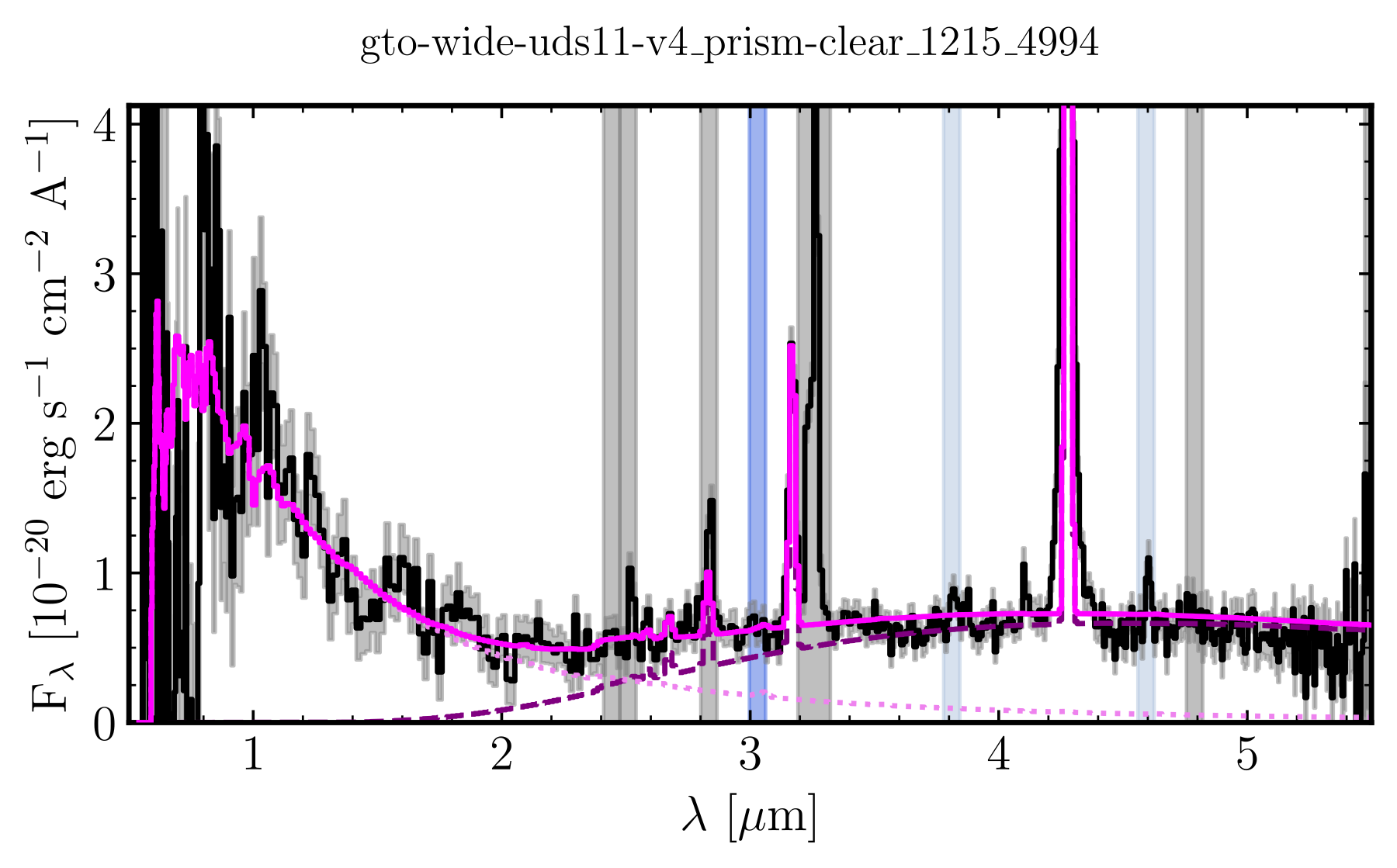
A remarkable Ruby: Absorption in dense gas, rather than evolved stars, drives the extreme Balmer break of a Little Red Dot at $z=3.5$

Anna de Graaff, Hans-Walter Rix, Rohan P. Naidu, et al.

JWST/NIRSpec+NIRCam+MIRI data on The Cliff, a luminous Little Red Dot at z=3.55, reveal an extreme Balmer break—about twice stronger than any previously seen at high-z—alongside broad Hα (FWHM∼1500 km s⁻¹) and He I emission but no significant metal lines. Stellar-population solutions (even with steep dust or IMF tweaks) fail, and their formal M*∼10^10.5 M⊙ with re∼40 pc would imply implausibly high stellar-collision rates. The spectra and continuum are instead best matched by a “black hole star” configuration: a powerful central ionizing source embedded in dense, absorbing gas that imprints the Balmer edge and Hα absorption while favoring an intrinsically red continuum over heavy dust. This makes The Cliff compelling evidence that at least some LRDs are not ultra-dense galaxies but compact, accretion-powered nuclei shrouded by dense gas.

2025-03-20 · 2503.16596v1

A "Black Hole Star" Reveals the Remarkable Gas-Enshrouded Hearts of the Little Red Dots

Rohan P. Naidu, Jorryt Matthee, Harley Katz, et al.

JWST/NIRSpec spectroscopy of the point-like source MoM-BH*-1, observed ~660 Myr after the Big Bang, reveals an enormous Balmer break, broad multi-peaked Hβ, and deep Balmer-line absorption. The authors model it as a “black hole star”: a supermassive black hole enshrouded by extremely dense, turbulent, dust-free gas whose atmosphere imprints the break and absorption while dominating the observed light; narrow [OIII] and residual UV are attributed to a faint host. The data are well matched by a simple Cloudy setup that reproduces the break strength, Balmer EWs, UV faintness, and MIRI continuum, with line ratios consistent with high densities that can collisionally suppress [OIII] and a hint of variability reinforcing the SMBH interpretation. They further argue that Little Red Dots can be explained as BH*s embedded in comparably bright hosts, implying current LRD black hole masses—derived with steep dust corrections and standard scaling relations—may be overestimated by orders of magnitude.

2025-03-14 · 2503.11752v1

BlackTHUNDER strikes twice: rest-frame Balmer-line absorption and high Eddington accretion rate in a Little Red Dot at $z=7.04$

Francesco D'Eugenio, Roberto Maiolino, Michele Perna, et al.

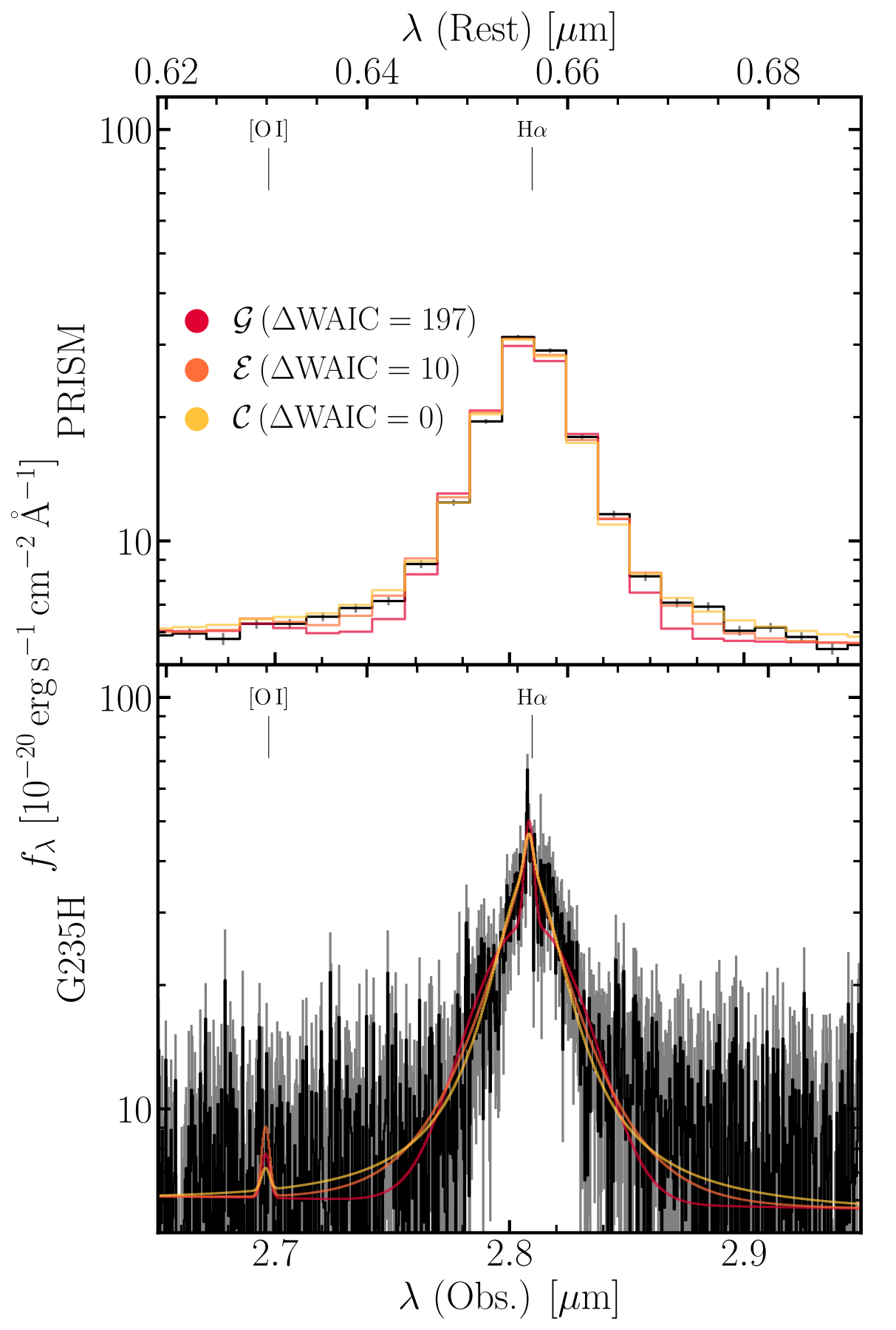
BlackTHUNDER re-analyzes JWST/NIRSpec-IFS G395H data for the Little Red Dot Abell2744-QSO1 at z=7.04, focusing on the Hα region. The Hα profile is distinctly non-Gaussian, requiring at least two broad Gaussians plus a narrow component, and shows strong rest-frame Balmer-line absorption (EW ≈22 Å) centered at the systemic velocity of the broad line; the absorber’s dispersion (σ_abs ≈110 km s⁻¹) matches that inferred from the Balmer break, arguing for a long‑lived, non-flowing structure. An Hα-based virial mass of log(MBH/M⊙) ≈7.2 and a deconvolved narrow-line width σ_n ≈22 km s⁻¹ yield MBH/Mdyn = 0.15–1.2, confirming an overmassive black hole with limited room for a host galaxy. The revised mass implies high accretion, λ_Edd ≈0.7–1.6 (potentially super‑Eddington at the low‑mass end), tying Balmer-break strength directly to Balmer-line absorption in LRDs.