2026-06-01 · 2605.30424v1
F. Valentino, K. Ito, M. Farcy, et al.
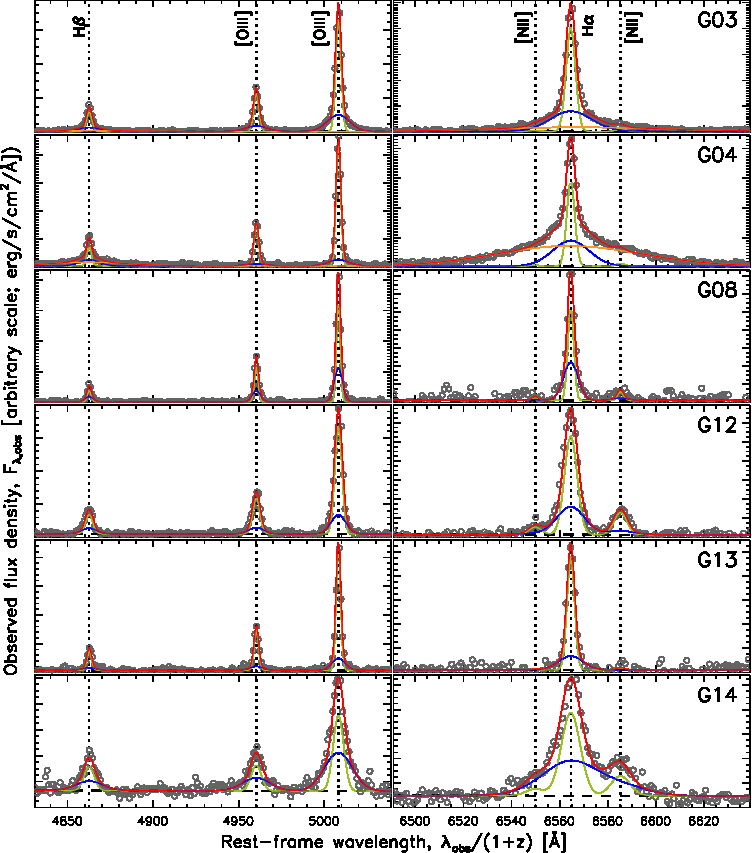
This paper searches JWST/NIRSpec archival spectra of 87 massive quenched galaxies at z≈1.5-4.5 and finds [NeV] λ3427 in six, arguing that this coronal line cleanly isolates luminous SMBH accretion in systems where residual star formation is not a viable explanation. Four of the six [NeV] hosts also show broad Hα with FWHM ≳ 4000 km s^-1, implying MBH ≈ 10^8.5-10^9.5 Msun, while the [NeV] luminosities indicate quasar-like power outputs of roughly 10^45-10^46 erg s^-1 and Eddington ratios of about 10-50%. The strongest [NeV] emitters sit in the youngest post-starburst galaxies with Dn4000 ≲ 1.3, whereas older quenched systems lack comparable activity, pointing to intense radiatively efficient black-hole growth that can continue for several hundred Myr after the main quenching event. That timing matters because it links early quenching to delayed but still powerful SMBH growth, and provides a concrete empirical target for models that aim to produce the first massive passive galaxies.