2026-05-28 · 2605.27903v1
A. J. Barger, L. L. Cowie
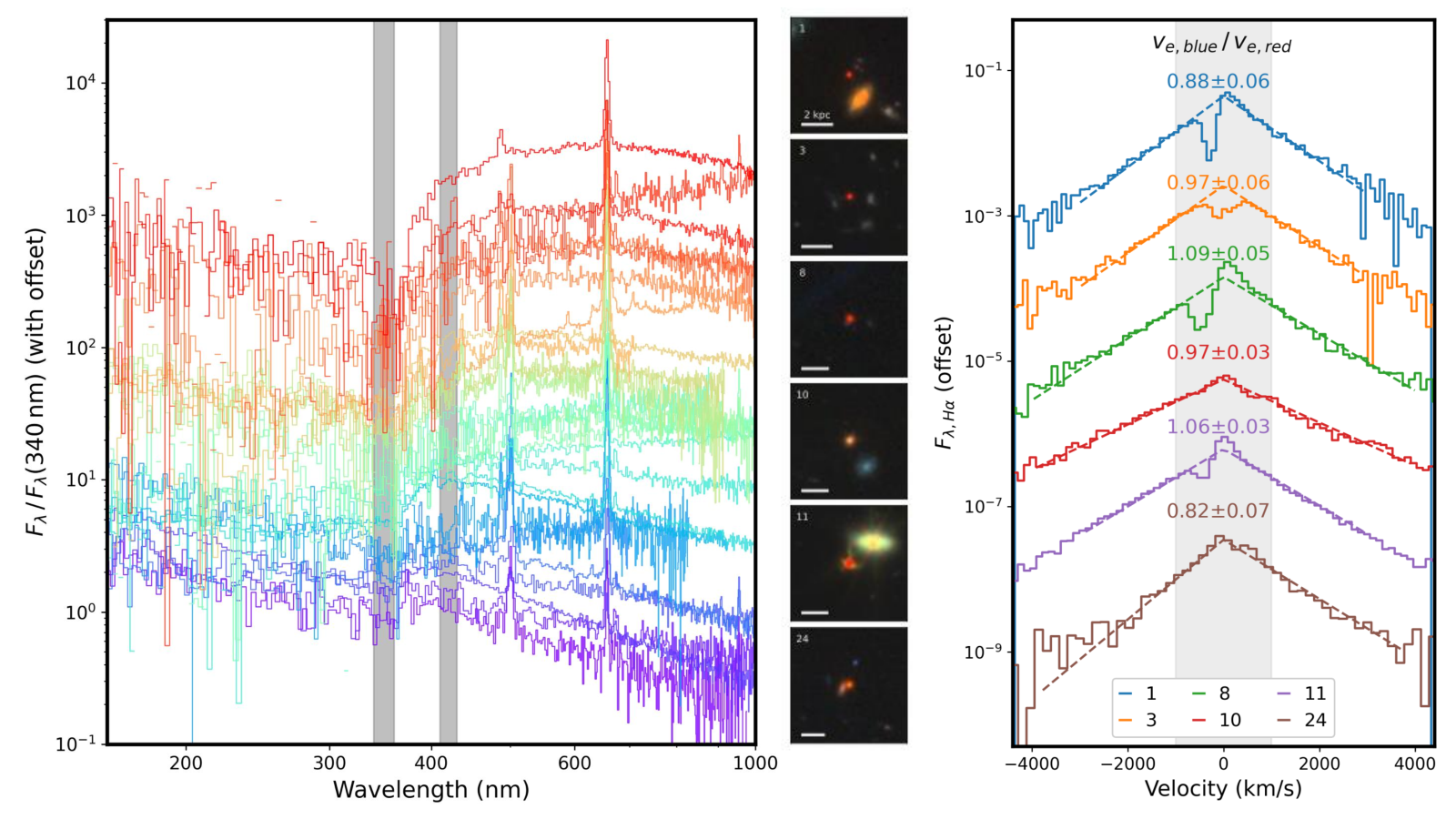
Using JWST imaging of the lensed A2744 field, this paper defines a sample of 31 sub-0.25 arcsecond compact pairs, or “Double Dots,” and shows their separations are strongly skewed to small values, consistent with most being physical systems rather than chance alignments. The main empirical result is that close pairs are extremely common among known broad-line high-redshift sources in the field: at least 16 of 24 published little red dots and both previously identified high-redshift BLAGNs are double systems, with a median observed separation of 0.15 arcseconds. The authors then show that unresolved companions can materially reshape the observed SED, including washing out the canonical LRD v-shape, and that 2D spectroscopy can place the broad-line emission on either the redder or bluer member of the pair. That makes compact pairing itself a powerful marker of broad-line activity at high redshift and points to merger-driven accretion as a plausible underlying trigger.