654 indexed papers · 430 research notes

Research archive

Reset
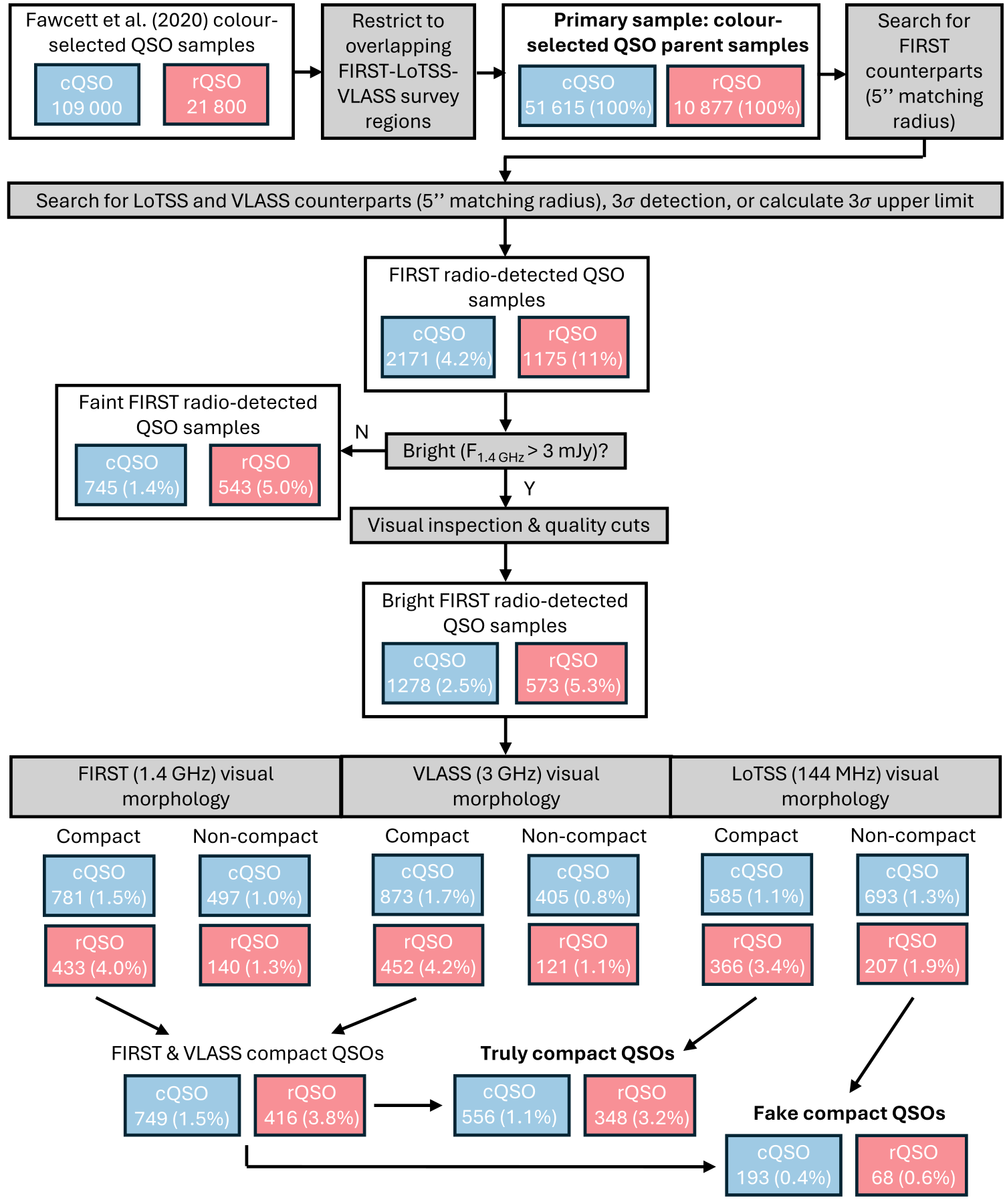
Figure 2 from A striking excess of red quasars with steep radio spectral slopes: a dusty blow-out phase revealed through AGN-driven shocks?

2026-03-25 · 2603.24739v1 · Research note

A striking excess of red quasars with steep radio spectral slopes: a dusty blow-out phase revealed through AGN-driven shocks?

Ciera L. Sargent, David M. Alexander, Claire L. Greenwell, et al.

Across SDSS quasars at 0.2<z<2.4, compact red quasars show an excess near α1.4–3 GHz≈−1 that strengthens with dust extinction. The authors interpret this as wind/jet–ISM shocks during a dusty blow-out phase, but radio spectra alone do not establish that mechanism.

2026-03-23 · 2603.22393v1 · Research note

MEOW: The increase in the obscured AGN fraction in mid-infrared from 0 < z < 6 with JWST MIRI

Teodora-Elena Bulichi, Gene C. K. Leung, Anna-Christina Eilers, et al.

Using JWST/MIRI-selected sources, MEOW infers that obscured AGN become increasingly dominant with redshift: its SED-based luminosity functions imply a 98–99% obscured fraction at z=4.5–6 for luminous AGN, relative to UV type-1 quasars.

2026-03-18 · 2603.17967v1 · Research note

JWST Reveals Two Overmassive Black Hole Candidates in Dwarf Galaxies at z $\approx$ 0.7: Pushing Black Hole Searches into the Dwarf-Galaxy Regime

E. Iani, P. Rinaldi, A. Torralba, et al.

Two z≈0.7 compact dwarfs combine blue, burst-dominated UV–optical emission with a MIRI hot-dust excess. SED-inferred AGN luminosities imply candidate black holes disproportionately massive for ≈10^7 M⊙ hosts, but masses depend strongly on the assumed Eddington ratio.

2026-02-25 · 2602.22386v1 · Research note

Little Red Dots as Obscured Little Blue Dots: A Super-Eddington Unification Model

Piero Madau, Roberto Maiolino

This modeling study argues that Little Red Dots are high-inclination, dust-reddened counterparts of super-Eddington Little Blue Dots. Anisotropic continua and modest BLR/dust covering factors can reproduce several LRD ensemble observables, but the proposed orientation unification remains model-dependent.

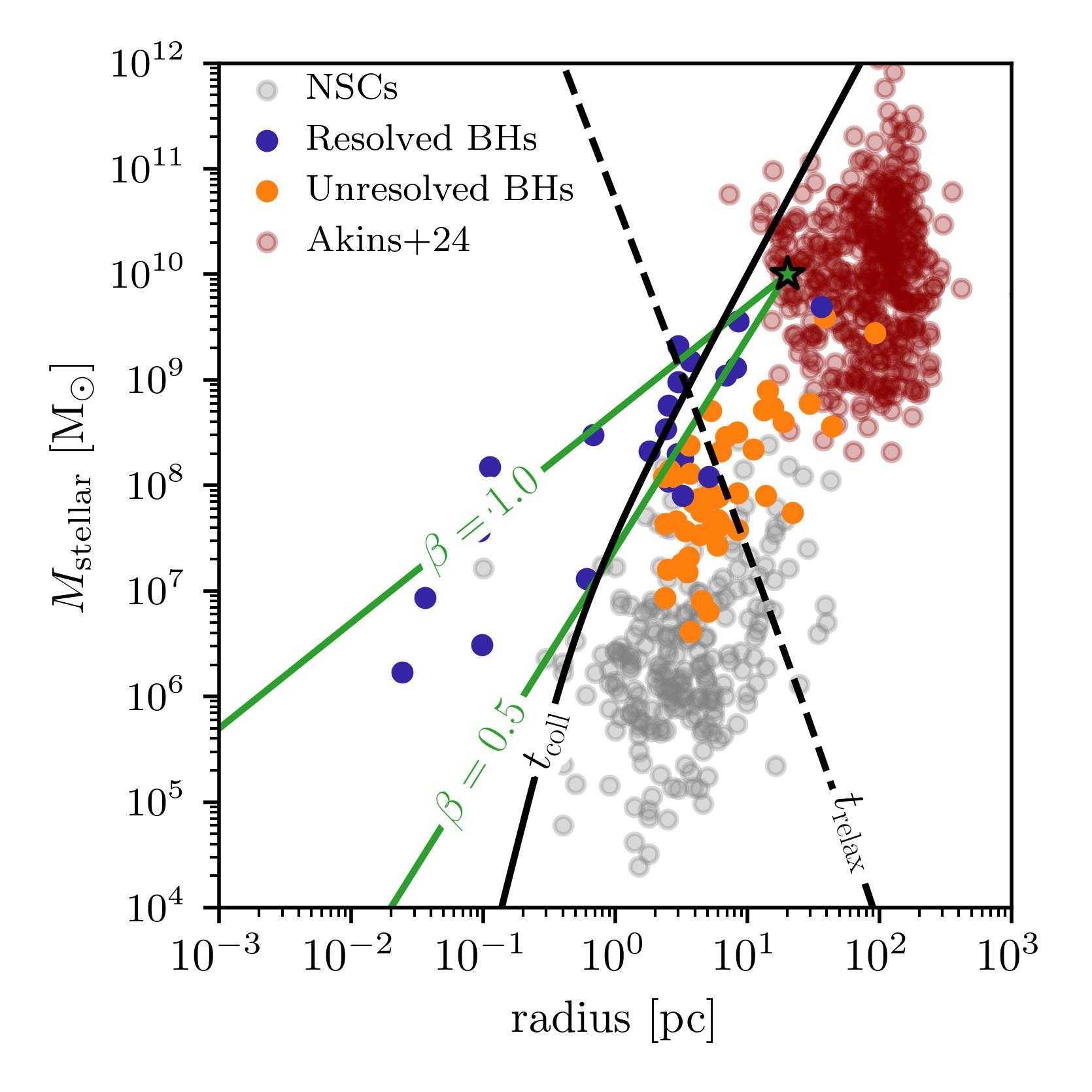
Figure 3 from Constraints on dynamically-formed massive black holes in Little Red Dots from X-ray non-detections

2026-02-24 · 2602.21002v1 · Research note

Constraints on dynamically-formed massive black holes in Little Red Dots from X-ray non-detections

M. Liempi, D. R. G. Schleicher, M. A. Latif, et al.

Using X-ray non-detections of Little Red Dots, the authors model collisionally formed black-hole seeds and argue that heavy-seed evolutionary tracks can meet flux limits, conditional on degenerate assumptions about structural evolution, accretion, metallicity, and absorption.

Figure 1 from Direct pathway to the Early Supermassive Black Holes: A Red Super-Eddington Quasar in a Massive Starburst Host at $z=7.2$

2026-02-12 · 2602.12325v1 · Research note

Direct pathway to the Early Supermassive Black Holes: A Red Super-Eddington Quasar in a Massive Starburst Host at $z=7.2$

Qinyue Fei, Seiji Fujimoto, Gabriel Brammer, et al.

GNz7q at z=7.1899 combines a 10^7.55-M⊙, apparently super-Eddington black hole with a massive, rapidly star-forming host. The authors argue that its near-local BH-to-stellar mass ratio makes it a plausible progenitor channel for luminous z≈6 quasars.

Figure 9 from Obscured AGN at z < 1.5: X-ray to Far-Infrared SEDs and Host Galaxy Morphologies in the GOODS Fields

2026-01-29 · 2601.22227v1 · Research note

Obscured AGN at z < 1.5: X-ray to Far-Infrared SEDs and Host Galaxy Morphologies in the GOODS Fields

William W. H. Jarvis, Connor Auge, David Sanders, et al.

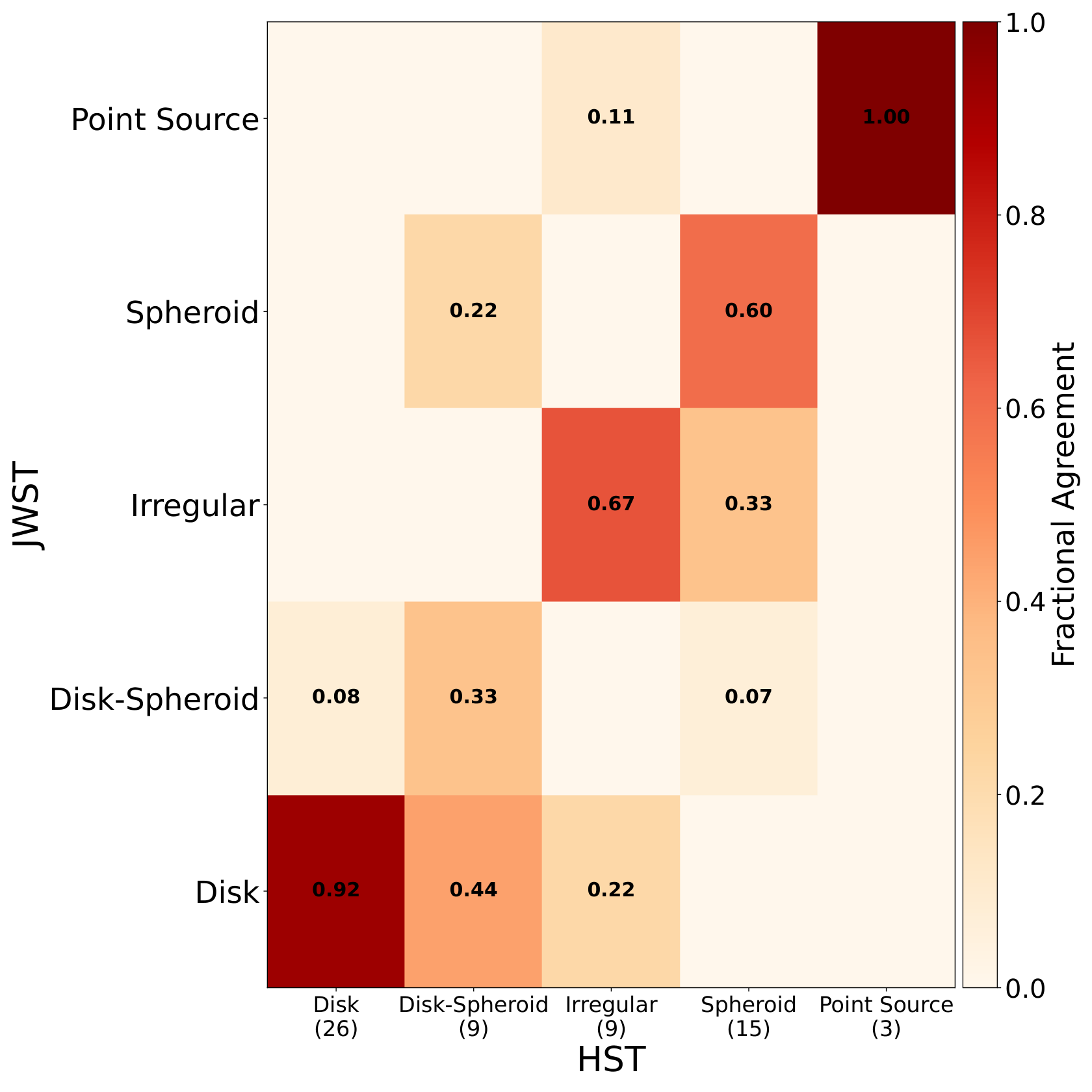
For 194 X-ray AGN at z<1.5 in GOODS, the authors find predominantly obscured SEDs and mainly disk-dominated hosts. A statistically distinct, faint obscured SED class is more spheroid-rich, while the observed interaction fraction does not establish triggering causality.

Figure 10 from JWST Spectroscopic Census of ALMA Faint Submillimeter Galaxies in the Hubble Ultra Deep Field

2026-01-26 · 2601.18149v1 · Research note

JWST Spectroscopic Census of ALMA Faint Submillimeter Galaxies in the Hubble Ultra Deep Field

Tomokazu Kiyota, Masami Ouchi, Daisuke Iono, et al.

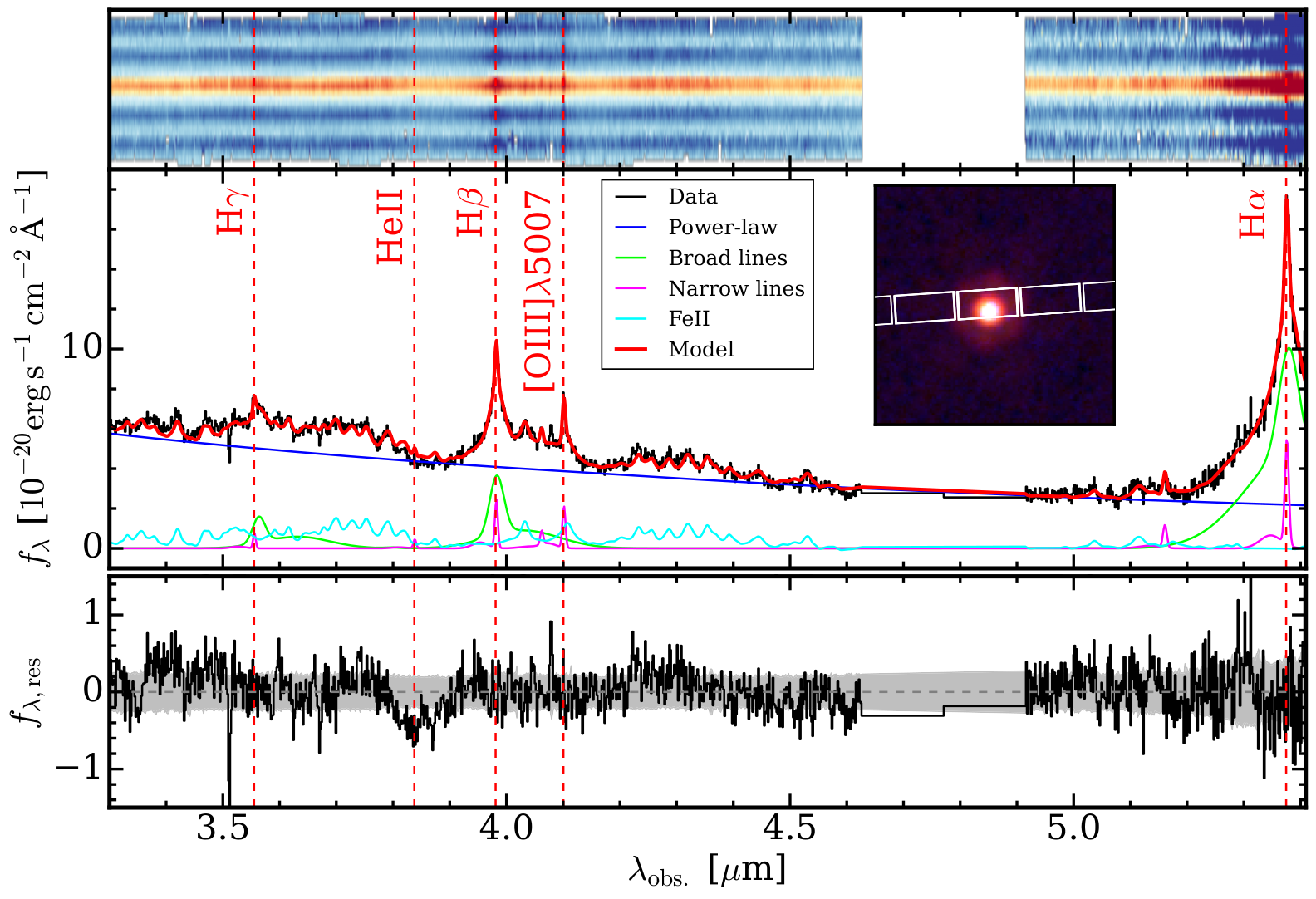
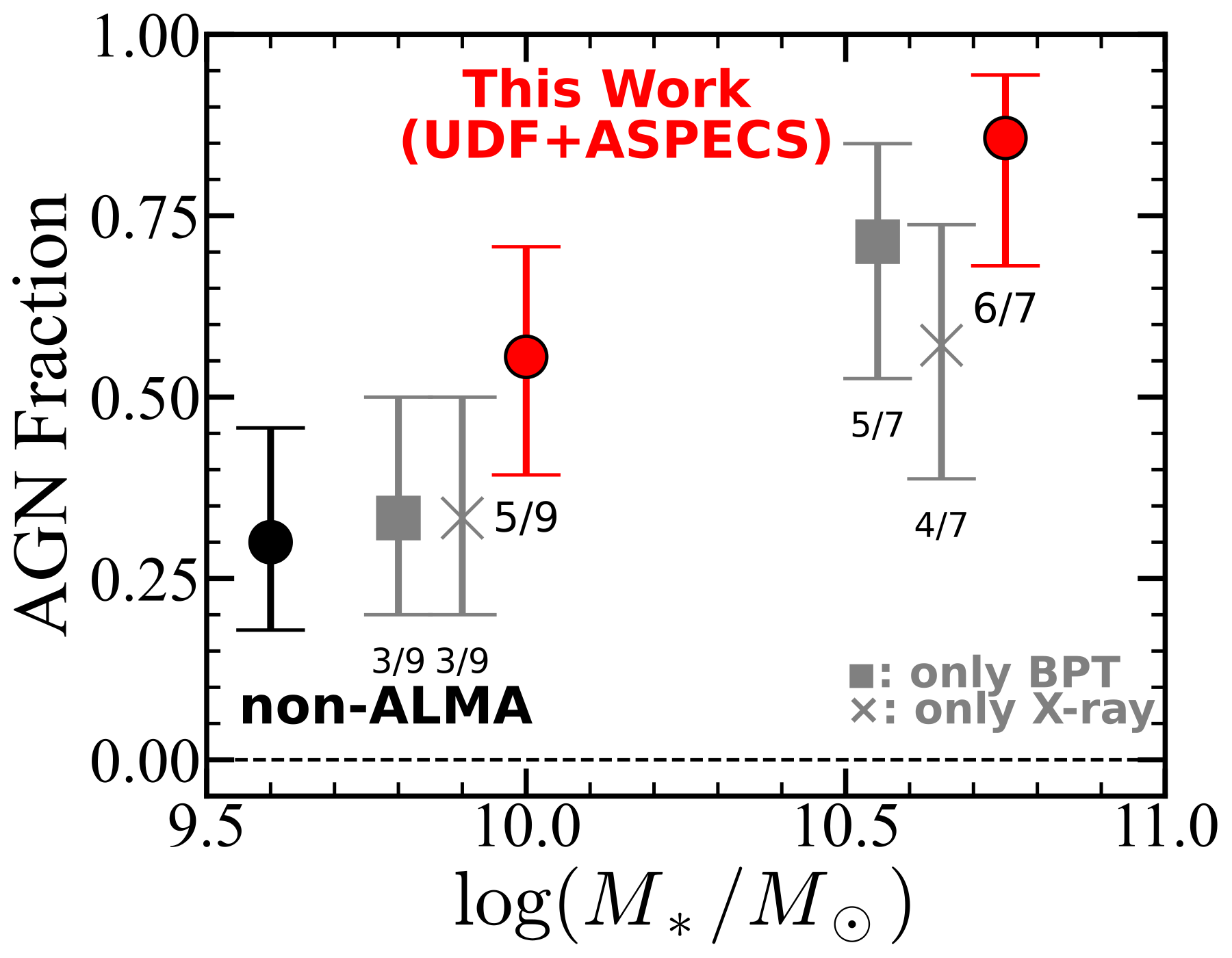
JWST/NIRSpec spectroscopy of 16 ALMA-selected HUDF faint SMGs finds dusty, massive z=1–4 galaxies with mostly obscured AGN classifications, yet star-formation, metallicity, and bulk-ISM properties broadly consistent with comparable high-redshift star-forming populations.

Figure 3 from The rest ultraviolet to infrared spectral energy distributions of heavily reddened quasars are "V-shaped" and hot-dust poor

2026-01-24 · 2601.17416v1 · Research note

The rest ultraviolet to infrared spectral energy distributions of heavily reddened quasars are "V-shaped" and hot-dust poor

Matthew Stepney, Manda Banerji, Shenli Tang, et al.

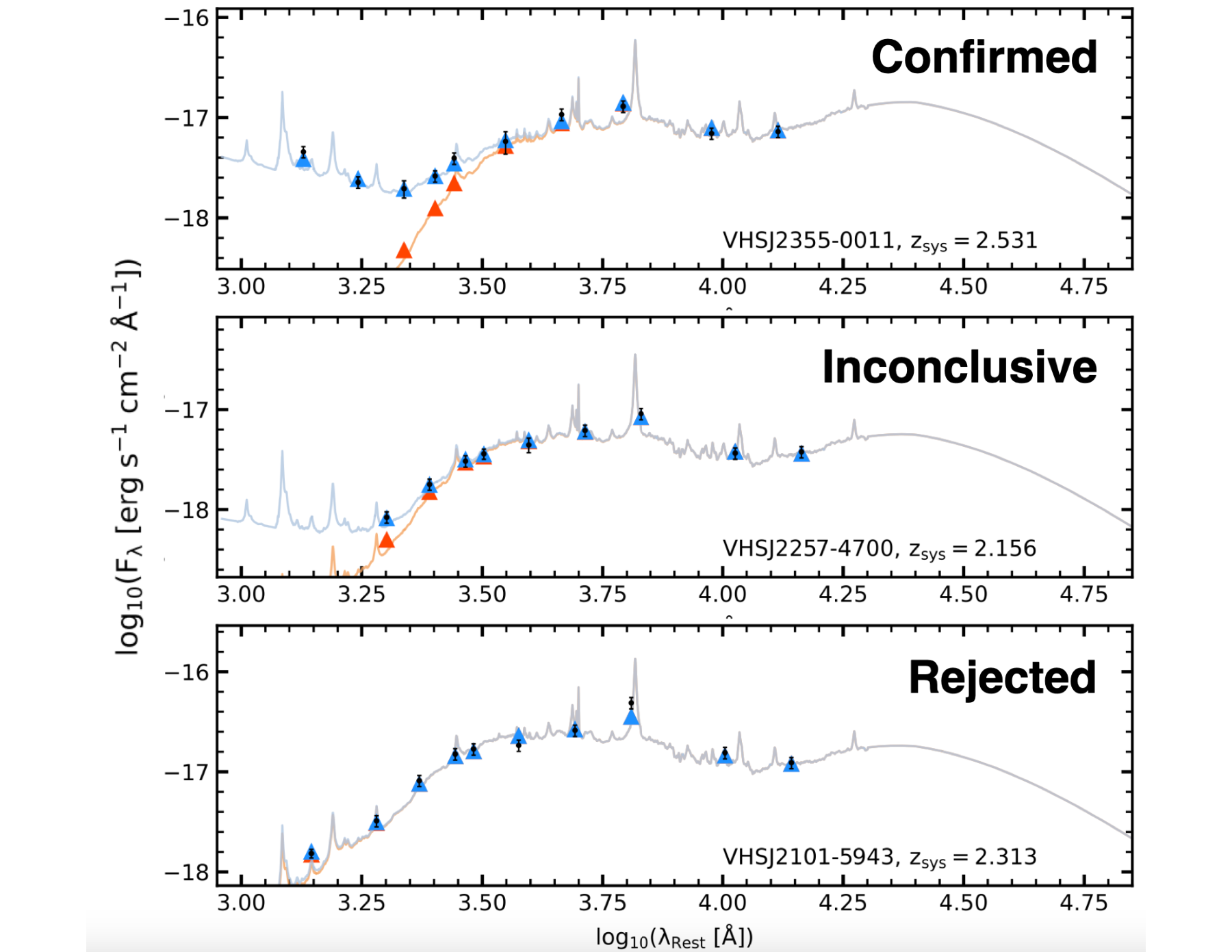
For 63 heavily reddened quasars at z=0.7–2.7, two-component UV–IR fits frequently yield V-shaped SEDs and comparatively weak hot dust. The authors identify four cosmic-noon objects meeting Little Red Dot continuum-slope selections, but do not uniquely establish the UV-emission mechanism.

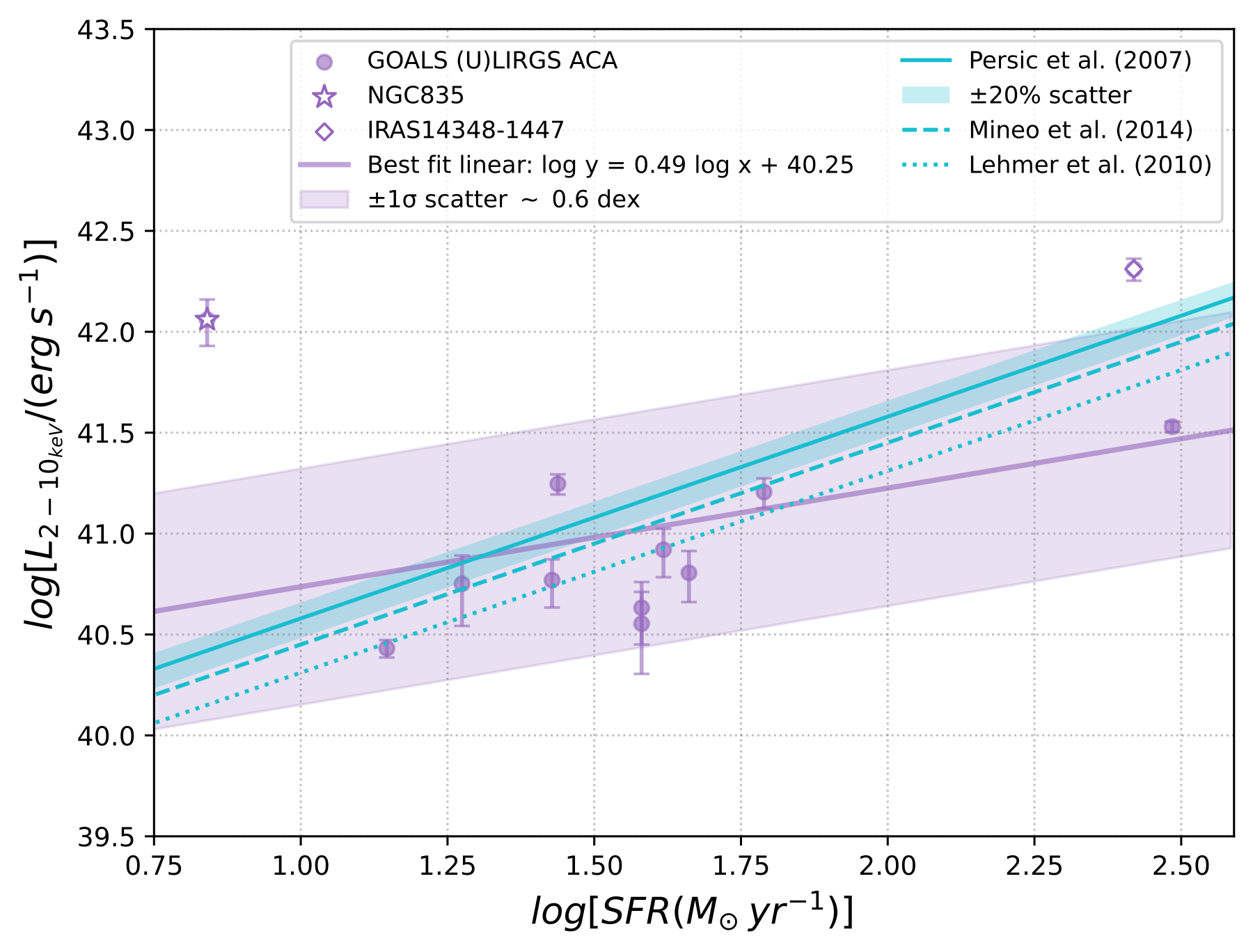
Figure 1 from Probing Heavily Obscured AGN in Major Galaxy Mergers Using the mm-X-ray Correlation

2026-01-21 · 2601.15186v1 · Research note

Probing Heavily Obscured AGN in Major Galaxy Mergers Using the mm-X-ray Correlation

M. Droguett-Callejas, E. Treister, L. Barcos-Muñoz, et al.

In local merging (U)LIRGs, 230-GHz continuum combined with X-ray luminosity and IR-based SFR can conservatively separate star-formation-compatible systems from candidate obscured AGN; the authors identify one confirmed AGN and two strong candidates, but calibration remains preliminary.

2026-01-16 · 2601.11466v1 · Research note

Pseudo Little Red Dot: an Active Black Hole Embedded in a Dense and Dusty, Metal-Poor Starburst Galaxy at z=5.96

Karina I. Caputi, Ryan A. Cooper, Pierluigi Rinaldi, et al.

JWST spectroscopy identifies a lensed z=5.96 “pseudo-LRD” whose red optical colour is Hα-line driven, yet whose broad Hα supports a ∼3×10^6 M⊙ black hole embedded in a dusty, dense, very metal-poor starburst.

2026-01-13 · 2601.08212v1 · Research note

Diverse Origins of Broad H$α$ Lines in Heavily Obscured AGNs Revealed by Multi-epoch Spectroscopy

Shoichiro Mizukoshi, Takeo Minezaki, Subaru Ubukata, et al.

Five-epoch spectroscopy of three AGNs with A_V>50 mag finds broad-Hα behavior is not uniform: Mrk 268 varies at 4.3σ, consistent with direct BLR emission, whereas MCG -3-34-64 and UGC 5101 favor outflow and/or scattering contributions.

2025-12-31 · 2601.00044v1 · Research note

Born in the Dark: The Catastrophic Collapse of Fuzzy Dark Matter Solitons as the Origin of Little Red Dots

Tak-Pong Woo

The authors propose that LRDs are transient, Compton-thick inflows within fuzzy-dark-matter soliton cores. Their size-and-column arguments favor boson masses of a few ×10^-22 eV, but the mechanism remains an analytic, idealized-merger scenario requiring radiation-hydrodynamic tests.

2025-12-20 · 2512.18421v1 · Research note

The evolution of obscured AGN across cosmic time -- A large quasar survey for the 2040s

Tanya Urrutia, Darshan Kakkad, Paula Sánchez-Sáez, et al.

This is a survey proposal, not a new AGN measurement: it argues that repeat optical MOS spectroscopy of >50 million multi-selected candidates to z~6.5 could quantify obscuration demographics while exposing selection biases among obscured populations.

Figure 1 from From "The Cliff" to "Virgil": Mapping the Spectral Diversity of Little Red Dots with JWST/NIRSpec

2025-12-17 · 2512.15853v1 · Research note

From "The Cliff" to "Virgil": Mapping the Spectral Diversity of Little Red Dots with JWST/NIRSpec

Guillermo Barro, Pablo G. Perez-Gonzalez, Dale Kocevski, et al.

JWST/NIRSpec spectroscopy of 118 little red dots reveals a continuum–line sequence: red, curved Balmer-break SEDs give way to bluer, power-law-like systems. A galaxy plus enshrouded-black-hole model can reproduce the trend, but its physical decomposition remains non-unique.

2025-12-01 · 2512.02096v1

Discovery of two little red dots transitioning into quasars

Shuqi Fu, Zijian Zhang, Danyang Jiang, et al.

Reports two COSMOS LRDs—Forge I (z=2.868) and Forge II (z=2.925)—whose V-shaped UV–optical SEDs, compact morphologies, and broad Paschen/He I lines meet LRD criteria. Unlike typical LRDs, they show strong X-ray, radio, and mid-IR emission, moderate X-ray obscuration, a 6.4 keV Fe K line in Forge II, and unusually large year-scale X-ray variability while UV broad lines remain weak/absent. The spectra reveal strong He I absorption in both and rare Pa absorption in Forge II, indicating dense, low-ionization gas with mixed inflow/outflow kinematics as the envelope thins. Authors argue these hybrids are LRDs in transition, with dispersing dense gas and an emerging dust torus, implying some LRDs evolve into normal AGN/quasars.
2025-11-24 · 2511.19602v1 · Research note

Tracing AGN-Galaxy Co-Evolution with UV Line-Selected Obscured AGN

Luigi Barchiesi, Lucia Marchetti, Mattia Vaccari, et al.

A 184-object COSMOS sample selected through [Ne V] or C IV combines X-ray–radio SED fitting with Simba analogues. The authors infer obscured, high-accretion transitional populations, with [Ne V] hosts pre-quenching and C IV hosts more often quenched.

2025-11-17 · 2511.13650v1 · Research note

JWST observes the assembly of a massive galaxy at z~4

Aayush Saxena, Roderik A. Overzier, Catarina Aydar, et al.

JWST resolves TGSSJ1530+1049 at z=4 into a compact, massive, actively star-forming association around a radio AGN. Its geometry and kinematics support both jet–gas interaction and galaxy interactions, with the authors predicting merger into a massive galaxy within a few Gyr.

2025-11-13 · 2511.10725v1 · Research note

Back to basics: Little Red Dots as galaxies and dust-obscured AGNs in a synthetic NIRCam sky simulated with L-GalaxiesBH

Diego Herrero-Carrión, Daniele Spinoso, David Izquierdo-Villalba, et al.

In an L-GalaxiesBH synthetic NIRCam lightcone, photometric LRDs are modeled as a mixed galaxy–AGN population: older low-mass stellar systems and higher-mass systems whose relatively faint AGN preserve a Balmer-break-driven V-shaped SED; torus obscuration is secondary.

2025-11-11 · 2511.08671v1 · Research note

JWST/NIRSpec Reveals a Small Population of Dominant Dust-Obscured Ionizing Sources in Galaxies at 1 < z < 3

Si-Rui Ge, Nikko J. Cleri, Joel Leja, et al.

JWST/NIRSpec line-ratio comparisons find optical and near-IR ionizing-source classifications agree for 49/55 z<3 galaxies, but six mismatches identify plausible dust-hidden AGN or star formation; the proposed physical explanations require follow-up spectroscopy.

2025-11-10 · 2511.07515v1 · Research note

The Deepest GLIMPSE of a Dense Gas Cocoon Enshrouding a Little Red Dot

Vasily Kokorev, John Chisholm, Rohan P. Naidu, et al.

Deep JWST spectroscopy of the lensed z=3.501 LRD GLIMPSE-17775 finds broad exponential line wings, Balmer absorption/break, and fluorescence-rich Fe II/O I emission consistent with a dense, partially ionized AGN cocoon; the super-Eddington inference remains model-dependent.

2025-10-29 · 2510.25089v1 · Research note

XRISM Spectroscopy of the Stellar-mass Black Hole GRS 1915+105

Jon M. Miller, Liyi Gu, John Raymond, et al.

XRISM/Resolve resolves a Compton-thick, warm-obscured yet sub-Eddington GRS 1915+105 into narrow photoionized emission zones, supporting outer-disk occultation. A warped, precessing disk is favored over inner-disk thickening, but residual spectral structure and geometry remain unresolved.

2025-10-13 · 2510.11780v1 · Research note

Cross-correlation of Luminous Red Galaxies with ML-selected AGN in HSC-SSP III: HOD Parameters for Type I and Type II Quasars

Rodrigo Córdova Rosado, Andy D. Goulding, Jenny E. Greene, et al.

LRG–AGN cross-correlations at z=0.7–1.0 imply that luminous unobscured quasars occupy roughly three-times more massive halos and far fewer satellite galaxies than reddened/obscured AGN, challenging a purely orientation-based unification picture.

2025-10-13 · 2510.11010v1 · Research note

The Relation Between AGN and Host Galaxy Properties in the JWST Era: II. The merger-driven evolution of Seyferts at Cosmic Noon

Nina Bonaventura, Jianwei Lyu, George H. Rieke, et al.

JWST/NIRCam morphologies and matched controls indicate that obscured, Seyfert-luminosity AGN hosts at cosmic noon are more disturbed than inactive galaxies. The authors interpret the combined trends with column density and X-ray/IR selection as a major-merger evolutionary branch.

2025-10-08 · 2510.07365v1 · Research note

A JWST MIRI LRS Survey of 37 Massive Star-Forming Galaxies and AGN at Cosmic Noon -- Overview and First Results

Jed McKinney, Miriam Eleazer, Alexandra Pope, et al.

JWST/MIRI LRS plus archival Spitzer spectra of 37 luminous, massive galaxies at z=0.65–2.46 yield widespread 3.3 μm PAH detections and a low-scatter SFR relation, while ice-aware decomposition reveals PAH-ratio differences from local LIRGs.

2025-10-08 · 2510.07303v1 · Research note

Confirming Near- to Mid-IR Photometrically-Identified Obscured AGNs in the JWST era

George H. Rieke, Yang Sun, Jianwei Lyu, et al.

Rest-optical spectroscopy generally supports 1–6 μm SED-selected obscured AGN in massive (log M⋆>9.5) galaxies to z≈3, but redshift errors can create false positives. For dwarfs, a Haro 11 limiting template is proposed to reduce warm-dust contamination.

Figure 2 from Evidence of violation of Case B recombination in Little Red Dots

2025-10-07 · 2510.06362v1 · Research note

Evidence of violation of Case B recombination in Little Red Dots

G. P. Nikopoulos, D. Watson, A. Sneppen, et al.

JWST/NIRSpec Balmer decompositions in seven Little Red Dots generally support Case B recombination plus strong broad-line extinction, but RUBIES EGS-49140 is inconsistent at >5σ, plausibly indicating optically thick, very dense gas rather than an ordinary dust law.

Figure 4 from JWST-discovered AGN: evidence for heavy obscuration in the type-2 sample from the first stacked X-ray detection

2025-09-30 · 2510.00112v1 · Research note

JWST-discovered AGN: evidence for heavy obscuration in the type-2 sample from the first stacked X-ray detection

Andrea Comastri, Giorgio Lanzuisi, Fabio Vito, et al.

Rest-frame Chandra stacking of 38 JWST Type-2 AGN yields a ≳3σ 10–30 keV signal but softer-band limits, a spectral pattern the authors interpret as population-average, high-covering-factor Compton-thick obscuration rather than an unobscured continuum.

Figure 4 from Irony at z=6.68: a bright AGN with forbidden Fe emission and multi-component Balmer absorption

2025-09-30 · 2510.00101v1 · Research note

Irony at z=6.68: a bright AGN with forbidden Fe emission and multi-component Balmer absorption

Francesco D'Eugenio, Erica Nelson, Xihan Ji, et al.

Deep JWST/NIRSpec spectroscopy of the z=6.68 Little Red Dot Irony supports an AGN viewed through dense, stratified, multi-component gas: Balmer absorption covers both continuum and broad-line emission, while black-hole inferences remain profile-dependent.

2025-09-18 · 2509.15331v1

Modeling the JWST MIRI Counts, Insights Into the Source Properties and Role of Dust-Obscured AGN

Edgar P. Vidal, Anna Sajina, Amber R. Banks, et al.

The authors update the SIDES framework with revised star-forming, starburst, quiescent, and AGN SED templates plus a probabilistic assignment of the AGN contribution to the IR, applying it within pySIDES and the SC SAM lightcone. The model reproduces JWST/MIRI number counts, redshift distributions, and AGN fractions across the filters, finding AGN dominate at bright fluxes (Sν ≳ 20 μJy) while main-sequence galaxies set the faint-end counts. They quantify field-to-field variance, showing ≈30% uncertainty in bright AGN counts for survey areas <25 arcmin², and provide MIRI color–color and joint NIRCam+MIRI flux diagnostics for selecting obscured AGN. This delivers a practical forward model for interpreting MIRI-selected dusty AGN and for designing future mid/far-IR surveys.

2025-09-11 · 2509.09770v1

Early Stages of Dusty Tori: The First Infrared Spectra from a Highly Multiscale Quasar Simulation

Jaeden Bardati, Philip F. Hopkins, Gordon T. Richards

First IR spectra from a fully self-consistent, cosmological-to-sub-sublimation quasar simulation (post-processed with SKIRT) show that the emission is dominated by a torus-like structure built from a highly magnetized, turbulence-supported outer accretion disk plus dusty gas tidally stripped from the ISM. In this early phase the nucleus is buried and Compton-thick, and the escaping near–mid-IR luminosity varies by nearly an order of magnitude with sightline, driven largely by extinction in an inflowing cold dusty stream. Self-absorption within the torus cools the SED and suppresses silicate emission, while reprocessing by the surrounding ISM imprints prominent silicate absorption; sublimation zones stratified by grain size/composition yield intrinsically varied extinction curves that emerge grayed after multiple scatterings. Clearing biconical cavities in later stages preserves MIR anisotropy and silicate features, implying a buried, IR-bright phase early in dusty starburst quasar evolution.

2025-09-08 · 2509.07100v1

Active galactic nuclei-heated dust revealed in "little red dots"

I. Delvecchio, E. Daddi, B. Magnelli, et al.

This Letter median-stacks NIRCam, MIRI, and ALMA imaging for 302 photometrically selected little red dots across CEERS, JADES(+SMILES), and PRIMER (z≈2–11; median z≈6.2). The stacked SED rises to ≈3 µm in the rest frame, and CIGALE fits require a dusty AGN component in most (≳50%) LRDs; combined with ALMA non-detections and deep Chandra stack null results, this points to Compton-thick gas (NH>3×10^24 cm^-2) likely confined within Rsub≈0.1 pc. The inferred geometry leaves optical/UV and broad-line emission largely unobscured, matching blue UV slopes and strong Balmer features. While LRDs are heterogeneous, the prevalence of AGN-heated dust implies obscured black-hole growth is common in this population.

2025-09-05 · 2509.05423v1

Another view into JWST-discovered X-ray weak AGNs via radiative dusty feedback

W. Ishibashi, A. C. Fabian, R. Maiolino, et al.

The authors revisit the X-ray weakness of JWST-selected AGN by mapping dusty gas dynamics onto the N_H–λ plane using the effective Eddington limit for dust. Varying metallicity, grain size, and composition shifts the critical boundary: low-Z, dust-poor gas resists radiation pressure, enabling long-lived nuclear absorption and heavy X-ray obscuration consistent with early JWST-AGN and LRDs. The blowout vs. stalling analysis shows that higher metallicity is needed to expel larger columns, whereas substantial columns stall at low Z, making metallicity a key regulator of obscuration. The framework also naturally links Balmer absorption features and weak radio emission to the same radiative dusty feedback physics.

2025-09-01 · 2509.01674v1

Understanding the Evolution of Black Hole Accretion and Dust out to z=4 with a Deep Imaging Extragalactic Survey with PRIMA

Andreas L. Faisst, Chian-Chou Chen, Laure Ciesla, et al.

This Concept/Survey paper lays out PRIDES, a 1.6 deg^2 COSMOS-field program with PRIMA to fill the mid‑IR gap (24–240 μm) between JWST and ALMA and trace dust and black‑hole growth out to z≈4. With hyperspectral imaging and spectroscopy, PRIDES will constrain IR SED shapes, dust temperatures, and obscured SFRs while identifying dust‑obscured AGN via PAH and silicate features, detecting mid‑IR emission even beyond z>3. Simulations indicate photometric redshifts from PAH features with accuracy that degrades as the AGN contribution increases, and silicate strengths track AGN hardness. Together, these data will map the fraction of obscured star formation and the prevalence of buried SMBH accretion across environments in COSMOS.

2025-08-29 · 2508.21678v1

Investigating Little Red Dots with UV Excess: Are They the High-Redshift Siblings of Blue Hot DOGs?

Lulu Bao, Chao-Wei Tsai, Jingwen Wu, et al.

The authors stack NIRCam+MIRI photometry for 326 “V-shape” LRDs (from Akins24 and Kokorev24) and compare their UV–NIR SEDs to median-stacked Blue-excess Hot DOGs (BHDs) to test the analog hypothesis. Despite superficially similar “V-shapes,” LRDs turn over at shorter wavelengths, have much bluer rest-IR continua, show F1800W non-detections in stacks, and require far lower dust attenuation in SED fits—indicating little or no AGN-heated hot dust. They also argue the UV excess in LRDs is unlikely to be scattered AGN light, and note compact morphologies plus lower X-ray detection frequencies. Bottom line: LRDs are not simply high‑z siblings of BHDs, pointing to a distinct early SMBH growth pathway from the super‑Eddington, merger-driven Hot DOG phase.

2025-08-27 · 2508.19618v1

The BlueDOG at Cosmic Noon: A Possible Analog to Little Red Dots?

Seongjae Kim, Woong-Seob Jeong, Minjin Kim, et al.

Spectro-photometry of the hyperluminous BlueDOG ADFS-KMTDOG-102 (z=2.604) in ADF-S shows an extremely massive, heavily obscured system (log M*=12.3) with SED shape akin to JWST little red dots. Gemini-S GMOS+FLAMINGOS-2 spectra indicate AGN-dominated UV line ratios, a double-peaked, ~2″-extended Lyα, and an extinction-corrected broad Hα giving an enormous black hole (log MBH=10.2). The source thus links DOG-like hyperluminous systems to LRD-like SEDs at cosmic noon, suggesting rapid black-hole growth in a mature stellar host. The blue-excess UV continuum remains unresolved—consistent with either recent star formation or AGN-scattered light, with the Lyα escape fraction sitting near LAE relations.

2025-08-18 · 2508.12599v1

SMILES Data Release II: Probing Galaxy Evolution during Cosmic Noon and Beyond with NIRSpec Medium-Resolution Spectra

Yongda Zhu, Nina Bonaventura, Yang Sun, et al.

SMILES DR2 releases medium-resolution NIRSpec MSA spectra for 166 GOODS-S/HUDF galaxies spanning 0<z<7.5, with a strong emphasis on cosmic noon (z~1–3). Using the G140M/F100LP and G235M/F170LP settings to provide contiguous ~1–3 µm coverage (split near 1.8 µm), the team delivers reduced 1D/2D spectra, robust redshifts, emission-line catalogs (GELATO) and pPXF fits for quiescents, plus ancillary SED results. The dataset is tuned to capture rest‑optical diagnostics for dusty and obscured systems, enabling work on AGN, multi‑phase outflows, excitation, and metallicity in environmental context. Public HLSP availability makes this a ready benchmark set for cosmic‑noon black‑hole growth and ISM studies.

2025-08-11 · 2508.08460v1

MAGAZ3NE: Far-IR and Radio Insights into the Nature and Properties of Ultramassive Galaxies at $z\gtrsim3$

Wenjun Chang, Gillian Wilson, Ben Forrest, et al.

Adds ten FIR-to-radio passbands to the MAGAZ3NE UV–NIR catalogs and performs UV–radio SED fits for two ultramassive galaxies, COS-DR3-195616 (z=3.255) and COS-DR1-209435 (z=2.481), revising earlier classifications. The full SEDs show 195616 is unobscured and quenching with a largely depleted molecular-gas reservoir, while 209435 is a heavily obscured, actively star-forming UMG with a long depletion timescale. The authors forecast that 209435 will grow by 0.34 dex to log(M⋆/M⊙)=11.72 over 0.72 Gyr and present multi-pronged evidence for AGN in both systems, with feedback likely linked to gas depletion in 195616 but not yet suppressing star formation in 209435. The work demonstrates how FIR–radio constraints prevent UV–NIR-only misclassification and sharpen the AGN–quenching picture for ultramassive galaxies at early times.

2025-08-04 · 2508.02792v1

Luminous Mid-IR Selected Obscured Quasars at Cosmic Noon in SDSS Stripe82 II: Spectroscopic Diversity and Broad H$α$ Emissions

Ben Wang, Yuzo Ishikawa, Joseph F. Hennawi, et al.

Survey of 24 WISE W4–bright, optically faint/red SDSS Stripe 82 candidates confirms 23 luminous Type‑2 quasars at z = 0.88–3.49 using Gemini/GNIRS plus Keck/LRIS and KCWI spectra. About one‑third (8/23) unexpectedly show broad Hα (FWHM > 2000 km/s) while sharing SEDs with JWST “little red dots,” marking them as lower‑z analogues of heavily obscured broad‑line AGN. The sample also exhibits relatively weak [O III] λ5007 given their high bolometric luminosities, and the authors construct a new Type‑2 QSO composite spectrum. Results demonstrate that simple mid‑IR plus extreme r−W4 color selection efficiently recovers a spectroscopically diverse obscured quasar population at cosmic noon, informing SMBH growth demographics that connect to the LRD population.

2025-07-31 · 2507.23774v1

Lord of LRDs: Insights into a "Little Red Dot" with a low-ionization spectrum at z = 0.1

Xihan Ji, Francesco D'Eugenio, Ignas Juodžbalis, et al.

A nearby LRD analog is uncovered: the broad-line AGN SDSS J102530.29+140207.3 at z=0.1 shows the hallmark V-shaped SED, broad Balmer emission (FWHM 1000–2000 km/s), and deep Balmer absorption. New GTC optical spectra reveal a G–K-giant-like continuum with a clear CH G-band and unusually deep low-ionization absorption, plus a series of [Fe II] emission lines; similar [Fe II] features are identified in a JWST-selected LRD at z=2.26. Multi-epoch data show small but significant Hα variability, and NuSTAR confirms extreme X-ray weakness consistent with Compton-thick obscuration (NH>10^24 cm^-2). Together these point to a dense, complex nuclear environment that reproduces LRD hallmarks locally and informs early black-hole growth, though the strength of the ionic/atomic/molecular absorptions remains challenging for standard stellar/AGN models.

2025-07-29 · 2507.22206v1

The X-ray Link Between High Eddington Ratio Dust-Obscured Galaxies (DOGs) and Hot DOGs

Fan Zou, W. N. Brandt, Elena Gallo, et al.

Targets seven high-λEdd DOGs and combines new, deeper Chandra exposures with archival X-ray data to measure line-of-sight obscuration. Finds these systems are typically buried: 6/7 have N_H ≳ 10^23 cm^-2 and 3/7 are Compton-thick (N_H ≳ 10^24 cm^-2), with observed X-rays strongly suppressed relative to the mid-IR relation. Placing the sources on the λEdd–N_H plane shows they overlap the regime occupied by Hot DOGs. Authors argue both populations trace a post-merger phase where rapidly accreting SMBHs are enshrouded by dust-rich gas.

2025-07-14 · 2507.10674v1

BASS. XLIX. Characterization of highly luminous and obscured AGNs: local X-ray and [NeV]$λ$3426 emission in comparison with the high-redshift Universe

Alessandro Peca, Michael J. Koss, Kyuseok Oh, et al.

A BAT-selected local analog set of 21 highly luminous, obscured Seyfert 1.9–2 AGN at z<0.6 (log L_X,2–10keV>44.6) is modeled with NuSTAR, XMM-Newton, Suzaku, and Chandra to recover N_H, Γ, intrinsic L_X, covering factor, Fe Kα, and [NeV] λ3426. The sample is highly variable: 82% vary overall (73% in 2–10 keV flux; 33% in line-of-sight N_H), and 6/12 with M_BH estimates fall in the N_H–λ_Edd “forbidden region,” where they also show enhanced N_H variability/outflow signatures—consistent with a clearing phase. [NeV] λ3426 is detected in 85% and, when renormalized to the same [OIII] peak, is significantly stronger than in JWST-selected z=2–9 narrow-line AGN. These local benchmarks calibrate [NeV]-based obscured AGN searches and frame expectations for future high‑z X-ray follow-up.

2025-07-11 · 2507.08298v1

Obscured and unobscured X-ray AGNs I: Host galaxy properties

Carlos G. Bornancini, Gabriel A. Oio, Georgina Coldwell

X-ray selected AGNs from zCOSMOS (0.5<z<0.9) are split by obscuration (NH) and excitation (log[OIII]/Hβ>0.5) to compare host properties. Unobscured sources show a clearer rise of the ionization index O32=[OIII]/[OII] with L2–10 keV than obscured ones, while high-excitation obscured AGNs reach higher X-ray luminosities on average. High-excitation systems also have elevated R23, implying lower gas metallicities reminiscent of z~4–6 galaxies. λsBHAR positively correlates with NH, O32, and R23, linking high specific accretion to harder radiation fields in less enriched environments.

2025-07-09 · 2507.07171v1

Little Red Dots from Small-Scale Primordial Black Hole Clustering

Borui Zhang, Wei-Xiang Feng, Haipeng An

Proposes LRD heavy seeds as runaway-merger products of primordial black holes initially clustered by small-scale long–short mode coupling. Monte Carlo solutions of the Smoluchowski equation yield merger timescales sufficient to assemble 10^5–10^8 Msun SMBHs within the first Gyr while evading CMB distortion limits. The scenario predicts a distinctive stochastic gravitational-wave background and high birth spins inherited from cluster tidal torques. Interpretation assumes LRDs host obscured AGN.

2025-07-08 · 2507.06339v1

High-Resolution Optical IFU Spectroscopy of the Complex Galaxy Merger II Zw 096

C. Riesco, E. Treister, G. Venturi, et al.

Using VLT/MUSE in both NFM and WFM, this work resolves II Zw 096 into three or more interacting galaxies and maps ionized-gas morphology, kinematics, and excitation across the system. Velocity fields show rotation with strong deviations and widespread shocks, consistent with a collapsing small-group scenario and intense star formation. A compact D1 knot (≤175 pc) that contributes 40–70% of the IR luminosity shows strong multiwavelength evidence for a heavily obscured AGN. Multi-component fits to Hα+[N II] and continuum mapping clarify the internal structure and current merger stage.

2025-07-04 · 2507.03230v1

Little Red Dots from Ultra-Strongly Self-Interacting Dark Matter

M. Grant Roberts, Lila Braff, Aarna Garg, et al.

Proposes ultra-strongly self-interacting dark matter (uSIDM) as a route to rapid gravothermal core collapse in early halos, yielding massive black hole seeds (≳10^5 Msun) by z≳5 that can power Little Red Dots. Builds a semi-analytic framework tracking halo evolution, collapse redshifts z_coll, and the SMBH mass function with stochastic growth via a log-normal Eddington ratio and finite duty cycle. Finds that uSIDM reproduces LRD abundance, compactness, and characteristic BH masses, with a z≈5 SMBH mass function matching LRD data and SIDM merger-tree results, especially at m_BH≳10^7 Msun. Implies LRDs could be incisive tracers of non-gravitational dark sector physics and that early SMBH assembly may depart from CDM expectations.

2025-06-26 · 2506.20896v1

Blowing star formation away in AGN Hosts (BAH) -- IV: Feeding and feedback in 3C 293 observed with JWST NIRSpec

Maitê S. Z. de Mellos, Rogemar A. Riffel, Gabriel L. Souza-Oliveira, et al.

JWST/NIRSpec IFU mapping of 3C 293’s inner ~2 kpc separates the gas into a rotating disk (σ ~100 km s−1), a blueshifted broad outflow (σ ~250 km s−1), and a very broad ionized outflow (σ ~640 km s−1). H2 2.12 μm, [Fe II] 1.64 μm, and Paα trace multiphase flows through heavy dust (A_V up to ~35), with H2 inflow along dust lanes at Ṁ_in ~4×10⁻⁴ M⊙ yr−1. Peak outflow rates reach 0.08±0.02 M⊙ yr−1 (hot H2) and 6.5±1.7 M⊙ yr−1 (ionized), and the jet-driven outflow carries ≈5% of the radio-jet power—sufficient to suppress star formation. The stellar field is a rotating disk whose kinematic center is offset by ~0.5 arcsec from the NIR continuum peak, consistent with a disturbed, post-merger nucleus.

2025-06-19 · 2506.16145v1

Measurements of the z=4-10 X-ray Luminosity Function: the high space density of moderate-luminosity, obscured AGN

C. L. Barlow-Hall, J. Aird

The authors measure the z=4–10 X-ray luminosity function at intermediate luminosities by combining UltraVISTA-selected COSMOS2020 galaxies with Chandra COSMOS imaging, using both blind detections and forced X-ray extraction (21 blind + 11 extracted). They find AGN space densities that exceed low‑z XLF extrapolations: consistent at z=4–5, but ~10× higher at z=5–7 and potentially up to ~220× at z=7–10. The sample indicates a dominantly obscured early AGN population with an obscured fraction of 0.982(+0.007/−0.008), and correcting for this further boosts the inferred densities. These results bridge bright-end quasar counts and JWST detections of faint AGN, implying a larger fraction of early galaxies hosted rapidly growing SMBHs than previously thought.

2025-06-13 · 2506.12124v1

JWST IFU observations uncover host galaxy continua in extremely red and obscured quasars

Yu-Ching Chen, Nadia L. Zakamska, Andrey Vayner, et al.

JWST/NIRSpec IFU datacubes of six extremely red quasars at z=2.4–2.9 plus two lower‑z dust‑obscured quasars are decomposed across wavelength to isolate host‑galaxy continua and morphologies. The hosts are compact (Re = 1.4–2.9 kpc) with stellar masses 10^10.6–10.9 Msun, and many targets show quasar–host centroid offsets of 0.4–1.3 kpc suggestive of post‑merger dynamics or patchy obscuration. ERQs sit 0.5–2 dex above the local MBH–M* relation and appear more compact, lower‑n, and lower‑mass than HST‑based inferences, underscoring the leverage of IFU‑based continuum separation. The authors note that the apparent over‑massive black holes may reflect selection bias.

2025-05-30 · 2505.24308v1

Inferring Obscured Cosmic Black Hole Accretion History from AGN Found by JWST/MIRI CEERS Survey

Cheng-An Hsieh, Tomotsugu Goto, Chih-Teng Ling, et al.

Builds the obscured black hole accretion history from CEERS MIRI sources whose AGN components are identified via CIGALE SED fitting, then converts accretion power and MIR luminosity functions into BHAD across 0<z<4.25. By summing BHARs for composites+AGNs and by integrating LFs (modified Schechter and double power law) down to 1e7 L_sun—two orders fainter than pre-JWST—the authors find BHAD peaking at z≈1–2 (ρ_Ldisk, DPL) or z≈2–3 (modified Schechter). At z≈3 their MIR-inferred BHAD lies above X-ray estimates, hinting at obscured growth missed in X-rays. The new depth strengthens the census of faint, dusty accretion, though the z≈3 excess is within current uncertainties and awaits larger samples.

2025-05-27 · 2505.20821v1

A candidate for True Type-2 AGN without hidden central BLRs Identified by central Tidal Disruption Event

Gu Ying, Zheng Qi, Cheng Peizheng, et al.

Reports SDSS J233454.07+145712.9 as a candidate true type‑2 AGN uncovered via a central TDE singled out in 20‑year optical light curves (CSS/PTF/PanSTARRS/ZTF), with a 2009–2013 outburst showing the steep‑rise/smooth‑decline template and otherwise quiescent behavior. TDE modeling (TDEFIT/MOSFIT) favors disruption of a 4.7 Msun main‑sequence star by a 1.17×10^7 Msun black hole, implying an unobscured line‑of‑sight to within ≈20 light‑days of the nucleus. Spectroscopy shows only narrow lines and BPT AGN classification; hypothetical broad Balmer components yield virial masses inconsistent with M–sigma at >6σ, disfavoring hidden BLRs. Together this positions SDSS J2334 as a TT2AGN candidate and demonstrates TDE flares as a practical route to identify BLR‑less nuclei among type‑2 spectra.

2025-05-26 · 2505.20439v1

The Properties of Little Red Dot Galaxies in the ASTRID Simulation

Patrick LaChance, Rupert A. C. Croft, Tiziana Di Matteo, et al.

Using the ASTRID cosmological simulation, the authors generate mock NIRCam-like views at z=5–8 and identify 17 systems that meet little red dot color-plus-size cuts. These ASTRID LRDs are massive, compact, and dusty—log(M*/Msun)≥9.7, log(MBH/Msun)≥6.8, r_half,*=325–620 pc, with F444W attenuation >1.25—and are bright at F444W=23.5–25.5. Their recent quenching and a dust-obscured AGN produce a steep rest-optical red slope while UV light is star-dominated, pointing to an AGN-feedback-driven miniquenching phase. Lower-mass/fainter galaxies lack sufficient central dust, and many highest-Eddington BH hosts are not LRDs because high SFRs and low attenuation yield flatter spectra; the paucity of low-mass LRDs may partly reflect limited resolution.

2025-05-14 · 2505.09669v1

Chandra Rules Out Super-Eddington Accretion Models For Little Red Dots

Andrea Sacchi, Akos Bogdan

Stacks Chandra data for 55 JADES/NGDEEP-selected little red dots in the 7 Ms CDF-S, reaching ~390 Ms effective exposure, yet finds no soft- or hard-band signal. The resulting flux limits translate to bolometric luminosities more than an order of magnitude below those inferred from JWST, directly ruling out current super-Eddington SED models tailored for LRDs. The non-detections are instead consistent only with extreme obscuration, requiring NH ≳ 10^25 cm^-2. The authors therefore argue the SMBHs in LRDs are likely less massive and/or less luminous than currently claimed.

2025-05-14 · 2505.09542v1

A weak Ly$α$ halo for an extremely bright Little Red Dot: Indications of enshrouded SMBH growth

Alberto Torralba, Jorryt Matthee, Gabriele Pezzulli, et al.

Deep VLT/MUSE mapping around the ultra-luminous LRD A2744-45924 (z=4.464, μ=1.8; L_Hα≈10^44 erg s^-1) reveals a modest, spatially offset Lyα halo with exponential scale length ≈5.7 pkpc and a narrow line (FWHM 270±15 km s^-1) whose flux is only 7% of Hα. Compact N IV] λ1486 coincides with the point-like Hα seen by JWST, while the far-UV continuum centroid shifts with the Lyα offset. The authors argue Hα traces the AGN whereas Lyα is powered by star formation; four neighboring Lyα halos (Δz<0.02, Δr<100 pkpc) show no luminosity excess indicative of AGN illumination. Altogether this points to a dense, near-unity covering-factor cocoon that shrouds the SMBH, suppressing UV/ionizing escape and signaling enshrouded early black-hole growth.