654 indexed papers · 430 research notes

Research archive

Reset

2026-09-11 · 2609.10803v1 · Research note

The THRILS Factor: Investigating the properties of Little Red Dots (LRDs) at 3<z<6 with JWST/NIRSpec

Ananya Ganapathy, Rebecca L. Larson, Erini Lambrides, et al.

Deep JWST/NIRSpec spectra of nine z=3–6 LRDs favor electron-scattering-like broad-line profiles in five cases, implying substantial ionized columns but ∼50% covering fractions; this challenges unity-covering cocoon models while supporting an AGN-related origin.

Figure 1 from Small-Scale Clustering of Primordial Black Holes: The Little Red Dot Mass Function and the High-Redshift Galaxy Tension

2026-09-09 · 2609.09078v1 · Research note

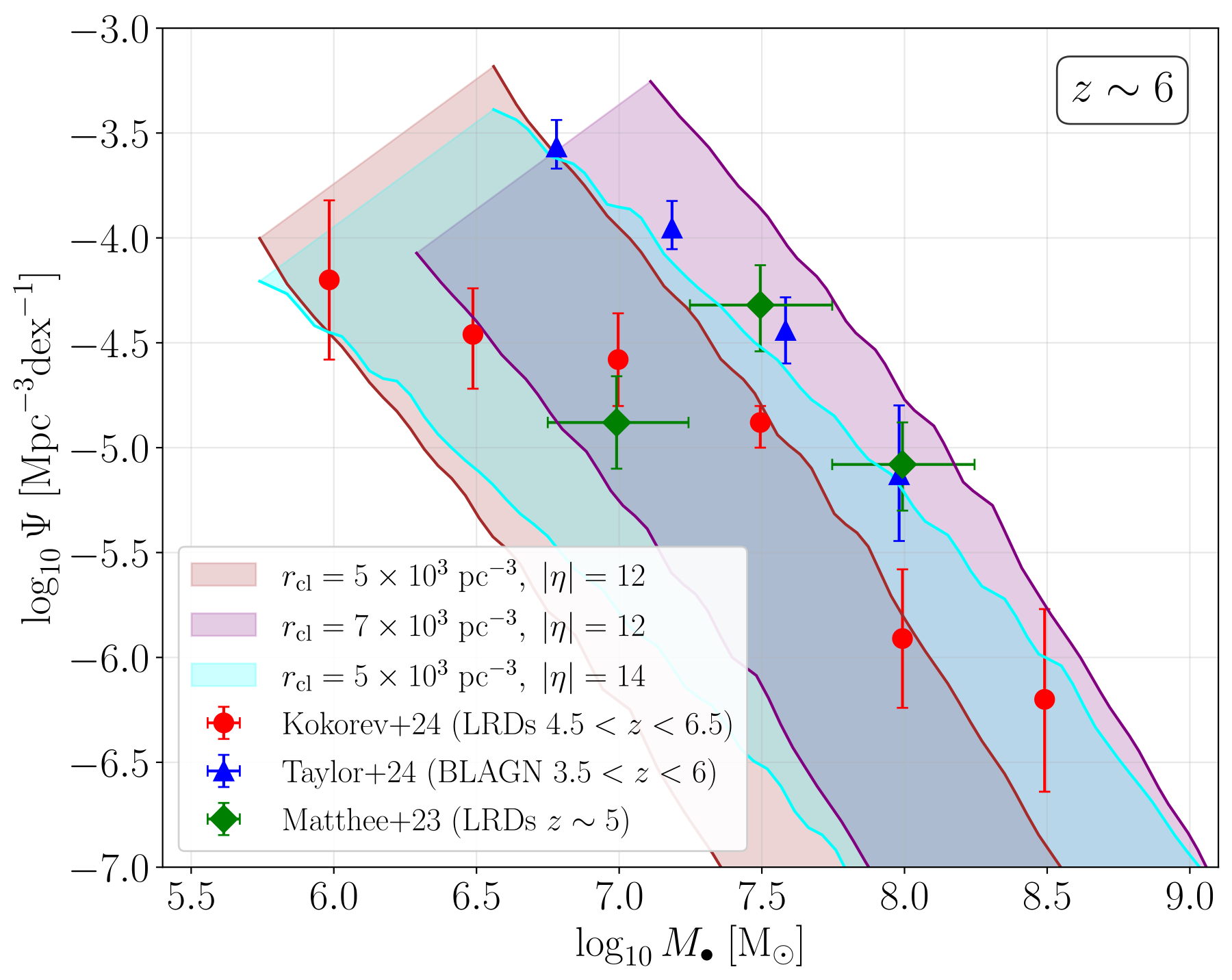
Small-Scale Clustering of Primordial Black Holes: The Little Red Dot Mass Function and the High-Redshift Galaxy Tension

Borui Zhang, Wei-Xiang Feng, Haipeng An

This analytic PBH-cluster framework claims that runaway mergers can reproduce the LRD SMBH mass function with a 1–10% accretion duty cycle while linking overmassive, compact hosts to seed-driven halo evolution; key gas dynamics remain unmodeled.

Figure 3 from Between Little Red Dots and Star-Forming Galaxies: A Sequence in the Optical Continuum Slope

2026-09-08 · 2609.07025v1 · Research note

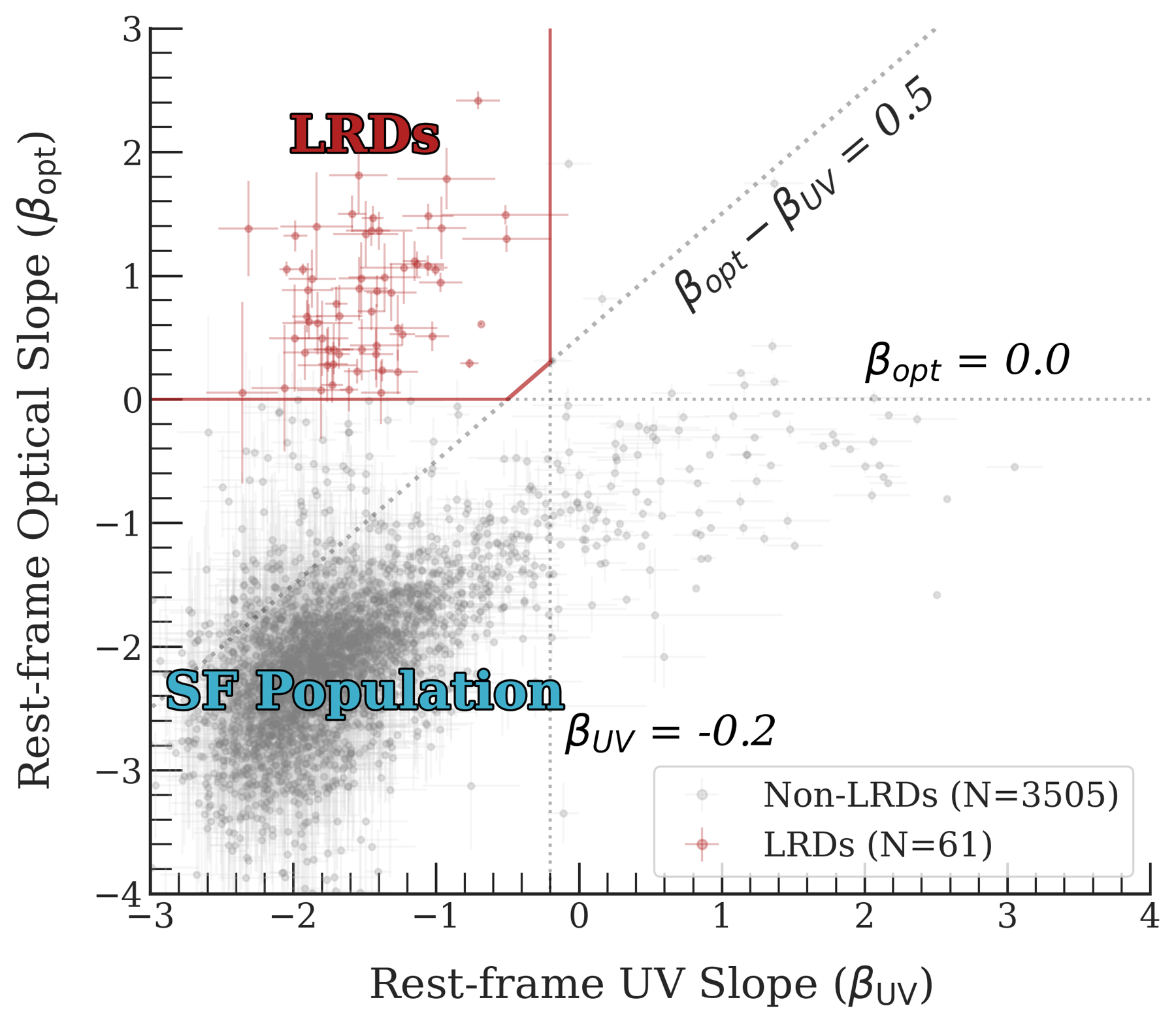
Between Little Red Dots and Star-Forming Galaxies: A Sequence in the Optical Continuum Slope

Kristiphong Boonmee, Akio K. Inoue, Masafusa Onoue, et al.

In 3,566 JWST/NIRSpec galaxies at z=3.0–8.1, UV–optical continuum slopes reveal a continuously populated path from star-forming galaxies to LRDs. The authors interpret it as changing host/BH* continuum contributions, while stressing model-dependent mass-ratio limits.

2026-09-02 · 2609.00437v1 · Research note

Formation of Heavy Seed Black Holes and Little Red Dots-like Compact Clusters in Metal-enriched Star-forming Regions

Sunmyon Chon, Shingo Hirano, Ke-Jung Chen, et al.

A radiation-hydrodynamic zoom-in simulation links locally intense LW fields, weakly enriched compact clusters, supermassive stars, and heavy seeds. Five of eight simulated >10^6 M⊙ clusters have intrinsic V-shaped, LRD-like continua, but the proposed observational connection remains model-dependent.

2026-09-01 · 2608.30459v1 · Research note

Broad-band host measurements of little red dots and similar compact nuclei require source-conditioned polychromatic PSFs

Sergio Bonaque-González

For unresolved LRD nuclei, stellar broad-band PSFs can create wavelength-dependent residuals that a Sérsic fit misassigns to a host. Source-conditioned polychromatic PSFs sharply reduce false host detections in point-only simulations, but do not yet establish corrected host properties for a defined real-LRD sample.

Figure 2 from Spatial decomposition of Little Red Dots with JWST/NIRSpec IFU into broad-line red cores and narrow-line blue host galaxies

2026-07-13 · 2607.09647v1 · Research note

Spatial decomposition of Little Red Dots with JWST/NIRSpec IFU into broad-line red cores and narrow-line blue host galaxies

Yuzo Ishikawa, Anna-Christina Eilers, Rohan P. Naidu, et al.

Spatially resolved NIRSpec spectroscopy of five z≈5 broad-Hα Little Red Dots supports a two-component morphology: compact red continuum/broad-line cores and generally extended blue continuum/narrow-line regions, while imperfect separation and small-sample limitations preclude a unique physical origin.

Figure 4 from Little Red Dots on FIRE: Exploring the formation and observational signatures of ultra-compact early galaxies

2026-06-23 · 2606.23683v1 · Research note

Little Red Dots on FIRE: Exploring the formation and observational signatures of ultra-compact early galaxies

Niranjan Chandra Roy, Daniel Anglés-Alcázar, Rachel K. Cochrane, et al.

FIRE simulations show that transient, inflow-built ultra-compact stellar cores can match several LRD observables without AGN, but fail for the reddest optical continua and most extreme lines, favoring heterogeneous hybrid stellar+AGN interpretations.

Figure 5 from Through the Veil: Ly$α$ Illuminates the Host Galaxies of Little Red Dots

2026-06-10 · 2606.09970v1 · Research note

Through the Veil: Ly$α$ Illuminates the Host Galaxies of Little Red Dots

Zhiyuan Ji, Yang Sun, Mauro Giavalisco, et al.

In 110 z≥4 little red dots, 32 Lyα detections and resolved imaging of 13 higher-redshift systems indicate that escaping Lyα more plausibly traces extended host-scale gas than the compact red/Balmer-line component, although continuum-subtraction and depth limit morphology.

2026-06-08 · 2606.06585v1 · Research note

A Population of Red Galaxies with Very Strong Emission Lines at $z > 5$ Revealed by the NIRCam Medium Bands: ''Classic'' LRDs, Dusty Star-Forming Galaxies, and a Missing Population of LRDs

Sunna Withers, Adam Muzzin, Swara Ravindranath, et al.

Medium-band NIRCam colors identify 26 red, strong-line galaxies at z=5.01–8.60. Nine unresolved objects evade common Little Red Dot cuts; the authors favor a missed LRD population, but dusty star formation and AGN remain viable alternatives.

2026-06-03 · 2606.03522v1 · Research note

The UV Side of Little Red Dots: Red, Compact, and Iron-Enhanced Rest-UV Emission with a Strong Downturn around Ly$α$

Makoto Ando, Yuichi Harikane, Harley Katz, et al.

Across roughly 100 JWST-selected LRDs, rest-UV emission is redder and about four times more compact than matched star-forming galaxies. Stacked spectral trends and high Fe II/Mg II favor a substantial compact central component, although its physical origin remains model-dependent.

2026-04-16 · 2604.14551v1 · Research note

Discovery of low-redshift analogues to "Little Red Dots" in DESI: A later evolutionary stage of compact LRDs?

Weiyu Ding, Xu Kong, Wei-Jian Guo, et al.

Five DESI DR1 sources at z=0.2–0.4 reproduce LRD-like V-shaped SEDs and broad Balmer lines, but their AGN-like line ratios and substantially larger hosts make an evolutionary connection to z>4 LRDs plausible rather than established.

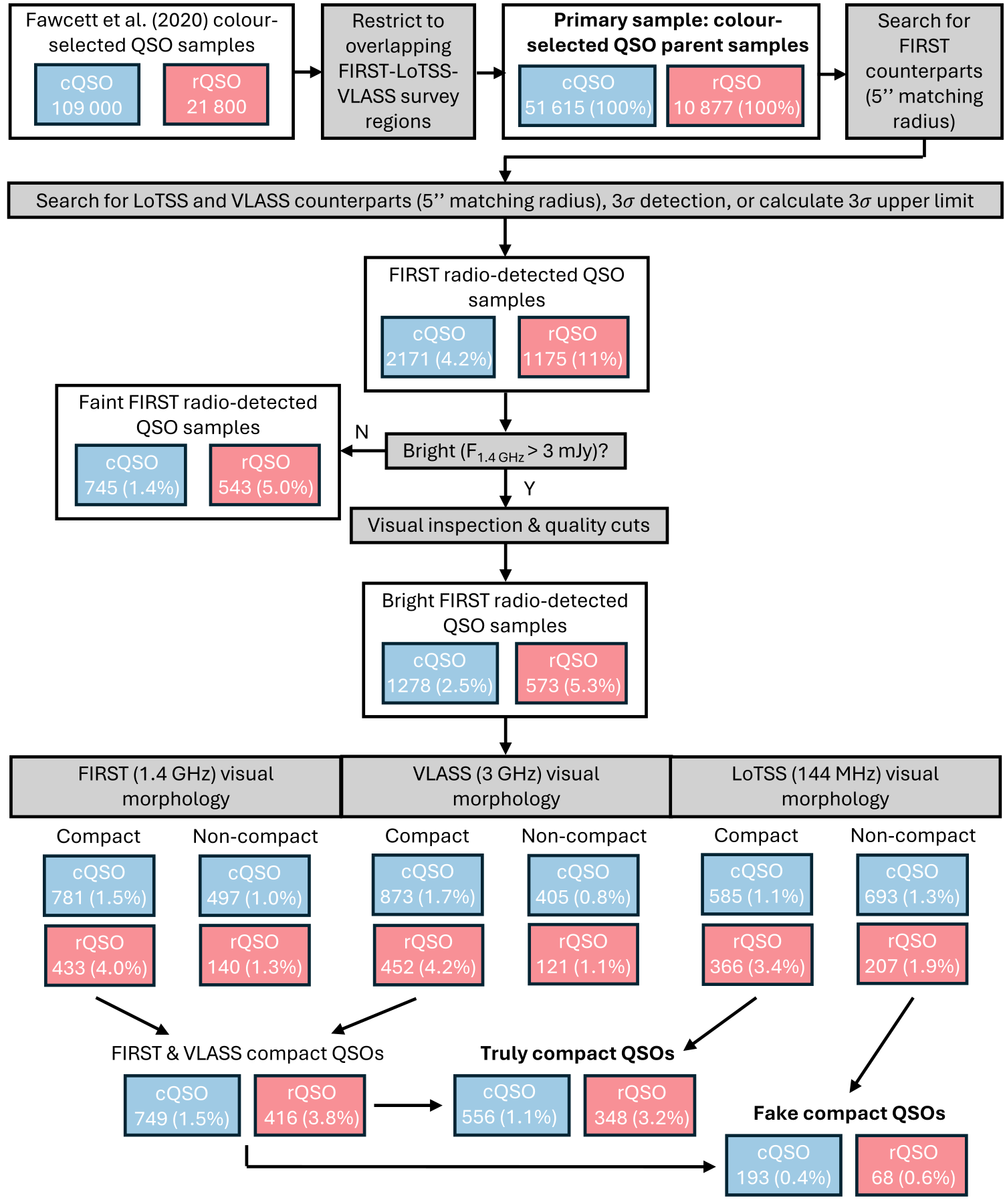
Figure 2 from A striking excess of red quasars with steep radio spectral slopes: a dusty blow-out phase revealed through AGN-driven shocks?

2026-03-25 · 2603.24739v1 · Research note

A striking excess of red quasars with steep radio spectral slopes: a dusty blow-out phase revealed through AGN-driven shocks?

Ciera L. Sargent, David M. Alexander, Claire L. Greenwell, et al.

Across SDSS quasars at 0.2<z<2.4, compact red quasars show an excess near α1.4–3 GHz≈−1 that strengthens with dust extinction. The authors interpret this as wind/jet–ISM shocks during a dusty blow-out phase, but radio spectra alone do not establish that mechanism.

2026-03-25 · 2603.24700v1 · Research note

A PANORAMIC of UV-optical morphologies of "Little Red Dots": Two groups of LRDs distinguished by UV half-light radius

Aidan P. Cloonan, Katherine E. Whitaker, Sinclaire M. Manning, et al.

Across 181 photometrically selected PANORAMIC LRDs, rest-optical emission is generally unresolved (<100 pc) while UV sizes vary. Splitting by Balmer-break size yields compact-UV and extended-UV groups, a pattern also seen less significantly in spectroscopic RUBIES LRDs.

2026-03-02 · 2603.01668v1 · Research note

A Unified Explanation for JWST Little Red Dots and High-Redshift Low-Mass Disk-like Galaxies: Prolate Galaxies Viewed End-on vs Side-on

Yingjie Peng

Peng proposes that many JWST little red dots are ordinary low-mass prolate galaxies viewed close to their long axes: projection and maximal columns could jointly produce compact red continua and broadened Balmer profiles, while side-on counterparts appear elongated.

2025-10-20 · 2510.17952v1 · Research note

Evolutionary Tracks and Spectral Properties of Quasi-stars and Their Correlation with Little Red Dots

Andrew D. Santarelli, Ebraheem Farag, Earl P. Bellinger, et al.

MESA quasi-star models predict a long-lived, cool late stage whose continuum broadly resembles two JWST Little Red Dots, including one measured Balmer break, but mismatched extreme breaks and simplified atmospheres prevent identification of LRDs as quasi-stars.

2025-09-02 · 2509.02664v1

Little Red Dots Are Nurseries of Massive Black Holes

Fabio Pacucci, Lars Hernquist, Michiko Fujii

Assuming the star-only interpretation of compact, red z∼5 Little Red Dots, the authors model ultradense cores where dynamical friction for 10 M⊙ stars in the inner 0.1 pc is <0.1 Myr, triggering rapid mass segregation. A Fokker–Planck core-evolution calculation, an analytic collisional-growth model, and direct N-body simulations all converge on runaway mergers that build a very massive star of 9×10^3–5×10^4 M⊙ within <1 Myr. The VMS then contracts on a ∼8000 yr Kelvin–Helmholtz timescale and collapses to an ∼10^4 M⊙ black hole. This route yields seed number densities above direct-collapse expectations and, with a dense residual core, can power elevated tidal disruption event rates.

2025-07-31 · 2508.00057v1

Discovery of a Little Red Dot candidate at $z\gtrsim10$ in COSMOS-Web based on MIRI-NIRCam selection

Takumi S. Tanaka, Hollis B. Akins, Yuichi Harikane, et al.

Using COSMOS-Web’s joint NIRCam–MIRI imaging, the authors conduct the first targeted search for little red dots beyond z≈10, leveraging F770W to isolate the V‑shaped SED signature and cull Balmer‑break contaminants. They uncover one robust source, CW-LRD-z10, with zphot=10.5(+0.7/−0.6), MUV=−19.9(+0.1/−0.2), compact morphology, a clear V‑shaped SED, and an F115W non‑detection consistent with an LRD at z∼10. From this single detection they infer a number density at MUV≈−20 of 1.2(+2.7/−1.0)×10⁻⁶ Mpc⁻³ mag⁻¹, implying the LRD fraction rises with redshift to ≈3% at z∼10. If confirmed, this points to LRDs as a common early population potentially tied to the first SMBH growth; deep spectroscopy is still required to secure the redshift and nature of CW-LRD-z10.

2025-07-05 · 2507.04011v1

Investigating the Growth of Little Red Dot Descendants at z<4 with the JWST

Jean-Baptiste Billand, David Elbaz, Fabrizio Gentile, et al.

Using CEERS imaging, the authors select z<4 “post-LRD” candidates by requiring a compact, very red core plus a blue star-forming envelope, then model inner/outskirts with stellar-only SED fits and single-Sérsic morphologies. The sample shows LRD-like cores with M* ~1e10 Msun, Σ* ~1e11 Msun kpc^-2, and compact sizes about 1 kpc below the size–mass relation, while adding an extended young component; their number density at z=3±0.5 (~10^-4.15 Mpc^-3) matches that of LRDs at 5<z<7, indicating an evolutionary link. Outskirts mass fraction and size increase toward lower redshift (≈250 pc at z=5 to ≈600 pc at z=3), as the core stays red/compact and the hallmark V-shaped SED fades, consistent with growth by cold accretion. This offers an explanation for the apparent decline of LRD counts at lower z, with the caveat that it assumes a single evolutionary path and stellar-only modeling.
2025-06-03 · 2506.03244v1

Cosmic Outliers: Low-Spin Halos Explain the Abundance, Compactness, and Redshift Evolution of the Little Red Dots

Fabio Pacucci, Abraham Loeb

Proposes that Little Red Dots are the visible outcomes of galaxies forming in the extreme low-spin tail of the halo angular-momentum distribution, using Mo–Mao–White scaling to link halo spin to compact disk sizes. Assuming progenitors in the lowest ~1% of spins at z ~ 5 reproduces both the observed number densities and compact effective radii of ~80–300 pc, without requiring a choice between BH- or star-dominated power. The observed redshift trend arises from the competition between an increasing compact-halo fraction and cosmological surface-brightness dimming, yielding an “LRDs Era” at 4 < z < 8; at z < 4 they are bright but rare, while at z > 8 they are common but faint. Agreement with current counts, plus excess small-scale clustering and spectral signs of extreme core densities, supports the low-spin origin.

2025-05-26 · 2505.20439v1

The Properties of Little Red Dot Galaxies in the ASTRID Simulation

Patrick LaChance, Rupert A. C. Croft, Tiziana Di Matteo, et al.

Using the ASTRID cosmological simulation, the authors generate mock NIRCam-like views at z=5–8 and identify 17 systems that meet little red dot color-plus-size cuts. These ASTRID LRDs are massive, compact, and dusty—log(M*/Msun)≥9.7, log(MBH/Msun)≥6.8, r_half,*=325–620 pc, with F444W attenuation >1.25—and are bright at F444W=23.5–25.5. Their recent quenching and a dust-obscured AGN produce a steep rest-optical red slope while UV light is star-dominated, pointing to an AGN-feedback-driven miniquenching phase. Lower-mass/fainter galaxies lack sufficient central dust, and many highest-Eddington BH hosts are not LRDs because high SFRs and low attenuation yield flatter spectra; the paucity of low-mass LRDs may partly reflect limited resolution.

2025-05-20 · 2505.14768v1

X-ray properties of massive compact relic galaxies

Orsolya E. Kovacs, Norbert Werner, Akos Bogdan, et al.

Chandra and XMM-Newton data are used to map hot atmospheres around seven local compact ellipticals selected as red‑nugget analogs, probing BH–bulge–halo coupling. Only MRK 1216 and PGC 32873 show luminous, spatially extended halos enabling radial thermodynamic profiles, with MRK 1216’s RGS spectrum hinting at super‑solar α/Fe. The others have faint or undetected halos, several instead showing AGN‑like power‑law emission. On galaxy scaling planes, cEGs follow a slightly steeper M⋆–LX and sit on the lower edge of M⋆–Mvir, implying red nuggets—and possibly their LRD progenitors—host a diverse range of halo atmospheres.