654 indexed papers · 430 research notes

Research archive

Reset
Figure 1 from From "The Cliff" to "Virgil": Mapping the Spectral Diversity of Little Red Dots with JWST/NIRSpec

2025-12-17 · 2512.15853v1 · Research note

From "The Cliff" to "Virgil": Mapping the Spectral Diversity of Little Red Dots with JWST/NIRSpec

Guillermo Barro, Pablo G. Perez-Gonzalez, Dale Kocevski, et al.

JWST/NIRSpec spectroscopy of 118 little red dots reveals a continuum–line sequence: red, curved Balmer-break SEDs give way to bluer, power-law-like systems. A galaxy plus enshrouded-black-hole model can reproduce the trend, but its physical decomposition remains non-unique.

2025-12-16 · 2512.14844v1

Doubling NIRSpec/IFS capability to calibrate the single epoch black hole mass relation at high redshift

Eleonora Parlanti, Bartolomeo Trefoloni, Stefano Carniani, et al.

Presents a NIRSpec/IFU reduction that exploits the red signal on NRS2 for medium‑resolution gratings, effectively doubling the usable wavelength coverage and recovering Hα beyond the nominal range; the authors also note the exposure‑time trade‑off when using adjacent dispersers. Applied to five z≈2 quasars with reverberation‑mapped MBH, the extended cubes enable joint Hβ–Hα measurements at R≈1000. Hβ‑based single‑epoch masses best match RM, while Hα recipes show ≈0.5 dex larger scatter; for the least‑massive, high‑λEdd object (MBH,RM≈10^7.5 M⊙, λEdd=0.8) all SE estimators overpredict by ~1 dex, suggesting a bias at high accretion. The work delivers the first high‑z SE calibrations from Hβ and Hα for the newfound early‑BH population, with uncertainties still limited by sample size.

Figure 1 from HELM's deep: Highly Extincted Low-Mass galaxies seen by JWST

2025-12-16 · 2512.14822v1 · Research note

HELM's deep: Highly Extincted Low-Mass galaxies seen by JWST

L. Bisigello, G. Gandolfi, A. Grazian, et al.

JWST/CEERS SED fitting identifies 1,361 candidate low-mass galaxies with unexpectedly high attenuation. Their similar sizes and axis ratios to non-dusty dwarfs disfavor a simple edge-on explanation, while modest clustering and lower inferred sSFR motivate—but do not establish—environmental evolution.

Figure 4 from From ASTRID to BRAHMA -- The role of overmassive black holes in little red dots in cosmological simulations

2025-12-15 · 2512.13957v1 · Research note

From ASTRID to BRAHMA -- The role of overmassive black holes in little red dots in cosmological simulations

Patrick LaChance, Aklant Kumar Bhowmick, Rupert A. C. Croft, et al.

BRAHMA mock observations suggest that overmassive, dense-gas-enshrouded AGN can yield AGN-dominated LRD colors and an LRD density of (2.04 ± 0.32) × 10^-4 Mpc^-3 at z=5–8; this is a model-dependent explanation, not a direct detection of the proposed environments.

2025-12-14 · 2512.12509v1 · Research note

THRILS -- The High-(Redshift+Ionization) Line Search: Program Description & Redshift Catalog

Taylor A. Hutchison, Rebecca L. Larson, Pablo Arrabal Haro, et al.

THRILS delivers deep JWST/NIRSpec G395M spectroscopy in two pointings, yielding 89 measured redshifts and empirical magnitude thresholds. Its >8-hour integrations expose faint lines inaccessible to shallower EGS spectroscopy, enabling targeted follow-up rather than population-level physical conclusions.

2025-12-05 · 2512.06159v1

From the Intergalactic to the Interstellar Scales -- EQUALS: a High-resolution Legacy Survey of Gas in the Distant Universe Using ESPRESSO

Trystyn Berg, Valentina D'Odorico, Elisa Boera, et al.

EQUALS is an ESPRESSO Large Programme delivering R ≈ 140,000 spectra for 23 bright z ≈ 4 QUBRICS quasars, reaching ~20 per 1 km s−1 pixel in the Lyα forest and ~40 redward via hour-long, Fabry–Pérot–calibrated blocks. The survey is tuned to the small-scale Lyα forest (k > 0.1 s km−1), promising a ~20× tighter IGM temperature measurement at z ~ 4 and, consequently, 5–15× stronger constraints on dark-matter particle mass. The resolution enables weak-line work (e.g., Mg II) to separate thermal from turbulent broadening, and isotopic C II shifts (~3 km s−1) in ~8 high-N(H I) systems to probe early stellar yields. Data products will be released via CANFAR and the ESO Archive as a legacy benchmark for future epoch measurements.

2025-12-04 · 2512.05213v1 · Research note

GA-NIFS: A smouldering disk galaxy undergoing ordered rotation at z=4.26

Gareth C. Jones, Roberto Maiolino, Francesco D'Eugenio, et al.

JWST/NIRSpec plus ALMA data indicate that the single z=4.2603 galaxy DLA0817g1 has matched Hα–[C II] disk morphology and rotation, enriched but weakly excited gas, and a revised molecular-gas budget consistent with a dynamically relaxed “smouldering” system.

Figure 3 from Little red dot variability over a century reveals black hole envelope via a giant Einstein cross

2025-12-04 · 2512.05180v1 · Research note

Little red dot variability over a century reveals black hole envelope via a giant Einstein cross

Zijian Zhang, Mingyu Li, Masamune Oguri, et al.

Four lensed views of the z≈4.3 LRD RX1 provide an ≈80–130-year observed-frame baseline and show up to 0.7-mag intrinsic color/brightness differences. Blackbody fits are consistent with a changing, ∼2000-AU photosphere, but do not yet establish pulsation over accretion variability.

Figure 5 from Highly-ionized gas in lensed z = 6.027 Little Red Dot seen through [OIII] 88$μ$m with ALMA

2025-12-04 · 2512.05097v1 · Research note

Highly-ionized gas in lensed z = 6.027 Little Red Dot seen through [OIII] 88$μ$m with ALMA

Kirsten K. Knudsen, Johan Richard, Mathilde Jauzac, et al.

Deep ALMA spectroscopy detects [O III] 88 μm from the lensed z=6.027 Little Red Dot A383-5.1. Its high [O III]/[C II] ratio and dust-continuum limits favor a dust-poor, strongly ionized ISM, but do not directly measure ionizing-photon escape.

Figure 9 from Probing AGN Feedback in Dwarf Galaxies with Spatially Resolved NIR Coronal Lines from JWST

2025-12-04 · 2512.05041v1 · Research note

Probing AGN Feedback in Dwarf Galaxies with Spatially Resolved NIR Coronal Lines from JWST

Archana Aravindan, Thomas Bohn, Gabriela Canalizo, et al.

JWST/NIRSpec IFU maps of four dwarf AGN with [O III] outflows find extended, predominantly AGN-photoionized near-IR coronal emission and compact broad components. The results link coronal-line visibility to outflows, but small-sample correlations do not establish causation.

2025-12-03 · 2512.04208v1 · Research note

A Black-Hole Envelope Interpretation for Cosmological Demographics of Little Red Dots

Hiroya Umeda, Kohei Inayoshi, Yuichi Harikane, et al.

Fitting ∼400 COSMOS-Web little red dots with a black-hole-envelope SED model yields cool, 4000–6000 K photospheres and bolometric luminosities typically 1–2 dex below dusty-quasar estimates, reducing the inferred tension with established AGN demographic constraints.

Figure 1 from A Comprehensive JWST/NIRSpec Census of Broad-Line Active Galactic Nuclei: Faint, Tiny, but Highly Accreting Sources in the Remote Universe

2025-12-02 · 2512.03281v1 · Research note

A Comprehensive JWST/NIRSpec Census of Broad-Line Active Galactic Nuclei: Faint, Tiny, but Highly Accreting Sources in the Remote Universe

Caroline Baccus, Xinfeng Xu

A JWST/NIRSpec search of roughly 80,000 spectra identifies 252 broad-line AGN to z=7.2, extending census statistics to fainter, lower-mass systems. The authors find high-redshift objects commonly at inferred Eddington ratios of 0.1–1, subject to heterogeneous depth and line-detection limits.

2025-12-02 · 2512.03239v1 · Research note

(Re)solving the complex multi-scale morphology and V-shaped SED of a newly discovered strongly-lensed Little Red Dot in Abell 383

Josephine F. W. Baggen, Pieter van Dokkum, Ivo Labbé, et al.

JWST imaging of a z=6.027, doubly lensed Little Red Dot resolves red and blue compact components separated by about 300 pc. Their blended light can produce an LRD-like V-shaped SED, but the red component remains ambiguously stellar or AGN-powered.

Figure 1 from A Critical Evaluation of the Physical Nature of the Little Red Dots

2025-12-02 · 2512.03130v1 · Research note

A Critical Evaluation of the Physical Nature of the Little Red Dots

Kohei Inayoshi, Luis C. Ho

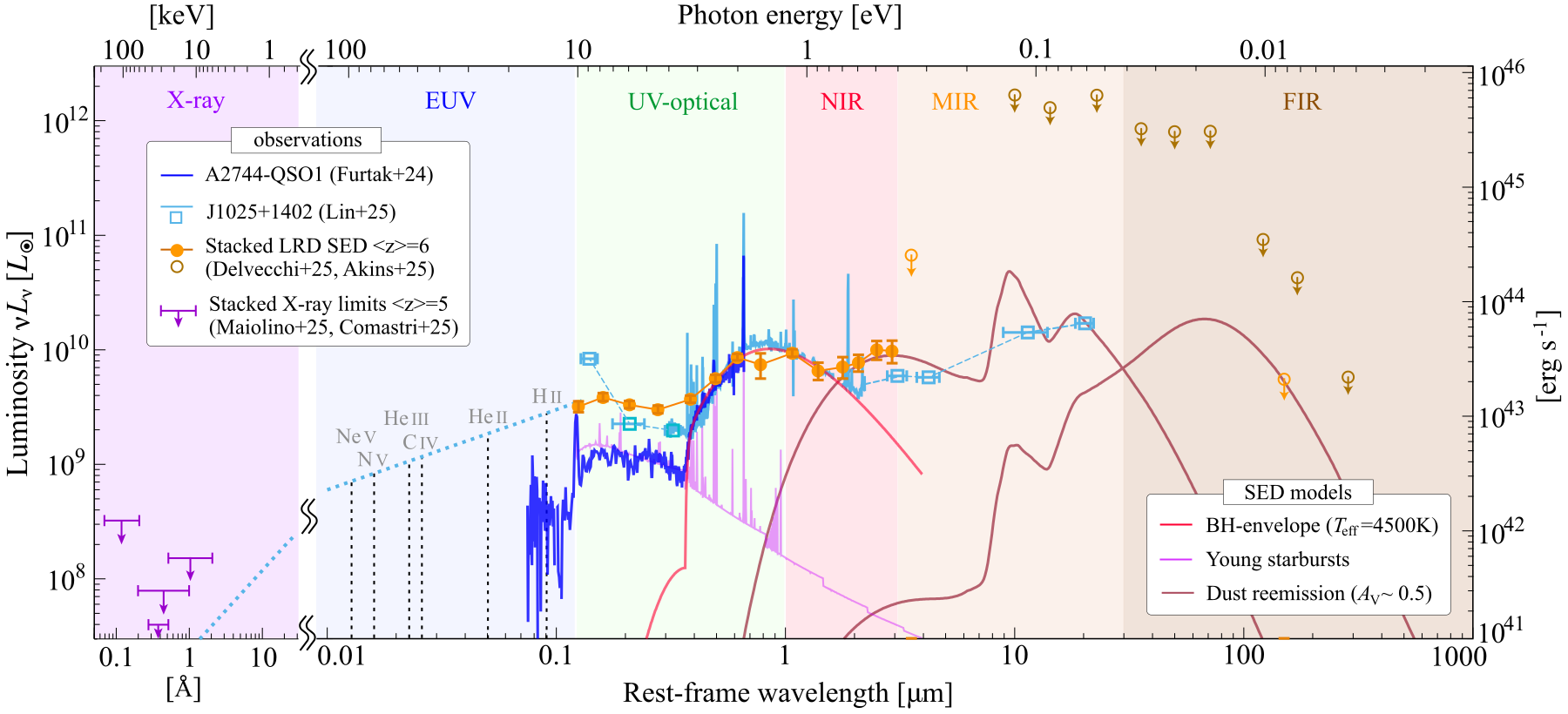
This review argues that LRD broad Balmer lines, red optical continua, Balmer absorption/breaks, and weak infrared/X-ray behavior favor embedded accreting black holes over a purely stellar origin, while leaving the gas geometry and evolutionary interpretation unresolved.

2025-12-01 · 2512.02117v1 · Research note

VENUS: When Red meets Blue -- A multiply imaged Little Red Dot with an apparent blue companion behind the galaxy cluster Abell 383

Miriam Golubchik, Lukas J. Furtak, Joseph F. V. Allingham, et al.

JWST resolves the lensed z=6.027 system A383-LRD1 into a compact red LRD candidate and a blue companion separated by ~380 pc. Lensing exposes a faint intrinsic LRD, but its AGN/BH* interpretation and association with the companion remain photometric inferences.

2025-12-01 · 2512.02096v1

Discovery of two little red dots transitioning into quasars

Shuqi Fu, Zijian Zhang, Danyang Jiang, et al.

Reports two COSMOS LRDs—Forge I (z=2.868) and Forge II (z=2.925)—whose V-shaped UV–optical SEDs, compact morphologies, and broad Paschen/He I lines meet LRD criteria. Unlike typical LRDs, they show strong X-ray, radio, and mid-IR emission, moderate X-ray obscuration, a 6.4 keV Fe K line in Forge II, and unusually large year-scale X-ray variability while UV broad lines remain weak/absent. The spectra reveal strong He I absorption in both and rare Pa absorption in Forge II, indicating dense, low-ionization gas with mixed inflow/outflow kinematics as the envelope thins. Authors argue these hybrids are LRDs in transition, with dispersing dense gas and an emerging dust torus, implying some LRDs evolve into normal AGN/quasars.

2025-12-01 · 2512.02093v1 · Research note

COSMOS-3D: Dense Circumnuclear Gas across Black Hole Growth Phases at z ~ 3

Zi-Jian Li, Siwei Zou, Jianwei Lyu, et al.

Two z~3 X-ray AGNs with He I λ10830 absorption indicate dense, broad-line-region-scale circumnuclear gas, but their contrasting obscuration, accretion rates, and outflow signatures provide only a two-object, model-dependent case for an evolutionary sequence.

Figure 2 from OzDES Reverberation Mapping of Active Galactic Nuclei: Final Data Release, Black-Hole Mass Results, & Scaling Relations

2025-12-01 · 2512.01261v1 · Research note

OzDES Reverberation Mapping of Active Galactic Nuclei: Final Data Release, Black-Hole Mass Results, & Scaling Relations

H. McDougall, T. M. Davis, Z. Yu, et al.

Final OzDES analysis uses multi-year optical monitoring to calibrate high-redshift BLR radius–luminosity relations from Hβ, Mg II, and C IV reverberation lags, yielding 62 RM black-hole masses and single-epoch estimates for 246 additional AGN.

2025-11-26 · 2511.21820v1 · Research note

Little Red Dots host Black Hole Stars: A unified family of gas-reddened AGN revealed by JWST/NIRSpec spectroscopy

Anna de Graaff, Raphael E. Hviding, Rohan P. Naidu, et al.

A 116-object JWST LRD sample shows narrowly peaked, thermal-like optical continua and coordinated line–continuum trends. The authors interpret these correlations as evidence for AGN embedded in dense gas envelopes, while assigning [O III] largely to faint star-forming hosts.

2025-11-24 · 2511.19602v1 · Research note

Tracing AGN-Galaxy Co-Evolution with UV Line-Selected Obscured AGN

Luigi Barchiesi, Lucia Marchetti, Mattia Vaccari, et al.

A 184-object COSMOS sample selected through [Ne V] or C IV combines X-ray–radio SED fitting with Simba analogues. The authors infer obscured, high-accretion transitional populations, with [Ne V] hosts pre-quenching and C IV hosts more often quenched.

2025-11-22 · 2511.18133v1 · Research note

Full calibration of the tomographic redshift distribution from the HSC PDR3 Shape Catalog with DESI

J. Choppin de Janvry, S. Gontcho A Gontcho, U. Seljak, et al.

DESI DR1+DR2 clustering redshifts calibrate all four HSC PDR3 shear-source bins, extending spectroscopic leverage beyond z≈1.2. The authors infer modest high-redshift-bin shifts relative to earlier HSC calibration, after bias and magnification corrections.

Figure 2 from Too Quiet for Comfort: Local Little Red Dots Lack Variability over Decades

2025-11-20 · 2511.16082v1 · Research note

Too Quiet for Comfort: Local Little Red Dots Lack Variability over Decades

Colin J. Burke, Zachary Stone, Yue Shen, et al.

Three nearby proposed Little Red Dot analogs show <3–4% optical-continuum variability over rest-frame five years; two also have broad-Hα changes below a few percent over roughly 15 years, challenging ordinary variable, photoionized broad-line interpretations.

2025-11-19 · 2511.15359v1 · Research note

Changing-look Active Galactic Nuclei from the Dark Energy Spectroscopic Instrument. V. Dramatic Variability in High-Ionization Broad Emission Lines

Zhi-Qiang Chen, Jun-Jie Jin, Wei-Jian Guo, et al.

A DESI–SDSS comparison identifies 97 z>0.9 changing-look quasars with high-ionization broad-line transitions. Their lower Eddington ratios, line–luminosity co-variability, and ∼3-year rest-frame transition times are consistent with—though do not prove—accretion-state changes.

2025-11-17 · 2511.13650v1 · Research note

JWST observes the assembly of a massive galaxy at z~4

Aayush Saxena, Roderik A. Overzier, Catarina Aydar, et al.

JWST resolves TGSSJ1530+1049 at z=4 into a compact, massive, actively star-forming association around a radio AGN. Its geometry and kinematics support both jet–gas interaction and galaxy interactions, with the authors predicting merger into a massive galaxy within a few Gyr.

Figure 2 from A Fleeting GLIMPSE of N/O Enrichment at Cosmic Dawn: Evidence for Wolf Rayet N Stars in a z = 6.1 Galaxy

2025-11-17 · 2511.13591v1 · Research note

A Fleeting GLIMPSE of N/O Enrichment at Cosmic Dawn: Evidence for Wolf Rayet N Stars in a z = 6.1 Galaxy

Danielle A. Berg, Rohan P. Naidu, John Chisholm, et al.

Deep JWST/NIRSpec spectroscopy of the compact, lensed z=6.1025 galaxy RXCJ2248-ID3 finds high N/O, low metallicity, and WN-like Wolf–Rayet signatures. The authors interpret these jointly as short-lived, WN-dominated nitrogen enrichment after a recent burst.

2025-11-13 · 2511.10725v1 · Research note

Back to basics: Little Red Dots as galaxies and dust-obscured AGNs in a synthetic NIRCam sky simulated with L-GalaxiesBH

Diego Herrero-Carrión, Daniele Spinoso, David Izquierdo-Villalba, et al.

In an L-GalaxiesBH synthetic NIRCam lightcone, photometric LRDs are modeled as a mixed galaxy–AGN population: older low-mass stellar systems and higher-mass systems whose relatively faint AGN preserve a Balmer-break-driven V-shaped SED; torus obscuration is secondary.

2025-11-12 · 2511.09304v1 · Research note

Variability of optical spectral index to support a central sub-parsec binary black hole system in quasar SDSS J001224-102226.51

Zhang XueGuang

Using two SDSS epochs of the z=0.228 quasar SDSS J0012-1022, the authors argue that an anomalous luminosity–optical-slope change is consistent with phase-dependent obscuration of two accreting black holes. It supports, but does not establish, a sub-parsec binary interpretation.

2025-11-12 · 2511.09278v1 · Research note

Little red dots as embryos of active galactic nuclei

Jian-Min Wang, Yi-Lin Wang, Yong-Jie Chen, et al.

This abstract-only paper proposes that little red dots are nascent AGN systems containing sub-million-solar-mass central black holes plus a more massive embedded stellar-mass-black-hole population, attributing their V-shaped SEDs and Balmer absorption to distinct, model-dependent components.

Figure 1 from Bridging scales: Modeling suppressed Bondi accretion on black holes and its impact on galaxy growth

2025-11-11 · 2511.08683v1 · Research note

Bridging scales: Modeling suppressed Bondi accretion on black holes and its impact on galaxy growth

Antonio J. Porras-Valverde, Priyamvada Natarajan, Angelo Ricarte, et al.

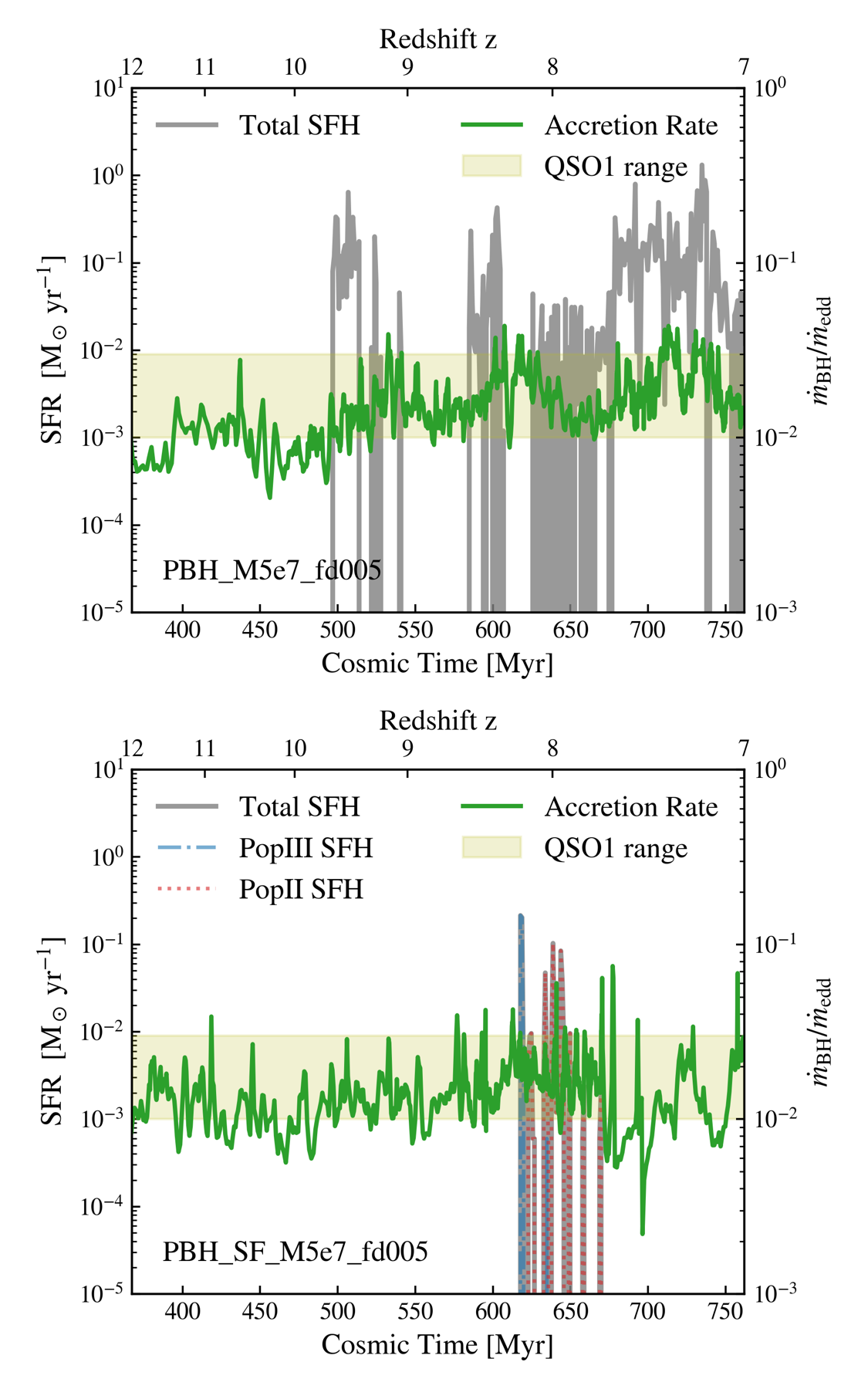
A semi-analytic test of GRMHD-motivated magnetic suppression finds that limiting suppression to low-Eddington accretion and rescaling AGN feedback can retain local galaxy and black-hole demographics while allowing rapid early black-hole growth.

2025-11-11 · 2511.08671v1 · Research note

JWST/NIRSpec Reveals a Small Population of Dominant Dust-Obscured Ionizing Sources in Galaxies at 1 < z < 3

Si-Rui Ge, Nikko J. Cleri, Joel Leja, et al.

JWST/NIRSpec line-ratio comparisons find optical and near-IR ionizing-source classifications agree for 49/55 z<3 galaxies, but six mismatches identify plausible dust-hidden AGN or star formation; the proposed physical explanations require follow-up spectroscopy.

2025-11-11 · 2511.08477v1 · Research note

Supermassive Dark Stars and their remnants as a possible solution to three recent cosmic dawn puzzles

Cosmin Ilie, Jillian Paulin, Andreea Petric, et al.

The authors propose supermassive dark stars as a unified, still-unconfirmed explanation for early compact luminous sources and massive black holes. Their argument combines tentative helium absorption candidates with parameterized growth tracks, rather than a population-level observational test.

Figure 1 from Probing the Physical Origin of the Balmer Decrement in the Broad-line Region of Nearby Active Galactic Nuclei via Spectral Variability

2025-11-11 · 2511.07714v1 · Research note

Probing the Physical Origin of the Balmer Decrement in the Broad-line Region of Nearby Active Galactic Nuclei via Spectral Variability

Suyeon Son, Minjin Kim, Luis C. Ho, et al.

Multi-epoch SDSS spectroscopy of 1,116 nearby type-1 AGNs finds broad-line Hα/Hβ decreases as individual AGNs brighten. The authors argue continuum-driven BLR radiative-transfer and excitation changes, rather than variable intrinsic dust reddening, predominantly drive this variability.

2025-11-10 · 2511.07578v1 · Research note

From Feedback-Free Star Clusters to Little Red Dots via Compaction

Avishai Dekel, Dhruba Dutta Chowdhury, Sharon Lapiner, et al.

This paper proposes that feedback-free cluster formation, dry cluster migration, and later wet compaction can jointly make compact, black-hole-hosting LRDs at z=4–8. The central prediction remains a partly untested synthesis because no simulation yet follows all processes together.

2025-11-10 · 2511.07515v1 · Research note

The Deepest GLIMPSE of a Dense Gas Cocoon Enshrouding a Little Red Dot

Vasily Kokorev, John Chisholm, Rohan P. Naidu, et al.

Deep JWST spectroscopy of the lensed z=3.501 LRD GLIMPSE-17775 finds broad exponential line wings, Balmer absorption/break, and fluorescence-rich Fe II/O I emission consistent with a dense, partially ionized AGN cocoon; the super-Eddington inference remains model-dependent.

Figure 2 from A JWST/NIRSpec Integral Field Unit Survey of Luminous Quasars at z ~ 5-6 (Q-IFU): Rest-frame Optical Nuclear Properties and Extended Nebulae

2025-11-08 · 2511.06085v1 · Research note

A JWST/NIRSpec Integral Field Unit Survey of Luminous Quasars at z ~ 5-6 (Q-IFU): Rest-frame Optical Nuclear Properties and Extended Nebulae

Weizhe Liu, Xiaohui Fan, Huan Li, et al.

JWST/NIRSpec IFU observations of 27 luminous z≈5–6 quasars find ≈10^9 M⊙ actively accreting black holes and extended [O III] in six systems; nuclear optical properties broadly resemble lower-redshift quasars, while shallow data limit environmental inferences.

Figure 1 from Discovery of an X-ray Luminous Radio-Loud Quasar at $z=3.4$: A Possible Transitional Super-Eddington Phase

2025-11-07 · 2511.05029v1 · Research note

Discovery of an X-ray Luminous Radio-Loud Quasar at $z=3.4$: A Possible Transitional Super-Eddington Phase

Sakiko Obuchi, Kohei Ichikawa, Satoshi Yamada, et al.

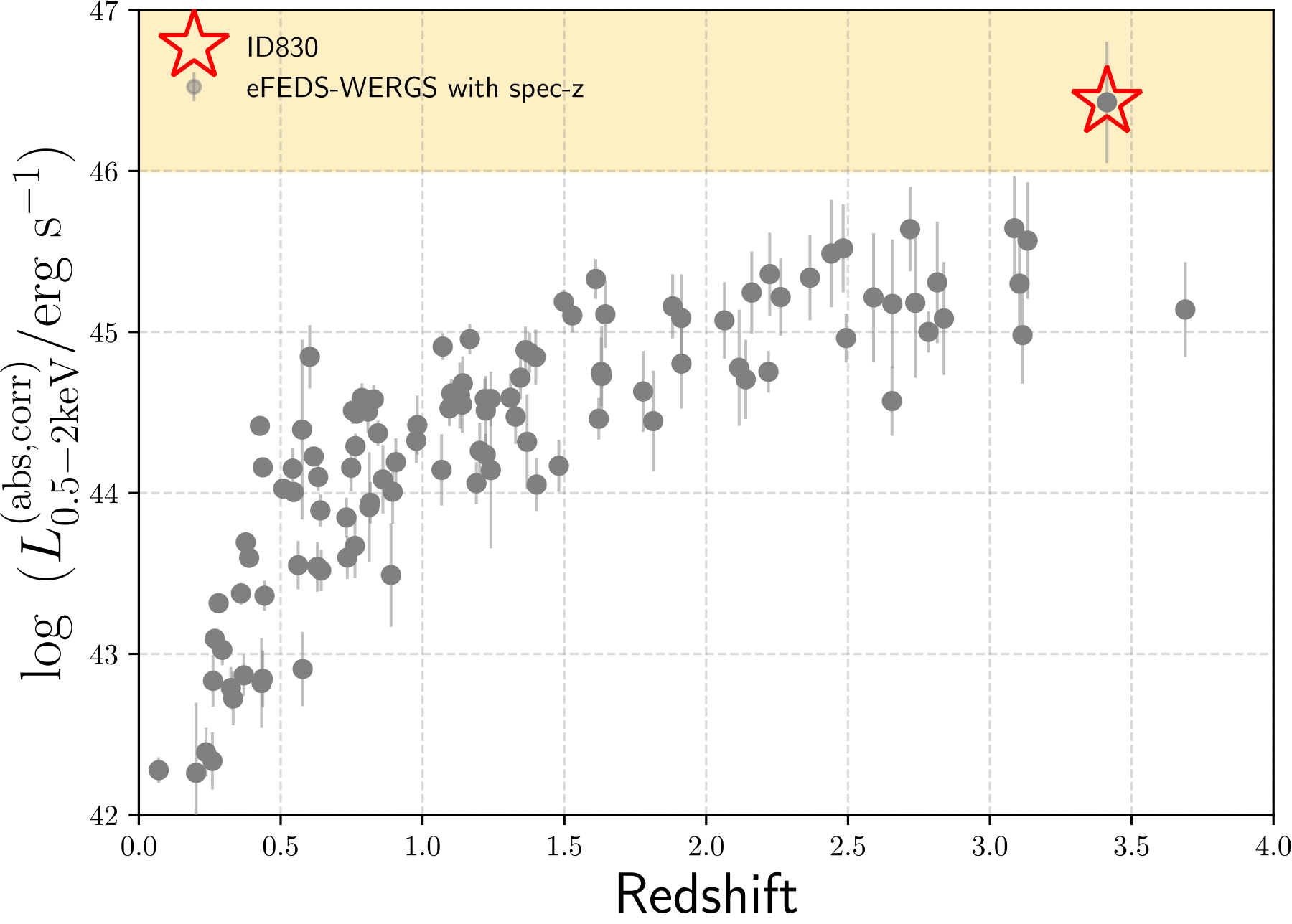
ID830 is a z=3.4351 radio-loud quasar with extreme, steep X-ray emission and a UV-based super-Eddington estimate. The authors interpret its X-ray excess as corona-plus-jet emission during a possible post-burst transition, not a demonstrated evolutionary state.

2025-11-04 · 2511.02902v1 · Research note

A close look at the black hole masses and hot dusty toruses of the first quasars with MIRI-MRS

Sarah E. I. Bosman, Javier Álvarez-Márquez, Frederick B. Davies, et al.

JWST/MIRI-MRS spectroscopy of four luminous type-1 quasars at z=7.08–7.64 yields mutually consistent broad-line black-hole masses of (4–15)×10^8 M⊙ and directly detects hot-torus emission, without resolving the early-SMBH growth tension.

2025-11-04 · 2511.02523v1 · Research note

Dynamical Masses and Radiative Transfer Modeling of HD 698: a Be Binary in Evolutionary Transition

Ilfa A. Gabitova, Alex C. Carciofi, Tajan H. de Amorim, et al.

HD 698 is modeled as a 55.927-day post-mass-transfer Be binary with precisely measured component masses and a luminous, inflated probable stripped donor. The authors argue that this system samples a short-lived transition before the donor becomes a subdwarf.

2025-10-30 · 2510.26990v1 · Research note

Faint active galactic nuclei supplied 31-75% of hydrogen-ionizing photons at z>5

Mainak Singha, Sangeeta Malhotra, James Ely Rhoads

A joint luminosity-function and escape-fraction model attributes 31–75% of z>5 ionizing photons to AGN, but the result depends on assumed galaxy escape fractions and an outflow-based AGN LyC-escape prescription available here only in the abstract.

2025-10-30 · 2510.26884v1 · Research note

Constraining the AGN tori at cosmic noon using high-resolution JWST imaging and simultaneous SED fitting

Devang H. Liya, David J. Rosario, Matthaios Charidis

For 88 X-ray-selected CEERS AGN at 0.7≤z≤3.5, simultaneous central and integrated JWST/archival SED fitting yields tighter torus constraints. Among 66 luminous sources, torus covering fraction peaks near 0.25 and is not statistically distinguishable from a luminosity-matched local comparison.

2025-10-29 · 2510.25089v1 · Research note

XRISM Spectroscopy of the Stellar-mass Black Hole GRS 1915+105

Jon M. Miller, Liyi Gu, John Raymond, et al.

XRISM/Resolve resolves a Compton-thick, warm-obscured yet sub-Eddington GRS 1915+105 into narrow photoionized emission zones, supporting outer-disk occultation. A warped, precessing disk is favored over inner-disk thickening, but residual spectral structure and geometry remain unresolved.

Figure 2 from SHELLQs-JWST: Revealing the Spectra of Extended Emission in 12 z > 6 Quasar Host Galaxies using the JWST NIRSpec Fixed Slit

2025-10-25 · 2510.22403v1 · Research note

SHELLQs-JWST: Revealing the Spectra of Extended Emission in 12 z > 6 Quasar Host Galaxies using the JWST NIRSpec Fixed Slit

Camryn L. Phillips, Michael A. Strauss, Masafusa Onoue, et al.

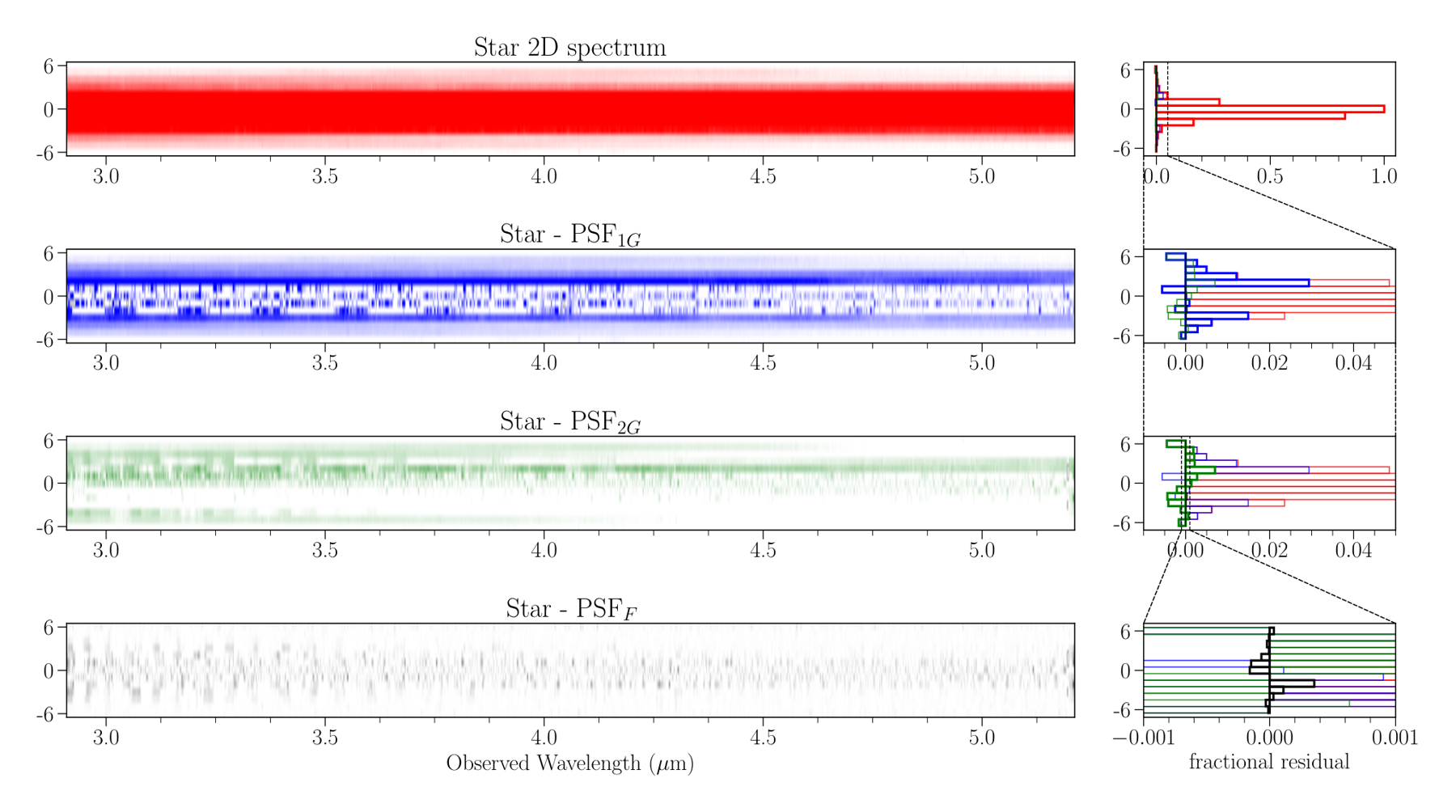
In twelve z=6.0–6.4 low-luminosity SHELLQs quasars, wavelength-dependent PSF subtraction isolates extended host emission. The authors report mostly main-sequence-consistent Hα upper-limit SFRs, one [O III] outflow, and one disk-like rotation, while narrow-line-region contamination complicates interpretation.

2025-10-22 · 2510.19904v1 · Research note

The Synthetic Absorption Line Spectral Almanac (SALSA)

Dylan Nelson, Celine Peroux, Philipp Richter, et al.

SALSA publicly releases synthetic absorption-line spectra from cosmological simulations, using Voronoi-mesh ray tracing to connect ISM, CGM, and IGM gas to survey-like observables. Its principal value is controlled mock-survey and galaxy–absorber analyses, bounded by ionization, yield, and dust-model assumptions.

Figure 2 from Ultra-Strongly Self-Interacting Dark Matter: From Phenomenology to Astrophysical Observables

2025-10-20 · 2510.18142v1 · Research note

Ultra-Strongly Self-Interacting Dark Matter: From Phenomenology to Astrophysical Observables

M. Grant Roberts, Wolfgang Altmannshofer, Pierce Giffin, et al.

This two-component SIDM model identifies parameter space that authors argue meets relic-density, velocity-dependent scattering, linear-power, and representative direct-detection constraints; a subpercent ultra-interacting component is proposed to seed early black holes relevant to little red dots.

2025-10-20 · 2510.17952v1 · Research note

Evolutionary Tracks and Spectral Properties of Quasi-stars and Their Correlation with Little Red Dots

Andrew D. Santarelli, Ebraheem Farag, Earl P. Bellinger, et al.

MESA quasi-star models predict a long-lived, cool late stage whose continuum broadly resembles two JWST Little Red Dots, including one measured Balmer break, but mismatched extreme breaks and simplified atmospheres prevent identification of LRDs as quasi-stars.