654 indexed papers · 430 research notes

Research archive

Reset

2026-01-20 · 2601.14368v1 · Research note

The Little Red Dots Are Direct Collapse Black Holes

Fabio Pacucci, Andrea Ferrara, Dale D. Kocevski

A radiation-hydrodynamic direct-collapse black-hole model can fit one prototypical Little Red Dot spectrum with low residuals while producing Compton-thick obscuration. The result is a model-based explanation, not yet a population-level demonstration that all LRDs are DCBHs.

2026-01-15 · 2601.10573v1 · Research note

Origins of the UV continuum and Balmer emission lines in Little Red Dots: observational validation of dense gas envelope models enshrouding the AGN

Yoshihisa Asada, Kohei Inayoshi, Qinyue Fei, et al.

Across 28 z=5–7.2 LRDs, UV-to-Hα behavior resembles young starbursts rather than unobscured AGN, while nine blue broad-line controls resemble Type 1 AGN. The authors therefore favor opaque black-hole envelopes, but the correlations do not uniquely establish the ionizing mechanism.

2026-01-13 · 2601.08936v1 · Research note

A possible pathway to UHZ1-type systems at z~10 by heterogeneous mass primordial black holes as dark matter

Alexander Kashlinsky, Fernando Atrio-Barandela, Diego Martín-González

This analytic PBH-dark-matter scenario argues that PBH shot noise advances low-mass halo collapse and dynamical friction concentrates massive PBHs, potentially assembling UHZ1-like central black-hole masses by z≈10 without super-Eddington gas accretion; viability remains parameter-dependent.

Figure 2 from VENUS: Two Faint Little Red Dots Separated by $\sim70\,\mathrm{pc}$ Hidden in a Single Lensed Galaxy at $z\sim7$

2026-01-09 · 2601.06015v1 · Research note

VENUS: Two Faint Little Red Dots Separated by $\sim70\,\mathrm{pc}$ Hidden in a Single Lensed Galaxy at $z\sim7$

Hiroto Yanagisawa, Masami Ouchi, Miriam Golubchik, et al.

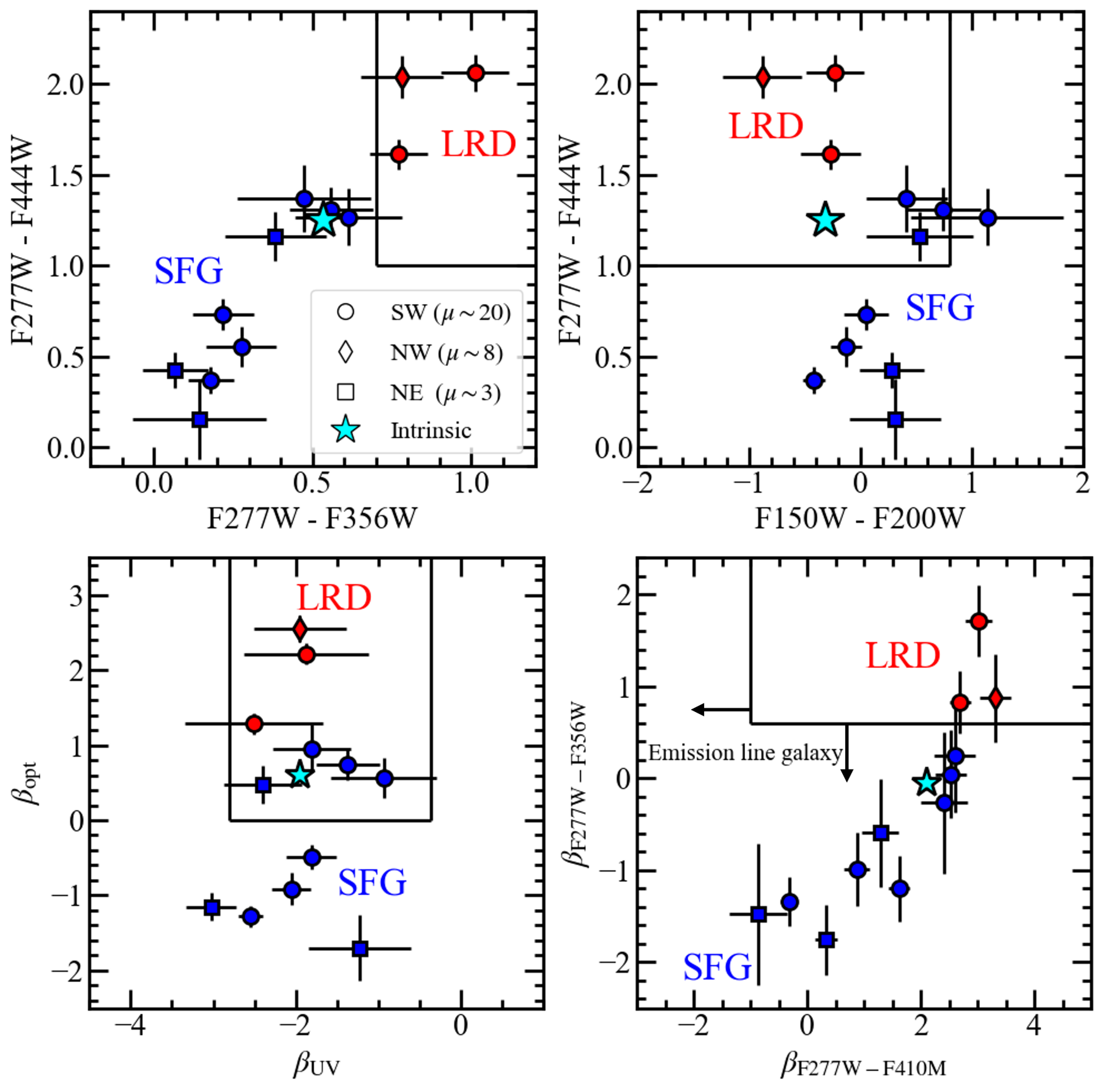
Strong lensing resolves “Red Eyes” into two faint, off-centre LRDs in a z≈7 star-forming galaxy, separated by ≈70 pc. The result demonstrates that host light can conceal LRD-like components in otherwise ordinary high-redshift galaxies.

2026-01-08 · 2601.04955v1 · Research note

Rapid emergence of overmassive black holes in the early Universe

Sunmyon Chon, Shingo Hirano, Tomoaki Ishiyama, et al.

A cosmological radiation-hydrodynamic zoom simulation produces two unusually massive heavy seeds in an overdense, strongly irradiated environment; their growth and transient obscuring disks offer a proposed route to overmassive high-redshift black holes and an LRD-like phase.

Figure 1 from Little Red Dots: The Assembly of Early Supermassive Black Holes in the JWST Era

2025-12-31 · 2601.00089v1 · Research note

Little Red Dots: The Assembly of Early Supermassive Black Holes in the JWST Era

David D Vaida, Ryan Jeffrey Farber

This mini-review argues that little red dots are probably heterogeneous: broad Balmer lines and compact, V-shaped SEDs support accretion in some, whereas pervasive multiwavelength non-detections and viable stellar fits prevent a population-wide AGN identification.

2025-12-31 · 2601.00044v1 · Research note

Born in the Dark: The Catastrophic Collapse of Fuzzy Dark Matter Solitons as the Origin of Little Red Dots

Tak-Pong Woo

The authors propose that LRDs are transient, Compton-thick inflows within fuzzy-dark-matter soliton cores. Their size-and-column arguments favor boson masses of a few ×10^-22 eV, but the mechanism remains an analytic, idealized-merger scenario requiring radiation-hydrodynamic tests.

Figure 5 from Pulsational Instability of Quasi-Stars: Interpreting the Variability of Little Red Dots

2025-12-19 · 2512.17997v1 · Research note

Pulsational Instability of Quasi-Stars: Interpreting the Variability of Little Red Dots

Matteo Cantiello, Jake B. Hassan, Rosalba Perna, et al.

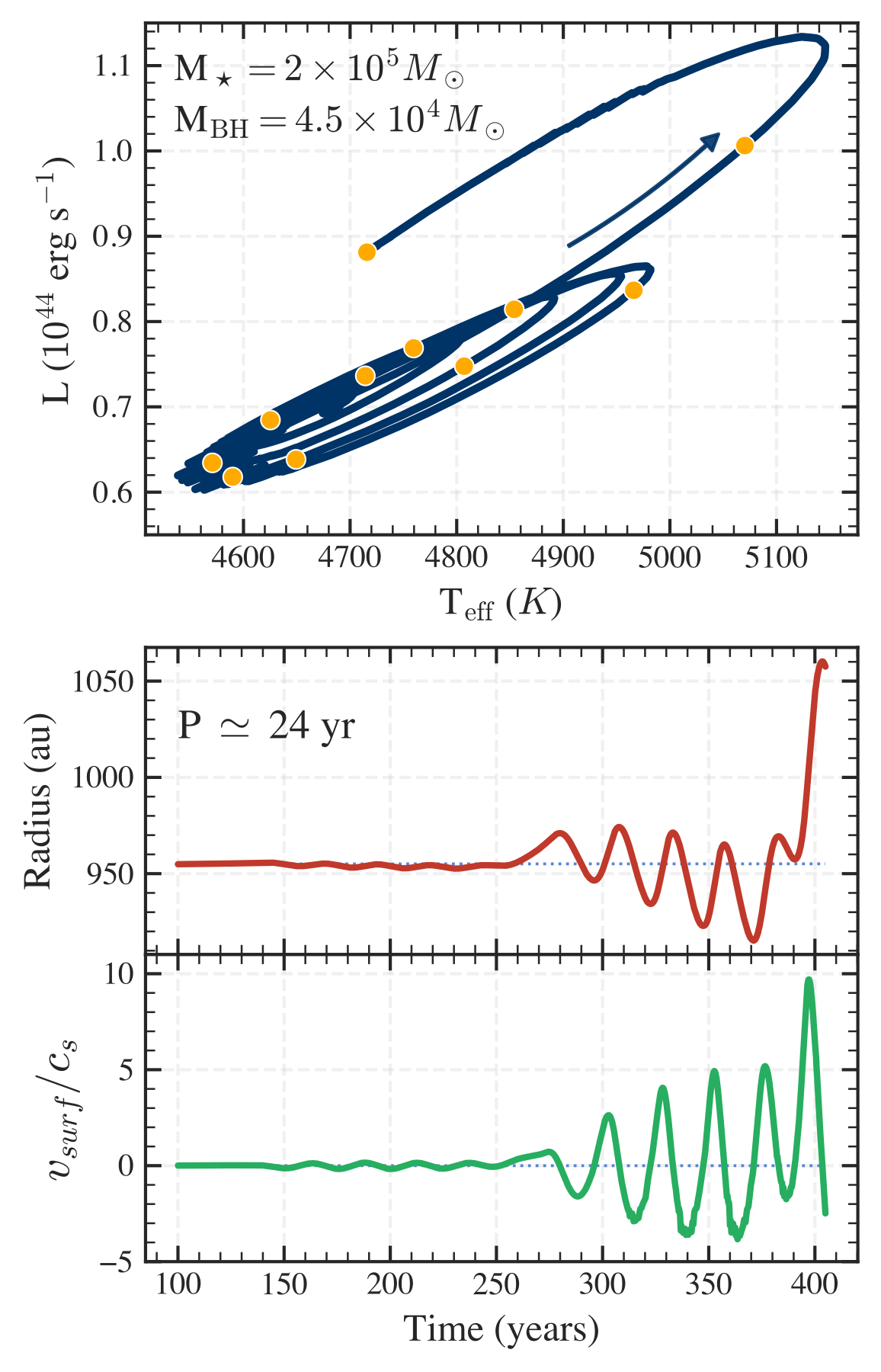
Stellar-evolution and pulsation models place cool quasi-star envelopes in an instability strip whose radial-mode timescales are compatible with R2211-RX1, but sparse monitoring and unresolved nonlinear mass loss prevent a demonstrated periodic or uniquely quasi-star interpretation.

Figure 1 from From "The Cliff" to "Virgil": Mapping the Spectral Diversity of Little Red Dots with JWST/NIRSpec

2025-12-17 · 2512.15853v1 · Research note

From "The Cliff" to "Virgil": Mapping the Spectral Diversity of Little Red Dots with JWST/NIRSpec

Guillermo Barro, Pablo G. Perez-Gonzalez, Dale Kocevski, et al.

JWST/NIRSpec spectroscopy of 118 little red dots reveals a continuum–line sequence: red, curved Balmer-break SEDs give way to bluer, power-law-like systems. A galaxy plus enshrouded-black-hole model can reproduce the trend, but its physical decomposition remains non-unique.

Figure 4 from From ASTRID to BRAHMA -- The role of overmassive black holes in little red dots in cosmological simulations

2025-12-15 · 2512.13957v1 · Research note

From ASTRID to BRAHMA -- The role of overmassive black holes in little red dots in cosmological simulations

Patrick LaChance, Aklant Kumar Bhowmick, Rupert A. C. Croft, et al.

BRAHMA mock observations suggest that overmassive, dense-gas-enshrouded AGN can yield AGN-dominated LRD colors and an LRD density of (2.04 ± 0.32) × 10^-4 Mpc^-3 at z=5–8; this is a model-dependent explanation, not a direct detection of the proposed environments.

Figure 3 from Little red dot variability over a century reveals black hole envelope via a giant Einstein cross

2025-12-04 · 2512.05180v1 · Research note

Little red dot variability over a century reveals black hole envelope via a giant Einstein cross

Zijian Zhang, Mingyu Li, Masamune Oguri, et al.

Four lensed views of the z≈4.3 LRD RX1 provide an ≈80–130-year observed-frame baseline and show up to 0.7-mag intrinsic color/brightness differences. Blackbody fits are consistent with a changing, ∼2000-AU photosphere, but do not yet establish pulsation over accretion variability.

Figure 5 from Highly-ionized gas in lensed z = 6.027 Little Red Dot seen through [OIII] 88$μ$m with ALMA

2025-12-04 · 2512.05097v1 · Research note

Highly-ionized gas in lensed z = 6.027 Little Red Dot seen through [OIII] 88$μ$m with ALMA

Kirsten K. Knudsen, Johan Richard, Mathilde Jauzac, et al.

Deep ALMA spectroscopy detects [O III] 88 μm from the lensed z=6.027 Little Red Dot A383-5.1. Its high [O III]/[C II] ratio and dust-continuum limits favor a dust-poor, strongly ionized ISM, but do not directly measure ionizing-photon escape.

2025-12-03 · 2512.04208v1 · Research note

A Black-Hole Envelope Interpretation for Cosmological Demographics of Little Red Dots

Hiroya Umeda, Kohei Inayoshi, Yuichi Harikane, et al.

Fitting ∼400 COSMOS-Web little red dots with a black-hole-envelope SED model yields cool, 4000–6000 K photospheres and bolometric luminosities typically 1–2 dex below dusty-quasar estimates, reducing the inferred tension with established AGN demographic constraints.

2025-12-02 · 2512.03239v1 · Research note

(Re)solving the complex multi-scale morphology and V-shaped SED of a newly discovered strongly-lensed Little Red Dot in Abell 383

Josephine F. W. Baggen, Pieter van Dokkum, Ivo Labbé, et al.

JWST imaging of a z=6.027, doubly lensed Little Red Dot resolves red and blue compact components separated by about 300 pc. Their blended light can produce an LRD-like V-shaped SED, but the red component remains ambiguously stellar or AGN-powered.

Figure 1 from A Critical Evaluation of the Physical Nature of the Little Red Dots

2025-12-02 · 2512.03130v1 · Research note

A Critical Evaluation of the Physical Nature of the Little Red Dots

Kohei Inayoshi, Luis C. Ho

This review argues that LRD broad Balmer lines, red optical continua, Balmer absorption/breaks, and weak infrared/X-ray behavior favor embedded accreting black holes over a purely stellar origin, while leaving the gas geometry and evolutionary interpretation unresolved.

2025-12-01 · 2512.02117v1 · Research note

VENUS: When Red meets Blue -- A multiply imaged Little Red Dot with an apparent blue companion behind the galaxy cluster Abell 383

Miriam Golubchik, Lukas J. Furtak, Joseph F. V. Allingham, et al.

JWST resolves the lensed z=6.027 system A383-LRD1 into a compact red LRD candidate and a blue companion separated by ~380 pc. Lensing exposes a faint intrinsic LRD, but its AGN/BH* interpretation and association with the companion remain photometric inferences.

2025-12-01 · 2512.02096v1

Discovery of two little red dots transitioning into quasars

Shuqi Fu, Zijian Zhang, Danyang Jiang, et al.

Reports two COSMOS LRDs—Forge I (z=2.868) and Forge II (z=2.925)—whose V-shaped UV–optical SEDs, compact morphologies, and broad Paschen/He I lines meet LRD criteria. Unlike typical LRDs, they show strong X-ray, radio, and mid-IR emission, moderate X-ray obscuration, a 6.4 keV Fe K line in Forge II, and unusually large year-scale X-ray variability while UV broad lines remain weak/absent. The spectra reveal strong He I absorption in both and rare Pa absorption in Forge II, indicating dense, low-ionization gas with mixed inflow/outflow kinematics as the envelope thins. Authors argue these hybrids are LRDs in transition, with dispersing dense gas and an emerging dust torus, implying some LRDs evolve into normal AGN/quasars.
2025-11-26 · 2511.21820v1 · Research note

Little Red Dots host Black Hole Stars: A unified family of gas-reddened AGN revealed by JWST/NIRSpec spectroscopy

Anna de Graaff, Raphael E. Hviding, Rohan P. Naidu, et al.

A 116-object JWST LRD sample shows narrowly peaked, thermal-like optical continua and coordinated line–continuum trends. The authors interpret these correlations as evidence for AGN embedded in dense gas envelopes, while assigning [O III] largely to faint star-forming hosts.

Figure 2 from Too Quiet for Comfort: Local Little Red Dots Lack Variability over Decades

2025-11-20 · 2511.16082v1 · Research note

Too Quiet for Comfort: Local Little Red Dots Lack Variability over Decades

Colin J. Burke, Zachary Stone, Yue Shen, et al.

Three nearby proposed Little Red Dot analogs show <3–4% optical-continuum variability over rest-frame five years; two also have broad-Hα changes below a few percent over roughly 15 years, challenging ordinary variable, photoionized broad-line interpretations.

2025-11-13 · 2511.10725v1 · Research note

Back to basics: Little Red Dots as galaxies and dust-obscured AGNs in a synthetic NIRCam sky simulated with L-GalaxiesBH

Diego Herrero-Carrión, Daniele Spinoso, David Izquierdo-Villalba, et al.

In an L-GalaxiesBH synthetic NIRCam lightcone, photometric LRDs are modeled as a mixed galaxy–AGN population: older low-mass stellar systems and higher-mass systems whose relatively faint AGN preserve a Balmer-break-driven V-shaped SED; torus obscuration is secondary.

2025-11-12 · 2511.09278v1 · Research note

Little red dots as embryos of active galactic nuclei

Jian-Min Wang, Yi-Lin Wang, Yong-Jie Chen, et al.

This abstract-only paper proposes that little red dots are nascent AGN systems containing sub-million-solar-mass central black holes plus a more massive embedded stellar-mass-black-hole population, attributing their V-shaped SEDs and Balmer absorption to distinct, model-dependent components.

2025-11-11 · 2511.08477v1 · Research note

Supermassive Dark Stars and their remnants as a possible solution to three recent cosmic dawn puzzles

Cosmin Ilie, Jillian Paulin, Andreea Petric, et al.

The authors propose supermassive dark stars as a unified, still-unconfirmed explanation for early compact luminous sources and massive black holes. Their argument combines tentative helium absorption candidates with parameterized growth tracks, rather than a population-level observational test.

2025-11-10 · 2511.07578v1 · Research note

From Feedback-Free Star Clusters to Little Red Dots via Compaction

Avishai Dekel, Dhruba Dutta Chowdhury, Sharon Lapiner, et al.

This paper proposes that feedback-free cluster formation, dry cluster migration, and later wet compaction can jointly make compact, black-hole-hosting LRDs at z=4–8. The central prediction remains a partly untested synthesis because no simulation yet follows all processes together.

2025-11-10 · 2511.07515v1 · Research note

The Deepest GLIMPSE of a Dense Gas Cocoon Enshrouding a Little Red Dot

Vasily Kokorev, John Chisholm, Rohan P. Naidu, et al.

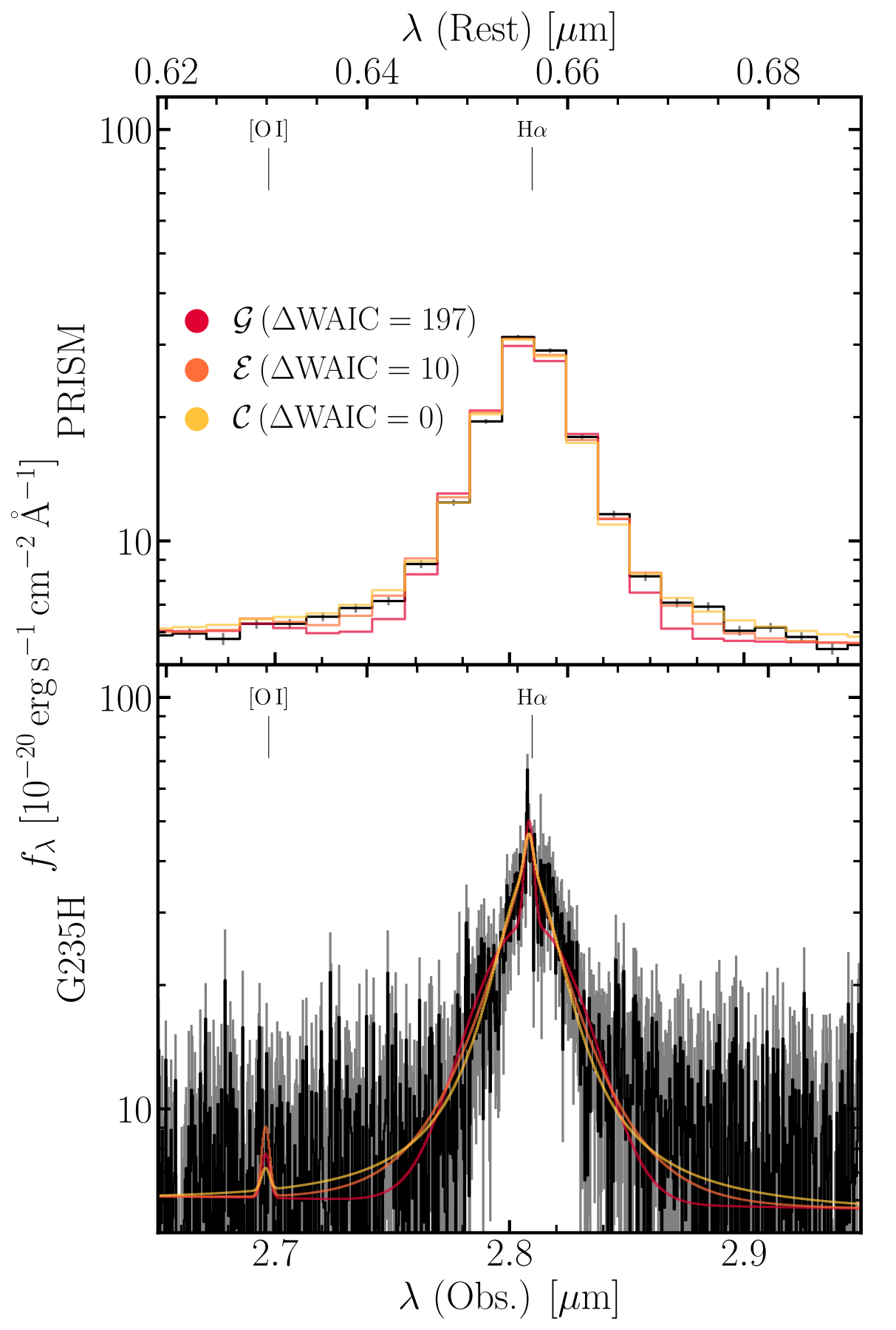
Deep JWST spectroscopy of the lensed z=3.501 LRD GLIMPSE-17775 finds broad exponential line wings, Balmer absorption/break, and fluorescence-rich Fe II/O I emission consistent with a dense, partially ionized AGN cocoon; the super-Eddington inference remains model-dependent.

2025-10-30 · 2510.26990v1 · Research note

Faint active galactic nuclei supplied 31-75% of hydrogen-ionizing photons at z>5

Mainak Singha, Sangeeta Malhotra, James Ely Rhoads

A joint luminosity-function and escape-fraction model attributes 31–75% of z>5 ionizing photons to AGN, but the result depends on assumed galaxy escape fractions and an outflow-based AGN LyC-escape prescription available here only in the abstract.

Figure 2 from Ultra-Strongly Self-Interacting Dark Matter: From Phenomenology to Astrophysical Observables

2025-10-20 · 2510.18142v1 · Research note

Ultra-Strongly Self-Interacting Dark Matter: From Phenomenology to Astrophysical Observables

M. Grant Roberts, Wolfgang Altmannshofer, Pierce Giffin, et al.

This two-component SIDM model identifies parameter space that authors argue meets relic-density, velocity-dependent scattering, linear-power, and representative direct-detection constraints; a subpercent ultra-interacting component is proposed to seed early black holes relevant to little red dots.

2025-10-20 · 2510.17952v1 · Research note

Evolutionary Tracks and Spectral Properties of Quasi-stars and Their Correlation with Little Red Dots

Andrew D. Santarelli, Ebraheem Farag, Earl P. Bellinger, et al.

MESA quasi-star models predict a long-lived, cool late stage whose continuum broadly resembles two JWST Little Red Dots, including one measured Balmer break, but mismatched extreme breaks and simplified atmospheres prevent identification of LRDs as quasi-stars.

2025-10-09 · 2510.08354v1 · Research note

Mephisto: Self-Improving Large Language Model-Based Agents for Automated Interpretation of Multi-band Galaxy Observations

Zechang Sun, Yuan-Sen Ting, Yaobo Liang, et al.

Mephisto couples LLM-guided tree search to CIGALE SED fitting, recovering near-grid-search solutions for 256 COSMOS2020 galaxies with far fewer evaluated models. For Little Red Dots, competing stellar-only and stellar+AGN photometric fits remain viable rather than physically resolved.

Figure 3 from The $M_{\rm BH}-M_{*}$ Relationship at $3<z<7$: Big Black Holes in Little Red Dots

2025-10-08 · 2510.07376v1 · Research note

The $M_{\rm BH}-M_{*}$ Relationship at $3<z<7$: Big Black Holes in Little Red Dots

Brenda L. Jones, Dale D. Kocevski, Fabio Pacucci, et al.

For 70 JWST broad-line AGN at 3<z<7, the authors infer black holes overmassive relative to local broad-line AGN, with the offset and BH-to-stellar-mass ratio increasing toward high redshift; LRD-rich sample composition contributes substantially.

Figure 2 from Evidence of violation of Case B recombination in Little Red Dots

2025-10-07 · 2510.06362v1 · Research note

Evidence of violation of Case B recombination in Little Red Dots

G. P. Nikopoulos, D. Watson, A. Sneppen, et al.

JWST/NIRSpec Balmer decompositions in seven Little Red Dots generally support Case B recombination plus strong broad-line extinction, but RUBIES EGS-49140 is inconsistent at >5σ, plausibly indicating optically thick, very dense gas rather than an ordinary dust law.

Figure 1 from A z ~ 0.4 Galaxy Reflecting the high-redshift Little Red Dots: An Extended Starburst with an Overmassive Black Hole

2025-10-03 · 2510.02801v1 · Research note

A z ~ 0.4 Galaxy Reflecting the high-redshift Little Red Dots: An Extended Starburst with an Overmassive Black Hole

Xiaoyang Chen, Kohei Ichikawa, Masayuki Akiyama, et al.

Gemini/GMOS IFU plus archival SED data identify J2048 at z=0.4330 as an LRD-like AGN with spatially extended young-starburst and ionized-outflow signatures; the authors infer a ~400 M⊙ yr⁻¹ SFR and an unusually high inferred black-hole-to-stellar-mass ratio.

Figure 7 from The warm outer layer of a Little Red Dot as the source of [Fe II] and collisional Balmer lines with scattering wings

2025-09-30 · 2510.00103v1 · Research note

The warm outer layer of a Little Red Dot as the source of [Fe II] and collisional Balmer lines with scattering wings

Alberto Torralba, Jorryt Matthee, Gabriele Pezzulli, et al.

Deep JWST spectra of the single z=5.535 LRD GN-9771 reveal optical [Fe II] and unusual Balmer profiles consistent with a dense, ∼7000 K radiative-transfer layer; if scattering dominates the wings, standard virial black-hole masses may be biased high.

Figure 4 from Irony at z=6.68: a bright AGN with forbidden Fe emission and multi-component Balmer absorption

2025-09-30 · 2510.00101v1 · Research note

Irony at z=6.68: a bright AGN with forbidden Fe emission and multi-component Balmer absorption

Francesco D'Eugenio, Erica Nelson, Xihan Ji, et al.

Deep JWST/NIRSpec spectroscopy of the z=6.68 Little Red Dot Irony supports an AGN viewed through dense, stratified, multi-component gas: Balmer absorption covers both continuum and broad-line emission, while black-hole inferences remain profile-dependent.

2025-09-24 · 2509.20455v1

BlackTHUNDER: Shedding light on a dormant and extreme little red dot at z=8.50

Gareth C. Jones, Hannah Übler, Roberto Maiolino, et al.

BlackTHUNDER presents JWST/NIRSpec IFU spectroscopy of UNCOVER_20466 (z=8.50), confirming its LRD nature and an overmassive central black hole. Balmer decrements indicate little dust, yielding an Hβ-based bolometric output and Eddington ratio only ~10% of earlier estimates—consistent with a currently subdued/dormant phase. Strong Lyα (f_esc ≈ 30%) and an extreme [O III]4363/Hγ imply AGN photoionization with ultra-dense gas (n_e ~ 10^7 cm^-3). The source sits on local M_BH–σ_* and M_BH–M_dyn relations and is compatible with growth from a heavy seed (~10^3 M⊙), marking it as a likely progenitor core of a later galaxy.

2025-09-24 · 2509.20453v1

On the Fate of Little Red Dots

Andres Escala, Lucas Zimmermann, Sebastian Valdebenito, et al.

Analyzes Little Red Dots in a stellar-only framework by mapping collision, relaxation, and age timescales and folding in recent N-body results for extreme stellar systems. Finds typical LRD cores sit in the tage ~ tcoll < trelax regime, triggering core runaway collisions that form a massive black hole; in more extreme cases with tcoll < trelax the whole system enters a “Forbidden Stellar Zone” and collapses. This pathway yields high BH formation efficiencies (~10–50% of the stellar mass), naturally explaining LRD transience, frequent X-ray non-detections prior to seed formation, and over-massive remnants once formed. Concludes LRDs are prime sites to catch nascent, potentially already supermassive, BH seeds at z≈4–8.

2025-09-23 · 2509.19585v1

NEXUS: A Search for Nuclear Variability with the First Two JWST NIRCam Epochs

Zachary Stone, Yue Shen, Ming-Yang Zhuang, et al.

NEXUS uses two NIRCam epochs (Wide-1.1 in Sep 2024 and Deep-1 in Jun 2025; 9-month baseline) to run a nuclear-variability search across ~25k sources in F200W and F444W with PSF-matched difference imaging. The pipeline reaches ~0.18 mag (F200W) and ~0.15 mag (F444W) sensitivity at 28 mag (0.2″ aperture), improving to ~0.01–0.02 mag at <25 mag, and outperforms single-epoch aperture photometry by >30%. They flag 465 high-confidence extragalactic variables whose photo-z distribution mirrors the parent sample to zphot>10. Crucially, ten spectroscopically confirmed broad-line LRDs at 3≲z≲7 show no detectable variability, yielding 3σ F444W limits of ~3–10% (median ~5%), implying weak rest-optical continuum variability; rare nuclear transients remain to be confirmed with continued monitoring and spectroscopy.

2025-09-23 · 2509.19422v1

Spectral Uniformity of Little Red Dots: A Natural Outcome of Coevolving Seed Black Holes and Nascent Starbursts

Kohei Inayoshi, Kohta Murase, Kazumi Kashiyama

Proposes a two-component origin for LRD SEDs during assembly of Mh ≳ 1e10–11 Msun halos at z ≃ 4–10: a super-Eddington–fed seed BH (growing to ~1e6–1e7 Msun) inflates a dense envelope at Teff ≃ 5000 K that makes the red optical, while a coeval ~1e7 Msun nuclear starburst supplies the blue UV. This naturally yields the V-shaped UV–optical continuum and the weakness of X-ray/IR/radio signatures, with broad lines arising despite envelope scattering. A key prediction is a nearly constant Lopt/LUV ≃ 2–10 for ≃15 Myr (~one-third Salpeter) until SNe expel nuclear gas and quench the envelope. Population-wide, the ratio stays uniform at z ≃ 4–8 but declines toward lower z as red envelopes fail, linking LRD phases to later normal AGN states.

2025-09-22 · 2509.17484v1

Islands of Electromagnetic Tranquility in Our Galactic core and Little Red Dots that Shelter Molecules and Prebiotic Chemistry

Remo Ruffini, Yu Wang

Proposes that both the Milky Way’s Sgr A*+CMZ and JWST-selected little red dots are “electromagnetically tranquil” nuclei: million-solar-mass black holes embedded in dense, cold, molecule-rich cores that are infrared-bright yet X‑ray faint. By aligning scales, gas content, and low-Eddington accretion, the paper argues these environments shield fragile molecules and permit complex organic chemistry near the nucleus. The CMZ example (e.g., nitrile-bearing cloud G+0.693−0.027) motivates the idea that similar chemistry could arise in compact LRD cores. If common, such tranquil nuclei could link early black-hole growth to the formation and delivery of prebiotic molecules in the early universe.

2025-09-11 · 2509.09607v1

Discovery of Multiply Ionized Iron Emission Powered by an Active Galactic Nucleus in a z~7 Little Red Dot

Erini Lambrides, Rebecca Larson, Taylor Hutchison, et al.

THRILS spectroscopy of the z~7 Little Red Dot THRILS_46403 (CEERS-10444/RUBIES_49140) reveals bona fide AGN tracers: multiple Fe lines including a 4.5σ [Fe VII] and several [Fe II], plus an auroral [N II] detection at 3.1σ. Three Balmer lines show broad emission with superposed narrow absorption whose small widths and depths imply a partially covering absorber at or beyond the broad-line region. Electron-temperature diagnostics indicate O++ is markedly hotter than N+ across densities, pointing to a powerful, hard central ionizing source. Together these features establish multiply ionized iron emission from an accreting SMBH within the first 800 Myr and suggest direct sight-lines from the disk to gas at or beyond the BLR.

2025-09-08 · 2509.07100v1

Active galactic nuclei-heated dust revealed in "little red dots"

I. Delvecchio, E. Daddi, B. Magnelli, et al.

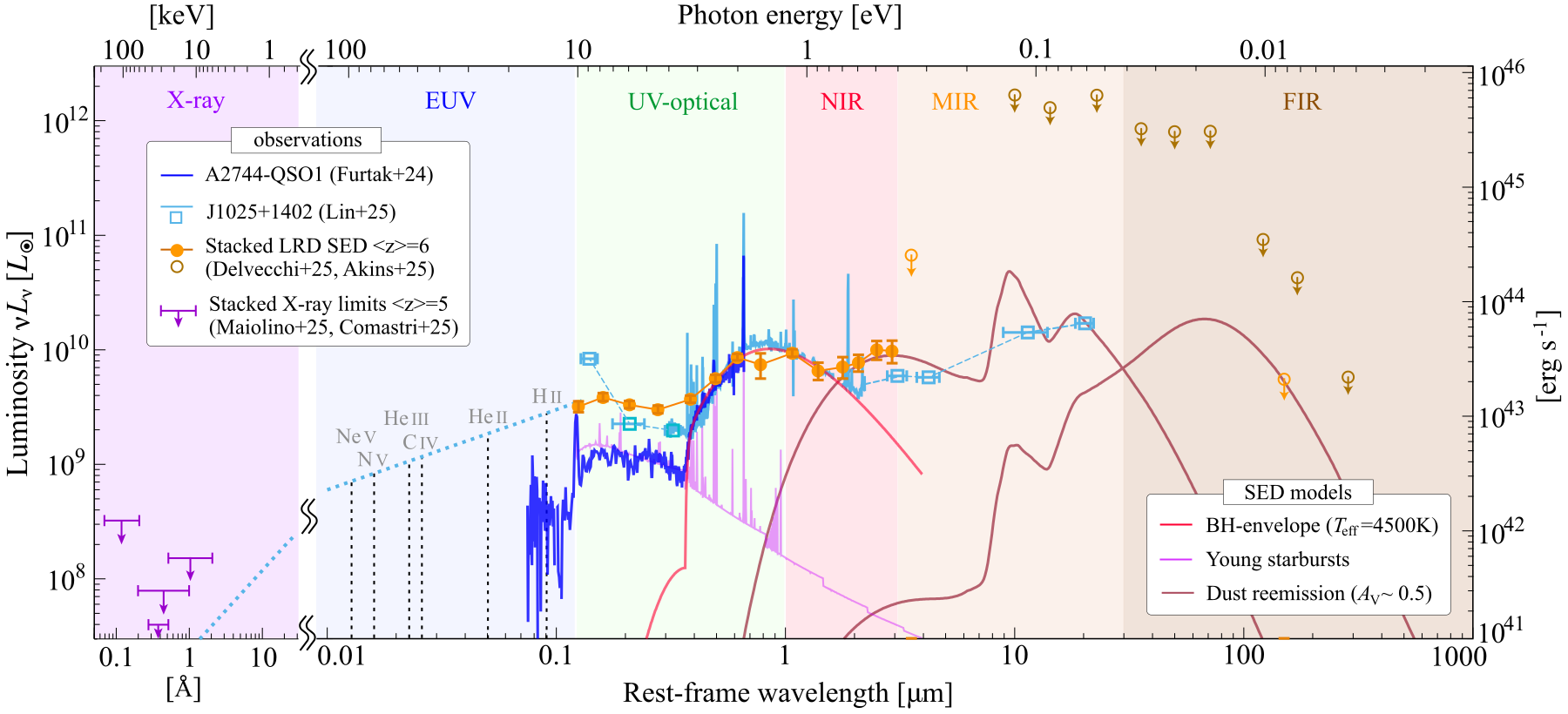
This Letter median-stacks NIRCam, MIRI, and ALMA imaging for 302 photometrically selected little red dots across CEERS, JADES(+SMILES), and PRIMER (z≈2–11; median z≈6.2). The stacked SED rises to ≈3 µm in the rest frame, and CIGALE fits require a dusty AGN component in most (≳50%) LRDs; combined with ALMA non-detections and deep Chandra stack null results, this points to Compton-thick gas (NH>3×10^24 cm^-2) likely confined within Rsub≈0.1 pc. The inferred geometry leaves optical/UV and broad-line emission largely unobscured, matching blue UV slopes and strong Balmer features. While LRDs are heterogeneous, the prevalence of AGN-heated dust implies obscured black-hole growth is common in this population.

2025-09-05 · 2509.05434v1

What you see is what you get: empirically measured bolometric luminosities of Little Red Dots

Jenny E. Greene, David J. Setton, Lukas J. Furtak, et al.

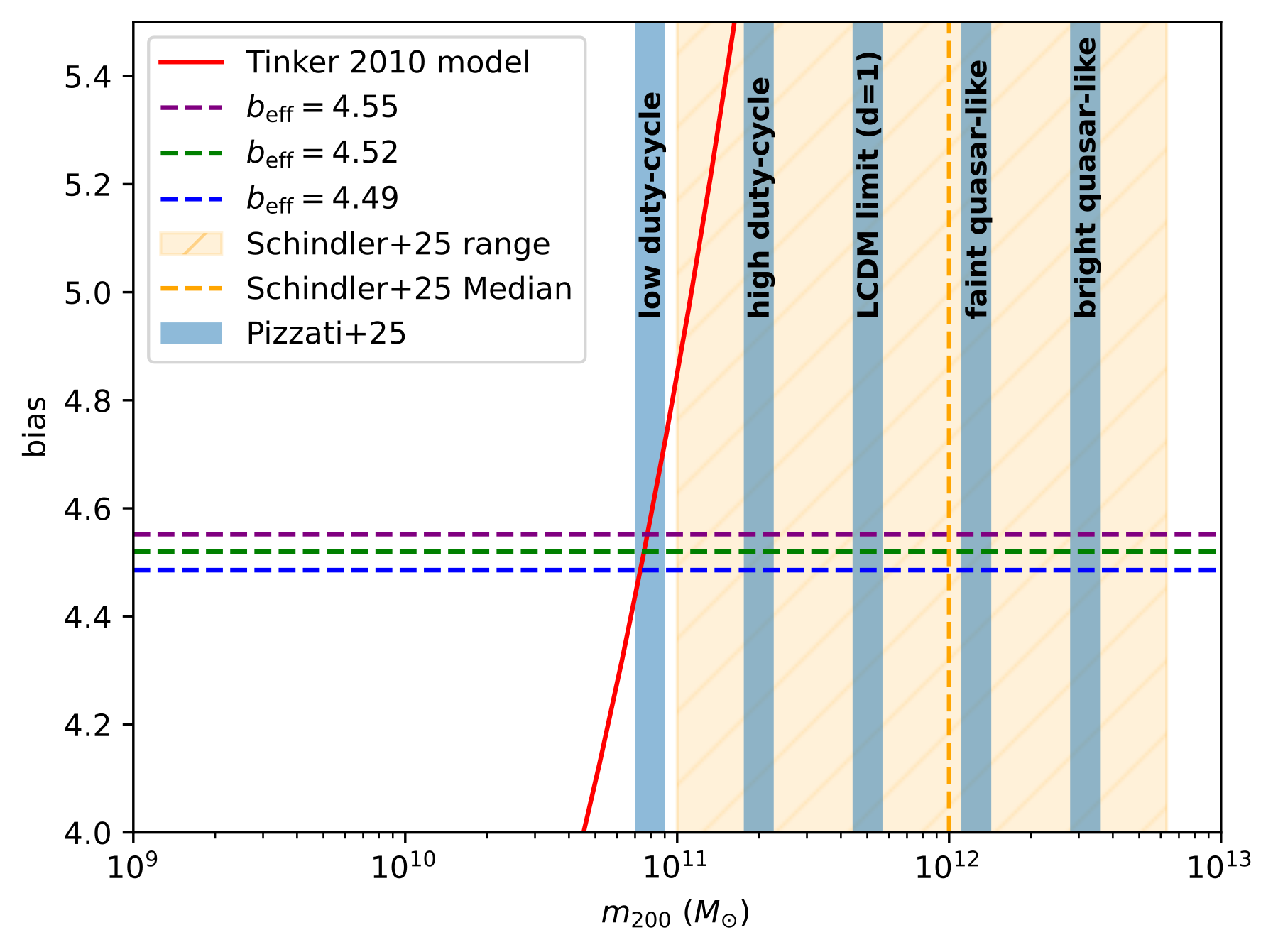
Empirically integrating X-ray–to–far-IR SEDs for two of the most luminous Little Red Dots (A2744-45924 and RUBIES-BLAGN-1), the authors directly measure bolometric luminosities rather than adopting standard AGN corrections. They find that over half of Lbol emerges in the rest-frame optical with Lbol/L5100≈5, while X-ray, UV, and reprocessed mid/far-IR components are sub-dominant, and deep ALMA/MIRI limits rule out a standard dust-reddened AGN SED. New bolometric corrections lower previously inferred luminosities by ~10×, implying BH masses of ~10^5–10^7 Msun (and ~10^8 Msun hosts) if radiating near Eddington and easing tensions with clustering and BH mass density. A key assumption is that far-IR luminosities lie well below current observational limits.

2025-09-03 · 2509.03576v1

How similar are narrow-line Seyfert 1 galaxies and high-z type 1 AGN?

M. Berton, E. Järvelä, A. Tortosa, et al.

Review draws a line between local narrow-line Seyfert 1s and the newly uncovered z>4 type 1 AGN/LRDs: both host low-mass (∼10^6–10^7 M⊙) black holes accreting near or above Eddington and often show features like steep, variable X-rays and, in a subset, relativistic jets. The authors argue jets can help shed angular momentum in super-Eddington flows, making NLS1s practical analogs for early SMBH growth. Radio examples underscore the wide range from host-dominated star-formation morphologies to blazar-like, large-scale jets. Key caveat: some systematic differences remain, plausibly tied to distinct environments and evolutionary paths at high redshift.

2025-09-03 · 2509.03571v1

Do Little Red Dots Vary?

Amy Secunda, Rachel S. Somerville, Yan-Fei Jiang, et al.

Simulated light curves for little red dots are generated under two variability prescriptions: an empirical sub‑Eddington DRW tuned to low‑z AGN and a radiation‑MHD–motivated super‑Eddington disk model. With today’s 2–4‑epoch JWST sampling, the DRW case would have produced far more rest‑UV/optical variability than is seen, while the super‑Eddington model naturally matches the near‑steady continua. The high‑cadence nexus imaging should yield Δm>1 mag if DRW holds, but only the lowest‑mass LRDs vary appreciably in the super‑Eddington scenario; meanwhile, twinkle spectroscopy is still expected to detect broad‑line variability if soft X‑rays can reach the BLR. Net result: super‑Eddington accretion neatly explains the missing continuum variability while allowing line changes.

2025-09-03 · 2509.03291v1

What Do Radio Emission Constraints Tell Us About Little Red Dots as Tidal Disruption Events?

Krisztina Perger, Judit Fogasy, Sándor Frey

The authors test whether little red dots can be explained as tidal disruption events by confronting 3 GHz stacking-based radio non-detections of LRDs with known TDE radio luminosities and volumetric rates. Converting the VLASS/GOODS-N/COSMOS stacking limits into rest-frame specific luminosities across the LRD redshift range, they find radio-quiet TDEs are fully consistent with the limits, while radio-loud TDEs fit only in restricted redshift–spectral-index regions. Forward-modeling fluxes for representative TDEs (RQ: XMMSL1 J0740−85, ASASSN-14li; RL: Sw J1112.82, Sw J2058+05) and comparing number densities shows that delayed, long-lived radio flares plus cosmological time dilation still keep a TDE origin plausible from the radio point of view. The single radio-detected LRD (PRIMER-COS 3866) also lies within the allowed parameter space.

2025-09-03 · 2509.03283v1

A two-phase model of galaxy formation: IV. Seeding and growing supermassive black holes in dark matter halos

Yangyao Chen, Houjun Mo, Huiyuan Wang

Builds a seed-to-SMBH pathway inside a two-phase (fast/slow halo growth) framework: Pop III remnants are bred in mini-halos at the H2- (or delayed atomic-) cooling thresholds, then grow via nuclear-burst super-Eddington episodes, SGC sub-cloud capture, and finally mergers. Implemented on subhalo merger trees, the model produces a broad seed spectrum (10–10^5 Msun at z≈20–30) and a multi-piece, redshift-dependent M_BH–M_* relation set by the dominant channel. A key result is that early nuclear bursts enable rapid mass gain, naturally yielding compact accretors reminiscent of JWST little red dots before merger-dominated quiescence. The framework links LW background and halo assembly rate to BH demographics and matches current constraints.

2025-09-02 · 2509.02664v1

Little Red Dots Are Nurseries of Massive Black Holes

Fabio Pacucci, Lars Hernquist, Michiko Fujii

Assuming the star-only interpretation of compact, red z∼5 Little Red Dots, the authors model ultradense cores where dynamical friction for 10 M⊙ stars in the inner 0.1 pc is <0.1 Myr, triggering rapid mass segregation. A Fokker–Planck core-evolution calculation, an analytic collisional-growth model, and direct N-body simulations all converge on runaway mergers that build a very massive star of 9×10^3–5×10^4 M⊙ within <1 Myr. The VMS then contracts on a ∼8000 yr Kelvin–Helmholtz timescale and collapses to an ∼10^4 M⊙ black hole. This route yields seed number densities above direct-collapse expectations and, with a dense residual core, can power elevated tidal disruption event rates.

2025-09-02 · 2509.02662v1

No Luminous Little Red Dots: A Sharp Cutoff in Their Luminosity Function

Yilun Ma, Jenny E. Greene, Marta Volonteri, et al.

Wide-area imaging over 15.3 deg^2 targets the bright end of little red dots at 4.5<z<4.9 with K<23.7 and finds only one candidate (ECOSMOS-LumLRD-z5, z_phot≈4.6), implying n(M5100<-23.5)≈10^-8 cMpc^-3—about ten times below UV-selected quasars at the same optical luminosity. Combining with JWST-identified LRDs, the optical LF shows a sharp cutoff at λL5100≈2.5×10^44 erg s^-1, whereas the quasar LF turns over at ≳20× higher luminosity. The result confirms LRDs are exclusively low-luminosity rather than quasar counterparts. If the LF shape holds, it favors low-mass black holes accreting within a narrow Eddington-ratio range.

2025-08-29 · 2508.21748v1

A direct black hole mass measurement in a Little Red Dot at the Epoch of Reionization

Ignas Juodžbalis, Cosimo Marconcini, Francesco D'Eugenio, et al.

Strong lensing plus JWST/NIRSpec IFS resolves narrow Hα kinematics and spectroastrometric shifts in the lensed Little Red Dot Abell2744‑QSO1 at z=7.04, enabling a direct rotation curve from ~10–200 pc. The curve is Keplerian and rules out compact extended mass profiles (e.g., MW‑like nuclear star cluster, Plummer, or a DM cusp), implying a central point mass of order 5×10^7 M⊙ consistent with Balmer‑line virial estimates. The inferred stellar content is minimal, with MBH/M* > 2, pointing to a near‑“naked” black hole in a pristine environment. This result validates virial BH masses for LRDs at the EoR and captures a massive BH seed in its earliest growth phase.