Research


The Early Universe Laboratory works on the formation and evolution of galaxies in the first two billion years of cosmic time, combining JWST imaging and slitless spectroscopy with ALMA interferometry, gravitational lensing and many other large survey datasets. A recurring theme is developing novel methods and delivering data products that make these measurements possible for the wider community, and opening up previously underexplored science domains.

The full list of my research publications is available in this ADS library.
Filter
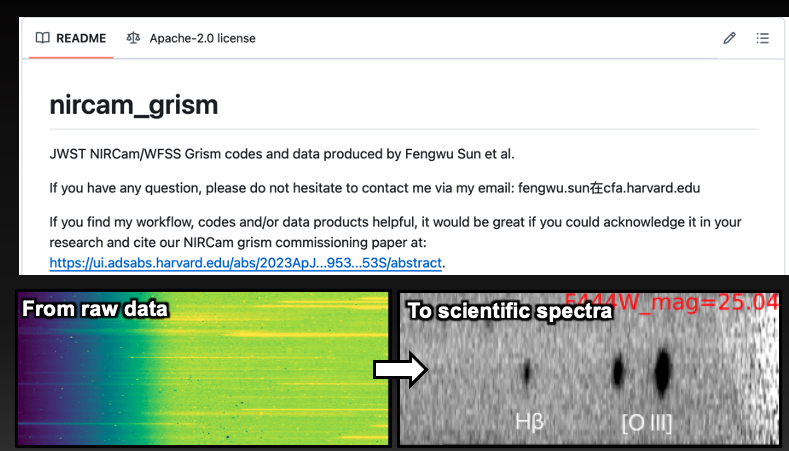
NIRCam WFSS data processing notebook on GitHub

NIRCam WFSS Data Processing Notebook & Calibrations on  GitHub
Sun, F. et al. (2023)

A step-by-step public notebook for reducing JWST/NIRCam grism spectra, together with my calibrations of the grism dispersion, tracing and sensitivity functions.

Code Data JWST

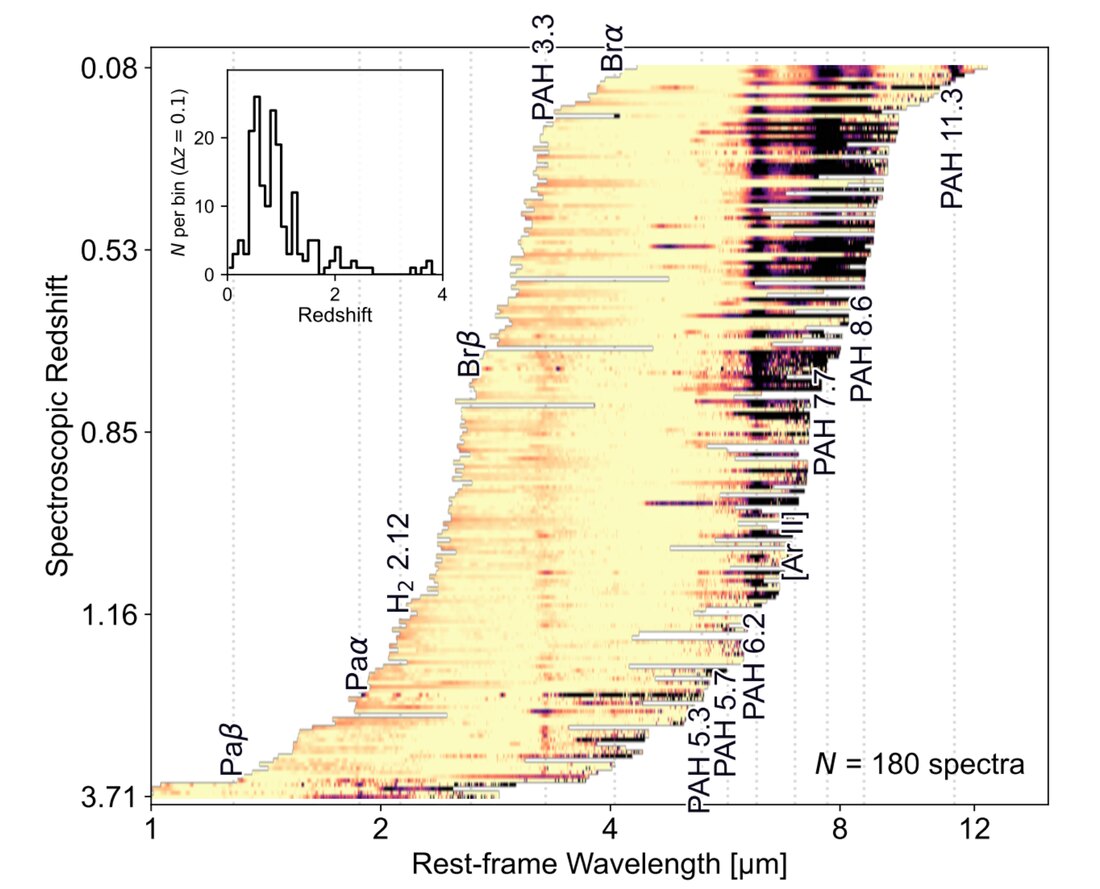
Rest-frame mid-infrared spectral atlas of 180 galaxies from the MIRI prism wide-field slitless spectroscopy calibration

MIRI WFSS Calibration & Extraction Workflow on  GitHub
Sun, F. et al. (2026c)

Calibration suite, extraction workflow and mid-infrared spectral atlas for JWST/MIRI prism wide-field slitless spectroscopy. Used without the slit, the P750L prism disperses the whole imager field into 5–14 µm spectra at R ≈ 100. The paper validates each calibration step and releases spectra of 180 galaxies at z = 0.08–3.71.

Code Data JWST

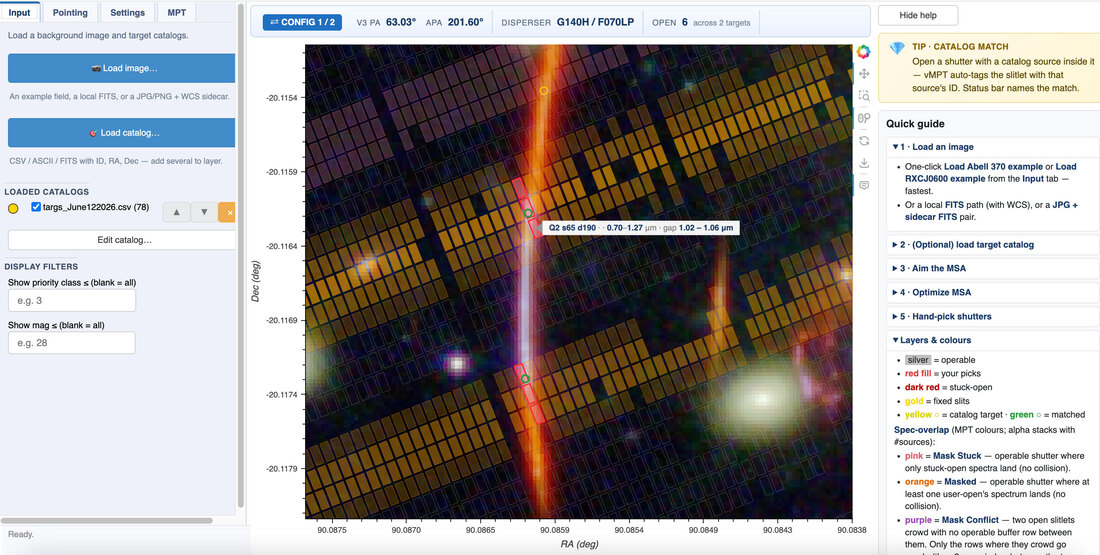
vMPT interface showing a NIRSpec MSA shutter grid over a target-field image with the conflict layers switched on

vMPT — visual MSA Planning Tool on  GitHub

Interactive Bokeh app for JWST/NIRSpec MSA planning
An interactive app for planning JWST/NIRSpec MSA observations directly on a target-field image. It optimises the pointing and roll angle over the MSA shutter grid, protects high-priority targets from spectral overlap, supports hand-picking shutters with live conflict feedback, and exports APT-loadable plans in the eMPT format.

Code JWST

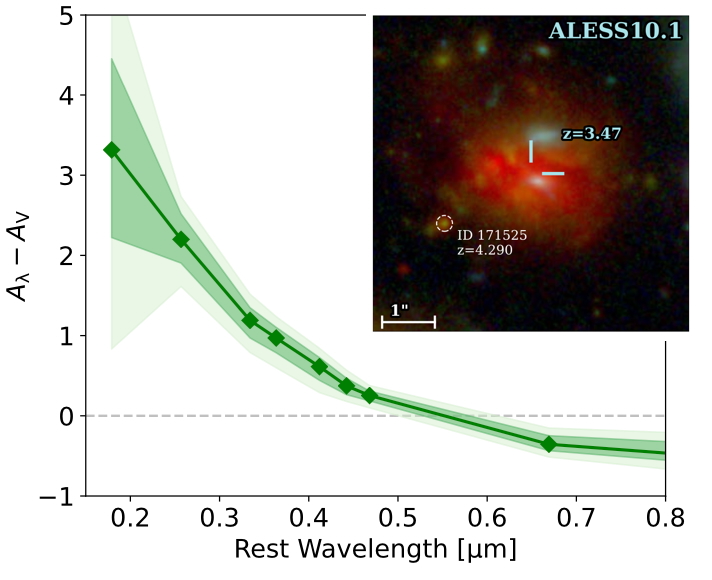
Emission-line galaxies and dust extinction at z ~ 3.5 in the JADES Origins Field

JADES: Discovery of Large Reservoirs of Small Dust Grains in the Circumgalactic Medium of Massive Galaxies at \(z\sim3.5\)
Sun, F. et al. (2026a)

NIRCam imaging and grism spectroscopy in the JADES Origins Fields yield 1,445 emission-line galaxies at \(z=0-9\) and two protoclusters at \(z=3.47\) and 3.69. Seven background galaxies show reddened continua explained by dust in the circumgalactic medium of foreground dusty galaxies, implying small dust grains dominate.

JWST ALMA Dust Massive Galaxies Protocluster

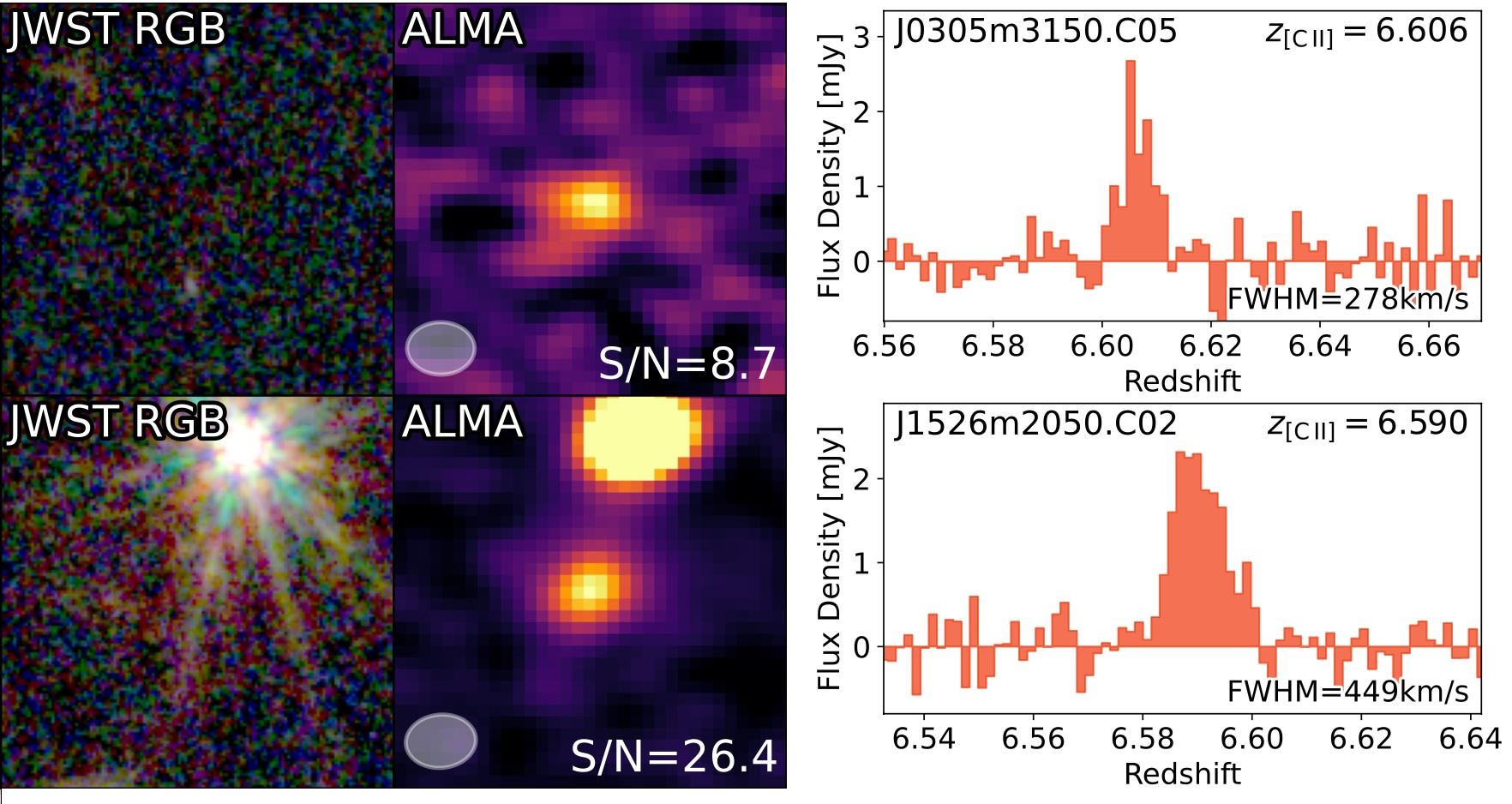
Two JWST/NIRCam-dark starburst galaxies at z = 6.6 detected with ALMA

The Identification of Two JWST/NIRCam-Dark Starburst Galaxies at \(z=6.6\) with ALMA
Sun, F. et al. (2026b)

Two dusty star-forming galaxies at \(z=6.6\) selected from ASPIRE are robustly detected in ALMA continuum and [C II] yet remain extraordinarily faint in the NIRCam bands. With star formation rates of roughly \(80-250\,\mathrm{M}_{\odot}\,\mathrm{yr}^{-1}\), they may be progenitors of massive quiescent galaxies at \(z \gtrsim 4\) and descendants of UV-luminous galaxies at \(z>10\).

JWST ALMA Dust Massive Galaxies

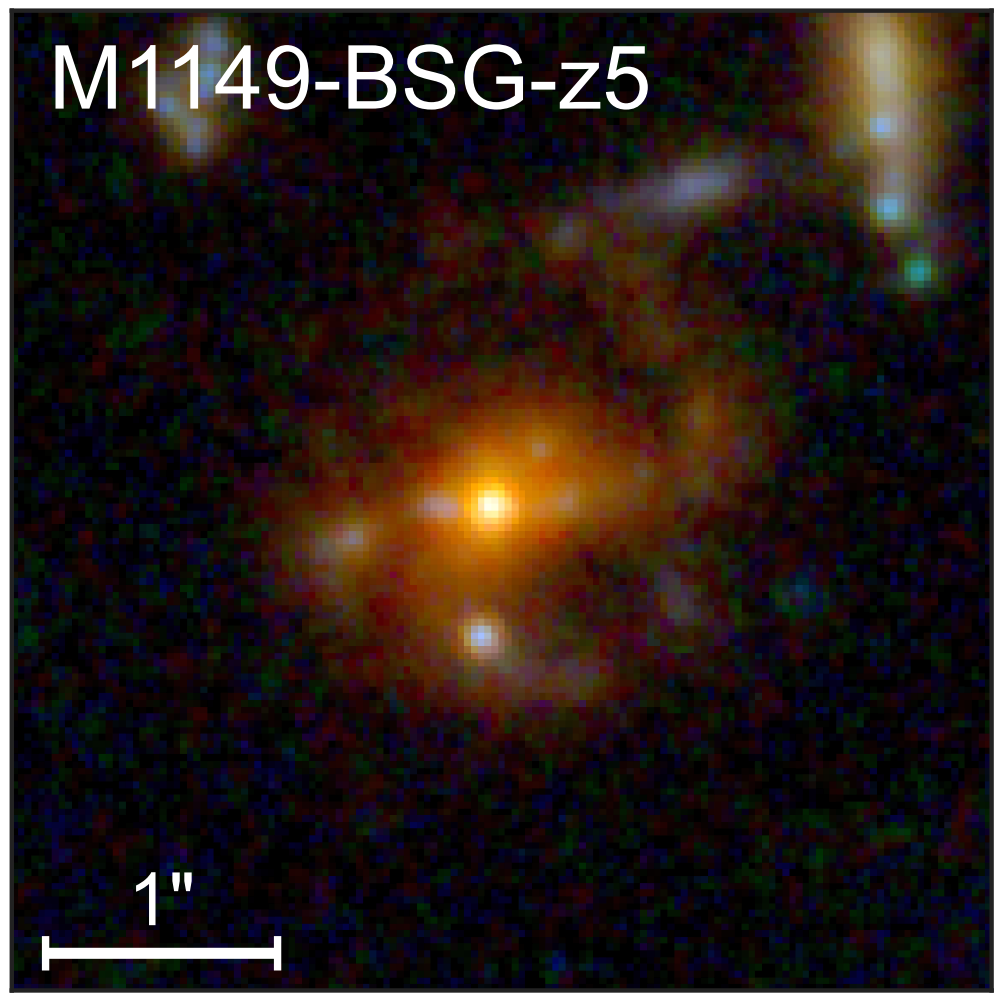
JWST colour image of M1149-BSG-z5, a barred spiral galaxy at z = 5.102 behind MACS J1149

A Massive Barred Spiral Galaxy at \(z=5.102\) Discovered by JWST
Wang, X., Sun, F., Asada, Y., et al. (2026)

A massive barred spiral galaxy (M1149-BSG-z5) behind MACS J1149+2223, and the highest-redshift barred galaxy candidate to date. Modelling reveals a 4.5 kpc stellar bar, spiral arms at 5.5 kpc, an extended disk (\(M_\ast=10^{10.45}\,M_\odot\)) and a broad-line AGN.

Student-leading JWST Massive Galaxies AGN / LRD

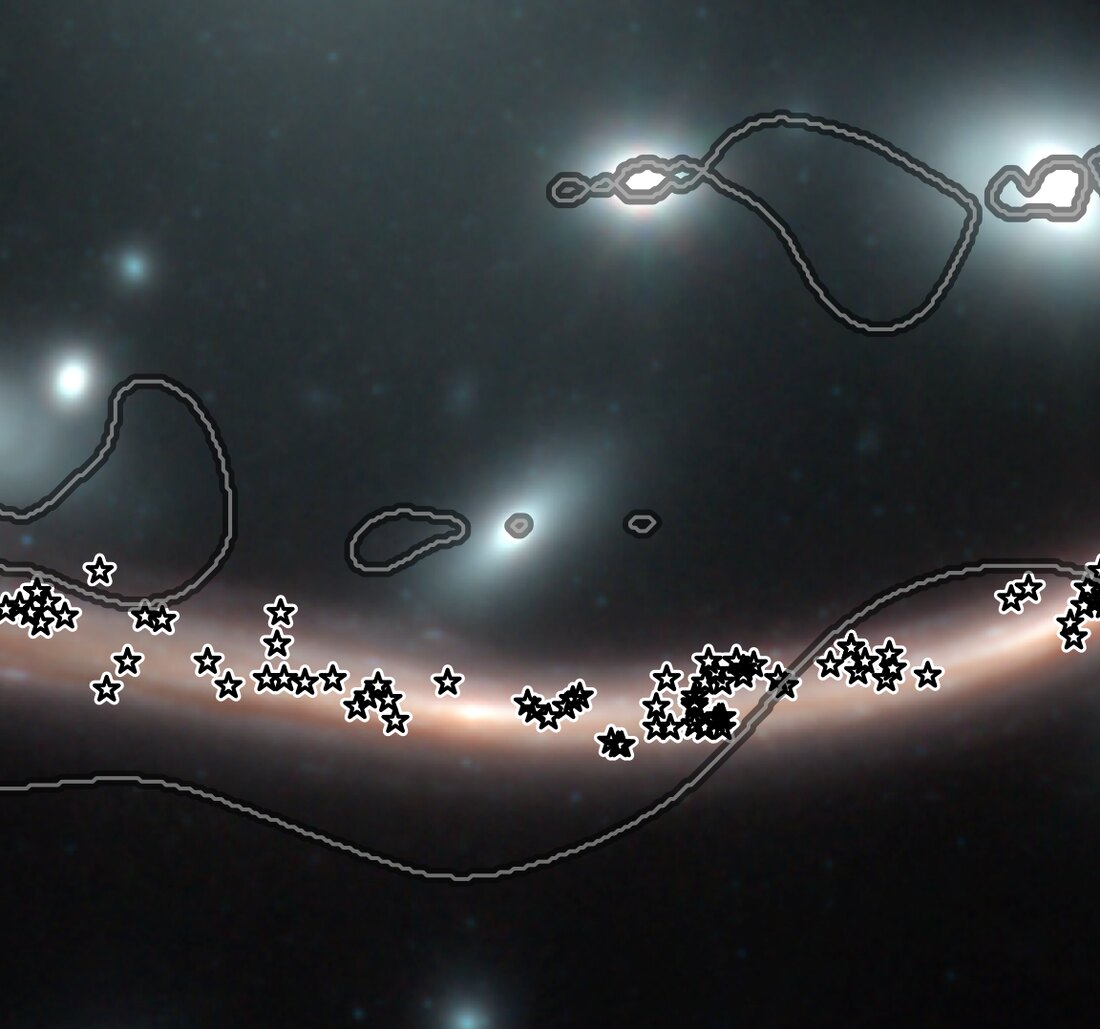
JWST image of the Dragon arc behind Abell 370 with over 100 magnified stellar events marked

First Statistical Study of Over 100 Magnified Stellar Events at Redshift \(z\approx0.725\) with JWST
Palencia, J. M., Sun, F., Diego, J. M., et al. (2026)

The first statistical sample of more than 100 individually magnified stellar events in the Dragon arc behind Abell 370, turning intracluster microlensing into a quantitative probe of a distant galaxy's stellar population and of small-scale dark matter structure in the lens.

Student-leading JWST Gravitational Lensing Transients

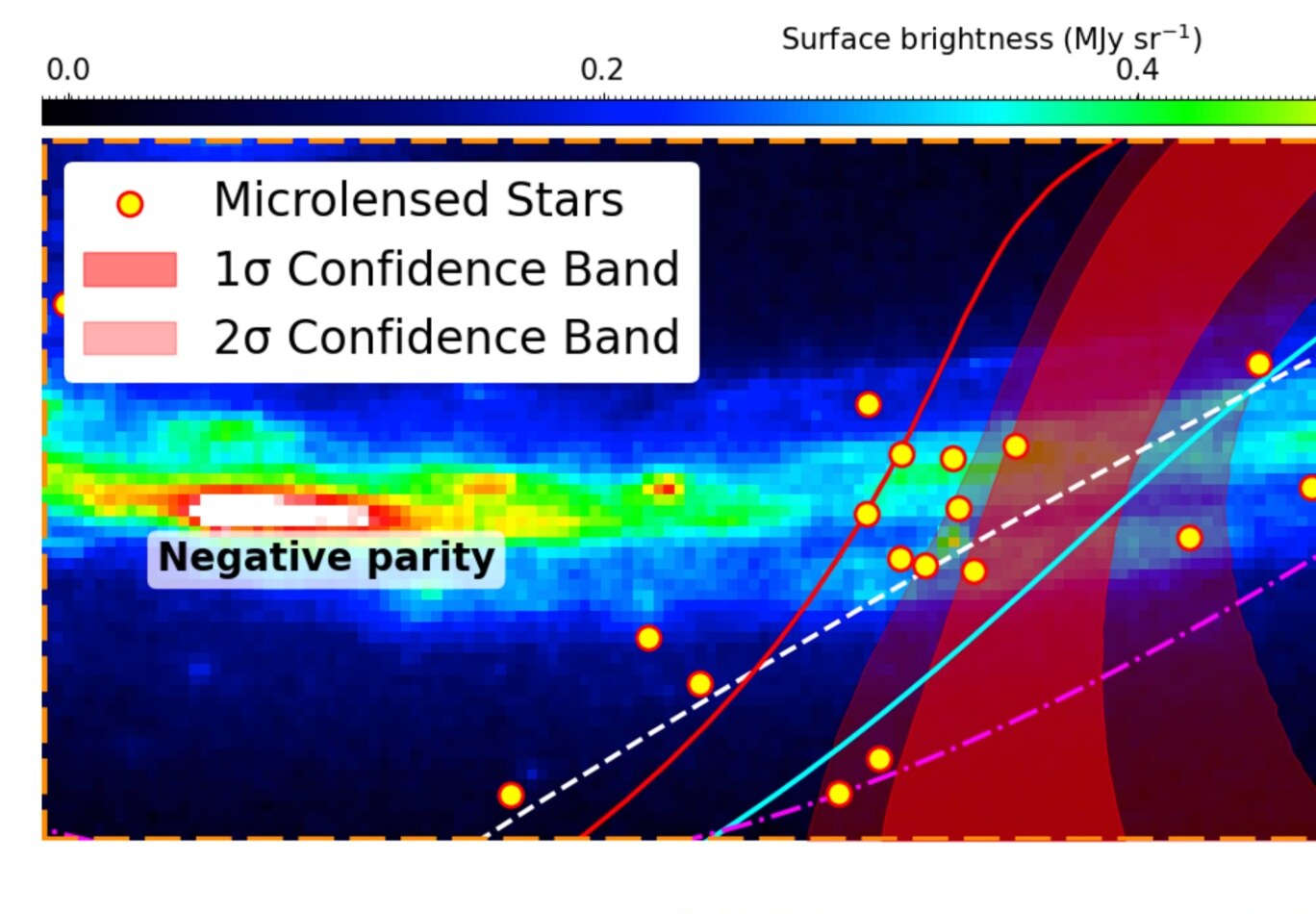
Surface-brightness map of the Dragon Arc with the 1 and 2 sigma critical-curve confidence bands and the microlensed stars

Kinematic Mapping of Giant Arcs: A New Method to Locate Lensing Critical Curves
Zhou, R., Dai, L., Ji, L., et al. (2026)

A kinematics-based method to locate the lensing critical curve from the line-of-sight velocity field of a giant arc. Applied to the Dragon Arc behind Abell 370 with archival VLT/MUSE Hβ mapping, it constrains the critical curve to 0.23″ and places the magnified stars on the negative-parity side.

Gravitational Lensing Student-leading

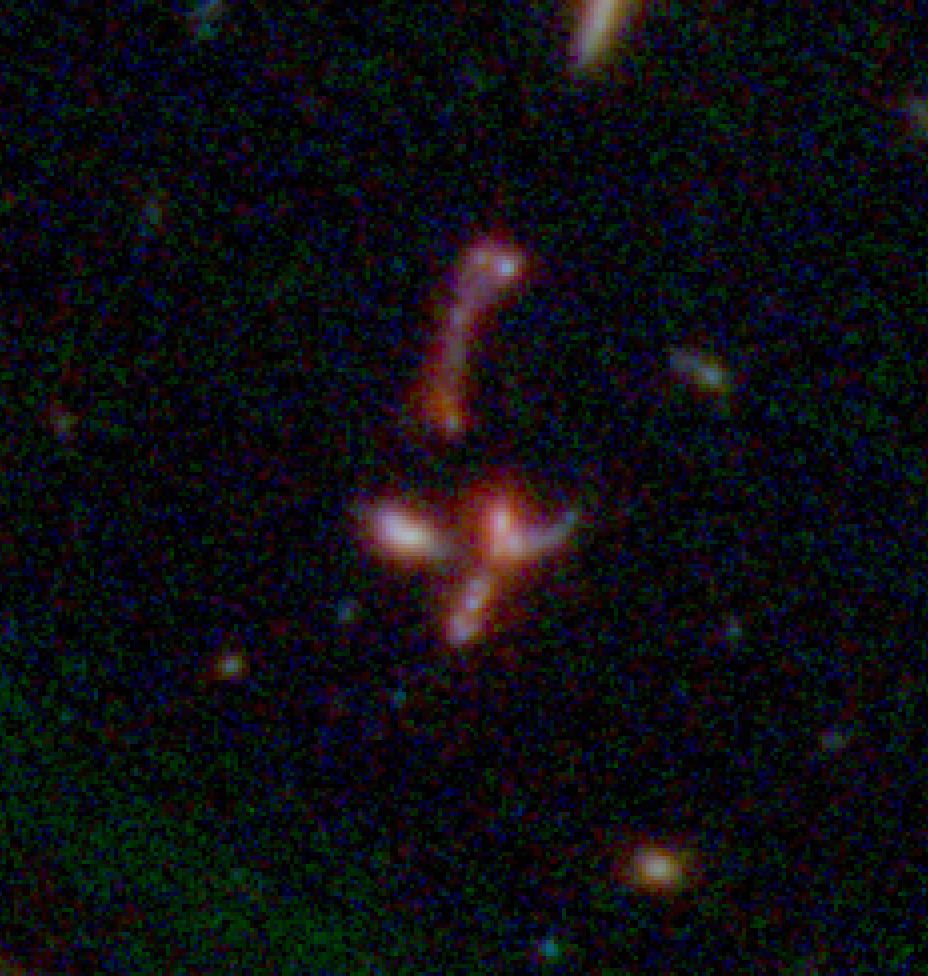
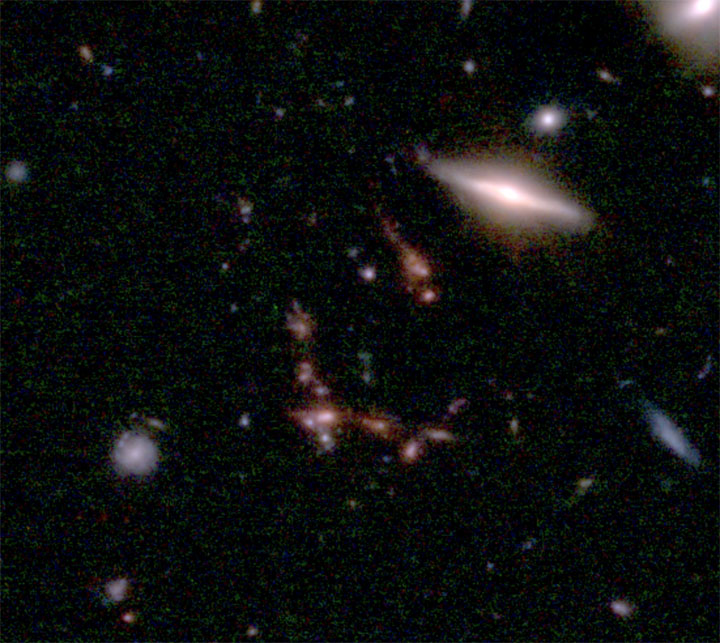
JWST colour image of the compact protogroup at z ~ 5, a chain of red galaxies

A Compact Protogroup at \(z\sim5\): A Massive Galaxy Caught in Formation
Laishram, R., Koyama, Y., Sun, F., et al. (2026)

A compact protogroup at \(z\sim5\) in which a massive galaxy appears to be caught in formation. It offers a rare view of how the most massive structures assembled only about a billion years after the Big Bang, linking stellar-mass build-up to dense environments.

JWST Massive Galaxies Protocluster

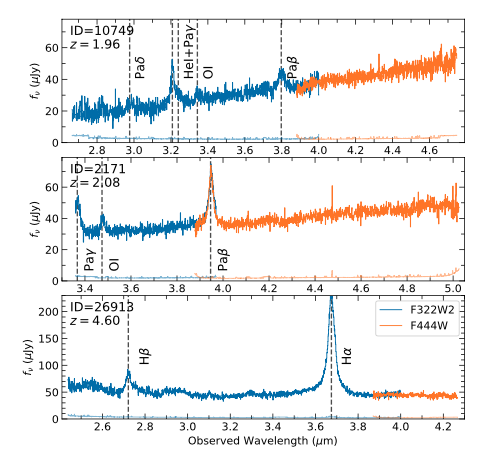
NEXUS Early Data Release NIRCam imaging and grism spectroscopy coverage

NEXUS Early Data Release: NIRCam Imaging and WFSS Spectroscopy from the First (Partial) Wide Epoch
Zhuang, M., Wang, F., Sun, F. et al. (2026)

The Early Data Release of the Multi-Cycle JWST-NEXUS Treasury program: NIRCam imaging and slitless spectroscopy from the first, partial NEXUS-Wide epoch, covering the central 100 arcmin2 of the NEXUS field near the North Ecliptic Pole, inside the Euclid Ultra-Deep Field.

Data JWST

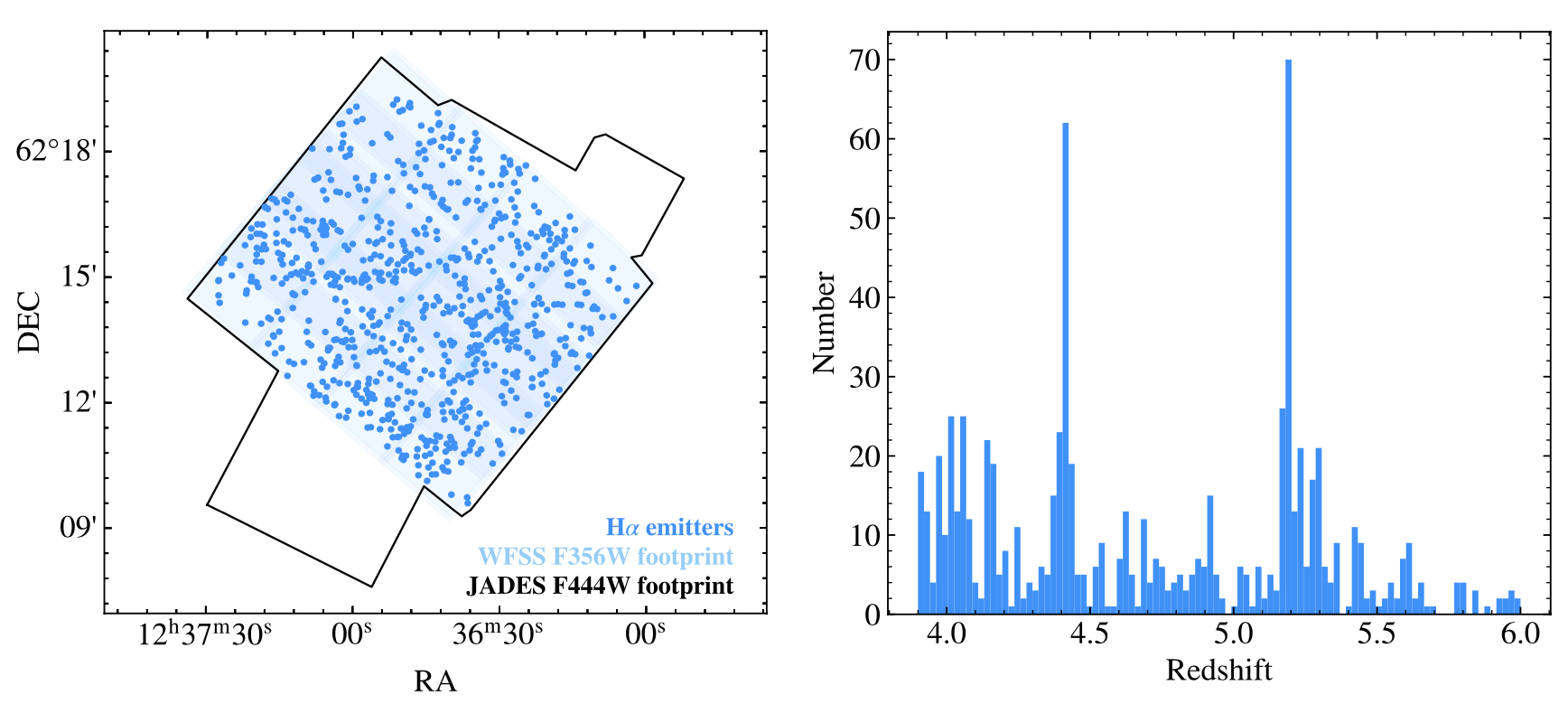
H-alpha emitter luminosity function and clustering at z ~ 4-6

The Luminosity Function and Clustering of H\(\alpha\) Emitting Galaxies at z≈4-6 from a Complete NIRCam Grism Redshift Survey
Lin, X., Egami, E., Sun, F. et al. (2026a)

Luminosity functions and clustering of 888 Hα emitters at \(3.75<z<6\) in GOODS-N, from JWST CONGRESS and FRESCO grism spectroscopy. The sample spans ~62 arcmin2 and reaches \(L_{\rm H\alpha}\sim10^{41.2}\,{\rm erg\,s^{-1}}\); we identify two filamentary protoclusters at \(z\approx4.41\) and 5.19.

Student-leading JWST Protocluster

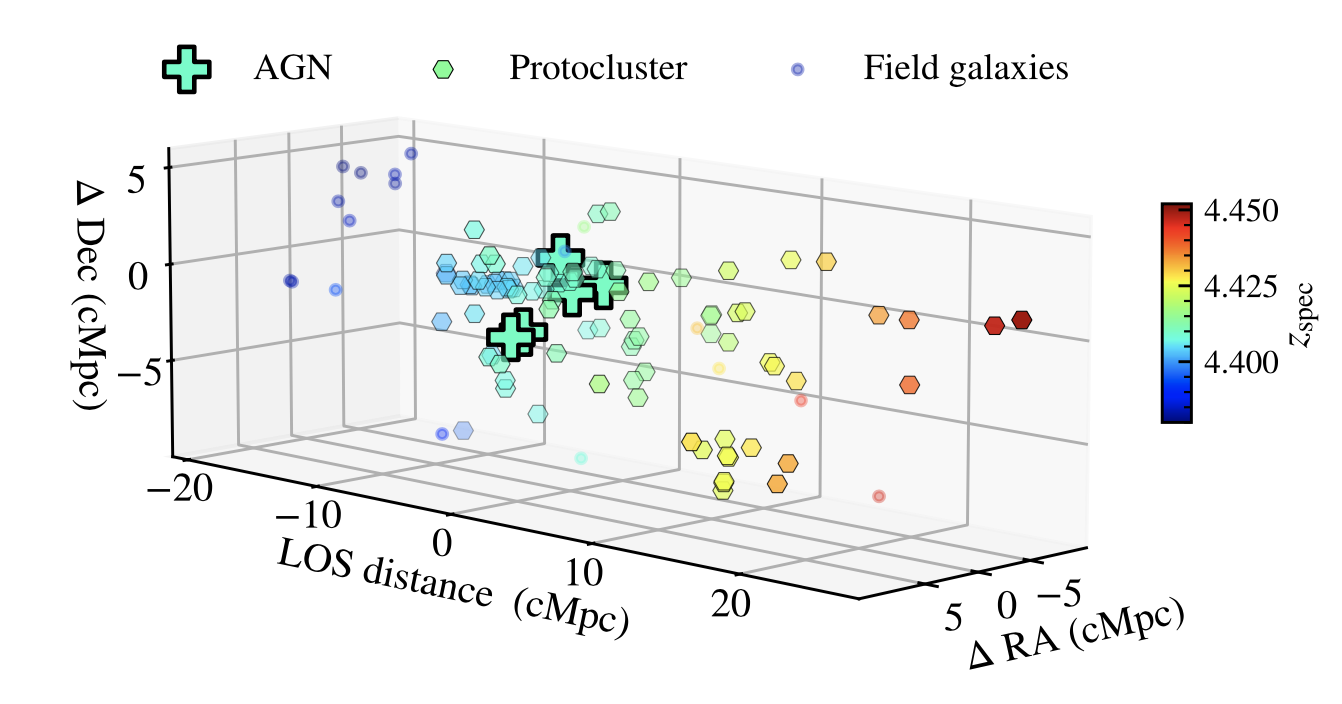
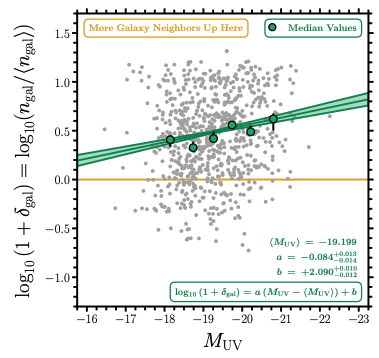
Environments of low-luminosity AGNs at 3.9 < z < 6

The Large-scale Environments of Low-luminosity AGNs at 3.9<z<6 and Implications for Their Host Dark Matter Halos from a Complete NIRCam Grism Redshift Survey
Lin, X., Fan, X., Sun, F. et al. (2026b)

Large-scale environments and clustering of 28 low-luminosity AGNs at \(z=3.9-6\) in GOODS-N, identified from CONGRESS and FRESCO NIRCam grism data via broad Hα emission or V-shaped continua and compared with 782 Hα emitters. The AGNs do not preferentially reside in denser environments.

Student-leading JWST AGN / LRD

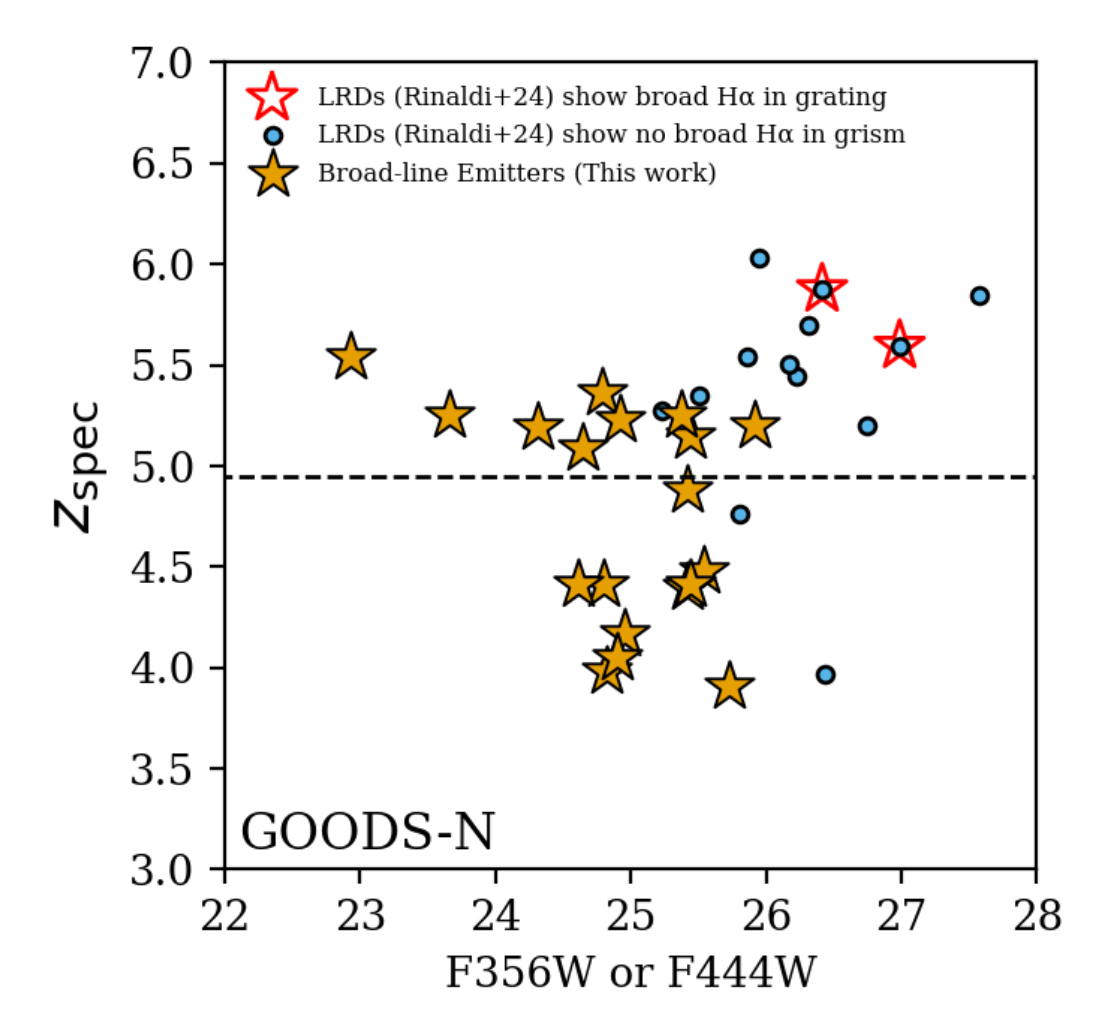
Broad H-alpha emitters in the GOODS-N field

Abundant Population of Broad H\(\alpha\) Emitters in the GOODS-N Field Revealed by CONGRESS, FRESCO, and JADES
Zhang, J., Egami, E., Sun, F. et al. (2026)

A spectroscopic search for broad Hα emitters at \(z\sim3.7-6.5\) in GOODS-N using JWST/NIRCam slitless spectroscopy from FRESCO and CONGRESS plus JADES imaging. We identify 19 broad-line sources with FWHM > 1000 km/s, of which 42% fail the standard colour selection for little red dots.

Student-leading JWST AGN / LRD

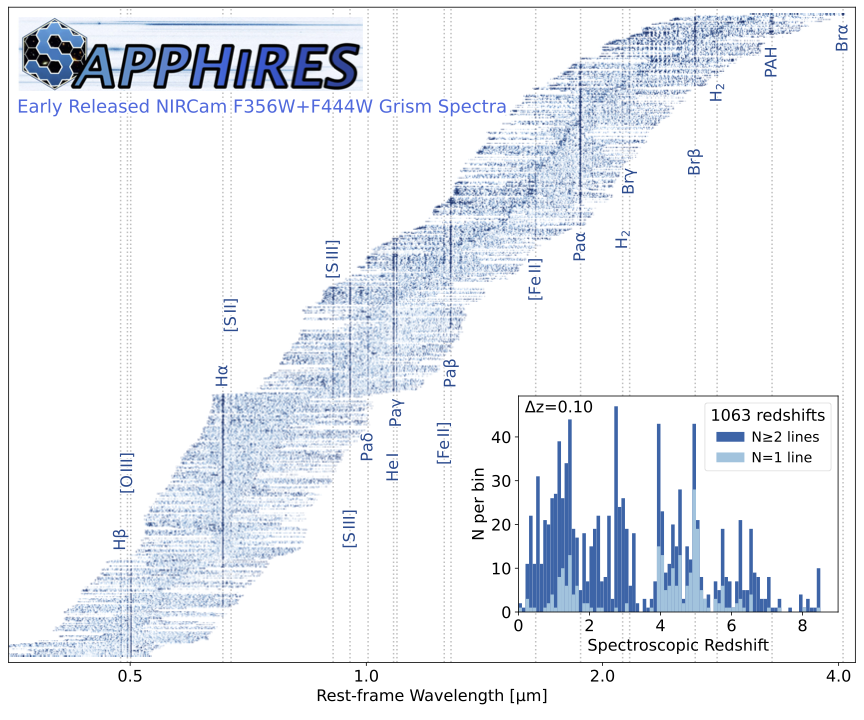
SAPPHIRES Early Data Release stacked grism spectra

SAPPHIRES (JWST Cycle-3 GO-6434) Early Data Release on  GitHub
Sun, F. et al. (2025b)

The early data release of SAPPHIRES, a JWST Cycle-3 Treasury survey using NIRCam wide-field slitless spectroscopy in pure parallel. This release presents NIRCam imaging and WFSS data obtained in parallel to the Frontier Field cluster MACS J0416.1-2403.

Data JWST

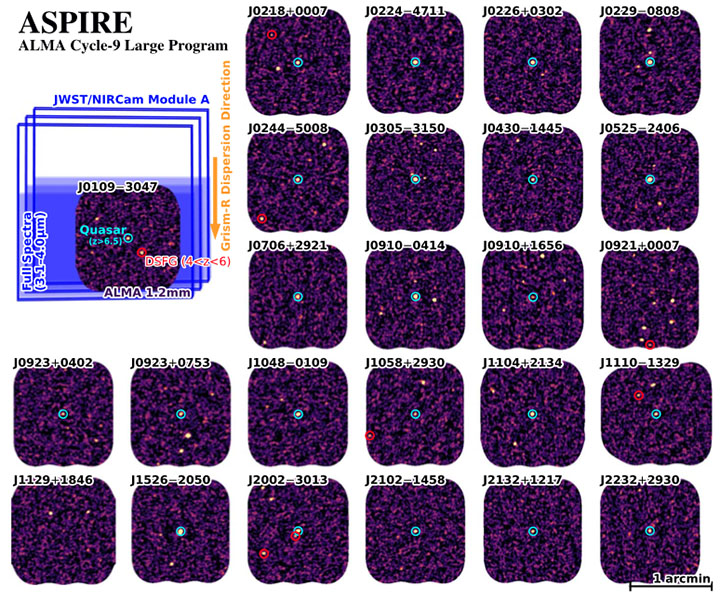
ASPIRE ALMA 1.2 mm continuum map along a quasar sightline

ASPIRE: Spectroscopically Complete Census of Obscured Cosmic Star Formation Rate Density at z=4–6
Sun, F. et al. (2025a)

A stringent measurement of the dust-obscured star formation rate density at z = 4-6 from the ASPIRE JWST medium and ALMA Cycle-9 large programs, combining NIRCam grism spectroscopy and ALMA 1.2 mm continuum maps along 25 independent quasar sightlines over ~35 arcmin2.

JWST ALMA Dust

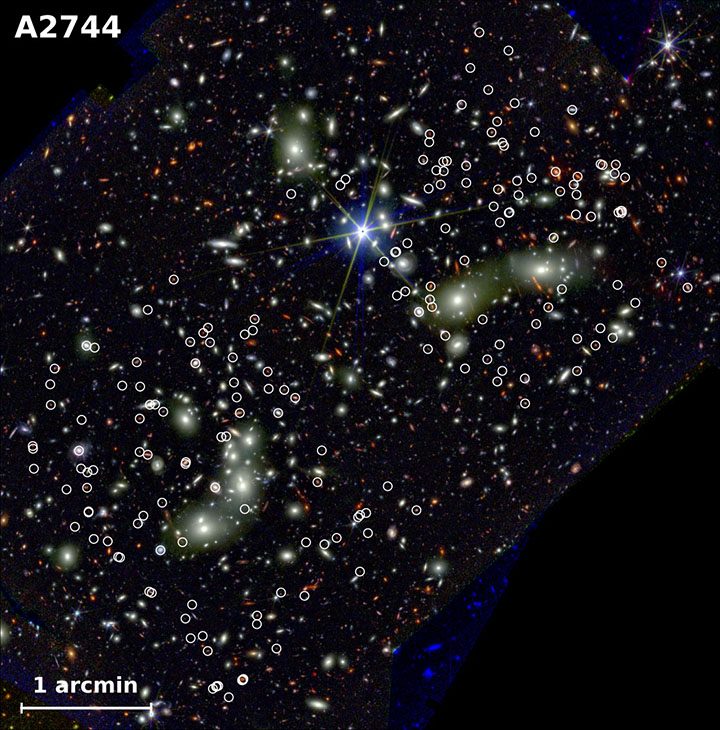
MAGNIF grism coverage over the Abell 2744 field

MAGNIF: Spectroscopic Census of H\(\alpha\) Luminosity Functions and Cosmic Star Formation at z ~ 4.5 and 6.3
Fu, S., Sun, F., Jiang, L. et al. (2025)

H\(\alpha\) luminosity functions at \(z\sim4.5\) and 6.3 from the JWST MAGNIF survey, based on 248 H\(\alpha\) emitters identified from grism spectra and HST+JWST photometric redshifts. The field-to-field variation highlights the need for multiple fields to mitigate cosmic variance.

Student-leading JWST Gravitational Lensing

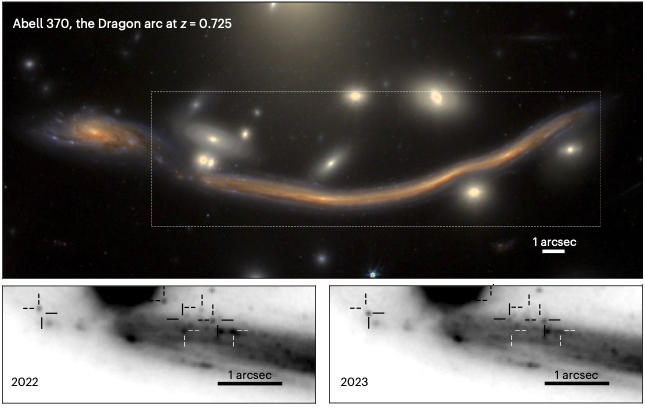
More than 40 gravitationally magnified stars in the Dragon arc at z = 0.725

Identification of more than 40 gravitationally magnified stars in a galaxy at redshift 0.725
Fudamoto, Y., Sun, F., Diego, J. M. et al. (2025)

More than 40 microlensed stars discovered in a single galaxy behind Abell 370 at redshift 0.725 — "the Dragon arc" — using JWST time-domain imaging. The sample makes it possible to study stellar populations in a distant galaxy and to constrain dark matter substructure in the lensing plane.

JWST Gravitational Lensing Transients

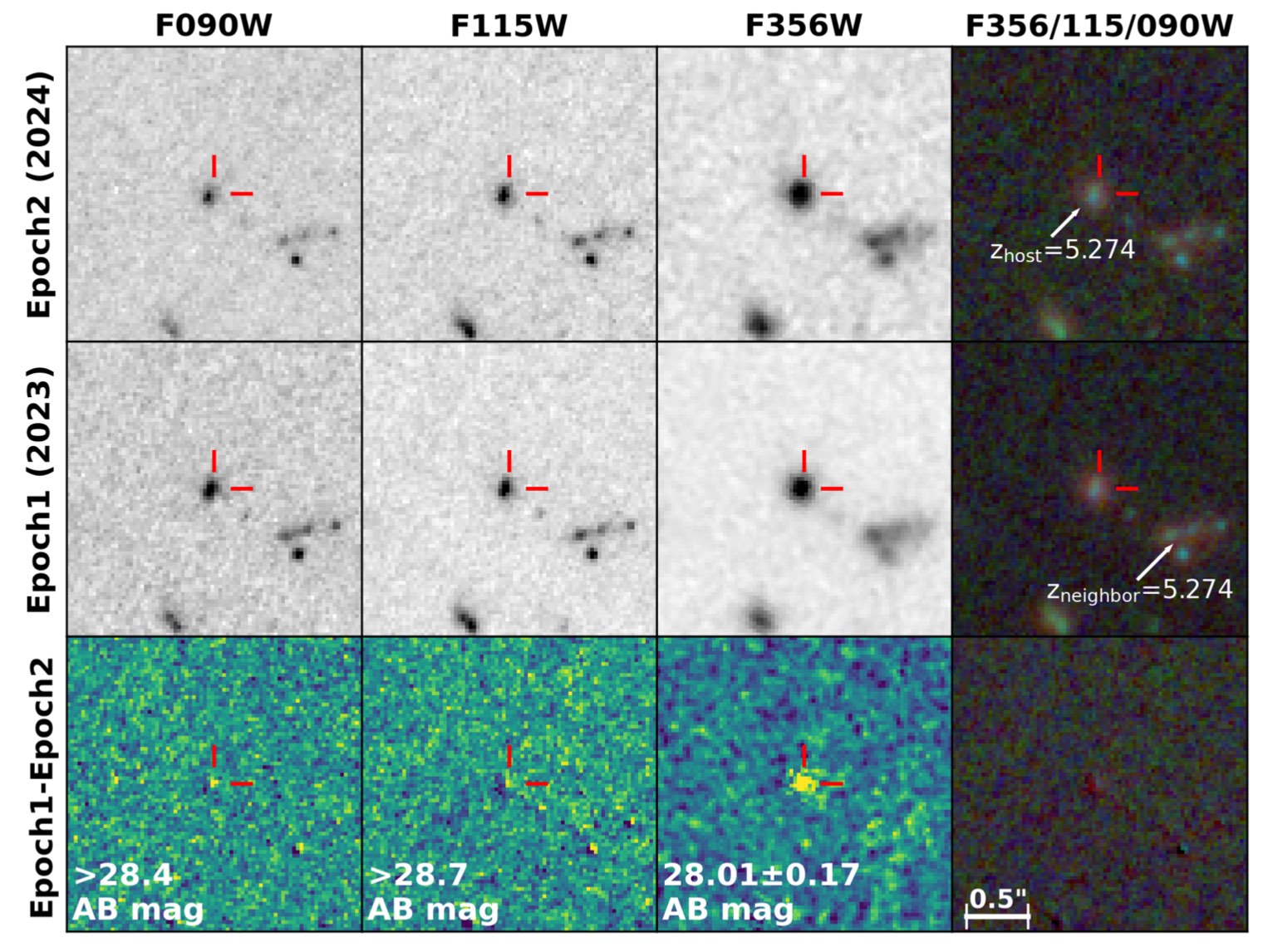
Difference image of the z = 5.274 transient AT 2023adya in GOODS-N

The First Photometric Evidence of a Transient/Variable Source at z>5 with JWST
DeCoursey, C., Egami, E., Sun, F. et al. (2025)

The first photometric evidence of a transient/variable source beyond z = 5. AT 2023adya lies in a \(z_\mathrm{spec}=5.274\) galaxy in GOODS-N and dimmed by ~0.2 mag in the rest-frame optical over about two rest-frame months, a signal that persists in the difference image at the galaxy centre.

Student-leading JWST Transients

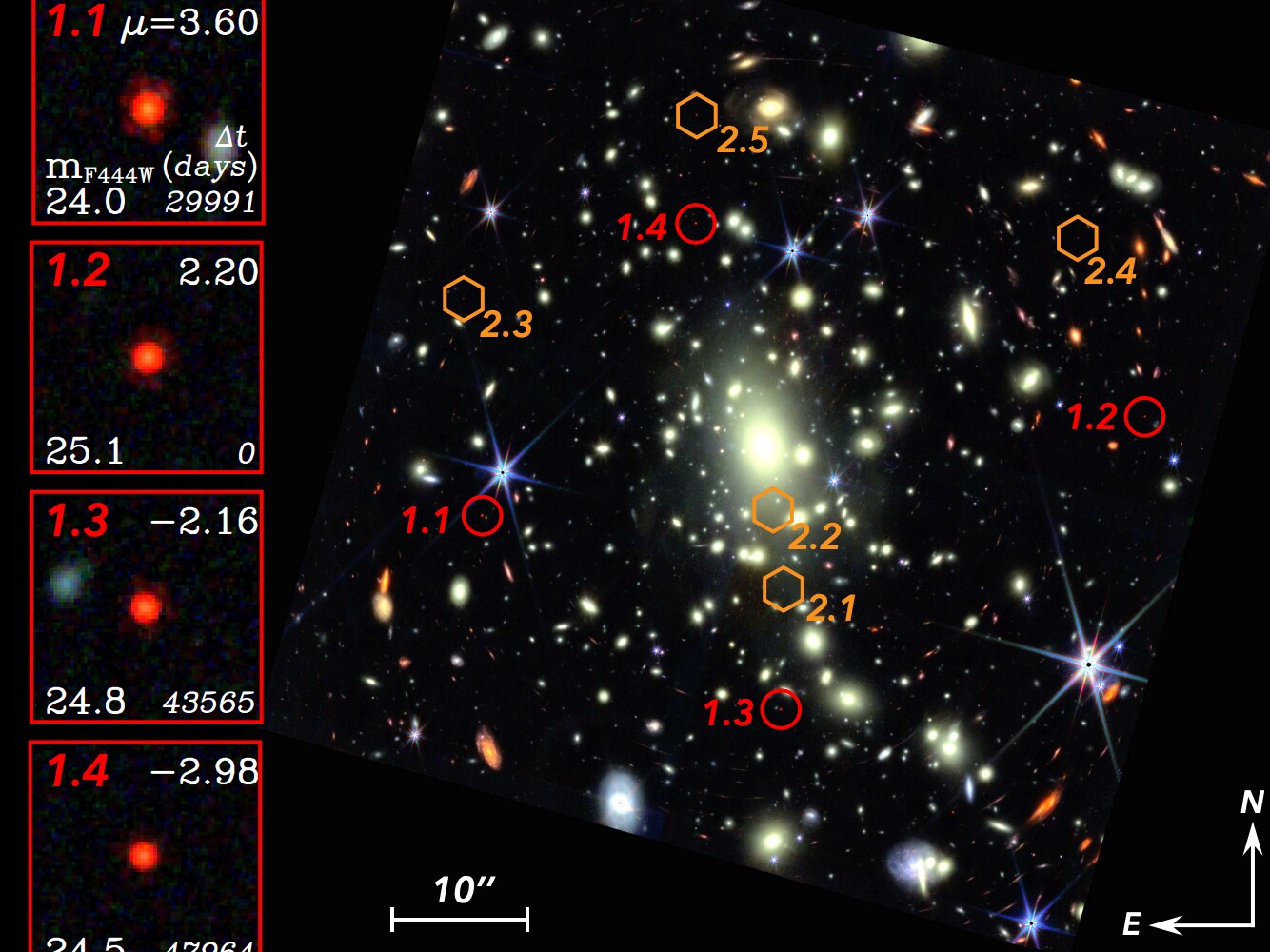
Four lensed images of the little red dot RX1 with their magnifications and time delays, beside the JWST colour image of the lensing cluster RXC J2211-0350

Little Red Dot Variability over a Century Reveals a Black Hole Envelope via a Giant Einstein Cross
Zhang, Z., Li, M., Oguri, M., et al. (2025)

Two gravitationally lensed little red dots at \(z\approx4.3\) behind RXCJ2211−0350, one quadruply imaged with time delays spanning ~130 yr. Its images differ by up to 0.7 mag, matching blackbody temperature changes in a ~2000 AU, \({\gtrsim}10^6\,M_\odot\) photosphere — suggesting LRDs are AGN with stellar-like envelopes.

Student-leading JWST Gravitational Lensing AGN / LRD

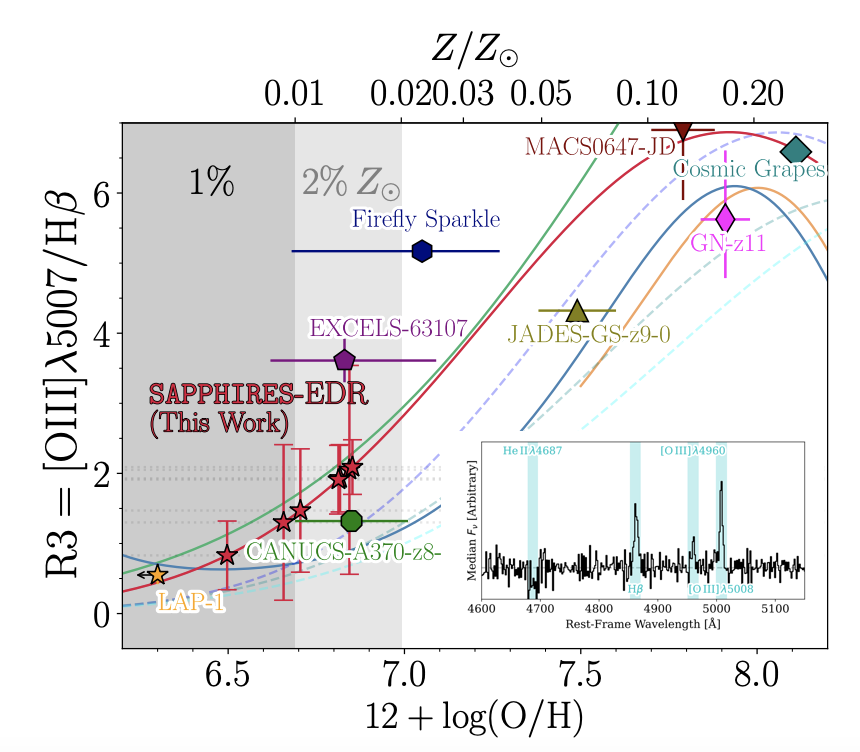
Extremely metal-poor galaxy candidates from the SAPPHIRES early data release

SAPPHIRES: Extremely Metal-Poor Galaxy Candidates with 12 + log(O/H) \(< 7.0\) at \(z \sim 5 - 7\) from Deep JWST/NIRCam Grism Observations
Hsiao, T., Sun, F., Lin, X. et al. (2025)

Seven extremely metal-poor galaxy candidates at \(z\sim5-7\) found in deep NIRCam slitless spectroscopy from SAPPHIRES, selected by low [O iii] λ5008/Hβ ratios. Two have 12 + log(O/H) < 6.7 (\(Z<1\%\,Z_\odot\)), breaking the metallicity floor seen locally and at high redshift.

Student-leading JWST

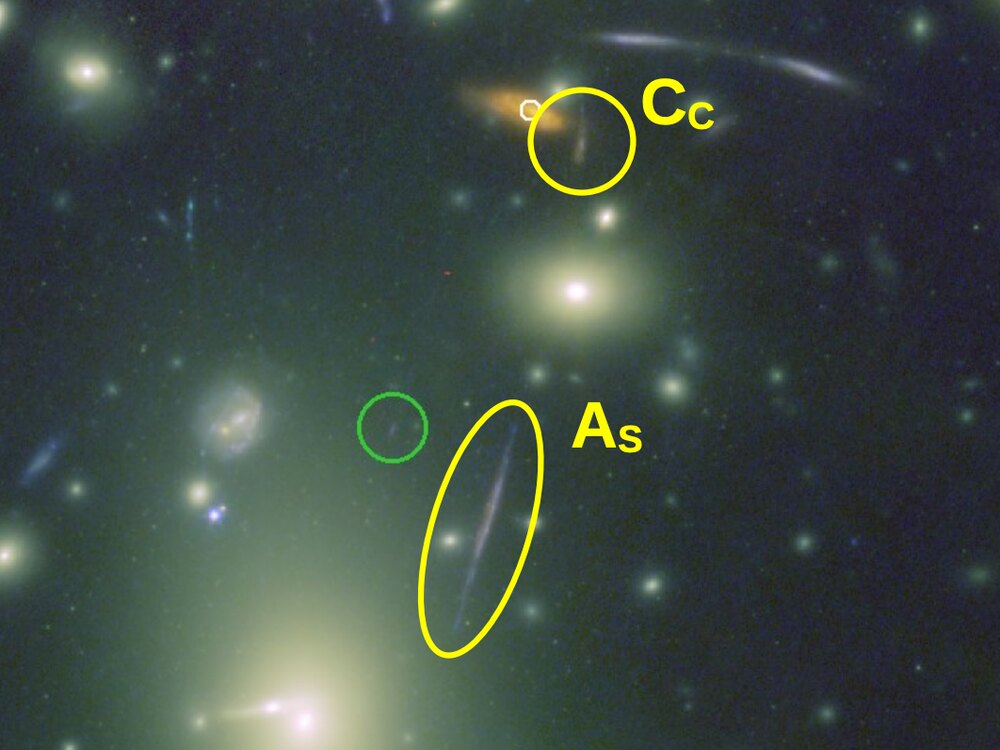
JWST colour image of the Abell 370 field with the counter-image C_c circled and the arc segment A_s outlined

JWST Lens Model for A370: A Very Low Dark Matter Fraction for a Brightest Cluster Galaxy and Lensing Properties for the Dragon Arc
Diego, J. M., Sun, F., Palencia, J. M., et al. (2025)

A new JWST-based lens model of the galaxy cluster Abell 370, inferring a very low dark-matter fraction for the brightest cluster galaxy and quantifying the lensing properties of the Dragon arc. The model provides the magnification and caustic structure needed to interpret the microlensed stellar events detected along the arc.

JWST Gravitational Lensing

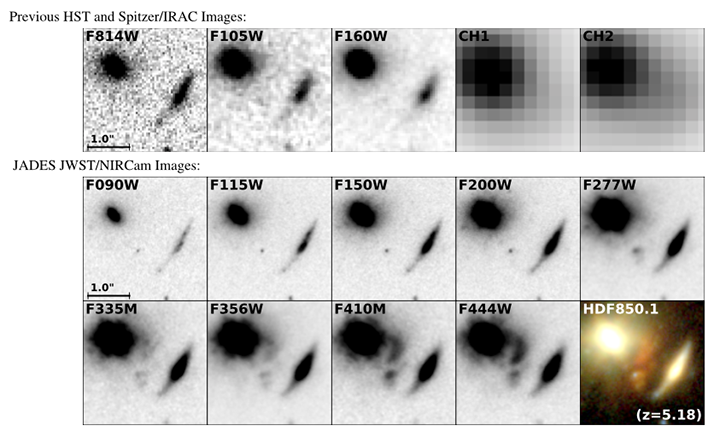
HDF850.1 resolved by JWST/NIRCam at z = 5.18

JADES: Resolving the Stellar Component and Filamentary Overdense Environment of HST-dark Submillimeter Galaxy HDF850.1 at z = 5.18
Sun, F. et al. (2024)

Nine-band NIRCam imaging at 0.8-5.0 µm from JADES detects and resolves the rest-frame UV-optical counterpart of HDF850.1, the brightest submillimeter galaxy in the Hubble Deep Field, splitting into two components because of heavy central dust obscuration.

JWST Dust Massive Galaxies Protocluster

Extreme galaxy overdensity at z = 5.4 in GOODS-S

JADES: Discovery of an Extreme Galaxy Overdensity at z = 5.4 with JWST/NIRCam in GOODS-S
Helton, J. M., Sun, F., Woodrum, C. et al. (2024a)

An extreme galaxy overdensity at z = 5.4 in GOODS-S found with JADES and JEMS imaging plus FRESCO slitless spectroscopy: 81 galaxies confirmed at 5.2<z<5.5, with photometric redshifts accurate down to m∼29-30 mag.

Student-leading JWST Protocluster

High-redshift galaxy overdensities in GOODS-N and GOODS-S

Identification of High-Redshift Galaxy Overdensities in GOODS-N and GOODS-S
Helton, J. M., Sun, F., Woodrum, C. et al. (2024b)

A systematic search for high-redshift galaxy overdensities at \(4.9<z_\mathrm{spec}<8.9\) in GOODS-N and GOODS-S, combining JADES and JEMS NIRCam imaging with FRESCO slitless spectroscopy. We identify several overdensity candidates and assess their significance against the field.

Student-leading JWST Protocluster

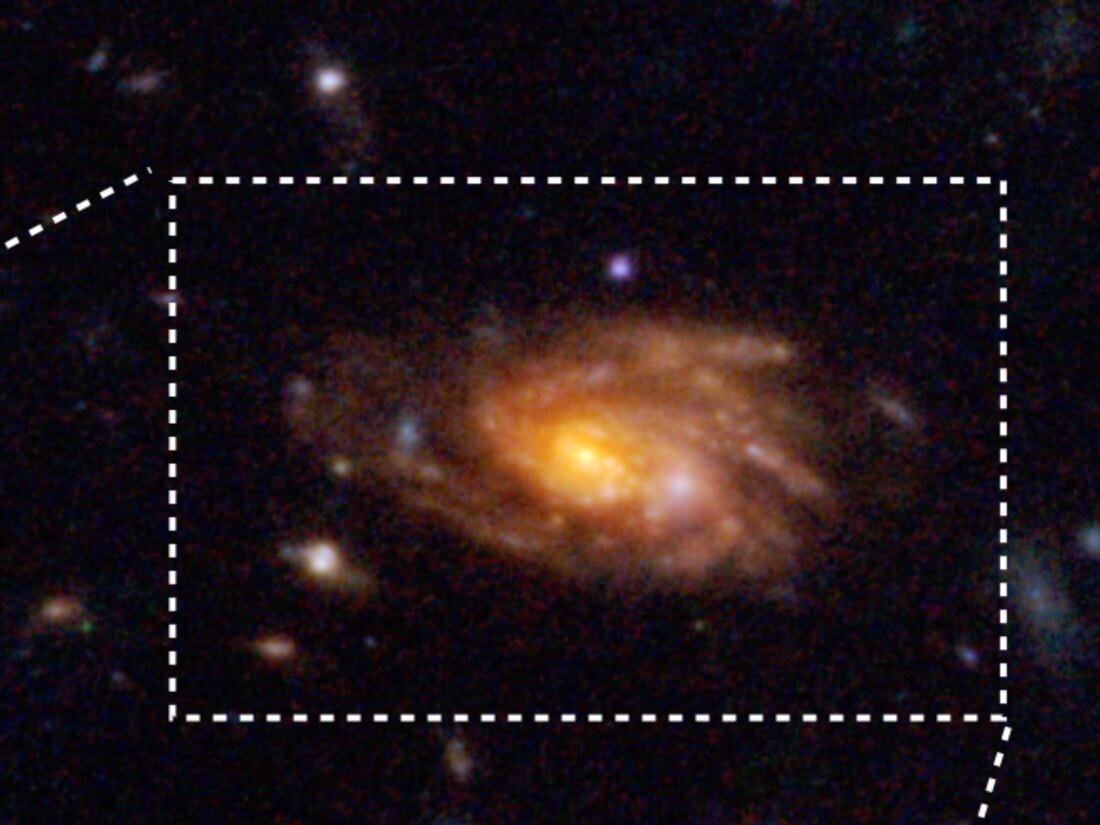
JWST colour image of the dusty multiarm spiral A2744-DSG-z3 at z = 3.06, shown as an inset on a wider field

The Identification of a Dusty Multiarm Spiral Galaxy at \(z=3.06\) with JWST and ALMA

Wu, Y., Cai, Z., Sun, F., et al. (2023)

A2744-DSG-z3, a gravitationally lensed dusty multiarm spiral at \(z=3.06\) found with ALMA and resolved by JWST/NIRISS. Lensing gives ~290 pc resolution on the most distant stellar spiral known: a main-sequence galaxy with SFR =\(85\pm30\,M_\odot\) yr\(^{-1}\), \(M_\ast\approx10^{10.6}\,M_\odot\) and a compact dusty core.

Student-leading JWST ALMA Dust Massive Galaxies Gravitational Lensing