Projects


JWST and ALMA programs that I lead, co-lead or contribute to, using wide-field imaging, slitless spectroscopy and interferometry to study galaxies across cosmic time.

Under construction. Project pages and data products are still being added, and some links point to internal or in-preparation resources.
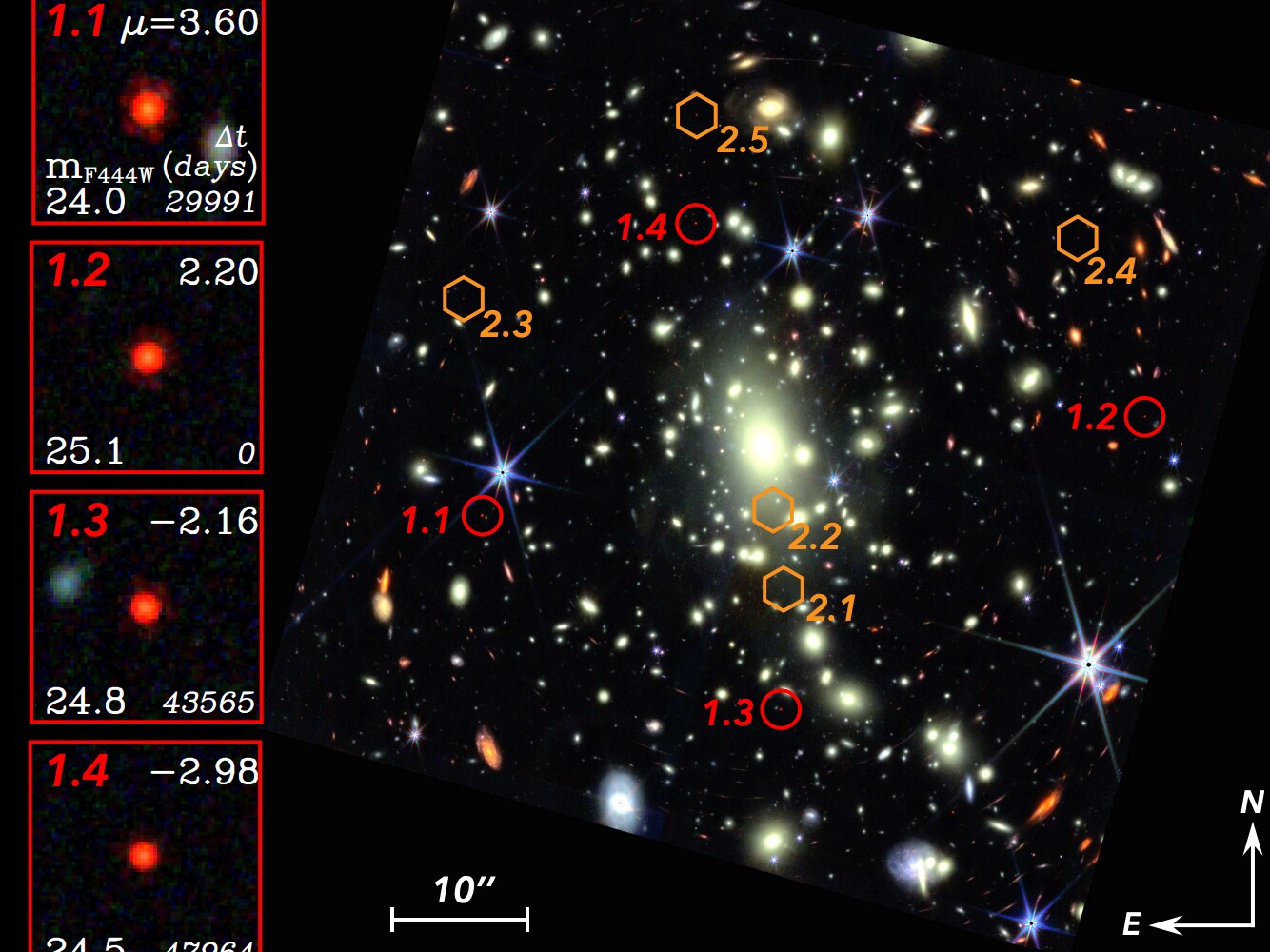
Four lensed images of the little red dot RX1 with their magnifications and time delays, beside the JWST colour image of the lensing cluster RXC J2211-0350

Little Red Dots in a Time (Delay) Machine

GO-10005 PI: Sun, F. (Cycle 5; 49.3 h over 2 years)
A JWST/NIRCam monitoring program targeting gravitationally lensed, multiply imaged little red dots (LRDs). Because the lensed images follow light paths that differ by many decades, the same source is observed at several epochs of its own history — a natural time machine for studying LRD variability and the structure of their broad-line regions. Co-PIs: Z. Zhang, M. Li, X. Lin.

JWST PI AGN / LRD Gravitational Lensing

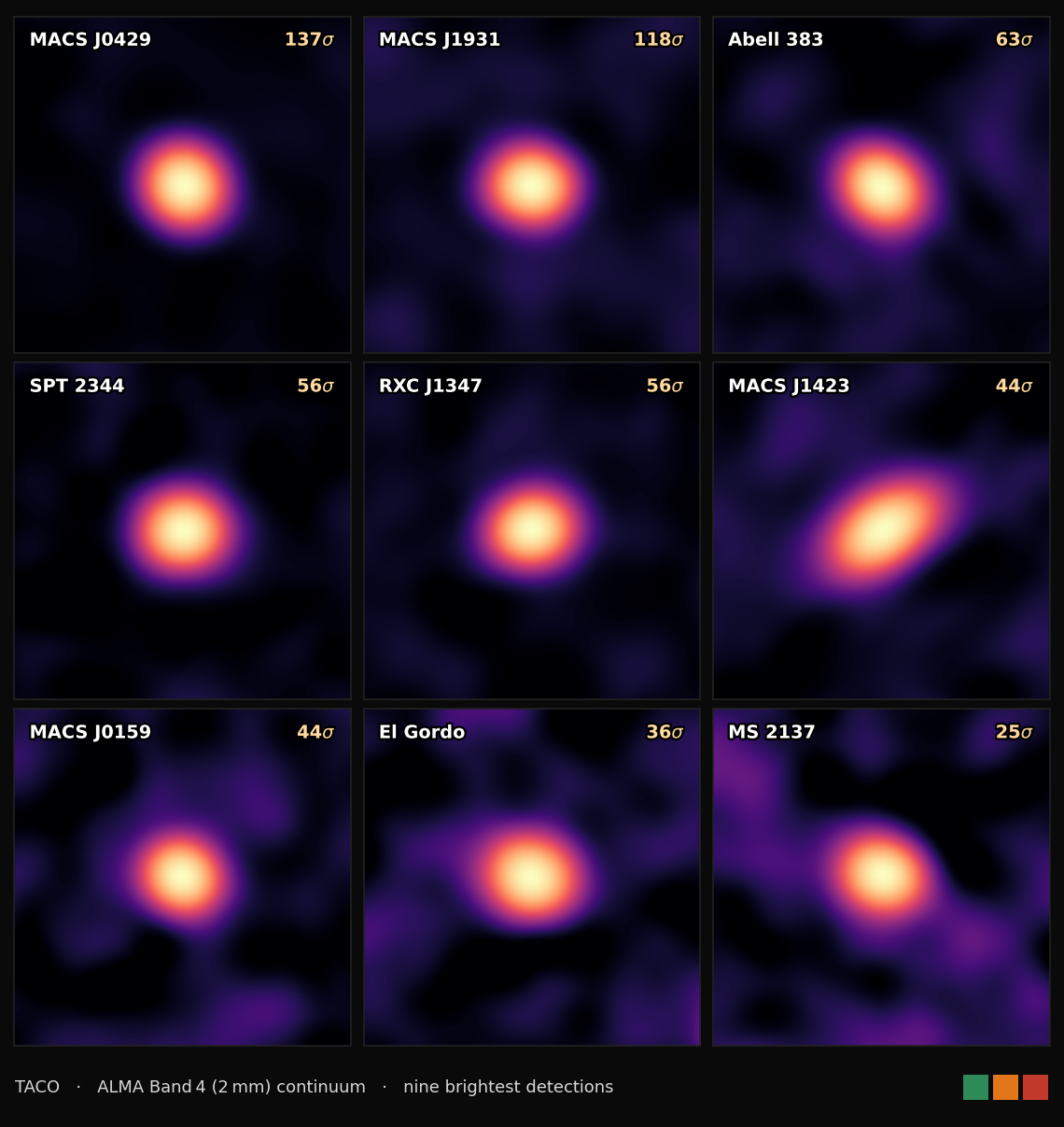
ALMA 2 mm continuum cutouts of TACO cluster fields

Two-millimeter ALMA Cluster Observations (TACO)
 Program Website

PIs: Sun, F. & Egami, E. (2022.1.01356.S; 2025.1.00360.S)

A 2 mm ALMA continuum survey of massive lensing clusters, using them as gravitational telescopes to detect strongly magnified, sub-L* dusty star-forming galaxies at z>4 and pin down the faint end of the infrared luminosity function. Lensing pushes the source counts ~30× deeper than blank fields. Secondary goals: Rayleigh–Jeans dust masses, serendipitous CO emitters, and resolved Sunyaev–Zeldovich measurements of the clusters.

ALMA PI Gravitational Lensing

SAPPHIRES survey logo

Slitless Areal Pure-Parallel HIgh-Redshift Emission Survey (SAPPHIRES)
 Team Website & Early Data Release

PI: Egami, E.; co-PI & Program design Lead: Sun, F. (GO-6434, 709 h)

A JWST Cycle-3 Treasury survey using NIRCam wide-field slitless spectroscopy in pure parallel, totalling 709 hours of charged time (557-hour exposures). It aims for a highly complete spectroscopic census of the most luminous (MUV < −21) galaxies and AGNs at z = 4–9 and beyond, constraining their number density and their role in galaxy evolution around the epoch of reionization.

JWST WFSS co-PI

MAGNIF survey logo

Medium-band Astrophysics with the Grism of NIRCam in Frontier Fields (MAGNIF)
 Internal Team Website

GO-2883 PI: Sun, F. (Cycle 2; 39 h)
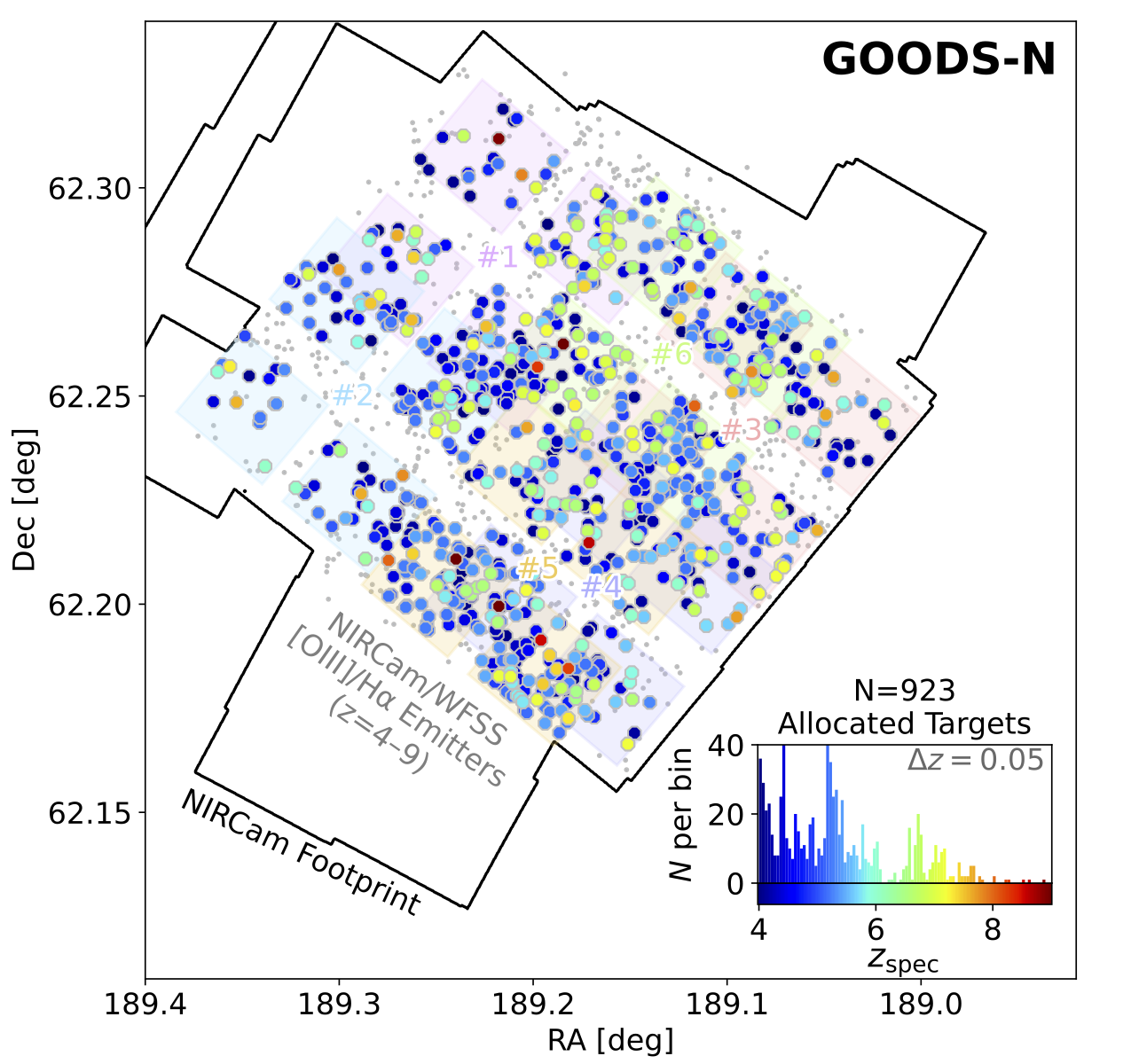
A JWST Cycle-2 program that obtained NIRCam grism spectroscopy of four Frontier Field clusters (Abell 2744, Abell 370, MACS J0416 and MACS J1149) through the medium-band filters F360M and F480M. The medium bands suppress sky and cluster background and mitigate source confusion, reaching great depth for emission-line galaxies in specific redshift windows at modest cost in telescope time.

JWST WFSS PI Gravitational Lensing

EMERALD and DIVER pointing footprints

EMERALD+DIVER: AGN and UV Spectroscopy in the Early Universe
 Program Website

GO-7935 PI: Sun, F.; GO-8018 PI: Lin, X. (Cycle 4; 110.2 h combined)
Two combined JWST Cycle-4 GO programs, GO-7935 (EMERALD) and GO-8018 (DIVER), studying AGN and UV spectroscopy in the early Universe. The merged program keeps the original EMERALD science scope and adds DIVER deep UV spectroscopy in a joint analysis framework, combining rest-optical and UV diagnostics to tighten constraints on AGN demographics, ionization conditions and chemical enrichment during reionization.

JWST PI AGN / LRD

Dragon Survey logo

Dragon Survey
 Internal Team Website

PI: Fudamoto, Y.; co-PI: Sun, F. (GO-7345, 55.3 h over 3 years; GO-12583 continuation)

A NIRCam monitoring program of the giant lensed Dragon arc in Abell 370, continued in Cycle 5. Repeated imaging catches extremely magnified stars as they brighten while crossing the cluster's micro-caustic network, probing the stellar luminosity function and the small-scale granularity of cluster dark matter. The release combines the GO-7345 epochs with archival NIRCam imaging of Abell 370.

JWST co-PI Gravitational Lensing

VENUS program logo

VENUS — Vast Exploration for Nascent Unexplored Sources
 Program Website

PIs: Fujimoto, S. & Coe, D.; Observation strategy/setup lead: Sun, F. (JWST GO-6882)
VENUS (Vast Exploration for Nascent Unexplored Sources) is a JWST imaging Treasury and follow-up program led by S. Fujimoto and D. Coe. Epoch 1 delivers uniform NIRCam ten-filter imaging of 60 massive lensing clusters over ~0.16 deg2 to 5σ ≈ 28 mag; Epoch 2 adds NIRSpec PRISM+G395M spectroscopy and multi-epoch imaging for time-domain lensing.

JWST co-I Gravitational Lensing

ASPIRE survey logo

A SPectroscopic survey of biased halos In the Reionization Era (ASPIRE)
 Team Website

PI: Wang, F.; NIRCam WFSS calibration & ALMA lead: Sun, F. (JWST GO-2078; ALMA 2022.1.01077.L)
A 65-hour quasar legacy survey targeting 25 quasars at z = 6.5–6.8, enabling NIRCam/WFSS spectroscopy and imaging along the full quasar light cones. It detected Hβ+[O iii] emission from roughly five hundred galaxies at 5.3 < z < 7 over 280 arcmin2, a hundred of them physically associated with the central quasars. ASPIRE-ALMA adds 100-hour Band-6 mosaics of the same 25 fields.

JWST ALMA WFSS co-I

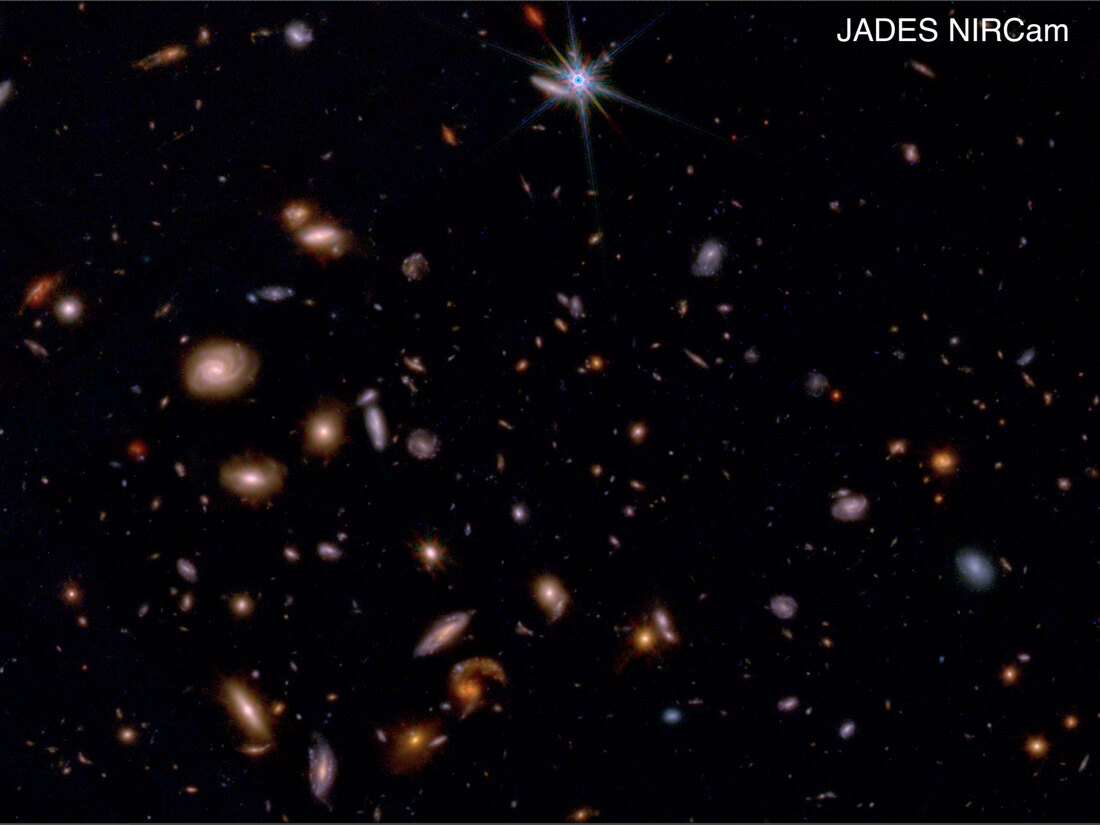
JADES NIRCam deep field, a dense field of distant galaxies

JADES — JWST Advanced Deep Extragalactic Survey
 Survey Website

NIRCam + NIRSpec guaranteed-time survey; co-I: Sun, F. (NIRCam science team)
JADES was the largest programme of JWST Cycle 1: NIRCam imaging in 8–10 bands over 42 arcmin2 to beyond 30th magnitude, another 167 arcmin2 at ~25 h, coordinated MIRI parallels, and NIRSpec spectroscopy of more than 5000 targets on 31 pointings — all in GOODS-N and GOODS-S, using NIRCam and NIRSpec guaranteed time.

JWST co-I

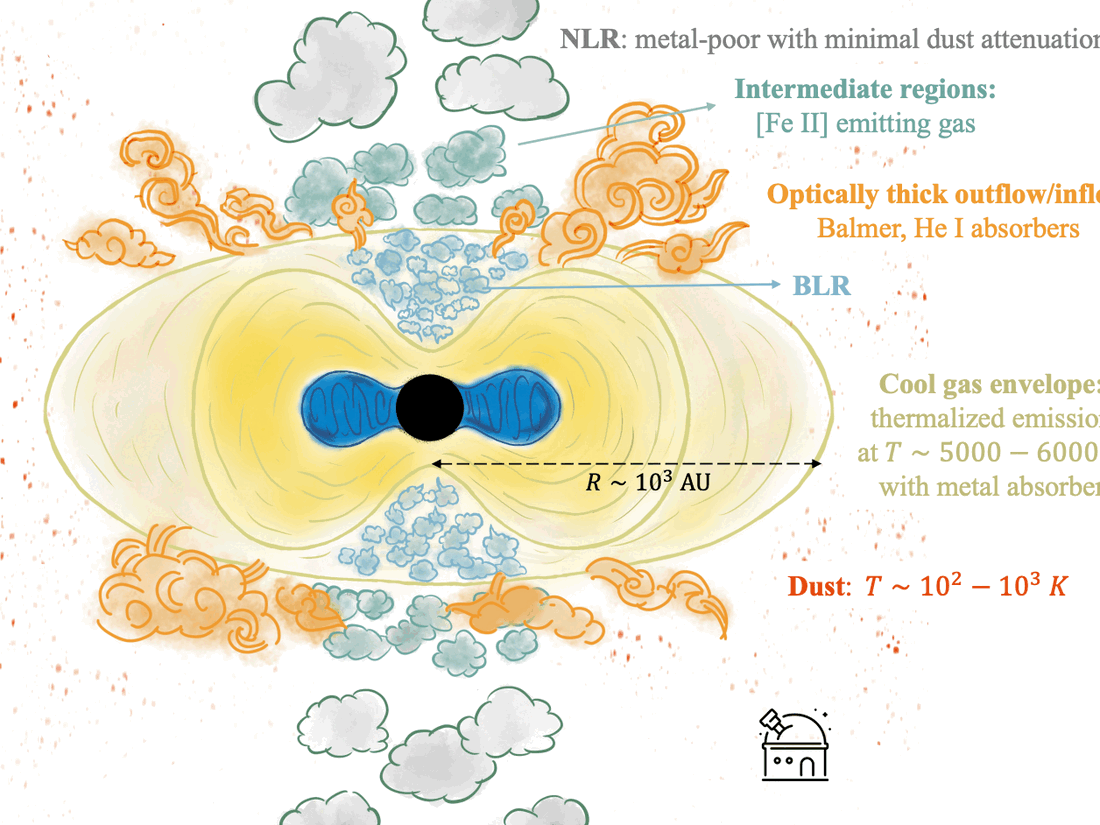
Schematic of a little red dot: black hole, broad-line region, cool gas envelope, optically thick outflows and dust

(LRDs)2 — The Low-ReDshift Little Red Dots Survey
 Paper    Home page (Internal)

PIs: Lin, X. & Fan, X.; co-I: Sun, F.

A systematic search for low-redshift little red dots in DESI DR1, finding 27 at z = 0.2–0.9 with a number-density lower limit of 7.5 × 10−10 cMpc−3. Near-IR spectroscopy of 18 shows the same hallmarks as their high-redshift counterparts — compact morphology, V-shaped continua, broad Balmer emission and blackbody-like continua — and we are now conducting multi-wavelength follow-up campaigns of these low-redshift LRDs to understand their nature.

JWST co-I AGN / LRD